8801
Development and bioefficacy study of plant-based
proteins diets for juvenile African catfish
Chabi IB1, Kayodé APP1*, Agassoussi OAS1, Agbobatinkpo PB1, Chikou A2, Codjia3 J.T.C.
1Laboratoire de Valorisation et de Gestion de la Qualité de Bioingrédients Alimentaires, Faculté des Sciences Agronomiques, Université d’Abomey-Calavi, 01 BP 526 Cotonou, Bénin.
2Laboratoire d’Hydrologie et d’Aquaculture, Faculté des Sciences Agronomiques, Université d’Abomey-Calavi, 01 BP 526 Cotonou, Bénin.
3Laboratoire de recherché en Ecologie Animale et Zoogéographie, Faculté des Sciences Agronomiques, Université d’Abomey-Calavi, 01 BP 526 Cotonou, Bénin.
* Corresponding author: E-mail address: [email protected] ; Tel +229 97870734
Original submitted in on 19th June 2015. Published online at www.m.elewa.org on 31st October 2015
http://dx.doi.org/10.4314/jab.v94i1.2
ABSTRACT
Objectives: The aim of this study is to improve the growth performance of the juvenile catfish (Clarias gariepinus) by using feed formula derived from local feed ingredients.
Methodology and results: Three diets with formulas differing in the feed ingredients and biological process were tested. These were: diet 1 (Soybean meal, Fish meal, Moringa leaf meal, Roasted corn meal), diet 2 (Soybean meal, Fish meal, Moringa leaf meal, Roasted corn meal, Corn malt meal) and diet 3 (Soybean meal, Fish meal, Moringa leaf meal, Roasted corn meal, Corn malt meal, Kpètè-kpètè (traditional starter of opaque African beer). Coppens® is an imported efficient feed that was used as control. The fish were fed twice daily for a rearing period of 35 days in a randomized tree blocks. Results of the study showed an overall good survival rate and growth performance of the fish. All the parameters assessed showed significant better values in fish fed with control diet than formulated diets. However, there was no significant difference between values survival rate, weight gain, specific growth rate (SGR), feed conversion ratio (FCR) and protein efficiency ratio (PER) of the formulated diets.
Conclusions and application of results: Results indicated that all the three diets can be used as a fishmeal but their efficiency still needs to be improved. Though with low crude protein ratio (p˂0.05), diet 3 exhibits the same results as the other diets probably because it is fermented and incorporated with malted corn grain. Incorporation of malted cereal flour in fish feeds can improve their efficiency.
Keywords: Clarias gariepinus, lactic acids fermentation, malting, plant protein INTRODUCTION
The fisheries sector significantly contributes to the nutrition and livelihood of millions of people worldwide (Datta, 2011). Global preference for fish has doubled in the last thirty years (George and Otubusin, 2007). Capture fisheries and aquaculture
supplied the world with about 148 million tonnes of fish in 2010, which correspond to 217.5 billion of dollar US. The aquaculture sector provided nearly to 59.9 million tonnes of this total production (FAO, 2012). Nowadays, more than 40% of fish and
Journal of Applied Biosciences 94:8801 – 8808
8802
shellfish used for human consumption are reared in aquaculture. The yearly contribution of Sub-Saharan Africa to the global aquaculture production is estimated to 0.6% (FAO, 2012). Africa has increased its contribution to global production from 1.2 percent to 2.2 percent in the past ten years, albeit constraint by various difficulties. Aquaculture production is vulnerable to adverse factors including disease and environmental conditions (FAO, 2012). More importantly, the cost of the feed remains the major constraint to the emergence of fish breeding in the developing countries Siddhuraju and Becker, 2003; Gabriel et al., 2007). The cost of fishmeal increased constantly and lead to a significant increase of the price of commercial feed (Ye et al., 2011). Currently fish feeding alone account for 60 to 75% of the total cost of fish production (Babalola 2010). Thus, the development of local ingredients-based feed formulations, with adequate bioefficacy and cheaper cost is highly desirable (Soltan et al., 2008). To reach this aim, there is a need to consider some scientific-based evidence. First, soybean is regarded as an economical and nutritious feedstuff with high crude protein content and a reasonably balanced amino acid profile (Carter and Hauler, 2000).
According to Jiang et al.,. (2013), soybean meal as a most common plant protein of fishmeal replacer has been used in a variety fish species. Second,Moringa leaves are known to have a high content of protein, minerals and vitamin, hence an ideal nutritional supplement, for fish feeding in partial replacement of fishmeal (Fletcher, 1998). Thirdly, fermentation is a simple and cheap process, which may lead to an increase in the nutrient level through microbial metabolism (Wee, 1991). The African Catfish (Clarias gariepinus) is used as biological model because; it is widely considered one of the most important tropical catfish species for aquaculture (Obasa et al., 2013). It is omnivorous and grows fast. It tolerates relatively poor water quality (Rad et al., 2003). Moreover, the African catfish is appreciated by consumers for the quality of its meat (Pruszyński, 2003) and is mostly smoked and widely used in soups (Amisah et al., 2009). This study was carried out to evaluate the effects of malting, lactic acids fermentation in diets containing high level and various plant protein sources i.e. soybean seed, Moringa oleifera leaf and corn meal on growth performance and feed utilization in juvenile of Clarias gariepinus.
MATERIEL AND METHODS
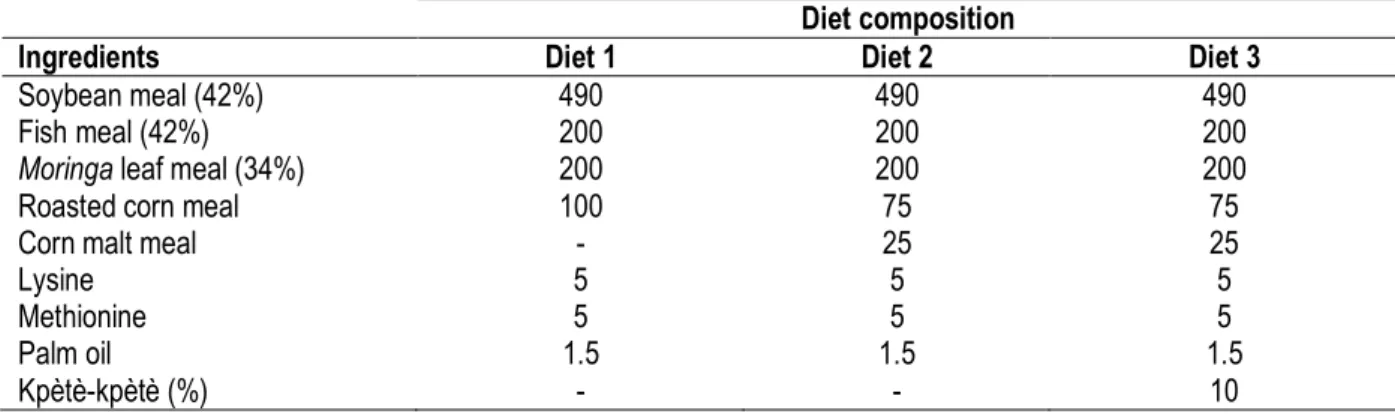
Experimental site: The feed formulation and processing were done in the Laboratoire de Valorisation et de Gestion de la Qualité de Bioingrédients Alimentaires and the bioefficacy study conducted at the Laboratoire d’Hydrologie et d’Aquaculture; both at the Faculté des Sciences Agronomiques, Université d’Abomey-Calavi. Meal preparation: Soybeans seeds were purchased from local market, roasted (120°C, 15min) and dehulled to minimize level of anti-nutritive factors and improve digestibility. Part of corn was also roasted and the remaining portion was malted by soaking, germination and drying. Fresh leaves of Moringa oleifera were harvested and dried at 42°C during 24h using a ventilated oven drying (Venticell, Fisher, Bioblock Scientific, MMM, Medcenter). All the ingredients treated were ground. Formulation of diets: Three types of diets were formulated. Each diet contained 490 g/kg soybean meal, 200 g/kg fishmeal and 200 g/kg Moringa leaves meal. Specifically, diet 1 contained 100 g/kg corn meal whereas
diets 2 and 3 contained each 75. Diet 2 was formulated in incorporating 25 malting corn meal. Diet 3 was obtained after three days of fermentation of equal amount of diet 2 by kpètè-kpètè (10 %). Kpete-kpete is the starter used to ferment tchoukoutou; the most produced and consumed opaque sorghum beer in Benin. Lactic acids bacteria and yeasts have been reported to be the major microorganisms involved in the fermentation of tchoukoutou (Kayodé et al.,. 2007). The formulated diets were prepared in pellet form (2 mm) and dried at 42°C during 24 hours by ventilated oven drying (Venticell, Fisher, Bioblock Scientific, MMM, Medcenter) prior to feeding. The control diet used was a reference foreign floating feed (CatCo® Coppens International Bv, Helmond, Netherlands). The ingredient proportion and proximate composition of the formulated diets are shown in tables 1 and 2 respectively.
8803
Table 1: ingredient composition (g/kg) used to formulate the experiment diets with its proportion Diet composition
Ingredients Diet 1 Diet 2 Diet 3
Soybean meal (42%) 490 490 490
Fish meal (42%) 200 200 200
Moringa leaf meal (34%) 200 200 200
Roasted corn meal 100 75 75
Corn malt meal - 25 25
Lysine 5 5 5
Methionine 5 5 5
Palm oil 1.5 1.5 1.5
Kpètè-kpètè (%) - - 10
Table 2: Proximate composition of different test diets (on dry matter basis)
Proximate composition (%) Diet 1 Diet 2 Diet 3 Control*
Dry matter 85.51±0.1a 85.64±0.6a 92.40±1.0b 91.07±0.1 Crude protein 40.33±0.2a 40.30±0.1a 37.55±0.1b 42* Crude fat 17.23±0.3a 16.87±0.6b 17.19±0.3a 13* Ash 10.34±1.2a 10.88±1.3b 11.07±0.5c 9.5* Fibre 2.69±0.2a 1.93±0.3b 3.15±0.5c 1.9* Gross energy 4.84±0.3a 4.95±0.4b 4.93±0.1b 4.7*
*values supplied by Coppens ® trough product packing excepted dry matter. Fish origin and experimental Design: Two hundred
and forty (240) juvenile African catfish (Clarias gariepinus) (average weight of 22±4g) were obtained from a fish farm (Joanne Esteve, Zivie, Benin). The fish were acclimatised to the control diet for four days in concrete tank before the start of the trial. The experiment lasted five weeks (November to December 2013) and the fish were randomly distributed into twelve plastic tanks at a density of 20 fish per tank with four dietary treatments. The fish were fed twice per day at 8:00 a.m. and 17:00 p.m. The firsts two weeks the daily diet was 6 % of the biomass; and 4% biomass the following weeks. The ration was adjusted every week when new mean weights of fish for the various experimental units were determined. At each feeding, the leftover feed were collected and weighed to calculate the total feed intake on dry matter basis. The experiment was conducted under the natural photoperiod of 12-h dark/12-h light cycle. Measurement of physicochemical parameters: Water quality parameters including dissolved oxygen, temperature and pH were measured using temperature and dissolved oxygen meter WTW Oxi 197 and pH-meter WTW pH 324 respectively. These were measured three days per week and three times per day (between7:00-8:00 a.m.; 12:00-13:00 p.m. and 17:00-1(between7:00-8:00 p.m). Feeds were analyzed for dry matter by oven drying to constant weight during 48 h at 105 °C, and crude ash by
incineration during 24 h at 550 °C (AOAC, 1990). Protein was determined by the Kjeldahl digestion method, crude lipid by the Soxhlet extraction method (AOAC, 1990), and energy was determined by the adiabatic bomb calorimeter (Parr Instrument Company-Moline, Illinois 61265 USA). Each analysis was performed in triplicates. Bioefficacy study of the diets
Antimicrobial activity of diet against the pathogen strains: This was performed on the diet 3. Since this diet was inoculated with the starter of opaque sorghum beer, reported to possess probiotic properties (Kayodé et al.,. 2012); bioactivity was tested. Hence, the capacity of diet 3 to inhibit the indicator pathogens was determined by modifying the disc diffusion method of NCCLS (2003). Twenty milliliters (20 mL) of molten Mueller-Hinton Agar (MHA, CM 337, Oxoid, UK) were poured into sterile Petri dishes and allowed to solidify. 100 µL of the overnight Mueller-Hinton broth (MHB, CM 405, Oxoid, UK) culture of each pathogen strain, which were adjusted to 0.5 McFarland-turbidity, was spread on the plates. Once the plates were dried aseptically, five blank discs papers (6 mm in diameter) were placed onto the surface of the agar. The pellets of diet 3 were diluted with sterile distilled water to obtain a solution of 667 mg ml-1. This solution was stirred vigorously using a magnetic stirrer for 30 min and then centrifuged at 3 500 g for 30 min. Forty microliters (40 µL) of each supernatant were placed into
8804 the discs. The plates were left at room temperature for 1 h so that the absorbed supernatant become diffused into the agar, and then incubated at 37°C for 24 h. The tests were carried out in duplicate.
Evaluation of Growth performance and feed efficiency: All biometric data were taken every week during rearing and feeding only after feeding had stopped for 24h. In order to avoid stress, initial and weekly weights and lengths were recorded under moderate anaesthesia 2-phenoxyethanol (2-PE, Wako Pure Chemical Industries, Osaka, Japan). Thus, the growth parameters and feed utilization were calculated as follow:
Mean Weight Gain (MWG) determined by computing the difference between the Mean Final Weight (Wf) and the Mean Initial Weight (Wi) per number of fish (N): MWG = (Wf - Wi)/ N.
Specific Growth Rate (SGR): SGR (%/day) = 100 x (lnWf - lnWi)/t
Feed Conversion Ratio (FCR), FCR = Total feed intake/ (Wf - Wi);
Weight gain ratio WGR = (Wf −Wi)/ Wi
Protein Efficiency Ratio (PER), PER = wet weight gain/protein intake.
Survival (%) = 100 x (Initial Number of fish stocked – Mortality)/Initial Number of fish stocked.
Statistical analysis: Mean values and standard deviations were calculated from the experimental data. The Statistical Package for Social Science (SPSS), version 16.0 (Chicago, IL, USA) was used. All experimental data were subjected to the one-way analysis of variance (ANOVA). Significant difference was established at 5%.
RESULTS
Inhibitory effect of diet 3: The antimicrobial activity of diet 3 against pathogen microorganisms was shown in table 3. Diet 3 inhibited all indicator strains include negative and positive Gram and the yeast used. The minimum diameter of the inhibition zone was observed
with positive Gram (MRSA 12.0±1.5 mm) and the higher was obtained with negative Gram (Salmonella typhi R 30951401, 15.0±0.5 mm). Clearly, the diet 3 exhibited antimicrobial activity against indicator pathogens.
Table 3 In vitro inhibition of indicator pathogens by diet 3.
Pathogen strains Inhibition zone (mm diameter)
Escherichia coli O157:H7 ATCC 700728 14.0±1.5
Escherichia coli ATCC 25922 13.0±0.8
Klebsiella pneumoniae ATCC 35657 12.0±1.0
Salmonella. typhi R 30951401 15.0±0.5
Staphylococcus aureus ATCC 27844 13.2±0.8
MRSA* 12.0±1.5
Candida albicans MHMR 15.0±2.0
*MRSA: Methicillin resistant Staphylococcus aureus. Changes in temperature, dissolved oxygen and pH of water during the rearing period: The mean ±SD of water quality parameters measured during the rearing period are shown in table 4. The water temperature ranged between 25.3 and 30.7°C with a mean value of 27.79°C for all treatment. At the beginning of the trial, we noticed a high temperature, which decreased afterward due to the harmattan period started. The pH and
dissolved oxygen (D.O) of water in all tanks were in the range between 6.09 and 8.03; and 2.56 and 4.67 mg/L respectively. The dissolved oxygen levels in all treatments decrease significantly (p˂0.05) during the day, since water was nor stirred nor replaced. However, there is no significant difference (p˂0.05) in temperature, pH and dissolved oxygen between treatment groups.
Table 4: Mean and standard deviation values of different water quality parameters in experimental treatment
Treatments Temperature (°C) pH D.O (mg/l)
Control diet 27.81±1.33 7.15±0.4 3.56±0.18
Diet 1 27.66±1.31 7.05±0.35 3.58±0.14
Diet 2 27.79±1.39 7.07±0.36 3.55±0.19
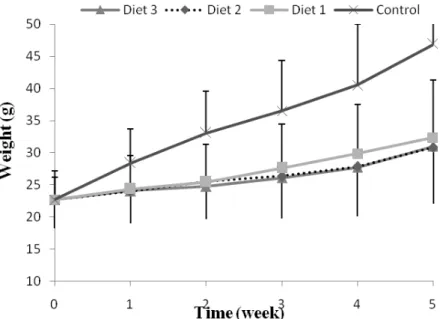
8805 Growth performance and feed utilization: The growth performance and feed utilization of juvenile catfish (C. gariepinus) are presented in table 5. The trend in weekly mean body weight as affected by the feeding type was depicted in the figure1. The final gain weight of control group was twofold higher than the initial weight. Weight gain ratio of fish was significantly higher (P˂0.05) for fish fed with control diet (coppens) compared with fish fed with formulated diets. However, no significant differences (P˃0.05) were observed among the groups fed with formulated diets (1, 2 and 3). The mortality rate throughout the experimental period was relatively low and
was only due to cannibalism. No significant difference (P˃0.05) among the treatments was found for survival, which was above 94% in all treatments. By the end of the rearing and feeding period, significant differences in the specific growth rate between the treatments were observed. The highest specific growth rate was found in the control diet. No significant differences were observed between all the remaining diet (1, 2 and 3) treatments. There were significant differences (P˂0.05 between the feed conversion ratio and the protein efficiency ratio (PER) values for all dietary treatments.
Table 5: Growth performance and feed utilization of the juvenile fed at different feeding frequencies
Parameters Control
diet
Diet 1 Diet 2 Diet 3 P-value
Initial mean weight (g) 22.7±3.5 22.7±4.4 22.7±3.8 22.7±4.4
Final mean weight (g) 46.9±12a 32.4±8.9b 31.0±7.7b 30.9±8.7b 0.004 Weight Gain Ratio (%) 106.6±3a 42.7±10.4b 36.7±6.7b 35.9±9.6b 0.000 Specific Growth Rate (% day-1) 2.1±0.7a 1.0±0.2b 0.9±0.4b 0.9±0.4b 0.002 Feed Conversion Ratio 2.76±0.9 a 4.6±1.5 b 4.8±1.7 b 4.8±1.6 b 0.013 Protein Efficiency Ratio 1.22±0.3 a 0.78±0.1 b 0.82±0.3 b 0.84±0.2 b 0.026
Survival Rate (% ) 95.3±3,4 96.4±2.2 95.0±2.8 94.2±3.6 0.725
8806 DISCUSSION
The water quality parameters in all tanks were within the quite acceptable range for C. gariepinus culture as reported by Britz and Hecht (1987). The results showed that the highest level of mixed plant proteins with lysine and methionine supplementation in diets combined with biological processes such as lactic acid fermentation and malting did not affect the survival rate of juvenile catfish. Fish fed with a plant-based diet may benefit from a stronger immune response to certain pathogens derived toxins since several plant non-starch polysaccharides are known to stimulate the immune system of fish (Skjermo et al., 2006). Indeed, fermentation and malting processes are favourable to the occurrence of such non-starch polysaccharides. At the end of the rearing, fish fed with diets (1, 2 and 3) had significant (p˂0.05) lower final weight, weight gain ratio and specific growth rate compared to fish fed with control diet (all fishmeal). This low performance has been noticed despite the adding of lysine and methionine to the formulated diets. A similar observation was reported by Andrews and Page (1974), who added synthetic lysine and methionine to a soybean meal-based. ; and noticed that all vegetable diets failed to improve catfish growth. Yet, this study-formulated diet contained a little amount of fishmeal (20%) but reached 42% of crude proteins content. The lack of a significant difference (p˃0.5) in fish fed with the diets 1 and 2 (40 % proteins) and diet 3 (with relatively low level of protein 37%) may be an indicator of beneficial effect of bioprocesses (fermentation and malting). Indeed, malting and fermentation have potential to reduce significantly levels of tannins and phytates in plant products and thereby improved protein digestibility (Onyango et al., 2013). Several reasons could explain the reduction in growth performance in groups fed with the formulated diets compared to control diet. First, the presence of antinutritional factors in vegetable protein source which would have compromised the nutrient bioavailability (Lim and Lee, 2009, Kayodé et al.,. 2006) is a key defavorable
factor. Second, relatively low feed intake due to the lack of adequate granule texture resulting in quick disaggregation in water and the absence of feed attractants able to improve dietary palatability (Espe et al., 2006) need consideration. It was observed during the trial, that the pellets of the formulated diets quickly sank to the bottom and dissociated rapidly in the water within 5 min. These observations are in close agreement with report by Cabral et al., . (2013) performing similar experiements.
An essential micronutrient for fish is phosphorus, a vital component of the skeletal System (Roy et al., 2014). In plant protein sources, approximately 70% of the total phosphorus is present as phytate phosphorus, which cannot be absorbed and utilized by monogastric animals including fish (Lall, 1991). Antinutritional factors block the action of endogenous digestive enzymes to induce a low digestibility (Roosta et al., 2011). The apparent digestibility of phosphorus, calcium, iron, copper and manganese was better in fish fed 30 % incorporation of the fermented oilseed meal (Roy et al., 2014). The feed conversion ratio (FCR) ranged between 2.76 and 4.8. This parameter was significantly lower for control diet compared to the formulated diets (1, 2 and 3). However, the value of FCR found in this study is better than those previously reported in other studies on Africa catfish (Amisah et al., 2009). The improvement of FCR values is largely dependent on both the dietary formulas and the feed distribution scheme (Borges et al., 2009). The protein efficiency ratio (PER) is a useful parameter to evaluate as the quality of aquafeed. The feed conversion ratio (FCR) and the protein efficiency ratio (PER) were essentially the same for fish fed with the three formulated diets (1, 2 and3). Therefore, the protein utilization among the three diets was similar (Hedrick et al., 2005). The overall growth performance and high survival rates in all treatments suggest that all the diets were suitable for fish.
CONCLUSION
This study indicates that incorporation of plant- source proteins in catfish diet associated with malted cereal and lactic acids fermentation can be used for rearing juvenile catfish (Clarias gariepinus) with detectable growth pattern. Still, it is necessary to improve the feed structure
and texture to allow their floating and aggregation in water. Such improvements will allow a better stability of the pellet and increased feed intake and fish growth performances.
CONFLICT OF INTEREST STATEMENT None declared.
8807 ACKNOWLEDGMENTS
This research was granted by the University of Abomey-Calavi through the BioZoo project. The valuable technical assistance of Florentin Assimalekpo and Elias Noumatekpo is gratefully acknowledged. Thanks are also due to Prof. Philippe A. Laleye.
REFERENCES
Amisah S, Oteng MA, Ofori JK, 2009. Growth performance of the African catfish, Clarias gariepinus, fed varying inclusion levels of Leucaena leucocephala leaf meal. J. Appl. Sci. Environ. Manage. 13: 21 – 26.
Andrews JW, Page JW, 1974. Growth factors in the fishmeal component of catfish diets. J. Nutr. 104: 1091–1096.
Babalola, TOO, 2010. Utilization of dietary animal fats and vegetable oils by African catfish (Heterobranchus longifilis) fingerlings. Ph.D. Thesis University of Ilorin, Nigeria.
Borges P, Oliveira B, Casal S, Dias J, Conceição L, Valente LMP, 2009. Dietary lipid level affects growth performance and nutrient utilisation of Senegalese sole (Solea senegalensis) juveniles. British Journal of Nutrition 102: 1007–1014. Britz PJ, Hecht T, 1987. Temperature preferences and
optimum temperature for growth of African sharptooth catfish (Clarias gariepinus) larvae and post-larvae. Aquaculture 63: 205-214. Cabral EM, Fernandes TJR, Campos SD, Castro-Cunha
M, Oliveira MBPP, Cunha LM, Valente LMP, 2013. Replacement of fishmeal by plant protein sources up to 75% induces good growth performance without affecting flesh quality in ongrowing Senegalese sole. Aquaculture 380: 130–138.
Carter CG, Hauler RC, 2000. Fishmeal replacement by plant meals in extruded feeds for Atlantic salmon, Salmo salar L. Aquaculture 185: 299– 311.
Coppens, 2013. Aliments pour Clarias. CatCo® grower 13-EF Coppens International bv., Helmond I the Netherlands. http://www.coppens.com. Datta SN, 2011. Culture of Azolla and its efficacy in diet
of Labeo rohita. Aquaculture 310: 376-379. Espe M, Lemme A, Petri A, El-Mowafi A. 2006. Can
Atlantic salmon (Salmo salar) grow on diets devoid of fishmeal? Aquaculture 255: 255–262 FAO, 2012. The State of World Fisheries and Aquaculture (230 pages). http://www.fao.org/ docrep/016/i2727e/i2727e.pdf.
Fletcher LJ, 1998. Moringa oleifera (the kelor tree). The Australian New Crops newsletter Issue No. 9: 1-6.
Gabriel UU, Akinrotimi OA, Bekibele DO, Onunkwo DN, Anyanwu PE, 2007. Locally produced fish feed, potentials for aquaculture development in sub-Saharan African Journal of Agricultural Research. 297: 287-295.
George FOA, Otubusin SO, 2007. Fish feed development for sustainable aquaculture fish production in Africa. Paper prepared for presentation at the Farm Management Association of Nigeria Conference, Ayetoro, Nigeria, September 4-6, 2007.
Hedrick RL, Popma TJ, Davis DA, 2005. Pond Production and Fatty Acid Profiles of the Fillets of Channel Catfish Reared on Diets with Different Protein Sources. North American Journal of Aquaculture 67:304–311.
Jiang HB, Li Chen LQ, Qin JG, Gao LJ, Li EC, Yu N, Sun SM, Jiang XQ, 2013. Partial or complete substitution of fishmeal with soybean meal and cottonseed meal in Chinese mitten crab Eriocheir sinensis diets. Aquacult Int 21:617– 628.
Kayodé, APP., Nout, MJR., Bakker, EJ., Van Boekel, MAJS. 2006. Evaluation of the simultaneous effects of processing parameters on the iron, and zinc solubility of infant sorghum porridge by Response Surface Methodology. Journal of Agricultural and Food Chemistry, 54, 4253-4259. Kayodé APP, Hounhouigan DJ, Nout MJR, Niehof A, 2007. Household production of sorghum beer in Benin: technological and socio-economical aspects. Int. J. Cons. Stud. 3: 258-264. Lall SP, 1991. Digestibility, metabolism and excretion of
dietary phosphorus in fish. In: Cowey, CB, Cho, CY. (Eds.), Nutritional Strategies &Aquaculture Waste. University of Guelph, Guelph, Ontario, Canada, pp. 21–36.
Lim SJ, Lee KJ, 2009. Partial replacement of fishmeal by cottonseed meal and soybean meal with iron and phytase supplementation for parrot fish Oplegnathus fasciatus. Aquaculture 290: 283 -289.
8808 National Committee for Clinical Laboratory Standards,
2003. Method for Antifungal Disk Diffusion Susceptibility Testing of Yeast: Proposed Guideline M44-P. NCCLS, Wayne, PA, USA. Obasa SO, Bamidele NA, Agbon AO, Idowu MO, Taiwo
IO, Alegbeleye WO, Akinyemi AA, 2013. Growth, Nutrient Utilization, Carcass Quality and Yield of African Mud Catfish, Clarias gariepinus Fingerlings Fed Varying Dietary Levels of Dry Moringa (Moringa Oleifera) Seed Meal. Aquatic Biology Research 2: 26-33.
Onyango CA, Ochanda SO, Mwasaru MA, Ochieng JK, Mathooko FM, Kinyuru JN, 2013. Effects of Malting and Fermentation on Anti-nutrient Reduction and Protein Digestibility of red Sorghum, White Sorghum and Pearl Millet. Journal of Food Research 2: 41-49.
Pruszyński T, 2003. Effects of feeding on ammonium excretion and growth of the African catfish (Clarias gariepinus) fry. Czech J. Anim. Sci. 48: 106–112.
Rad F, Kurt GI, Bozaoủlu AS, 2003. Effects of spatially localized and dispersed patterns of feed distribution on the growth, size dispersion and feed conversion ratio of the African Catfish (Clarias gariepinus). Turk J Vet Anim Sci 28, 851-856.
Reigh RC, 1999. Production characteristics of pond-raised channel catfish Ictalurus punctatus fed diets with and without animal protein for three growing seasons. Journal of the World Aquaculture Society 30: 154–160.
Robinson E. H, Li MH, 1999. Evaluation of practical diets with various levels of dietary protein and animal protein for pond-raised channel catfish Ictalurus punctatus. Journal of the World Aquaculture Society 30:147–153.
Roosta HR, Javadi T, Nazari F, 2011. Isolation and characterization of trypsin inhibitors (Kunitz Soybean Trypsin Inhibitor, Bowmanbirk Inhibitor) in Soybean. Adv. Environ. Biol. 5: 145–153 Roy T, Banerjee G, Dan SK, Ghosh P, Ray AK, 2014.
Improvement of nutritive value of sesame oilseed meal in formulated diets for rohu, Labeo rohita (Hamilton), fingerlings after fermentation with two phytase-producing bacterial strains isolated from fish gut. Aquacult Int 22: 633–652. Siddhuraju P, Becker K, 2003. Comparative nutritional evolution of differentially processed mucuna seeds (Mucuna pruriens L.) DC. Var. utilis (Wall ex Wight) (Baker ex Burck) on growth performance, feed utilization and body composition in Nile tilapia (Oreochromis niloticus L.). Aquacuture Research 34: 487– 500. Silva JMG, Espe M, Conceição, LEC, Dias J, Valente
LMP, 2009. Senegalese sole juveniles (Solea senegalensis Kaup, 1858) grow equally well on diets devoid of fishmeal provided the dietary amino acids are balanced. Aquaculture 296: 309–317.
Skjermo J, Storseth TR, Hansen K, Handa A, Oie G, 2006. Evaluation of b-(1-N3,1-N6)-glucans and high-Malginate used as immunostimulatory dietary supplement during first feeding and weaning of Atlantic cod (Gadus morhua L.). Aquaculture 261: 1088–1101.
Soltan MA., Hanafy MA, Wafa MIA, 2008. An evaluation of fermented silage made from fish by-products as a feed ingredient for African catfish (Clarias gariepinus). Global Veterinaria 2: 80-86. Ye J, Liu X, Wang Z, Wang K, 2011. Effect of partial
fishmeal replacement by soybean meal on the growth performance and biochemical indices of juvenile Japanese flounder Paralichthys olivaceus. Aquacult Int 19:143–153.