HAL Id: tel-02937258
https://tel.archives-ouvertes.fr/tel-02937258
Submitted on 13 Sep 2020HAL is a multi-disciplinary open access archive for the deposit and dissemination of sci-entific research documents, whether they are pub-lished or not. The documents may come from teaching and research institutions in France or abroad, or from public or private research centers.
L’archive ouverte pluridisciplinaire HAL, est destinée au dépôt et à la diffusion de documents scientifiques de niveau recherche, publiés ou non, émanant des établissements d’enseignement et de recherche français ou étrangers, des laboratoires publics ou privés.
system based on ultra wide-band radar for obstacles
detection and identification dedicated to vulnerable road
users
Rahmad Sadli
To cite this version:
Rahmad Sadli. Study and development of a road collision avoidance system based on ultra wide-band radar for obstacles detection and identification dedicated to vulnerable road users. Signal and Image processing. Université de Valenciennes et du Hainaut-Cambresis, 2019. English. �NNT : 2019VALE0005�. �tel-02937258�
N◦ d’ordre: 19/06 Thèse de doctorat
présentée à
l’UNIVERSITE POLYTECHNIQUE HAUTS-DE-FRANCE Pour l’obtention du grade de
Docteur en Sciences
Spécialité: ELECTRONIQUE par:
Rahmad SADLI Ecole doctorale :
Sciences Pour l’Ingénieur (ED SPI 072)
Equipe de recherche, Laboratoire :
Institut d’Electronique, de Micro-Electronique et de Nanotechnologie - Département d’Opto-Acousto-Electronique (IEMN DOAE - UMR 8520)
Institut Français des Sciences et Technologies des Transports de l’Aménagement et des Réseaux (Laboratoire Électronique Ondes et Signaux pour les Transport IFSTTAR/LEOST)
Etude et développement d’un dispositif routier
d’anticollision basé sur un radar ultra large bande pour
la détection et l’identification notamment des usagers
vulnérables
Soutenue le 12/03/2019, devant le jury composé de:Président du jury:
Mr. Abdenour HADID. Professeur à l’Université de Oulu, Finland
Rapporteurs:
Mr. Vahid MEGHDADI. Professeur à l’Université de Limoges - ENSIL Mr. Anthony GHIOTTO. MCF-HDR à IMS, Bordeaux INP
Examinateur
Mme. Maria-Gabriella DI BENEDETTO. Professeur à l’Université La Sapienza, Rome
Directeur de thèse:
Mme. Atika RIVENQ MENHAJ, Professeur à IEMN-DOAE, UPHF, Valenciennes
Co-directeur de thèse:
Mr. Charles TATKEU, Directeur de Recherche à IFSTTAR, Villeneuve d’Ascq
Encadrant:
Mr. Yassin EL HILLALI, MCF-HDR à IEMN-DOAE, UPHF, Valenciennes
Invité
POLYTECHNIQUE HAUTS-DE-FRANCE UNIVERSITY
Doctoral School of Engineering Science
Doctoral Thesis
Speciality: Electronique
Study and Development of a Road Collision Avoidance
System Based on Ultra Wide-Band Radar for
Obstacles Detection and Identification Dedicated to
Vulnerable Road Users
by:
Rahmad SADLI
Prof. Vahid MEGHDADI (Rapporteur) Dr. Anthony GHIOTTO (Rapporteur)
Mme. Prof. Maria-Gabriella DI BENEDETTO (Examiner) Prof. Abdenour HADID (Examiner)
Mme. Prof. Atika RIVENQ MENHAJ (Supervisor) Dr. Charles TATKEU (Co-Supervisor) Dr. Yassin EL HILLALI(Co-Supervisor)
Dr. Amir NAKIB (Invited Member) March 12, 2019
À ma mère À la mémoire de mon père À ma femme À mes filles et À mes frères et mes sœurs
Aknowledgements
This PhD thesis has been supported by the French National Agency for Research
(ANR) through the project CYCLOPE. I gratefully acknowledge the support of this
in-stitution. I also thank European Union, the French Government and the Region
Hauts-de-France who have supported this work through ELSAT 2020 project
(Ecomo-bility, Logistics, Security and Adaptability in Transport to 2020).
Thanks to IEMN-DOAE and IFSTTAR-COSYS-LEOST for welcoming me during my PhD thesis.
I am very grateful to my PhD thesis advisors, Mr. Yassin EL HILLALI, Associate Professor at the University of Polytechnique Hauts-de-France, Prof. Atika RIVENQ MENHAJ, Professor at the University of Polytechnique Haut-de-France, and Mr. Charles TATKEU, Research Director at the IFSTTAR, Villeneuve d’Ascq, for their guidance and
encouragement.
I would like also to thank Prof. Jamal ASSAAD, Director of IEMN-DOAE laboratory, and his staff members as well for allowing me to join the IEMN-DOAE researchers and to access the highly cost Lab materials.
Special thanks to the committee members: Prof. Vahid MEGHDADI, Mr. Anthony
GHIOTTO, Prof. Maria-Gabriella DI BENEDETTO, Prof. Abdenour HADID,
and Mr. Amir NAKIB for their time to review this manuscript and for their remarks to enrich this PhD work.
I am indebted to my mother for all of the love and support she has given throughout my life time. I would not be where I am today without her. She is a single most influential person in my life.
A very special thanks to my beloved wife, Andika Vebrina, who is always beside me. Her prayers and her supports make me strong to do all of this.
I dedicate this PhD thesis to my little girls, Fatimah and Arifa. I love you so much. Special thanks also to all my brothers and sisters, Bang Din, Akak, Bang Lah, Fanda,
Nyanyak, Lala, Dek Yan, and Dek Si. Thanks for supporting and praying for me all the
time.
I would like to thank also all of my colleagues in Polytechnique of Aceh, my fellow
Indonesian Students in Valenciennes. Their supports, their helps, and their advises are
invaluable to me.
Finally, thanks to all my friends at IEMN-DOAE and IFSTTAR for being a part of my journey and making it memorable and unforgettable.
Résumé Dans ce travail de thèse, nous présentons nos travaux qui portent sur l’identification des cibles en général par un radar Ultra-Large Bande (ULB) et en particulier l’identification des cibles dont la surface équivalente radar (SER) est faible telles que les piétons et les cy-clistes. Ce travail se décompose en deux parties principales, la détection et la reconnaissance. Dans la première approche du processus de détection, nous avons proposé et étudié un détecteur de radar ULB robuste qui fonctionne avec des données radar 1-D (A-scan) à une dimension. Il exploite la combinaison des statistiques d’ordres supérieurs (HOS) et du dé-tecteur de seuil automatique connu sous le nom de CA-CFAR pour Cell-Averaging Constant False Alarm Rate. Cette combinaison est effectuée en appliquant d’abord le HOS sur le signal reçu afin de supprimer une grande partie du bruit. Puis, après avoir éliminé le bruit du sig-nal radar reçu, nous implémentons le détecteur de seuil automatique CA-CFAR. Ainsi, cette combinaison permet de disposer d’un détecteur de radar ULB à seuil automatique robuste. Afin d’améliorer le taux de détection et aller plus loin dans le traitement, nous avons évalué l’approche des données radar 2-D (B-Scan) à deux dimensions. Dans un premier temps, nous avons proposé une nouvelle méthode de suppression du bruit, qui fonctionne sur des données B-Scan. Il s’agit d’une combinaison de WSD (Wavelet Shrinkage Denoising) et de HOS. Pour évaluer les performances de cette méthode, nous avons fait une étude comparative avec d’autres techniques de suppression du bruit telles que l’analyse en composantes principales (PCA-Principal Component Analysis), la décomposition en valeurs singulières (SVD-Singular Value Decomposition), la WSD, et la HOS. Les rapports signal à bruit -SNR- des résultats finaux montrent que les performances de la combinaison WSD et HOS sont meilleures que celles des autres méthodes rencontrées dans la littérature.
A la phase de reconnaissance, nous avons exploité les données des deux approches à 1-D et à 2-D obtenues à partir du procédé de détection.
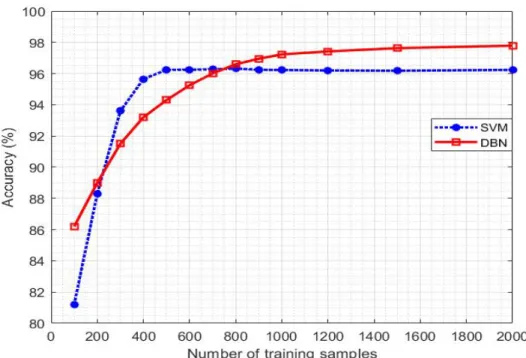
Dans la première approche à 1-D, les techniques SVM (Support Vector Machines) et le DBN (Deep Belief Networks) sont utilisées et évaluées pour identifier la cible en se basant sur la signature radar. Les résultats obtenus montrent que la technique SVM donne de bonnes performances pour le système proposé où le taux de reconnaissance global moyen atteint 96,24%, soit respectivement 96,23%, 95,25% et 97,23% pour le cycliste, le piéton et la voiture. Dans la seconde approche à 1-D, les performances de différents types d’architectures DBN composées de différentes couches ont été évaluées et comparées. Nous avons constaté que l’architecture du réseau DBN avec quatre couches cachées est meilleure et la précision totale moyenne peut atteindre 97,80%. Ce résultat montre que les performances obtenues avec le DBN sont meilleures que celles obtenues avec le SVM (96,24%) pour ce système de reconnaissance de cible utilisant un radar ULB.
Résumé | Abstract iii
Dans l’approche bidimensionnelle (2-D), le réseau de neurones convolutifs (CNN) a été utilisé et évalué. Nous avons proposé trois architectures de CNN. La première est le modèle modifié d’Alexnet, la seconde est une architecture avec les couches de convolution arborescentes et une couche entièrement connectée, et la troisième est une architecture avec les cinq couches de convolution et deux couches entièrement connectées. Après comparaison et évaluation des performances de ces trois architectures proposées nous avons constaté que la troisième archi-tecture offre de bonnes performances par rapport aux autres propositions avec une précision totale moyenne qui peut atteindre 99,59%.
Enfin, nous avons effectué une étude comparative des performances obtenues avec le CNN, DBN et SVM. Les résultats montrent que CNN a les meilleures performances en termes de précision par rapport à DBN et SVM. Cela signifie que l’utilisation de CNN dans les données radar bidimensionnels permet de classer correctement les cibles radar ULB notamment pour les cibles à faible SER et SNR telles que les cyclistes ou les piétons.
Mots-clés CA-CFAR, CNN, détection des cyclistes et piétons, Deep Belief Networks, DBN, HOS, identification des cyclistes et piétons, radar Ultra-Large Bande, radar ULB, Réseau de Neurones Convolutifs, Statistiques d’Ordres Supérieurs, Support Vector Machines, SVM, usagers vulnérables, Wavelet Shrinkage Denoising, WSD.
Abstract In this thesis work, we focused on the study and development of a system identifi-cation using UWB-Ultra-Wide-Band short range radar to detect the objects and particularly the vulnerable road users (VRUs) that have low RCS-Radar Cross Section- such as cyclist and pedestrian. This work is composed of two stages i.e. detection and recognition.
In the first approach of detection stage, we have proposed and studied a robust UWB radar detector that works on one dimension 1-D radar data ( A-scan). It relies on a combination of Higher Order Statistics (HOS) and the well-known CA-CFAR (Cell-Averaging Constant False Alarm Rate) detector. This combination is performed by firstly applying the HOS to the received radar signal in order to suppress the noise. After eliminating the noise of the received radar signal, we apply the CA-CFAR detector. By doing this combination, we finally have an UWB radar detector which is robust against the noise and works with the adaptive threshold.
In order to enhance the detection performance, we have evaluated the approach of using two dimensions 2-D (B-Scan) radar data. In this 2-D radar approach, we proposed a new method of noise suppression, which works on this B-Scan data. The proposed method is a combination of WSD (Wavelet Shrinkage Denoising) and HOS. To evaluate the performance of this method, we performed a comparative study with the other noise removal methods in literature including Principal Component Analysis (PCA), Singular Value Decomposition (SVD), WSD and HOS. The Signal-to-Noise Ratio (SNR) of the final result has been com-puted to compare the effectiveness of individual noise removal techniques. It is observed
that a combination of WSD and HOS has better capability to remove the noise compared to that of the other applied techniques in the literature; especially it is found that it allows to distinguish efficiency the pedestrian and cyclist over the noise and clutters whereas other techniques are not showing significant result.
In the recognition phase, we have exploited the data from the two approaches 1-D and 2-D, obtained from the detection method.
In the first 1-D approach, Support Vector Machines (SVM) and Deep Belief Networks (DBN) have been used and evaluated to identify the target based on the radar signature. The results show that the SVM gives good performances for the proposed system where the total recognition accuracy rate could achieve up to 96,24%.
In the second approach of this 1-D radar data, the performance of several DBN architec-tures compose of different layers have been evaluated and compared. We realised that the DBN architecture with four hidden layers performs better than those of with two or three hidden layers. The results show also that this architecture achieves up to 97.80% of accuracy. This result also proves that the performance of DBN is better than that of SVM (96.24%) in the case of UWB radar target recognition system using 1-D radar signature.
In the 2-D approach, the Convolutional Neural Network (CNN) has been exploited and evaluated. In this work, we have proposed and investigated three CNN architectures. The first architecture is the modified of Alexnet model, the second is an architecture with three convolutional layers and one fully connected layer, and the third is an architecture with five convolutional layers and two fully connected layers. The performance of these proposed architectures have been evaluated and compared. We found that the third architecture has a good performance where it achieves up to 99.59% of accuracy.
Finally, we compared the performances obtained using CNN, DBN and SVM. The results show that CNN gives a better result in terms of accuracy compared to that of DBN and SVM. It allows to classify correctly the UWB radar targets like cyclist and pedestrian.
Keywords CA-CFAR, Convolutional Neural Networks, CNN, cyclists and pedestrians de-tection, cyclists and pedestrians identification, Deep Belief Networks, DBN, Higher Order Statistics, HOS, Support Vector Machines, SVM, Ultra-Wide Band radar, UWB radar, vul-nerable users, Wavelet Shrinkage Denoising, WSD
1 INTRODUCTION 1
1.1 Background . . . 2
1.2 Problematics . . . 4
1.3 CYCLOPE Project . . . 4
1.3.1 Brief Introduction . . . 4
1.3.2 Relation between Thesis Work and CYCLOPE Project . . . 5
1.4 The General Research Context . . . 6
1.5 Thesis Scope . . . 6
1.6 Methodology . . . 6
1.7 Thesis Contributions . . . 7
1.8 Thesis Organization . . . 8
1.9 List of Publications . . . 9
2 STATE OF THE ART 11 2.1 Intelligent Transportation System (ITS) . . . 12
2.1.1 Applications of ITS . . . 12
2.1.2 Key Underlying ITS Technologies . . . 13
2.2 Overview of Autonomous Vehicles . . . 14
2.2.1 Autonomous Vehicles Operational Levels . . . 15
2.2.2 Key Technologies in Autonomous Vehicle . . . 17
2.3 Environmental Perception Systems . . . 17
2.3.1 Systems and Applications of Anti-Collision . . . 18
2.3.2 Systems and Applications of VRUs Protection . . . 19
2.4 Radar Systems . . . 20
2.4.1 Radar Equation . . . 20
2.4.2 Range Resolution . . . 21
2.4.3 Different type of Radar . . . 21
2.5 Ultra-Wide Band Radar . . . 24
2.5.1 Ultra-Wide Band Technology . . . 24
2.5.2 UWB Waveform . . . 25
2.5.3 Impulse UWB Radar . . . 26
2.6 Radar Detector and Noise Removal Method . . . 27
CONTENTS
3 STUDY AND DEVELOPMENT OF UWB RADAR DETECTOR 31
3.1 UWB Radar Module . . . 32
3.2 Detection Theory . . . 35
3.2.1 Probability of Detection and Probability of False Alarm . . . 35
3.2.2 Neyman-Pearson Criteria . . . 37
3.3 Development of UWB Radar Detector . . . 38
3.3.1 Moving Target Indication (MTI) . . . 38
3.3.2 Higher Order Statistics . . . 39
3.3.3 Time Delay Estimation . . . 41
3.3.4 Proposed UWB Radar Detector . . . 43
3.4 Conclusion of Chapter 3 . . . 49
4 STUDY AND DEVELOPMENT OF UWB RADAR TARGETS RECOG-NITION 51 4.1 Radar Signature . . . 52
4.1.1 Obtaining Radar Signature . . . 52
4.2 SVM-Based Approach . . . 55
4.2.1 Solving optimization problem . . . 56
4.2.2 SVM kernel . . . 56
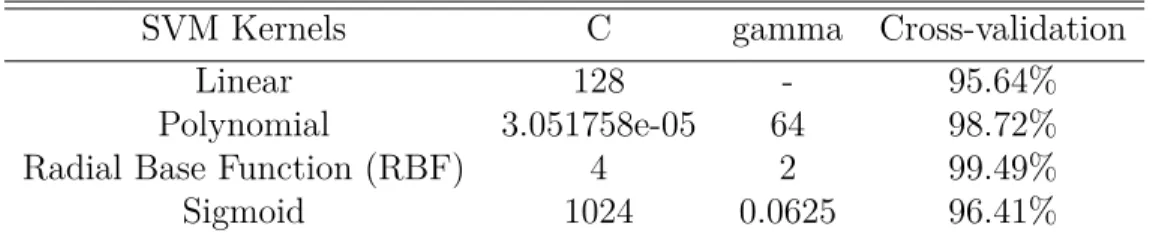
4.2.3 Experimental SVM Results . . . 57
4.3 A Deep Belief Network Approach . . . 59
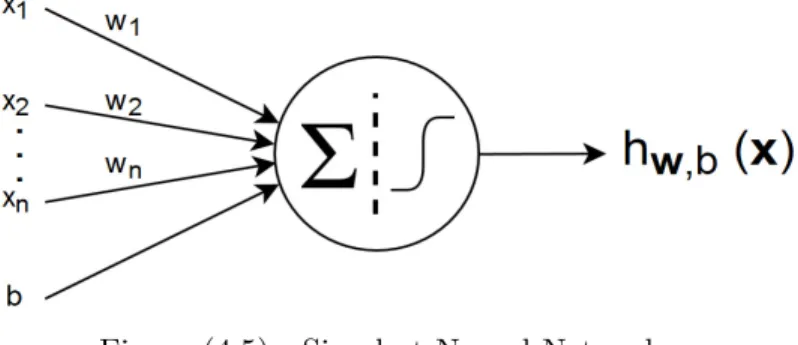
4.3.1 Introduction of Artificial Neural Networks . . . 59
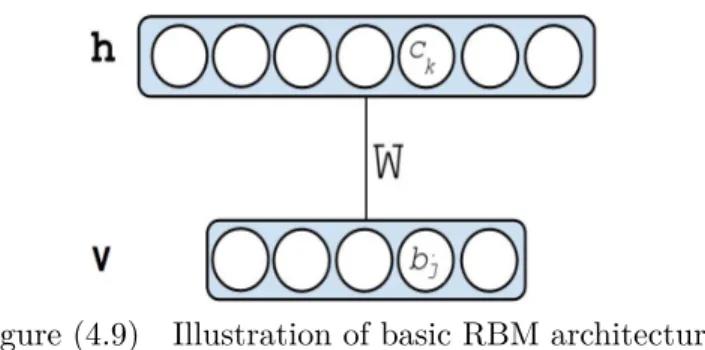
4.3.2 Restricted Boltzmann Machine (RBM) . . . 66
4.3.3 Training Deep Belief Network . . . 72
4.3.4 Results and Discussion . . . 73
4.3.5 Performance Comparison of DBN and SVM . . . 78
4.4 Conclusion of Chapter 4 . . . 78
5 ENHANCING RADAR TARGET DETECTION AND IDENTIFICATION 81 5.1 Study of Noise Removal Techniques . . . 82
5.1.1 Principal Component Analysis (PCA) . . . 82
5.1.2 Singular Value Decomposition (SVD) . . . 84
5.1.3 Wavelet Shrinkage Denoising (WSD) . . . 85
5.1.4 Combination of HOS and WSD (Proposed Method) . . . 86
5.1.5 Results and Discussion . . . 86
5.2 Convolutional Neural Network (CNN) Approach for Enhancing the Identifica-tion of UWB Radar Targets . . . 91
5.2.1 Preprocessing 2-D Radar Data . . . 91
5.2.2 Convolution Neural Network . . . 93
5.2.3 Results and Discussions . . . 99
5.2.4 Validation of the Developed System . . . 106
5.3 Conclusion of Chapter 5 . . . 108
2.1 Illustration of connected vehicles and infrastructure [28] . . . 15
2.2 Roles of human driver and driving automation system by level of driving au-tomation [29] . . . 16
2.3 Autonomous Vehicles Levels [27] . . . 17
2.4 Basic Principle of Radar . . . 20
2.5 Description of pulse radar system (source:[43]) . . . 22
2.6 FMCW signal with two ramps, transmitted and received signal with delay τ and Doppler fD (source:[37]) . . . 23
2.7 Illustration of Doppler Radar (source:[44]) . . . 24
2.8 Gaussian-pulse-based waveforms [51] . . . 26
2.9 Plot of the first four-order of Gegenbauer Polynomial [52] . . . 27
2.10 Basic UWB Radar Principle . . . 28
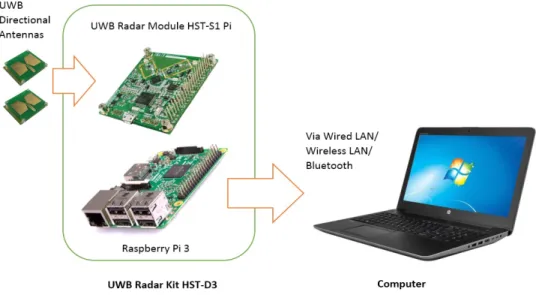
3.1 Diagram Connection of the HST-D3 with the PC . . . 32
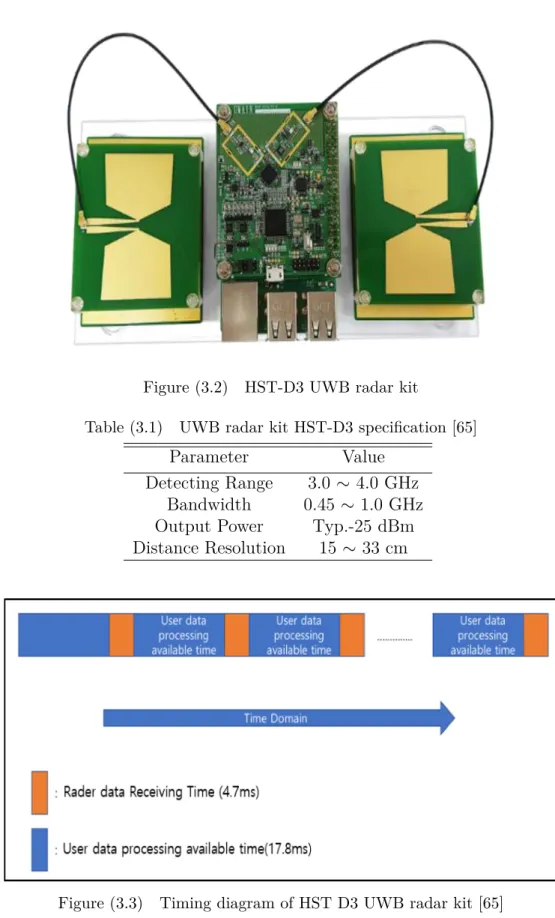
3.2 HST-D3 UWB radar kit . . . 33
3.3 Timing diagram of HST D3 UWB radar kit [65] . . . 33
3.4 Example of radar signal in the absence of target . . . 34
3.5 Example of radar signal in the present of target . . . 34
3.6 Probability densities for hypothesis testing problem . . . 35
3.7 Probability densities for hypothesis testing problem of false alarm . . . 36
3.8 Probability densities for hypothesis testing problem of miss detection . . . . 37
3.9 Basic 2-pulse canceller . . . 39
3.10 Performance comparison between 4thorder Cumulant (Tugnait4) and 4thorder cross-moment. . . 42
3.11 The comparison result between HOS and ordinary second order statistics in the presence of two radar targets with the threshold value set to 0.1 . . . 42
3.12 The comparison result between HOS and ordinary second order statistics in the presence of two radar targets with the threshold value set to 0.05 . . . . 43
3.13 CA-CFAR algorithm architecture [54] . . . 44
3.14 CA-CFAR detects false alarms, Pf a = 10−5, M = 80, and N = 2. . . . 45
3.15 Correct detection of CA-CFAR, Pf a= 10−5, M = 20, and N = 2. . . . 45
3.16 Miss detection of CA-CFAR, Pf a = 10−5, M = 20, and N = 2. . . . 45
3.17 Comparison of CA-CFAR performance run directly on the signal without time delay estimation and with time delay estimation (HOS), Pf a = 10−5, M = 150, and N = 2. A real target presents at 5 meters away from the radar. . . . 46
LIST OF FIGURES
3.18 Comparison of CA-CFAR performance run directly on the signal without time delay estimation and with time delay estimation (HOS), Pf a = 10−5, M = 150,
and N = 2. A real target presents at 2.5 meters away from the radar. . . . . 46
3.19 Comparison of CA-CFAR performance run directly on the signal without time delay estimation and with time delay estimation (HOS), Pf a = 10−5, M = 150, and N = 2. Two real targets present respectively at 2.5 and 7 meters away from the radar. . . 47
3.20 Comparison of CA-CFAR performance applied directly to the signal without time delay estimation and with time delay estimation (HOS), Pf a= 10−5, and N = 2. . . . 48
4.1 Diagram of determination of radar signature . . . 52
4.2 Signatures of the three different targets . . . 53
4.3 Normalized signatures of the three different targets followed by their power spectral densities. As can be seen, the figure shows that the different nature of radar target yielded different radar signature . . . 54
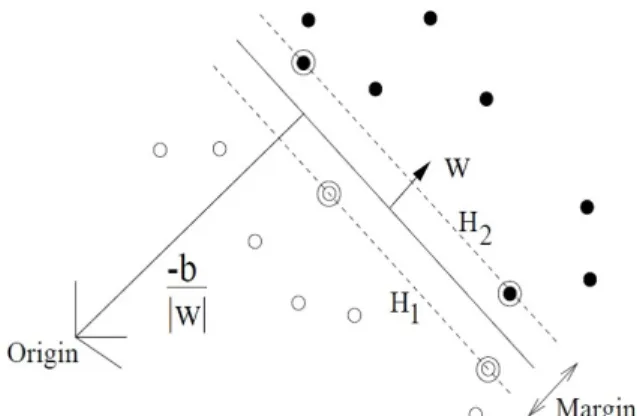
4.4 Illustration of Support Vectors, Hyperplane and Margin . . . 55
4.5 Simplest Neural Networks . . . 60
4.6 Plots of the sigmoid, tanh and rectified linear functions . . . 61
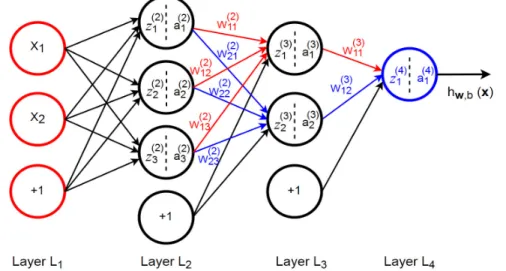
4.7 Network with two hidden layers . . . 61
4.8 Detail explanation of the network with two hidden layers from figure 4.7 . . 62
4.9 Illustration of basic RBM architecture . . . 66
4.10 Constrastive divergence process based on MCMC using Gibbs sampling . . . 71
4.11 Ilustration of training DBN . . . 72
4.12 The accuracy comparison between the training and the validation data for the first architecture with two hidden layers: 3000-2000. . . 74
4.13 The loss comparison between the training and the validation data for the first architecture with two hidden layers: 3000-2000. . . 74
4.14 The accuracy comparison between the training and the validation data for the second architecture with three hidden layers: 3000-750-2000. . . 75
4.15 The loss comparison between the training and the validation data for the second architecture with three hidden layers: 3000-750-2000. . . 75
4.16 The accuracy comparison between the training and the validation data for the third architecture with four hidden layers: 3000-750-750-2000. . . 76
4.17 The loss comparison between the training and the validation data for the third architecture with four hidden layers: 3000-750-750-2000. . . 76
4.18 Comparison SVM and DBN performance for the use of different numbers of training samples . . . 78
5.1 Original B-scan radar data for three different targets . . . 87
5.2 Results of applying noise removal methods for pedestrian data (a) B-scan after pulse canceller, direct coupling has been eliminated, (b) B-scan after PCA processing, (c) B-scan after SVD processing, (d) B-scan after WSD processing, (e) B-scan after HOS processing, (f) and B-scan after using combination WSD and HOS. . . 88
5.3 Results of applying noise removal methods for cyclist data (a) B-scan after pulse canceller, direct coupling has been eliminated, (b) B-scan after PCA processing, (c) B-scan after SVD processing, (d) B-scan after WSD processing, (e) B-scan after HOS processing, (f) and B-scan after using combination WSD
and HOS. . . 89
5.4 Results of applying noise removal methods for car data (a) B-scan after pulse canceller, direct coupling has been eliminated, (b) B-scan after PCA process-ing, (c) B-scan after SVD processprocess-ing, (d) B-scan after WSD processprocess-ing, (e) B-scan after HOS processing, (f) and B-scan after using combination WSD and HOS. . . 90
5.5 Sliding window process on the result of radar data after applying noise removal method . . . 91
5.6 Description of applying Non-Maximum Suppression to obtain the precision position on the overlapped windows . . . 92
5.7 Saving co-ordinate of the detected maximum energy area . . . 92
5.8 Centralizing of Energy Distribution . . . 93
5.9 Result examples of transforming detected region into power spectral density 93 5.10 Architecture of LeNet-5 [88] . . . 94
5.11 Illustration of 2-D convolutional process (source: [87] . . . 95
5.12 Description of applying Max Pooling . . . 96
5.13 AlexNet Architecture source: [92] . . . 98
5.14 Visualisation of 30 random feature maps on convolution layer 3 . . . 100
5.15 Visualisation of 30 random feature maps on convolution layer 5 . . . 100
5.16 Visualisation of feature maps on fully connected layer 2 . . . 101
5.17 Training vs validation performance of the CNN architecture 1 . . . 102
5.18 Training vs validation performance of the CNN architecture 2 . . . 103
5.19 Training vs validation performance of the CNN architecture 3 . . . 104
5.20 Radar setup and an example of experiment where a cyclist moved in front of the radar . . . 107
List of Tables
3.1 UWB radar kit HST-D3 specification [65] . . . 33
3.2 Detection possibilities . . . 36
3.3 Transfer Functions For Several Higher Order Pulse Canceller [66] . . . 39
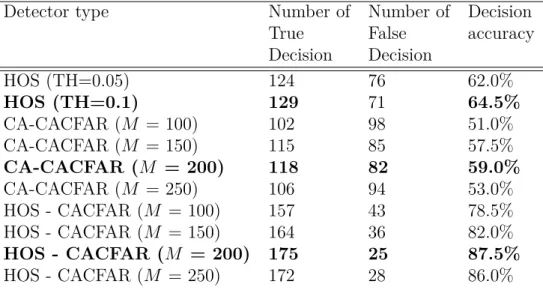
3.4 Performance evaluation between HOS with the fixed threshold (T H), CA-CFAR without time delay estimation, and CA-CA-CFAR after time delay estima-tion by HOS. (N = 2, Pf a = 10−5) . . . 48
4.1 Best Parameters for C and γ . . . . 58
4.2 Confusion matrix of using RBF kernel for three identification target . . . 59
4.3 The result of DBNs with different numbers of layers . . . 77
4.4 Confusion matrix for the configuration of hidden layer architecture: 3000-2000 77 4.5 Confusion matrix for the configuration of hidden layer architecture: 3000-750-2000 . . . 77
4.6 Confusion matrix for the configuration of hidden layer architecture: 3000-750-750-2000 . . . 77
4.7 Comparison results of the three DBN architectures and SVM with RBF kernel 77 5.1 Performance Comparison SNR(dB) For Different Noise Removal Methods . . 87
5.2 Proposed CNN architectures for UWB radar identification system . . . 99
5.3 Distribution of Dataset . . . 101
5.4 Learning Parameters . . . 101
5.5 Confusion matrix of the first proposed CNN architecture based on investigating dataset . . . 102
5.6 Confusion matrix of the second proposed CNN architecture based on investi-gating dataset . . . 103
5.7 Confusion matrix of the third proposed CNN architecture based on investigat-ing dataset . . . 104
5.8 Comparison results of the three proposed CNN architectures . . . 104
5.9 Confusion matrix of the CNN performance for the usage of 500 training data per class . . . 105
5.10 Confusion matrix of the CNN performance for the usage of 1000 training data per class . . . 105
5.11 Confusion matrix of the CNN performance for the usage of 2000 training data per class . . . 105
5.12 Confusion matrix of the CNN performance for the usage of 3000 training data per class . . . 105 5.13 Confusion matrix of the CNN performance for the usage of 4000 training data
per class . . . 106 5.14 Comparison results of the use of different numbers of training examples . . . 106 5.15 Confusion matrix of the CNN performance based on recorded data stream . 108 5.16 Validation of system on the recorded radar data stream using the proposed
List of Acronyms
ACAS/FOT Advanced Collision Avoidance System/Field Operational Test
ACS Anti-Collision System
ANN Artificial Neural Network
ATIS Advanced Traveler Information Service
ATMS Advanced Traffic Management System
AVCS Advanced Vehicle Control and Safety
AWGN Additive White Gaussian Noise
BS Base Station
BSS Blind Source Separation
CA-CFAR Cell-Averaging Constant False Alarm Rate
CMS Collision Mitigation System
CNN Convolution Neural Network
CYCLOPE Cyclo Protection Electronically
DBN Deep Belief Network
DSRC Dedicated Short Range Communication
CEM Electromagnetic compatibility
ETC Electronic toll collection
EU European Union
FCC Federal Communications Commission
FCW Forward Collision Warning
FMCW Frequency Modulated Continuous Wave
FN False Negative
FP False Positive
FSK-CW Frequency Shift-Keying-Continuous Wave
GPS Global Positioning System
HOS Higher Order Statistics
ITS Intelligent Transport System
MTI Moving Target Indication
MBWA Mobile Broadband Wireless Access
MCMC Markov Chain Monte Carlo
NC Negative Condition
OEDR Object and Event Detection and Response
PC Personal Condition
PCA Principal Component Analysis
PROSPECT Proactive Safety for Pedestrians and Cyclists
RBF Radial Based Function
RCS Radar Cross-Section
ReLU Rectified Linear Unit
ROC Receiver Operating Characteristic
RBM Restricted Boltzmann Machine
SAE Society of Automotive Engineers
SAVE-U Sensors and System architecture for Vulnerable road Users Protection
SNR Signal Noise Ratio
SRR Short Range Radar
SVD Singular Value Decomposition
SVM Support Vector Machine
TMS Traffic Management System
TN True Negative
TP True Positive
UWB Ultra Wide-Band
VRUs Vulnerable Road Users
CHAPTER
1
INTRODUCTION
Contents
1.1 Background . . . . 2 1.2 Problematics . . . . 4 1.3 CYCLOPE Project . . . . 4 1.3.1 Brief Introduction . . . 41.3.2 Relation between Thesis Work and CYCLOPE Project . . . 5
1.4 The General Research Context . . . . 6
1.5 Thesis Scope . . . . 6
1.6 Methodology . . . . 6
1.7 Thesis Contributions . . . . 7
1.8 Thesis Organization . . . . 8
In the first Chapter of this thesis book, we present the background and the problematic of this work. The discussion will be followed by the CYCLOPE project presentation from which the thesis work is one part. Then, followed by presenting general context of this research, the scope of the thesis presentation, the methodology used, thesis contributions, and the thesis organization.
1.1
Background
The increasing number of accidents and fatalities on the road has pushed the governments to make the road safety becomes one of the national priority concerns. Development of accident prevention systems is one of the focuses of this priority and it has also become one of the major concerns of automobile producers and researchers in the last decades in order to contribute to the improvement of the road safety.
Pioneered by the accident prevention systems, nowadays, the developments of the road safety systems have been shifted to the developments of Intelligence Transportation Systems (ITS) and Intelligent vehicles. With a huge improvement of the computer systems both hardware and software and the telecommunication technologies, it allows the vehicles to communicate among others and to the transportation infrastructures.
The integration of autonomous vehicles and ITS system, advanced mobility which a lot of safer, and environmental sustainability expected can be achieved soon or later. Related to the improvement of the road safety topic and toward the autonomous vehicles or drive-less cars system, the work of this thesis focus on the basic core of accident prevention system and it particularly concerns on developing a vulnerable road users identification that is robust to weather conditions.
Based on the Royal Society for the Prevention of Accidents, 95% of all accidents in the roads are caused by human error [1] and almost half of the road accident portions was the vulnerable road users including pedestrians, cyclists and motorcyclists [2]. The statistic shows that in 2015, 21% of the road victims were the pedestrians, 8% were the cyclists and 14% were the motorcyclists, and around 2000 people riding bicycle die every year in traffic accidents in EU countries [2][3].
One of the factors that contributes to the injuries and mortality of pedestrians and cyclists is mainly the lack of drivers visibility. As we know, there are many blind spots around the trucks and buses environments, that can make a fundamental crash accident between them and the uncovered road users [4]. Therefore, deploying an intelligent system of obstacles identification in automotive systems such as trucks and buses is crucial in order to have a better security in the road.
Over the years, many techniques have been proposed in order to reduce the injuries and mortality caused by road crash accidents. Crash warning and collision avoidance systems promise a great contribution in enhancing the protection of the pedestrians and the cyclists. This potential solutions include the computer vision for objects detection, identification as
1.1. Background 3
suggested in [5] and the radar system. However, the performance of the camera-based sys-tem decreases when illumination is low, as an example in cloudy, smoggy, foggy and night conditions. On the other hand, the radar system is robust to such conditions, and it can provide accurately the distance both stationary and moving targets while the camera can’t. By consequence, it detects and tracks their movement and can reduce this fatal error.
In order to achieve this objective, we propose to use Ultra-Wide Band (UWB) short-range radar to detect the movement of the vulnerable cyclists and pedestrians. The proposed radar uses UWB technology in order to reach high obstacles detection. This technology is characterized by a very low power density and a very small pulse width, from few picoseconds to few nanoseconds. The amplitude of the pulse should be normalized to comply with Federal Communications Commission (FCC) mask. The wide bandwidth used (several GHz) allows signals with a precise temporal resolution, a low probability of interception/detection and offers robustness against multipath fading [6]. Thus, the UWB radar offers a great interest in short range road safety applications [7].
In one side, since this technology is characterized by a very low power density, detection of radar targets that have low Radar Cross-Section (RCS) like pedestrians and cyclists is addressed for two main challenges. These challenges include in one hand, the ability to distinguish the target over the noises and static clutter and in the other hand, the ability to estimate the accurate detection targets position. Indeed, target detection for the low RCS is a complex process that includes such signal processing phases as raw radar data preprocessing, background subtraction and noise removal [8][9]. It is highly influenced by the capacity to distinguish successfully the useful radar information and the noise or clutter. This latter problematic becomes one of our focus studies in this thesis.
In another side, the use of UWB in the short-range radar system presents many advan-tages. Firstly, the brevity of UWB pulses with strong spectral contents makes it possible to obtain information on the target with a rich transitory response content. This allows the easy dissociation of various echoes at the reception stage. Then, the broad band spectrum authorizes to obtain results on the entire frequency band in a single measurement together with a strong capacity of detection. The pulse spectrum has abilities to penetrate through naturally screening materials [10]. Considering all these properties, UWB radar using very short pulses is of great interest for many applications such as obstacles detection and targets identification in short range[11].
Based on these advantages, in this thesis, we also proposed target recognition using machine learning dedicated to vulnerable road users especially for the pedestrians and the cyclists. Three methods have been investigated in this work i.e. Support vector Machines (SVM), Deep Belief Network (DBN) and Convolutional Neural Network (CNN).
The developed system was financed by the French National of Research Agency (ANR) through its project called CYCLOPE (Cyclo Protection Electronically) that will be presented briefly in the next section of this chapter. This project focuses on developing a technical so-lution to facilitate the integration of the cyclists into urban traffics by improving their safety and the comfort of the bus drivers. The UWB radar has been chosen for this system because it is a suitable candidate thanks to its immunity to various climatic and environmental
con-ditions and variations. This thesis was carried out in the IEMN (Institute of Electronics and Microelectronics and Nanotechnology) of Université Polytechnique Hauts-de-France (UPHF), Valenciennes and LEOST (Laboratory of Electronics, Wave and Signals for the Transports) of IFSTTAR villeneuve d’Ascq, Lille France.
1.2
Problematics
Since this technology is characterized by a very low power density, detection of radar targets that have low Radar Cross-Section (RCS) like pedestrians and cyclists is addressed for two main challenges. These first challenges include the ability to distinguish the target over the noises and static clutter and the second challenge consists in estimating the accurate detec-tion targets posidetec-tion. Target detecdetec-tion for the low RCS is a complex process that includes signal processing phases such as raw radar data preprocessing, background subtraction and noise removal [8] [9], The target detection is highly influenced by the capacity to distin-guish successfully the useful radar information over the noise or clutter. This problematic becomes one of our studies in this thesis beside the radar target recognition. Another chal-lenge concerns the target recognition process. Indeed, in a real environment, recognizing the pedestrian and cyclist using UWB radar system is a complex problem and the solution to overcome this situation, requires a good machine learning system. Therefore in the current thesis work, we have evaluated, in the two different approaches, 1-D and 2-D radar data, the Support Vector Machine (SVM), Deep Belief Network and Convolution Neural Network (CNN) to recognize the radar target.
1.3
CYCLOPE Project
1.3.1
Brief Introduction
To accelerate energy transition, the promotion of soft mobility is becoming a major issue where cycling is one of the proposed solutions. However, in towns and cities, urban planning does not always favor cohabitation between transport modes such as cycling and buses. Our objective is to propose novel solution that facilitates the integration of the cyclist in urban traffic by providing the alerting systems to bus drivers. The project is organized in two parts, namely "Radio technology" and "Human and social sciences". The originality of the project relies on the strong interaction between the two parts to foresee the influence of the technical solutions chosen on the users behavior. Simulations should allow to test for the acceptability of the proposed solutions before experimental testing. The consortium relies on skills and expertise in Science and Information technology, Human and Social sciences, a technological SME-Small and Medium Enterprise- and public transport operator.
The objective of this national CYCLOPE project is to develop an innovative and low-cost technical solutions to facilitate the integration of cyclists in urban traffic by
improv-1.3. CYCLOPE Project 5
ing both their safety, the traffics flow and the comfort of bus drivers. We have a multi-disciplinary vision, STIC-Sciences and Technologies of Information and Communication- and HSS-Humanities and Social Sciences. Indeed, we are aware that technological innovation can not respond alone to the whole problem. The most targeted application in CYCLOPE is the collaborative sharing of bus lanes (or other public transport space). One means recommended in CYCLOPE is the exploitation of the radio signals emitted by the bus (communication sig-nals to its terminal) using compact electronic devices embedded on the bicycle to alert cyclist of the bus presence in the lane adjacent to the bus lane so that Cyclist adopts the appropri-ate behaviors. The other means is to exploit signal radar to provide information to the bus driver. It is therefore not a matter of deploying a new radio link or modifying the current radar systems but of taking advantage of signals already present (which are diverted from their function initial or improved) by means of low cost devices integrated into the cyclist’s equipment. More specifically, the CYCLOPE project consists of a "radio techniques" com-ponent and a "human and social sciences" comcom-ponent. One of the originality of CYCLOPE project consists in conducting the two parts in strong interaction in order to anticipate as soon as possible the impact of the technical choices made on the behavior of the users and to adapt the information delivered to favor the collaboration between them.
Another aim is to enhance the safety and sense of safety perceived by cyclists and bus drivers. Indeed, one of the brakes in the practice of advanced cycling by non-cyclists is the risk of a bicycle accident. It’s clear that the incentive to cycle for citizens must first go through the demonstration of the safety of this means of transport. Safety is enhanced when bike lanes are offered or, at least, lanes sufficiently separated from those of cars. These other ways are naturally the clean or reserved ways of public transport (tram or bus). This security is also improved if cyclists get reliable information from their environment allowing them to anticipate the behavior of others and to adapt their own behavior. Thus, if the physical place is left to the cyclist to be cleared at the arrival of a bus, an element of security would be to inform the cyclist of the presence at the back of a bus, so that this cyclist can adapt his behavior. It also seems essential to study the behavior of motorists traveling in the lane adjacent to the bus when the cyclist riding in front of the bus is reintegrated into their lane. Indeed, this cyclist, informed of the arrival of a bus, could potentially arise unexpectedly while it can be partly or completely concealed by the bus. All these questions would find answers in the project CYCLOPE which proposes, through the approaches of technological studies and behaviors of the cyclists, to answer this societal problem, the cyclist’s behavioral study approach is not limited to surveys, but is extended to the intensive use of a Bicycle Driving Simulator and Driving Simulator on various carefully selected topics and scenarios.
1.3.2
Relation between Thesis Work and CYCLOPE Project
This dissertation is one part of the national CYCLOPE project which aims to study and develop a radar system based on UWB technology in order to protect the vulnerable road users. The work is focused on detection and identification using Ultra-Wide Band (UWB) radar targets, particularly for pedestrian and cyclist.
1.4
The General Research Context
The Radar, stand for RAdio Detection And Ranging, works is based on radio-frequency waves that used to determine the presence of objects located in a close environment by analyzing parameters such as position, velocity, and direction of movement. Initially, the radar applica-tion was designed to military applicaapplica-tion, but since World War II, the radar technologies have been used in many industrial developments system. Now, many consumer applications have emerged in aeronautics, shipping, robotics, meteorology or even in driving assistant. In this thesis, we are particularly interested in UWB short range radars for automotive applications. The use of UWB in the short-range radar system presents many advantages. Firstly, the brevity of UWB pulses with strong spectral contents makes it possible to obtain information on the target with a rich transitory response content. This allows the easy dissociation of various echoes at the reception stage. Then, the broad band spectrum authorizes to obtain results on the entire frequency band in a single measurement together with a strong capacity of detection. The pulse spectrum has abilities to penetrate through naturally screening ma-terials [10]. Considering all these properties, UWB radar using very short pulses is of great interest for many applications of obstacle detection and target identification in short range [11]. Based on these advantages, in this work, we have investigated the use of UWB short range radar for target detection and recognition of the vulnerable road users particularly the pedestrian and cyclist.
1.5
Thesis Scope
The scope of this thesis is to study and develop a recognition system based on UWB radar technology that is especially addressed to detect and identify the pedestrians and the cyclists. In this work, it is used only one UWB radar transceiver that allows detection of the distance and the determination of the nature of obstacle. For that, we used in this work, two different approaches of radar data, 1-D radar data (A-scan) and 2-D radar data (B-scan) that have been treated differently. In addition, in this work, we have analyzed possibilities of UWB radar to be used as a suited choice for developing a good protection system for the vulnerable road users.
1.6
Methodology
As mentioned in the previous section, the blind spots around the trucks and buses environ-ments can be a fundamental cause of this crash accidents between them and these uncovered road users. This main problematic has motivated us to propose a better solution in order to facilitate the integration of the cyclists in urban traffics and to provide a better protection of the pedestrians as well. Our main objective is to encourage people to cycle safer by providing a better solution with the possibility of warning cyclists in case dangerous maneuvers of cars
1.7. Thesis Contributions 7
and heavy goods vehicles (HGVs) occur[12].
This work is split in two stages i.e detection and recognition. In the first method of the detection stage, we have proposed and investigated a new robust UWB radar detector for 1-Dimensional raw radar data. It is a combination of HOS (Higher Order Statistics) and CA-CFAR (Cell-Averaging Constant False Alarm Rate) detector.
The first idea of using HOS is to have a good time delay estimation for the radar echo. As in literature [13], they used the HOS method to estimate time delay in unknown spatially correlated noise and the result is better than that of cross correlation method. Then compared to the second order statistics, HOS has better performance thanks to its ability to suppress the noise. Then, we compared the performance between automatic threshold CA-CFAR detector and HOS with fixed threshold value. From this comparison, we obtained that the performance of HOS detector with fixed threshold value is better than that of CA-CFAR. We noticed that the performances obtained using the CA-CFAR detector depend on the choice of the reference cell numbers. Indeed, if reference cell numbers is not properly set, CA-CFAR will result in a lot of false alarm or miss detection. Based on this fact, we proposed a robust UWB radar detector by combining the HOS and CA-CFAR. To do this combination, we firstly apply the HOS on the received signal. Indeed, not all the noise is eliminated, but most of them can be suppressed. As the noise has been eliminated, then we apply the CA-CFAR to have automatic threshold value. By doing this combination, we finally have an automatic threshold of UWB radar detector that is robust against the noise.
In the second part of detection stage, we proposed a novel noise removal method, that is a combination of Wavelet Shrinkage Denoising (WSD) and Higher Order Statistics (HOS). In this part, different types of noise removal techniques have been applied such as Principal Component Analysis (PCA), Singular Value Decomposition (SVD), WSD and HOS and the results have been analyzed. In addition, the signal-to-noise ratio (SNR) of the final results has been computed to compare the effectiveness of individual noise removal techniques.
For identification stage, different approaches have been investigated such as Support Vec-tor Machines (SVM), Deep Belief Network (DBN) and Convolution Neural Network (CNN).
1.7
Thesis Contributions
This PhD work contributes to the area of the road safety by using UWB radar, particularly for detecting the presence or movement of the vulnerable road users that have a low RCS-Radar Cross Section- like pedestrians and cyclists. Specifically, based on the problematic described in the previous section. The detailed contributions of this work are:
1. The first, we have proposed, developed and tested a robust UWB radar detector by combining the HOS and CA-CFAR in the 1-D. This combination takes the advantages of the capability of HOS in suppressing the noise and of the ability of CA-CFAR in adapting with dynamic threshold values. As the result, this combination promises a good detector for 1-D UWB radar application and specifically, for cyclists and pedestrians detection.
2. The second, we have developed and tested the capability to recognize radar targets by using the normalized 1-D radar signature. In order to classify the radar target using this radar signature, we have evaluated two different types of machine learning algorithms, Support Vector Machine (SVM) and Deep Belief Networks (DBN). The input for both recognition methods is the normalized 1-D radar signature. The results show that both SVM and DBN can potentially be used efficiency to classify the UWB radar target. Moreover, DBN provides better accuracy than SVM.
3. The third, we have enhanced the capability of detection of this UWB radar by using 2-D approach. In this case, we have proposed a new method of noise removal. The combination of Wavelet Shrinkage Denoising (WSD) and the HOS have been applied and the signal-to-noise ratio (SNR) of the final results has been computed and compared with the other signal-to-noise removal techniques. It is observed that a combination of WSD and HOS has better capability to remove the noise compared to the others; especially it is found that it allows to distinguish efficiency the pedestrian and cyclist over the noise and clutters whereas other noise removal techniques are not showing significant result.
4. The last but not the least, we have successfully applied the Convolutional Neural Network (CNN) to 2-D radar signature. After applying this latter, we use the sliding windows approach to search the candidates of the radar target. The 2-D radar signature can be obtained by implementing non-maximum suppression. This simple technique detects the energy surrounding of the radar target position and takes the one that is maximum, and eliminates the others. After transforming it into the power spectral, this signature can be used as an input of the CNN. Finally, we compared the CNN, DBN and SVM performance, and the results show that CNN gives better results in terms of accuracy compared to both DBN and SVM. And also, it allows efficient classification of UWB radar targets particularly the cyclist and pedestrian presenting low RCS.
As a final remark, it is important to acknowledge that most of the inspiration and moti-vation for this work remains a lot of challenges and we considered as the vision of the future perspectives. One of it is, to test this system in a real environment where the radar needs to be mounted on the vehicle such as bus or trucks. We have also combined this UWB radar system with the camera-based system in order to have a robust recognition system to protect the VRUs.
1.8
Thesis Organization
In Chapter 1, we presents the Introduction of Background and Problematic, national CY-CLOPE Project, Thesis scope, Methodology, Thesis contributions and Thesis Organization. Chapter 2 makes a review on the State of the Art of Intelligent Transport System (ITS), System and Applications of Anti-Collision, System and Application of VRUs protection, and Ultra-wide Band Radar. Chapter 3 focuses on 1-D UWB Radar Targets Detection, the time delay estimation and detailed discussions on the proposed of robust UWB radar detector. Chapter 4 presents the Radar Targets Recognition on 1-D radar signature. In this chapter,
1.9. List of Publications 9
it will be discussed about the way the Support Vector Machine (SVM) recognizes the radar targets by using normalized 1-D radar signature as its input features, then followed by inves-tigation of Deep Belief Network (DBN). In Chapter 5, we will focus on a new proposition of UWB radar target detection and identification using 2-D radar approach. In the first part of this section, the discussion will be focused on increasing radar Signal-to-Noise Ratio (SNR) by proposing a new noise removal method. We compared different methods such as Singu-lar Value Decomposition (SVD), Principal Component Analysis (PCA), Wavelet Shrinkage Denoising (WSD), Higher Order Statistics (HOS) and our proposed method, a combination between HOS and WSD. After that, in the second part of this Chapter, a Convolution Neural network (CNN) is presented in order to enhance the recognition rate. Finally, the conclusion of this work and the perspectives are presented in the last Chapter 6.
1.9
List of Publications
Journals
– R. Sadli, C. Tatkeu, K. Hamidoun, Y. El Hillali and A. Rivenq, "UWB radar recognition system based on HOS and SVMs," in IET Radar, Sonar & Navigation, vol. 12, no. 10, pp. 1137-1145, 10 2018.
– K. Hamidoun, R. Sadli, Y. Elhillali, R. Elassali, A. Rivenq and K. Elbaamrani, ’Im-plementation of a New IR-UWB System Based On M-OAM Modulation On FPGA Component’, International Journal of Wireless & Mobile Networks (IJWMN) Vol. 10, No. 2, April 2018.
– L. Maatougui, L. Sakkila, R. Sadli, A. Rivenq, "Computation of Correlation and Cumu-lant 4 under FPGA Architecture", International Journal of Engineering and Technical Research (IJETR), ISSN: 2321-0869 (O) 2454-4698 (P), Volume-5, Issue-3, July 2016.
Conferences
– R. Sadli, Y. El Hillali, L. Sakkila, A. Rivenq, C. Tatkeu, "The 4th Order Statistics on Ultra Wideband Short-Range Radar (UWB-SRR) for Cyclist Detection", 3rd Annual International Conference on Transportation 5-8 June 2017, Athens, Greece.
– R. Sadli, L. Maatougui, Y. El Hillali, C. Tatkeu, A. Rivenq, "Implementation of the 4th Order High Order Statistics (HOS) Based on FPGA for an UWB Short-Range Radar Receiver", Colloque International TELECOM’2017 & 10émes JFMMA 10, 11, & 12 Mai 2017, Rabat, Moroc.
Oral Presentations and Posters
– R. Sadli, Y. El Hillali, A. Rivenq, C. Tatkeu, "Implementation of the 4th Order High Order Statistics (HOS) Based on FPGA for an UWB Short-Range Radar Receiver", La journée Matinée De Chercheurs, 2017 à Mons, Belgique. (Poster).
– R. Sadli, Y. El Hillali, A. Rivenq, C. Tatkeu, "Study and Implementation of UWB radar in Combination with Vision-based System to Protect the Cyclists" La matinée des Doctorants IEMN-DOAE, Valenciennes, 20 october 2017. (Oral Presentation format Pecha Kucha).
– R. Sadli, Y. El Hillali, A. Rivenq, C. Tatkeu, "Development of Algorithms for Perception the Cyclists by the Bus", Les journées des doctorants 2017 du COSYS, Marne La Vallée les 22 et 23 juin 2016. (Oral Presentation)
– R. Sadli, Y. El Hillali, A. Rivenq, C. Tatkeu, "New UWB radar Recognition System Based on Higher Order Statistics and Support Vector Machine", Journée du club EEA ’véhicule autonome – transport intelligent’, Valenciennes 9-10 novembre 2017. (Oral Presentation).
– L. Maatougui, R. Sadli, "Développement d’un système de détection et de suivi des piétons", Journée du club EEA ’véhicule autonome – transport intelligent’, Valenciennes 9-10 novembre 2017. (Poster)
CHAPTER
2
STATE OF THE ART
Contents
2.1 Intelligent Transportation System (ITS) . . . . 12 2.1.1 Applications of ITS . . . 12 2.1.2 Key Underlying ITS Technologies . . . 13 2.2 Overview of Autonomous Vehicles . . . . 14 2.2.1 Autonomous Vehicles Operational Levels . . . 15 2.2.2 Key Technologies in Autonomous Vehicle . . . 17 2.3 Environmental Perception Systems . . . . 17 2.3.1 Systems and Applications of Anti-Collision . . . 18 2.3.2 Systems and Applications of VRUs Protection . . . 19 2.4 Radar Systems . . . . 20 2.4.1 Radar Equation . . . 20 2.4.2 Range Resolution . . . 21 2.4.3 Different type of Radar . . . 21 2.5 Ultra-Wide Band Radar . . . . 24 2.5.1 Ultra-Wide Band Technology . . . 24 2.5.2 UWB Waveform . . . 25 2.5.3 Impulse UWB Radar . . . 26 2.6 Radar Detector and Noise Removal Method . . . . 27 2.7 Conclusion of Chapter 2 . . . . 29
This chapter will expose about the State of the Art relative to this research topic including the Intelligent Transport System (ITS), overview of Autonomous Vehicle, Environmental Perception Systems, Radar Systems, Radar Detector and Noise Removal Method.
2.1
Intelligent Transportation System (ITS)
Intelligent Transport Systems (ITS) are advanced technologies including Advanced Traffic Management (ATMS), Advanced Traveler Information Service (ATIS), and Advanced Vehicle Control and Safety (AVCS) [14] which aims to provide innovative service relative to different modes of transportation and management. ITS is a system that uses computers, controls, communications, and various automation technologies in order to improve the road safety, throughput, and efficiency of transportation. It is also targeted to reduce energy consumption and environmental impact [15].
By integrating communication and information technology applications into management and operation of the transportation system across all modes [16], These technologies enable users to be better informed and make safer, more coordinated, and smarter use of transport networks [17]. An advancing transportation safety, mobility, and environmental sustainability can be achieved by using these technologies.
The ITS has emerged in the year of 1991’s since the electronic technologies have taken place an important role in optimizing surface transportation followed by dramatically im-proved the computer both hardware and software, communication and sensor technologies [18].
2.1.1
Applications of ITS
Nowadays, ITS has been integrated in several applications [19]:
Electronic toll collection (ETC); this technology equips vehicles with sophisticate com-munication system in order to collect the tolls electronically. The performance of toll service stations can be increased now by minimizing the delay.
Highway data collection; this system provides the traffic information to the traffic control center to analyze and identify areas of congestion on the road network. The collection of data are gathered by using Geo-referencing systems such as GPS, GSM, and GPRS.
Traffic management system (TMS); A system that plays an important role in management transportation that collects real-time information from different hardware components like cameras and speed sensors to improve the flow of vehicle traffic and safety.
Emergency vehicle pre-emption: This system makes it possible to provide these types of vehicles with solutions enabling them to circulate without problems in a road network even in situations of congestion without increasing congestion on the road network.
2.1. Intelligent Transportation System (ITS) 13
Road condition monitoring: [20], It proposes a road condition monitoring system using multiple sensors data for ensuring communication between vehicle and providing as a web application if some disaster occurs.
2.1.2
Key Underlying ITS Technologies
In this subsection, we present several key underlying technologies for ITS systems, such as Computer Technologies, Wireless Networks, Detection Technologies, Global Positioning System (GPS) and Anti-Collision Technologies.
Computer Technologies
Computer technologies play an important rule in developing ITS technologies. With the evolution of hardware and software dramatically, it allows us to integrate ITS technologies into transport infrastructures and management system. Computer technologies is a main key to solve problems in transport systems.
Wireles Network
The wireless networks are used to establish communication between vehicles and roadside infrastructures.
It is a standard communication commonly used for wireless internet access [21]. The technologies used are known: Wi-Fi, WiMax,DSRC, MBWA, UWB, etc [19].
Detection Technologies
Detection technologies including static and mobile detection is aimed to gather information related to the the road users activities. Static detections using sensors or detectors fixed along the road such as loops and magnetic sensors, cameras, acoustic RF sensors [19]. Mobile detection exploiting GPS on vehicles, or those installed on mobile phones and hybrid detection [19].
GPS technologies
GPS technologies have been integrated on the vehicles in order to localize their position. [21] GPS is a core technology behind the vehicle navigation and route guidance systems.
Anti-Collision and Recognition Technologies
Nowadays, with the increasing number of vehicles circulating in the roads, the technologies of anti-collision and obstacles recognition are necessary embedded on the vehicles. Radar, Lidar, Ultra-sonic, and Camera are the core of this technologies.
To summarize the discussion about the intelligence transportation system, the emerging of ITS is aimed to provide an innovative service that allows the road users to be better informed and make them safer, more coordinated and smarter use of transport networks. ITS technology is an integration of communication and information technology into different modes of transportation managements which brings a number of social, environmental, and economical benefits.
Relating to ITS technology and still in its framework, intelligent vehicles is important to be mentioned in this state of the art. Intelligence vehicles is a promising technology for future transportation systems.They share cooperatively essential information between vehicles and roadside units or infrastructures [22] and surely, they drives autonomously. The way it perceives the surrounding environment is a key of this technology. Therefore in the following section, we will discuss about this technology.
2.2
Overview of Autonomous Vehicles
Even though a statement that human beings are poor drivers as documented in popular culture is over-dramatized. The facts that human can sometimes be at times distracted, drowsy, drunk, drugged, and irrational decision maker are the proof evidences that can not be denied [23]. An extensive investigations of recent years showed, the large majority of road traffic accidents (50–70%) happened because of wrong actions of the drivers. The correctness of the decisions taken by the driver and driving skills are the basis for the majority of the reasons for the road traffic accidents [24]. These limitations led the researchers all over the world to develop a perception-control vehicle system called intelligent vehicle to overcome the human constrains.
These vehicles can communicate and share information with the ITS infrastructure and between self driving cars. However, designing and building the autonomous system that drives better than the average human drive is not easy. There is a complex problematic such as problems of localization, mapping, scene perception, vehicle control, trajectory optimization, and higher-level planning decisions associated with autonomous vehicle development still remain full of open challenges that have need to be fully solved [23] before this system is safely to be used. However, driver-less vehicle or autonomous vehicle is a promising technology for future transportation system. It potentially has the capacity to improve road safety and to have a better mobility. It also potentially will be used in order to overcome the human mobility constraints particularly for elderly and disabled people [25].
2.2. Overview of Autonomous Vehicles 15
Figure (2.1) Illustration of connected vehicles and infrastructure [28]
intelligent research domain. In the last few decades, autonomous vehicles was considered just a science-fiction. Nowadays, we can find the technologies that allow a car to self-park [26] and to break automatically in emergency conditions. Soon, we will see cars will navigate without a driver under full conditions. Their presence will not only change the way of moving, but also will have an impact on the social evolution of the society, security and environment.
2.2.1
Autonomous Vehicles Operational Levels
There are five levels of autonomous driving vehicles defined by the Society of Automotive Engineers (SAE)[27]. The levels 1, 2 and 3 required driving license but levels 4 and 5 are driver-less. Tabel 2.2 [29] and figure 2.3 shows the summary of vehicles autonomous levels.
Figure (2.2) Roles of human driver and driving automation system by level of driving automation [29]
2.3. Environmental Perception Systems 17
Figure (2.3) Autonomous Vehicles Levels [27]
2.2.2
Key Technologies in Autonomous Vehicle
This technology originated from multi-disciplinary scientific researches such as vehicle control systems, robotics, sensors, machine perception, innovation, mapping and machine learning [30]. The important keys in creation of this autonomous vehicle are telecommunication and navigation systems, sensors technologies and artificial intelligence systems. These core technologies can be derived into four parts based on the functionality of self driving car [31]: environment perception, car navigation, path planning, and the car control.
2.3
Environmental Perception Systems
Perceiving surrounding environment, so that the drivers can interact consequently, is the key success of reducing the road traffic accident. As earlier mentioned in the chapter 1, the focus of this thesis work is on developing a system that the bus can perceive the movement of the VRUs particularly in the blind spot areas, so that the system can give spatial alert to the bus driver to be aware of the presence of the VRUs around them. Therefore, related to this
topic, there are two main concerns of the discussion in this section: the anti-collision and the Vulnerable Road Users (VRUs) protection systems and applications.
2.3.1
Systems and Applications of Anti-Collision
In recent years, the obstacle and collision avoidance have attracted a lot of researcher’s attention. With the aim of developing a technology that can facilitate to prevent or to reduce road accidents due to human error and to make drivers comfort, this technology has become very popular in these days. In order to achieve a good level precision, there are two difference technologies approach have been used, passive and active sensor system [32] [33] that it depends on the applications.
In passive technology, a sensor receives signals coming from environment. This kind of sensors includes in particular stereo-cameras or optical-flow cameras [33]. While, the active system works based on the response (information gathered) of transmitted signals from a sensor to analyze the actual situation.
There are many research projects and applications have been conducted and developed relating to Anti-collision systems and the some of them will be discussed in the following paragraphs.
In [34], they used a combination of the laser beams and camera to estimate position of the vehicle after 1 second, then project it on the road surface. The installed camera on the vehicle is used to capture the positions of each laser beams. The obstacles can be detected by measuring the difference between normal and abnormal road conditions.
In [35], an Anti-Collision System (ACS) that allows Automatic breaking system, has been developed by using a stereo multi-purpose camera and ultrasonic sensor. The camera has been used to get dimensional data of the vehicle and its environment and the obstacle is detected by ultrasonic sensor. These information are then sent to an automated emergency braking system that breaks the vehicle at an appropriate time and condition.
In [36], they developed a collision avoidance system in heavy traffic where the vehicles speed normally less than about 20 km/h. This system puts 8 ultra-sonic sensors to cover all around the car.
In [37], they reported that an autonomous cruise control (ACC) system was firstly in-troduced by Mercedes-Benz in 1999 for their S-class series car. This ACC is a 77 GHz radar-based. Since then, several type of radar system have emerged in developing the au-tonomous car system. They are based mainly on one of the following technologies: FMCW, FSK-CW (Frequency Shift-Keying-Continuous Wave) and MFSK-CW (Multiple Frequency Shift Keying-Continuous Wave). For the Short Range Radar (SRR) technologies mainly use UWB technologies: UWB pulse, spread spectrum techniques and radar "Stepped Frequency". National Highway Traffic Safety Administration U.S. Department of Transportation en-tered a collaborative research project in Advanced Collision Avoidance System/Field Oper-ational Test (ACAS/FOT) Program. The members are: Delphi-Delco Electronic Systems,