HAL Id: tel-01172614
https://tel.archives-ouvertes.fr/tel-01172614
Submitted on 7 Jul 2015HAL is a multi-disciplinary open access archive for the deposit and dissemination of sci-entific research documents, whether they are pub-lished or not. The documents may come from teaching and research institutions in France or abroad, or from public or private research centers.
L’archive ouverte pluridisciplinaire HAL, est destinée au dépôt et à la diffusion de documents scientifiques de niveau recherche, publiés ou non, émanant des établissements d’enseignement et de recherche français ou étrangers, des laboratoires publics ou privés.
optical access networks
Ozgur Can Turna
To cite this version:
Ozgur Can Turna. Bandwidth allocation and energy efficiency solutions in optical access networks. Networking and Internet Architecture [cs.NI]. Institut National des Télécommunications, 2014. En-glish. �NNT : 2014TELE0005�. �tel-01172614�
THESE DE DOCTORAT CONJOINT TELECOM SUDPARIS et L’UNIVERSITE PIERRE ET MARIE CURIE
Thèse n° 2014 TELE0005 Spécialité : Informatique Présentée parÖzgür Can TURNA
Pour obtenir le grade de DOCTEUR DE TELECOM SUDPARISAllocation des ressources et des solutions pour économiser de l'énergie
dans les réseaux optiques d'accès
Soutenue le 30 Janvier 2014 devant le jury composé de :
Philippe GRAVEY Rapporteur Directeur d'étude à Telecom Bretagne
Dominique CHIARONI Rapporteur Chercheur Senior (Team Leader) à Alcatel-Lucent France Serge FDIDA Examinateur Professeur à l'université Pierre et Marie Curie
Nihal PEKERGIN Examinateur Professeur à l’université Paris Est Créteil Val de Marne Catherine LEPERS Examinateur Professeur à Telecom SudParis
Hakima CHAOUCHI Examinateur Professeur à Telecom SudParis Tülin ATMACA Directrice Professeur à Telecom SudParis Halim ZAİM Co-encadrant Professeur à l'université d’Istanbul
Doctor of Science Thesis Telecom & Management SudParis and Pierre & Marie Curie University
Thèse n° 2014 TELE0005
Specialization
Presented by
Özgür Can TURNA
Submitted in partial satisfaction of the requirements for the degree of Doctor of Science
TELECOM SUDPARIS
Bandwidth Allocation and Energy Efficiency Solutions in Optical Access
Networks
30 January 2014, committee in charge:
Philippe GRAVEY Reviewer Director of Studies at Telecom Bretagne
Dominique CHIARONI Reviewer Senior Researcher (Team Leader) at Alcatel-Lucent France Serge FDIDA Examiner Professor at University Pierre & Marie Curie
Nihal PEKERGIN Examiner Professor at University Paris Est Créteil Val de Marne Catherine LEPERS Examiner Professor at Telecom SudParis
Hakima CHAOUCHI Examiner Professor at Telecom SudParis Tülin ATMACA Director Professor at Telecom SudParis Halim ZAİM Co-supervisor Professor at Istanbul University
I First and foremost I wish to thank my advisor Professor Tülin ATMACA for her patience, for being inspirational and supportive during this thesis. She gave me directions and ideas in all steps of my studies. Especially I would like to thank to her for accepting me as her student and giving me the opportunities to finish my thesis.
I would also like to thank to my co$supervisor Professor Halim ZAIM for his advices and supports for my studies in Turkey.
I am also grateful to Prof.Dr. Philippe GRAVEY and Mr. Dominique CHIARONI for accepting to be rapporteur of my thesis and for their promotive advices. I wish to express my sincere thanks to Prof.Dr. Serge FDIDA, Prof.Dr. Nihal PEKERGIN, Prof.Dr. Catherine LEPES and Prof.Dr. Hakima CHOUCHI to accepting being a jury member and attending to my defense.
I would like to thank all of my colleagues who have supported with collaborations and substantial ideas over our meetings. Especially I would like to thank to Prof.Dr. Hakima CHOUCHI, Tuan Dung NGUYEN and Glenda GONZALEZ for their contributions to my studies.
Without financial support from Telecom SudParis and Istanbul University, I would not be able to continue my studies in France. I gratefully appreciate their supports.
At last I want to give my best regards to Dr. Muhammed Ali AYDIN and Zeynep AYDIN for their endless support and friendship.
Özgür Can Turna December 2013, Paris
III The advancements in information technologies have been progressed enormously. Improvements in telecommunication systems are one of the most important steps of the progress in information technologies. Although the telecommunication infrastructure has come into our lives for the first time with telephony networks, they have been diversified and enhanced by the discovery of Internet. Today, telecommunication technologies vary from satellite communication to communication over power lines at home. Considering the telecommunication infrastructures, Internet has the most importance. Internet is not only a telecommunication infrastructure but also a network of networks in which several independent telecommunication infrastructures operate as an overall system. From the commercial aspect, Internet invention brings new industry branches as network device manufactures, operators, service providers, etc. Service providers try to reach as much subscribers as they can with lower costs. Optical networks are distinguished as a solution to solve increasing bandwidth demand and error free data transmission over long haul.
The network architectures which constitute the Internet are handled as hierarchical three levels (backbone networks$WAN, metropolitan networks$MAN and access networks). The usage of optic fibers and optic based switching techniques in WAN and MAN networks are of long standing. In access networks, solutions can be grouped as wireless and fixed. For fixed access networks, twisted pair copper cables or coaxial links were used until the recent past. This property of access networks is a result of service providers’ intention to use existing telephony or cable TV systems without laying down new links. The data transmission capacity of twisted pair copper links is limited with specific distances even if they use complex techniques. In Internet infrastructures, this property causes bottleneck for access networks. Using optical technologies in access networks provide solutions to overcome this bottleneck.
Optical access networks can be classified as three categories in terms of topology: point$to$point topology, star topology with intermediate active elements and tree topology with passive splitter “known as Passive Optical Network $ PON”. The first two topologies are not more cost$effective than tree topology with passive splitter in terms of operation expenditures or implementation
IV PON consists of Optical Line Terminals$OLT at central office of service provider, Optical Network Unit$ONU at user side, passive combiners/splitters and optical fibers between them. PONs are named as; Time Division Multiplexing PON (TDM$PON) and Wavelength Division Multiplexing PON (WDM$PON) according to the used multiple access mechanism. Ethernet PON (EPON) and Gigabit$PON (GPON) are two main standard branches over TDM$PON structure. WDM$PON structure is not widely implemented since it is not still be a cost$effective solution. However, next generation PON (NG$PON) structure is thought to base on WDM$TDM hybrid PON solution. Two main problems (accessing more users over longer distances and increasing the bandwidth) are focused on for next generation PON standards. Also, one of the other popular research topics is the increasing number of mobile devices and mobile networks and design of optical$wireless convergence system to satisfy the bandwidth demands of these devices. In this study, general overview about PON systems is presented and existing PON mechanisms and classifications are investigated. After the general overview of PONs, a novel dynamic bandwidth allocation algorithm for EPON is introduced. This proposed algorithm is named as “Half Cycling Dynamic Bandwidth Allocation$hcDBA” by the inspiration of its half cycling processing mode. Later, an improvement of hcDBA algorithm with early prediction mechanism is presented. The simulated traffic behavior of EPON’s upstream channel has been investigated in order to support the decision of traffic generator in further studies. The newly proposed algorithm have been implemented on NS2 simulation tool and compared to existing EPON dynamic bandwidth allocation algorithms. The comparison results and performance analysis are given for mono$service and multi$service cases for 1 Gbps and 10 Gbps link capacities. As a result statement of the study, hcDBA algorithm performs better than existing mechanism in terms of byte loss ratio and access delays.
Energy conservation is one of the hot topics in telecommunication networks. Access networks constitute a remarkable portion of the total energy consumption in telecommunication networks. ITU$T and IEEE organizations published recommendation for energy conservation in PONs. While, total energy consumption of ONUs is more than other equipment in fix access network the standards and most of the researches focused on saving energy at ONU side. As a result of researches XG$PON includes some improvements in energy$efficiency compared to GPON standard. In this thesis I focused on an energy efficiency method based on energy conservation on OLT side. The proposed method save energy by dynamically moving OLT cards to deep sleep mode according to the incoming and outgoing traffic loads.
Keywords: Energy Efficiency, Ethernet Passive Optical Network (EPON), Multipoint Control Protocol (MPCP), Network Simulation, Optical Access Network (OAN), Passive Optical Network (PON), Performance Evaluation, Resource Allocation, Quality of Service (QoS), Time Division Multiplexing (TDM), Wavelength Division Multiplexing (WDM)
V Les technologies de l'information ont connu un essor important ces dernières années. L'amélioration des systèmes de télécommunications est l'une des étapes les plus importantes de l’évolution des technologies de l’information. Bien que l'infrastructure de télécommunication a été adoptée d'abord pour les réseaux de téléphonie, celle$ci à bien évoluée depuis pour embrasser la technologie de l’Internet. Aujourd'hui, les technologies de télécommunication varient depuis les communications par satellite aux communications sur les lignes électriques à domicile sans oublier les communications sans fil et les communications optiques. Compte tenu des infrastructures de télécommunication, le réseau Internet aujourd’hui a gagné la plus grande place. Internet n'est pas seulement une infrastructure de télécommunication, mais aussi un réseau de réseaux dans lesquels plusieurs infrastructures de télécommunication indépendantes fonctionnent comme un système global. Du point de vue commercial, l’invention de l'Internet apporte de nouvelles branches de l'industrie en tant que dispositif de réseau de produits manufacturés, les opérateurs, les fournisseurs de services, etc. Les fournisseurs de services cherchent à atteindre autant que possible l’abonné à moindre coût ; on parle d’une approche « user and service centric ». Les réseaux optiques se distinguent comme une solution pour résoudre la demande croissante de bande passante et sans erreur de transmission de données sur de longues distances.
Les architectures de réseaux qui constituent Internet sont traités comme trois niveaux hiérarchiques (backbone réseaux WAN, les réseaux métropolitains ou réseaux MAN et les réseaux d’accès LAN). L'utilisation de fibres optiques et les techniques de commutation optique à base de WAN et MAN est très ancienne. Dans les réseaux d'accès, les solutions peuvent être regroupées comme fixe et sans fil. Pour les réseaux d'accès fixes, on peut citer la paire torsadée de câbles en cuivre ou les liaisons coaxiales qui ont été utilisés jusqu'à un passé récent. Cet établissement de réseaux d'accès est le résultat de l'intention des fournisseurs de services d'utiliser des systèmes de téléphonie ou la télévision par câble existantes sans poser de nouveaux liens. La capacité de transmission de données de liens torsadés paire de cuivre est limitée par des distances précises, même si elles utilisent des techniques complexes. Dans les infrastructures de l'Internet, cette propriété entraîne l'incidence des goulots d'étranglement pour les réseaux d'accès en plus de l'exploitation de WAN, MAN et des réseaux d’accès locaux. En utilisant des technologies optiques dans les réseaux d'accès pour fournir des solutions pour surmonter cet obstacle.
VI arbre avec répartiteur passif connu sous le nom de « Passive Optical Network – PON ». Les deux premières topologies ne sont pas efficaces en termes de cout tel que topologie arbre avec répartiteur passif en termes de dépenses de fonctionnement ou des dépenses de mise en œuvre. En utilisant des éléments intermédiaires passifs, la structure de l'arbre a été largement utilisée en raison de son avantage de coût.
PON se compose des Optical Line Terminal $ OLT au central de prestataire de services, et de Optical Network Unit $ONU du côté de l'utilisateur, des multiplexeurs passifs / répartiteurs et des fibres optiques entre eux. Les réseaux optiques PON sont nommés comme: Time Division Multiplexing PON (TDM$PON) et Wavelength Division Multiplexing PON (WDM$PON), selon le mécanisme d'accès multiple utilisé. Ethernet PON (EPON) et Gigabit PON (GPON) sont deux branches principales de la norme sur la structure TDM$PON. La structure WDM$PON est peu appliquée car il n'est pas toujours une solution rentable. Cependant, la prochaine génération PON (NG$PON) la structure est considérée basé sur la solution hybride WDM PON$TDM. Deux problèmes principaux sont considérés dans la future génération PON; il s’agit de multiplexage de plusieurs utilisateurs sur de longues distances et l'augmentation de la bande passante. En outre, l'un des autres sujets qui sont étudiés est le nombre croissant d'appareils mobiles et de réseaux mobiles et la conception du système de convergence optique sans fil pour satisfaire les besoins en bande passante de ces dispositifs.
Dans ce travail de thèse, un aperçu général sur les systèmes PON est présenté et sont étudiés les mécanismes et classification PON existants. Après la présentation générale de PONs, nous introduisons notre première contribution qui est un algorithme d'allocation dynamique de bande passante pour EPON. Cet algorithme proposé est désigné comme « Half cycling Dynamic Bandwidth Allocation – hcDBA » .Par la suite, une amélioration de l'algorithme de hcDBA avec mécanisme de prédiction précoce est présentée. Le comportement du trafic de simulation de canal en amont d’EPON a été étudié afin de soutenir la décision du générateur de trafic dans d'autres études. Pour évaluer notre nouvel algorithme proposé, nous avons procéder à son implémentation sous le simulateur NS2 et nous l’avons comparé par rapport aux algorithmes existants d'allocation de bande passante dynamique EPON. Les résultats de la comparaison et l'analyse des performances sont données pour les cas mono $ services et multi$services pour 1 Gbps et 10 Gbps de capacités de liaison. Notre simulation montre bien que notre algorithme hcDBA est performant comparé aux mécanismes existants en termes de taux de perte de paquets et de délai d’accès.
Dans notre seconde contribution, nous sommes intéressés au problème de consommation d’énergie qui est un sujet d’actualité dans les réseaux de télécommunication. Les études montrent aujourd’hui que les réseaux d'accès constituent une partie remarquable de la consommation totale d'énergie dans les réseaux de télécommunication. Les organisations ITU$T et IEEE ont publié la recommandation pour la conversation de l'énergie pour les réseaux PONs. Bien que, la consommation totale d'énergie des nœuds ONU est plus importantes que d'autres équipements dans le réseau d'accès fixe, les normes et la plupart des travaux de recherches ont porté sur les économies d'énergie du côté de ONU. A la suite des travaux de recherches XG$PON comprend des améliorations dans l'efficacité énergétique par rapport à la norme GPON. En 2012 GreenTouch consortium a développé BiPON qui a obtenu un grand succès pour diminuer la
VII proposée permet d’économiser de l'énergie en déplaçant dynamiquement des cartes d’OLT en mode de sommeil profond en fonction des charges de trafic entrant et sortant.
Mots clés: Allocation des ressources, évaluation de la performance, l'efficacité énergétique, Ethernet Passive Optical Network (EPON), Protocole Multipoint contrôle, optique d'accès au réseau, réseau optique passif, réseau de simulation, la qualité de service, Time Division Multiplexing, Wavelength Division Multiplexing
IX
1 Introduction... 1
1.1 Objective...3
1.2 Organization of the thesis ...3
2 Passive Optical Networks Overview ...5
2.1 Why to Pass Fiber Infrastructure in Access Networks? ...5
2.2 Classification of Optical Access Networks ...6
2.2.1 Classification by End$Point ...6
2.2.2 Classification by Infrastructure...7
2.2.2.1 Point$to$Point Architecture...7
2.2.2.2 Active Star Architecture ...8
2.2.2.3 Passive Tree Architecture ...8
2.2.3 Comparison of Optical Access Network Topologies ...9
2.3 Multiple Access Methods Used in PONs ... 10
2.3.1 Time Division Multiple Access (TDMA) ...10
2.3.2 Subcarrier Multiple Access (SCMA) ...10
2.3.3 Wavelength Division Multiple Access (WDMA)...11
2.3.4 Optical Code Division Multiple Access (OCDMA)...12
2.4 Evolution of Passive Optical Networks ... 12
2.5 PON Standards ... 15
2.5.1 Ethernet Passive Optical Network (EPON) ...15
2.5.1.1 Transmission in EPON...15
X
2.5.3 Gigabit Passive Optical Network (GPON) ...19
2.5.3.1 Transmission in GPON ...19
2.5.4 Next Generation PON (XG$PON1, NGPON2)...20
3 Analysis of Dynamic Bandwidth Allocation Algorithms on EPON ...22
3.1 Dynamic Bandwidth Allocation Algorithms...23
3.2 Online DBA ...23
3.3 Offline DBA...24
3.4 Half Cycling DBA ...26
3.5 Prediction Enhancement for hcDBA ... 31
3.6 Performance Evaluation...33
3.6.1 Simulation Environment and Parameters...33
3.6.2 Performance Evaluation...34
3.6.2.1 Comparison of hcDBA – IPACT – oDBA ...35
3.6.2.1.1 Byte Loss Rate Comparison ...35
3.6.2.1.2 Access Delays Comparison...36
3.6.2.1.3 Packet Delay Variation Comparison ...38
3.6.2.2 Performance Analysis of Early Prediction Mechanisms ...39
3.6.2.2.1 Access Delay Comparison ...40
3.7 Conclusion...42
4 Traffic Characterization on EPON Upstream Channel ...44
4.1 Dynamic Bandwidth Allocation in EPON ...45
4.2 Traffic Models ...46
4.2.1 Poisson Traffic Modeling ...46
4.2.2 Self$Similar Traffic Modeling...47
4.3 Simulation Environment ...48
4.4 Numerical Results...49
4.5 Conclusion...50
5 Energy Efficiency on Passive Optical Networks ...54
5.1 ONU Oriented Solutions ...56
5.1.1 Fast Sleep Power Saving Technique ...57
5.1.2 Deep Sleep Power Saving Technique...57
XI
5.2 Aggregation Node Oriented Solutions ...59
5.3 OLT Oriented Solutions...60
5.3.1 Wavelength Routing for Selective OLT Sleep ...60
5.3.2 Elastic OLT ...61
5.3.3 Selective Shutdown with Optical Switches...62
5.3.4 Hybrid Active/Passive Architecture Using Optical Switch ...62
5.4 Our Dynamic Energy Efficiency Algorithm for OLT ...62
5.4.1 Developed Architecture...63
5.4.2 Proposed Algorithm for Control Plane...64
5.4.3 Simulation Environment ...67
5.4.4 Performance Evaluation...69
5.4.4.1 Access Delay Analysis ...74
5.4.4.2 Buffer Occupancy ...76
5.4.5 Conclusion...77
6 General Conclusion ...79
6.1 Future Directions ... 81
7 Résumé en français de la thèse ...83
7.1 Objectif ...85 7.2 Organisation de la thèse...86 7.3 Contributions...87 7.4 Orientations futures ...89 List of Publications ... 91 References ...93
XIII
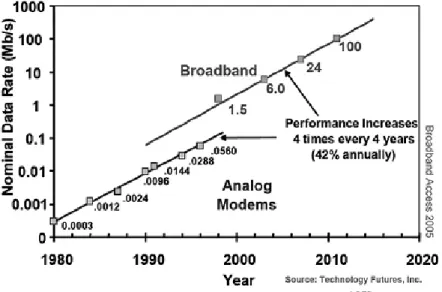
Figure 2.1: Evolution of bandwidth in access networks (Lee, et al., 2006) ...6
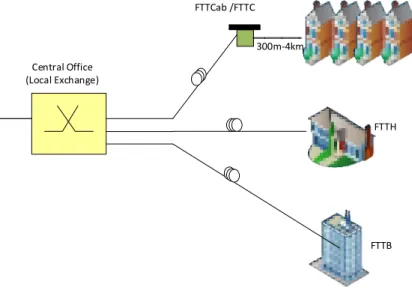
Figure 2.2: Point$to$Point Connected Optical Access Network...7
Figure 2.3: Active Star Connected Optical Access Network ...8
Figure 2.4: Passive Tree Connected Optical Network...9
Figure 2.5: Cost Comparison of Optical Access Network Types (Koonen, 2006) ...9
Figure 2.6: Time Division Multiple Access ...10
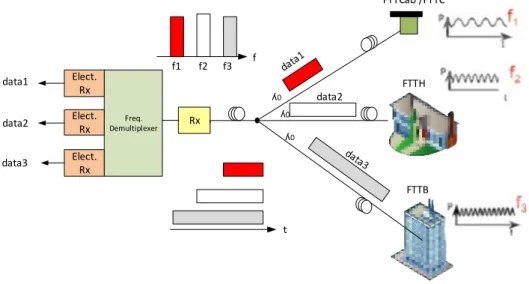
Figure 2.7: Subcarrier Multiple Access...11
Figure 2.8: Wavelength Division Multiple Access...12
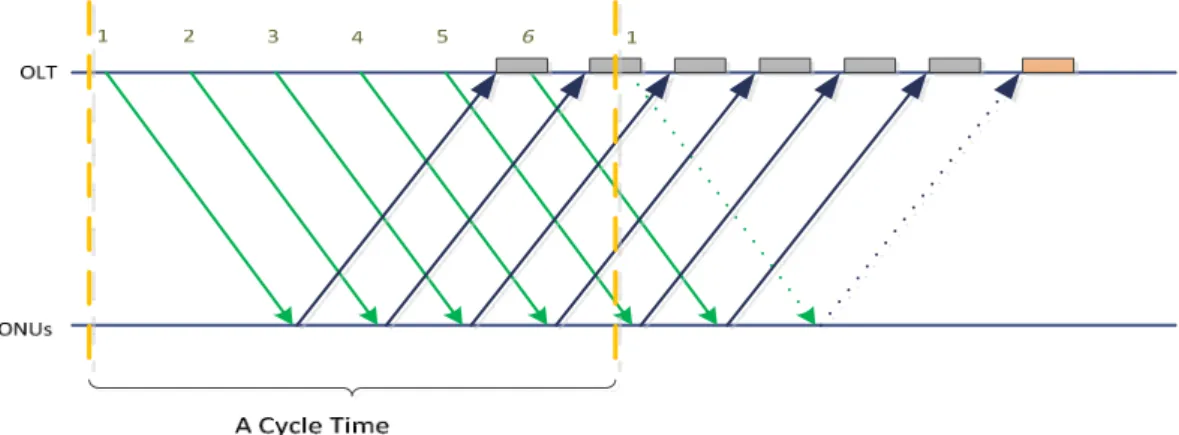
Figure 2.9: Working Scheme of MPCP (Zheng & Mouftah, 2009) ...17
Figure 3.1: Bandwidth allocation for upstream channel in Online DBA Algorithm ...24
Figure 3.2: Bandwidth allocation for upstream channel in Offline DBA Algorithm...25
Figure 3.3: Bandwidth allocation for upstream channel in offline part of hcDBA Algorithm...27
Figure 3.4: GATE Timer work flow in OLT ...28
Figure 3.5: Byte Loss Ratio with Mono$Service ...36
Figure 3.6: Byte Loss Ratio in Case1 and Case2 with Multi$Service...36
Figure 3.7: Mean Access Delay with Mono$Service...37
Figure 3.8: Mean Access Delay with Multi$Service ...38
Figure 3.9: Packet Delay Variations (PDV) (1 Gbps) ...39
Figure 3.10: Mean Access Delay with Mono$Service Traffic...40
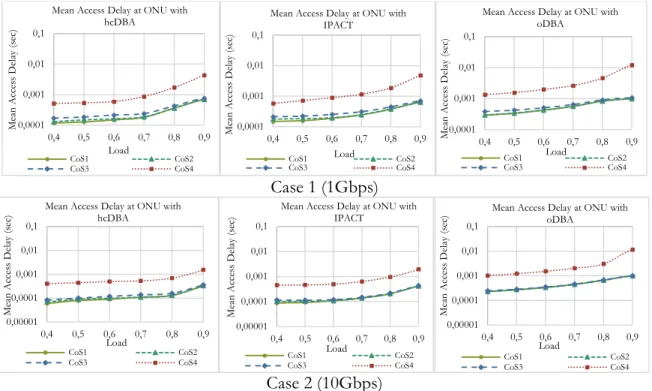
Figure 3.11: Mean Access Delay with Multi$Service Traffic (1 Gbps) ...41
Figure 3.12: Mean Access Delay with Multi$Service Traffic (10 Gbps)...41
Figure 4.1: EPON Upstream Path (Nguyen, 2010) ...45
Figure 4.2: IPACT Scheme ...46
Figure 4.3: Comparison of the self$similar Internet traffic (measured) with Poisson (Fowler, 1999) ...47
Figure 4.4: The histogram and log histogram of inter$arrival times of a Poisson process ...47
Figure 4.5: Inter arrival time distribution a1$a4: Poisson traffic, b1$b4: EPON upstream traffic, c1$c4: Self$similar traffic...51
XIV Figure 5.1: World Energy Consumption 1990 $2040 (U.S. Energy Information Administration,
2013)...54
Figure 5.2: Energy consumption of a typical telecommunication network (Mukherjee, 2011)...55
Figure 5.3: An example of the estimation of power consumption (Otaka, 2008) ...56
Figure 5.4: Fast Sleep Mode State Transitions (ITU$T, G.Sup45, 2009) ...57
Figure 5.5: Link aggregation in (a) standard operation and (b) energy$aware operation (Imaizumi, et al., 2009) ...59
Figure 5.6: Sleep control of EA. (a) Configuration. (b) State diagram (Shimazu, et al., 2010) ...59
Figure 5.7: Energy$efficient optical access by WDM$TDMA PON and wavelength routing technologies, with wavelength assignment for (a) high$traffic condition and (b) low$traffic condition. (Kani, 2013a)...60
Figure 5.8: Concept of Elastic OLT (Iiyama, et al., 2010) ...61
Figure 5.9: OLT with Optical Switches (Zhang, et al., 2011) ...61
Figure 5.10: General Architectural Design of OLT Couple with switch$box...64
Figure 5.11: Finite State Machine of Transition between two modes in Control Plane...65
Figure 5.12: Control plane decision flow...66
Figure 5.13: Simulation environment ...67
Figure 5.14: Generated traffic example (Average data send – Timeline) 1s intervals, Average Load: 0.18 ...68
Figure 5.15: Generated traffic example (Average data send – Timeline) 1s intervals, Average Load: 0.38 ...68
Figure 5.16: Generated traffic example (bitrate histogram) 1s intervals, Average Load: 0.18 (a), 0.38 (b) ...69
Figure 5.17: Number of On$Off transition under different load experiments (St: 5 ms, Rt: 25 ms) ...70
Figure 5.18: Sleep Duration of OLT couple (St: 5 ms, Rt: 25 ms)...71
Figure 5.19: Sleep Duration of OLT couple (St: 5 ns, Rt: 5 ms) ...72
Figure 5.20: Average Access Delay Comparison (θ : 3 sec, St: 5 ms Rt: 25 ms)...73
Figure 5.21: Average Access Delay Comparison (θ: 10sec, St: 5ms Rt: 25ms)...73
Figure 5.22: Average Access Delay Comparison (θ: 3sec, St: 5ns Rt: 5ms)...74
Figure 5.23: Average Access Delay Comparison (θ: 10sec, St: 5ns Rt: 5ms) ...74
XV Table 2.1: Summary of EPON and 10G$EPON Protocols and Features (Gorshe & Mandin, 2009)
...18
Table 3.1: Parameter Definitions for p$hcDBA Algorithm ...32
Table 3.2: Traffic Distribution (Nguyen, et al., 2009)...33
Table 3.3: Simulation Parameters...34
Table 4.1: Simulation parameters for three different cases ...49
Table 4.2: Correlation values of Poisson traffic and EPON upstream traffic ...49
Table 5.1: Different types of sleep mode for a PON (Bokhari & Saengudomlert, 2013) ...58
XVII AES Advanced Encryption Standard
AON Active Optical Network APON ATM Passive Optical Network ATM Asynchronous Transfer Mode BMT Burst Mode Transceiver
BPON Broadband Passive Optical Network CapEx Capital Expenditures
CBR Constant Bit Rates
CSMA/CD Carrier Sense Multiple Access with Collision Detection DBA Dynamic Bandwidth Allocation
DSL Digital Subscriber Line
EBD Excess Bandwidth Distribution EDFA Erbium$Doped Fiber Amplifier EFM Ethernet in the First Mile EoD Education on Demand
EPON Ethernet Passive Optical Network FEC Forward Error Correction
FSAN The Full Service Access Network FTTB Fiber$to$the$Building
FTTC Fiber$to$the$Curb FTTH Fiber$to$the$Home
XVIII GFP Generic Framing Procedure
GPON Gigabit Passive Optical Network
hcDBA Half Cycling Dynamic Bandwidth Allocation HDTV High$Definition Television
IEEE Institute of Electrical and Electronics Engineers IPACT Interleaved Polling with Adaptive Cycle Time IPTV Internet Protocol Television
ITUAT International Telecommunications Union Telecommunication Standardization Sector
LAN Local Area Network MAC Media Access Control MAN Metropolitan Area Network MPCP Multi Point Control Protocol NS2 Network Simulator 2
OAM Operation Administration and Maintenance OCDMA Optical Code Division Multiple Access oDBA Offline Dynamic Bandwidth Allocation OLT Optical Line Terminal
ONU Optical Network Unit OpEx Operational Expenditures
pAhcDBA Half Cycling Dynamic Bandwidth Allocation with Prediction P2MP Point$to$Multi$Point
P2P Point$to$Point
PDV Packet Delay Variation PON Passive Optical Network PPBP Poisson Pareto Burst Process QoS Quality of Service
RTT Round Trip Time
SBA Static Bandwidth Allocation SCMA Subcarrier Multiple Access
XIX TACONT Transmission Container
TCO Total Cost Ownership
TDMA Time Division Multiple Access
TDMAPON Time Division Multiplexing – Passive Optical Network VDSL Very$High$Bit rate Digital Subscriber Line
VoD Video on Demand VoIP Voice over IP WAN Wide Area Network
WDMA Wavelength Division Multiple Access
1 Introduction
The advancements on information technology in recent 50 years have enormously increased. Telecommunication area covers pretty much of advancements on information technologies. Although the telecommunication infrastructure has been spread into our lives with telephony networks, they became diversified and enhanced by discovery of Internet, war and science oriented developments of countries. Nowadays, telecommunication technologies provide different services that vary from satellite technologies to data transfer via indoor electricity lines. Internet is the most important issue regarding current telecommunication infrastructures. Internet is a network of networks that acts as not only a single telecommunication infrastructure but also as a system that combines many independent telecommunication infrastructures. Internet has begun as a scientific study but now it has become a phenomenon that connects the world and has enormous affects such as even regime shifts. From a different point of view, internet has also caused revealing different areas such as service providers, operators, network hardware vendors etc. Internet’s commercial aspects also caused these actors to search for more customers and market. All of these advancements are triggered to search solutions to fulfill the increasing bandwidth demands and meet more customers with low budgets. Here optical networks distinguish as an optimal solution for problems such as increasing bandwidth demand and error$free transmission over long haul. Using optics in data communication is founded in 1965 and after in 80s it is used in long$haul communication systems. Today, optic fiber becomes indispensable for core and metropolitan network infrastructures. In 90s, bandwidth demand of end$users increased. This brings the idea of using optics in access networks as well. Today, most of the service provider infrastructures are based on optic solutions.
It is widely believed that a new video$centric world that will enable many new applications and opportunities is starting to be experienced. These opportunities will include services such as IPTV, video on demand (VoD), education on demand (EoD), HDTV, video conferencing, high$quality interactive$video gaming, and video surveillance. With the recent introduction of HD quality camcorders, it is becoming easier for consumers to generate high$bandwidth signals for upstream transmission (Lee, et al., 2006). These bandwidth hungry applications cause pressure on service providers to support more bandwidth in access networks.
Passive Optical Network (PON) seems to be the most promising solution for fix access network thanks to its cost$effective performance. PON gives the opportunity to serve more bandwidth to far distance compared to copper line access solutions (xDSL). Besides, PON is the economical solution among optical access solutions. PON needs fewer storage in central$office and less fiber planting compared to other optical fix access network solutions. Another point of interest for service providers is giving data, telephony and TV services on one medium (triple$play) where wavelength division multiplexing make it available to carry three services separately on single fiber to subscribers. As a result of these advantages of PON, it has been widely deployed to support broadband Internet, telephony and IPTV service.
PON uses a simple tree architecture where central$office unit (Optical Line Terminal – OLT) has one fiber interface to communicate with subscribers and other interfaces for control and backbone connections. The single fiber link from OLT connected with many subscribers unit (Optical Network Unit – ONU) by being divided with passive (no energy consuming) splitters. Owing to the tree architecture (by a result of passive splitter/couplers), data transmission in downstream accrues as broadcasting. In upstream direction, a multiple access technique has to run for sharing single fiber link to connect to central$office. PON performance is related to the link carry capacity and the bandwidth allocation scheme that is used to schedule each ONU. Today the released PON standard as Ethernet Passive Optical Network (EPON) and Gigabit Passive Optical Network (GPON) use Time Division Multiplexing (TDM) for scheduling downstream and Time Division Multiple Access (TDMA) for scheduling upstream usage. Both downstream and upstream schedule is controlled by OLT. A dynamic bandwidth allocation algorithm works on OLT for up/down channel bandwidth allocation. For a specific algorithm we cannot say that it is the perfect solution for channel utilization and performance. While some algorithms may perform a good channel utilization, they can suffer delay and fairness problems.
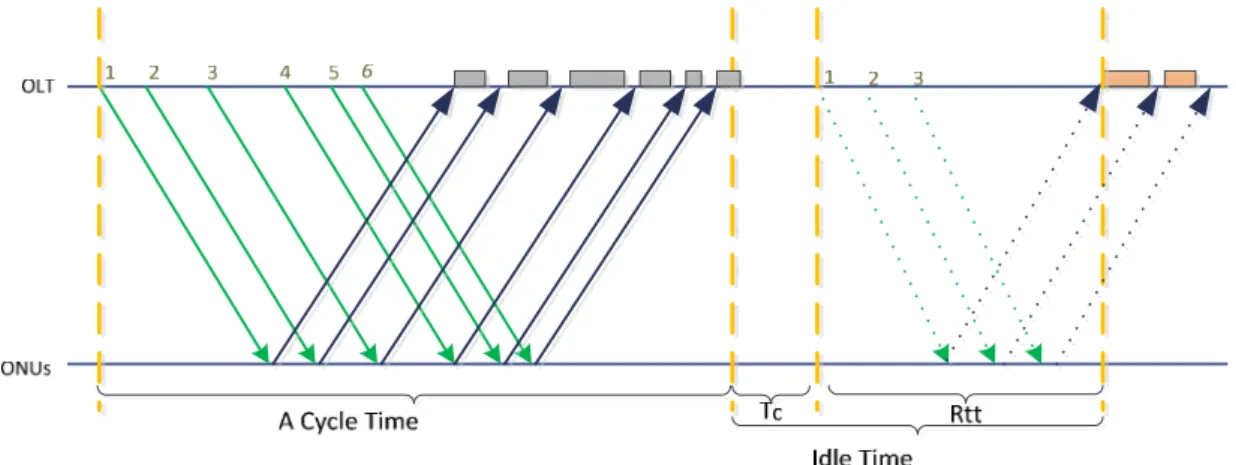
PON standards leave bandwidth allocation scheme as an open subject for implementers to make further developments available. The standards only figure out the messaging structure and general principles of bandwidth allocation scheme. For EPON, Multi Point Control Protocol (MPCP), which is placed in OLT, is responsible for the bandwidth allocation, signaling and new ONU registration. MPCP define two control packets GATE, and REPORT to negotiate with ONUs in scheduling the upstream bandwidth. Each upstream cycle OLT collects report messages and make bandwidth granting decisions for each ONU upstream. When and how long an ONU can use the upstream is informed by the gate message. OLT can send gate messages as soon as it receives a report (online scheme) or it can collects all the report messages before deciding and giving grants (offline scheme). Online scheme is an easy method to implement and has a good bandwidth utilization for efficient bandwidth allocation offline scheme where can be better to give fair allocation decisions.
Energy consumption is one of the crucial problems for future of globe. Global energy consumption is increasing day$by$day where fossil sources are diminishing. Thus, in the last decade, industry and academia tend to develop more energy effective products. Access networks consume 70 percentage of total energy used in telecommunication networks (Mukherjee, 2011). For the future projection, it seems that energy consumption in access networks still keeps its portion as a challenge. Besides being the most promising solution for future access networks, PON has a good manner in case of energy efficiency. An optical access network is not consist of just PON. It has
also other network equipment named as aggregation node (Ethernet Aggregation – EA) to connect multiple OLT cards to a single backbone connection. Thus, energy consumption in access network is handle from three different perspectives; (ONU side, OLT side, EA side). ONU side has the big portion of energy consumption because of the count of ONUs per PON. Thus, most of the energy efficiency methods in access networks are based on ONU enhancements. An ONU does not actively in use all the time under TDM scheme. Therefore, ONU can sleep in idle periods. ITU$T G.Sup45 recommendation describes four different power saving methods; power shedding, dozing, deep sleep, and fast/cyclic sleep for ONUs. To save energy on OLT side, some OLT can be powered off according to the traffic load. This process can cause data loss and derogation in service quality so can be acceptable only idle hours of the day (midnight). Also wavelength routing and some other techniques can be used to selectively close OLT cards. Similarly, EAs also can put into sleep when one EA can do the task of two or more EAs.
In the scope of this dissertation, we aim to provide an analysis of passive optical network standards. Classification, evolution and standardization procedures of optical access technologies are given. While bandwidth allocation has a major impact for PON performance the dynamic bandwidth allocation schemes for EPON are examined and a novel bandwidth allocation scheme based on combination of online and offline bandwidth allocation techniques is proposed. Afterwards, energy conservation in optical access networks are explored and an OLT based control plane proposed.
1.1 Objective
In the near future all fix access networks thought to be designed as sort of passive optical network (FttH, FttB, FttC, FttP …). PON’s performance and energy consumption is related to the development in optic and electronic components used in ONU, OLT, EA, and amongst them. Besides it is highly effected by the bandwidth allocation, scheduling, buffering and processing methodologies. In this dissertation, as mentioned before dynamic bandwidth allocation in EPON and energy efficient working techniques are examined. Service quality is the key point for operators while choosing novel techniques. In the view of access solutions the key quality issues can be thought as access delay and drop values. Increasing the service quality with better bandwidth allocation scheme is one of the objective of this dissertation. On the other hand, in last decade energy$efficient design of electronic devices gets more attention for decreasing the global energy consumption. While PON has a great portion in energy consumption of telecommunication networks we aim to propose a contribution to decrease energy consumption for TDM$PON implementations. Energy efficiency on ONU side is highly studied in literature thus, we focused on energy conservation on OLT side of PON.
1.2 Organization of the thesis
Chapter 2 presents the general information on optical access networks. First the situation in access networks and necessity for optic solutions have figured out. After classification and cost of different optical access solutions are given. Then the promising architecture (passive tree architecture known as PON) has been investigated. PON has to use a multiple medium access
protocol for sharing single connection to OLT. Possible multiple access connection types thought on PON given in the following section. As a historical summary, evolution of PON is given. At the end of the chapter, standardization studies are summarized.
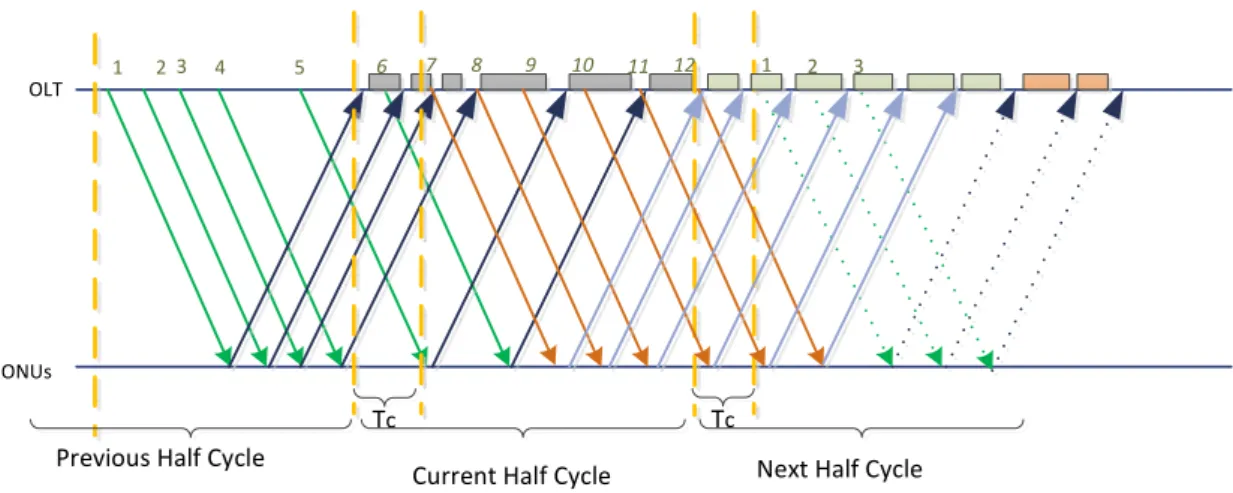
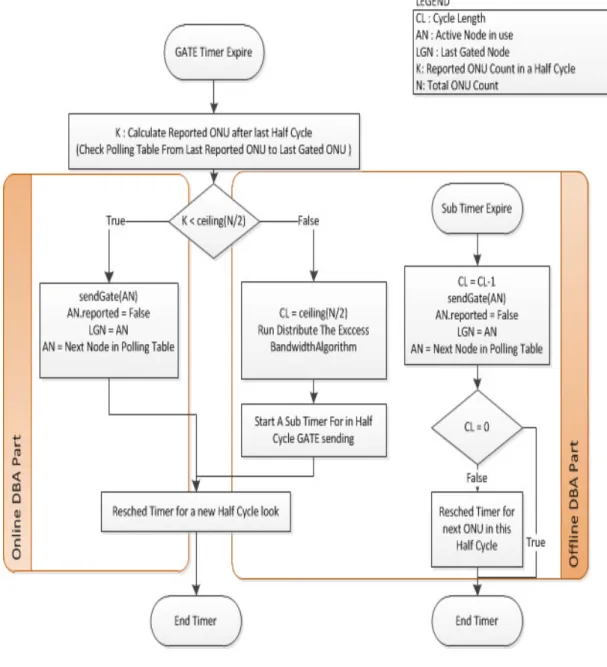
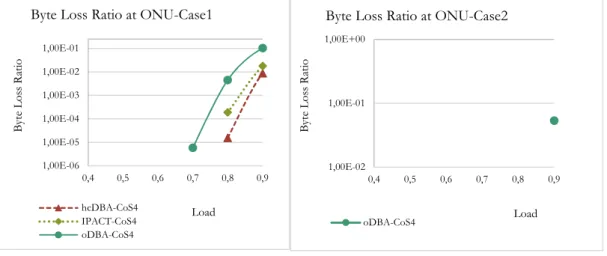
Dynamic bandwidth allocation algorithms are examined in chapter 3. After giving online and offline DBA schemes a novel DBA method named as hcDBA is presented. HcDBA uses positive characteristic of online and offline DBA schemes and tries to eliminate the drawbacks. Performance evaluation of hcDBA is given in case of access delay, byte loss and packet delay variation. An enhancement based on prediction for hcDBA is proposed and performance evaluation of prediction enhancement is examined.
Chapter 4 presents an investigation about the traffic characterization study on upstream of EPON with IPACT algorithm. The output traffic pattern from PON is investigated to decide which traffic generator can be selected for MAN traffic simulations.
Chapter 5 includes the energy$efficiency studies about optical access networks. Standardization works and other propositions in literature are summarized. The energy efficiency techniques divided three sub groups as ONU oriented, OLT oriented, and EA oriented. Where the standards and most of the investigations are based on ONU side. We propose a novel OLT based energy conservation technique. Two OLTs joint as a couple with dedicate connection for control messaging. A detailed control plane is shown for dynamic energy conservation behavior. According to the traffic load change system can put to sleep one of the OLTs. Energy conservation is directly related to the sleeping period of OLT. The performance evaluation how much one OLT can be kept in sleep and the access delay is examined by comparing to classic working access delays. The advantages of dynamic sleep scheme for OLT is given in the conclusion.
Chapter 6 includes the overall summary of the thesis and gives ideas and topics for future directions.
2 Passive Optical Networks Overview
Nowadays, optical technologies are widely used in all kind of telecommunication networks. Day$ by$day, the novel access network infrastructure implementations alter to fiber. Since, optics bring some sort of advantages that copper lines cannot supply as; long$haul reach, less effecting by environmental factors, this passing is proceeds fast.
There are different kinds of access network topologies which can be designed to serve subscribers. However, from the view of service provider, while making investments on new technologies one of the key point is to gain back as soon as possible. For a perfect service providing point$to$point fiber connection to each subscriber could be the best solution. However this is highly expensive in case of capital expenditures and operational expenditures. Passive Optical Network (PON) is accepted to be the promising solution for today and future needs. As it has used widely for today’s broadband internet access solutions.
PON has a tree topology where a shared medium consists. This medium has to be shared among subscribers. Multiple access methods are used for shared medium scheduling. Time Division and Wavelength Division multiple access methods are deployed in today PON solutions. APON BPON, GPON, EPON, 10GEPON, XGPON, NGPON, and so on are the standardizations. In this chapter the optical technologies used in access networks and their classification are given. After, most promising optical access solution; Passive Optical Network (PON) is widely examined. Multiple access techniques, optical components and standards are summarized.
2.1 Why to Pass Fiber Infrastructure in Access Networks?
In all over fix network solutions, the fastest way to carry data is using the fiber technology, which is based on using light spectrum. Theoretically it is possible to carry data at 20Tbps rate over one single fiber. However the capacity of a system is determined by the slowest equipment. Although, the bit rate drops down dramatically in optical systems because of the electronic equipment at the start and end point of the fiber line, using fiber transmission infrastructure is faster than twisted pair or coaxial approaches. It is well known that the conventional access networks based on twisted$pair copper cable have very limited bandwidth$distance products. At data rates of 100
Mb/s, the transmission distance is limited to about 100m and requires the use of highly sophisticated transmission technologies (Chrissan, 2004). To overcome this limitation, it is essential to use a carrier medium as single$mode optical fiber as the transmission media in future access networks. Single$mode fiber provides essentially unlimited transmission bandwidth over extremely long$haul.
Network systems that constitutes internet are discussed as hierarchical three structures. Backbone networks (WAN), metropolitan networks (MAN) and access networks. The usage of optical fibers and optical switching techniques dates back to years ago. The connection on access networks can be classified as wireless and fixed solutions. Twisted pair copper cables or coaxial lines have been used until recent years as transmission medium for fixed networks. These types of solutions have been used due to demand of service providers to employ existing telephony or cable TV networks for providing internet service. Twister pair copper cables have limited transmission capacity up to specific distances even if complex techniques are used. This causes a bottleneck for access networks on Internet against the data rate of WAN, MAN and LANs. This bottleneck is solved by migrating to optical technologies in access network. Figure 2.1 shows the average data transmission rates of access networks in history and projection for future.
Figure 2.1: Evolution of bandwidth in access networks (Lee, et al., 2006)
2.2 Classification of Optical Access Networks
2.2.1 Classification by EndAPoint
Optical access networks are also named as Fiber$to$the$… (FTTX) solutions where X refers to the end point of the fiber line. FTTH (Home), FTTB (Building, Business), FTTC (Curb, Cabinet), FTTP (Premises) are mostly used. The last letter just give information about the end point and is not related to the underlying structure of the optical access solution. FTTH means that the end point of the optical access network reach to the subscribers’ home. In FTTB, fiber line comes to a business location or building and subscribers are connected with LAN (mostly Ethernet) inside the building. Same for FTTC, in which the end point of fiber line deployed in a cabinet for one or a
number of streets and subscriber connections done with DSL or Cable Modem solutions. The major expense to pass fiber infrastructure is digging and ducking of the fiber line. For FTTH solution, 85% of installation cost is digging and ducking expense where the equipment cost is just 3% (Koonen, 2006). Thus, service providers try to use existing access solutions as much as possible. For green networking, the desired solution is (FTTH/P) where there will be no active element on the access network. For economic considerations, FTTH proliferation is limited. However, the final goal is to provide a fiber connection to each customer premise or home.
2.2.2 Classification by Infrastructure
For implementation of fiber lines, we can classify infrastructure models into three types as Point$ to$Point, Active Star, Passive Tree topologies. Some other topologies like ring and bus also can be used in optical access networks but they are not very common. Ring is mostly common in metropolitan networks and bus is common in local area networks.
2.2.2.1 PointAtoAPoint Architecture
Point$to$point working scheme is the idealist approach in terms of flexibility. All the connections are unshared by end$points like connection between backbone network routers. As shown in Figure 2.2, each subscriber unit is connected to the central office with a separate fiber line. Thus, users are completely isolated to each other and taking a service that is secure and insensitive to other’s traffic. Contrary, it requires digging and ducking of separated fiber lines and termination point for each fiber line inside the central office cabinet. These two conditions increase the setup expense of the system drastically. Consequently, the overall cost and the overall income from subscribers cannot be balanced to compete with other approaches and system can be profitable over a couple of years. Besides, the amount of ending points in central office are excessive and it brings stock problems.
Central Office (Local Exchange) FTTCab /FTTC FTTH FTTB 300m-4km
2.2.2.2 Active Star Architecture
In Figure 2.3, structure of Active Star Architecture is given. Contrary to point$to$point architecture, the network is connected to central office with a single fiber line. To reach each end point with a fiber, an active (power consuming) node is used between central office and end points. By the usage of active node the number of fiber line and termination points in central office are decreased by and the stock problem is solved. This approach decreases the setup cost of the system. Conversely, the active part of increase the operational cost of the system. On the whole lifetime the active node must be supplied with electricity, secured, and keep safe against natural disasters. Active star architecture is less flexible compared to point$to$point architecture. In active star the users have to share a single fiber after active node, so the bandwidth capacity is less than point$to$ point architecture. Since, it is a better alternative in terms of expenses it can be preferred to point$ to$point architecture. Networks have active star topology also named and known as Active Optical Networks (AON). Central Office (Local Exchange) FTTCab /FTTC FTTH FTTB 300m-4km Active Node
Figure 2.3: Active Star Connected Optical Access Network
2.2.2.3 Passive Tree Architecture
The aim on the development of passive tree connected network is to split up the light inside fiber without any active elements. By the development of passive optical splitters, necessity of active node in star architecture is eliminated. One fiber line starting from the central office is divided and shared with optical splitters among subscribers without any active element on the delivery line. This optical tree architecture is named as Passive Optical Network (PON). In Figure 2.4 a PON architecture is given. PONs have lower operational cost by eliminating the active part of AONs while having all the advantages that AON brings, compared to point$to$point architecture. The transmission on PON occurs purely in optical domain over the fiber and passive splitters. The beam goes through the shared medium and divided to all lines by passive splitters on the transmission from central office to the subscribers. End$point devices convert the beam signal to electronic domain and processed. The device filters the packets, which are destined to it, and forward them to the subscriber. In uplink, the packets are converted to beam signal and forwarded to the central office unit without any interrupt. The disadvantage of PON compared to AON is
just the number of users who can be connected. The reason is the going down of beam signal after passing through each splitter. The signal power must be over an energy level to be converted by the end$point device. This limitation is one of the main topics that researchers are studying on. Despite of this limitation, PON is the best solution regarding the expenses. Thus, PON becomes very popular in fix access solutions.
Central Office (Local Exchange) FTTCab /FTTC FTTH FTTB 300m-4km Optical Power Splitter/Combiner
Figure 2.4: Passive Tree Connected Optical Network
2.2.3 Comparison of Optical Access Network Topologies
Point$to$Point architecture seems to be acceptable in case of giving best service opportunity. However the economic aspects are on contrary. Figure 2.5 gives comparison of point$to$point and point$to$multi$point architecture expenses with two different number of customers connected to the system. P2P refers to Point$to$Point connection, P2MP as Point$to$Multi$Point and N1, N2are
the customer numbers where N2> N1. With less customer connections, P2P networks seems to
be suitable but this scenario becomes reversed as the length of line and/or number of customer increases. Total cost of P2P can be lower with less user and for a short range where L0is the point
the fiber length makes P2P undesirable compared to P2MP solutions. While the purpose of service providers is to access as much as customer and a long range cover, P2MP solutions perform better.
2.3 Multiple Access Methods Used in PONs
In PONs, it is requisite to use a multiple access method to share usage of one common fiber line among ONUs. While OLT is able to send the data as broadcast, ONUs have to be sure that the data packets they are sending not collide with others packets. The multiple access methods which are used for optical access solutions are given below and summarized after.
Time Division Multiple Access (TDMA) Subcarrier Multiple Access (SCMA)
Wavelength Division Multiple Access (WDMA) Optical Code Division Multiple Access (OCDMA)
2.3.1 Time Division Multiple Access (TDMA)
In TDMA systems, packets are scheduled by time slots on the upstream channel as seen in Figure 2.6. This can be achieved by packet transmission synchronization inside each ONU. Synchronization is done by sending grant information from OLT. These grant information tell each ONU the exact time to send packet. For each ONU, the correct time to send packet is calculated by distance discovery protocols according to the distance between OLT and ONU. Burst Mode Transceiver (BMT) is used in OLT to quickly synchronize packets form different ONUs and able to process different amplitude levels caused by the loss on the way. Since ONUs are sharing the common capacity given by OLT, if the number of ONUs increases the bandwidth amount of each ONU decreases.
FTTCab /FTTC FTTH FTTB t Rx data2 Time Division
Figure 2.6: Time Division Multiple Access
2.3.2 Subcarrier Multiple Access (SCMA)
In SCMA, each ONU modulates its traffic flow to a different electrical carrier frequency as seen in Figure 2.7. After, these electronic frequencies are modulated to optical power by laser diodes. Thus, the packet flows are put in different frequency bands and forwarded from ONUs to OLT through
independent channels. Therefore, different kinds of signals can be carried over independent channels (i.e. broadband data connection on one channel and analog video streaming on some others). There is no necessity of time synchronization among channels. The wavelength used by each ONU has no impact. However, if the chosen wavelengths are closed to each other, the optical impulse of different frequencies can produce noise to each other. This noise can affect the packet data. Thus to eliminate the noise, the laser wavelengths are chosen with some gaps. This can be achieved by thermal tuning of the emission wavelength.
Rx FTTCab /FTTC FTTH FTTB f f1 f2 f3 t Freq. Demultiplexer Elect. Rx Elect. Rx Elect. Rx data1 data2 data3 data2 ʎ0 ʎ0 ʎ0
Figure 2.7: Subcarrier Multiple Access
2.3.3 Wavelength Division Multiple Access (WDMA)
WDMA is seem to be a promising solution in optical access networks and this kind of implementation is called as Wavelength Division Multiplexing PON (WDM$PON). A sample WDM$PON is shown in Figure 2.8. In WDMA, each ONU use different wavelengths to send packets to OLT. Wavelengths are separated at the splitting points of PON systems with multiplexers/de$multiplexers. Since each wavelength is isolated from others, different type of traffic can be carried on WDM$PONs. Time synchronization is not necessary either. Same wavelength can be used both in upstream and downstream simultaneously. The isolation at the wavelength de$multiplexer must be capable of not allowing crosstalk. Because of the de$multiplexer at the splitting point of PON, systems that need broadcasting such as cable TV services are prevented to serve.
Each ONU needs a laser diode that is capable of working on a particular wavelength. This necessity makes the system more expensive, difficult to maintain and cause more storage problems. As an alternative method universal colorless ONUs can be used. By so, storage and cost problems can be decreased. Implementation of colorless ONUs can be achieved with different approaches. For example, a light source (i.e. Super luminescent LED) can be used that has used spectral slicing to cut unnecessary large spectrum with multiplexer inside ONU (Frigo, et al., 1998). Another approach is using reflection modulation that reuse the light comes from OLT on a suitable channel
to carry data on upstream channel (Frigo, et al., 1995). Thus, the light source is not necessary in ONUs so the cost can be decreased. In both approaches, going down of the reach distance is the limitation. Optical amplifiers can be used to overcome these problems.
FTTCab /FTTC FTTH FTTB WDM Mux ʎ ʎ1 ʎ2 ʎ3 t Rx Rx Rx data1 data2 data3 data2 ʎ1 ʎ2 ʎ3 WDM Demux
Figure 2.8: Wavelength Division Multiple Access
2.3.4 Optical Code Division Multiple Access (OCDMA)
In OCDMA, each ONU uses an optical code to separate itself from others. It can be categorized in two parts; time sliced code word using OCDMA and spectrum sliced code word using OCDMA. In time sliced OCDMA, each ONU uses a different signature array from short optic impulses and send this signature with data by on$off modulation. The array must be at least one bit length of data. Therefore, a very speedy signature array is needed for a moderate data flow rate. This situation degrade the reach range of system. OLT check the incoming signal with known signature arrays to recognize from which ONU it is coming. If the signature arrays are not orthogonal, crosstalk may occur.
In Spectrum Sliced OCDMA, each ONU takes a different spectrum slice combination from a wide band optical source (like LED) to modulate with data. If the spectral slices are not perfectly orthogonal, crosstalk may occur. A scenario where time and spectral slicing used can increase the number of reached ONUs (Adams, et al., 2005).
2.4 Evolution of Passive Optical Networks
In 1980, when the optic technologies is at the beginning of their evolution and just used in long haul communication systems, PON technology was introduced (Ballance, 1990) (Okada, et al., 1990). In this period, fiber has found lots of place in telecommunication companies’ core, backbone and metro networks. In 90s, the increase of bandwidth demand of end$users paves the way for using optical fiber lines to be used as an access network solution. This opened the way for the standardization studies. One of the main events for development of PONs is the foundation of “Full Service Access Network” (FSAN) working group (Faulkner, et al., 1997). At the start of its
study, FSAN group has decided to use PON topology and “Time Division Multiplexing/Multiple Access – TDM/TDMA” in access solutions. In 1996, FSAN consortium decided Asynchronous Transfer Mode (ATM) is the best encapsulation method in multi$service networks. This decision has formed the first PON standard. This standard has accepted and presented by ITU$T as a full recommendation letter under (ITU$T Rec. G.983.1, 2005). This first standard is known as ATM$ PON (APON).
Nippon Telegraph and Telephone (NTT) Company used APON to delivery broadband access on whole Japan. At this period, in USA some service providers perform limited experiments or deployments. Besides Verizon and Southwestern Bell Communications (SBC) (now part of AT&T) used APON in business approaches and improvements of cooper telephony systems. In this period APON seems to be expensive compared to novel SONET based platforms.
At the end of 90s, PON ripens as a mature technology to implement. However for the business especially in USA and Europe, PON applications were pushed back for reasons. First reason is that the capital expenditure is still too high for that day, second reason is the necessity of bandwidth supported by fiber lines is much higher than the demand, and third reason is the ambiguity in the industry as governments have not approved the standards. By this moment, cable TV systems are not capable to give three$play services. Thus service providers head towards to xDSL systems. There were a little exceptions like FTTC implementation for new buildings by Bellsouth Company (Effenberger, et al., 2007).
Since APON proved itself as an optimistic solution for access, its users (NTT and Bellsouth) have known that it is inadequate and has to be developed (Ueda, et al., 2001). As a result of that, Broadband PON (BPON) systems developed as an improvement to APON. BPON is developed by the requirement analysis of FSAN and written under ITU$T G.983 standards series. In this standard 622Mbps downlink and 155Mbps or 622Mbps uplink transmission speed. Each central office unit (Optical Line Terminal) has a reach up to 32 users at 20km. BPON also uses TDM mechanism and ATM packaging. Since, BPON seems an upgrade to APON and mostly call with the same name. BPON used by three companies (Bellsouth, SBC, and Verizon) in USA from 2003 to 2007.s
In March 2001, the working group 802.3 in IEEE consortium started 802.3ah “Ethernet in the First Mile” (EFM) project. The main aim is to use Ethernet frames in PON systems. IEEE adopted a technology based approach contrary to FSAN/ITU’s approach. The key idea is a PON system must use Ethernet frames from the connected local network with a small arrangement on packets. By this means EPON turns to the best access network solution to carry best$effort internet traffic. In June 2004, IEEE 802.3ah’s EPON standard is approved. EPON is standardized as capable to serve 16 ONU’s over 10$20km. EPON is commercialized by chance because of NTT’s need to struggle other service providers to give favorable bandwidth. Since, EPON gained much more interest in East Asia region (Shinohara & Manabe, 2006).
Meanwhile the EPON standard was developed, FSAN/ITU (ITU workgroup 15, SG15) were working on a novel PON standard (Next$Generation PON). First studies were on ATM structure, then Ethernet packaging was used. At last, physical layer packaging was adopted (like Generic Framing Procedure in SDH/SONET). This study was standardized under G.984 standard document and named as Gigabit$Capable PON (GPON). For transmission “Generic
Encapsulation Method” or “GPON Encapsulation Mode” (GEM) is used, and bandwidth capacity on downlink has increased 2,5Gbps and capacity on uplink to 1,25Gbps.
In 2007, IEEE 802.3av workgroup was founded to develop 10Gbps EPON (10G$EPON) systems. This work adopts two ideas such as; 10Gbps downlink with 10Gbps uplink capacity and 10Gbps downlink with 1Gbps uplink capacity working systems. They specify that asymmetric infrastructures are sufficient for near future needs. The desired use case is to support 10Gbps up/down symmetric capacity. 802.3av workgroup finalized their studies and published the standard in September 2009 (IEEE Standart For Information Technology 802.3av, 2009). In 10G$EPON wavelengths were selected to allow backward compatibility to allowing coexistence of 1G$EPON and RF Video transmission. Since 802.3av is working on 10G$EPON, FSAN group is working to develop their new standardization named as NG$PON (FSAN Group, 2009).
On the road of NG$PON, in 2010 ITU$T published next version of G$PON named as XG$PON (ITU$T Rec. G.987 series, 2010). XG$PON extends the G$PON standard as 10Gbps downstream and 2.5Gbps upstream capacities. It also allow coexistence with G$PON. XG$PON does not bring to much improvements in terms of split ratio and target distance. For these improvements, the next step is thought to include Wavelength Division Multiplexing (WDM) to go beyond XG$PON. This decision illustrates the NG$PON strategies. FSAN consortium is developing ideas on multiple enhancement systems. While XG$PON is suitable for backward compatibility, NG$PON seems to be unavailable for coexisting of old standards. In NG$PON,
Besides, ITU$T 15 and IEEE 802.3 working groups agreed to exchange the ideas for new PON standard development. This is expected to allow next generation products to work with less conformity problem (Effenberger & El$Bawab, 2009).
Wavelength Division Multiplexing Passive Optical Networks (WDM$PON) is seen to be solution for next generation access and backhaul networks. WDM$PONs have the advantages such as; scalable bandwidth, access to long$haul, ability to give different bandwidth capacity on different wavelength. These benefits make WDM$PON a suitable solution to use mutually for home, business access, and backhaul networks. Thus, WDM$PON is highly discussed in recent researches (Grobe & Elbers, 2009). Since home users do not need more than 1Gbps bandwidth capacity, WDM$PON systems are expensive solutions compared to EPON and GPON systems. Besides, wavelength division limits, obstruct the expansion. By sharing each wavelength among subscribers, the cost can be decreased and much more subscribers can be reached (as 1:500 division rates). These values can be available by using each wavelength by a number of subscribers (e.g. in a Dense$ Wavelength Division Multiplexing PON – DWDM$PON 40thwavelength each is separated as 1:8
or 1:16 ). By keeping the separation ratio lower than EPON$GPON values, the bandwidth given per user can be increased (Grobe & Elbers, 2009).
In Korea, between 2003 and 2006, ETRI and Novera developed wavelength division multiplexing PON systems that have 16 wavelengths and 1.25Gbps up/down link capacity. In 2007, Korea Telecom (KT) used first Burst Mode Transceiver (BMT) and in March 2008 second one was achieved. Since April 2008, KT uses the WDM$PONs developed by ETRI to give broadband access service. Besides, in Korea hybrid solutions such as WDM$TDM$PON and long$reach WDM$PON are under development with government supported projects (Nikitin, et al., 2009).
In 2012, GreenTouch consortium released Bit$Interleaved PON (GreenTouch Consortium, 2012). While it has the same equipment with XG$PON, the running protocol has changed. Bi$PON protocol is constructed on the fact that over %90 of the traffic processed in ONUs are unnecessary.
2.5 PON Standards
In this part some standardizations and their general working schemes are summarized. Generally there are two ongoing standardization branches for PON architecture. One of these branches is carried on by IEEE Ethernet in the First Mile Group (EPON, 10G$EPON) and the other one is carried on by International Telecommunication Union (Telecommunication) Study Group 15 (APON, BPON, GPON, XG$PON, NG$PON).
2.5.1 Ethernet Passive Optical Network (EPON)
EPON is a classical implementation for TDM$PON. It is defined in (IEEE 802.3ah, 2004) standardization document. While developing EPON, Ethernet in the First Mile (EFM) group decided that it is better to use Ethernet framing instead of ATM cells, which is used in APON. Since, most of the carried data is IP based, carrying IP data on ATM cells consumes time and power and brings unnecessary overhead because of the 5byte header for each 48byte data in ATM cells. EPON uses variable$size packets up to 1518 bytes according to the IEEE 802.3 protocol for Ethernet. In standard, an OLT can handle connections up to 64 ONUs.
EPON uses VoIP to carry voice traffic and circuit emulation services (CES) to carry all other types of traffic. CES, as its name implies, allows synchronous circuit traffics over asynchronous packet$ based networks. The primary benefits of CES over EPON are low cost and simplicity of deployment to support all types of legacy TDM applications across EPONs. While there is too much network equipment use legacy TDM and ATM based protocols, CES gives the opportunity to carry them over much more cost$effective packet$based networks.
2.5.1.1 Transmission in EPON
In EPON, upstream traffic from all ONUs share a fiber line to connect central office equipment (OLT). Thanks to the coupler behavior, traffic from the ONUs just forwarded to OLT. ONUs are unaware of upstream traffic of other ONUs, since other ONUs cannot listen upstream traffic. Conversely, classical collision resolution algorithms (i.e. Carrier Sense Multiple Access with Collision Detection CSMA/CD) cannot be used for multiple access. Because, when one ONU send data on upstream channel other ONUs cannot sense it and cannot predict the collisions at OLT. OLT can notify ONUs about the collisions with a control message. However such approach introduce to much delay to ONU$OLT transmission and that makes a huge derogation on system performance. Another solution may be using wavelength division multiplexing (WDM) to eliminate the collision of traffic form each ONU. This kind of EPON system is known as WDM$EPON. This approach needs tunable transmitter or a transmitter matrix capable to work with multi wavelengths in subscriber side. Tunable transmitter is an expensive solution and transmitter matrix has storage problems. Thus, WDM did not seem to be a promising solution (Zheng & Mouftah, 2009).
Compared to CSMA/CD and WDM approaches, time division multiplexing (TDM) that uses only one wavelength seemed to be a better solution for EPON development. In TDM, each ONU has to use the time slots arranged by OLT to send packets on upstream channel. Each time slot can carry one or more Ethernet packets. ONU collects the subscriber packets till a time slot has arrived. When the schedule comes to ONU it fill all the time slot with buffered client packets. Owing to the working principle of TDM, no collisions occur. Only one wavelength is used in OLT. So it is a favorable solution on the expenditure side (Zheng & Mouftah, 2009).
To make bandwidth allocation for each ONU, OLT needs a bandwidth allocation algorithm that collects bandwidth demands according to an allocation plan or service layer agreement (SLA). It is a challenge to find appropriate solution when and how much an ONU is going to use the upstream channel. This process generally named as bandwidth allocation and can be classified into two groups; static and dynamic. Static bandwidth allocation is simple and easy to implement. Each ONU uses a fix time slot for each cycle. However static allocation is not a good solution for bandwidth utilization for highly arbitrary internet traffic. The bandwidth requirement of an Internet user at time tis more than the request att1. In such a case static allocation cannot distribute the excess bandwidth. A smarter way is to allocate the bandwidth dynamically. Generally, the bandwidth allocation is done dynamically “Dynamic Bandwidth Allocation (DBA)”. DBA, gives the ability that OLT can grant different time slots for each ONU. In DBA, polling methods is often used for bandwidth allocation. By the use of polling OLT can dynamically allocate bandwidth to each ONU and can schedule many ONU communication properly. Thus, bandwidth utilization is highly increased and results increase in network performance (Zheng & Mouftah, 2009). Dynamic bandwidth allocation scheme for EPON is summarized in follows.
2.5.1.2 Dynamic Bandwidth Allocation in EPON
For EPON, lots of dynamic bandwidth allocation algorithms presented in recent studies are based on bandwidth utilization and QoS aware bandwidth sharing. When all the specifications are considered, a DBA algorithm cannot be perfect against others. Some algorithms can perform better in terms of QoS and fairness; while some others perform better in bandwidth utilization. Some algorithms can performs better but they may be complex for design and difficult to implement (Skubic, et al., 2009).
Interleaved Polling with Adaptive Cycle Time (IPACT) (Kramer, 2002a), is known as one of the best DBA algorithms in terms of the bandwidth utilization. In IPACT, while ONUi is sending packets to upstream channel, OLT is sending channel usage information (including the allocated bandwidth and when to start) to other ONUs starting form ONUi+1. ONUi+1can be scheduled beforeONUifinishes sending packet. This time slots are scheduled in a cycle for each ONU. Such that the first bit of upstream traffic fromONUi+1starts just the guard time afterONUitime slots lasts (Skubic, et al., 2009). DBA algorithms are analyzed in detail in next chapter.
2.5.1.3 Multi Point Control Protocol (MPCP)
In EPON, Multi Point Control Protocol (MPCP) works as Media Access Control (MAC) layer and is responsible of bandwidth allocation control, auto discovery, and distance computation. IEEE 802.3ah [IEEE Std. 802.3ah 2004] defines MPCP for OLT$ONU communication. MPCP contains five control message types. REGISTER REQ, REGISTER, and REGISTER ACK are used in new
ONU registration process. REPORT and GATE messages are for medium access control. REPORT message is used to report the packet tail inside ONU buffers to OLT. OLT arrange the bandwidth amount for each ONU by examining the report messages. Report messages can carry different fullness threshold value instead of full queue length information. GATE messages are sent from OLT to ONUs to give them non$overlapped windows.
Figure 2.9: Working Scheme of MPCP (Zheng & Mouftah, 2009)
In Figure 2.9 general working scheme of MPCP is shown. REPORT messages that carry queue fill amount information are sent to upstream channel, and GATE messages that carry granted window size are sent to downstream channel. OLT collects the occupancy of user queues by REPORT messages. After that OLT use a Medium Access Control (MAC) algorithm to make a decision for next cycle how much bandwidth will be granted for which ONU. After, this information forwarded to ONUs with GATE message.
2.5.2 Ten Gigabit Ethernet Passive Optical Network (10GAEPON)
The IEEE 802.3av Task Force, formed in September 2006, was chartered to improve upon the 1G$EPON by defining a set of new physical layers for 10G$EPON. Today’s new high bandwidth consuming applications such as IPTV, HDTV, 3DTV and Online video gaming need 50$100Mbps bandwidth per user which cannot be provided by EPON's 1Gbps capacity. 10G$EPON can provide much more bandwidth for FTTH, FTTB users and can fulfill the 1Gbps link capacity requirement for 4G wireless network access points. 10G$EPON uses most parts of the EPON protocol. For coexistence with EPON, combination of TDM and coarse wavelength division multiplexing (CWDM) is used. In the downstream direction the 1Gbps and 10Gbps channels are separated in wavelength domain. 1Gbps transmission limited to 1480$1500nm band and 10Gbps transmission using 1575$1580nm band. In the upstream direction, the 1Gbps and 10Gbps bands are overlapped. 1Gbps band spreads from 1260nm to 1360nm; 10 Gbps band uses 1260nm to 1280nm band. In 10G$EPON 10Gbps capacity is used in downstream; 1Gbps and 10Gbps capacities are available for upstream direction. For 10Gbps capable links 64B/66B block line code is used for 1Gbps it is same as EPON 6B/8B. 802.3av specification uses a split ratio as 1:16 or