
Copyright © 2016 European Crohn’s and Colitis Organisation (ECCO). Published by Oxford University Press. All rights reserved.
For permissions, please email: [email protected] 516
doi:10.1093/ecco-jcc/jjw008 Advance Access publication January 22, 2016 Original Article
Original Article
Anti-TNF Monotherapy for Crohn’s Disease: a
13-year Multicentre Experience
Laurent Peyrin-Biroulet,
aJulia Salleron,
bJérôme Filippi,
cCatherine Reenaers,
dOphélie Antunes,
cVirginie Filipe,
aEdouard Louis,
dXavier Hébuterne,
cXavier Roblin,
eaDepartment of Gastroenterology, Nancy University Hospital, Université de Lorraine, Nancy, France bDepartment of
Biostatistics, Institut de Cancérologie de Lorraine, Vandoeuvre les Nancy, France cInstitute for Research on Cancer and
Aging, Department of Gastroenterology & Nutrition, Hôpital de l’Archet, Nice, France dGastroenterology Department,
University of Liège, Liège, Belgium eGastroenterology Department, University Hospital of Saint-Etienne, Saint-Etienne, France
Corresponding author: Prof. Laurent Peyrin-Biroulet, MD, PhD, Inserm U954 and Department of Gastroenterology, Nancy University Hospital, Université de Lorraine, Nancy 1, France. Tel.: + 33 3 83 15 33 61; fax: + 33 3 83 15 36 33; email: [email protected]
Abstract
Background: Anti-tumour necrosis factor [TNF] therapy in combination with thiopurine is the most effective strategy for Crohn’s disease, but raises safety concerns.
Methods: In a retrospective multicentre study, we investigated long-term outcome of patients starting anti-TNF monotherapy for Crohn’s disease and investigated whether introducing an immunomodulator in patients losing response to anti-TNF monotherapy is effective for resetting immunogenicity. Results: A total of 350 adult patients with Crohn’s disease received either infliximab [n = 178,
51%] or adalimumab [n = 172, 49%] monotherapy. Mean duration of follow-up was 42 months. An immunomodulator was initiated in 53 patients [15%]. At last follow-up, 73.1% [n = 38] were in clinical remission [one patient with missing data]. Multivariate analysis identified anti-TNF type [higher need for starting immunomodulator for infliximab than for adalimumab; p = 0.0058] and first- vs second-/third-/fourth-line anti-TNF therapy [p = 0.014] as predictors of immunomodulator initiation. Among the 18 patients with available data, introduction of an immunomodulator was able to restore infliximab trough level within the therapeutic range and to induce clinical remission in 10 patients [55%]. Cumulative probability of remaining on anti-TNF therapy was 57.9% at 5 years among the 297 patients not starting an immunomodulator during follow-up.
Conclusion: An immunomodulator was initiated in 15% of patients with Crohn’s disease starting anti-TNF monotherapy. Independent predictors of immunomodulator initiation were infliximab use and second-/third-/fourth-line anti-TNF therapy. Resetting immunogenicity with an immunomodulator was effective in half of patients in a sub-study. Persistence of anti-TNF treatment at 5 years was observed in half of the 297 patients not starting an immumodulator in a real-life setting.
Key words: Infliximab; adalimumab; Crohn’s disease; anti-TNF monotherapy
1. Introduction
Crohn’s disease [CD] is a chronic disabling and progressive condi-tion.1 Anti-tumour necrosis factor [TNF] therapy is increasingly used
to treat inflammatory bowel disease [IBD] refractory to standard medications.2,3 The SONIC trial demonstrated that infliximab in com-bination therapy with azathioprine is the most effective strategy for CD.4 A SONIC-like trial is not available for other biologicals known
by guest on November 8, 2016
http://ecco-jcc.oxfordjournals.org/
to be effective in CD, namely adalimumab, certolizumab pegol, vedolizumab, and natalizumab. A recent French nationwide survey among private gastroenterologists found that the use of combination therapy is very low, representing only 4.5% of IBD patients in a real-life setting.5 This may be partly explained by safety concerns such as lymphoma risk associated with the use of combination therapy.6,7 By contrast, there is no increased risk of malignancy among IBD patients treated with anti-TNF monotherapy except for skin cancers.6,7
Anti-TNF monotherapy may be associated with a better safety profile than combination therapy, especially in some specific patient populations such as young males and elderly people.6,7
Accumulating evidence indicates that combination therapy reduces immunogenicity of anti-TNF therapy and improves trough levels in IBD patients.6,7 Interestingly, a recent pilot study suggested that the addition of an immunomodulator to anti-TNF therapy might be effec-tive in patients who have lost response to anti-TNF agents owing to formation of antidrug antibodies.8 Levels of antibodies to infliximab [ATI] gradually decreased while trough levels of infliximab [TRI] increased; clinical response was restored in all five included patients.8
We therefore evaluated in a large multicentre retrospective study, enrolling all consecutive adult patients who started anti-TNF mono-therapy for CD in four referral centres, the short- and long-term outcomes of these patients. We also investigated whether starting an immunomodulator among patients losing response to anti-TNF monotherapy could be used for resetting immunogenicity and improving pharmacokinetics without representing a loss of opportu-nity for these patients.
2. Methods
2.1. Study population
All consecutive adult patients treated between January 1, 2000 and March 16, 2013 in four referral centres (Nancy, Nice, and Saint-Etienne [France] and Liège [Belgium]) with anti-TNF monotherapy [infliximab or adalimumab] as a first-, second-, third- or fourth-line anti-TNF-therapy were included in this retrospective study. Patients receiving episodic anti-TNF treatment were excluded. Short-term efficacy of anti-TNF monotherapy was evaluated at Weeks 4–12 and was classified as no response, partial response, or complete response. Response was judged by the physician, as no clinical score is routinely used in any of the participating centres and as it was a retrospective study. Long-term efficacy was evaluated by record-ing anti-TNF persistence as well as clinical benefit at last known follow-up. The need for initiating an immunomodulator during follow-up was evaluated. All CD-related surgeries and hospitalisa-tions were collected. All adverse events occurring during follow-up were recorded.
In the subgroup of patients followed at Saint-Etienne University Hospital, TRI and ATI were measured according to routine practice in all patients losing clinical response to infliximab therapy [ELISA technique from Theradiag, Marne La Vallée, France]. Faecal calpro-tectin levels and Crohn’s Disease Activity Index [CDAI] scores were also collected in this centre according to routine practice. If patients had undetectable TRI with high ATI [> 200 ng/ml]9, azathioprine was then introduced [2.5mg/kg/d] without modification of inflixi-mab dose.
2.2. Statistical analysis
Qualitative variables were given as frequency and percentage. Quantitative variables were calculated as medians with interquartile range [IQR].
The cumulative incidences of optimising anti-TNF therapy, remaining on anti-TNF therapy and on combination therapy, start-ing an immunomodulator, and experiencstart-ing an adverse event related to the immunomodulator were calculated using the Kaplan-Meier estimator. When possible, the median survival time and its 95% con-fidence interval [95% CI] were computed.
Potential predictive factors of immunomodulator initiation were first tested by bivariate analyses using the Cox proportional hazards model. Parameters with a p-value less than 0.2 in bivariate analysis were introduced in a multivariate Cox proportional hazards model with backward selection. Results were expressed with hazard ratio and its 95% confidence interval [95% CI]. To investigate predic-tors of clinical remission after immunomodulatory introduction, uncontrolled disease and partial response were pooled and we used bivariate Cox proportional-hazards model. Univariate analysis was performed to identify independent predictors of clinical remission
Table 1. Demographic and baseline characteristics at anti- tumour
necrosis factor [TNF] monotherapy initiation.
Parameter N = 350
Age 35.2 [23.7;43.9]
Gender [male] 44.3% [155]
Active smoker 54.9% [162]
Duration of disease [years] 4.4 [1.5;12.1]
Number line of biological therapy
•1st line 68.6% [240]
•2nd line 29.1% [102]
•3rd line 2.0% [7]
•4th line 0.3% [1]
Age at diagnosis [years]a
•< 16 13.9% [47] •17–40 68.7% [233] •> 40 17.4% [59] Localisation of diseasea •Ileum: L1 36.6% [123] •Colon: L2 20.3% [70] •Ileocolon: L3 43.0% [148] Behavioura •Pure inflammatory: B1 57.7% [195] •Stricturing: B2 25.1% [85] •Penetrating: B3 17.2% [58] Perianal disease 39.0% [137]
Previous intestinal resection 33.1% [115]
Concomitant medications
•Oral 5-ASA 9.8% [34]
•Budesonide 8.7% [30]
•Systemic [oral or intravenous] steroids 23.3% [81]
•Ciclosporin 1.1% [4]
Indication of anti-TNF monotherapy initiation
•Complicated behaviour 34.6% [121] •Flare 13.1% [46] •Fistula 19.4% [68] •Stenosis 15.1% [53] •Prophylaxis 8.3% [29] •Manifestation extra-digestive 7.7% [27] •Steroid-dependent disease 16.9% [59] •Steroid-refractory disease 14.0% [49] •Immunosuppressicve therapy failure 26.3% [92] •Failure of a first anti-TNF therapy 12.6% [44]
Results are expressed as median [interquartile range] for quantitative pa-rameters and as percentage [frequency] for qualitative papa-rameters.
5-ASA, 5-aminosalicylic acid.
aAccording to the Montreal classification
by guest on November 8, 2016
http://ecco-jcc.oxfordjournals.org/
and pharmacokinetics normalisation after introduction of azathio-prine in the subgroup of patients with available information.
Data were analysed with SAS software version 9.2 [SAS Inc., Cary, NC 27513]. A p-value less than 0.05 was considered significant.
3. Results
3.1. Baseline characteristics of the 350 patients
The median duration of follow-up since anti-TNF monotherapy initiation for the overall population was 35 months [IQR: 18.3– 53.3] [Table 1]. Median age at anti-TNF monotherapy initiation was 32.2 years [23.7–43.9] and 155 patients were males [44.3%]. Median disease duration at time of anti-TNF monotherapy initia-tion was 4.4 years [1.5–12.1]; 240 patients [68.6%] started anti-TNF monotherapy as first-line anti-anti-TNF therapy; the remaining 110 patients started first-line anti-TNF therapy in association with an immunomodulator and received anti-TNF monotherapy as second-, third-, or fourth-line anti-TNF therapy. Anti-TNF monotherapy was infliximab [n = 178, 51%] or adalimumab [n = 172, 49%]. According to the Montreal classification, 126 [36.7%] patients had ileal disase [L1], 70 [20.3%] colonic disease [L2], and 148 [43.0%] ileocolonic disease. A total of 195 [57.7%] patients had uncompli-cated disease, 85 [25.1%] patients had stricturing behaviour, and 58 [17.1%] had penetrating behaviour. Of the 350 patients, 137 [39%] had perianal disease. One-third of patients had previous intestinal resection. About 10% of patients were on an oral 5-amon-isalicylate [5-ASA], 30 [8.7%] on budesonide, and 81 [23.3%] on systemic [oral or intravenous] steroids. The main indications of anti-TNF monotherapy were a complicated behaviour for 121 patients [34.6%], steroid-dependent or -refractory disease for 108 patients [31%], immunosuppressive therapy failure for 92 [26.3%], and fail-ure of a first anti-TNF therapy for 44 [12.6%] patients [Table 1].
3.2. Short-term clinical efficacy of anti-TNF monotherapy
Clinical efficacy as judged by the physician after anti-TNF induction therapy was observed in 94% of patients [complete response 65.7% and partial response 28.4%], and non-primary response in 6% of patients.
3.3. Long-term outcome of anti-TNF monotherapy Anti-TNF therapy optimisation [shortening interval and/or increas-ing the dose] was performed in 163 [47.8%; missincreas-ing data for 9 out of 350 patients] of 350 patients during follow-up. The cumulative probability of optimising anti-TNF therapy was 26.9% [95% CI: 22.4%; 32.1%] and 58.8% [51.8%; 65.9%] at 1 and 5 years, respec-tively [Supplementary Figure 1, available as Supplementary data at ECCO-JCC online]. Median time to optimisation was 47 months [28;56]. Of the 163 patients, 80% of patients shortened the inter-val between infliximab infusions or adalimumab injections, whereas 20% increased the dose of anti-TNF treatment.
After a median follow-up of 33 months [IQR: 17–52], 297 [85%] out of 350 patients did not require the introduction of an immu-nomodulator; 92 out of 297 patients stopped anti-TNF therapy during follow-up. Of these 92 patients, 42 [46.7%] were switched to another anti-TNF agent, 10 [11.1%] stopped when they under-went intestinal resection, 8 [8.9%] stopped while being in clinical benefit, and the 32 remaining patients for other reasons. The cumu-lative probability of remaining on anti-TNF therapy from time of anti-TNF monotherapy initiation for the 297 patients was 90.6% [86.0%;93.2%] and 57.9% [49.9%;64.9%] at 1 and 5 years, respectively [Figure 1]. At last follow-up, 75.4% [n = 215] of the
297 patients who did not start an immunomodulator were in clini-cal remission as judged by the physician, 16.8% [n = 48] had partial clinical response, and only 7.7% [n = 22] had uncontrolled disease.
1.0
0.8
0.6
Probability of remaining on anti-
TNF therapy 0.4 0.2 0.0 0 Patients at risk, n 297 231 153 106 62 37 18 12 24
Time since anti-TNF monotherapy initiation (months)
36 48 60 72
Censored
Figure 1. Cumulative probability of remaining on anti-tumour necrosis factor [TNF] therapy from time of anti-TNF monotherapy initiation in the 297 patients not
needing an immunomodulator during follow-up.
by guest on November 8, 2016
http://ecco-jcc.oxfordjournals.org/
3.4. Long-term outcome of the 53 patients starting an immunomodulator
After a median follow-up of 12.8 months [range, 4.5–30.1], an immunomodulator was initiated in 53 out of 350 patients [15%]: 33 [62%] with azathioprine and 20 [38%] with methotrexate. The cumulative probability of starting an immunomodulator was 7.1% [4.8%;10.5%] and 25.9% [19.5%;33.9%] at 1 and 5 years, respectively [Figure 2A]. At last follow-up, 28.9% of the 53 patients were still on combination therapy, 46.1% were on anti-TNF mono-therapy [and thus had stopped the immunomodulator], 9.6% were
on immunomodulator alone [and thus had stopped the anti-TNF agent], and 13.4% had stopped both anti-TNF therapy and immu-nomodulator. The probability of remaining on combination ther-apy [ie patients who stopped neither the anti-TNF agent nor the immunomodulator] from time of immunomodulator initiation for the 53 patients was 61.8% [46.3%; 73.9%] and 31.8% [17.1%; 47.6%] at 6 and 24 months, respectively [Figure 2B]. This prob-ability was 50.6% [30.3%; 74.8%] at 12 months for patients on methotrexate and 48.6% [31.5%; 68.9%] for patients on azathio-prine [p = 0.964]. Perianal disease was not predictive of remaining 1.0
A
B 0.8
0.6
Probability of starting an immunomodulator
0.4 0.2 0.0 0 Patients at risk, n 350 261 169 114 63 37 18 12 24
Time since anti-TNF monotherapy initiation (months)
36 48 60 72
Censored
1.0
0.8
0.6
Probability of remaining on combination therapy
0.4 0.2 0.0 0 Patients at risk, n 53 27 16 10 8 5 2 6 12
Time since immunomodulator initiation (months)
18 24 30 36
Censored
Figure 2. Panel A: Cumulative probability of starting an immunomodulator from time of anti- tumour necrosis factor [TNF] monotherapy initiation in the overall
population [n = 350]. Panel B: Cumulative probability of remaining on combination therapy from time of immunomodulator initiation in the 53 patients.
by guest on November 8, 2016
http://ecco-jcc.oxfordjournals.org/
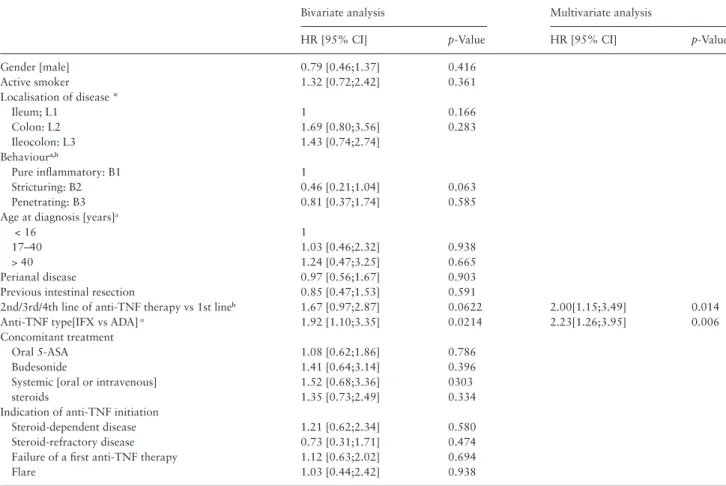
on combination therapy [p = 0.067]: 39.4% [21.0%; 65.4%] at 12 months for patients with perianal disease and 56.2% [38.4%; 79.6%] for patients with no perianal disease. The cumulative prob-ability of experiencing an adverse event related to immumodulator use from time of drug initiation was 17.4% [8.6%;33.3%] and 22% [11.3%;40.4%] at 6 and 12 months, respectively [Supplementary Figure 2, available as Supplementary data at ECCO-JCC online]. This cumulative probability was 5.6% [0.8%;33.4%] at 12 months for patients on methotrexate and 32.8% [16.5%;58.4%] for patients on azathioprine [p = 0.114]. At last follow-up, 13.5% [n = 7] had uncontrolled disease, 13.5% [n = 7] had partial response, and 73.1% [n = 38] were in clinical remission as judged by the physician [one patient with missing data at last follow-up]. In bivariate analysis, predictors of immunomodulator initiation were anti-TNF type [higher need for immunomodulator initiation for inf-liximab than for adalimumab; p = 0.02] and first- vs second-/third-/ fourth-line anti-TNF therapy [p = 0.06] [Table 2]. In multivariate analysis, both variables were statistically significant [p = 0.0058 and 0.014, respectively] [Table 2]. Predictors of clinical remission after immunomodulatory introduction are presented in Table 3. The type of immunomodulator was not a predictive factor of clinical remis-sion after immunomodulator introduction [p = 0.065, Table 3]. Two [10.5%] out of the 19 patients treated with methotrexate had uncontrolled disease (vs 15.1% [n = 5] of the 33 patients on aza-thioprine); 5.3% [n = 1] had partial response (vs 18.2% [n = 6]);
and 84.2% [n = 16] were in clinical remission (vs 66.7% [n = 22]) as judged by the physician.
Perianal disease was not a predictor of clinical remission at last follow-up after immunomodulator introduction [p = 0.065; table 3]: 9.5% [n = 2] of the 21 patients with perianal disease and available data at last follow-up had uncontrolled luminal disease at last follow-up (vs 16.1% [n = 5] of the 31 patients with no perianal disease), 14.3% [n = 3] had partial response (vs 12.9% [n = 4] in the no perianal dis-ease group), and 76.2% [n = 16] were in clinical remission (vs 71.0% [n = 22] in the no perianal disease group) as judged by the physician. 3.5. Resetting immunogenicity by adding
azathioprine in case of loss of response
Pharmacokinetics of infliximab after adding azathioprine in IBD patients who lost response and having undetectable TRI with very high ATI [> 200 ng/ml] were analysed. A total of 13 CD patients [mean age: 36 years, sex ratio 1] with available data could be ana-lysed. All 13 patients had permanent ATI defined by ATI > 200ng/ ml at two consecutive infliximab infusions. CDAI ranged between 150 and 300 and faecal calprotectin level 450 to 800 µg/g stools. The mean TRI increased at 6 months from 0.015 [0.01–0.02] to 0.9 [0.01–2.7] µg/ml [p = 0.01, Figure 3]. Conversely, mean ATI level decreased at 6 months from 320 [200–600] to 60 [10–500] [p = 0.01, Figure 4A]. For 7 out of 13 patients, the trough level
Table 2. Bivariate and multivariate analyses on predictors of immunomodulator initiation.
Bivariate analysis Multivariate analysis
HR [95% CI] p-Value HR [95% CI] p-Value
Gender [male] 0.79 [0.46;1.37] 0.416 Active smoker 1.32 [0.72;2.42] 0.361 Localisation of disease * Ileum; L1 1 0.166 Colon: L2 1.69 [0.80;3.56] 0.283 Ileocolon: L3 1.43 [0.74;2.74] Behavioura,b Pure inflammatory: B1 1 Stricturing: B2 0.46 [0.21;1.04] 0.063 Penetrating: B3 0.81 [0.37;1.74] 0.585
Age at diagnosis [years]a
< 16 1
17–40 1.03 [0.46;2.32] 0.938
> 40 1.24 [0.47;3.25] 0.665
Perianal disease 0.97 [0.56;1.67] 0.903
Previous intestinal resection 0.85 [0.47;1.53] 0.591
2nd/3rd/4th line of anti-TNF therapy vs 1st lineb 1.67 [0.97;2.87] 0.0622 2.00[1.15;3.49] 0.014
Anti-TNF type[IFX vs ADA] α 1.92 [1.10;3.35] 0.0214 2.23[1.26;3.95] 0.006
Concomitant treatment
Oral 5-ASA 1.08 [0.62;1.86] 0.786
Budesonide 1.41 [0.64;3.14] 0.396
Systemic [oral or intravenous] 1.52 [0.68;3.36] 0303
steroids 1.35 [0.73;2.49] 0.334
Indication of anti-TNF initiation
Steroid-dependent disease 1.21 [0.62;2.34] 0.580
Steroid-refractory disease 0.73 [0.31;1.71] 0.474
Failure of a first anti-TNF therapy 1.12 [0.63;2.02] 0.694
Flare 1.03 [0.44;2.42] 0.938
5-ASA, 5-aminosalicylic acid; IFX, infliximab; ADA, adalimumab; HR, hazard ratio. 95% CI, 95% confidence interval; TNF, tumour necrosis factor. aAccording to the Montreal classification.
bFactors introduced in multivariate analysis.
by guest on November 8, 2016
http://ecco-jcc.oxfordjournals.org/
of infliximab was within normal range at 6 months following ini-tiation of azathioprine [TRI > 1.5 µg/ml with ATI < 20 ng/ml] and all 7 patients were in clinical remission at 6 months [CDAI
< 150] [Figure 4B]. A biomarker remission [faecal calprotectin < 250 µg/g stools] was obtained at 4 months in 7 out of 13 patients [Supplementary Figure 3, available as Supplementary data at ECCO-JCC online] and all 7 patients also had trough level of infliximab within normal range. No factor at time of immu-nomodulator initiation [disease duration, C-reactive protein level, duration of infliximab therapy, previous use of an immunomodu-lator] was associated with clinical remission or pharmacokinet-ics normalisation [considered as resetting of immunogenicity] [data not shown]. A TRI ≥ 1 µg/ml at 4 months predicted clinical remission, biomarker remission, and normalisation of both TRI and ATI at 6 months with positive predictive value and nega-tive predicnega-tive value of 100%. Results were comparable to adali-mumab therapy. Five patients presenting loss of response under adalimumab maintenance therapy [40 mg every other week] and with undetectable TRA and positive antibodies to adalimumab were optimised with the addition of azathioprine. Three out of five patients were in clinical remission at 6 months [CDAI < 150], with biomarker remission [faecal calprotectin < 250 µg/g stools] and trough level of adalimumab within therapeutic range [TRA > 4.9 µg/ml].
3.6. Crohn’s disease-related surgeries and hospitalisations
Among the 350 patients, the cumulative probability of having intestinal resection was 6.2% [4.0%; 9.4%] and 24.9% [19.2%; 32.0%] at 1 and 5 years, respectively. Among the 350 patients, the cumulative probability of having at least one hospitalisation was 7.4% [4.9%; 10.8%] and 19.2% [13.9%; 26.6%] at 1 and 5 years, respectively.
3.7. Safety in the overall population [n = 350]
A total of 157 out of 350 patients [44.8%] experienced adverse events judged as possibly related to anti-TNF therapy during fol-low-up, with 30 serious adverse events [Table 4]. Of the 127 non-serious adverse events, 43 were infections, 11 allergic reactions, 13 psoriasiform lesions, 28 unspecific skin lesions, and 32 others; of the 30 serious adverse events, 7 were infections, 8 allergic reactions, 4 psoriasiform lesions, 2 unspecific skin lesions, and 9 others. No cancer or lymphoma was detected during follow-up. The cumulative
Table 3. Bivariate analysis on predictors of clinical remission after
immunomodulator introduction. Bivariate analysis HR [95% CI] p-Value Gender [male] 0.87 [0.45;1.68] 0.690 Active smoker 1.31 [0.62;2.77] 0.479 Disease locationa Ileum: L1 1 Colon: L2 1.55 [0.61;3.95] 0.359 Ileocolonic: L3 0.88 [0.39;1.96] 0.758 Behavioura,b Uncomplicated [B1] 1 Complicated [B2 + B3] 1.21 [0.59;2.48] 0.593 Age at diagnosis [years]a
< 16 1
17–40 1.07 [0.43;2.63] 0.890
> 40 1.25 [0.41;3.79] 0.689
Perianal disease 1.19 [0.61;2.34] 0.601
Previous intestinal resection 0.90 [0.45;1.80] 0.764 2nd/3rd/4th line of anti-TNF therapy vs
1st line α
1.67 [0.83;3.30] 0.148 Anti-TNF type [IFX vs ADA] α 0.60 [0.29;1.26] 0.178 Concomitant treatment
Oral 5-ASA 1.39 [0.61;3.22] 0.413
Budesonide 1.18 [0.48;2.88] 0.714
Systemic [oral or intravenous] 1.53 [0.76;30.7] 0.234
Steroids 1.54 [0.79;2.97] 0.205
IMM type [methotrexate vs azathioprine] 1.94 [0.96;3.92] 0.065 Time between anti-TNF therapy and
IMM introduction < 12 months vs > = 12 months
1.11 [0.56;2.34] 0.756
5-ASA, 5-aminosalicylic acid; IFX, infliximab; ADA, adalimumab; IMM, immunomodulatory; TNF, tumour necrosis factor; HR, hazard ratio; CI, con-fidence interval.
HR, hazard ratio. 95% CI, 95% confidence interval aAccording to the Montreal classification. bFactors included in multivariate analysis.
3
Infliximab trough level (µg/mL) 2 1 0 2,5 1,5 0,5 M0 M2 M4 M6
Figure 3. Infliximab trough levels [µg/ml] before start of azathioprine treatment at Month [M] 0 (mean: 0.015 [0.01–0.02]) and at 6 months (M6; mean: 0.9
[0.01–2.7]; p = 0.01) in 13 infliximab-treated patients.
by guest on November 8, 2016
http://ecco-jcc.oxfordjournals.org/
probability of experiencing at least one adverse event among the 350 patients was 25.4% [21.0%; 30.7%] and 43.7% [37.7%; 50.6%] at 1 and 5 years, respectively.
4. Discussion
This is the first study investigating the long-term efficacy and safety profile of anti-TNF monotherapy for CD. The SONIC trial clearly demonstrated that combination therapy is superior to anti-TNF monotherapy for maintaining steroid-free clinical remission at 6 months.4 However, several studies showed that combination ther-apy is associated with an increased risk of malignancies, particularly an increased risk of lymphoma.6,7 Importantly, this risk is known to be mainly driven by concomitant thiopurine use.6,7 By contrast, all available studies failed to identify an increased risk of malig-nancy among IBD patients treated with anti-TNF monotherapy.6,7 In this context, some physicians use anti-TNF as monotherapy in IBD patients, as demonstrated in a recent survey conducted among private gastroenterologists in France.5 Whether starting anti-TNF monotherapy should be considered as an option in clinical practice for CD patients is still a matter of debate.
We found that only 6% of patients were primary non-responders. This is consistent with data from a large observational study assessing Antibodies to infliximab level (ng/mL) 0 100 200 300 400 500 600 700 M0 M2 M4 M6 CDAI SCORE A B 0 100 50 150 200 250 300 350 M0
Infliximab trough levels > 1.5 with antibodies to infliximab < 20 (n=7)
M2 M4 M6
Figure 4. Panel A: Antibodies to infliximab [ng/ml] before start of azathioprine treatment at Month [M] 0 (mean: 320 [200–600]) and at 6 months (M6; mean: 60
[10–500]; p = 0.01) in 13 infliximab-treated patients. Panel B: Crohn’s Disease Activity Index [CDAI] scores before start of azathioprine treatment at Month [M] 0 and at 6 months [M6] in 13 infliximab-treated patients.
Table 4. Safety [%, n] in the overall population [n = 350].
Adverse events 44.8% [157]
Serious adverse events 8.6% [30]
-infections 23.3% [7]
-allergic reactions 26.7% [8]
-psoriasiform lesions 13.3% [4]
-unspecific skin lesions 6.7% [2]
-others 30.0% [9]
Non-serious adverse events 36.3% [127]
-infections 33.9% [43]
-allergic reactions 8.7% [11]
-psoriasiform lesions 10.2% [13]
-unspecific skin lesions 22.0% [28]
-others 25.2% [32]
by guest on November 8, 2016
http://ecco-jcc.oxfordjournals.org/
the long-term clinical benefit of infliximab in 614 consecutive patients with CD from a single centre during a median follow-up of 55 months and showing that 10.9% of patients were primary non-responders to infliximab.10 Our data indicate that in the short term, monotherapy with anti-TNF therapy is highly efficacious in CD in a real-life setting.
However, long-term data are needed to further evaluate whether some patients can be treated with anti-TNF therapy without need-ing a concomitant immunomodulator. We showed that only 15% of patients needed initiation of an immunomodulator during follow-up. Importantly, three-quarters of patients on anti-TNF monotherapy were in clinical remission as judged by the physician at last report, showing that most patients not needing an immunomodulator have long-term clinical benefit. In the overall population, the cumulative probability of having intestinal resection was 24.9% at 5 years and the cumulative probability of having at least one hospitalisation was 19.2% at 5 years. In a recent French observational study of a refer-ral-centre cohort, the cumulative probability of the first CD-related major abdominal surgery was 25.9% at 5 years.2 In CD, the annual incidence of hospitalisations was 20%.11 Loss of response is frequent with anti-TNF therapy in IBD.12,13 Consistently, we found that the cumulative probability of optimising anti-TNF therapy was 58.8% at 5 years. Overall, these findings indicate that starting with anti-TNF monotherapy does not seem to dramatically worsen disease outcomes.
Combination therapy reduces immunogenicity and increases anti-TNF trough levels.6,7 This likely contributes to the greater effi-cacy profile of combination therapy over anti-TNF monotherapy. Starting a concomitant immunomodulator while being on anti-TNF monotherapy is often perceived as a missed opportunity for these patients, as it might be too late to prevent immunogenicity. Preliminary findings suggest that this approach may be used for resetting immunogenicity in IBD patients on anti-TNF monotherapy losing drug response.8 However, this awaits confirmation in a larger series of patients. In our study, starting azathioprine treatment in case of loss of response to anti-TNF in 13 infliximab- and 5 adali-mumab-treated patients induced clinical remission, biomarker remis-sion, and normalisation of anti-TNF trough levels in 55% of patients at 6 months. It is noteworthy that one-quarter of patients starting an immunomodulator after initiation of anti-TNF monotherapy were still on combination therapy and three-quarters of these were in clinical remission at last follow-up. The safety profile of azathio-prine, when introduced after start of anti-TNF monotherapy, is con-sistent with previous reports on thiopurine in IBD. Overall, these results indicate that introduction of an immunomodulator could be considered in clinical practice among patients who lose response to anti-TNF monotherapy, as it may be efficacious in terms of clinical remission and improvement of pharmacokinetics profile.
Interestingly, independent predictors of immunomodulator ini-tiation were anti-TNF type [higher need for immunomodulator initiation for infliximab than for adalimumab] and first- vs sec-ond-/third-/fourth-line anti-TNF therapy in multivariate analysis. Recently, two meta-analyses showed that clinical remission rates at 6 months or 1 year were similar with adalimumab monotherapy and with combination therapy in CD.14,15 However, all monoclonal anti-bodies have the potential for immunogenicity. Furthermore, whereas combination therapy with infliximab is known to be more effective than infliximab monotherapy, no SONIC-like trial is available for adalimumab. The fact that first-line anti-TNF therapy was associ-ated with a lower need for combination therapy may only reflect more refractory disease.
Limitations of our study include the retrospective study design and the lack of evaluation of objective signs of inflammation
[C-reactive protein and endoscopy] due to missing data. We did not include a control group of patients receiving combination therapy as by definition this would lead to major bias due to uncontrolled study. However, there are several strengths. This is a large cohort of patients with CD [n = 350] treated over a 13-year period; large pharmacokinetics data after introduction of an immunomodulator were available in 18 patients; the mean duration of follow-up was 42 months; and it was a multicentre cohort study. Our findings were confirmed by other groups.16,17
In conclusion, an immunomodulator was initiated in 15% of patients with Crohn’s disease starting anti-TNF monotherapy. Independent predictors of immunomodulator initiation were infliximab use and second-/third-/fourth-line anti-TNF therapy. Resetting immunogenic-ity with an immunomodulator was effective in half of patients in a sub-study. Persistence of anti-TNF treatment at 5 years was observed in half of the 297 patients not starting an immumodulator during fol-low-up. Taken together, our findings indicate that some CD patients could remain on anti-TNF monotherapy in the long term, without rep-resenting a missed opportunity for these patients. This might improve the risk-benefit profile of current strategies based on a widespread and earlier use of biologicals in CD patients. Indeed, this may be a way to improve the long-term safety profile of anti-TNF agents by limiting the number of patients being exposed to combination therapy.
Conflict of Interest
LPB: consulting fees from Merck, Abbott, Janssen, Genentech, Mitsubishi, Ferring, Norgine, Tillots, Vifor, Shire, Therakos, Pharmacosmos, Pilège, BMS, UCB-pharma, Hospira, Celltrion, Takeda, Boerhinger-Ingelheim, Lilly, Pfizer; lec-ture fees from Merck, Abbott, Janssen, Ferring, Norgine, Tillots, Vifor, Therakos, HAC-pharma. XR: consulting and lecture fees from MSD, Abbvie, Hospira, Janssen, Pfizer, Takeda, Norgine, Ferring, HAC Pharma, Theradiag. JF: consult-ing fees from Abbvie, Astellas pharma, Janssen, Takeda; lecture fees from Abbvie, Chugaï pharma, Ferring, MSD, Norgine. XH: consulting fees from Abbvie, Baxter, Fresenius Kabi, Nestlé Health Sciences, Takeda; lecture fees from Abbvie, Mayoli-Spindler, MSD, Nestlé Health Sciences, Norgine, Nutricia, Takeda, Vifor. CR: consulting fees from Abbvie, MSD, Janssen; lectures fees from Abbvie, MSD, Roche, Takeda, Falk. EL; consulting and lecture fees from Abbvie and MSD.
Author Contributions
LPB, study design and concept, data interpretation, drafting of the manuscript; JS, data analysis and interpretation, critical review of the manuscript; JF, CR, OA, VF, EL, XH, data collection and critical review of the manuscript; XR, data interpretation, drafting of the manuscript.
Supplementary Data
Supplementary data are available at ECCO-JCC online.
References
1. Peyrin-Biroulet L, Cieza A, Sandborn WJ, et al.; International Programme to Develop New Indexes for Crohn’s Disease [IPNIC] group. Develop-ment of the first disability index for inflammatory bowel disease based on the international classification of functioning, disability and health. Gut 2012;61:241–7.
2. Peyrin-Biroulet L, Oussalah A, Williet N, Pillot C, Bresler L, Bigard MA. Impact of azathioprine and tumour necrosis factor antagonists on the need for surgery in newly diagnosed Crohn’s disease. Gut 2011;60:930–6. 3. Williet N, Pillot C, Oussalah A, et al. Incidence of and impact of
medi-cations on colectomy in newly diagnosed ulcerative colitis in the era of biologics. Inflamm Bowel Dis 2012;18:1641–6.
by guest on November 8, 2016
http://ecco-jcc.oxfordjournals.org/
4. Colombel JF, Sandborn WJ, Reinisch W, et al.; SONIC Study Group. Inf-liximab, azathioprine, or combination therapy for Crohn’s disease. N Engl
J Med 2010;362:1383–95.
5. Duchesne C, Faure P, Kohler F, et al.; CREGG [Club de Reflexion des cabinets et Groupes d’Hépato-Gastroentérologie]. Management of inflam- matory bowel disease in France: a nationwide survey among private gas-troenterologists. Dig Liver Dis 2014;46:675–81.
6. Dulai PS, Siegel CA, Peyrin-Biroulet L. Anti-tumor necrosis factor-α monotherapy vs combination therapy with an immunomodulator in IBD.
Gastroenterol Clin North Am 2014;43:441–56.
7. Dulai PS, Siegel CA, Colombel JF, Sandborn WJ, Peyrin-Biroulet L. System-atic review: monotherapy with antitumour necrosis factor α agents vs combi-nation therapy with an immunosuppressive for IBD. Gut 2014;63:1843–53. 8. Ben-Horin S, Waterman M, Kopylov U, et al. Addition of an immunomod-ulator to infliximab therapy eliminates antidrug antibodies in serum and restores clinical response of patients with inflammatory bowel disease.
Clin Gastroenterol Hepatol 2013;11:444–7.
9. Paul S, Del Tedesco E, Marotte H, Rinaudo-Gaujous M, Moreau A, Phelip JM, Genin C, Peyrin-Biroulet L, Roblin X. Therapeutic drug monitoring of infliximab and mucosal healing in inflammatory bowel disease: a prospec-tive study. Inflamm Bowel Dis 2013;19:2568–76.
10. Schnitzler F, Fidder H, Ferrante M, et al. Long-term outcome of treatment with infliximab in 614 patients with Crohn’s disease: results from a single-centre cohort. Gut 2009;58:492–500.
11. Peyrin-Biroulet L, Loftus EV Jr, Colombel JF, Sandborn WJ. The natu-ral history of adult Crohn’s disease in population-based cohorts. Am J
Gastroenterol 2010;105:289–97.
12. Gisbert JP, Panés J. Loss of response and requirement of infliximab dose intensification in Crohn’s disease: a review. Am J Gastroenterol 2009;104:760–7.
13. Billioud V, Sandborn WJ, Peyrin-Biroulet L. Loss of response and need for adalimumab dose intensification in Crohn’s disease: a systematic review.
Am J Gastroenterol 2011;106:674–84.
14. Kopylov U, Al-Taweel T, Yaghoobi M, et al. Adalimumab monother-apy vs combination thermonother-apy with immunomodulators in patients with Crohn’s disease: A systematic review and meta-analysis. J Crohns Colitis 2014;8:163241.
15. Jones J, Kaplan GG, Peyrin-Biroulet L, et al. Impact of Con-comitant Immunomodulator Treatment on Efficacy and Safety of Anti-TNF Therapy in Crohn’s Disease: A Meta-Analysis of Placebo Controlled Trials With Individual Patient-Level Data.
Gastroenterol-ogy 2013;144:S179.
16. Ong DE, Kamm MA, Hartono JL, Lust M. Addition of thiopurines can recap-ture response in patients with Crohn’s disease who have lost response to anti-tumor necrosis factor monotherapy. J Gastroenterol Hepatol 2013;28:1595–9. 17. Papamichael K, Karatzas P, Mantzaris GJ. Addition of an immunomodula-tor as a rescue therapy for loss of response to adalimumab dose escalation in patients with Crohn’s disease. J Crohns Colitis 2015;9:589–90.
by guest on November 8, 2016
http://ecco-jcc.oxfordjournals.org/
![Table 1. Demographic and baseline characteristics at anti- tumour necrosis factor [TNF] monotherapy initiation.](https://thumb-eu.123doks.com/thumbv2/123doknet/5672515.138022/2.918.471.819.405.1026/table-demographic-baseline-characteristics-tumour-necrosis-monotherapy-initiation.webp)
![Figure 1. Cumulative probability of remaining on anti-tumour necrosis factor [TNF] therapy from time of anti-TNF monotherapy initiation in the 297 patients not needing an immunomodulator during follow-up.](https://thumb-eu.123doks.com/thumbv2/123doknet/5672515.138022/3.918.221.700.700.1061/cumulative-probability-remaining-necrosis-monotherapy-initiation-patients-immunomodulator.webp)
![Figure 2. Panel A: Cumulative probability of starting an immunomodulator from time of anti- tumour necrosis factor [TNF] monotherapy initiation in the overall population [n = 350]](https://thumb-eu.123doks.com/thumbv2/123doknet/5672515.138022/4.918.208.716.263.1056/cumulative-probability-starting-immunomodulator-necrosis-monotherapy-initiation-population.webp)
![Figure 3. Infliximab trough levels [µg/ml] before start of azathioprine treatment at Month [M] 0 (mean: 0.015 [0.01–0.02]) and at 6 months (M6; mean: 0.9 [0.01–2.7]; p = 0.01) in 13 infliximab-treated patients.](https://thumb-eu.123doks.com/thumbv2/123doknet/5672515.138022/6.918.94.442.183.648/figure-infliximab-trough-azathioprine-treatment-infliximab-treated-patients.webp)
![Table 4. Safety [%, n] in the overall population [n = 350].](https://thumb-eu.123doks.com/thumbv2/123doknet/5672515.138022/7.918.95.446.814.1035/table-safety-n-overall-population-n.webp)
