Democratic and Popular Republic of Algeria
Ministry of Higher Education and Scientific Research
Ahmed Draia University - Adrar
Faculty of Science and Technology
Department of Mathematics and Computer Science
A Thesis Presented to Fulfil the Master’s Degree in Computer Science Option: Intelligent Systems.
Title:
Distributed Memory Bound Word
Counting For Large Corpora
Prepared by:
Bekraoui Mohamed Lamine & Sennoussi Fayssal Taqiy Eddine
Supervised by: Mr. Mediani Mohammed
In front of
President : CHOUGOEUR Djilali Examiner : OMARI Mohammed Examiner : BENATIALLAH Djelloul
II
years and its applications can be met in a wide range of areas. NLP tasks make the core of very popular services such as Google translation, recommendation systems of big commercial companies such Amazon, and even in the voice recognizers of the mobile world.
Nowadays, most of the NLP applications are data-based. Language data is used to estimate statistical models, which are then used in making predictions about new data which was probably never seen. In its simplest form, computing any statistical model will rely on the fundamental task of counting the small units constituting the data.
With the expansion of the Internet and its intrusion in all aspects of human life, the textual corpora became available in very large amounts. This high availability is very advantageous performance-wise, as it enlarges the coverage and makes the model more robust both to noise and unseen examples. On the other hand, training systems on large data quantities raises a new challenge to the hardware resources, as it is very likely that the model will not fit into main memory. This is where the external memory (disk) comes in handy.
The idea of exploiting the disks to hold parts of the data while working on other parts in main memory proved very useful in many NLP tasks. In particular, the tasks which may inflate the training data with combinatorial compositions, such as machine translation or language modelling. However, to the best of our knowledge, the solutions which exist for this purpose do not take full advantage of the parallel architectures which are very common nowadays. This work is an initial step towards combining parallelism with external memory in the n-gram counting task. We build our solution on top of the STXXL library, which gives access to many ready-to-use external memory data structures, while supporting parallelism in the IO level. We go a step further, by distributing the computation over many machines each of which runs the computation using multiple threads. The result is a highly parallel solution, which can perform counting on large datasets on limited resources hardware. Our solution can achieve up to 4 times speedup over a single unit-single disk solution.
To the best of our knowledge, software products which perform this task (e.g.KenLM) have the following limitations: assuming that the vocabulary is not larger than the ram, don’t support distributed parallelism and don’t support parallel disk model.
Our work some with the objective to overcome these limitations by indexing the text wish give us the ability to support large vocabulary , use STXXL wish give us the ability to support parallel disk model , use different component to support distributed parallelism.
This thesis describes the several performance techniques used to apply our solutions. Key words: Memory, NLP, STXXL, Corpora, disk
III
Le statistique Traitement Automatique de la Langue Naturelle (TALN) a connu un succès considérable au cours des dernières années et ses applications peuvent être satisfaites dans un large éventail de domaines. Tâches de la (TALN) font le noyau de services très populaires tels que la traduction Google, les systèmes de recommandation des grandes entreprises commerciales telles que Amazon, et même dans les connaisseurs de la voix du monde mobile. De nos jours, la plupart des applications (TALN) sont basées sur des données. Les données linguistiques sont utilisées pour estimer les modèles statistiques, qui sont ensuite utilisés pour faire des prédictions sur de nouvelles données qui n'ont probablement jamais été vues. Dans sa forme la plus simple, le calcul d'un modèle statistique reposera sur la tâche fondamentale de compter les petites unités constituant les données.
Avec l'expansion d'Internet et son intrusion dans tous les aspects de la vie humaine, les corpus textuels sont devenus disponibles en très grande quantité. Cette haute disponibilité est très avantageuse en termes de performances, car elle élargit la couverture et rend le modèle plus robuste à la fois pour le bruit et les exemples non vus. D'un autre côté, la formation de systèmes sur de grandes quantités de données soulève un nouveau défi pour les ressources matérielles, car il est très probable que le modèle ne rentrera pas dans la mémoire principale. C'est là que la mémoire externe (disque) est utile.
L'idée d'exploiter les disques pour conserver des parties des données tout en travaillant sur d'autres parties de la mémoire principale s'est avérée très utile dans de nombreuses tâches (TALN). En particulier, les tâches qui peuvent gonfler les données d'apprentissage avec des compositions combinatoires, telles que la traduction automatique ou la modélisation de langage. Cependant, à notre connaissance, les solutions qui existent à cet effet ne tirent pas pleinement parti des architectures parallèles qui sont très courantes de nos jours.
Ce travail est une première étape vers la combinaison du parallélisme avec la mémoire externe dans la tâche de comptage n-gramme. Nous construisons notre solution en se basant sur la bibliothèque STXXL, qui donne accès à de nombreuses structures de données de mémoire externe prêtes à l'emploi, tout en prenant en charge le parallélisme au niveau des E / S. Nous allons plus loin, en répartissant le calcul sur de nombreuses machines dont chacune exécute le calcul en utilisant plusieurs threads. Le résultat est une solution hautement parallèle, qui peut effectuer le comptage sur de grands ensembles de données sur du matériel à ressources limitées. Notre solution peut atteindre jusqu'à 4 fois l'accélération sur une seule unité de disque unique. À notre connaissance, les produits logiciels qui exécutent cette tâche (par exemple, KenLM) ont les limitations suivantes: le vocabulaire n'est pas plus grand que la RAM, ne supportant ni le parallélisme distribué, ni le modèle de disque parallèle.
Notre travail dans l'objectif de surmonter ces limitations en indexant le texte, nous permet de prendre en charge un large vocabulaire, l'utilisation de STXXL nous permet de prendre en charge des modèles de disques parallèles, d'utiliser différents composants pour supporter le parallélisme distribué.
Cette thèse décrit les différentes techniques de performance utilisées pour appliquer nos solutions.
IV ماھم نإ .تلااجملا ةغلل ةيللآا ةجلاعملا يھ ا ساسأ مجرت لثم ةياغلل ةروھشملا تامدخل ة 'لجوج' تاكرشلاب ةصاخلا ةيصوتلا ةمظنأو لا ةيراجتلا ىربك لثم ‘ 'نوزامأ ، ةلومحملا فتاوھلا ملاع يف توصلا ىلع فرعتلا ةزھجأ يف ىتحو . تقولا يف ،رضاحلا تاقيبطت مظعم ةغلل ةيللآا ةجلاعملا دمتعت جذامنلا ريدقتل ةغللا تانايب مادختسا متي .تانايبلا ىلع ا ،ةيئاصحلإ يتلاو ا تانايبلا لوح تاؤبنت ءارجإ يف كلذ دعب اھمادختسا متي طسبأ يف .اھتيؤر قبسي مل امبر يتلا ةديدجل تلااحلا ، دمتعي ح باس جذومن يأ يف ةلثمتملا ةيساسلأا ةمھملا ىلع يئاصحإ َدع تادحولا ةلكشملا لل تانايب . ةايحلا بناوج عيمج يف اھلخدتو تنرتنلإا يف عسوتلا عم ،ةيرشبلا اذھ .ادج ةريبك تايمكب ةحاتم صوصنلا تحبصأ ا ا مكل لئاھل وھ ش ديفم ءي ،ةياغلل ةوق رثكأ جذومنلا لعجيو ةيطغتلا عسوي هنلأ شيوشتلل ةمواقمو ةيحان نم .ةيئرملا ريغ ةلثملأاو ،ىرخأ ت هذھ هجاو ا ةمظنلأ يوتحت يتلا ىلع تانايبلا نم ةريبك تايمك اًديدج اًيدحت بساحلا زاھجلا يف ، بسانتي لاأ اًدج لمتحملا نم ثيح مجح جذومنلا رلا ةركاذلا عم .ةيسيئ و ھ ھا ان رود لعفُي (صرقلا) ةيجراخلا ةركاذلا . ل صارقلأا للاغتسا ةركف تتبثأ ضعب ظفح لأا ةيسيئرلا ةركاذلا يف ىرخأ ءازجأ ىلع لمعلا ءانثأ تانايبلا نم ءازج اھنأ فم يف ةياغلل ةدي م ديدعلا ن ةغللا ةجلاعم تاقيبطت هجو ىلع . ،صوصخلا خضت دق يتلا ماھملا بيردتلا تانايب م رتلا ةرثكل يك اب ت ، رتلا لثم وأ ةيللآا ةمج عمو .ةغللا ةجذمن ،كلذ دح ىلع ،انملع ةيزاوملا ىنبلا نم ةلماك ةدافتسا ديفتست لا ضرغلا اذھل ةدوجوملا لولحلا نإف لا ج ةعئاش يف اد رضاحلا تقولا . عم يزاوتلا نيب عمجلا وحن ىلوأ ةوطخ وھ لمعلا اذھ لامعتسا دع يف ةيجراخلا ةركاذلا ن) -(مارغ لحلا ينبن نحن ىلع ًادامتعا ةبتكم ) STXXL ( ، ةزھاجلا ةيجراخلا ةركاذلا تانايب لكايھ نم ديدعلا ىلإ لوصولا حيتت يتلاو ،مادختسلال ىوتسم يف يزاوتلا معد عم جارخلااو/لاخدلاا . مث ةوطخ بھذن ،ىرخأ اھنم لك ةزھجلأا نم ديدعلا ىلع باسحلا عيزوت للاخ نم مدختسي سحلا مادختساب با ةيونا ةددعتم (threads) م لح يھ ةجيتنلاو . ت ٍزاو ،ةياغلل ةزھجأ ىلع ةريبكلا تانايبلا تاعومجم ىلع دامتعلاا ىلإ يدؤي نأ نكمي يذلاو تاذ دراوم .ةدودحم هانمدق يذلا لحلا ققحي نأ نكمي ىلإ لصي ام انل 4 ةدحول دحاو لح ىلع ةعرسلا فاعضأ تاذ صرق دحاو . اًقفو عمل ،انتفر ةمھملا هذھ يدؤت يتلا ةيجمربلا تاجتنملا ) لثم KenLM ( ا اھيدل :ةيلاتلا دويقل ضارتفاب موقت ربكأ تسيل تادرفملا نأ نم لا ةركاذ ةيسيئرلا ، و معدت لا عيزوتلا لا م يزاوتملا صرقلا جذومن معدت لاو يزاوت . انلمع فدھي ىلع بلغتلل لح صنلا ةسرھف قيرط نع دويقلا هذھ م فدھب انحن معد ىلع ةردقلا تادرفم ادج ةريثك ، و ختسا انمد ) STXXL ( فدھب صرقلا جذومن معد ىلع ةردقلا انحنم ،يزاوتملا نع مادختساو ا فلتخم رص ة معدل عيزوتلا لا م يزاوت . ا هذھ فصت ةلاسرل نم ديدعلا لا تاينقت تاذ ءادلأا لاعفلا مدختسملا انلولح قيبطتل . :ةيسيئرلا تاملكلا ةجلاعم ،ةركذم _ اغللا ت _ ،ةيعيبطلا STXXL ، صوصنلا ، صرقلا .
V
Dedications
To My dear father the mercy of God, He took care of education and the reason for access to what I am now.
To my mother who has always encouraged us with her prayers, may God protect her and bring them good health and long life.
To my brother Abdelhamide who has always encouraged us and his wife Keltoume and little girl Firdousse.
To my sisters Fouzia and Fatima and Hanane and Nassira and little girl Souhila. To my dear parents with all my feelings of respect, gratitude and gratitude for
all the sacrifices made to raise me and to assure my education in the best conditions, that god gives them good health and long life.
A and all my friends and acquaintances. I dedicate this work.
VI
“Any accomplishment requires hard work and support, this project is no different”
Dedicated
To
My Mother
Who taught me to believe in Allah, and hard work but also to believe in myself. My Father
Who had been a source of motivation and inspiration.
Without forgetting my little sister and brothers, you are such pure souls that can lead a man to go further and achieve more. May god bless you as well as all the family.
I also express my gratitude to Mr. “MEDIANI Mohammed” for his guidance and encouragement in carrying out this project.
I humbly thank every person who believed in me, supported and encouraged me, as I dedicate this work to all students of “2nd Years Intelligent system
2017/2018 “
VII
First and foremost, we give our deep thanks to Allah for giving us the
opportunity and the strength to accomplish this work.
We would like to thank our supervisor Mr.Mediani Mohammed for his
help and support during our work for creating a research environment
that has been very inspiring. This work would not have been possible
without his guidance, encouragement and motivation. He deserves
our respect and thanks.
Our respect and gratitude to the members of the jury who made us the
honor of judging this work and their availability, observations and
reports that have enabled us to enrich our work.
Thanks to all the teachers of the faculty of Sciences and Engineering
Sciences.
I thank all my colleagues’ promotion 2017/2018.
All those who participated directly or indirectly to the realization of
this work.
VIII
ABSTRACT: ... II DEDICATIONS ... V ACKNOWLEDGEMENTS ... VII TABLE OF CONTENTS ... VIII LIST OF FIGURES ... X LIST OF TABLE ... X
CHAPTER 1: INTRODUCTION
1.1. INTRODUCTION ... 2
1.2.NATURAL LANGUAGE PROCESSING (NLP) ... 2
1.3.CORPORA IN NLP ... 4
1.4.SIZE OF DATA ... 6
1.5.RELATED WORK ... 10
1.6.EXTERNAL MEMORY FOR LARGE DATASETS ... 10
1.7.EXTERNAL SORTING ... 11
1.8.CONCLUSIONS ... 12
CHAPTER 2: STXXL 2.1 INTRODUCTION ... 14
2.2 I/O-EFFICIENT ALGORITHMS AND MODELS ... 15
2.2.1 ALGORITHM ENGINEERING FOR LARGE DATA SETS ... 17
2.2.2 C++ STANDARD TEMPLATE LIBRARY ... 17
2.2.3 THE GOALS OF STXXL ... 18
2.2.4 OVERVIEW ... 19
2.3 THE DESIGN OF THE STXXL LIBRARY ... 19
2.4 AIO LAYER ... 21
2.5 BM LAYER ... 21
2.6 STL-USER LAYER ... 21
2.6.1 VECTOR ... 22
2.6.2 STACK ... 22
2.6.3 QUEUE AND DEQUE ... 22
2.6.4 PRIORITY QUEUE ... 23
2.6.5 MAP ... 23
2.6.6 GENERAL ISSUES CONCERNING STXXL CONTAINERS ... 23
2.6.7 ALGORITHMS ... 24
2.7 PARALLEL DISK SORTING ... 24
IX 2.9 STREAMING LAYER ... 27 2.10 STXXL APPLICATIONS ... 28 2.11 CONCLUSION ... 28 CHAPTER 3 : IMPLEMENTATION 3.1 IMPLEMENTATION DETAIL ... 30
3.2 EXTERNAL DATA STRUCTURES ... 30
3.2.1 VOCABULARY INDEXING: ... 30
3.2.2 VECTOR POPULATING ... 32
3.2.3 VECTOR SORTING ... 33
3.2.4 COUNTING ... 34
3.3 PARALLEL COMPUTING ... 35
3.4 SHARED MEMORY PARALLELISM ... 35
3.5 ARCHITECTURE OF THE PROPOSED SYSTEM: ... 37
3.6 WORKING ENVIRONMENT: ... 37 3.6.1 HARDWARE ENVIRONMENT ... 37 3.6.2 CORPORA: ... 39 3.7 RESULTS ... 39 3.8 CONCLUSIONS ... 41 CHAPTER 4 CONCLUSIONS 4.1 CONCLUSIONS AND FUTURE WORK... 43
X
Figure 2.1 : Schemes of parallel disk model (left) and memory hierarchy (right). ... 15
Figure 2.2 : Structure of STXXL ... 20
Figure 3.1 : indexing process ... 31
Figure 3.2 : Berkeley DB structures used in the application and their interaction ... 32
Figure 3.3 : Presentation of the N-grams STXXL VECTOR ... 32
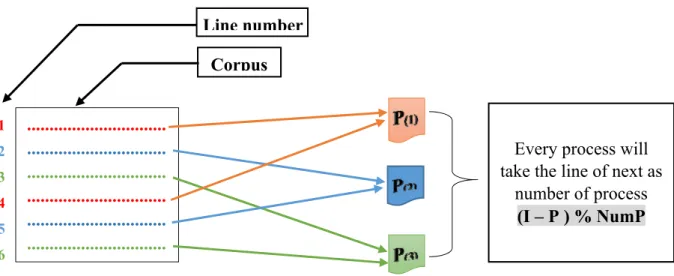
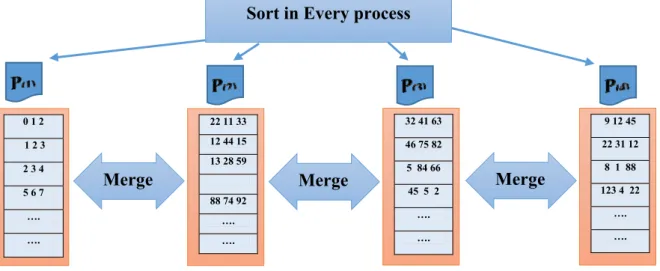
Figure 3.4 : this figure show how every process fill the n-gram vectors ... 33
Figure 3.5 : Distributed sort STXXL Sort ... 34
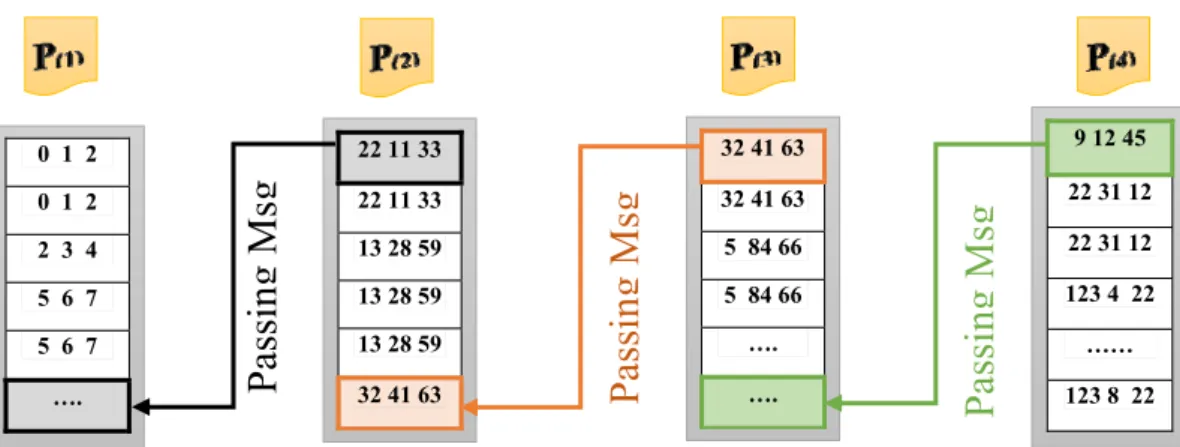
Figure 3.6 : Solution to the problem which arises after distributed sorting: The same n-gram may exist on two different units ... 35
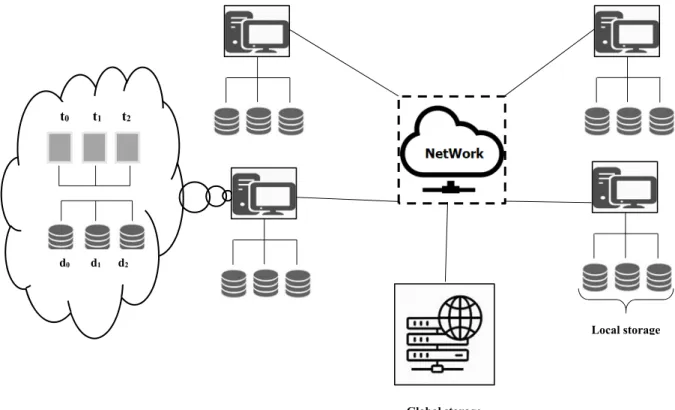
Figure 3.7 : Typical hardware setup of our system ... 36
Figure 3.8 : General scheme of our Counting system. ... 37
Figure 3.9 : work environment ... 38
List of Table:
Table 1.1 : Comparison of frequencies in a general and a specialised corpus. ... 6Table 3.1 : hardware properties ... 37
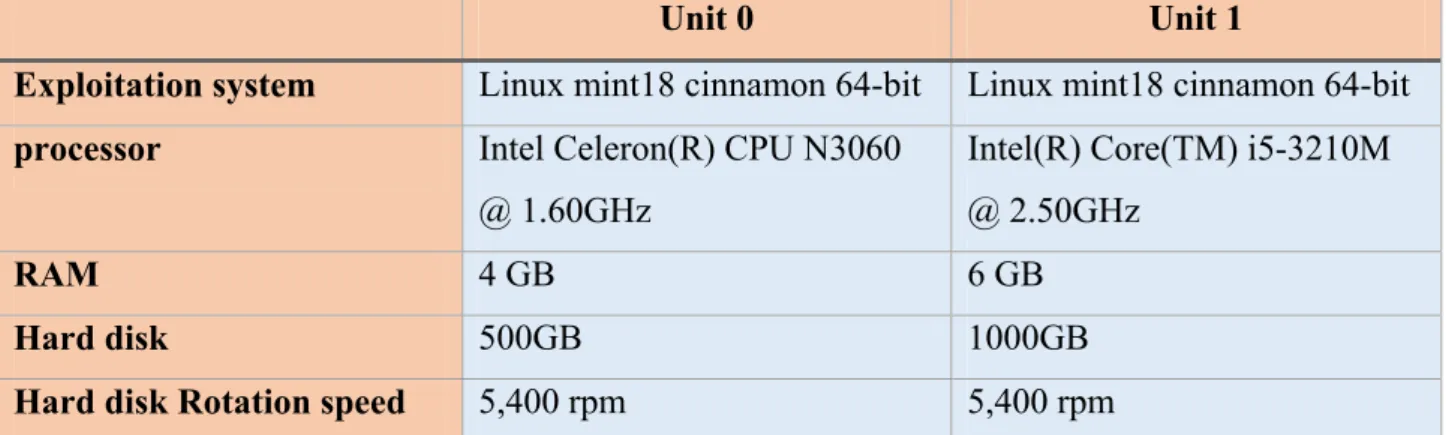
Table 3.2 : Disk properties ... 38
Table 3.3 : Table of our experimental result ... 40
XI NLP: Natural Language Processing
NLU: Natural Language Understanding PDM: Parallel Disk Model
STL: Standard Template Library
CGAL: Computational Geometry Algorithms Library TPIE: Tropical Plant International Expo
LEDA-SM: Extending LEDA to Secondary Memory LRU: Last Recently Used
DAG: directed acyclic graph POD: Plain Old Data type BFS: Breadth-first search MSD: Most Significant Digit
CHAPTER 1
2
1.1. Introduction
People communicate in many different ways: through speaking and listening, making gestures, using specialised hand signals (such as when driving or directing traffic), or through various forms of text.
By text we mean words that are written or printed on a flat surface (paper, card, street signs and so on) or displayed on a screen or electronic device in order to be read by their intended recipient (or by whoever happens to be passing by). Will a computer program ever be able to convert a piece of text into a programmer friendly data structure, which describes the meaning of the natural language text? Unfortunately, no consensus has emerged about the form or the existence of such a data structure. Until such fundamental Artificial Intelligence problems are resolved, computer scientists must settle for the reduced objective of extracting simpler representations that describe limited aspects of the textual information. These simpler representations are often motivated by specific applications, or by our belief that they capture something more general about natural language. They can describe syntactic information (e.g., part-of-speech tagging, chunking, and parsing) or semantic information (e.g., word-sense disambiguation, semantic role labelling, named entity extraction, and anaphora resolution). Text corpora have been manually annotated with such data structures in order to compare the performance of various systems. The availability of standard benchmarks has stimulated research in Natural Language Processing (NLP) and effective systems have been designed for all these tasks. Such systems are often viewed as software components for constructing real-world NLP solutions.
Natural language processing is important for different reasons to different people. For some, it offers the utility of automatically harvesting arbitrary bits of knowledge from vast information resources that have only recently emerged. To others, it is a laboratory for the investigation of the human use of language--a primary cognitive ability--and its relation to thought.[1]
1.2. Natural Language Processing (NLP)
Natural Language Processing is a theoretically motivated range of computational techniques for analysing and representing naturally occurring texts at one or more levels of linguistic analysis for the purpose of achieving human-like language processing for a range of tasks or applications.[2]
The goal of NLP is “to accomplish human-like language processing”. The choice of the word ‘processing’ is very deliberate, and should not be replaced with ‘understanding’. Although the
3
field of NLP was originally referred to as Natural Language Understanding (NLU) in the early days of AI, it is well agreed today that while the goal of NLP is true NLU, that goal has not yet been accomplished. A full NLU System would be able to:
1. Paraphrase an input text
2. Translate the text into another language
3. Answer questions about the contents of the text 4. Draw inferences from the text
While NLP has made serious inroads into accomplishing goals 1 to 3, the fact that NLP systems cannot, of themselves, draw inferences from text, NLU still remains the goal of NLP. There are more practical goals for NLP, many related to the particular application for which it is being utilized.[3] For example, an NLP-based IR system has the goal of providing more precise, complete information in response to a user’s real information need. The goal of the NLP system here is to represent the true meaning and intent of the user’s query, which can be expressed as naturally in everyday language as if they were speaking to a reference librarian. Also, the contents of the documents that are being searched will be represented at all their levels of meaning so that a true match between need and response can be found, no matter how either are expressed in their surface form.[4]
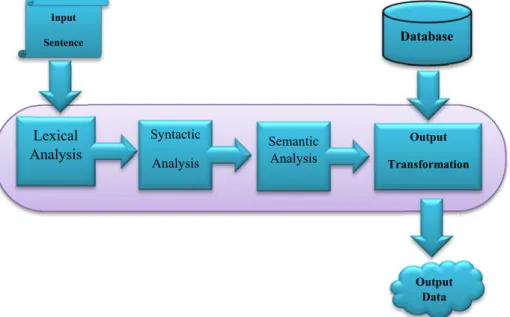
In the next figure we will show you the NLP steps:
Figure 1.1 : Natural Language Processing steps Lexical Analysis Syntactic Analysis Semantic Analysis Output Transformation Database Input Sentence Output Data
4
1.3. Corpora in NLP
Corpus linguistics, a branch of linguistics that deals with building corpora and investigation of their data, has already celebrated its 55th anniversary counting from the appearance of the Brown corpus. The idea of corpora that contain big data has attracted scholars’ attention for a long time. During the last decade more and more corpora are being compiled automatically. From traditional text collections they vary both in their volume and content. This is closely related to the growing availability of technical resources and thus the gradually changing paradigm in corpus linguistics moving forward from “manual” approach to more automatic one. By a classical or traditional approach one can understand a compilation of corpora based on a previously described methodology: selection of texts involving their representativeness and balance, their correction, annotation and upload. New corpora contain in general texts that were automatically crawled from the Web. Researchers find it attractive to make statistical inferences on increasingly larger scope of data.[5]
The first thing to do when we got access to a new corpus is to explore the content using some basic methods, typically by counting the words. We can find out which words are the most frequent in the corpus, and by ranking the words by corpus frequency we can study the distribution of the vocabulary of the corpus. By using normalized frequencies, we can make comparisons between different corpora. We can e.g., compare the vocabulary frequency distribution of English (British National Corpus), Swedish (Stockholm-Umeå Corpus), and Swedish Sign Language (Swedish Sign Language Corpus).[6]
By using basic corpus linguistic tools, either built-in web interface tools for corpora such as COCA or BNC, or software such as AntConc, we can also look at recurring sequences of words or signs, either as sequences of tokens (called n-grams) or as collocations.[7]
Starting with basic methods such as these, we can move on to study many aspects of language production using both quantitative and qualitative methods. However, there are limitations to what corpora can tell us.
• No negative evidence: just because a word or a sign does not occur in a corpus (however large and well balanced) does not mean that the word or sign never can occur in the language. However, a representative corpus can show us what is central and typical in a language. The findings of a study can tell us something about the subset of language that is included in that corpus, but not necessarily about language as a whole. However, if the corpus is
5
representative of the language we are interested in we can make careful generalizations about the language.
• A corpus can rarely provide explanations, and thus most corpus studies combine quantitative and qualitative work. Sometimes other methods, such as questionnaires, eye gaze or EEG experiments are better suited to answer a particular question. Sometimes a descriptive corpus study can give new ideas on what to look for using other methods.[8]
To summarize: make sure that you select the right corpus for your study, find out as much as you can about the corpus, take the characteristics and limitations of the corpus into account, and make careful generalizations!
Corpus analysis provides quantitative, reusable data, and an opportunity to test and challenge our ideas and intuitions about language. Further, analysis applied to corpora as transcriptions or other types of linguistic annotation can be checked for consistency and inter-annotator agreement, and the annotated corpus can be reviewed and reused by others.[9]
Corpora are essential in particular for the study of spoken and signed language: while written language can be studied by examining the text, speech, signs and gestures disappear when they have been produced and thus, we need multimodal corpora in order to study interactive face-to- face communication.[10]
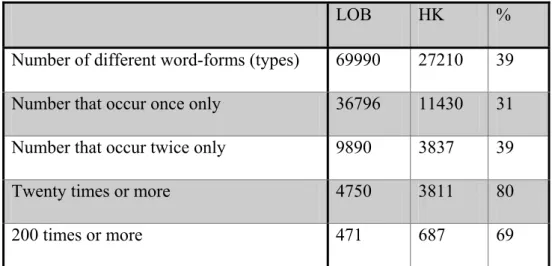
The proportions suggested above relate to the characteristics of general reference corpora, and they do not necessarily hold good for other kinds of corpus. For example, it is reasonable to suppose that a corpus that is specialised within a certain subject area will have a greater concentration of vocabulary than a broad-ranging corpus, and that is certainly the case of a corpus of the English of Computing Science (James et al 1994). It is a million words in length, and some comparisons with a general corpus of the same length (the LOB corpus) are given in Table 1 (the corpus of English of Computing Science is designated as 'HK').[11]
6
LOB HK %
Number of different word-forms (types) 69990 27210 39 Number that occur once only 36796 11430 31 Number that occur twice only 9890 3837 39
Twenty times or more 4750 3811 80
200 times or more 471 687 69
Table 1. 1 Comparison of frequencies in a general and a specialised corpus.
The number of different word forms, which is a rough estimate of the size of the vocabulary, is far less in the specialised text than it is in the general one — less than 40% of its size. The proportion of single occurrences is another indication of the spread of the vocabulary, and here the proportional difference between the two corpora is even greater, with the specialised corpus having only 31% of the total of the other corpus. Word forms which occur twice are also much less common in the specialised corpus, but the gap closes quite dramatically when we look at the figures for twenty occurrences. At a frequency of 200 and above the proportions are the other way round, and the general corpus has only 69% of the number of such words in the specialised corpus. Assuming that the distribution of the extremely common words is similar in the two corpora, these figures suggest that the specialised corpus highlights a small, probably technical vocabulary.[12]
This is only one example, but it is good news for builders of specialised corpora, in that not only are they likely to contain fewer words in all, but it seems as if the characteristic vocabulary of the special area is prominently featured in the frequency lists, and therefore that a much smaller corpus will be needed for typical studies than is needed for a general view of the language.[13]
1.4. Size of DATA
The minimum size of a corpus depends on two main factors: the kind of query that is anticipated from users, and the methodology they use to study the data.
There is no maximum size. We will begin with the kind of figures found in general reference corpora, but the principles are the same, no matter how large or small the corpus happens to be.
7
To relate the kind of query to the size of the corpus, it is best to start with a list of the "objects" that you intend to study; the usual objects are the physical word forms or objects created by tags, such as lemmas. Then try them out on one of the corpora that is easy to interrogate, such as the million-word corpora on the ICAME CD-ROM (Hofland 1999).[14] The Brown-group of corpora are helpful here, because they have been proof-read and tagged and edited over many years, and with a million words the sums are easy.
To illustrate how this can be done, let us take the simple case of a researcher wishing to investigate the vocabulary of a corpus. For any corpus one of the first and simplest queries is a list of word forms, which can be organised in frequency order. (NB word forms are not lemmas, where the various inflections of a "word" in the everyday sense are gathered together, but the message would not be much different with lemmas.[15]
The frequencies follow Zipf's Law (1935), which basically means that about half of them occur once only, a quarter twice only, and so on. So for the first million-word corpus of general written American English (the Brown corpus), there was a vocabulary of different word forms of 69002, of which 35065 occurred once only. At the other end of the frequency scale, the commonest word, the has a frequency of 69970, which is almost twice as common as the next one, of, at 36410.[16]
There is very little point in studying words with one occurrence, except in specialised research, for example authorship studies (Morton 1986). Recurrence — a frequency of two or more — is the minimum to establish a case for being an independent unit of the language; but only two occurrences will tell us very little indeed about the word. At this point the researcher must fix a minimum frequency below which the word form will not be the object of study. Let us suggest some outline figures that may guide practice. A word which is not specially ambiguous will require at least twenty instances for even an outline description of its behaviour to be compiled by trained lexicographers. But there are other factors to consider, the consequences of what seems to be a general point that alternatives — members of a set or system — are often not equally likely. The same tendency that we see in Zipf's Law is found in many other places in the numerical analysis of a corpus. Very often the main meaning or use or grammatical choice of a word is many times as frequent as the next one, and so on, so that twenty occurrences may be sufficient for the principal meaning of a word, while some quite familiar senses may occur only seldom. This applies also to frequent words which can have some important meanings or uses which are much less common than the principal ones. Word classes occur in very different
8
proportions, so if the word can be both noun and verb, the verb uses are likely to be swamped by the noun ones, and for the verb uses researchers often have recourse to a tagged corpus. In many grammatical systems one choice is nine times as common as the other, so that for every negative there are nine positives.[17]
So some additional leeway will have to be built in to cope with such contingencies. If the objects of study are lemmas rather than word forms, the picture is not very different. The minimum number of instances needed for a rough outline of usage will rise to an average of about fifty for English (but many more for highly inflected languages).[18]
If the research is about events which are more complicated than just word occurrence, then the estimate of a suitable corpus size will also get more complicated. For example if the research is about multi-word phrases, it must be remembered that the occurrence of two or more words together is inherently far rarer than either on its own. So if each of the two words in a minimal phrase occur 20 times in a million word corpus, for 20 instances of the two together the arithmetic suggests a corpus of approximately 5 billion words will be needed. For three words together of this frequency the size of the corpus could be beyond our imaginings.[19]
However, words do not occur according to the laws of chance, and if the phrases chosen are normal ones in the language, they will occur many times more often than the arithmetic projection above; so a much smaller corpus is likely to contain sufficient instances. To estimate roughly the size of a corpus for retrieval of a combination of two objects, first estimate the size you will need for the less common object on its own and then raise that figure by an order of magnitude. If there are 20 instances per million words for each of two words in a phrase, then twenty million words is likely to provide 20 instances of the pair (rather than the 5 billion projected by the arithmetic); if there are three of this frequency than 200 million words will probably be enough.[ 19]
These are the kinds of figures that you will need to use in estimates of your optimal corpus size. Now we must build in the considerations of the methodology that you intend to use, because this can have a dramatic effect on the size.[ 19]
The main methodological point is whether, having examined directly the initial results of corpus searches you intend to return to indirect methods and use the computer for further stages, recycling and refining early results6. If the latter, you will have to increase the minimum number of occurrences of your object quite substantially. This is because the regularities of occurrence that the machine will search for are not on the surface, and the way the computer
9
works is to examine the contexts minutely searching for frequently repeated patterns. Having found these it can then isolate instances of unusual and particular co-occurrences, which can either be discarded or studied separately after the main patterns have been described. For example, if the computer searches for the adjectives that come between in and trouble, in text sequence (Bank of English 17/10/04)[20] these are: ( Unspecified, terrible, deep, serious, Cuba, serious, serious, great...) .
It is reasonable already to anticipate that deep and serious are likely to be important recurrent collocates, but single instances of the others do not offer useful evidence. In fact unspecified does not recur, terrible is a good collocate, with 33 instances out of 1729. Deep is an important collocate with 251 instances, 14.5%, while Cuba is unique, serious is slightly greater than deep at 271. Great, on the other hand, scores merely 8. The next in sequence is big, which at 235 instances is up with deep and serious. As we examine more and more instances, these three adjectives gradually separate themselves from all the others because of the number of times they appear — in total (757), almost half of all the instances. The nearest contender is real, at 142 quite considerably less common, and after that financial at 113. The computer also records as significant collocates terrible (35), dire (31) and desperate (28); deeper (14), double (14), foul (11), bad (14), such (28), enough (17) and worse (11).[20]
The pure frequency picks out the three or four collocates that are closely associated with the phrase in trouble, and reference to the statistical test (here the t-score) adds another dozen or so adjectives which, while less common in the pattern are still significantly associated and add to the general gloom that surrounds the phrase. Single occurrences like unspecified and Cuba drop into obscurity, as do terminal (2) and severe (4), which occur among the first 30 instances. The density of the patterns of collocation is one of the determinants of the optimal size of a corpus. Other factors include the range of ambiguity of a word chosen, and sometimes its distribution among the corpus components.
If you intend to continue examining the first results using the computer, you will probably need several hundred instances of the simplest objects, so that the programs can penetrate below the surface variation and isolate the generalities. The more you can gather, the clearer and more accurate will be the picture that you get of the language.[21]
10
1.5. Related work
To the best of our knowledge, KenLM is the only public software which perform n-gram counting and language modelling using external memory. It was created to allow training very large language models on machines with limited memory resources. It computes the n-gram probabilities using an important number of sorting over the set of all n-grams.
KenLM defines a language model state object that speeds up the process of calculating language model probability. A state object consists of context words, back-offs and length. KenLM does use external memory for extract large corpora [22]. However, it doesn’t support the parallelism, neither on the disk level nor on the processing level. Moreover, it assumes that the underlying vocabulary fits into main memory. In this work, we try to perform the counting step without these assumptions. Furthermore, we support parallelism both on the disk level and on the processing level.
1.6. External Memory For large datasets
As, mentioned before, dealing with very large corpora imposes using external memory to hold parts of the dataset while the processor is busy treating the parts kept in memory. However, in such scenario, retrieving identical data chunks (as needed in counting) would be a very expensive operation. It is a common practice to sort the large dataset (of course with the help of the external memory), so that a simple scan over the data would solve the retrieval problem. We can’t sort 1TB of data with 1GB of RAM (i.e., more data than available memory) in main memory because main memory is volatile. We want data to be saved between runs, and the data size great than the memory size that is great then address space.
The typical storage hierarchy is : CPU Registers – temporary variables, Cache – Fast copies of frequently accessed memory locations (Cache and memory should indistinguishable), Main memory (RAM) for currently used “addressable” data, and Disk for the main “big data” (secondary storage).
Solution: Utilize an External Sorting Algorithm, External sorting refers to the sorting of a file that resides on secondary memory (e.g., disk, flash, etc) ,in other side Internal sorting refers to the sorting of an array of data that is in RAM .
11
Objective: Minimize number of I/O accesses, external Sorting is part of the Query Evaluation, optimization subsystem and efficient Sorting algorithms can speed up query evaluation plans (e.g., during joins) [23]
1.7. External sorting
External Sorting Many important sorting applications involve processing very large files, much too large to fit into the primary memory of any computer. Methods appropriate for such applications are called external methods, since they involve a large amount of processing external to the central processing unit. There are two major factors which make external algorithms quite different:
First, the cost of accessing an item is orders of magnitude greater than any bookkeeping or calculating costs. [24]
Second, over and above with this higher cost, there are severe restrictions on access, depending on the external storage medium used: for example, items on a magnetic tape can be accessed only in a sequential manner.
The wide variety of external storage device types and costs makes the development of external sorting methods very dependent on current technology. These methods can be complicated, and many parameters affect their performance: that a clever method might go unappreciated or unused because of a simple change in the technology is a definite possibility in external sorting. For this reason, only general methods will be considered rather than specific implementations. For external sorting, the "systems" aspect of the problem is certainly as important as the "algorithms" aspect. Both areas must be carefully considered if an effective external sort is to be developed. The primary costs in external sorting are for input-output. A good exercise for someone planning to implement an efficient program to sort a very large file is first to implement an efficient program to copy a large file, then (if that was too easy) implement an efficient program to reverse the order of the elements in a large file. The systems problems that arise in trying to solve these problems efficiently are similar to those that arise in external sorts. Permuting a large external file in any non-trivial way is about as difficult as sorting it, even though no key comparisons, etc. are required. In external sorting, we are concerned mainly with limiting the number of times each piece of data is moved between the external storage medium and the primary memory, and being sure that such transfers are done as efficiently as allowed by the available hardware. External sorting methods have been developed which are suitable
12
for the punched cards and paper tape of the past, the magnetic tapes and disks of the present, and emerging technologies such as bubble memories and videodisks. The essential differences among the various devices are the relative size and speed of available storage and the types of data access restrictions. We'll concentrate on basic methods for sorting on magnetic tape and disk because these devices are in widespread use and illustrate the two fundamentally different modes of access that characterize many external storage systems. Often, modern computer systems have a "storage hierarchy" of several progressively slower, cheaper, and larger memories. Many of the algorithms can be adapted to run well in such an environment, but we'll deal exclusively with "two-level" memory hierarchies consisting of main memory and disk or tape.[25]
1.8. Conclusions
This chapter describes an example of integration between big data and text analysis techniques that can provide inspiration for future research. The possibility of quickly extracting a (well- defined) selection of tweets and computing variables associated to them is a promising starting point for research.
Analysis techniques that do not require language resources, such as repeated segments detection and extraction of characteristic words, can be applied more straightforwardly as they do not pose limitations on the language to select. Among the resources that are more specific to text analysis the use of the positive-negative dictionary included in Taltac2 was particularly useful for classifying the mood of the text, especially in the presence of events of high media coverage and emotional impact.
The recognition of hashtags can be considered an added value also in the analysis of content and user profiles, for example analysing the number of “#” in a text or the way they are used (attached to words in the text or as separated tags). The same can be said about the use of other special characters, such as “@” for targeting other users or links to images and web pages. The results of the analysis are unavoidably influenced by the use of a geographical filter on the source. However, the concentration of major media and political influencers makes the selected sample highly representative for what concerns the different types of users in an explorative analysis. Nevertheless, future work could explore the effect of different or wider geographical selections of publication place. [26]
CHAPTER 2
STXXL
14
2.1 INTRODUCTION
Massive data sets arise naturally in many domains. Spatial data bases of geographic information systems like Google Earth and NASA’s World Wind store terabytes of geographically-referenced information that includes the whole Earth. In computer graphics one has to visualize highly complex scenes using only a conventional workstation with limited memory. Billing systems of telecommunication companies evaluate terabytes of phone call log files. One is interested in analysing huge network instances like a web graph or a phone call graph. Search engines like Google and Yahoo provide fast text search in their data bases indexing billions of web pages. A precise simulation of the Earth’s climate needs to manipulate with petabytes of data. These examples are only a sample of numerous applications which have to process vast amounts of data. [27]
The internal memories of computers can keep only a small fraction of these large data sets. During the processing the applications need to access the external memory (e. g. hard disks) very frequently. One such access can be about 106 times slower than a main memory access. Therefore, the disk accesses (I/Os) become the main bottleneck.
The data is stored on the magnetic surface of a hard disk that rotates 4200– 15000 times per minute. In order to read or write a designated track of data, the disk controller moves the read/write arm to the position of this track (seek latency). If only a part of the track is needed, there is an additional rotational delay. The total time for such a disk access is an average of 3– 10 ms for modern disks. The latency depends on the size and rotational speed of the disk and can hardly be reduced because of the mechanical nature of hard disk technology. After placing the read/write arm, the data is streamed at a high speed which is limited only by the surface data density and the bandwidth of the I/O interface. This speed is called sustained throughput and achieves up to 80 MByte/s nowadays. In order to amortize the high seek latency, one reads or writes the data in blocks. The block size is balanced when the seek latency is a fraction of the sustained transfer time for the block. Good results show blocks containing a full track. For older low density disks of the early 90’s the track capacities were about 16-64 KB. Nowadays, disk tracks have a capacity of several megabytes.
Operating systems implement the virtual memory mechanism that extends the working space for applications, mapping an external memory file (page/swap file) to virtual addresses. This idea supports the Random Access Machine model in which a program has an infinitely large main memory. With virtual memory the application does not know where its data is located: in
15
the main memory or in the swap file. This abstraction does not have large running time penalties for simple sequential access patterns: The operating system is even able to predict them and to load the data in ahead. For more complicated patterns these remedies are not useful and even counterproductive: the swap file is accessed very frequently; the executable code can be swapped out in favour of unnecessary data; the swap file is highly fragmented and thus many random I/O operations are needed even for scanning. [27]
2.2 I/O-efficient algorithms and models
The operating system cannot adapt to complicated access patterns of applications dealing with massive data sets. Therefore, there is a need of explicit handling of external memory accesses. The applications and their underlying algorithms and data structures should care about the pattern and the number of external memory accesses (I/Os) which they cause.
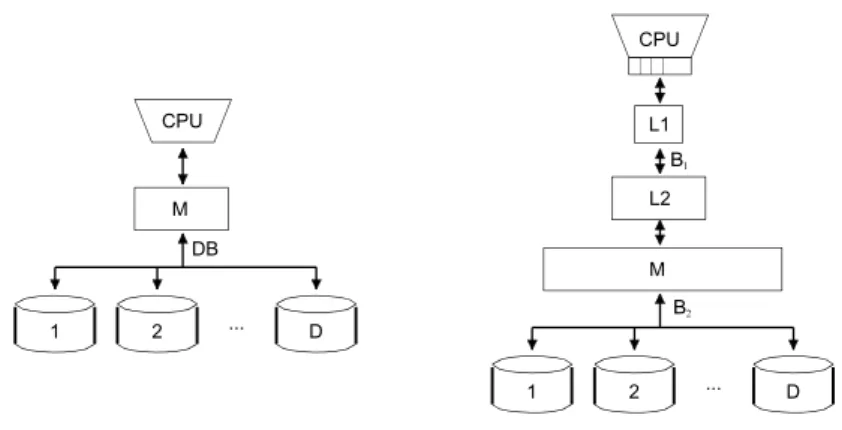
Several simple models have been introduced for designing I/O-efficient algorithms and data structures (also called external memory algorithms and data structures). The most popular and realistic model is the Parallel Disk Model (PDM) of Vitter and Shriver. In this model, I/Os are handled explicitly by the application. An I/O operation transfers a block of B consecutive elements from/to a disk to amortize the latency. [28]
Figure 2.1 Schemes of parallel disk model (left) and memory hierarchy (right). The application tries to transfer D blocks between the main memory of size M bytes and D independent disks in one I/O step to improve bandwidth, see Figure 1. The input size is N bytes which is (much) larger than M. The main complexity metrics of an I/O-efficient algorithm in PDM are the number of I/O steps (main metric) and the number of operations executed by the
M CPU DB 1 2 ... D L1 L2 M CPU 1 2 ... D
16
CPU. If not I/O but a slow internal CPU processing is the limiting factor of the performance of an application, we call such behaviour CPU-bound.
The PDM measures the transfers between the main memory and the hard disks, however, in modern architectures, the CPU does not access the main memory directly. There are a few levels of faster memory caches in-between (Figure 1): CPU registers, level one (L2), level two (L2) and even level three (L3) caches. The main memory is cheaper and slower than the caches. Cheap dynamic random access memory, used in the majority of computer systems, has an access latency up to 60 ns whereas L1 has a latency of less than a ns. However, for a streamed access a high bandwidth of several GByte/s can be achieved. The discrepancy between the speed of CPUs and the latency of the lower hierarchy levels grows very quickly: the speed of processors is improved by about 55 % yearly, the hard disk access latency only by 9 % . Therefore, the algorithms which are aware of the memory hierarchy will continue to benefit in the future and the development of such algorithms is an important trend in computer science. The PDM model only describes a single level in the hierarchy. An algorithm tuned to make a minimum number of I/Os between two particular levels could be I/O-inefficient on other levels. The cache-oblivious model in avoids this problem by not providing the knowledge of the block size B and main memory size M to the algorithm. The benefit of such an algorithm is that it is I/O-efficient on all levels of the memory hierarchy across many systems without fine tuning for any particular real machine parameters. Many basic algorithms and data structures have been designed for this model. A drawback of cache-oblivious algorithms playing a role in practice is that they are only asymptotically I/O-optimal. The constants hidden in the O-notation of their I/O-complexity are significantly larger than the constants of the corresponding I/O-efficient PDM algorithms (on a particular memory hierarchy level). For instance, a tuned cache-oblivious funnel sort implementation is 2.6–4.0 times slower than our I/O-efficient sorter from STXXL for out-of-memory inputs . A similar funnel sort implementation is up to two times slower than the I/O-efficient sorter from the TPIE library for large inputs. The reason for this is that these I/O-efficient sorters are highly optimized to minimize the number of transfers between the main memory and the hard disks where the imbalance in the access latency is the largest. Cache-oblivious implementations tend to lose on the inputs, exceeding the main memory size, because they do (a constant factor) more I/Os at the last level of memory hierarchy. In this paper we concentrate on extremely large out-of- memory inputs, therefore we will design and implement algorithms and data structures efficient in the PDM. [28]
17
2.2.1 Algorithm engineering for large data sets
Theoretically, I/O-efficient algorithms and data structures have been developed for many problem domains: graph algorithms, string processing, computational geometry, etc. (see the surveys). Some of them have been implemented: sorting, matrix multiplication, search trees, priority queues , text processing . However only few of the existing I/O-efficient algorithms have been studied experimentally. As new algorithmic results rely on previous ones, researchers, which would like to engineer practical implementations of their ideas and show the feasibility of external memory computation for the solved problem, need to invest much time in the careful design of unimplemented underlying external algorithms and data structures. Additionally, since I/O-efficient algorithms deal with hard disks, a good knowledge of low-level operating system issues is required when implementing details of I/O accesses and file system management. This delays the transfer of theoretical results into practical applications, which will have a tangible impact for industry. Therefore one of the primary goals of algorithm engineering for large data sets is to create software frameworks and libraries which handle both the low-level I/O details efficiently and in an abstract way, and provide well-engineered and robust implementations of basic external memory algorithms and data structures.[27]
2.2.2 C++ standard template library
The Standard Template Library (STL) is a C++ library which is included in every C++ compiler distribution. It provides basic data structures (called containers) and algorithms. STL containers are generic and can store any built-in or user data type that supports some elementary operations (e.g. copying and assignment). STL algorithms are not bound to a particular container: an algorithm can be applied to any container that supports the operations required for this algorithm (e.g. random access to its elements). This flexibility significantly reduces the complexity of the library.
STL is based on the C++ template mechanism. The flexibility is supported using compile-time polymorphism rather than the object oriented run-time polymorphism. The run-time polymorphism is implemented in languages like C++ with the help of virtual functions that usually cannot be inlined by C++ compilers. This results in a high per-element penalty of calling a virtual function. In contrast, modern C++ compilers minimize the abstraction penalty of STL inlining many functions.
18
STL containers include: std::vector (an unbounded array), std::priority queue, std::list, std::stack, std::deque, std::set, std::multiset (allows duplicate elements), std::map (allows mapping from one data item (a key) to another (a value)), std::multimap (allows duplicate keys), etc. Containers based on hashing (hash set, hash multiset, hash map and hash multimap) are not yet standardized and distributed as an STL extension.
Iterators are an important part of the STL library. An iterator is a kind of handle used to access items stored in data structures. Iterators offer the following operations: read/write the value pointed by the iterator, move to the next/previous element in the container, move by some number of elements forward/backward (random access). [28]
STL provides a large number of algorithms that perform scanning, searching and sorting. The implementations accept iterators that posses a certain set of operations described above. Thus, the STL algorithms will work on any container with iterators following the requirements. To achieve flexibility, STL algorithms are parameterized with objects, overloading the function operator (operator()). Such objects are called functors. A functor can, for instance, define the sorting order for the STL sorting algorithm or keep the state information in functions passed to other functions. Since the type of the functor is a template parameter of an STL algorithm, the function operator does not need to be virtual and can easily be inlined by the compiler, thus avoiding the function call costs.
The STL library is well accepted and its generic approach and principles are followed in other famous C++ libraries like Boost and CGAL. [28]
2.2.3 The goals of STXXL
Several external memory software library projects (LEDA-SM and TPIE) were started to reduce the gap between theory and practice in external memory computing. They offer frameworks which aim to speed up the process of implementing I/O-efficient algorithms, abstracting away the details of how I/O is performed.
The motivation for another project, namely STXXL, was that an easier to use and higher performance library was needed. Here are a number of key new or improved features of STXXL:
Transparent support of parallel disks. The library provides implementations of basic parallel disk algorithms. STXXL is the only external memory algorithm library supporting parallel disks. Such a feature was announced for TPIE in 1996.
19
The library is able to handle problems of a very large size (up to dozens of terabytes). Improved utilization of computer resources. STXXL explicit supports overlapping
between I/O and computation. STXXL implementations of external memory algorithms and data structures benefit from the overlapping of I/O and computation.
STXXL achieves small constant factors in I/O volume. In particular, “pipelining” can save more than half the number of I/Os performed by many algorithms.
Short development times due to well-known STL-compatible interfaces for external memory algorithms and data structures. STL algorithms can be directly applied to STXXL containers (code reuse); moreover, the I/O complexity of the algorithms remains optimal in most cases. [27]
2.2.4 Overview
The chapter is structured as follows. Section 3 overviews the design of STXXL. We explain the design decisions we have made to achieve high performance in Sections 4–6 in detail. Section 7 engineers an efficient parallel disk sorting, which is the most important component of an external memory library. The concept of algorithm pipelining is described in Section 8. The design of our implementation of pipelining is presented in Section 9. Section 10 gives a short overview of the projects using STXXL. We make some concluding remarks and point out the directions of future work in Section 11.
The shortened preliminary material of this paper has been published in conference proceedings.
2.3 THE DESIGN OF THE STXXL LIBRARY
STXXL is a layered library consisting of three layers (see Figure 2). The lowest layer, the Asynchronous I/O primitives layer (AIO layer), abstracts away the details of how asynchronous I/O is performed on a particular operating system. Other existing external memory algorithm libraries only rely on synchronous I/O APIs or allow reading ahead sequences stored in a file using the POSIX asynchronous I/O API . These libraries also rely on uncontrolled operating system I/O caching and buffering in order to overlap I/O and computation in some way. However, this approach has significant performance penalties for accesses without locality. Unfortunately, the asynchronous I/O APIs are very different for different operating systems (e.g. POSIX AIO and Win32 Overlapped I/O). Therefore, we have introduced the AIO layer was introduces to make porting STXXL easy. Porting the whole library to a different platform
20
requires only implementing the thin AIO layer using native file access methods and/or native multithreading mechanisms.
The Block Management layer (BM layer) provides a programming interface emulating the parallel disk model. The BM layer provides an abstraction for a fundamental concept in the external memory algorithm design — a block of elements. The block manager implements block allocation/deallocation, allowing several block-to-disk assignment strategies: striping, randomized striping, randomized cycling, etc. The block management layer provides an implementation of parallel disk buffered writing, optimal prefetching, and block caching. The implementations are fully asynchronous and designed to explicitly support overlapping between I/O and computation.
The top of STXXL consists of two modules. The STL-user layer provides external memory sorting, external memory stack, external memory priority queue, etc. which have (almost) the same interfaces. [27]
Figure 2.2. Structure of STXXL
(including syntax and semantics) as their STL counterparts. The Streaming layer provides efficient support for pipelining external memory algorithms. Many external memory algorithms, implemented using this layer, can save a factor of 2–3 in I/Os. For example, the algorithms for external memory suffix array construction implemented with this module require only 1/3 of the number of I/Os which must be performed by implementations that use conventional data structures and algorithms (either from the STXXL STL-user layer, LEDA-SM, or TPIE). The win is due to an efficient interface that couples the input and the output of
21
the algorithm–components (scans, sorts, etc.). The output from an algorithm is directly fed into another algorithm as input, without needing to store it on the disk in-between. This generic pipelining interface is the first of this kind for external memory algorithms.
2.4 AIO LAYER
The purpose of the AIO layer is to provide a unified approach to asynchronous I/O. The layer hides details of native asynchronous I/O interfaces of an operating system. Studying the patterns of I/O accesses of external memory algorithms and data structures, we have identified the following functionality that should be provided by the AIO layer:
• To issue read and write requests without having to wait for them to be completed. • To wait for the completion of a subset of issued I/O requests.
• To wait for the completion of at least one request from a subset of issued I/O requests. • To poll the completion status of any I/O request.
• To assign a callback function to an I/O request which is called upon I/O completion (asynchronous notification of completion status), with the ability to co-relate callback events with the issued I/O requests. [28]
2.5 BM LAYER
The BM layer includes a toolbox for allocating, deallocating, buffered writing, prefetching, and caching of blocks. The external memory manager (object block manager) is responsible for allocating and deallocating external memory space on disks. The manager supports four parallel disk allocation strategies: simple striping, fully randomized, simple randomized, and randomized cycling.
2.6 STL-USER LAYER
When we started to develop the library we decided to equip our implementations of external memory data structures and algorithms with well known generic interfaces of the Standard Template Library, which is a part of the C++ standard. This choice would shorten the application development times, since the time to learn new interfaces is saved. Porting an internal memory code that relies on STL would also be easy, since interfaces of STL-user layer
22
data structures (containers in the STL terminology) and algorithms have the same syntax and semantics. We go over the containers currently available in STXXL. [27]
2.6.1 Vector
STL vector is an array, supporting random access to elements, constant time insertion and removal of elements at the end. The size of a vector may vary dynamically. The implementation of stxxl::vector is similar to the LEDA-SM array. The content of a vector is striped block wise over the disks, using an assignment strategy given as a template parameter. Some of the blocks are cached in a vector cache of fixed size (also a parameter). The replacement of cache blocks is controlled by a specified page-replacement strategy. STXXL has implementations of LRU and random replacement strategies. The user can provide his/her own strategy as well. The STXXL vector has STL-compatible Random Access Iterators. One random access costs O(1) I/Os in the worst case. Sequential scanning of the vector costs O(1/DB) amortized I/Os per vector element.
2.6.2 Stack
A stack is a LIFO data structure that provides insertion, removal, and inspection of the element at the top of the stack. Due to the restricted set of operations a stack can be implemented I/O-efficiently and applied in many external memory algorithms. Four implementations of a stack are available in STXXL, which are optimized for different access patterns (long or short random insert/remove sequences) and manage their memory space differently (own or shared block pools). Some of the implementations (e.g. stxxl::grow shrink stack2) are optimized to prefetch data ahead and to queue writing, efficiently overlapping I/O and computation. The amortized I/O complexity for push and pop stack operations is O (1/DB). [28]
2.6.3 Queue and Deque
The design STXXL FIFO queue of is similar to stxxl::grow shrink stack2. The implementation holds the head and the tail blocks in the main memory. Prefetch and write block pools are used to overlap I/O and computation during queue operations.
The STXXL implementation of external memory deque is an adaptor of an (external memory) vector. This implementation wraps the elements around the end of the vector circularly. It provides the pop/push operations from/to both ends of the deque in O(1/DB) amortized I/Os if parameterized with a properly configured stxxl::vector.
23
2.6.4 Priority queue
External memory priority queues are the central data structures for many I/O efficient graph algorithms. The main technique in these algorithms is time-forward processing, easily realizable by an I/O efficient priority queue. This approach evaluates a DAG with labelled nodes.
2.6.5 Map
The map is an STL interface for search trees with unique keys. Implementation of map is a variant of a B+-tree data structure supporting the operations insert, erase, find, lower bound and upper bound. Operations of map use iterators to refer to the elements stored in the container, e.g. find and insert return an iterator pointing to the data.
2.6.6 General issues concerning STXXL containers
Similar to other external memory algorithm libraries, STXXL has the restriction that the data types stored in the containers cannot have C/C++ pointers or references to other elements of external memory containers. The reason is that these pointers and references get invalidated when the blocks containing the elements they point/refer to are written to disk. To get around this problem, the links can be kept in the form of external memory iterators (e.g. stxxl::vector::iterator). The iterators remain valid while storing to and loading from the external memory. When dereferencing an external memory iterator, the referenced object is loaded from external memory by the library on demand (if the object is not in the cache of the data structure already). [27]
STXXL containers differ from STL containers in treating allocation and distinguishing between uninitialized and initialized memory. STXXL containers assume that the data types they store are plain old data types (POD). The constructors and destructors of the contained data types are not called when a container changes its size. The support of constructors and destructors would imply a significant I/O cost penalty, e.g. on the deallocation of a non-empty container, one has to load all contained objects and call their destructors. This restriction sounds more severe than it is, since external memory data structures cannot cope with custom dynamic memory management anyway, which is the common use of custom constructors/destructors.
24
2.6.7 Algorithms
The algorithms of the STL can be divided into two groups by their memory access pattern: scanning algorithms and random access algorithms.
Scanning algorithms:
Scanning algorithms work with Input, Output, Forward, and Bidirectional iterators only. Since random access operations are not allowed with these kinds of iterators, the algorithms inherently exhibit a strong spatial locality of reference. STXXL containers and their iterators are STL-compatible, therefore one can directly apply STL scanning algorithms to them, and they will run I/O-efficiently. Scanning algorithms are the majority of the STL algorithms. STXXL also offers specialized implementations of some scanning algorithms (stxxl::for each, stxxl::generate, etc.), which perform better in terms of constant factors in the I/O volume and internal CPU work. These implementations benefit from accessing lower level interfaces of the BM layer instead of using iterator interfaces, resulting in a smaller CPU overhead. Being aware of the sequential access pattern of the applied algorithm, the STXXL implementations can do prefetching and use queued writing, thereby leading to the overlapping of I/O with computation.
2.7 PARALLEL DISK SORTING
Sorting is the first component we have designed for STXXL, because it is the fundamental tool for I/O- efficient processing of large data sets. Therefore, an efficient implementation of sorting largely defines the performance of an external memory software library as a whole. To achieve the best performance our implementation [29] uses parallel disks,
No previous implementation has all these properties, which are needed for a good practical sorting. LEDA-SM and TPIE concentrate on single disk implementations. For the overlapping of I/O and computation they rely on prefetching and caching provided by the operating system, which is suboptimal since it does not use prefetching information.
Barve and Vitter implemented a parallel disk algorithm [30] that can be viewed as the immediate ancestor of our algorithm. Innovations with respect to our sorting are: a different allocation strategy that enables better theoretical I/O bounds; a prefetching algorithm that optimizes the number of I/O steps and never evicts data previously fetched; overlapping of I/O and computation; a completely asynchronous implementation that reacts flexibly to fluctuations in disk speeds; and an implementation that sorts many GBytes and does not have to limit
25
internal memory size artificially to obtain a nontrivial number of runs. Additionally, our implementation is not a prototype, it has a generic interface and is a part of the software library STXXL.
Algorithms in [31] have the theoretical advantage of being deterministic. However, they need three passes over data even for relatively small inputs.
Prefetch buffers for disk load balancing and overlapping of I/O and computation have been intensively studied for external memory merge sort. But we have not seen results that guarantee overlapping of I/O and computation during the parallel disk merging of arbitrary runs.
2.7.1 Implementation details
Runs are build of a size close to M/2 but there are some differences to the simple algorithm. Overlapping of I/O and computation is achieved using the call-back mechanism supported by the I/O layer. Thus, the sorter remains portable over different operating systems with different interfaces to threading.
We have two implementations with respect to the internal work: stxxl::sort is a comparison based sorting using std::sort from STL to sort the runs internally;
stxxl::ksort exploits integer keys and has smaller internal memory bandwidth requirements for large elements with small key fields. After reading elements, we extract pairs (key, pointerToElement), sort these pairs, and only then move elements in sorted order to write buffers from where they are output. For reading and writing we have used unbuffered direct file I/O.
Furthermore, we exploit random keys. We use two passes of MSD (most significant digit) radix sort of the key-pointer pairs. The first pass uses the m most significant bits where m is a tuning parameter depending on the size of the processor caches and of the TLB (translation look-aside buffer). This pass consists of a counting phase that determines bucket sizes and a distribution phase that moves pairs. The counting phase is fused into a single loop with pair extraction. The second pass of radix sort uses a number of bits that brings us closest to an expected bucket size of two. This two-pass algorithm is much more cache efficient than a one-pass radix sort. The remaining buckets are sorted using a comparison based algorithm: Optimal straight line code for n ≤ 4, insertion sort for n ∈ {5..16}, and quicksort for n > 16. Multi-way Merging. We have adapted the tuned multi-way merger from , i.e. a tournament tree stores pointers to the current elements of each merge buffer.