HAL Id: hal-00915902
https://hal.archives-ouvertes.fr/hal-00915902
Submitted on 18 Mar 2014
HAL is a multi-disciplinary open access
archive for the deposit and dissemination of
sci-entific research documents, whether they are
pub-lished or not. The documents may come from
teaching and research institutions in France or
abroad, or from public or private research centers.
L’archive ouverte pluridisciplinaire HAL, est
destinée au dépôt et à la diffusion de documents
scientifiques de niveau recherche, publiés ou non,
émanant des établissements d’enseignement et de
recherche français ou étrangers, des laboratoires
publics ou privés.
eigen-decomposition based Bayesian approach
Ngoc-Trung Tran, Fakhr-Eddine Ababsa, Maurice Charbit, Jacques Feldmar,
Dijana Petrovska-Delacrétaz, Gérard Chollet
To cite this version:
Ngoc-Trung Tran, Fakhr-Eddine Ababsa, Maurice Charbit, Jacques Feldmar, Dijana
Petrovska-Delacrétaz, et al.. 3D face pose and animation tracking via eigen-decomposition based Bayesian
approach. 9th International Symposium on Advances in Visual Computing (ISVC 2013), Jul 2013,
Rethymnon, Crete, Greece. pp.562–571, �10.1007/978-3-642-41914-0_55�. �hal-00915902�
3D Face Pose and Animation Tracking via
Eigen-Decomposition based Bayesian Approach
Ngoc-Trung Tran1, Fakhr-Eddine Ababsa2, Maurice Charbit1, Jacques
Feldmar1 , Dijana Petrovska-Delacr´etaz3and G´erard Chollet1
1
ENST, 75014 Paris, France1
{trung-ngoc.tran,maurice.charbit,gerard.chollet}@enst.fr [email protected]
2
IBISC, 91020 Evry, France2
[email protected] Telecom Sudparis, 91000 Evry, France3
Abstract. This paper presents a new method to track both the face pose and the face animation with a monocular camera. The approach is based on the 3D face model CANDIDE and on the SIFT (Scale In-variant Feature Transform) descriptors, extracted around a few given landmarks (26 selected vertices of CANDIDE model) with a Bayesian approach. The training phase is performed on a synthetic database gen-erated from the first video frame. At each current frame, the face pose and animation parameters are estimated via a Bayesian approach, with a Gaussian prior and a Gaussian likelihood function whose the mean and the covariance matrix eigenvalues are updated from the previous frame using eigen decomposition. Numerical results on pose estimation and landmark locations are reported using the Boston University Face Tracking (BUFT) database and Talking Face video. They show that our approach, compared to six other published algorithms, provides a very good compromise and presents a promising perspective due to the good results in terms of landmark localization.
1
Introduction
Tracking 3D face pose is an important issue and has received much attention in the last decades because of multiple applications involved such as: video surveil-lance, human computer interface, biometrics, etc. And it is much more challeng-ing if the face animation or expression needs to be recognized in the meantime in variety of applications. Difficulties come from a number of factors such as projection, multi-source lighting biological appearance variations, facial expres-sions as well as occluexpres-sions with accessories, e.g., glasses, hats... In this paper, we present a method using the model of landmarks to track pose efficiently as well as model facial animation. Note that the face is controlled by shape and animation which could be validated as landmark tracking problem.
Since the pioneer work of [1, 2], it is well-known that the Active Shape Model (ASM) and Active Appearance Model (AAM) provide an efficient approach for
face pose estimation and tracking landmarks of frontal or near-frontal faces. Some extensions [3, 4] have been developed to improve the method in terms of accurate landmarks or profile-view fitting. Recently, Saragih et al. [5] via exhaustive local search around landmarks constrained by a 3D shape model, can track single face of large Pan angle in well-controlled environment. However, it needs a lot of annotated data, which is costly in unconstrained environments, to learn 3D shape and local appearance distributions. One another approach tracks faces and estimate pose uses 3D rigid models such as semi-spherical or cylinder [6, 7], ellipsoid [8] or mesh [9]. These methods can estimate three rotations well even profile-view; however, non-rigid transformation can not be applied for animation problem.
For those who using synthesized databases or online tracking technique with 3D face. An early proposal [10] concerns optical flow and does adaptable changes. Optical flow can be very accurate but not robust on fast movements. Moreover, this approach accumulates errors to drift away and is not easy to recover in long video sequences. With the help of local features, which provides invariant descriptors to non-rigid motions, Chen and Davoine [11] took advantages of lo-cal features constrained by a 3d-face paramerized model, lo-called Candide-3, to capture both rigid and non-rigid head motions. But this methods does not work well in profile-view due to the large variation of landmarks. Ybanez et al. [12] found linear correlation between 3D model parameters and global appearance of stabilized face images. This method is robust for face and landmark tracking but limited just around frontal faces. Lefevre et al. [13] extended Candide by collect-ing more appearance information at profile-views and chose more random points to represent facial appearance. Their error function consists of structure and appearance features combined with dynamic modeling, is high dimension and is easy to fall into local minimum. Recently, faceAPI [14] showed impressive results in pose and face animation tracking; however, this is a commercial product that unable to be accessed to investigate and compare with other methods.
In this paper, we propose an Bayesian method using a 3D face model to build the face pose and animation tracking framework. Our contribution is that in our framework, the SIFT [15] is supposed to be local descriptor to track landmarks which are constrained by the 3D shape. And eigen decomposition is proprosed to use through Singular Value Decomposition (SVD) to update the tracking model robustly and balance between what we learned in training and what we are seeing at the moment. This approach is different what previous methods of face tracking did. We also take advantages of a synthesized database [11–13] without the need of big annotated data and propose the use of robust features to rigid and non-rigid changes. During tracking, candidate of new pose and animation is estimated via the posterior probability and the appearance model are then adjusted from new observations to environmental changes. This technique can make the system robust to changes of facial expression, pose and as well as environmental factors. The results on two public datasets show that our approach, compared to six other published algorithms, provides a very good compromise in terms of pose estimation and landmark localization.
Lecture Notes in Computer Science 3 The remaining of this paper are organized as follow: Section 2 gives some background face representation. Section 3 shows the proposed framework for tracking. Experimental results and analysis are presented in Section 4. Finally, we draw conclusions in Section 5.
2
Face Representation
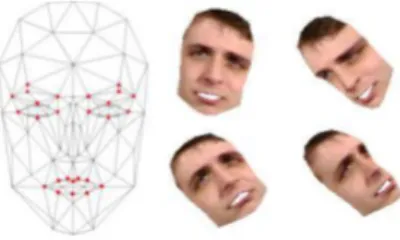
Fig. 1. Candide-3 and some sample synthesized images.
Candide-3 [16] is a very commonly used face shape model. It consists of 113 vertices and 168 surfaces. Fig. 1 represents the frontal view of the model. It is controlled both in translation, rotation, shape and animation:
g(σ, α) = Rs (g + Sσ + Aα) + t (1) where g is 3N-dimensional mean shape (N = 113 is the number of vertices) containing the 3D coordinates of the vertices. The matrices S and A control respectively shape and animation through σ and α parameters. R is a rotation matrix, s is the scale, and t is the translation vector. The model makes an perspective projection assumption to project 3D face onto 2D image. Like [11, 13, 12], only 6 dimensions raof the animation parameter are used to track eyebrows,
eyes and lips. Therefore, the full model parameter b of our framework has 12 dimensions: of 3 dimensions for rotation (rx, ry, rz), 3 dimensions for translation
(tx, ty, tz) and 6 dimensions for animation ra:
b = [rx, ry, rz, tx, ty, tz, ra] (2)
Texture model:In the Candide model, appearance or texture parameters are not available. Usually, we warp and map the image texture onto the triangles of the 3d mesh by the image projection.
3
Proposed Method
Our framework consists of two steps: training and tracking. The framework ben-efits a database of synthesized faces to train tracking model and applies new way of tracking face pose and animation. In this section, we describe our method in detail.
3.1 Training
In the work of [11], the authors align manually the Candide model on the first video frame and warp and map the texture from the image to the model. In our work, landmarks are annotated manually on the first video frame, then the POSIT algorithm [17] is used to fit and estimate the pose automatically from these landmarks to get the initial model parameters b0.
The acquisition of ground-truth is very costly and time consuming. In order to circumvent this drawback, synthetic database [11–13] using the Candide model is a good alternative. In order to collect training data, we do three following steps to obtain images using Candide and build appearance model for the next tracking step:
Data Generation After initialization, the texture is warped and mapped from the first video frame to the Candide model. Our database is built by rendering different views around the frontal image. Note that the full dimension of the parameters to track is 12, consists of pose and animation, that makes difficult to explore finely. However, the translation parameters tx and ty will not affect
the face appearances as well as facial animation will not be significant influence because the use of local features in tracking. Hence, only rotations are gridded for building the training database. Specifically, 7 values of Pan and Tilt and Roll from -30 to +30 by step of 10 are taken to create 73= 343 pose views as some
examples in Fig. 1.
Learning Appearance Model The framework adopts local descriptors which are robust to rigid and non-rigid motion. In this paper, we also use SIFT de-scriptor [15] to extract local features around 26 given landmarks in Fig. 1 as observed appearance. SIFT is invariant to affine transformation and helpful to localize accurate landmarks. In order to get the appearance model, we compute mean and covariance matrices of landmark descriptors on 343 images of the syn-thesized database which is generated from the first image. Each pair of mean and covariance matrix (µi
, Σi) plays the role of learning data for ith landmark which are 128 × 1 and 128 × 128 matrices respectively. And these matrices will be adjusted during tracking.
3.2 Tracking
Here we propose a Bayesian approach approximated from posteriori distribution:
p(bt|Y1:t) = p(Yt
|bt, Y1:t−1)p(bt|Y1:t−1)
p(Yt|Y1:t−1)
∝ p(Yt|bt, Y1:t−1)p(bt|Y1:t−1) (3)
Equation (3) is normally controlled by the observation model p(Yt|bt, Y1:t−1),
and the evolution p(bt|Y1:t−1) as the prior. Because Eq. 3 is still complicated to
Lecture Notes in Computer Science 5 Evolution Model The model p(bt|Y1:t−1) of state bt is dependent on only
previous observation Y1:t−1. We know ˆbt−1 was able to estimated from Y1:t−1.
So, we assume that p(bt|Y1:t−1) ∝ p(bt|ˆbt−1) which means bt is modeled
inde-pendently by a Gaussian distribution around its previous estimated state ˆbt−1,
where bt= (rx, ry, rz, tx, ty, tz, ra)t is the 12-dimensional vector in our context
expressed as:
p(bt|ˆbt−1) = N (bt; ˆbt−1, Ψ) (4)
where Ψ is a diagonal covariance matrix whose elements are the corresponding variances of parameters of the state vector σi, i = 1, .., 12. This model can be
considered as the prior information during tracking.
Observation Model The tracking system starts from the frontal face where Candide is fitted onto, and then it finds the candidate of face in the next frame t+ 1 from the state vector at time t, with t = 0 at the first frame. In order to obtain the observation Yt, the 3d Candide model is projected onto the next 2D
frame at t to localize 2D landmark positions. The appearance Yt is a vector of
local textures (y1
t, yt2, ..., y n
t) around these landmarks as the observation. These
observations can then be used to establish the observation model for tracking and the crucial point is to find an efficient observation model.
We make the assumption that the local appearances around landmarks are independent. The observation model is defined as a joint probability of Gaussian distributions, and the tracking problem can be solved as a maximum likelihood problem of a non-linear function.
p(Yt|bt, Y1:t−1) =
Yn
i=1p(y i
t|bt, y1:t−1i ) (5)
It means that the observation Ytis dependent on the state variable btas well
as previous observations Yt−1. Since the database of synthesized faces is
gen-erated in the range limit of (−30; 30) of three rotations that make the system limited in profile tracking. We can generate more data, however, it makes the framework less robust because of the variation for patches as well as occlusion problem at profile-view. Additionally, there are many factors such as illumina-tion, poses and facial expression that may affect to tracking. So, the learning model needs to be adaptive to changes of environment that brings us the idea of maximum likelihood problem (5) can be rewritten as follows:
p(Yt|bt, Y1:t−1) = Yn i=1N (y i t|µ i t, Σ i t) (6)
where n is the number of landmarks, N (yi
t|µit, Σti) denotes multivariate Gaussian
distribution of function value at observation around the ith landmark yi t, and
µi
tand Σti are mean and covariance matrices updated at time t during tracking.
Note that µi
0and Σ0i are pre-learned mean and covariance in training step at first
frame. The likelihood in Eq. 6 is controlled by two terms: µi
tand Σtiwhich model
these terms should be adjusted to fit changes of factors, but still ”remember” what it learned before. The proposed way how to update can be described as follows for mean vectors:
µit= (1 − α)µ i
t−1+ αyt−1i (7)
where forgetting factor α ∈ (0, 1) is a constant. This equation is a way to correct the error between the observation and the mean vector of appearance model. In order to update covariance matrices, Singular Value Decomposition (SVD) [18] is used to factorize the previous covariance matrix at time t − 1 into unitary matrices and singular matrix of eigen values: svd(Σi
t−1) = [Ut−1i , Sit−1,(Ut−1i )T].
Note that covariance matrix is positive definite, so unitary matrices are the same. Then, updating the singular matrix before composing all of them back to obtain a new covariance matrix at time t.
Sti= (1 − α)S i t−1+ α yt−1i − µit−1 2 2I and Σ i t= U i t−1Sti(U i t−1)T (8)
where I is identity matrix, k.k2 is norm-2. The equations denote how to do adaptive observation model, while keeping principal components of what is seen before. In order to do this, we use Eq. 7 for the eccentricity and the direction is changed when the new covariance matrix is decomposed to update in next step as Eq. 8. The updated mean and covariance matrices are used to model the observation as Eq. 6. To sum up, replacing the observation and evolution models respectively of equations (4) and (6) into (3) and taking the log of likelihood, we finally attempt to minimize the error function approximated as follows:
ˆbt= arg min bt n X i=1 yit− µ i t 2 (Σi t)−1+ bt− ˆbt−1 2 Ψ−1 (9) where ˆbt−1 is the model parameter estimated from previous frame. In our
op-timization context, the error function in (9) is a multi-dimensional function of the model parameter btthat we wish to minimize. It is not easy to solve
analyt-ically, so a derivative-free optimizer such as down-hill simplex [19] is preferred. Like [11], thirteen initial points are chosen randomly around the current state (12-dimensional space) to form the simplex and the solution that subjects to lo-cal minimum can be found by deformations and contracts during optimization.
4
Experimental Results
We adopted the Boston University Face Tracking (BUFT) database [6] and Talk-ing Face video3 to evaluate the performances of face pose estimation and its
animation by landmark tracking respectively.
BUFT:The pose ground-truth is captured by magnetic sensors “Flock and Birds” with an accuracy of less than 1o. The uniform-light set which is used to
3
Lecture Notes in Computer Science 7
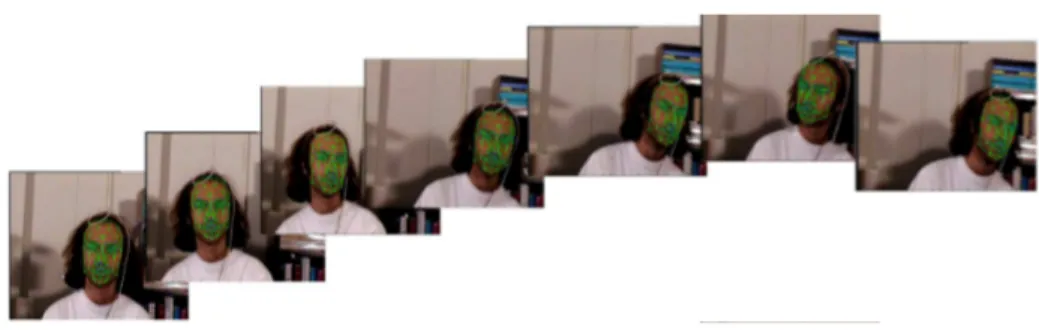
Fig. 2. An sample result of our method on one BUFT video.
evaluate, has a total of 45 video sequences (320×240 resolution) for 5 subjects (9 videos per subject) with available ground-truth which is formatted as (X pos, Y pos, depth, roll, yaw (or pan), pitch (or tilt)).
For each frame of one video sequence, we use the estimation of the rotation error ei = [θi− ˆθi]T[θi− ˆθi] like [13] to evaluate the accuracy and robustness,
where θi and ˆθi are (pan, tilt, roll) of the ground-truth and estimated pose at
frame i respectively. A frame is lost when ei exceeds the threshold. The
robust-ness is the number Ns of frames tracked successfully and Ps is the percentage
of frames tracked over all videos. The precision measures include Pan, Tilt, Roll and average rotation errors which are computed by Mean Absolute Error (MAE) as the measure of tracker accuracy over tracked frames: Epan, Etilt, Eroll and
Em = 13(Epan+ Etilt+ Eroll) where Epan = N1sPi∈Ss|θ
i
pan− ˆθpani | (similarly
for the tilt and roll) and Ss is set of tracked frames.
The Talking Face Video:is a freely 5000-frames video sequence of a talking person with face animations. The ground-truth is available with 68 facial points annotated manually on the whole video. Basing on movements of landmarks, we can estimate the face animation. On that account, we instead evaluate the pre-cision of landmark tracking as the accurate animation. The Root-Mean-Squared (RMS) error is normally used to evaluate the landmark tracking performance on this database. Despite that the number of landmarks of our system and other methods is different, the same evaluation scheme could be still applied on same number of landmarks with our work as well as other comparative methods.
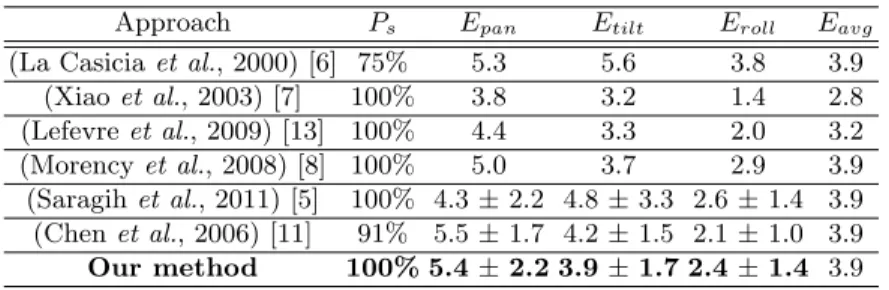
The performance of pose estimation in Table 1 shows the comparable results between our work and state-of-the-art methods in 3d pose tracking. Our perfor-mance is 100% robustness and the accuracy Em is 3.9, which outperforms [11]
and [6] both in terms of robustness and accuracy. And it gets the same result of mean error Em as [5, 8], but the variance of error of [5] is higher than our
work especially in Tilt. However, we are worse than [7, 13] at the accuracy. In spite of the fact that our result is quite encouraging, the Pan precision is still low compared to others. The reason why Pan rotation is bad-estimated, could probably comes from occlusion problem. When Pan is bigger than, for instance, 30o, some landmarks are occluded that make local descriptors is inefficient that
Table 1. The comparison of robustness (Ps) and accuracy (Epan, Etilt, Erolland Eavg)
between our method and state-of-the-art on uniform-light set of BUFT dataset. Approach Ps Epan Etilt Eroll Eavg (La Casicia et al., 2000) [6] 75% 5.3 5.6 3.8 3.9
(Xiao et al., 2003) [7] 100% 3.8 3.2 1.4 2.8 (Lefevre et al., 2009) [13] 100% 4.4 3.3 2.0 3.2 (Morency et al., 2008) [8] 100% 5.0 3.7 2.9 3.9 (Saragih et al., 2011) [5] 100% 4.3 ± 2.2 4.8 ± 3.3 2.6 ± 1.4 3.9 (Chen et al., 2006) [11] 91% 5.5 ± 1.7 4.2 ± 1.5 2.1 ± 1.0 3.9 Our method 100% 5.4 ± 2.2 3.9 ± 1.7 2.4 ± 1.4 3.9
classifiers only with variation of Pan angles that make their estimation of Tilt and Roll inefficient. Fig. 2 is an example of our method on one video of BUFT dataset.
In order to evaluate the landmark precision, we compare our method and FaceTracker4 proposed by [5]. Because the landmarks of our method, [5] and
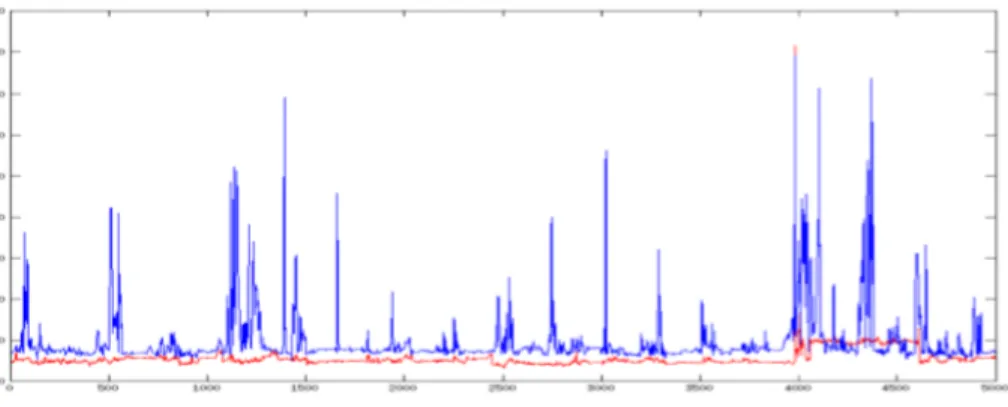
ground-truth are not the same, 12 landmarks around eyes, nose and mouth as in Fig. 3 are chosen to evaluate RMS error. The Fig. 4 shows the (Root Mean Square) RMS error which is computed using our method (red curve) and FaceTracker (blue curve) on the Talking Face video. The vertical axis is RMS error (in pixel) and the horizontal axis is the frame number. The model of [5] sometimes drift away the ground-truth, but recovers quickly to good location by benefiting face and landmark detectors. The Fig. 4 shows that even though our method just learned from the synthesized database, what we obtain is the same the state-of-the-art method as well and is even more robust.
Fig. 3. The 12 landmarks is used to compute RMS error where red (+), blue (∗) and green (o) markers are ground-truth, of Saragih et al. [5] and our method respectively on frames 110, 2500 and 4657 of Talking Face video.
The performance of our method for pose estimation could be improved if the Pan was estimated more accurately. One possible solution is assigning weights
4
Lecture Notes in Computer Science 9 to landmarks corresponds to the Pan value. Or projecting landmarks on tan-gent plane at each landmark that compute mean and covariance matrices as a function of face pose to deal with occlusion. In general, how to deal with oc-cluded landmarks is one of critical points to improve our performance. Although real-time computation is unreachable (about 5s/frame on Laptop Core 2 Duo 2.00GHz, 2G RAM) due to using down-hill simplex algorithm to optimize the energy function, it can be improved by using Gradient Descent in future work.
Fig. 4. The RMS error of 12 selected points for tracking in our framework (below red curve) and Saragih et al. [5] (above blue curve). The vertical axis is RMS error (in pixel) and the horizontal axis is the frame number.
.
5
Conclusion
In this paper, we propose a Bayesian method to deal with the problem of face tracking using one adaptive model through eigen decomposition. The synthesized database within local features are around landmarks to learn appearance model as mean and covariance matrices. For tracking, an energy function which is ap-proximated from posterior probability is minimized as difference between the observations and the appearance model. In order to adjust the model to changes of environments, the eigen decompostion is deployed. The results showed that the use of our model is comparable to some state-of-the-art methods of pose estimation and much more robust than state-of-the-art at landmark tracking or animation tracking. It demonstrated what we proposed is useful to both tasks of pose estimation and landmark tracking. Moreover, it is easy to build the learning database of synthesized images to learn without the need of real annotated data. With our current encouraging results, some other evolutions could be done to improve the performance. For examples, taking into account the weights of con-tribution to energy function which is dependent on the confidence of landmark observations at each time, computing appearance model as function of the pose
to make the objective function continuous. In general, the way how to improve Pan precision by dealing with occluded landmarks is a crucial point to think as future work. Finally, the speed can be improved to real-time application by using Gradient Descent like methods instead of down-hill simplex algorithm.
References
1. Cootes, T.F., Taylor, C.J.: Cj.taylor, ”active shape models - ”smart snakes. In: BMVC. (1992)
2. Cootes, T.F., Edwards, G.J., Taylor, C.J.: Active appearance models. TPAMI (1998) 484–498
3. Xiao, J., Baker, S., Matthews, I., Kanade, T.: Real-time combined 2d+3d active appearance models. In: CVPR. (2004)
4. Gross, R., Matthews, I., Baker, S.: Active appearance models with occlusion. IVC 24 (2006) 593–604
5. Saragih, J.M., Lucey, S., Cohn, J.F.: Deformable model fitting by regularized landmark mean-shift. IJCV 91 (2011) 200–215
6. Cascia, M.L., Sclaroff, S., Athitsos, V.: Fast, reliable head tracking under varying illumination: An approach based on registration of texture-mapped 3d models. IEEE Trans. PAMI 22 (2000) 322–336
7. Xiao, J., Moriyama, T., Kanade, T., Cohn, J.: Robust full-motion recovery of head by dynamic templates and re-registration techniques. International Journal of Imaging Systems and Technology 13 (2003) 85 – 94
8. Morency, L.P., Whitehill, J., Movellan, J.R.: Generalized adaptive view-based appearance model: Integrated framework for monocular head pose estimation. In: FG. (2008)
9. Vacchetti, L., Lepetit, V., Fua, P.: Stable real-time 3d tracking using online and offline information. IEEE Trans. PAMI 26 (2004) 1385–1391
10. DeCarlo, D., Metaxas, D.N.: Optical flow constraints on deformable models with applications to face tracking. IJCV 38 (2000) 99–127
11. Chen, Y., Davoine, F.: Simultaneous tracking of rigid head motion and non-rigid facial animation by analyzing local features statistically. In: BMVC. (2006) 12. Yb´a˜nez-Zepeda, J.A., Davoine, F., Charbit, M.: Local or global 3d face and facial
feature tracker. In: ICIP. Volume 1. (2007) 505–508
13. Lefevre, S., Odobez, J.M.: Structure and appearance features for robust 3d facial actions tracking. In: ICME. (2009)
14. FaceAPI: (http://www.seeingmachines.com)
15. Lowe, D.G.: Distinctive image features from scale-invariant keypoints. Interna-tional Journal of Computer Vision 60 (2004) 91–110
16. Ahlberg, J.: Candide-3 - an updated parameterised face. Technical report, Dept. of Electrical Engineering, Linkping University, Sweden (2001)
17. Dementhon, D.F., Davis, L.S.: Model-based object pose in 25 lines of code. IJCV 15 (1995) 123–141
18. Golub, G., Kahan, W.: Calculating the singular values and pseudo-inverse of a matrix. Journal of the Society for Industrial and Applied Mathematics Series B Numerical Analysis 2 (1965) 205–224
19. Nelder, J.A., Mead, R.: A simplex algorithm for function minimization. Computer Journal (1965) 308–313