Selfish Transportation Games
Dimitris Fotakis1, Laurent Gourv`es2, and J´erˆome Monnot2
1 National Technical University of Athens, 15780 Athens, Greece
2 Universit´e Paris-Dauphine, PSL Research University, CNRS UMR [7243], LAMSADE, 75016 Paris, France
[email protected], [email protected] , [email protected]
Abstract. We study a natural strategic situation arising from the selection of shared means of transportation. Some clients (the players) are located on different nodes of a given graph and they want to be transported from their location to a common destination point (e.g. school, airport). A fixed number of resources (also called buses) is available and each client has to choose exactly one. Individual costs depend on the route chosen by the buses and the distance between the nodes. We investigate the case where each bus has a static permutation which prescribes the order by which the clients are visited. We identify the cases admitting a pure strategy equilibrium and consider the construction of an equilibrium, via a dedicated algorithm, or a dynamics. We also determine the price of anarchy and the price of stability for two natural social functions.
Keywords: resource allocation game, existence and computation of equilibria, price of anarchy/stability
1 Introduction
In many applications some entities compete for the use of shared resources (e.g. processors, storage). These resources are typically rare enough to prevent the existence of an ideal situation where every entity is fully satisfied with the resources that it holds. Allocating scarce resources to a pool of agents is an important problem in the AGT community. An allocation can be found by a central planner who strives to optimize a prescribed social choice function. In practice, this approach is often too rigid as some users, who disregard the social cost and focus on their own individual cost, may not trust the planner’s global solution. Therefore, one may prefer a more flexible mechanism, i.e. a decentralized way for constructing an allocation with which the agents can interact and be proactive. Unfortunately such a mechanism would fail if the agents were unable to commit in a feasible allocation of the resources, or if every allocation that the agents build has a high social cost. As a consequence, it is necessary to evaluate the worth of a mechanism with respect to at least two criteria: (Stability) Can the agents reach a stable state where no one is capable to acquire more revenue? (Performance) Are these stable states good from a social viewpoint?
We address these questions in a context where some agents, located on different places of a map, compete for the use of some public means of transportation (e.g. buses), so as to reach a common des-tination (e.g. an airport). Our work, motivated by services like Dial-a-Ride, Lyft or Uber, uses strategic games to model the situation. The models are called selfish transportation games because every agent (also called player) controls a part of the entire solution (i.e. which transportation means she decides to take) and this agent’s choice is solely guided by her individual cost. Our study focuses on the existence of pure strategy equilibria, together with a worst-case analysis of the performance of the best (resp., worst) pure Nash equilibrium compared to configurations with minimum social cost. Two natural, yet different, notions of social cost are used. More importantly we concentrate on mechanisms where each bus visits and picks up the clients according to a fixed order (possibly different for each bus).
1.1 The Model
Let G = (V, E) be an undirected graph with a source s and a destination t. The graph is also endowed with a distance function d : V × V → R+which is possibly metric, i.e., symmetric and it obeys the
triangle inequality. The transportation game has a set N of n players, and each one is located on a vertex of V . The goal of each player is to be transported from its location to the destination t at the lowest cost. There is a set M of m ≥ 2 resources (also called buses). Each bus follows a path that starts from s, visits some players at their location, and finally reaches the destination t. We suppose that each bus j has its own algorithm Aj which, given V′ ⊆ V , determines its route, i.e. an s − t path whose set of intermediate nodes is V′. Every algorithm A
j is public. It is assumed that a bus always takes the direct link with distance d(a, b) between two consecutive clients a and b and all links between two distinct clients are possible.
We consider a strategic game in which each player chooses by which bus it is picked. Thus, M is the strategy space of every player in N. There are different ways to define ci(σ), the individual cost of a player i under strategy profile σ. In this work ci(σ)is the distance travelled by σi(the bus selected by player i) between the original location of i (when player i is picked) and the destination t.
We suppose that each Aj, for j ∈ M, is based on a permutation πj :{1, . . . , n} → N (independent of the current strategy profile). Actually πjindicates the reverse order by which the players are picked. This picking order is never violated, even if a bus visits a player’s location more than once. The permu-tation is an expression of preferences, or priorities, that a resource has over the set of players (or their locations).
Example 1. Consider an instance with 4 players and 2 buses. The permutations of the buses are (1 2 3 4) and (1 4 2 3), respectively. Suppose player 1 chooses bus 1 whereas the others choose bus 2. Thus, bus 1starts from s, visits 1 and goes to t. Bus 2 starts from s, visits players 3, 2, 4 and goes to t. Individual costs are c1(σ) = d(1, t), c4(σ) = d(4, t), c2(σ) = d(2, 4) + c4(σ)and c3(σ) = d(3, 2) + c2(σ).
In a totally equivalent model, every player is at t and wants to reach her location (e.g. airport to home). Each permutation πj indicates by which order the players are dropped. In Example 1, bus 1 transports player 1 to his home. Bus 2 starts from t, drops player 4, then player 2, then player 3. 1.2 Motivation and Related Work
Transportation problems have a prominent place in operations research and combinatorial optimization (e.g. the Traveling Salesman Problem [2] or Vehicle Routing Problems [22]) because they present both practical and theoretical challenges to the researchers.
Ridesharing systems (see e.g., [16, 18]) are emerging transportation models and tools where car owners can share a ride with other persons via a dedicated application (e.g. avego, blablacar, carpool-world, carticipate, etc.). Ridesharing systems, as public transportation systems, are valuable initiatives for the reduction of traffic congestion, CO2emissions and fuel expenditure.
In this article, we depart from the extensive literature dealing with centrally computed solutions (see e.g., [20]) and focus on game theoretic approaches. Concerning transportation models, numerous articles on vehicle-routing games deal with cooperative games (see e.g., [6, 12, 5]). However, noncoop-erative and competitive games are more closely related to our transportation game. For example, [13] study a competitive traveling salesmen problem in which two salespeople compete for visiting some clients earlier than their opponent. In this model, the players make their decisions in turn like in a game in perfect-information extensive form. A similar model, with possibly more than 2 salespersons, is considered in [17].
Our model of transportation differs from the aforementioned works since it is a strategic game. The literature on strategic games for routing problems can be divided in two parts, whether the players are non-atomic or atomic. In the mathematical models involving non-atomic players, there is traffic in a
network and each infinitesimal portion of this traffic is associated with an autonomous agent (see e.g. [10] for the notion of Wardrop equilibrium). In this article, we assume that the players are atomic. In comparison, an atomic player represents a non-negligible portion of the traffic.
As resource selection games, transportation games are reminiscent of scheduling games with coor-dination mechanisms [9]. In coorcoor-dination mechanisms we have a scheduling policy, which imposes a priority over players in each resource. The scheduling policy may be described by some simple rule, such as shortest (resp., largest) job first, or may be more sophisticated (see e.g., [4]). Moreover, the same or different scheduling policies can be used for the resources. The goal is to find natural coordi-nation mechanisms that can significantly improve the resulting price of anarchy (see e.g., [4, 7, 9]) or can ensure the existence of an equilibrium in pure strategies or the fast convergence to it (see e.g., [4]). Thus, coordination mechanisms modify (or enrich) the individual cost structure, aiming at improved efficiency (or equilibrium existence).
In transportation games, we employ a fixed player priority, possibly different in each bus, to simplify the individual cost structure and to allow for an efficient best response computation. Of course, one might think of more sophisticated player priorities and bus routes, which is somewhat reminiscent to more complex scheduling policies in coordination mechanisms. Such priorities may naturally depend on the set of players in the same bus and on their distances to each other and to the destination. But, if e.g., we pick the players in each bus according to the shortest route starting from the source, going through all of them, and ending up to the destination, determining such a route and the corresponding individual costs requires the solution to an NP-hard optimization problem. Keeping the player priorities fixed and independent of their partition into buses, we simplify the individual cost structure so that transportation games are amenable to theoretical analysis.
Transportation games also bear some resemblance to (non-cooperative versions of) hedonic games (see e.g., [11, 8]), where the players are partitioned into coalitions and the individual cost of each player depends on the identities of other players in the same coalition (but not on the identity of the coalition). In transportation games, the players in each bus could be regarded as a coalition and the individual cost of each player depends on the identities of other players in the same bus (but in a more subtle way than in the hedonic games of e.g., [15, 14]). The special case of transportation games with the same player permutation for all buses could be regarded as a hedonic game, since the individual cost of each player depends on the locations of other players in the same bus (but not on the bus itself). However, to enrich the individual cost structure of transportation games, we allow for different player permutations in the buses, which makes the individual cost of each player also depend on the bus (in addition to the locations of the players to be picked up after him). This is a significant departure from variants of hedonic games studied in the literature and a source of difficulty in establishing the existence of pure Nash equilibria.
1.3 Contribution
We conduct a theoretical analysis of the transportation game by providing answers to the following questions. Which case admits an equilibrium? Can we compute an equilibrium in polynomial time? Do the players naturally converge to an equilibrium? How good is the best (or worst) equilibrium in comparison with a social optimum?
This work only deals with pure strategy profiles (each player’s choice is deterministic). A pure Nash equilibrium (NE) is a strategy profile (also called state) σ such that no player can unilaterally change her strategy and benefit [21]. A strong equilibrium (SE) is a refinement of the NE to group deviations. In a SE, no group of players C can jointly deviate in such a way that every member of C benefits [3]. This
article also deals with the dynamics of the transportation game. We say that the dynamics converges if, starting from any strategy profile, every series of improvement moves (better response) eventually reaches a stable state. Depending on the context (unilateral or group deviations), this stable state can be a NE or a SE.
Our results show that if all the resources have the same permutation then a SE exists and it can be computed in polynomial time (Theorem 1). But if the permutations are not identical, then there exists a simple 2-resource 3-player instance without any NE (Proposition 2). If there are 2 resources and if the distances is metric, then the dynamics converges to a NE (Theorem 2). Moreover, this equilibrium can be computed in linear time (Theorem 3). We have considered possible extensions of this positive result and there are metric 3-resource instances without any NE (Proposition 3).
Section 3 is devoted to a special metric case where distances can be 1 or 2. We provide an algo-rithm that computes a NE in O(nm). In Section 4, we analyse the price of anarchy and stability of the transportation game under two natural social cost functions namely egalitarian and Vehicle Kilo-meters Travelled. These notions are worst case comparisons of the worst and best NE with a social optimum, respectively. Without metric, the price of anarchy and stability of our transportation game are unbounded, but they are bounded for metric distances. Some possible extensions and future works are discussed in the last section. Due to the space limitation, some proofs are omitted and are put in the Appendix.
2 Existence and Computation of an Equilibrium
At least two properties play an important role in the existence of an equilibrium: (i) whether the per-mutations of the buses are identical or not, (ii) whether the distances are metric or not.
2.1 Instances with Not Necessarily Metric Distances
Theorem 1. If all the resources have the same permutation π, then the dynamics converges to a SE. Moreover, a SE can be built in O(nm).
Proof. Let us suppose wlog. that π is the identity permutation. Associate with each state σ a vector Λ(σ)of dimension n. Define coordinate i of Λ(σ) as ci(σ). Given a state σ, if a coalition C deviates so that σ′denotes the new state, then Λ(σ′)is lexicographically smaller than Λ(σ). Indeed, let k be the member of C with smallest index. For i < k we have ci(σ) = ci(σ′)(because of priority π, no player iis affected by the strategy of a player j when i < k ≤ j) and ck(σ) > ck(σ′)(player k has decreased her cost). A SE σ is built as follows. Start from an empty solution and take the players in turn, from 1 to n. The current player, say i, is placed on the resource where its cost is minimum (break ties by selecting the resource with smallest index). The cost of i on resource j is d(i, t) if no other player is previously assigned to j, otherwise it is d(i, i′) + c
i′(σ)where i′is, among the players assigned to j, the one with largest index (i > i′). Since i > i′, i is picked just before i′. The assignment of i to j does not affect the cost of i′. The resulting state is lexicographically minimal and it is built in O(nm). ⊓⊔ Theorem 1 cannot be extended to show the existence of a super strong equilibrium (SSE), even with metric distances. A SSE is a refinement of the SE where no group of players C can jointly deviate in such a way that no member of C is worst off, while at least one member is better off.
Proposition 1. There exists a metric instance of the transportation game with m = 2 resources having identical permutations which does not admit any super strong equilibrium.
distances α β γ t 2 100 1 α 0 0 0 β 0 0 10 states 1 2 γ⋆ σ1 β α σ2 β α⋆ γ states 1 2 α⋆ σ3 β γ σ4 β⋆ α γ
Fig. 1. A non-metric instance of the transportation game with m = 2 resources and n = 3 players that does not admit any pure Nash equilibrium (see also Proposition 2).
The following result shows the importance of having identical permutations, if the distance is not metric. Proposition 2. There exists a non-metric instance of the transportation game with m = 2 resources and n = 3 players which does not admit any NE.
Proof. Let the resources be 1 and 2 and let the players be α, β and γ. The permutations are (α, β, γ) for resource 1 and (γ, β, α) for resource 2. The distances are depicted in Fig. 1, on the left. Let us see that the instance has no pure Nash equilibrium. If β is alone on a resource (or she is the last to be picked before traveling to t) then she wants to move. In Fig. 1, on the right, the 4 remaining configurations are depicted. The player with a star on its right has incentive to switch. Hence, this instance does not admit
any pure Nash equilibrium. ⊓⊔
We observe that every instance of the transportation game with n = 2 players and m = 2 resources admits a SSE (actually, already in the case of NE, one player which minimizes the distance to s with highest priority in case of ties does not wish to go elsewhere). Therefore, Proposition 2 cannot be extended to the case of two players.
2.2 Instances with Metric Distances
Theorem 2. For the transportation game with m = 2 resources and metric distances, better response dynamics converges to a NE.
Proof. Suppose for the sake of contradiction that there exists a cycle in the Nash dynamics. Let N0 ⊂ N be the players who never change their strategy in the cycle, whereas N1 := N\ N0 6= ∅.
Note that there is some positive integer kj, with j ∈ {1, 2}, such that the kj first players in the permutation of resource j are in N0and they play j. Indeed, it is a dominant strategy for the first player in the permutation of resource j to play j, because metric distances, ie., the triangle inequality imposes that the cost of that player cannot be lower (namely her distance to t).
For j ∈ {1, 2}, let pjdenote the player of N1coming first in the permutation of resource j. Let dj be the player of N0who is just before pj in the permutation of resource j. Let cdjdenote the cost of dj in the cycle which is invariant. In the cycle, if pjplays resource j then her cost is equal to d(pj, dj)+cdj, whatever the players of N1\ {pj} play.
It must be p1 6= p2, otherwise we get a contradiction with p1 ∈ N1 because the cost of p1does not depend on the strategy adopted by N1\ {p1}.
Since the players do unilateral deviations in the cycle, there must be a state of the cycle in which p1 and p2play the same strategy. Suppose wlog. that at some point p2profitably moves from resource 2 to resource 1, where p1is. The new cost of p2is at least her distance to p1plus the cost of p1.
At some point in the cycle p1 profitably moves to resource 2 where its cost is at least its distance to d2 plus the cost of d2.
d(p1, d1) + cd1 > d(p1, d2) + cd2 (2) Combine inequalities (1) and (2) to get that d(p2, d2) > d(p2, p1) + d(p1, d2), which is a violation of
the triangle inequality. ⊓⊔
From this proof, we know that a potential function exists. Providing an explicit potential function for metric transportation games with two resources is an open question. Another open question asks whether the Nash dynamics converges in polynomial time.
We next show how to efficiently compute one equilibrium with some central coordination (2 buses). Theorem 3. For m = 2 resources and metric distances, the transportation game has a NE that can be computed in O(n).
Proof (sketch). Let r1 and r2 be the two resources. We assign all players to r1, consider them one-by-one, as they appear in the permutation of r2, and let them deviate to r2, if this improves their cost. Moving players from r1to r2can only decrease the cost of those staying on r1. Hence, if a player does not move to r2 in her turn, she does not move to r2 later on. Using an argument similar to that in the proof of Theorem 2, we can show that after a player moves to r2, she never prefers to return to r1. Hence, this procedure reaches a pure NE in n steps. A complete proof is given in the Appendix. ⊓⊔ We note that the algorithm in the proof of Theorem 3 does not build a SE. Actually, a planar instance with 2 resources and without any SE can be designed (see Proposition 10 in the Appendix). An instance is planar if its distances are Euclidean distances between nodes of a 2-dimensional plane (in particular, it is metric). Moreover, the following proposition shows that the existence of a NE for m = 2 resources (and metric distances) cannot be extended to m = 3.
Proposition 3. There exists a planar instance with m = 3 resources which does not admit any NE. Proof (sketch). There are 8 players p0, . . . p7 whose coordinates in the plane are p0 = (4, 27), p1 = (4, 1), p2 = (6, 24), p3 = (5, 6), p4 = (17, 13), p5 = (4, 29), p6 = (2, 3), p7 = (20, 21), and t = (18, 6). There are 3 resources with permutations (p7p6p5p4p3p2p1p0), (p0p1p2p3p4p5p6p7) and (p3p2p6p7p0p5p4p1). This instance has 38 pure states. Since for the players p7, p0 and p3 selecting bus 1, bus 2 and bus 3, respectively, is a dominant strategy, the number of pure states that are candidates for an equilibrium is 35 = 243. An exhaustive examination of them shows that none is a pure NE. ⊓⊔ We believe that the above instance is minimal, i.e. any instance with at most 7 players contains a NE when m = 3. However, the Nash dynamics is not guaranteed to converge as indicated below. Proposition 4. There exists a metric instance with m = 3 resources and n = 7 players in which the Nash dynamics may cycle.
3 Computing a Pure Nash Equilibrium for Distances 1 and 2
For the simplest case of metric distances i.e., corresponding to the case that all distances are either 1 or 2, a NE exists for any number of resources and can be computed in linear time by a natural greedy algorithm. In Algorithm 1, a player is available for assignment to a resource if she is currently the first player in the resource’s permutation. Among all available players, Greedy picks the player u that can be
Algorithm 1 Greedy algorithm for computing a NE
Input: set N of n players, set M of m resources, permutations πjfor all j ∈ M (each πjends with⊳),
distance function d (we assume that d(u,⊳) = ∞). Output: assignment σ : N → R that is a PNE
for all j ∈ M do
cost(j)← 0; pj← t; nj← the first player in πj;
for all v ∈ N do
cost(v)← ∞; σ(v) ← ⊳; while ∃j with nj6= ⊳ do
k = arg minj{cost(j) + d(pj, nj)}; u ← nk;
in case of ties, select resource k with minimum cost(k) if σ(u) =⊳ then
assign u to resource k and set σ(u) ← k and c(u) ← cost(k) + d(pk, u);
if σ(u) 6= ⊳ and c(u) > cost(k) + d(pk, u)then
restore cost(σ(u)) and pσ(u)to their values before u’s assignment to σ(u);
nσ(u)becomes the first player v after u in πσ(u)with c(v) > cost(σ(u)) + d(pσ(u), v);
reassign u from σ(u) to k and set σ(u) ← k and c(u) ← cost(k) + d(pk, u);
let nkbe the next player after u in πk(nkbecomes⊳ if u is the last player);
if σ(u) = k then pk← u
return assignment σ
assigned to a resource k at a minimum cost. Ties are broken in favor of resources with minimum cost. If player u is not assigned to any resource, she is assigned to k. Otherwise, if u prefers k to her current resource, she is reassigned to k. In both cases, u is removed from the permutation of resource k and Greedy continues. We next show that Greedy terminates with a pure NE assignment if the distances are either 1 or 2.
Example 2. Consider an instance with 8 players, p0, . . . , p7, and 3 resources r1, r2and r3. The permu-tations are (p7p6p5p4p3p2p1p0), (p0p1p2p3p4p5p6p7)and (p3p2p6p7p0p5p4p1)for r1, r2 and r3, respectively. The nodes are partitioned in three sets: {t, p0, p1}, {p2, p3, p4} and {p5, p6, p7}. The nodes in the same set are within distance 1 to each other. All other distances are 2. In Algorithm 1, at the beginning, players p7, p0 and p3 are available for assignment to r1, r2 and r3, respectively. In the first iteration, p0 is assigned to r2 and p1 becomes available for r2. In the subsequent iterations, p7 is assigned to r1, p3 to r3, and p1 to r2 (this takes place last due to the tie breaking rule). At this point, we have that n1 = p6and n2 = n3 = p2. Next, p6is assigned to r1, p2 to r3, p2and p3are considered for and not assigned to r2, p4 is assigned to r2, and p5is assigned to r1. From that point on, p6, p7, p0, p5, p4 and p1 are considered for and not assigned to r3, p4, p3, p2, p1 and p0 are considered for and not assigned to r1, and p5, p6 and p7 are not assigned to r2. The final assignment is (p7p6p5) to r1, (p0p1p4)to r2, and (p3p2)to r3, which is a NE.
Theorem 4. Algorithm 1 computes a NE in O(nm) time if the distances are either 1 or 2. Moreover, each player is reassigned at most once through the execution of the algorithm.
Proof. We refer to a player u as a candidate for resource j if either nj = uor u appears in πj after nj (so u will be considered for assignment or reassignment to j in a subsequent iteration). For convenience, we let costmax= max
jcost(j)and costmin = minjcost(j).
We use induction on the number of iterations and show that at the end of the current iteration: (i) no assigned player wants to deviate to any resource j, unless she is a candidate for j; (ii) costmax− costmin ≤ 2; (iii) costmin does not decrease from one iteration to the next; and (iv) if player u is
reassigned from resource σ(u) to resource k, her cost at σ(u) is costmax = costmin+ 2and her cost at k is costmin + 1. At the end of the algorithm, no player is a candidate for any resource. Hence, (i) implies that if Greedy terminates, the assignment σ is a pure NE.
Claims (i)-(iv) are true before the first iteration. We inductively assume that (i)-(iv) hold at the end of any iteration. To establish (i)-(iv) hold at the end of the next iteration, we distinguish between three cases: whether u is assigned for the first time to k, whether u is reassigned to k, and whether u stays with σ(u). If u stays with σ(u), nothing changes and (i)-(iv) remain true at the end of the current iteration.
If u is assigned or reassigned to k, u does not want to deviate at the end of the current iteration, because k minimizes u’s cost among all resources j with nj = u. If u is assigned to k, other resources and assigned players are not affected, and claim (i) remains true. If u is reassigned to k, the cost of resource σ(u) decreases. To maintain (i), we let nσ(u)be the first player after u in πσ(u) that wants to be assigned to σ(u) (this may involve some backtracking in πσ(u)). Then, if an assigned player wants to deviate to σ(u), so as to take advantage of u’s move out of σ(u), she has become a candidate for σ(u). So, claim (i) holds at the end of the current iteration.
As for claims (ii)-(iv), since all distances are either 1 and 2, and due to the greedy choice of resource kand to the tie-breaking rule, k’s cost is equal to costmin. Hence, if u is assigned for the first time to k, u’s cost becomes at most costmin+ 2. Moreover, costmindoes not decrease and costmaxeither does not change or becomes c(u) ≤ costmin+ 2. Therefore, (ii)-(iv) hold after u’s assignment.
If u is reassigned from σ(u) to k, the cost of u at σ(u) is c(u) = costmax= costmin+ 2. Further-more, cost(k) = costmin(just before u’s reassignment) and the cost of u at k (after u’s reassignment) is costmin+ 1. These follow from the facts that costmax− costmin ≤ 2 at the end of the previous iteration, that c(u) > cost(k) + d(pk, u)and that all distances are 1 and 2. So, after u’s reassignment, cost(k) is at most costmaxand cost(σ(u)) decreases by 2 and becomes costmin. These imply that (ii)-(iv) remain true after u’s reassignment.
Claims (iii) and (iv) imply that any player is reassigned at most once. Due to (iv), if a player u is reassigned from resource σ(u) to resource k, cost(σ(u)) decreases from costmax to costmin = costmax− 2 and the new cost of u at k is costmin + 1. Thus, if u is reassigned from resource k later on, the new costmin would be costmin − 1, which contradicts (iii). Hence, Greedy terminates after n assignments and at most n reassignments.
Each reassignment causes a backtrack of at most n players in πσ(u). But only assigned players with cost costmin+ 2can be reassigned to σ(u) after u moves out. So, after u is reassigned to k, we need to insert at the beginning of πσ(u) only assigned players that appear after u in πσ(u) and have cost equal to costmin+ 2. Since there are at most m such players, the additional running time due to each reassignment is O(m). So the running time of Greedy is O(nm), i.e., linear in the size of the input. ⊓⊔
4 The Price of Anarchy and the Price of Stability
We consider two different social functions. For a strategy profile σ, D(σ) is the total distance travelled by the buses when they transport at least one client (for each bus we neglect the distance between s and the first client). This function reflects the environmental impact of the solution and it corresponds to the objective Vehicle Kilometers Travelled considered in [18]. The second function is the classical egalitarian social cost function E(σ) defined as maxi∈Nci(σ), which is also the maximum distance travelled by a single bus if the distance between s and the first client is neglected.
For every f ∈ {D, E} and any given instance, σ∗ denotes a state for which f(σ∗)is minimum. The (pure) price of anarchy (PoA for short) is the largest ratio f(σ)/f(σ∗), over all instances of the game,
where σ is a pure NE [19]. The (pure) price of stability (PoS for short) is the largest ratio f(σ)/f(σ∗), over all instances of the game, where σ is the best NE with respect to f [1]. Therefore PoA ≥ PoS. Proposition 5. For every n ≥ 3, the PoS is unbounded for D or E if the distance is not metric, even if all the permutations are identical.
Proof. If n ≤ 2 and m ≥ 2, PoS=PoA= 2 even in non-metric case. Suppose n > m ≥ 2. Let ε ∈ (0, 1). Player m + 1 is at distance 1/ε from every player i ∈ [1; m]. Every other distance is ε. In a NE σ, no two players i, i′ satisfying 1 ≤ i < i′ ≤ m are on the same bus. Thus they all have an individual cost of ε. Whichever resource player m + 1 selects, her individual cost is 1/ε + ε so f (σ) ≥ 1/ε for every f ∈ {D, E}. Meanwhile there exists a state such that every edge traversed by a bus has distance ε (e.g. no player i ≤ m is on the resource selected by player m + 1). When ε → 0 the PoS tends to ∞.
Suppose 3 ≤ n ≤ m. Let ε ∈ (0, 1). All node distances are ε except for the cases given below: t 1 2 3 . . . n
2 3ε ε ε ε . . . ε 3 1/ε ε 1/ε 1/ε . . . 1/ε
In a NE σ, players 1 and 2 are on the same resource. Player 3 cannot be picked right before player 1 so her individual cost is at least 1/ε. It follows that f(σ) ≥ 1/ε for every f ∈ {D, E}. Meanwhile there exists a state such that every edge traversed by a bus has distance ε or 3ε (players 1 and 2 are on distinct
resources). So PoS → ∞ when ε → 0. ⊓⊔
4.1 Function D with metric distances
Due to Proposition 5, from now on, we assume that the distances are metric. Lemma 1. If d is metric, d(x, y) ≤ D(σ∗)holds for all nodes x, y ∈ N ∪ {t}.
Proof. If x and y are covered by the same bus in σ∗, then suppose wlog. that the bus visits x before y. Therefore, D(σ∗)is at least the distance covered by the bus between x and y, while the latter is at least d(x, y), by the triangle inequality. Hence, suppose x and y are covered by two different buses in σ∗, and denote them by bx and by, respectively. Therefore, D(σ∗)is at least the distance covered by bx between x and t plus the distance covered by by between y and t. The latter is at least d(x, y), by the
triangle inequality. ⊓⊔
Proposition 6. If d is metric, then D(σ) ≤ nD(σ∗)holds for every state σ.
Combining Lemma 1 with Proposition 6, we obtain the following upper bound on the PoA (and on the PoS). Interestingly, Proposition 7 shows that this bound is tight.
Corollary 1. The PoA with respect to D of the transportation game on n players with metric distances and m ≥ 2 resources is upper bounded by n.
Proposition 7. For any n ≥ 2, there are metric instances of the transportation game on n players and m≥ 2 resources where the PoS is asymptotically n, even if all the resources have the same permutation.
Proof. Suppose 2 ≤ n ≤ m and consider an instance where d(i, t) = 1, ∀i ∈ N. Take any δ in (0, 1) and let d(i, i′) = δ, ∀i, i′ ∈ N. The triangle inequality is satisfied. The permutation of each bus is the identity. There is essentially one NE in this instance: every player is the single user of a resource. The social cost is n. In an optimal state, all the players use a single resource. The optimal social cost is at most 1 + (n − 1)δ. Thus, for δ small but positive, the PoS tends to n.
Suppose 2 ≤ m ≤ n and consider the following instance in which k is an integer:
– N = L ∪ R where L = {ℓi,j : 1≤ i ≤ k, 1 ≤ j ≤ m} and R = {ri,j : 1≤ i ≤ k, 1 ≤ j ≤ m}. Hence, there are n = 2km players and m ≥ 2 buses.
– d(u, v) = 1 if u, v ∈ L or u, v ∈ R, d(v, t) = a for some positive integer a when v ∈ R, d(v, t) = a2 when v ∈ L, and finally d(u, v) = a(1 + a) if u ∈ L and v ∈ R.
– Now, let us decompose L and R into k levels (L1, . . . , Lk)and (R1, . . . , Rk)respectively, where Li ={ℓi,j : j = 1, . . . , m} and Ri ={ri,j : j = 1, . . . , m}.
– All the buses have the same priority π defined by π(v) < π(u) if one of the following cases occurs: 1. v ∈ Li∪ Riand u ∈ Li′ ∪ Ri′ with i < i′;
2. v ∈ Liand u ∈ Ri;
3. v = ℓi,j, u = ℓi,j′ (resp., v = ri,j, u = ri,j′)with j < j′.
This instance is clearly metric. We claim that a state σ is a NE iff each bus contains exactly one player of each level of L and one player of each level of R.
Obviously, the condition is sufficient because for such a state, no unilateral deviation is profitable. Conversely, by contradiction, suppose there exists a NE σ which does not satisfy the condition and let q≥ 1 be the first level where the condition is violated. Namely, each bus in state σ contains exactly one player of each level L1, . . . , Lq−1, R1, . . . , Rq−1. Consider the two possibilities:
– One bus, say p, does not pick any player of Lq and another one, say p′, picks at least two players, say ℓq,jand ℓq,j′ where j < j′. By construction, cℓq,j′(σ)≥ cℓq,j(σ) + d(ℓq,j, ℓq,j′) = cℓq,j(σ) + 1. Now, if player ℓq,j′ moves from bus p′ to bus p, then its cost is at most cℓq,j(σ), which contradicts the stability of σ.
– The condition holds for Lqbut not for Rq. As previously, one bus, say p, has not picked any player of Rq while another bus, say p′, has picked at least two players, say rq,j and rq,j′ where j < j′. Hence, crq,j′(σ)≥ crq,j(σ) + 1 > crq,j′(σ−rq,j′, p).
In both cases we get a contradiction, so the property holds. We deduce that D(σ) = m(2k − 1)a + 2kma2 = na2+ a(n− m) iff σ is a NE. On the other hand, σ∗ uses only two buses: one containing all the players of L and another containing all the players of R. We have D(σ∗) = a2 + a + (n− 2). When a → ∞, D(σ)/D(σ∗)tends to n. Finally, the result follows from Corollary 1. ⊓⊔ The second instance in the proof of Proposition 7, with a = 1, applies to the special case where the distances are 1 or 2 (which always admits a NE by Theorem 4). So, we get an asymptotic lower bound of 2 on the PoS. An upper bound of 2 on the PoA is directly obtained from the fact that for every state σ, D(σ) consists of |N| terms which are either 1 or 2.
4.2 Function E without metric
Lemma 2. d(x, y) ≤ 2E(σ∗)holds for every pair of nodes (x, y) ∈ N, and d(x, t) ≤ E(σ∗)holds for every node x ∈ N.
Lemma 3. In any pure Nash equilibrium, the cost of a player is at most (2⌈n
m⌉ − 1)E(σ∗).
Proof. By contradiction, suppose there is a pure NE σ and a player i such that ci(σ) > (2⌈mn⌉ − 1)E(σ∗). Let k denote the number of players that the bus selected by i picks between i and t (this includes i). Using Lemma 2 we have ci(σ) ≤ (2k − 1)E(σ∗). These bounds on ci(σ)give k > ⌈mn⌉. But if more than ⌈n
m⌉ players use the same bus, then there must be another bus, say b, selected by less than n
m players. Even if player i appears last in the permutation of b, her cost if she moves to b would be less than (2n
m − 1)E(σ∗)(Lemma 2). We get a contradiction with the fact that σ is a NE. ⊓⊔ Corollary 2. The PoS with respect to E of the transportation game is O(n
m).
Proof. For n > m, the upper bound comes from Lemma 3. The lower bound comes from the second instance in the proof of Proposition 7 in which the worst individual cost in a pure Nash equilibrium is (2k− 1)a(1 + a) + a2. There is a state in which the worst individual cost is at most 2k + a2− 1. For a
large, the PoS tends to 2k = n/m. ⊓⊔
Proposition 8. For the transportation game, PoA= 2⌈n
m⌉ − 1 if n > m and PoA= 1 if n ≤ m. Proof. If n ≤ m then every player can be alone on her bus. By Lemma 2 (second part), the PoA is 1. Now suppose n > m. The upper bound comes from Lemma 3. Let us describe the lower bound.
Suppose n and m are even, especially m = 2p and n = q2p, where q is even. Decompose N in m sets of size q as follows: Nj ={1j, 2j, . . . , qj}, with j = 1 . . . 2p. For every player pair u, v such that u∈ Nj, v ∈ Nj′and j 6= j′we have d(u, v) = 2. If u and v belong to the same set Njthen d(u, v) = 0. For every u ∈ N, d(u, t) = 1. Thus the triangle inequality holds. If j ∈ [1, 2p] is odd then the first players of the permutation of resource j are (1j, 1j+1, 3j, 3j+1, . . . , q− 1j, q− 1j+1)followed by the rest of the players in an arbitrary order. If j ∈ [1, 2p] is even then the first players of the permutation of resource j is (2j, 2j−1, 4j, 4j−1, . . . , qj, qj−1)followed by the rest of the players in an arbitrary order.
Consider the state σ where each resource j ∈ [1, 2p] is selected by the first 2q players in its permu-tation. This state is a pure Nash equilibrium because every player has cost at most 4q − 1 and deviating induces a cost of 4q + 1. In an optimal state the players of Nj are on resource j; the maximum cost is
1. Therefore the PoA is at least 4q − 1 = 2n/m − 1. ⊓⊔
We can also bound the PoA according to the parameters dmin = minx6=yd(x, y) and dmax = max d(x, y). As an immediate corollary, we obtain that PoS = PoA = 2 for distances 1 and 2.
Proposition 9. PoS = PoA = dmax/dminfor the transportation game.
5 Future Directions
In this work we supposed that the route of the buses are prescribed by a permutation that is independent of the current state. There is an interesting challenge of proposing different ways to define the route of the buses. This modification would induce a different structure of the individual costs and possibly provide better PoA and PoS, under the constraint that a pure equilibrium exists. This challenge is similar to the search of coordination mechanisms in scheduling games.
In transportation problems, it is important to predict the situation so it would be interesting to identify the cases where the equilibrium is unique. In the future, the model of transportation can be extended in several natural aspects. Each bus may have a capacity, its own speed and dedicated roads. The players may have different sizes (e.g. a player is a group of persons).
References
1. Elliot Anshelevich, Anirban Dasgupta, Jon M. Kleinberg, ´Eva Tardos, Tom Wexler, and Tim Roughgarden. The price of stability for network design with fair cost allocation. In 45th Symposium on Foundations of Computer Science (FOCS 2004), 17-19 October 2004, Rome, Italy, Proceedings, pages 295–304. IEEE Computer Society, 2004.
2. David L. Applegate, Robert E. Bixby, Vasek Chvatal, and William J. Cook. The Traveling Salesman Problem: A Com-putational Study (Princeton Series in Applied Mathematics). Princeton University Press, Princeton, NJ, USA, 2007. 3. Robert J. Aumann. Acceptable points in general cooperative n-person games. In Albert W. Tucker and Robert D. Luce,
editors, Contribution to the Theory of Games, volume IV of Annals of Mathematics Studies, 40, pages 287–324. Princeton Univ. Press, 1959.
4. Yossi Azar, Kamal Jain, and Vahab S. Mirrokni. (almost) optimal coordination mechanisms for unrelated machine scheduling. In Shang-Hua Teng, editor, Proceedings of the Nineteenth Annual ACM-SIAM Symposium on Discrete Algorithms, SODA 2008, San Francisco, California, USA, January 20-22, 2008, pages 323–332. SIAM, 2008.
5. Filippo Bistaffa, Alessandro Farinelli, and Sarvapali D. Ramchurn. Sharing rides with friends: A coalition formation algorithm for ridesharing. In Blai Bonet and Sven Koenig, editors, Proceedings of the Twenty-Ninth AAAI Conference on Artificial Intelligence, January 25-30, 2015, Austin, Texas, USA., pages 608–614. AAAI Press, 2015.
6. Peter Borm, Herbert Hamers, and Ruud Hendrickx. Operations research games: A survey. Top, 9(2):139–199, 2001. 7. I. Caragiannis. Efficient coordination mechanisms for unrelated machine scheduling. Algorithmica, 66(3):512–540,
2013.
8. Katar´ına Cechl´arov´a. Stable partition problem. In Ming-Yang Kao, editor, Encyclopedia of Algorithms. Springer, 2008. 9. George Christodoulou, Elias Koutsoupias, and Akash Nanavati. Coordination mechanisms. Theor. Comput. Sci.,
410(36):3327–3336, 2009.
10. J. R. Correa and N. E. Stier-Moses. Wardrop equilibria. Wiley Encyclopedia of Operations Research and Management Science., 2011.
11. J. H. Dr`eze and J. Greenberg. Hedonic coalitions: Optimality and stability. Econometrica, 48(4):pp. 987–1003, 1980. 12. S. Engevall, M. Lundgren, and P. V¨arbrand. The heterogeneous vehicle - routing game. Transportation Science, 38(1):71–
85, 2004.
13. S´andor P. Fekete, Rudolf Fleischer, Aviezri Fraenkel, and Matthias Schmitt. Traveling salesmen in the presence of competition. Theoretical Computer Science, 313(3):377 – 392, 2004. Algorithmic Combinatorial Game Theory. 14. Moran Feldman, Liane Lewin-Eytan, and Joseph Naor. Hedonic clustering games. In Guy E. Blelloch and Maurice
Herlihy, editors, 24th ACM Symposium on Parallelism in Algorithms and Architectures, SPAA ’12, Pittsburgh, PA, USA, June 25-27, 2012, pages 267–276. ACM, 2012.
15. Martin Gairing and Rahul Savani. Computing stable outcomes in hedonic games. In Spyros C. Kontogiannis, Elias Koutsoupias, and Paul G. Spirakis, editors, Algorithmic Game Theory - Third International Symposium, SAGT 2010, Athens, Greece, October 18-20, 2010. Proceedings, volume 6386 of Lecture Notes in Computer Science, pages 174–185. Springer, 2010.
16. Ece Kamar and Eric Horvitz. Collaboration and shared plans in the open world: Studies of ridesharing. In Craig Boutilier, editor, IJCAI 2009, Proceedings of the 21st International Joint Conference on Artificial Intelligence, Pasadena, California, USA, July 11-17, 2009, page 187, 2009.
17. Graham Kendall and Jiawei Li. Competitive travelling salesmen problem: A hyper-heuristic approach. Journal of the Operational Research Society, 64:pp. 208–216, 2013.
18. Alexander Kleiner, Bernhard Nebel, and Vittorio A. Ziparo. A mechanism for dynamic ride sharing based on parallel auctions. In Toby Walsh, editor, IJCAI 2011, Proceedings of the 22nd International Joint Conference on Artificial Intelligence, Barcelona, Catalonia, Spain, July 16-22, 2011, pages 266–272. IJCAI/AAAI, 2011.
19. Elias Koutsoupias and Christos H. Papadimitriou. Worst-case equilibria. In Christoph Meinel and Sophie Tison, editors, STACS 99, 16th Annual Symposium on Theoretical Aspects of Computer Science, Trier, Germany, March 4-6, 1999, Proceedings, volume 1563 of Lecture Notes in Computer Science, pages 404–413. Springer, 1999.
20. Hoong Chuin Lau, Lucas Agussurja, Shih-Fen Cheng, and Pang Jin Tan. A multi-objective memetic algorithm for vehicle resource allocation in sustainable transportation planning. In Francesca Rossi, editor, IJCAI 2013, Proceedings of the 23rd International Joint Conference on Artificial Intelligence, Beijing, China, August 3-9, 2013. IJCAI/AAAI, 2013. 21. John Nash. Non-cooperative Games. The Annals of Mathematics, 54(2):286–295, 1951.
22. Paolo Toth and Daniele Vigo, editors. The Vehicle Routing Problem. Society for Industrial and Applied Mathematics, Philadelphia, PA, USA, 2001.
• • • • • •
1 4 3 5 2
t
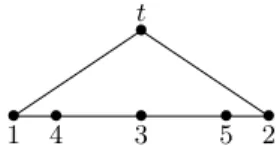
Fig. 2. The instance used in the proof of Proposition 1
A Appendix
Proposition 1. There exists a metric instance of the transportation game with m = 2 resources having identical permutations which does not admit any super strong equilibrium.
Proof. Consider the instance depicted in Fig. 2 with m = 2 resources available. We have d(1, t) = d(2, t), d(3, 1) = d(3, 2), d(4, 1) = d(5, 2) and d(3, t) > 0. The permutation of each resource is the identity. In order to break ties, resource 1 is always chosen if the two resources induce the same cost. A super strong equilibrium σ must be a Nash equilibrium so we can suppose that σ1 = 1and σ2 = 2. Now it suffices to consider all possible strategies for players 3, 4 and 5. Actually, for every profile, there exists within {3, 4, 5} a non-empty coalition of players who can deviate so that the cost of every member of the coalition does not increase and the individual cost of at least one player strictly decreases. E.g., consider the state σ = (1, 2, 2, 1, 1). We have c3(σ) = d(3, 2) + d(2, t), c4(σ) = d(4, 1) + d(1, t) and c5(σ) = d(5, 4) + d(4, 1) + d(1, t). If players 3 and 5 switch, then σ′ = (1, 2, 1, 1, 2). We have c3(σ′) = d(3, 1) + d(1, t) = c3(σ)and c5(σ′) = d(5, 2) + d(2, t) < c5(σ). ⊓⊔ Theorem 3. For m = 2 resources and metric distances, the transportation game has a NE that can be computed in O(n).
Proof. Let r1and r2be the two resources. We let wlog. the permutation of r1be the identity permutation and let π2 be the permutation of r2. We assign all players to r1, consider them one-by-one, as they appear in π2, and let them deviate to r2 if this improves their cost. More formally, for i = 1, . . . n, player j = π2(i)computes her cost cj(r1)in r1and cj(r2)in r2, in the current configuration. Player j stays in r1, if cj(r1)≤ cj(r2), and she moves to r2, otherwise.
Moving players from r1to r2can only decrease the completion time of those staying on r1. Hence, if a player does not move to r2 in her turn, she does not move to r2 later on. We next show that after a player moves to r2, she never prefers to return to r1. Therefore, the procedure above reaches a pure NE in n steps.
For sake of contradiction, let j be a player on r2that can improve her cost by returning to r1and let kbe the first player whose move from r1 to r2 makes j prefer r1to r2. For convenience, we let cj(r1) and cj(r2)(resp. c′j(r1)and c′j(r2)) be j’s cost on r1and r2before (resp. just after) k moves from r1to r2. We also use similar notation for k. By hypothesis, c′j(r1) < c′j(r2)and ck(r1) > ck(r2). Since the players move to r2in the order they appear in π2, k’s move to r2does not increase j’s completion time on r2, i.e., c′j(r2) = cj(r2). Moreover, by the triangle inequality,
ck(r2)≥ d(k, j) + cj(r2) = d(k, j) + c′j(r2) (3) since r2has to move from k to j and then from j to t. Since j prefers r1to r2after k’s move, k is picked after j in r1. Let ℓ < k be the node picked immediately after k in r1in the configuration just before k’s move from r1to r2. Then, the triangle inequality implies that
• • • • • • c b a t d e • • • • • • • • • 7 6 5 4 3 2 1 0 t
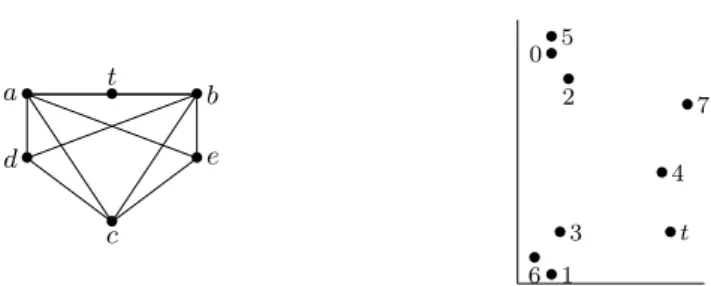
Fig. 3. On the left, an illustration of the instance used in the proof of Proposition 10. On the right, an illustration of the instance used in the proof of Proposition 3.
The second inequality holds because j is picked before k, and thus before ℓ, in r1. Hence, if j moves back to r1, r1 has to move from j to ℓ (possibly passing through other nodes) and then from ℓ to t. Hence, c′
j(r1)≥ d(j, ℓ) + cℓ(r1).
Combining (3) and (4) with ck(r1) > ck(r2), since k moves from r1 to r2, we obtain that d(k, j) + c′j(r2)≤ ck(r2) < ck(r1)≤ d(k, j) + c′j(r1)
Therefore, c′
j(r1) > c′j(r2), after k moves from r1to r2, which contradicts the hypothesis that j wants
to return to r1. ⊓⊔
Proposition 10. For m = 2 resources, there exists a planar instance without any strong equilibrium. Proof. Consider the planar instance depicted in Fig. 3. There are 5 players a, b, c, d and e. The permu-tations on resources 1 and 2 are (b, d, e, c, a) and (a, e, c, d, b), respectively. This instance admits two pure Nash equilibria which are not strong equilibria.
– In the first Nash equilibrium b, d and c are on resource 1 whereas a and e are on resource 2. Therefore d and e can simultaneously switch their strategies and benefit.
– In the second Nash equilibrium b, d are on resource 1 whereas a, e and c are on resource 2. Therefore
d, e and c can simultaneously switch their strategies and benefit. ⊓⊔
Proposition 3. There exists a planar instance with m = 3 resources which does not admit any NE. Proof. There are 8 players denoted by p0, . . . p7. Their coordinates in the plane are given in the next table.
p0 p1 p2 p3 p4 p5
(4, 27) (4, 1) (6, 24) (5, 6) (17, 13) (4, 29)
p6 p7 t
(2, 3) (20, 21) (18, 6) There are 3 resources with the following permutations.
high priority → low priority bus 1p7 p6p5 p4p3 p2p1 p0
bus 2p0 p1p2 p3p4 p5p6 p7
This instance has 38pure states. Since for the players p
7, p0and p3selecting bus 1, bus 2 and bus 3, respectively, is a dominant strategy, the number of pure states that are candidates for an equilibrium is 35 = 243. An exhaustive examination of them shows that none is a pure NE (see also Fig. 3, on the
right, for an illustration of the instance). ⊓⊔
Proposition 4. There exists a metric instance with m = 3 resources and n = 7 players in which the Nash dynamics may cycle.
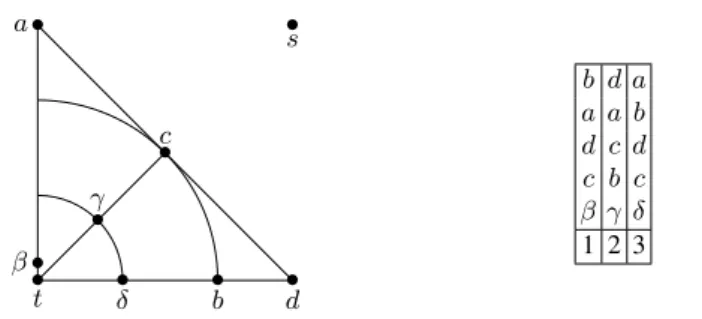
Proof. The metric space and the permutation of each resource are depicted on Figure 4. The priority is given from bottom to top, i.e. β is visited last on resource 1. The cycle consists of 10 states which are given in Table 1. In state σ1, player a can profitably deviate and play resource 1, resulting in state σ2. The next state is σ3where a star indicates which player moves, and so on. Finally, we can move from
σ10back to σ1. ⊓⊔ • • • • • • • • • β c s d b δ a γ t b d a a a b d c d c b c β γ δ 1 2 3
Fig. 4. The metric instance (on the left) and the permutation of each resource (on the right) used in the proof of Proposition 4
1 2 3 a⋆ σ1 b c d b⋆ σ2 a c d c⋆ σ3 a b d d⋆ σ4 a b c 1 2 3 a σ5 d b c⋆ a σ6 d c b⋆ a⋆ σ7 d c b 1 2 3 d⋆ σ8 c a b b σ9 c⋆ a d a b⋆ σ10 c d
Table 1. The 10 states of a cycle. For each state we suppose that β plays 1, γ plays 2 and δ plays 3. The star indicates which player profitably deviates.
Proposition 6. if d satisfies the triangle inequality, then D(σ) ≤ nD(σ∗)holds for every pure strategy profile σ.
Proof. For j ∈ M and a strategy profile σ, let {j1, . . . , jnj} be the players picked in this order by bus j. Thus, D(σ) = Pj≤mPnj
i=1d(ji, ji+1) where jnj+1 = tfor all bus. D(σ) consists of n terms and
each one is at most D(σ∗)by Lemma 1. ⊓⊔
Lemma 2. d(x, y) ≤ 2E(σ∗)holds for every pair of nodes (x, y) ∈ N, and d(x, t) ≤ E(σ∗)holds for every node x ∈ N.
Proof. For the first point if x and y are covered by the same bus in σ∗ then suppose wlog. that the bus visits x before y. Therefore 2E(σ∗) ≥ E(σ∗)≥ cy(σ∗) + d(x, y)≥ d(x, y). If x and y are covered by two different buses in σ∗then d(x, y) ≤ d(x, t) + d(y, t) ≤ c
x(σ∗) + cy(σ∗)≤ 2E(σ∗). For the second point we have E(σ∗)≥ c
x(σ∗)≥ d(x, t). ⊓⊔
Proposition 9. PoS = PoA = dmax/dminfor the transportation game.
Proof. Let σ and σ∗be a pure Nash equilibrium and a socially optimal state, respectively. Let ℓ∗denote the maximum number of players on the same resource in σ∗. Thus E(σ∗) ≥ ℓ∗d
min. By contradiction, suppose E(σ) > dmaxE(σ∗) ≥ dmaxℓ∗. Any player, say i, who has an individual cost of E(σ) in σ shares her bus with at least ℓ∗ other players. There must be a bus b, such that σi 6= b, selected by at most ℓ∗− 1 players in σ, otherwise there are strictly more players in σ than in σ∗. If player i moves to bus b then her individual cost is at most dmaxℓ∗. It contradicts the fact that σ is a Nash equilibrium, so dminE(σ)≤ dmaxE(σ∗).
The second instance given in the proof of Proposition 7 provides a lower bound of (4k − 1)/2k for