HAL Id: hal-00864291
https://hal.archives-ouvertes.fr/hal-00864291
Submitted on 23 Sep 2013
HAL is a multi-disciplinary open access
archive for the deposit and dissemination of
sci-entific research documents, whether they are
pub-lished or not. The documents may come from
teaching and research institutions in France or
abroad, or from public or private research centers.
L’archive ouverte pluridisciplinaire HAL, est
destinée au dépôt et à la diffusion de documents
scientifiques de niveau recherche, publiés ou non,
émanant des établissements d’enseignement et de
recherche français ou étrangers, des laboratoires
publics ou privés.
Implementation of the stroop task using an interactive
table: an experimental study
Holly Miller, Sébastien Kubicki, Christophe Kolski, Janick Naveteur
To cite this version:
Holly Miller, Sébastien Kubicki, Christophe Kolski, Janick Naveteur. Implementation of the stroop
task using an interactive table: an experimental study. CHI ’13 Extended Abstracts on Human
Factors in Computing Systems, Apr 2013, Paris, France. pp.253-258, �10.1145/2468356.2468402�.
�hal-00864291�
Implementation of the Stroop task
using an Interactive Table: An
experimental study
Abstract
We have implemented a psychological test, known as the Stroop task (in its reversed version), using the interactive TangiSense table that is equipped with RFID technology allowing the use of tangible objects. How the test was implemented, as well as the experimental study, are described in this paper. As a general description, participants moved a tangible object into one of four colored zones. The correct colored zone was indicated by a word for a color displayed in congruent or incongruent colored LED lights (e.g., “yellow” displayed in yellow or red, respectively). Participants took more time to place the object in a zone and made more errors when the word was lit with an incongruent than congruent color. These results suggest that the
TangiSense table has applicable value for psychological
research.
Author Keywords
Stroop; Interactive table; RFID; Tangible interactions; TangiSense
ACM Classification Keywords
H.5.m. Information interfaces and presentation (e.g., HCI): Miscellaneous.
Copyright is held by the author/owner(s).
CHI 2013 Extended Abstracts, April 27–May 2, 2013, Paris, France.
ACM978-1-4503-1952-2/13/04. Holly C. Miller Katholieke Universitat Leuven, 3000, Belgium [email protected] Sébastien Kubicki
Lab-STICC UMR6285 / UBO / ENIB European Center for Virtual Reality Technopôle Brest-Iroise
F-29280 Plouzané, France
Christophe Kolski
Univ. Lille Nord de France, F-59000 Lille UVHC, LAMIH, F-59000 Valenciennes CNRS, UMR 8201, F-59313 Valenciennes, France [email protected] Janick Naveteur
Univ. Lille Nord de France, F-59000 Lille
UVHC, LAMIH, F-59000 Valenciennes CNRS, UMR 8201,
F-59313 Valenciennes, France Univ Lille Nord de France, Lille 1, Neurosciences, F-59000 Lille
General Terms
Human Factors; Experimentation; Performance; Measurement.
Introduction
Interactive tables offer many user advantages including a large surface for interaction and the capacity to display virtual objects and to detect the presence of tangible objects on their surface. Information can be conveyed via a variety of modalities. Vision, touch, and sound can serve as stimuli [4]. Designers of interactive tables and applications are thus disposed to choose the optimal combination of information streams. This is not always easy since perceptual information can compete
with conceptual representations and impact user performance. For
example, incidental observations made in link with the TangiSense color learning research with preschoolers suggests that learning to place a colorless stenciled banana into a yellow zone demarcated on an
interactive table can be impaired if the base of the tangible object on which the image is fixed is painted green [3]. No such difficulty is experienced when the banana image is fixed to a yellow base. This problem is not unique to preschoolers; similar observations are commonly reported for humans of all ages in the psychological literature [5]. J.R. Stroop [7] most famously reported that people take longer to verbally articulate the font color of a word that represents an incongruent color (the word reads “red” but the font and accurate verbal response is “yellow”) than they do for a colored square. This
phenomenon, often referred to as the “Stroop Effect”, continues to be studied using variations of his
procedure [5]. One computerized version of the Stroop task that is now commonly employed requires
participants to respond using specific keys on a keyboard to report the font color of a displayed word regardless of the word’s meaning. During experimental trials a word representing a color is presented using an incongruent font color (e.g., “red” is shown in yellow) and the participant is required to indicate the color of the font (yellow). Latency and accuracy on these trials are compared with performance on control trials that can be colored squares, XXXX’s or arbitrary words presented in different font colors, or congruent words where the font color and the meaning of the word coincide exactly. In general, people have less difficulty choosing the correct response key in a short duration on control trials than experimental trials. Moreover, processing and disregarding the word meaning during experimental trials reduces accurate key presses [2]. A similar pattern of results has been observed when the task is reversed, and the participant is asked to respond to the meaning of the word, and to disregard the color of the font [5]. This “reverse Stroop effect” has been reported in variations of the task that involve spatial elements [6]. We have implemented this version using an interactive table, called TangiSense. This table and its software architecture are described in [4]; several hardware characteristics are provided in the next section. Due to a lack of space, the
implementation is described in this paper only through illustrations and their associated explanations (see Figure 1 and Figure 2).
In the current experimental study that implemented the reverse Stroop task, participants were asked to move a Figure 1. The TangiSense Stroop task.
tangible object into a colored zone that was identified by a written word for that color (see Figure 1). This version of the Stroop task was appropriate because it was known to produce the “Stroop effect” and also because we expected that choosing the colored zone that matched the meaning of the word would be more difficult than choosing the colored zone that matched the colored lights because the former required participants to generalize across semantic and
perceptual domains whereas the latter would enable an LED color matching perceptual strategy. Congruent words, where the color and the meaning of the displayed word were the same, were presented on control trials.
Method
Participants
A previous meta-analytic review reported a large overall effect size (d=2.1) for the Stroop phenomenon in young adults [9]. An a priori power calculation using GPOWER revealed that for a large effect size, with alpha set to .01 (two-tailed) a sample size of 7 would be required for 99% power [1]. We chose to recruit ten right-handed young adults (age range 18-34; M=24.4 years; SD=6.0) whose native language was French and who had normal or corrected to normal vision at the University of Valenciennes and Hainaut-Cambrésis, France. There were 6 male and 4 female participants.
Apparatus
Description of the table
The TangiSense interactive table was designed by the RFIDées company, and is made up of “tiles” of 2.5 cm2,
each containing 64 antennas (8 x 8). Each tile contains a DSP processor, which reads the RFID antennas, the antenna multiplexer, and the communication processor. The reading strategies are prioritized, and the code is
distributed between the processor reader antennas, the processor in charge of multiplexing, and the host computer. The table used in the study measures 1 m square and contains 25 “tiles” slabs (5 x 5) of 1,600 antennas in total. Each antenna contains four RGB LEDs, which enable the display of virtual objects including colored zones, and word stimuli. The tiles are associated with a control interface connected to the host computer by an Ethernet link. For more details, the reader can see [4].
Description of the virtual and tangible objects
The virtual objects consisted of words, zones, and feedback stimuli presented in colored LED lights (Red, Green, Yellow, Blue).
The words projected (“Red”, “Green”, “Yellow”, “Blue”) were written in French (“Rouge”, “Vert”, “Jaune”, “Bleu”), 11.5 cm tall, centered horizontally, and 70 cm from the start zone. The start zone was a dark circle (8 cm diameter) outlined in white LED lights located 3.5 cm from the edge of the table and centered
horizontally. Each of the four colored zones were dark circles (18 cm diameter) outlined in one of four colors with LED lights and were located an equidistance (32 cm) from the start zone, and were arranged in a semi-circle.
Feedback for errors was presented as an “X” (14 cm tall) that appeared 11 cm above the start zone in white LED lights (see Figure 2). The tangible object was a clear cylinder (4 cm diameter, 1 cm tall), see Figure 1.
Procedure
Participants were invited to play a reaction time game on the TangiSense interactive table. Upon arrival each participant signed a consent form that described the
activity. It was written that they would be asked to move a tangible object from a start zone to one of four equidistant colored zones. A word representing a color would be illuminated with colored lights on the table. They were instructed to attend to the meaning of the word and ignore the color of the lights. Their objective was to place the tangible object in the zone that matched the meaning of the word as quickly and
accurately as possible using their dominant right hand. The
experimenter then verbalized the instructions and demonstrated how the table worked. When the participant indicated that he/she was ready to begin, he/she was instructed to put the object in the start zone to initiate the first trial. The experimenter remained present in the room. Each testing session consisted of 160 trials, with an equal number of congruent and incongruent trials presented in a randomized order. A testing trial was initiated once the tangible object (on which was placed an RFID tag) was placed in the start zone. One second after the RFID object tag was detected in this zone a word representing a color (“green”, “red”, “blue”, “yellow”) was illuminated with either a congruent or an incongruent color. Once displayed, a timer was
activated to record the response time to displace the object from the start zone to a colored zone. Once placed into a colored zone, a white halo appeared underneath the object regardless of whether it was placed correctly or incorrectly (see Figure 2). Further movement of the object (corrections) was not allowed
nor was recorded. Accuracy was measured by recording the number of correct placements. An inaccurate placement was followed by the illumination of a white X. The feedback was displayed until the participant moved the tangible object from the colored zone to the start zone to begin the next trial. The participant was allowed to return the object at his/her own pace. Each trial required, on average, 3.75 sec and the total duration of the reverse Stroop task was approximately 10 min.
Once the task was completed, participants were asked to specify their level of agreement to 7 questions by indicating a position along a 10 cm continuous line between two response end-points (visual analogue scale; VAS). The first two questions related to the perceived difficulty of (1) congruent and (2)
incongruent trials. The remaining questions ascertained (3) how boring or amusing they found the task overall, (4) whether it required a lot or little attention to avoid making errors, (5) whether their performance speed relative to other imagined players was bad or good, (6) whether the number of errors they made relative to other imagined players was few or many and (7) whether playing the game made them feel fatigued or energized. The total duration of participation was approximately 15 min.
The response time data for each participant was averaged across all trials and any response time that was 2 standard deviations above the individual’s average was eliminated for comparison regardless of trial type. This was done because on some trials the RFID tag was not immediately detected and thus an artificially long response time was recorded (2% of trials). The overall average by trial type for each participant was then log transformed. This was done to Figure 2. The TangiSense Stroop
Task. An incongruent trial where “RED” (“ROUGE” in French) is lit in yellow (top left). An incorrect response for this incongruent trial (top right). A congruent trial where “BLUE” (“BLEU”) is lit in blue (bottom left). The correct response for this trial (bottom right).
correct for the positive skewness inherent to response time data. These transformed averages were then subjected to analysis.
The number of response errors was counted by trial type for each participant. The response time by word presented (Red, Yellow, Blue, Green) was also
averaged, and log transformed, to investigate whether there were any spatial biases.
RESULTS
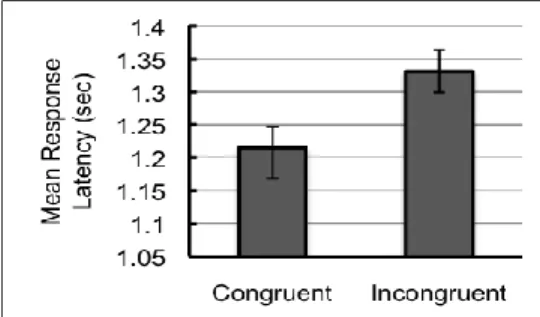
The average time to move the tangible object into a colored zone was shorter for congruent (M=1.21 s;
SD=.10) than incongruent (M=1.33 s; SD=.15) trials
(see Figure 3). Response errors were produced less frequently for congruent (M=0.20; SD=.63) than incongruent (M=2.20; SD=2.04) trials (see Figure 4). When asked to respectively evaluate the difficulty of the different trial types, participants reported that congruent trials were easier (M=1.41; SD=1.2) than incongruent trials (M=5.34; SD=1.41).
A one-way analysis of variance (ANOVA) for correlated samples indicated that the difference in response time was significant F(1, 9)=75.39, p<.01, d=.95, it was shorter for congruent trials. This difference was not affected by the location of the target zone, as time to respond did not differ according to the word presented on the table F(3, 27)=.52, p=.67. Response error rate also differed significantly between trial types F(1, 9)=12, p<.01, d=1.32 as did perceived difficulty F(1, 9)=84.04, p<.01, d=3.01, accuracy was higher for congruent trials and these trials were perceived to be easier.
Participants indicated that in general they found the task amusing (M=7.85, SD=2.07) and that playing the game was stimulating (M=6.02, SD=2.32). They
believed that relative to other players they responded quickly (M=6.91, SD=1.37), and made few errors (M=2.34, SD=2.13). This is despite the fact that they believed the task demanded a great deal of attention (M=2.37, SD=2.58).
DISCUSSION
When participants were confronted with information that required them to attend to relevant conceptual dimensions while simultaneously ignoring irrelevant perceptual dimensions, their response accuracy and response time were reduced relative to when the same conceptual information did not require the processing and suppression of irrelevant perceptual information. These findings are consistent with and extend those reported in the psychological literature [5]. The size of the effect that we observed was large (d=.95), which reflects the fact that on average all participants showed poorer performance on incongruent than congruent trials. Taken together, these results evidence that Stroop-like interference can negatively affect user experience of a task designed for tangible computing technology. On average, participants reported that the task demanded a great deal of attention. Despite this, the task was perceived as amusing and relatively invigorating. Observations made during the execution of the task include, laughing at errors, crying out at errors (“Damn!”) and providing self-praise for a succession of fast and quick responses. This may be interpreted as evidence for the appealing nature of interactive tables. Participants may enjoy standing and moving around more than sitting in front of a
computer. Given that standing and moving are
associated with reduced risk of depression, anxiety, and medical disorders when compared to sitting [8], it is Figure 4. The mean number of response
errors made by trial type. Error bars represent SEM.
Figure 3. The mean response time for congruent and incongruent trials. Error bars represent standard error of the mean (SEM).
possible that interactive tables may be inherently more suitable for human work-life.
This experiment was meant to directly investigate the effects of cognitive conflict on user performance and experience of an application designed for the
TangiSense interactive table. This was satisfactorily
accomplished. However, there were other factors that could be, but were not, considered. For example, interactive tables offer the unique possibility to record object trajectory shifts. Thus, it is possible to measure action inhibition and decision-making as a function of object movement. Further research with the
TangiSense table will take advantage of this possibility.
In addition, performance on the reverse and not the typical Stroop task was examined in the current study even though it could be argued that more or less interference may have occurred using the original version. Further research comparing performance on both versions is planned.
Conclusion
The Stroop effect emerged when conflicting information streams were displayed by an application designed for the TangiSense interactive table. Irrelevant and discordant perceptual information increased response time and decreased accuracy. These findings have two primary implications. First, care should be taken when information streams are selected during the
development of applications for interactive tables. Second, interactive tables can be used to further examine Stroop-like phenomenon.
Acknowledgements
This research work was partially financed by the “Ministère de l'Education Nationale, de la Recherche et de la Technologie”, the “région Nord Pas de Calais”, the
CNRS, the FEDER, CISIT, and especially the "Agence Nationale de la Recherche” (TTT and IMAGIT ANR projects 2010 CORD 01701). The authors would like to thank also Yohan Lebrun and Maxence Courbez for their contributions.
References
[1] Erdfelder, E., Faul, F., and Buchner, A. GPOWER: A general power analysis program. Behavior Research
Methods, Instruments, & Computers, 28, (1996), 1-11.
[2] Fairclough, S.H., and Houston, K. A metabolic measure of mental effort. Biological Psychology, 66(2) (2004), 177-190.
[3] Kubicki, S., Lepreux, S., and Kolski, C. Evaluation of an interactive table with tangible objects: Application with children in a classroom. In Proc. 2nd Workshop on
Child Computer Interaction "UI Technologies and Educational Pedagogy", at CHI'2011, Vancouver, May.
[4] Kubicki, S., Lepreux, S., and Kolski, C. RFID-driven situation awareness on TangiSense, a table interacting with tangible objects. Personal and Ubiquitous
Computing, 16(8), (2012), 1079-1094DOI: 10.1007/s00779-011-0442-9
[5] MacLeod, C.M. Half a century of research on the Stroop effect: An integrative review. Psychological
Bulletin, 109(2), (1991), 163-203.
[6] Palef, S.R. Judging pictorial and linguistic aspects of space. Memory and Cognition, 6(1), (1978), 70-75. [7] Stroop, J.R. Studies of interference in serial verbal reactions. Journal of Experimental Psychology, 18(6), (1935), 643-662.
[8] Van der Ploeg, H.P., Chey, T., Korda, R.J., Banks, E., and Bauman, A. Sitting time and all-cause mortality risk in 222 497 Australian adults. Archives of Internal
Medicine, 172(6), (2012), 494-500.
[9] Verhaeghen, P., and De Meersman, L. Aging and the Stroop effect: A meta-analysis. Psychology and