HAL Id: hal-02520476
https://hal.archives-ouvertes.fr/hal-02520476
Submitted on 26 Mar 2020HAL is a multi-disciplinary open access
archive for the deposit and dissemination of sci-entific research documents, whether they are pub-lished or not. The documents may come from teaching and research institutions in France or abroad, or from public or private research centers.
L’archive ouverte pluridisciplinaire HAL, est destinée au dépôt et à la diffusion de documents scientifiques de niveau recherche, publiés ou non, émanant des établissements d’enseignement et de recherche français ou étrangers, des laboratoires publics ou privés.
Estimation of business process system adequacy
Saïd Assar
To cite this version:
Saïd Assar. Estimation of business process system adequacy. BPMDS 2007 : 8th Workshop on Business Process Modeling, Development, and Support, Jun 2007, Trondheim, Norway. pp.385 - 388. �hal-02520476�
Estimation of Business Process System Adequacy
Saïd Assar
Information Systems department, GET/INT, Evry – France [email protected]
Abstract. In information systems projects, the adequacy of designed and
implemented solution is difficult to define and to measure. Using literature review and empirical investigation, adequacy is defined in this paper as the best compromise between quality requirements and cost constraints. Quality and cost are defined as the weighted sum of quality and cost items. The obtained model is briefly illustrated to show a possible usage of our proposal.
Keywords: BPM system quality, BMP system cost, BPM system evaluation.
1 Introduction
Problems related to information systems (IS) development and implementation have been recognized as wicked problems: it is almost impossible to specify the problem in an absolute manner, the design of a given solution corresponds to a certain understanding of the problem (and vice versa), it is always possible to imagine and/or to design a better solution, etc. The solution to a wicked problem will often have a political aspect; it will be an adequate compromise between conflicting requirements and constraints combined with a mutual agreement between stakeholders [10, 11]. For such an adequate compromise to be reached, the IS engineering process must rely on tools and techniques so that all stakeholders can get an early estimation of the IS to be constructed and how much effort it will take to implement it [11]. In the IS engineering field in general, such tools already exist: conceptual modeling, functional and HCI prototyping, software evaluation techniques, project typologies and contingency factors, etc. In the case of ERP implementation for example, experience capitalization can be used to estimate at early project stages how much time, money and organizational changes are needed. It can give an early insight about the adequacy between the targeted ERP implementation and the requiring enterprise [8].
The subject of this short paper is a proposal for estimating at initial design stages the adequacy of possible business process support solutions. The main idea is to consider adequacy as a compromise between the quality of proposed or implemented system and its cost. Quality relates to the quality of business processes design and to the quality of the targeted system, while cost is estimated from different perspectives (organizational, technical, financial, etc.).
The rest of this paper is structured as follows: section 2 presents briefly related works concerning quality of IS modeling and engineering. Section 3 describes the model and it constituents while section 4 illustrates how the model can be used.
2
Related Works
Lot of work has been dedicated to IS quality in general and to conceptual models quality in particular. In [4], DeLone and McLean lay down the basis of empirical evaluation of IS success. Information quality and system quality impact user usage and user satisfaction which in turn impacts the individual and the organization performance. Concerning the quality of conceptual models, fundamental ideas are introduced in [5] through a three concept framework. Syntax relate the model to modeling language, semantics relates the model to the domain, and pragmatics relates the model to audience participation and interpretation. Multiple other works concerning IS quality and model quality are based on this framework [6, 12].
Model evaluation can be extended to evaluate tools supporting model creation or execution. In [2], an extension of the syntax-semantics-pragmatics framework is used for workflow system evaluation. In [3], workflow systems are evaluated in a more pragmatic way by measuring performance objectives like speed (the time between service ordering and its delivery), quality (the degree in which each service is in accordance with the product specifications), flexibility (the ability of the process to be adapted to the changing needs) and reliability (the extent to which the processes perform as expected without unscheduled maintenance).
Another trend of research in empirical IS evaluation is the search and assessment of success factors. In such approaches, the focus is on post-hoc evaluation of IS implementations such as ERP projects [7]. In the specific context of BPM support, [1] report on an empirically derived process modeling success model. The subjective and empirical nature of this type of research limits the scope of the results.
3
Empirical Definition of BPS Adequacy
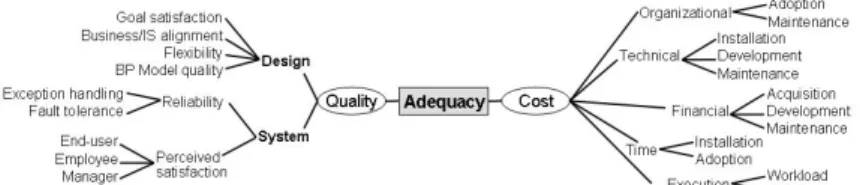
We intuitively define adequacy as the best compromise between quality requirements and expected cost. Quality is twofold: design quality and implementation (or system) quality (figure 1). The design quality concerns the designed solution: to which extent it satisfies the goals of the organization, to which extent it aligns the IS with its business strategy, how much flexibility is possible, together with the intrinsic quality of the BP model used to design the business processes.
Fig. 1. Components of the adequacy model.
The system quality characterize the implemented system: the level of reliability which in turn corresponds to degree of fault tolerance and to level of correct handling of exceptions, and the perceived satisfaction of all stakeholders (end-user or client, organization employees and managers). We did not include the level of fit between
the support system and the designed business processes as it seems to us very difficult to measure [9]. Cost is related to the expected (or realized) cost of installing (and/or developing), maintaining and using the designed/implemented system. Different layers of cost are identified: organizational cost of adopting and maintaining the system and the designed processes (organization change, human resources hiring and/or training, etc.), technical and financial cost for acquiring, installing, developing and maintaining the designed system, the time (or delays) necessary to install and adopt the designed system, the execution cost is the workload and resource consumption during the execution of the BP process on the supporting system.
The global quality of a BP design or implementation is a calculated aggregate of different quality items defined in the model. To each quality item must be associated a metric (or an estimation technique) so that to get a numerical value. The estimation of the global quality can then be seen as the sum of the weighted value of each quality item. In a similar manner, the global cost is the sum of the weighted value of each cost item. Adequacy can then be defined using the following formula:
Adequacy = ∑wi*qi / ∑wj*cj . (1)
where qi is the measured (or estimated) value for quality item i and cj is the measured
(or estimated) value for cost item j.
4
Illustration
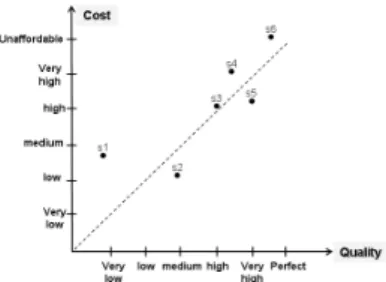
Let's consider the situation where a company wants to move from an IS composed of heterogeneous legacy and proprietary systems to a BPM based system. Six different scenarios can be imagined:
- S1: do nothing, keep on maintaining the actual system
- S2: make a BPM analysis and design and implement an EAI solution using internal competencies for design and development
- S3: make a BPM analysis and implement an EAI solution through outsourcing - S4: make a BPM analysis and implement SAP partially using outsourcing
- S5: make a BPM analysis and design and implement an open source ERP using a combination of internal competencies and outsourcing
- S6: make a BPM analysis and design and implement SAP fully using outsourcing
Depending on the goals of the company, the available budget and time, the level of internal competencies in BP modeling, the expected level of business process flexibility, the level of organization maturity etc., the estimation of quality and cost items for each of the mentioned scenarios would lead to the situation depicted in figure 2. The most adequate solutions for this company - in its specific context - are (in descending order) solutions 2, 5 and 3, while solutions 4 and 6 are too expensive and solution 1 is of unacceptable quality.
5
Conclusion
The most adequate business process management solution for a given situation (a company with specific requirements, a certain budget and time constraints, etc.) is a delicate compromise between quality and cost. We have proposed in this paper an intuitive and empirical definition of adequacy. This definition is based on two main characteristics of BPM projects: quality and cost. Quality and cost are defined as the sum of weighted items. The selection of these items is based on literature review, but is of empirical nature however. Using experimental techniques and literature review, future work will investigate the definition of adequate metrics for quality and cost items, and will experiment the model on real life cases.
References
1. Bandara, W., Gable, G., Rosemann, M.: Business Processing Modeling Success: An Empirically Tested Measurement Model. Proceedings 27th ICIS conf., 895-913, (2006). 2. Carlsen, S., Krogstie, J., Lindland, O-I.: Evaluating Flexible Workflow Systems. Proceedings
of 30th Annual Hawaii Int. Conference on System Sciences (HICSS-30), 230-239, (1997). 3. Choennia, S., Bakkera, R., Baetsa, W.: On the Evaluation of Workflow Systems in Business
Processes. Electronic Journal of Inf. Syst. Evaluation, vol.6(2), (2003).
4. DeLone, W.H., McLean, E.R.: Information Systems Success: The Quest for the dependant variable. Journal of Information Systems Research, 3(1), 60-95, (1992).
5. Lindland, O-I., Sindre, G., Sølvberg, A.: Understanding Quality in Conceptual Modeling. IEEE Software 11(2), 42-49, (1994).
6. Maes, A., Poels. G.: Evaluating Quality of Conceptual Models Based on User Perceptions. Proceedings of 25th Entity/Relationship conference,54-67, (2006).
7. Nah, F.F-H., Lau, J.L-S., Kuang, J.: Critical Factors for Successful Implementation of Enterprise Systems. Business Process Management Journal, vol.7(3), 285-296, (2001). 8. Parr, A.N. , Shanks, G.: A Taxonomy of ERP Implementation Approaches. Proceedings of
the 33th Hawaii Int. Conference on System Science (HICSS-33), (2000).
9. Regev, G., Wegmann, A.: Remaining Fit: On the Creation and Maintenance of Fit. BPMDS workshop, CAiSE 2006 Workshops (2), 131-137, (2004).
10.Simon, H.A.: Whether Software Engineering Needs to Be Artificially Intelligent. IEEE Transaction on Software Engineering, vol.12(7),726-732, (1986).
11.Solvberg, A., Kung, D. C.: Information Systems Engineering. Springer-Verlag, 1993. 12.Taylor, C., Sedera, W.: Defining the Quality Business Process Reference Models. 14th