This is a pre-print of:
Verpoorten, D., Chatti, M., Westera, W., & Specht, M. (2010). Personal Learning Environment on a Procrustean Bed – Using PLEM in a Secondary-School Lesson. In C.A. Shoniregun & G.A. Akmayeva (Eds.), Proceedings of the London International Conference on Education (LICE-2010) (pp. 197-203). London, United Kingdom: LICE. ISBN:978-0-9564263-5-2
Using the Personal Learning Environment Manager in a Secondary-School
Lesson
Dominique Verpoorten
1, Mohamed Amine Chatti
2, Wim Westera
1, Marcus Specht
1CELSTEC, Open University of the Netherlands
1, University of Aachen
2, The Netherlands
{dve, wim, spe}@ou.nl
1[email protected]
2Abstract
This paper reports on the use of a Web 2.0 artifact by nine 14/15 year-old pupils in a formal learning context. The gathered data provides a first appreciation of how the participants saw the action of tagging resources as affecting four dimensions of their learning experience: satisfaction, feeling of learning, effects on memorization and understanding and personalization of the learning sequence. Based on these self-reported judgments, a discussion is opened on the mere decision to divert highly complex Web 2.0 tools into "ordinary" learning tools.
1. Introduction
Personal Learning Environments, widget technology, social software, all Web 2.0 artifacts which promote the bookmarking, tagging and sharing of resources, are gaining momentum [1, 2] and have even been portrayed as the future of education [3, 4]. However, their possible contribution to regular school instruction, remains unclear. This paper reports an attempt to incorporate a Web 2.0 artifact in a lesson. The artifact was developed by the University of Aachen. It is called PLEM (Personal Learning Environment Manager) [5]. While using this tool, students got acquainted with the tagging of the resources they found, that is with a common action conveyed and bolstered by the development of the Web 2.0. A modicum of empirical studies specifically address the cognitive and learning effects of the sequence "searching-tagging" on individuals [6, 7, 8, 9, 10]. The experiment presented here differs from these in that: (a) it takes place in a formal learning context, (b) it is set up in a secondary school, (c) it explicitly addresses contribution of tagging to generic skills
acquisition (memorizing, understanding) and not only to knowledge enhancement.
2. Methodology
2.1. Research designThe study took place in a "Religions Studies" class offered to pupils aged 14 to 15 at the European School Mol (Belgium). During a lesson of 45', they were asked to search for Web resources on an assigned topic (the Belgian missionary Father Damian), to add and tag these resources in their PLEM (Personal Learning Environment Manager) and to look at the evolution of their tags cloud. PLEM is a rich tool providing facilities to qualify and orchestrate a personal collection of Web resources. It offers many functions. However, the lesson plan chosen for the study restricted the use of PLEM to three of them: (a) bookmarking: learner bookmarks interesting contents related to his learning of the assigned topic, (b) tagging: learner assigns free-chosen keywords to the Web resources he found on the topic, (c) building a tags cloud: the system caters for a real-time visual representation of the resources and their tags. In this experiment, specific effects of each function are not assessed. Observations and questionnaires bear on the overall use of the tool as a learning appliance.
In the realm of Web 2.0 research, the three functions referred above are usually related to the so-called "social Web", stressing the fact that the resources and their qualifications can be shared with others. The assignment given here to pupils does not only drastically scope down the functions of PLEM. It also leaves out this social dimension. No mutual sharing of bookmarks, no comparison with peers' tags were included in the learning activity. (Interestingly, Glahn [6] recently pinpointed that
learners' main use of tagging and tags cloud was not "social" in the first place but initially guided by "cognitive management" needs of individuals).
Pupils were introduced to the tool during a 20 minutes session just before the beginning of the lesson. After the lesson, pupils answered an ad-hoc questionnaire meant to evaluate aspects of their learning experience: overall appreciation, feeling of learning, perceived contribution of the learning activity to understanding and memorization and contextualization of PLEM-based activity to an enhanced personalization of the unit of learning.
2.2. Data gathering
Three methods were used to collect data.
2.2.1. Questionnaires. This data comes from participants’ answers to an questionnaire available through the online service Questback. The questionnaire comprised 23 questions (in four groups) meant to examine:
• pupils' appreciation of the task and its level of complexity;
• pupils' judgement of learning, viz. questions asking students to report the learning they believe they achieved or can achieve as a consequence of having taken the lesson [11, 12, 13];
• pupils' evaluation of the benefit that can occur in the reflective process itself of filling in a questionnaire [12] about their learning experience;
• pupils' understanding of PLEM and its functionalities.
Self-reported evaluations therefore provide the major part of the gathered data. This approach, viz. taking "subjective" claims as the main material for the investigation, was adopted for the following reasons: • from a research perspective, it is important to
achieve more objective evaluations of subjectivity [14, 15], especially regarding the acceptance and real use of new appliances; • from a instruction perspective, asking for
students' opinion upon the learning sequence they experience might be a (meta-)learning vehicle of its own right. In their work on "reflection amplifiers", seen as structured opportunities for students to examine and evaluate various aspects of their learning experience, Verpoorten et al. [16] describe learners' appreciation of the task, judgment of learning and other auto-cognitive and rating instruments as techniques to train reflection and self-awareness;
• from a teacher/course evaluation, McKeachie et Kaplan [17] express the viewpoint that students'
estimation of their own learning, achievement of course goals, motivation for further learning, etc. are preferable to their evaluation of teacher or learning tools characteristics.
However, we looked for some triangulations with more "objective" data that are now described. 2.2.2. Analysis of a consequential task.As a final and integrative task, pupils were asked to write down a text about Father Damian from the elements they learnt through the PLEM-based sequence.
2.2.3. Observation of the activity outputs. This data comes from the analysis of participants' contribution in PLEM. By observing their tags and personal clouds, we tried to crosscheck some of their subjective claims.
3. Results
Due to the very small size of the sample, results are given as raw figures.
3.1. Judgment of learning
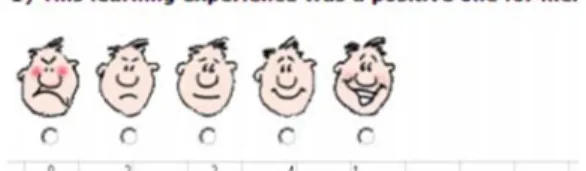
"Judgment of learning" is defined as asking learners to report the benefits they believe they reaped as a consequence of having taken a course or a lesson. To the question "What have you learnt from the lesson?", two answers (both explicitly stated and repeated by the teacher in his introduction and both clearly visible in the assignment page received by all pupils) were expected: (a) expected answer 1 (concerned with content): "I learnt about the life of Father Damian" (the historical character to which the web search was dedicated), (b) expected answer 2 (concerned with process): "I learnt about using a tool called PLEM". Results show that a majority of students restrain their judgment of learning to content-related aspects (expected answer n°1). Two pupils miss both points (content and process), talking about what they learnt from the whole year course. Only one pupil out of nine mentions: "we learnt to do tags". The same low proportion of pupils aware of a procedural learning (expected answer n°2) is found in the reasons given by pupils to justify their overall appreciation of the learning experience (see Figure 1).
Figure 1. One pupil claims to be very satisfied with the PLEM-based lesson, 4 satisfied, 2 indifferent, 2 not satisfied. The two unsatisfied pupils give the complexity of the tool as a justification for non satisfaction. The
two indifferent pupils do not give consistent answers, making reference to their experience of the whole course and not of the PLEM-based course. The satisfied and very satisfied people motivate their rating (several reasons possible) by: (a) a feeling of learning about the assigned topic (3 answers), (b) the fact that such a lesson is different from regular lessons (2 answers), (c) a feeling of learning about the tool used (1 answer). Again, the portion of learning linked to processes is mentioned only by one pupil, despite its explicit mention and the massive presence of the new tool in the learning activity. It could be objected that the weak occurrence of the expected answer n°2 is due to a pre-existing knowledge of the tool. As they would already master this aspect of the learning experience, they would not mention it as new learning. Though no explicit question was settled thereabout, the knowledge of the tool is quite doubtful due to its still experimental dimension and to its current non transparent address. Furthermore, only two pupils report a prior use of social bookmarking and none of tagging. From other indices (use of e-mail, resources used to get informed about a topic), participants also appear to be mainly anchored in a "book- culture".
3.2. Self-efficacy judgment
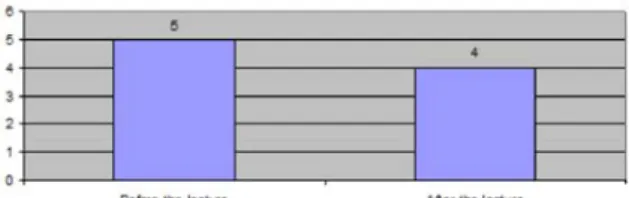
"Self-efficacy judgment" is defined as engaging pupils in self-assessment of their perceived level of knowledge of the assigned topic. Figure 2 compares these judgments, as collected before and after the lesson. Pupils could choose between four levels of knowledge going from ignorance to a detailed knowledge. In pupils' eyes, the PLEM-based learning activity resulted in learning gains.
Figure 2. On the self-efficacy scale, the group report progress.
3.3. Tagging and generic skills development
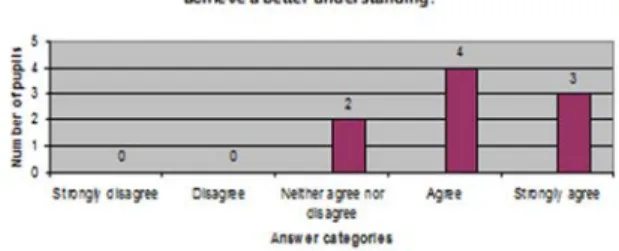
Since it is doubtful that Web 2.0 technologies will convince teachers without efforts to make explicit the competence these technologies are likely to train, the study collected appreciations of how the participants saw the action of tagging as affecting their understanding (see Figure 3) and memorization (see Figure 4), considered as generic skills.
Figure 3. Pupils are affirmative about the positive impact of tagging on their memorization.
Figure 4. Pupils are affirmative about the positive impact of tagging on their memorization.
We tried to obtain objective confirmation of this positive relationship that pupils trace between tagging and memorizing by analysing the final text. We compared the words used as tags to the words used in the final text. Words used in both were supposed to be evidence of memorization. Hence, this approach turned out to be flawed and did not give conclusive results. The only thing that can be said is that the words in the final text have been used as tags (see Table 1).
Table 1. Comparison of tags and words in the final text.
Tags on resources (in brackets, number of resources) Tags in the personal cloud Words in the final text Words common to tags and final text Pupil 1 34 (3) 25 7 5 Pupil 2 12 12 6 4 Pupil 3 23 (4) 22 7 4 Pupil 4 7 6 3 3 Pupil 5 5 5 6 2 Pupil 6 16 (2) 14 10 4 Pupil 7 20 (3) 20 13 10 Pupil 8 11 10 4 4 Pupil 9 6 6 5 3
3.4. Contextualization of the tagging activity
Four questions aimed at identifying participant perceptions in engaging with a learning events like the PLEM-based lesson. The purpose is to investigate how they posit different modes of engagement against each others. This part of the questionnaire tried to contextualize Web 2.0 appliances in a range of learning methods diversification. In this case, the assignment done in PLEM appears as one learning event among others. It could have been completed by regular chalk-and-talk teaching, collaborative learning, or drill-and-practice events. These possibilities replace the exploration of the topic done with the support of PLEM into the general issue of the diversification of
learning methods [18, 19]. The questions related to this issue requested an effort of imagination. Pupils were asked to give what would be the best location of the PLEM exercise in a broader sequence that would be dedicated to the same topic and that would include a lecture on the topic. From the answers (see
Figure 5), it appears that nearly the same amount of students would place this exercise before or after a lecture on the topic.
Figure 5. Ideal location of the PLEM exercise in a broader unit of learning.
Interestingly, this striking equality was also obtained in a research on the ELEKTRA serious game [20], conducted on a larger sample of pupils (see Figure 6) . Other study, other learning tool (a serious game) and similar results: according to pupils' claim, instructional activities of a learning sequence could be given different arrangements.
Figure 6. Ideal sequencing of activities using technological tools.
4. Discussion
Does it make sense to make a limited use of so an complex Web 2.0 tool, as PLEM, in a traditional environment as a classroom? From the study, we draw two observations regarding the relevance and the approach of Web 2.0 tools in secondary school settings.
4.1. Formal learning requests specific approaches
The use of Web 2.0 artifacts in formal instruction contexts has not retained much attention so far. Even widgets that claim to have just a link with the realm of school are far less numerous than widgets conceived for other domains. A quick search, conducted on January 22, 2010, on Yahoo Widgets website with the keywords "school", "education" and "learning" returns respectively 18, 46 and 56 results
while games, calendar, webcams, finance or news return 501, 101, 209, 80 and 616 results. Neither in Google gadgets nor in Apple Dashboard widgets, was education listed in the categories. On Google gadgets website, gadgets for sport returns 3527 results, games 29.927, finance 894, education 244, school 1219, learning 851. A closer look shows that, from a qualitative viewpoint, many widgets retrieved for the three keywords (school, learning, education) on the three websites are foreign to regular classroom or e-learning course, to say nothing of the sickening "Last day of school countdown" widget. Up to now, the available scientific literature does not put a lot into this issue. Its efforts mainly bear on mash-up integration of existing widgets and third-party tools with institution-centric information, services, LMSs and VLEs [21, 22, 23]. Concerns about architecture, interoperability and reusability are dominant and these technical issues remain impenetrable, if not incomprehensible, for the educator who sticks to a basic concern: what it means to work with these new technological artifacts and how this affects the type of educational support offered to the students. Technological development takes for granted that existing tools and widgets can be loaded with enough instructional value to be used in relation with formal instruction processes or units of learning [24], which might turn not to be the case or only at certain conditions sometimes hard to achieve at school. It also assumes that student's personal learning environments (PLEs) composed of widgets not offered by the institution should remain available as support for regular courses [25], which also might not be the case. For instance, Hardy et al. [26] show that even when undergraduates do have a good level of IT competence and confidence, they tend to be conservative in their approaches to university study, maintaining a clear separation between technologies for learning and for social networking. We therefore think it important to keep technological development and real-world experimentation in parallel, otherwise there is a risk to solve highly technical challenges while basic instructional practice is neglected. The handbook produced by the iCamp European project is a noticeable attempt to make Web 2.0 closer to real-world practice [27].
4.2. Scaffolds towards Web 2.0 tools are needed
In the area of personal learning environment research, Mödritscher et al. [28] have developed this daring pedagogical assumption: "we consider the learning environment an important part of the learning outcome as opposed to an instructional condition. Therefore, a learner designs her learning environment by establishing a network of people, artifacts, and tools (manually or with the support of
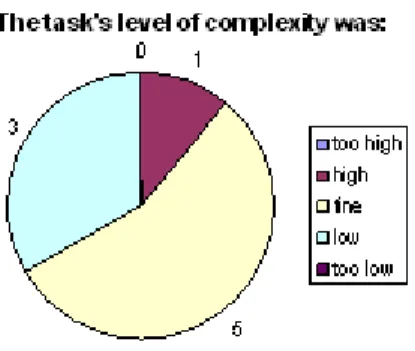
personalization services) and interacting with that environment" (in the same line of reasoning see [29]). This stance, very interesting but demanding in regard to the development of meta-learning abilities, establishes a macro-competence ("I am capable of designing my learning environment") but does not provide any clue about the scaffolding needed to achieve it. Obviously, the pupils having participated to the present study are far from the ambitious objective. Here, PLEM has been restricted to three of its functionalities. Despite this drastic amputation, the majority of pupils found that the task was at a right or at a high level of complexity (see Figure 7).
Figure 7. Even restricted and tutored use of PLEM represents a fine or high level of complexity for mostf pupils.
When asked to describe what PLEM is, only one pupil out of nine managed to give an answer reflecting the specifics of the tool. How can a pupil be guided to the understanding and the optimal management of a personal learning environment? Maybe through very constrained tasks like the ones presented here, even though they look ridiculous to current users of PLEs. The problem is that these advanced users, and developers of PLEs are among them, are already deep into self-regulated learning and take Web2.0 functionalities for granted as well as the knowledge and the skills going along these practice. Such assumptions can induce a certain blindness to the conditions of acceptance and use in real-world instruction settings.
5. Conclusion
As rightly expressed by Merrill et al.'s [30], there is a major difference between formal and informal learning: "Students are persons who submit themselves to the acquisition of specific knowledge and skill from instruction, learners are persons who derive meaning and change their behavior based on their experiences. All of us are learners, but only those who submit themselves to deliberate instructional situations are students". This article reported an attempt to have a Web 2.0 tool, so far used for informal learning, used by students in a formal learning context. A small-scale questionnaire
survey allowed to explore secondary pupils' perspective on their first confrontation with such a tool. Satisfaction, feeling of learning, perceived effects of the tool on generic competence have been documented. Results gave rise to observations related to the need for more investigation of real-world practice and to the scaffolding towards an autonomous usage of Web 2.0 artifacts.
6. References
[1] C. Owen, "Market Map: Gadget et Widget Universe", 2007. Retrieved 26 July, 2010, from
http://www.firstpartner.net/upload/pdf1231772560746.pdf
[2] S. Wilson, "Patterns of personal learning environments", 2008. Retrieved 26 July, 2010, from http://digitalcommons.bolton.ac.uk/iec_journalspr/4
[3] G. Attwell, "Personal Learning Environments - the future of eLearning?", 2007. Retrieved 26 July, 2010, from http://www.elearningeuropa.info/files/media/media11561. pdf
[4] D. Jones, "PLES: framing one future for lifelong learning, e-learning and universities", 2008. Paper presented at the 5th International Lifelong Learning (Ascilite), Melbourne.
[5] Anggraeni, "PLEM (http://eiche.informatik.rwth-aachen.de:3333/PLEM): A Web 2.0 Driven Service for Personal Learning Management", 2008. Unpublished Master thesis, Rheinisch-Westfalische Technische Hochschule Aachen.
[6] C. Glahn, M. Specht, and R. Koper, "Reflecting on web-readings with tag clouds", 2008. Paper presented at the 11th International Conference on Interactive Computer aided Learning (ICL), Valencia.
[7] S. Panke, and B. Gaiser, B, "With My Head Up in the Clouds'': Using Social Tagging to Organize Knowledge. Journal of Business and Technical Communication, 23, 2009, pp. 318-349.
[8] B. Raluca, P. Peter, and H. Lichan, . "Remembrance of things tagged: how tagging effort affects tag production and human memory", 2009. Paper presented at the Proceedings of the 27th international conference on Human factors in computing systems, Boston.
[9] C. Shergold, J. Davies, J., and S. Lamour, S, "Now we're talking: how tag clouds can improve skill conversations at university", 2009. Paper presented at the 7th e-learning@greenwich conference - Making it personal, Greenwich.
[10] J. Yew, F. P. Gibson, and S. D. Teasley, "Learning by Tagging: The Role of Social Tagging in Group Knowledge Formation", MERLOT Journal of Online Learning and Teaching, 2(4), 2006, pp. 275-285.
[11] R. Azevedo, R., "Computer Environments as Metacognitive Tools for Enhancing Learning", Educational Psychologist, 40, 2005, pp. 193-197.
[12] C. Ellett, K. Loup, R. Culross, J. McMullen, and J. Rugutt, "Assessing Enhancement of Learning, Personal Learning Environment, and Student Efficacy: Alternatives to Traditional Faculty Evaluation in Higher Education", Journal of Personnel Evaluation in Education, 11(2), 1997, pp. 167-192.
[13] V. Richmond, P. McCroskey, P. Kearney, and T.G. Plax, "Power in the classroom VII: Linking behavior alteration techniques to cognitive learning", Communication Education, 36, 1987, pp. 1-12.
[14] B. De Finetti, "Methods for discriminating levels of partial knowledge concerning a test item", British Journal of Mathematical and Statistical Psychology, 18, 1965, pp. 87-123.
[15] D. Leclercq, "Qualités édumériques de systèmes d’évaluation pédagogique des performances cognitives des étudiants", Labset, University of Liège, Belgium, 2004.
[16] D. Verpoorten, W. Westera, and M. Specht, "A classification framework of techniques for amplifying student's reflection in e-learning courses", Journal of Interactive Learning Research, 21(4), 2010.
[17] W.J. McKeachie, and M. Kaplan, "Persistent problems in evaluating college teaching, American Association of Higher Education Bulletin, 48(6), 1996, pp. 5-9.
[18] D. Verpoorten, C. Delfosse, and S. Jacobs, S., "Representing learning trails with the 8 Learning Events Model". Retrieved 27 July, 2010, from http://www.labset.net/projets/iclass/debate1.htm
[19] D. Verpoorten, M. Poumay, and D. Leclercq, "The eight learning events model: A pedagogic conceptual tool supporting diversification of learning methods", Interactive Learning Environments, 15:2, 2007, pp. 151 - 160.
[20] J-L. Castaigne, and D. Verpoorten, "Final ELEKTRA report: Macroadaptivity - Why a varied learning diet?", University of Liège, Belgium, 2008.
[21] J.I. Asensio-Perez, M.L. Bote-Lorenzo, G. Vega-Gorgojo, Y.A. Dimitriadis, E. Gomez-Sanchez, E., and E.D. Villasclaras-Fernandez, "Adding mash-up based tailorability to VLEs for scripted Collaborative Learning", 2008. Paper presented at the 1st Workshop MUPPLE’08, Maastricht, The Netherlands.
[22] O. Casquero, J. Portillo, R. Ovelar, J. Romo, and M. Benito, M., "iGoogle and gadgets as a platform for integrating institutional and external services", 2008. Paper presented at the 1st Workshop MUPPLE’08, Maastricht, The Netherlands.
[23] S. Wilson, P. Sharples, P., and D. Griffiths, "Distributing education services to personal and institutional systems using Widgets", 2008. Paper
presented at the 1st Workshop MUPPLE’08, Maastricht, The Netherlands.
[24] L. de la Fuente Valentín, D. Leony, A. Pardo, and C. Delgado Kloos, "Mashups in Learning Design: pushing the flexibility envelope", 2008. Paper presented at the 1st Workshop MUPPLE’08, Maastricht, The Netherlands.
[25] S. Verjans, H. Hermans, M. Bertrand, J. Eshuis, D. Janssen and F. Mofers, "Principes voor een Persoonlijke Leer- en Werkomgeving voor de Open Universiteit Nederland", Instellingsbreed Programma Onderwijs (IPO), Heerlen, The Netherlands, 2008.
[26] J. Hardy, D. Haywood, S. Bates, J. Paterson, S. Rhind, H. Macleod, and J. Haywood, "Expectations and Reality: Exploring the use of learning technologies across the disciplines", 2008. Paper presented at the Sixth International Conference on Networked Learning, Halkidiki, Greece.
[27] Icamp, "How to use social software in higher education - A handbook". Retrieved 26 July, 2010, from http://www.icamp.eu/wp-content/uploads/2009/01/icamp-handbook-web.pdf
[28] M. Mödritscher, F. Wild, and S. Sigurdarson, "Language Design for a Personal Learning Environment Design Language". Paper presented at the 1st Workshop MUPPLE’08, Maastricht, The Netherlands.
[29] M. Moedritscher, and F. Wild, F., "Why not Empowering Knowledge Workers and Lifelong Learners to Develop their own Environments?", 2009. Paper presented at the I-Know 09, Graz, Austria.
[30] M. Merrill, L. Drake, M. Lacey, M., and J. Pratt, "Reclaiming instructional design", Educational Technology, 36(5), 1996, pp. 5-7.