HAL Id: hal-02508838
https://hal.inria.fr/hal-02508838
Submitted on 16 Mar 2020
HAL is a multi-disciplinary open access
archive for the deposit and dissemination of
sci-entific research documents, whether they are
pub-lished or not. The documents may come from
teaching and research institutions in France or
abroad, or from public or private research centers.
L’archive ouverte pluridisciplinaire HAL, est
destinée au dépôt et à la diffusion de documents
scientifiques de niveau recherche, publiés ou non,
émanant des établissements d’enseignement et de
recherche français ou étrangers, des laboratoires
publics ou privés.
Data Centric Workflows for Crowdsourcing
Pierre Bourhis, Loïc Hélouët, Zoltan Miklos, Rituraj Singh
To cite this version:
Pierre Bourhis, Loïc Hélouët, Zoltan Miklos, Rituraj Singh. Data Centric Workflows for
Crowdsourc-ing. Petri Nets 2020 - 41st International Conference on Application and Theory of Petri Nets and
Concurrency, Jun 2020, Paris, France. pp.1-39. �hal-02508838�
Data Centric Workflows for Crowdsourcing
1Bourhis, Pierre1 and H´elou¨et, Lo¨ıc2and Miklos, Zoltan3 and Singh, Rituraj3 2
1
CNRS, Univ. Lille and 2INRIA Rennes and3Univ. Rennes, France 3
Abstract. Crowdsourcing consists in hiring workers on internet to perform large 4
amounts of simple, independent and replicated work units, before assembling the 5
returned results. A challenge to solve intricate problems is to define orchestrations 6
of tasks, and allow higher-order answers where workers can suggest a process to 7
obtain data rather than a plain answer. Another challenge is to guarantee that 8
an orchestration with correct input data terminates, and produces correct out- 9
put data. This work proposes complex workflows, a data-centric model for crowd- 10
sourcing based on orchestration of concurrent tasks and higher order schemes. We 11
consider termination (whether some/all runs of a complex workflow terminate) and 12
correctness (whether some/all runs of a workflow terminate with data satisfying FO 13
requirements). We show that existential termination/correctness are undecidable 14
in general excepted for specifications with bounded recursion. However, universal 15
termination/correctness are decidable when constraints on inputs are specified in 16
a decidable fragment of FO, and are at least in co−2EXP T IM E. 17
1
Introduction
18Crowdsourcing leverages intelligence of crowd to realize tasks where human skills 19
still outperform machines [25]. It was successful in contributive science initiatives, 20
such as CRUK’s Trailblazer [3], Galaxy Zoo [5], etc. Most often, a crowdsourcing 21
project consists in deploying a huge number of tasks that can be handled by humans 22
in a reasonable amount of time. Generally, work units are simple micro-tasks, that 23
are independent, cheap, repetitive, and take a few minutes to an hour to complete. 24
They can be labeling of images, writing scientific blogs, etc. The requester publishes 25
the tasks on a platform with a small incentive (a few cents, reputation gain, good- 26
ies...), and waits for the participation from the crowd. However, many projects, 27
and in particular scientific workflows, can be seen as a coordination of high-level 28
composite tasks. As noted by [38], composite tasks are not or poorly supported 29
by crowdsourcing platforms. Crowdsourcing markets such as Amazon Mechani- 30
cal Turk [1], Foule Factory [4], CrowdFlower[2], etc. already propose interfaces and 31
APIs to access crowds, but the specification of crowd based complex processes is still 32
in its infancy. Some works propose solutions for data acquisition and management 33
or deployment of workf lows, mainly at the level of micro-tasks [17, 29]. Crowd- 34
forge uses Map-Reduce techniques to solve complex tasks [23]. Turkit [30] builds 35
on an imperative language embedding calls to services of a crowdsourcing plat- 36
form, which requires programming skills to design complex orchestrations. Turko- 37
matic [26] and [41] implement a Price, Divide and Solve (PDS) approach: crowd 38
workers divide tasks into orchestrations of subtasks, up to the level of micro-tasks. 39
However, current PDS approaches ask clients to monitor workflows executions. In 40
The next stage of crowdsourcing is hence to design more involved processes 1
still relying on the crowd. A first challenge is to fill the gap between a high-level 2
process that a requester wants to realize, and its implementation in terms of micro- 3
tasks composition. Moving from one description level to the other is not easy, and 4
we advocate the use of expertise of the crowd for such refinement. This can be 5
achieved with higher-order answers, allowing a knowledgeable worker to return an 6
orchestration of simpler tasks instead of a crisp answer to a question. A second 7
challenge in this setting is to give guarantees on the termination (whether some/all 8
runs terminate) and correctness of the overall process (whether the output data 9
returned by a crowdsourced process meet some requirements w.r.t input data). 10
This paper proposes a data-centric model called complex workflows, that define 11
orchestrations of tasks with higher-order schemes, and correctness requirements 12
on input and output data of the overall processes. Complex workflows are mainly 13
orchestrations of data transformation tasks, that start from initial input datasets 14
that are explicitly given as crisp data or represented symbolically with a logical 15
formula. Workers can contribute to micro-tasks (input data, add tags...) or refine 16
tasks at runtime. Some easy tasks (simple SQL queries or record updates) are au- 17
tomated. Input/Output (I/O) requirements are specified with a fragment of FO. 18
We address the question of termination (whether all/some runs terminate) and cor- 19
rectness (whether all/some runs terminate and meet the I/O requirements). Due 20
to higher-order, complex workflows are Turing complete, and hence existence of 21
a terminating run is undecidable. However, one can decide whether all runs of a 22
complex workflow terminate as soon as initial data is fixed or specified in an FO 23
fragment where satisfiability is decidable. Existential termination becomes decid- 24
able with the same constraints on initial data as soon as recursion in higher-order 25
rewritings is bounded. We then show that existential correctness is undecidable, and 26
universal correctness is decidable if constraints on data are expressed in a decidable 27
fragment of FO. The complexity of termination and correctness depends mainly on 28
the length of runs, and on the complexity of satisfiability for the FO fragment used 29
to specify initial data and I/O requirements. It is at least in (co-)2EXPTIME for 30
the simplest fragments of FO, but can increase to an n-fold complexity for FO 31
fragments that use both existential and universal quantification. 32
Several formal models have been proposed for orchestration of tasks and ver- 33
ification in data-centric systems or business processes. Workflow nets [40, 39], a 34
variant of Petri nets, address the control part of business processes, but data is 35
not central. Orchestration models such as ORC [22] or BPEL [36] can define busi- 36
ness processes, but cannot handle dynamic orchestrations and are not made to 37
reason on data. [10] proposes a verification scheme for a workflow model depicting 38
business processes with external calls, but addresses operational semantics issues 39
(whether some ”call pattern” can occur) rather than correctness of the computed 40
data. Several variants of Petri nets with data have been proposed. Obviously, col- 41
ored Petri nets [20] have a sufficient expressive power to model complex workflows. 42
But they are defined at a low detail level, and encoding higher-order necessarily 43
have to be done through complex color manipulations. Complex workflows sepa- 44
transitions manipulate global variables exist (see for instance [14]), but they can- 1
not model evolution of unbounded datasets. Other variants of PNs with tokens 2
that carry data have also been proposed in [27]. Termination and boundedness are 3
decidable for this model, but with non-elementary complexity, even when equal- 4
ity is the only predicate used. The closest Petri net variant to complex workflows 5
are Structured Data nets [9], in which tokens carry structured data. Higher order 6
was introduced in nested Petri nets [31] a model where places contain sub-nets. 7
Interestingly, termination of nested nets is decidable, showing that higher-order 8
does not imply Turing completeness. Data-centric models and their correctness 9
have also been considered. Guarded Active XML [7] (GAXML) is a model where 10
guarded services are embedded in structured data. Though GAXML does not ad- 11
dress explicitly crowdsourcing nor higher-order, the rewritings performed during 12
service calls can be seen as a form of task refinement. Restrictions on recursion in 13
GAXML allows for verification of Tree LTL (a variant of LTL where propositions 14
are statements on data). More recently, [8] has proposed a model for collaborative 15
workflows where peers have a local view of a global instance, and collaborate via 16
local updates. With some restrictions, PLTL-FO (LTL-FO with past operators) is 17
decidable. Business artifacts were originally developed by IBM [35], and verification 18
mechanisms for LTL-FO (LTL formula embedding FO statements over universally 19
quantified variables) were proposed in [13, 24]. LTL-FO is decidable for subclasses 20
of artifacts with data dependencies and arithmetic. [15] considers systems com- 21
posed of peers that communicate asynchronously. LTL-FO is decidable for systems 22
with bounded queues. Business artifacts allow for data inputs during the lifetime 23
of an artifact, but are static orchestrations of guarded tasks, described as legal 24
relations on datasets before and after execution of a task. Further, LTL-FO verifi- 25
cation focuses mainly on dynamics of systems (termination, reachability) but does 26
not address correctness. [18] considers data-centric dynamic systems (DCDS), i.e. 27
relational databases equipped with guarded actions that can modify their contents, 28
and call external services. Fragments of FO µ-calculus are decidable for DCDS with 29
bounded recursion. 30
2
Motivation
31Our objectives are to provide tools to develop applications in which human actors 32
execute tasks or propose solutions to realize a complex task, and check the cor- 33
rectness of the designed services. The envisioned scenario is the following: a client 34
provides a coarse grain workflow depicting important phases of a complex task to 35
process data, and a description of the expected output. The tasks can be completed 36
in several ways, but cannot be fully automated. It is up to a pool of crowdwork- 37
ers to complete them, possibly after refining difficult tasks up to the level of an 38
orchestration of easy or automated micro-tasks. 39
The crowdsourcing model presented in section 4 is currently used to design a 40
real example, the SPIPOLL initiative [6]. The objective of SPIPOLL is to study 41
populations of pollinating insects. The standard processes used by SPIPOLL call 42
for experience of large pools of workers to collect, sort and tag large databases 43
n0 Collect n1 Select nf Classif y D∅ Dranked n tlike D Dranked n0 tsplit n1 tdog n2 tcat n3 toth nf tjoin D Dranked
Fig. 1. a) A simple actor popularity poll, and b) a rule example.
with the needs of SPIPOLL, as tagging pictures of rare insects is not a simple 1
annotation task, and usually calls for complex validation processes. 2
Let us illustrate the needs and main features of complex workflows, refinement, 3
and human interactions on a simpler example. A client (for instance a newspaper) 4
wants to rank the most popular actors of the moment, in the categories comedy, 5
drama and action movies. The task is sent to a crowdsourcing platform as a high- 6
level process decomposed into three sequential phases: first a collection of the most 7
popular actors, then a selection of the 50 most cited names, followed by a classifi- 8
cation of these actors in comedy/drama/action category. The ranking ends with a 9
vote for each category, that asks contributors to associate a score to each name. The 10
client does not input data to the system, but has some requirements on the output: 11
it is a dataset Dranked with relational schema rout(name, cites, category, score), 12
where name is a key, cites is an integer that gives the number of cites of an actor, 13
category ranges over {drama, comedy, action} and score is a rational number be- 14
tween 0 and 10. Further, every actor appearing in the final database should have 15
a score and a number of cites greater than 0. Obviously, there are several ways to 16
collect actors names, several ways to associate a category tag, to vote, etc. How- 17
ever, the clients needs are defined in terms of an orchestration of high-level tasks, 18
without information on how the crowd will complete them, and without any ter- 19
mination guarantee. The orchestration is depicted in Figure 1-a. It starts from an 20
empty input dataset D∅, and returns an actor popularity dataset Dranked. 21
In the rest of the paper, we formalize complex workflows and their semantics 22
(Sec. 4). We then address termination (Sec. 5) and correctness (Sec. 6). More 23
precisely, given a complex workflow CW , we consider the following problems: 24
Universal termination: Does every run of CW terminate ? 25
Existential termination: Is there an input for which at least one run of CW 26
terminates ? 27
Universal correctness: For a given I/O requirement ψin,out relating input and 28
output data, does every run of CW terminate and satisfy ψin,out?
29
Existential correctness: For a given I/O requirement ψin,out, is there a particular 30
input and at least one run of CW that terminates and satisfies ψin,out? 31
3
Preliminaries
32We use a standard relational model [12], i.e., data is organized in datasets, that 33
follow relational schemas. We assume finite set of domains dom = dom1, . . . , doms, 34
a finite set of attribute names att and a finite set of relation names relnames. Each 35
(or table) is a pair rs = (rn, A), where rn is a relation name and A ⊆ att denotes 1
a finite set of attributes. Intuitively, attributes in A are column names in a table, 2
and rn the table name. The arity of rs is the size of its attributes set. A record of 3
a relational schema rs = (rn, A) is tuple rn(v1, . . . v|A|) where vi∈ dom(ai) (it is a 4
row of the table), and a dataset with relational schema rs is a multiset of records 5
of rs. A database schema DB is a non-empty finite set of tables, and an instance 6
over a database DB maps each table in DB to a dataset. 7
We address properties of datasets with First Order logic (FO) and predicates 8
on records. For simplicity and efficiency, we will consider predicates defined as sets 9
of linear inequalities over reals and integer variables. We use FO to define relations 10
between the inputs and outputs of a task, and requirements on possible values of 11
inputs and outputs of a complex workflow. 12
Definition 1 (First Order). A First Order formula (in prenex normal form) over 13
a set of variables
−→
X = x1, . . . , xn is a formula of the form ϕ ::= α( −→ X ).ψ( −→ X ) 14 where α( −→
X ) is an alternation of quantifiers and variables of
−→
X , i.e. sentences 15
of the form ∀x1∃x2, ... called the prefix of ϕ and ψ( −→
X ) is a quantifier free for- 16
mula called the matrix of ϕ. ψ(
−→
X ) is a boolean combinations of atoms of the 17
form rni(x1, . . . xk) ∈ Di, Pj(x1, . . . xn), where rni(x1, . . . xk)’s are relational state- 18
ments, and Pj(x1, . . . xn)’s are boolean function on x1, . . . xn called predicates. 19
In the rest of the paper, we consider variables that either have finite domains 20
or real valued domains, and predicates specified by simple linear inequalities of 21
dimension 2, and in particular equality of variables, i.e. statements of the form 22
xi= xj. One can decide in NP if a set of linear inequalities has a valid assignment, 23
and in polynomial time [21] if variables values are reals. Let
−→
X1 = {x1, . . . xk} ⊆ 24
−→
X . We write ∀−→X1 instead of ∀x1.∀x2. . . ∀xk, and ∃ −→
X1 instead of ∃x1.∃x2. . . ∃xk. 25
We use w.l.o.g. formulas of the form ∀
−→ X1∃ −→ X2. . . ψ(X) or ∃ −→ X1∀ −→ X2. . . ψ(X), where 26
ψ(X) is a quantifier free matrix, and for every i 6= j,
−→ Xi∩ −→ Xj = ∅. Every set of 27 variables −→
Xi is called a block. By allowing blocks of arbitrary size, and in particular 28
empty blocks, this notation captures all FO formulas in prenex normal form. We 29
denote by ϕ[t1/t2] the formula obtained by replacing every instance of term t1in ϕ 30
by term t2. Each variable xi in −→
X has a domain Dom(xi). A variable assignment 31
is a function µ that associates a value dxfrom Dom(x) to each variable x ∈ −→
X . 32
Definition 2 (Satisfiability). A variable free formula is satisfiable iff it evaluates 33
to true. A formula of the form ∃x, φ is satisfiable iff there exists a value dx ∈ 34
Dom(x) such that φ[x/dx] is satisfiable. A formula of the form ∀x, φ is satisfiable 35
iff, for every value dx∈ Dom(x), φ[x/dx] is satisfiable. 36
It is well known that satisfiability of an FO formula is undecidable in general, 37
but it is decidable for several fragments. The universal fragment (resp. existential 38
fragment) of FO is the set of formulas of the form ∀
−→
X .ϕ (resp. ∃
−→
quantifier free. We denote by ∀FO the universal fragment of FO and by ∃FO the 1
existential fragment. Checking satisfiability of the existential/universal fragment 2
of FO can be done non-deterministically in polynomial time. In our setting, where 3
atoms in FO formula are relational statements and linear inequalities, satisfiability 4
of formulas with only universal or existential quantifiers is decidable and (co)-NP- 5
complete. We refer interested readers to Appendix B for a proof. 6
One needs not restrict to existential or universal fragments of FO to get decid- 7
ability of satisfiability. A well known decidable fragment is (F O2), that uses only
8
two variables [34]. However, this fragment forbids atoms of arity greater than 2, 9
which is a severe limitation when addressing properties of datasets. The BS frag- 10
ment of FO is the set of formulas of the form ∃
→
Y1.∀ →
X2.ψ, where ψ is quantifier 11
free, may contain predicates, but no equality. The Bernays-Schonfinkel-Ramsey 12
fragment of F O [11] (BSR-FO for short) extends the BS fragment by allowing 13
equalities in the matrix ψ. Satisfiability of a formula in the BS or BSR fragment 14
of FO is NEXPTIME-complete (w.r.t. the size of the formula) [28]. 15
Recent results [37] exhibited a new fragment, called the separated fragment of 16
FO, defined as follows: Let V ars(A) be the set of variables appearing in an atom 17
A. We say that two sets of variables Y, Z ⊆ X are separated in a quantifier free 18
formula φ(X) iff for every atom At of φ(X), V ars(At)∩Y = ∅ or V ars(At)∩Z = ∅. 19
A formula in the Separated Fragment of F O (SF -FO for short) is a formula of the 20
form ∀ → X1.∃ → Y2. . . . ∀ → Xn.∃ → Ynφ, where → X1· · · ∪ → Xn and → Y1· · · ∪ → Yn are separated. 21
The SF fragment is powerful and subsumes the Monadic Fragment [32] (where 22
predicates can only be unary) and the BSR fragment. Every separated formula can 23
be rewritten into an equivalent BSR formula (which yields decidability of satisfia- 24
bility for SF formulas), but at the cost of an n-fold exponential blowup in the size of 25
the original formula. Satisfiability of a separated formula ϕ is hence decidable [37], 26
but with a complexity in O(2↓n|ϕ|). 27
A recent extension of F O2 called F O2BD allows atoms of arbitrary arity, but
28
only formulas over sets of variables where at most two variables have unbounded 29
domain. Interestingly, F O2BD formulas are closed under computation of weakest 30
preconditions for a set of simple SQL operations [19]. We show in Section 4 that 31
conditions needed for a non-terminating execution of a complex workflow are in 32
∀F O, and that ∀FO, ∃FO, BSR-FO, SF-FO are closed under precondition calculus. 33
4
Complex Workflows
34This section formalizes the notion of complex workflow, and gives their semantics 35
through operational rules. This model is inspired by artifacts systems [13], but 36
uses higher-order constructs (task decomposition), and relies on human actors (the 37
crowdworkers) to complete tasks. We assume a client willing to use the power of 38
crowdsourcing to realize a complex task that needs human contribution to collect, 39
annotate, or organize data. This complex task is specified as a workflow that or- 40
chestrates elementary tasks or other complex tasks. The client can input data to 41
the system (i.e. enter a dataset Din), and may have a priori knowledge on the 42
relation between the contents of his input and the plausible outputs returned after 43
such as opinion polls, citizen participation, etc. High-level answers of workers are 1
seen as workflow refinements, and elementary tasks realizations are simple opera- 2
tions that transform data. During an execution of a complex workflow, we consider 3
that each worker is engaged in the execution of at most one task. 4
Tasks: A task t is a work unit designed to transform input data into output data. 5
It can be a high-level description submitted by a client, a very basic atomic task 6
that can be easily realized by a single worker (e.g. tagging images), a task that can 7
be fully automated, or a complex task that requires an orchestration of sub-tasks 8
to reach its objective. We define a set of tasks T = Tac] Tcx] Taut where Tac 9
is a set of atomic tasks that can be completed in one step by a worker, Tcx is a 10
set of complex tasks which need to be refined as an orchestration of smaller sub- 11
tasks to produce an output, and Taut is a set of automated tasks performed by a 12
machine (e.g. simple SQL queries: selection, union, projection...). Tasks in Tacand 13
Taut cannot be refined, and tasks in Tautdo not require contribution of a worker. 14
Definition 3 (Workflow). A workflow is a labeled acyclic graph W = (N, →, λ) 15
where N is a finite set of nodes, modeling occurrences of tasks, →⊆ N × N is a 16
precedence relation, and λ : N → T associates a task name to each node. A node 17
n ∈ N is a source iff it has no predecessor, and a sink iff it has no successor. 18
In the rest of the paper, we fix a finite set of tasks T , and denote by W the set 19
of all possible workflows over T . Intuitively, if (n1, n2) ∈−→, then an occurrence 20
of task named λ(n1) represented by n1 must be completed before an occurrence 21
of task named λ(n2) represented by n2, and the data computed by n1 is used as 22
an input for n2. We denote by min(W ) the set of sources of W , by succ(ni) the 23
set of successors of a node ni, and by pred(ni) its predecessors. The size of W 24
is the number of nodes in N and is denoted |W |. We assume that when a task 25
in a workflow has several predecessors, its role is to aggregate data provided by 26
preceding tasks, and when a task has several successors, its role is to distribute 27
excerpts from its input datasets to its successors. With this convention, one can 28
model situations where a large database is split into smaller datasets of reasonable 29
sizes that are then processed independently. We denote by W \{ni} the restriction 30
of W to N\{ni}, i.e. a workflow from which node niis removed along with all edges 31
which origins or goals are node ni. We assume some well-formedness properties of 32
workflows: Every workflow has a single sink node nf. Informally, we can think 33
of nf as the task that returns the dataset computed during the execution of the 34
workflow. There exists a path from every node niof W to the sink nf. The property 35
prevents from launching tasks which results are never used to build an answer to a 36
client. We define a higher-order answer as a refinement of a node n in a workflow 37
by another workflow. Intuitively, n is simply replaced by W0 in W . 38
Definition 4 (Refinement). Let W = (N, −→, λ) be a workflow, W0= (N0, −→0 39
, λ0) be a workflow with a unique source node n0src = min(W0), a unique sink 40
node n0f such that N ∩ N0 = ∅. The refinement of n ∈ N by W0 in W is the 41
workflow W[n/W0] = (N[n/W0], −→[n/W0], λ[n/W0]), where N[n/W0]= (N \ {n}) ∪ N0, 42
n0 t1 n1 tlike n2 t2 n3 t3 D D0 n0 t1 n2 t2 n3 t3 n00 tsplit n01 tdog n02 tcat n03 toth n0f tjoin D D0
Fig. 2. A refinement of node n1 using rule (tlike, Wlike) of Figure 1-b.
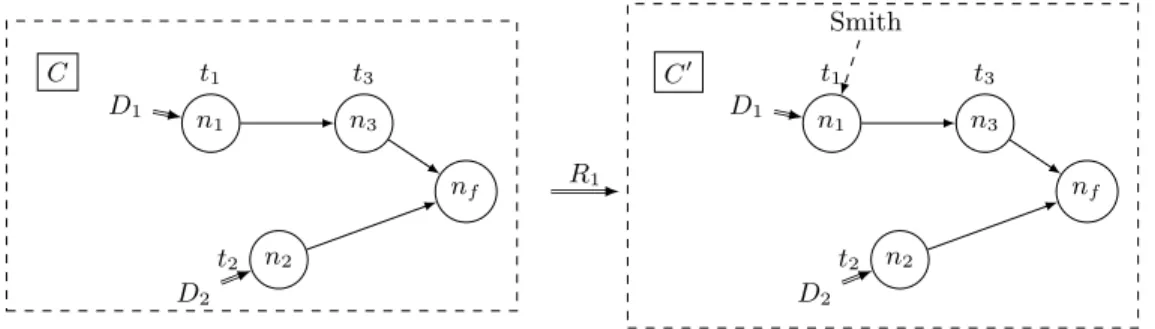
→[n/W0]=→0∪{(n1, n2) ∈→| n16= n ∧ n26= n} ∪ {(n1, n0src) | (n1, n) ∈→} ∪ {(n0f, n2) | 1
(n, n2) ∈→} 2
Definition 5. A Complex Workflow is a tuple CW = (W0, T , U , sk, R) where T 3
is a set of tasks, U a finite set of workers, R ⊆ T × 2W is a set of rewriting rules, 4
and sk ⊆ (U×R) ∪ (U×Tac) defines workers competences. W0is an initial workflow, 5
that contains a single source node ninit and a single sink node nf. 6
We assume that in every rule (t, W ) ∈ R, the labeling λ of W is injective. This 7
results in no loss of generality, as one can create copies of a task for each node in 8
W , but simplifies proofs and notations afterwards. Further, W has a unique source 9
node src(W ). The relation sk specifies which workers have the right to perform or 10
refine a particular task. This encodes a very simple competence model. We refer 11
to [33] for further studies on competences and more elaborated competence models. 12
Let us consider the example of Figure 2-left: a workflow contains a complex task 13
tlike which objective is to rank large collections of images of different animals with 14
a score between 0 and 10. The relational schema for the dataset D used as input for 15
tlikeis a collection of records of the form P icdata(nb, name, kind) where nb is a key, 16
name is an identifier for a picture, kind denotes the species obtained from former 17
annotation of data by crowdworkers. Let us assume that a worker u knows how 18
to handle task tlike (i.e. (u, tlike) ∈ sk), and wants to divide dataset D into three 19
disjoint datasets containing pictures of cats, dogs, and other animals, rank them 20
separately, and aggregate the results. This is captured by the rule R = (tlike, Wlike) 21
of Figure 1-b, where node n0 is an occurrence of an automated tasks that splits 22
an input dataset into datasets containing pictures of dogs, cats, and other animals, 23
n1, n2, n3represent tagging tasks for the respective animal kinds, and node nf is an 24
automated task that aggregates the results obtained after realization of preceding 25
tasks. A higher-order answer of worker u is to apply rule R to refine node n1 in 26
the original workflow with Wlike. The result is shown in Figure 2-right. 27
It remains to show how automated and simple tasks are realized and process 28
their input data to produce output data. At every node n representing a task 29
t = λ(n), the relational schemas of all input (resp. output) datasets are known and 30
denoted rsin
1 , . . . rsink (resp. rsout1 , . . . rsoutk ). We denote by Din = Din1 , . . . Dkin the 31
set of datasets provided by predecessors of t, and by Dout= Dout
1 . . . Dqoutthe set of 32
tasks executions only for nodes which inputs are not empty. The contents of 1
every Dout
i is the result of one of the operations below: 2
SQL-like operations : We allow standard SQL operations: 3
– Selection: For a given input dataset Din
i with schema rn(x1, . . . , xn) and 4
a predicate P (x1, . . . xn), compute Doutj = {rn(x1, . . . xn) | rn(x1, . . . xn) ∈ 5
Din
i ∧ P (x1, . . . xn)}. 6
– Projection: For a given input dataset Din
i with schema rn(x1, . . . xn) and an 7
index k ∈ 1..n compute Dout
j = {rn(x1, . . . xk−1, xk+1, . . . xn) | rn(x1, . . . xn) ∈ 8
Din
i }. 9
– Insertion/deletion : For a given input dataset Din
i and a fixed tuple rn(a1, . . . an),10
compute Dout
j = Dini ∪ {rn(a1, . . . an)} (resp. Djout= Diin\ {rn(a1, . . . an)}) 11
– Union: For two input dataset Din
i , Dink with schema rn(x1, . . . xn), compute 12
Djout= Diin∪ Din
k 13
– Join: For two input dataset Dini , Dink with schema rni(x1, . . . xn) and rnk(y1, . . . yq),14
for a chosen pair of indices indi, indkcompute Djout= {rn0(x1, . . . xn, y1, . . . yindk−115,
yindk+1, . . . yq) | xindi= yindk∧ rni(x1, . . . xn) ∈ D
in
i ∧ rnk(y1, . . . yq) ∈ Dink } 16
– Difference: For two input dataset Din
i , Dink with the same schema rn(x1, . . . xn), 17
compute Dout
j = Dini \ Dkin 18
workers operations : These are elementary tasks performed by workers to mod- 19
ify the datasets computed so far. These operations may perform non-deterministic 20
choices among possible outputs. 21
– Field addition: Given an input dataset Dini with schema rn(x1, . . . xn), a 22
predicate P (.), compute a dataset Doutj with schema rn0(x1, . . . xn, xn+1) such 23
that every tuple rn(a1, . . . , an) ∈ Diinis extended to a tuple rn(a1, . . . , an, an+1) ∈ 24
Dout
j such that P (a1, . . . an+1) holds. Note that the value of field xn+1can be 25
chosen non-deterministically for each record. 26
– Record input: Given an input dataset Din
i with schema rn(x1, . . . xn), and a 27
predicate P , compute a dataset Dout
j on the same schema rn(x1, . . . xn) with 28
an additional record rn(a1, . . . , an) such that P (a1, . . . , an) holds. Note that 29
the value of fields x1, . . . xn+1can be non-deterministically chosen. Intuitively, 30
P defines the set of possible entries in a dataset. 31
– Field update: For each record rn(a1. . . an) of Dini , compute a record rn(b1, . . . bn)32
in Dout
j such that some linear arithmetic predicate P (a1, an, b1, . . . bn) holds. 33
Again, any value for b1, . . . bn that satisfies P can be chosen. 34
Record to record arithmetic operations : For each record rni(a1. . . an) of 35
Din
i , compute a record in Doutj of the form rnj(b1, . . . bq) such that each bk, k ∈ 1..q 36
is a linear combination of a1. . . an. 37
These operations can easily define tasks that split a database Din
1 in two 38
datasets Dout
1 , Dout2 , one containing records that satisfy some predicate P and 39
the other one records that do not satisfy P . Similarly, one can describe input of 40
record from a worker, operations that assemble datasets originating from different 41
threads... To summarize, when a node n with associated task t with I predecessors 42
is executed, we can slightly abuse our notations and write Dout
when the task performs a deterministic calculus (SQL-based operations or record 1
to record calculus), and Dout
k ∈ Fk,t(Din1 , . . . DinI ) when the tasks involves non- 2
deterministic choice of a worker. We now give the operational semantics of complex 3
workflows. 4
An execution starts from the initial workflow W0(the initial high-level descrip- 5
tion provided by a requester). Executing a complex workflow consists in realizing 6
all its tasks following the order given by the dependency relation −→ in the or- 7
chestration, possibly after some refinement steps. At each step of an execution, the 8
remaining part of the workflow to execute, the assignments of tasks to workers and 9
the data input to tasks are memorized in a configuration. Execution steps consist 10
in updating configurations according to operational rules. They assign a task to a 11
competent worker, execute an atomic or automated task (i.e. produce output data 12
from input data), or refine a complex task. Executions end when the remaining 13
workflow to execute contains only the final node nf. 14
A worker assignment for a workflow W = (N, −→, λ) is a partial map wa : N → 15
U that assigns a worker to a subset of nodes in the workflow. Let wa(n) = wi. If λ(n) 16
is a complex task, then there exists a rule r = (λ(n), W ) ∈ R such that (wi, r) ∈ sk 17
(worker wi knows how to refine task λ(n)). Similarly, if λ(n) is an atomic task, 18
then (wi, λ(n)) ∈ sk (worker wi has the competences needed to realize λ(n)). We 19
furthermore require map wa to be injective, i.e. a worker is involved in at most one 20
task. We say that wi∈ U is free if wi6∈ wa(N ). If wa(n) is not defined, and wi is 21
a free worker, wa ∪ {(n, wi)} is the map that assigns node n to worker wi, and is 22
unchanged for other nodes. Similarly, wa\{n} is the restriction of wa to N \ {n}. 23
A data assignment for a workflow W is a function Dass : N → (DB ] {∅})∗, 24
that maps nodes in W to sequence of input datasets. For a node with k predecessors 25
n1, . . . nk, we have Dass(n) = D1. . . Dk. A dataset Di can be empty if ni has not 26
been executed yet, and hence has produced no data. Dass(n)[i/X]is the sequence 27
obtained by replacement of Di by X in Dass(n). 28
Definition 6 (Configuration). A configuration of a complex workflow is a triple 29
C = (W, wa, Dass) where W is a workflow depicting remaining tasks that have to 30
be completed, wa is a worker assignment, and Dass is a data assignment. 31
A complex workflow execution starts from the initial configuration 32
C0 = (W0, wa0, Dass0), where wa0 is the empty map, Dass0 associates dataset 33
Dinprovided by client to ninit and sequences of empty datasets to all other nodes 34
of W0. A final configuration is a configuration Cf = (Wf, waf, Dassf) such that 35
Wf contains only node nf, waf is the empty map, and Dassf(nf) represents 36
the dataset that was assembled during the execution of all nodes preceding nf 37
and has to be returned to the client. The intuitive understanding of this type of 38
configuration is that nfneeds not be executed, and simply terminates the workflow 39
by returning final output data. Note that due to data assignment, there can be more 40
than one final configuration, and we denote by Cf the set of all final configurations. 41
We define the operational semantics of a complex workflow with 4 rules that 42
transform a configuration C = (W, wa, Dass) in a successor configuration C0 = 43
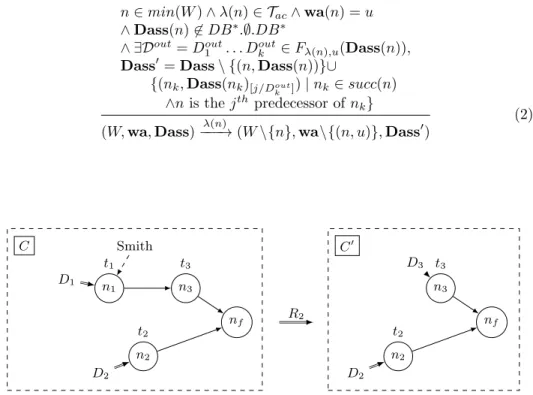
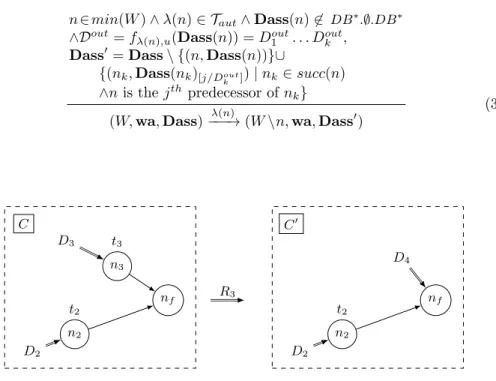
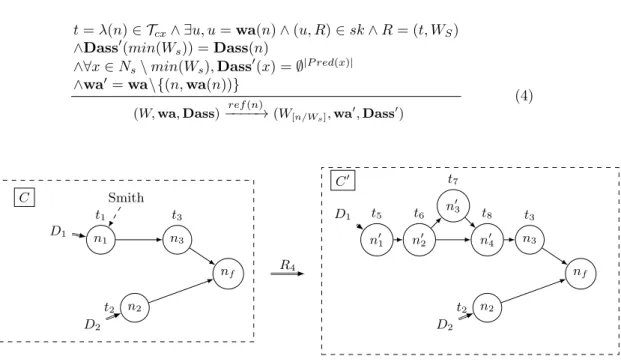
the execution of an atomic task by a worker, Rule 3 defines the execution of an 1
automated task, and Rule 4 formalizes refinement. We only give an intuitive de- 2
scription of semantic rules and refer reader to appendix A for a formal definition. 3
Rule 1 (Worker Assignment): A worker u ∈ U is assigned to a node n. The 4
rule applies if u is free, has the skills required by t = λ(n), if t is not an automated 5
task (t 6∈ Taut) and if node n is not already assigned to a worker. Note that a worker 6
can be assigned to a node even if it does not have input data yet, and is not yet 7
executable. This rule only changes the worker assignment part in a configuration. 8
Rule 2 (Atomic Task Completion): An atomic task t = λ(n) can be executed 9
if node n is minimal in current workflow W , it is assigned to a worker u = wa(n) 10
and its input data Dass(n) does not contain an empty dataset. Upon completion 11
of task t, worker u publishes the produced data Dout to the succeeding nodes of 12
n in the workflow and becomes available. This rule modifies the workflow part 13
(node n is removed), the worker assignment, and the data assignment (new data 14
is produced and made available to successors of n). 15
Rule 3 (Automated Task Completion): An automated task t = λ(n) can be 16
executed if node n is minimal in the workflow and its input data does not contain 17
an empty dataset. The difference with atomic tasks completion is that n is not 18
assigned a worker, and the produced outputs are a deterministic function of task 19
inputs. This rule modifies the workflow part (node n is removed), and the data 20
assignment. 21
Rule 4 (Complex Task refinement): The refinement of a node n with t = 22
λ(n) ∈ Tcx by worker u = wa(n) uses a refinement rule Rt such that (u, t) ∈ sk, 23
and Rt = (t, Wt). Rule 4 refines node n with workflow Wt = (Ns, −→s, λs) (see 24
Def. 4). Data originally used as input by n become inputs of the source node of 25
Wt. All other newly inserted nodes have empty input datasets. This rule changes 26
the workflow part of configurations and data assignment accordingly. 27
We say that there exists a move from a configuration C to a configuration C0, or 28
equivalently that C0 is a successor of configuration C and write C C0 whenever
29
there exists a rule that transforms C into C0. 30
Definition 7 (Run). A run ρ = C0.C1. . . Ck of a complex workflow is a finite 31
sequence of configurations such that C0 is an initial configuration, and for every 32
i ∈ 1 . . . k, Ci−1 Ci. A run is maximal if Ck has no successor. A maximal run 33
is terminated iff Ck is a final configuration, and it is deadlocked otherwise. 34
In the rest of the paper, we denote by Runs(CW, Din) the set of maximal 35
runs originating from initial configuration C0 = (W0, wa0, Dass0) (where Dass0 36
associates dataset Din to node ninit). We denote by Reach(CW, Din) the set of 37
configurations that can be reached from C0. Along a run, the size of datasets in use 38
can grow, and the size of the workflow can also increase, due to refinement of tasks. 39
Hence, Reach(CW, Din) and Runs(CW, Din) need not be finite. Indeed, complex 40
tasks and their refinement can encode unbounded recursive schemes in which work- 41
flow parts or datasets grow up to arbitrary sizes. Even when Reach(CW, Din) is 42
finite, a complex workflow may exhibit infinite cyclic behaviors. Hence, without 43
restriction, complex workflows define transitions systems of arbitrary size, with 44
In section 5, we give an algorithm to check termination of a complex workflow 1
with bounded recursion. Roughly speaking, this algorithms searches a reachable 2
configuration Cbad in which emptiness of a dataset D could stop an execution. 3
Once such a configuration is met, it remains to show that the statement D = ∅ 4
is compatible with the operations performed by the run (insertion, projections, 5
unions of datasets...) before reaching Cbad. This is done by computing backward 6
the weakest preconditions ensuring D = ∅ along the followed run, and checking 7
that they are satisfiable. Weakest precondition were introduced in [16] as a way to 8
prove correctness of programs. They were used recently to verify web applications 9
with embedded SQL [19]. 10
Definition 8. Let C C0 be a move of a complex workflow. Let m be the nature 11
of this move (an automated task realization, a worker assignment, a refinement...). 12
We denote by wp[m]ψ the weakest precondition required for C such that ψ holds 13
in C0 after move m.
14
Moves create dependencies among input and output datasets of a task, that are 15
captured as FO Properties. Further, the weakest precondition wp[m]ψ of an FO 16
property ψ is also an FO property. 17
Proposition 1. Let CW be a complex workflow, r be the maximal arity of rela- 18
tional schemas in CW and ψ be an FO formula. Then for any move m of CW , 19
wp[m]ψ is an effectively computable FO formula, and is of size in O(r.|ψ|). 20
We refer readers to Appendix B.1 for a proof of Proposition 1. If automated 21
tasks use SQL difference, universal quantifiers can be introduced in the weakest 22
precondition. Interestingly, if automated tasks do not use SQL difference, a weakest 23
precondition is mainly obtained by syntactic replacement of relational statements 24
and by changes of variables. It can increase the number of variables, but it does not 25
change the number of quantifier blocks nor their ordering, and does not introduce 26
new quantifiers when replacing an atom. We hence easily obtain: 27
Corollary 1. The existential, universal, BSR and SF fragments of FO are closed 28
under calculus of a weakest precondition if tasks do not use SQL difference. 29
5
Termination of Complex Workflows
30Complex workflows use the knowledge and skills of crowd workers to complete a 31
task starting from input data provided by a client. However, a workflow may never 32
reach a final configuration. This can be due to particular data input by workers 33
that cannot be processed properly by the workflow, or to infinite recursive schemes 34
appearing during the execution. 35
Definition 9 (Deadlock, Termination). Let CW be a complex workflow, Din 36
be an initial dataset, Dinbe a set of datasets. CW terminates existentially on input 37
Din iff there exists a run in Runs(CW, Din) that is terminated. CW terminates 38
universally on input Din iff all runs in Runs(CW, Din) are terminated. Similarly, 39
CW terminates universally on input set Din iff CW terminates universally on 40
every input Din ∈ Din, and CW terminates existentially on Din iff some run of 41
When addressing termination for a set of inputs Din, we describe Din sym- 1
bolically with a decidable fragment of FO (∀FO, ∃FO, BSR, or SF-FO). Complex 2
workflows are Turing powerful (we show in Appendix C.1 how to encode a counter 3
machine). So we get : 4
Theorem 1. Existential termination of complex workflows is undecidable. 5
An interesting point is that undecidability does not rely on arguments based 6
on the precise contents of datasets (that are ignored by semantic rules). Indeed, 7
execution of tasks only requires non-empty input datasets. Undecidability holds as 8
soon as higher order operations (semantic rule 4) are used. 9
Universal termination is somehow an easier problem than existential termina- 10
tion. We show in this section that it is indeed decidable for many cases and in 11
particular when the datasets used as inputs of a complex workflow are explicitly 12
given or are specified in a decidable fragment of F O. We proceed in several steps. 13
We first define symbolic configurations, i.e. descriptions of the workflow part of 14
configurations decorated with relational schemas depicting data available as input 15
of tasks. We define a successor relation for symbolic configurations. We then iden- 16
tify the class of non-recursive complex workflows, in which the length of executions 17
is bounded by some value KTcx. We show that for a given finite symbolic executions 18
ρS, and a description of inputs, one can check whether there exists an execution ρ
19
that coincides with ρS. This proof builds on the effectiveness of calculus of weakest 20
preconditions along a particular run (see Prop. 1). Then, showing that a complex 21
workflow does not terminate amounts to proving that it is not recursion-free, or 22
that it has a finite symbolic run which preconditions allow a deadlock. 23
Definition 10 (Symbolic configuration). Let CW = (W0, T , U , sk, R) be a 24
complex workflow with database schema DB. A symbolic configuration of CW is 25
a triple CS = (W, Ass, DassS) where W = (N, →, λ) is a workflow, Ass : N → U
26
assigns workers to nodes, and DassS : N → (DB)∗ associates a list of relational
27
schemas to nodes of the workflow. 28
Symbolic configuration describe the status of workflow execution as in stan- 29
dard configurations (see def. 6) but leaves the data part underspecified. For every 30
node n that is minimal in W , the meaning of DassS(n) = rs1, . . . rsk is that task 31
attached to node n takes as inputs datasets D1. . . Dk where each Di conforms 32
to relational schema rsi. For a given symbolic configuration, we can find all rules 33
that apply (there is only a finite number of worker assignments or task executions 34
), and compute successor symbolic configurations. This construction is detailed in 35
Appendix C.2. 36
Definition 11 (Deadlocks, Potential deadlocks). A symbolic configuration 37
CS = (W, Ass, DassS) is final if W consists of a single node n
f. It is a dead- 38
lock if it has no successor. It is a potential deadlock iff a task execution can occur 39
from this node, i.e. there exists n, ∈ min(W ) such that λ(n) is an automated or 40
A deadlocked symbolic configuration represents a situation where progress is 1
blocked due to shortage of competent workers to execute tasks. A potential deadlock 2
is a symbolic configuration CS where empty datasets may stop an execution. This
3
deadlock is potential because DassS does not indicate whether a particular dataset
4
Di is empty. We show in this section that one can decide whether a potential 5
deadlock situation in CS represents a real and reachable deadlock, by considering
6
how the contents of dataset Di is forged along the execution leading to CS. 7
Definition 12 (Symbolic run). A symbolic run is a sequence ρS = CS 0 m1 −→ 8 CS 1 m2 −→ . . . mk −→ CS
k where each CiS is a symbolic configuration, Ci+1 is a successor 9
of Ci, and C0S = (W0, Ass0, DassS) where W0, Ass0 have the same meaning as for 10
configurations, and DassS
0 associates to the minimal node n0 in W0 the relational 11
schema of Dass0(n0). 12
One can associate to every execution of a complex workflow ρ = C0 m1 −→ 13 C1. . . Ck a symbolic execution ρS = C0S m1 −→ CS 1 m2 −→ . . . mk −→ CS
k called its sig- 14
nature by replacing data assignment in each Ci= (Wi, Assi, Dassi) by a function 15
from each node n to the relational schemas of the datasets in Dassi(n). It is not 16
true, however, that every symbolic execution is the signature of an execution of 17
CW , as some moves might not be allowed when a dataset is empty (this can occur 18
for instance when datasets are split, or after a selection). A natural question when 19
considering a symbolic execution ρS is whether it is the signature of an actual run
20
of CW . The proposition below shows that the decidability of this question depends 21
on assumptions on input datasets. 22
Proposition 2. Let CW be a complex workflow, Din be a dataset, Din be an FO 23
formula with nin variables, and ρS = C0S. . . CiS be a symbolic run. If tasks do not 24
use SQL difference, then deciding if there exists a run ρ with input dataset Dinand 25
signature ρS is in 2EXP T IM E. Checking if there exists a run ρ of CW and an
26
input dataset Din that satisfies Din with signature ρS is undecidable in general. If 27
tasks do not use SQL difference, then it is in 28
– 2EXP T IM E if Dinis in ∃FO and 3EXPTIME if Dinis in ∀FO or BSR-FO. 29
– nin− f oldEXP T IM E where nin is the size of the formula describing Din if 30
Dinis in SF-FO 31
This proposition is proved in Appendix C.3. It does not yet give an algorithm 32
to check termination, as a complex workflows may have an infinite set of runs and 33
runs of unbounded length. However, semantic rules 1,2,3 can be used a bounded 34
number of times from a configuration (they decrease the number of available users 35
or remaining tasks in W ). Unboundedness then comes from the refinement rule 4, 36
that implements recursive rewriting schemes. 37
Definition 13. Let t be a complex task. We denote by Rep(t) the task names that 38
can appear when refining task t, i.e. Rep(t) = {t0| ∃u, W, (u, t) ∈ sk ∧ (t, W ) ∈ R ∧ 39
t0∈ λ(NW)}. The rewriting graph of a complex workflow CW = (W0, T , U , sk, R) 40
is the graph RG(CW ) = (Tcx, −→R) where (t1, t2) ∈−→R iff t2 ∈ Rep(t1). Then 41
CW is recursion-free if there is no cycle of RG(CW ) that is accessible from a task 42
When a complex workflow is not recursion free, then some executions may 1
exhibit infinite behaviors in which some task ti is refined infinitely often. Such an 2
infinite rewriting loop can contain a deadlock. In this case, the complex workflow 3
does not terminate. If this infinite rewriting loop does not contain deadlocks, the 4
complex workflow execution will never reach a final configuration in which all tasks 5
have been executed. Hence, complex workflows that are not recursion-free do not 6
terminate universally (see the proof of Prop. 3 for further explanations). We show 7
in Appendix C.4, Prop. 5 that recursion-freeness is decidable and in O(|T2
cx| + |R|). 8
Further, letting d denote the maximal number of complex tasks appearing in a 9
rule, there exists a bound KTcx ≤ d
|Tcx| on the size of W in a configuration, 10
and the length of a (symbolic) execution of CW is in O(3.KTcx) (see Prop. 6 in 11
Appendix C.4). We now characterize complex workflows that terminate universally. 12
Proposition 3. A complex workflow terminates universally if and only if: 13
i) it is recursion free, ii) it has no (symbolic) deadlocked execution, 14
iii) there exists no run with signature C0S. . . CiS where C S
i is a potential deadlock, 15
with Dk = ∅ for some Dk ∈ Dass(nj) and for some minimal node nj of Wi. 16
Condition i) can be easily verified, as shown in Prop. 5, Appendix C.4. If i) 17
holds, then there is a bound 3.KTcx on the length of all symbolic executions, and 18
checking condition ii) is an exploration of reachable symbolic configurations to 19
find deadlocks. It requires log(3.KTcx).KTcx space, i.e. can be done in EXPTIME 20
(w.r.t. KTcx). Checking condition iii) is more involved. First, it requires finding a 21
potential deadlock, i.e. a reachable symbolic execution CS
i with a minimal node nj 22
representing a task to execute. Then one has to check if there exists an actual run 23
ρ = C0. . . Ci with signature C0S. . . CiS such that one of the input datasets Dk in 24
sequence Dassi(nj) is empty. Let rsj = (rnk, Ak) be the relational schema of Dk, 25
with Aj= {a1, . . . , a|Aj|}. Then, emptiness of Dkcan be encoded as a universal FO 26
formula of the form ψi::= ∀x1, . . . x|Aj|, rnk(x1, . . . x|Aj|) 6∈ Dk. Then all weakest 27
preconditions needed to reach Ci with Dk = ∅ can be computed iteratively, and 28
remain in the universal fragment of FO (see Prop. 1). If a precondition ψjcomputed 29
this way (at step j < i) is unsatisfiable, then there is no actual run with signature 30
ρS such that Dk is an empty dataset. If one ends weakest precondition calculus 31
on configuration C0S with a condition ψ0 that is satisfiable, and Din |= ψ0, then 32
such a run exists and iii) does not hold. Similarly with inputs described by Din, if 33
Din∧ ψ0 is satisfiable, then condition iii) does not hold. Note that this supposes 34
that Dinis written in a decidable FO fragment. 35
Theorem 2. Let CW be a complex workflow, in which tasks do not use SQL dif- 36
ference. Let Din be an input dataset, and Din be an FO formula. Universal ter- 37
mination of CW on input Din is in co − 2EXP T IM E. Universal termination on 38
inputs that satisfy Din is undecidable in general. It is in 39
– co−2EXP T IM E (in K, the length of runs) if Dinis in ∀FO, co−3EXP T IM E 40
if Din is ∃FO or BSR-FO 41
One can notice that the algorithm to check universal termination of CWs guesses 1
a path, and is hence non-deterministic. In the worst case, one may have to explore 2
all symbolic executions of size at most 3 · KTcx. 3
Undecidability of existential termination has several consequences: As complex 4
workflows are Turing complete, automatic verification of properties such as reach- 5
ability, coverability, boundedness of datasets, or more involved properties written 6
in logics such as LTL FO [13] are also undecidable. However, the counter machine 7
encoding in the proof of Theorem 1 uses recursive rewriting schemes. A natural 8
question is then whether existential termination is decidable when all runs have 9
a length bounded by some integer Kmax. Indeed, when such a bound exists it is 10
sufficient to find a terminating witness, i.e. find a signature ρS of size Kmax end- 11
ing on a final configuration non-deterministically, compute weakest preconditions 12
ψ|ρS|, . . . , ψ0and check their satisfiability. The length of ψ0is in O(rKmax), and as 13
one has to verify non-emptiness of datasets used as inputs of tasks to allow execu- 14
tion of a run with signature ρS, the preconditions are in the existential fragment
15
of FO, yielding a satisfiability of preconditions in O(2rKmax).
16
Theorem 3. Let CW be complex workflow in which tasks do not use SQL dif- 17
ference, and which runs are of length ≤ Kmax. Let Din be a dataset, and Din a 18
FO formula. One can decide in 2 − EXP T IM E (in Kmax) whether CW termi- 19
nates existentially on input Din. If Din is in ∃FO, termination of CW is also in 20
2 − EXP T IM E. It is in 3 − EXP T IM E when Din is in ∀FO or BSR-FO 21
Recursion-free CWs have runs of length bounded by 3.KTcx, so existential ter- 22
mination is decidable as soon as automated tasks do not use SQL difference (which 23
makes alternations of quantifiers appear in weakest preconditions). The bound KTcx 24
can be exponential (see proof of Prop. 2), but in practice, refinements are supposed 25
to transform a complex task into an orchestration of simpler subtasks, and one can 26
expect KTcx to be a simple polynomial in the number of complex tasks. Another 27
way to bound recursion in a CW is to limit the number of refinements that can 28
occur during an execution. For instance, if each complex task can be decomposed 29
at most k times, the bound on length of runs becomes Kmax= 3 · k · n2+ 3 · |W0|. 30
6
Correctness of Complex Workflows
31Complex workflows provide a service to a client, that inputs some data (a dataset 32
Din) to a complex task, and expects some answer, returned as a dataset Dout. A 33
positive answer to a termination question means that the process specified by a 34
complex workflow does not deadlock in some/all executions. Yet, the returned data 35
can still be incorrect. We assume the client sees the crowdsourcing platform as a 36
black box, and simply asks for the realization of a complex task that needs specific 37
competences. However, the client may have requirements on the type of output 38
returned for a particular input. We express this constraint with a FO formula ψin,out 39
relating inputs and outputs, and extend the notions of existential and universal 40
termination to capture the fact that a complex workflow implements client’s needs 41
if some/all runs terminate, and in addition fulfill requirements ψin,out. This is called 42
Definition 14. A constraint on inputs and outputs is an FO formula 1 ψin,out::= ψin,out E ∧ ψ in,out A ∧ ψ in,out AE ∧ ψ in,out EA , where 2
– ψin,outE is a conjunction of ∃FO formulas addressing the contents of the in- 3
put/output dataset, of the from ∃x, y, z, rn(x, y, z) ∈ Din∧ P (x, y, z), where 4
P (.) is a predicate, 5
– ψin,outA is a conjunction of ∀FO formulas constraining all tuples of the in- 6
put/output dataset, of the form ∀x, y, z, rn(x, y, z) ∈ Din⇒ P (x, y, z) 7
– ψin,outAE is a conjunction of formulas relating the contents of inputs and outputs, 8
of the form ∀x, y, z, rn(x, y, z) ∈ Din⇒ ∃(u, v, t), ϕ(x, y, z, u, v, t), where ϕ is 9
a predicate. 10
– ψin,outEA is a conjunction of formulas relating the contents of inputs and outputs, 11
of the form ∃x, y, z, rn(x, y, z) ∈ Din, ∀(u, v, t), ϕ(x, y, z, u, v, t) 12
The ψAE part of the I/O constraint can be used to require that every record 13
in an input dataset is tagged in the output. The ψEA part can be used to specify 14
that the output is a particular record selected from the input dataset (to require 15
correctness of a workflow that implements a vote). 16
Definition 15 (Correctness). Let CW be a complex workflow, Dinbe a set of in- 17
put datasets, and ψin,outbe a constraint given by a client. A run in Runs(CW, D in) 18
is correct if it ends in a final configuration and returns a dataset Dout such that 19
Din, Dout |= ψin,out. CW is existentially correct with inputs Din iff there exists a 20
correct run Runs(CW, Din) for some Din∈ Din. CW is universally correct with 21
inputs Din iff all runs in Runs(CW, Din) are correct for every Din∈ Din. 22
In general, termination does not guarantee correctness. A terminated run start- 23
ing from an input dataset Dinmay return a dataset Dout such that pair Din, Dout 24
does not comply with constraint ψin,outimposed by the client. For instance, a run
25
may terminate with an empty dataset while the client required at least one an- 26
swer. Similarly, a client may ask all records in the input dataset to appear with 27
an additional tag in the output. If any input record is missing, the output will be 28
considered as incorrect. As for termination, correctness can be handled through 29
symbolic manipulation of datasets, but has to consider constraints that go beyond 30
emptiness of datasets. Weakest preconditions can be effectively computed (Prop. 1): 31
one derives successive formulas ψin,outi , . . . ψ0in,outbetween Din, Dout and datasets 32
in use at step i, . . . 0 of a run. However, the ψAEin,outpart of formulas is already in an 33
undecidable fragment of FO, so even universal termination is undecidable in gen- 34
eral, and even when a bound on the length of runs is known. It becomes decidable 35
only with some restrictions on the fragment of FO used to write ψin,out.
36
Theorem 4. Existential and universal correctness of CW are undecidable, even 37
when runs are of bounded length K. If tasks do not use SQL difference, and ψin,out
38
is in a decidable fragment of FO, then 39
– existential correctness is decidable for CWs with runs of bounded length, and is 40
respectively in 2EXP T IM E, 3EXP T IM E and 2K-fold-EXP T IM E for the
41
∃FO, ∀FO, BSR, and SF fragments. 42
– universal correctness is decidable and is respectively in co − 2EXP T IM E, 43
co − 3EXP T IM E and co-2K-fold-EXP T IM E for the ∀FO, ∃FO, BSR, and
44
Proof (Sketch). First, a CW that does not terminate (existentially or universally) 1
cannot be correct, and setting ψin,out ::= true we get a termination question.
2
So existential correctness is undecidable for any class of input/output constraint. 3
Then, if ψin,out is in a decidable fragment of FO, and operations do not use SQL
4
difference, then weakest preconditions preserve this fragment, and we can apply 5
the algorithm used for Thm. 2 and 3, starting from precondition ψ|ρS|= ψin,out.ut 6
Restricting constraints to ∃FO, ∀FO, BSR, or SF-FO can be seen as a limi- 7
tation. However, ∃FO can already express non-emptiness properties: ∃x1, . . . , ∃xk, 8
rn(x1, . . . , xk) ∈ Doutsays that the output should contain at least one record. Now, 9
to impose that every input is processed correctly, one needs a formula of the form 10
ψvalid
in,out::= ∀x1, . . . , xk, rn(x1, . . . xk) ∈ Din=⇒ ∃y1, . . . , yq, rn(x1, . . . xk, y1, . . . yq) ∈ 11
Dout∧ P (x1, . . . xk, y1, . . . yq), that asks that every input in Dinappears in the out- 12
put, and P () describes correct outputs. Clearly, ψvalid
in,outis not in the separated frag- 13
ment of F O. We can decide correctness for formulas ψin,outAE of the form ∀−→X1∃ −→
Y2, ϕ 14
as soon as every atom in ϕ that is not separated contains only existential variables 15
that take values from a finite domain. Then ψAEin,out can be transformed into an 16
∀FO formula which matrix is a boolean combination of separated atoms. 17
7
Conclusion
18We have proposed complex workflows, a model for crowdsourcing applications which 19
enables intricate data centric processes built on higher order schemes. We studied 20
termination and correctness of complex workflows w.r.t. requirement on inputs and 21
output of the overall process. Unsurprisingly, termination of a complex workflow 22
is undecidable, already due to the control part of the model. Now the question 23
of whether all runs terminate can be answered when the initial data is specified 24
in a fragment of FO for which satisfiability is decidable. Similar remarks apply to 25
correctness. Table 1 below summarizes the complexities of termination and correct- 26
ness for static complex workflows (without higher order answer) or with bounded 27
recursion, and for generic workflows with higher order. We consider complexity 28
of termination and correctness for different decidable FO fragments. The (co)- 29
2EXPTIME bound for the fragments with the lowest complexity mainly comes 30
from the exponential size of the formula depicting preconditions that must hold at 31
initial configuration (the EXPTIME complexity is in the maximal length of runs). 32
This can be see as an untractable complexity, but one can however expect depth 33
of recursion to be quite low, or even enforce such a depth. 34
Several questions remain open: So far, we do not know whether the complex- 35
ity bounds are sharp. Beyond complexity issues, crowdsourcing relies heavily on 36
incentives to make sure that a task progresses. Placing appropriate incentives to 37
optimize the overall cost of a complex workflow and ensure progress in an im- 38
portant topic. Similarly, a crux in crowdsourcing is monitoring, in particular to 39
propose tasks to the most competent workers. Cost optimization and monitoring 40
can be addressed as a kind of quantitative game. Other research directions deal 41
with the representation and management of imprecision. So far, there is no mea- 42
execution. Equipping domains with such measures is a way to provide control tech- 1
niques targeting improvement of trust in answers returned by a complex workflow, 2
and trade-offs between performance and accuracy of answers. 3
Workflow Type
FO Fragment (for Dinor ψin,out)
Problems & Complexity (no SQL diff.) Existential Termination Universal Termination Existential Correctness Universal Correctness Static, Recursive Bounded
FO Undecidable Undecidable Undecidable Undecidable ∃∗
(∀∗if univ. PB) 2EXP T co − 2EXP T 2EXP T co − 2EXP BSR,∀∗(∃∗if univ. PB) 3EXP T co − 3EXP T 3EXP T co − 3EXP T
SF nin−f oldEXP T co − nin-fold-EXP T 2KTcx-fold-EXP T co-2KTcx-fold-EXP T
Recursive Unbounded
FO Undecidable Undecidable Undecidable Undecidable ∃∗
(∀∗if univ. PB) Undecidable co − 2EXP T Undecidable co − 2EXP T BSR,∀∗(∃∗if univ. PB) Undecidable co − 3EXP T (K) Undecidable co − 3EXP T
SF Undecidable co − nin−f oldEXP T Undecidable co-2KTcx-fold-EXP T
Table 1. Complexity of Termination and Correctness (EXP T stands for EXPTIME).
References
41. Amazon’s Mechanical Turk. http://www.mturk.com. 5
2. Crowdflower. http://www.crowdflower.com. 6
3. Cruk’s trailblazer. http://www.cancerresearchuk.org. 7
4. Foule factory. http://www.foulefactory.com. 8
5. Galaxy zoo. http://zoo1.galaxyzoo.org. 9
6. Spipoll. http://www.spipoll.org. 10
7. S. Abiteboul, L. Segoufin, and V. Vianu. Static analysis of active XML systems. 11
Trans. on Database Systems, 34(4):23:1–23:44, 2009. 12
8. S. Abiteboul and V. Vianu. Collaborative data-driven workflows: think global, act 13
local. In Proc. of PODS’13, pages 91–102. ACM, 2013. 14
9. E. Badouel, L. H´elou¨et, and C. Morvan. Petri nets with structured data. Fundamenta 15
Informaticae, 146(1):35–82, 2016. 16
10. C. Beeri, A. Eyal, S. Kamenkovich, and Tova Milo. Querying business processes. In 17
Proc. of VLDB’06, pages 343–354. ACM, 2006. 18
11. P. Bernays and M. Sch¨onfinkel. Zum entscheidungsproblem der mathematischen logik. 19
Mathematische Annalen, 99(1):342–372, 1928. 20
12. E. F. Codd. Relational completeness of data base sublanguages. Database Systems, 21
pages 65–98, 1972. 22
13. E. Damaggio, A. Deutsch, and V. Vianu. Artifact systems with data dependencies 23
and arithmetic. Trans. on Database Systems, 37(3):22, 2012. 24
14. M. de Leoni, P. Felli, and M. Montali. A holistic approach for soundness verification 25
of decision-aware process models. In Proc. of ER’18, volume 11157 of LNCS, pages 26
219–235, 2018. 27
15. A. Deutsch, L. Sui, V. Vianu, and D. Zhou. Verification of communicating data-driven 28
web services. In Proc. of PODS’06, pages 90–99. ACM, 2006. 29
16. E. W. Dijkstra. Guarded commands, nondeterminacy and formal derivation of pro- 30
gram. Communications of the ACM, 18(8):453–457, 1975. 31
17. H. Garcia-Molina, M. Joglekar, A. Marcus, A. Parameswaran, and V. Verroios. Chal- 32
lenges in data crowdsourcing. Trans. on Knowledge and Data Engineering, 28(4):901– 33
911, 2016. 34
18. B.B Hariri, D. Calvanese, G. De Giacomo, A. Deutsch, and M. Montali. Verification 35
of relational data-centric dynamic systems with external services. In Proc. of PODS 36
19. S. Itzhaky, T. Kotek, N. Rinetzky, M. Sagiv, O. Tamir, H. Veith, and F. Zuleger. 1
On the automated verification of web applications with embedded SQL. In Proc. of 2
ICDT’17, volume 68 of LIPIcs, pages 16:1–16:18, 2017. 3
20. K. Jensen. Coloured petri nets: A high level language for system design and analysis. 4
In Proc. of Petri Nets’90, volume 483 of LNCS, pages 342–416, 1989. 5
21. L.G. Khashiyan. Polynomial algorithms in linear programming. U.S.S.R. Computa- 6
tional Mathematics and Mathematical Physics, 20:51–68, 1980. 7
22. D. Kitchin, W.R. Cook, and J. Misra. A language for task orchestration and its 8
semantic properties. In Proc. of CONCUR’06, pages 477–491, 2006. 9
23. A. Kittur, B. Smus, S. Khamkar, and R.E. Kraut. Crowdforge: Crowdsourcing com- 10
plex work. In Proc. of UIST’11, pages 43–52. ACM, 2011. 11
24. A. Koutsos and V. Vianu. Process-centric views of data-driven business artifacts. 12
Journal of Computer and System Sciences, 86:82–107, 2017. 13
25. P. Kucherbaev, F. Daniel, S. Tranquillini, and M. Marchese. Crowdsourcing processes: 14
A survey of approaches and opportunities.IEEEInternetComputing, 20(2):50–56,2016. 15
26. A. Kulkarni, M. Can, and B. Hartmann. Collaboratively crowdsourcing workflows 16
with turkomatic. In Proc. of CSCW’12, pages 1003–1012. ACM, 2012. 17
27. R. Lazic, T. Newcomb, J. Ouaknine, A.W. Roscoe, and J. Worrell. Nets with tokens 18
which carry data. Fundamenta Informaticae, 88(3):251–274, 2008. 19
28. H.R. Lewis. Complexity results for classes of quantificational formulas. J. Comput. 20
Syst. Sci., 21(3):317–353, 1980. 21
29. G. Li, J. Wang, Y. Zheng, and M.J. Franklin. Crowdsourced data management: A 22
survey. Trans. on Knowledge and Data Engineering, 28(9):2296–2319, 2016. 23
30. G. Little, L.B. Chilton, M. Goldman, and R.C. Miller. Turkit: tools for iterative tasks 24
on Mechanical Turk. In Proc. of HCOMP’09, pages 29–30. ACM, 2009. 25
31. I.A. Lomazova and Ph. Schnoebelen. Some decidability results for nested Petri nets. 26
In Perspectives of System Informatics, pages 208–220, 1999. 27
32. L. L¨owenheim. ¨Uber m¨oglichkeiten im relativkalk¨ul.Math. Ann., 76(4):447–470, 1915. 28
33. P. Mavridis, D. Gross-Amblard, and Z. Mikl´os. Using hierarchical skills for optimized 29
task assignment in knowledge-intensive crowdsourcing. In Proc. of WWW’16, pages 30
843–853. ACM, 2016. 31
34. M. Mortimer. On languages with two variables. Mathematical Logic Quarterly, 32
21(1):135–140, 1975. 33
35. A. Nigam and N.S. Caswell. Business artifacts: An approach to operational specifi- 34
cation. IBM Systems Journal, 42(3):428–445, 2003. 35
36. OASIS. Web Services Business Process Execution Language. Technical report, OASIS, 36
2007. http://docs.oasis-open.org/wsbpel/2.0/OS/wsbpel-v2.0-OS.pdf. 37
37. T. Sturm, M. Voigt, and C. Weidenbach. Deciding first-order satisfiability when uni- 38
versal and existential variables are separated. In Proc. of LICS’16, pages 86–95, 2016. 39
38. S. Tranquillini, F. Daniel, P. Kucherbaev, and F. Casati. Modeling, enacting, and 40
integrating custom crowdsourcing processes. TWEB, 9(2):7:1–7:43, 2015. 41
39. W.M.P. Van Der Aalst, M. Dumas, F. Gottschalk, Ter H., M. La Rosa, and 42
J. Mendling. Correctness-preserving configuration of business process models. In 43
Proc. of FASE’08, pages 46–61, 2008. 44
40. W.M.P Van Der Aalst, K.M. van Hee, A.H.M. ter Hofstede, N. Sidorova, HMW 45
Verbeek, M. Voorhoeve, and M.T. Wynn. Soundness of workflow nets: classification, 46
decidability, and analysis. Formal Aspects of Computing, 23(3):333–363, 2011. 47
41. Q. Zheng, W. Wang, Y. Yu, M. Pan, and X. Shi. Crowdsourcing complex task auto- 48