Surveys
with
the
4-rn
International Liquid
Mirror
Telescope
J.
Poels, O. Moreau,J,
Manfroid,J.
Surdej,B. Borra, J.F.
Claeskens, C.Jean,
F. Montfort,
J.P. Swings,B.
Vangeyte,E.
van Dessel,Th.
NakosI
Institute of Astrophysics and Geophysics, Liège University, Belgium2
Royal Observatory of Belgium3
Laval University, CanadaAbstract.
The working principleof
liquid mirror telescopes(LMTs)
isfirst
re-minded as well as their advantages and disadvantages over classical telescopes. For several obvious reasons (access to regions near the south galactic pole, galactic
cen-ter, good image quality, ...), u best site location for such a LMT is somewhere in the Atacama desert.
At
latitudes near -22-
-29 degree, a deep (B:24
mag,) LMTsur-vey
will
approximately cover 90 square degrees at high galactic latitude, specially useful for gravitational lensing studies, for the identification of various classes ofinteresting extragalactic objects (cf. clusters, supernovae, etc. at high redshift) and subsequent follow-up observations with 8m-class telescopes. A short description of
the handling of data products is also presented.
Telescope Technical
Description
The
surfaceof a
reflectingrotating liquid
takesthe
shapeof a
paraboloid which is the ideal surface for the primarymirror
of an astronomical telescope.The
focal lengthF
ofthe mirror
is relatedto
the gravity g
andthe
angularvelocity
of the
turntable
c.,,byF :
gf2u2. The
containerand
the
bearing reston a
three-pointmount
that
alignsthe
axisof rotation
parallel
to
thegravitational
fieldof the
Earth
(Figure 1).The
container must belight
andrigid.
A
thin
layer (0.5
mm
to
1 mm)
of
mercury
is
then
spreadon
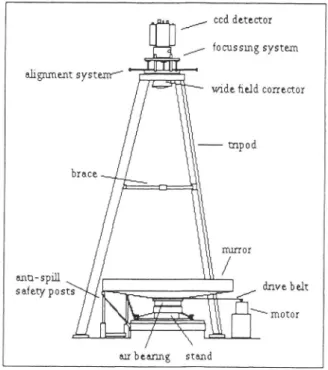
the container. Figure 2 shows the entire telescope system. Comparingthe
LMT
to
a conventional telescope, rù/e seethat
they
aresimilar
with
the
exceptionof the
mount.The
top
parts
are identical, consistingin
a
focusing system and a detector. There is some cost savingin
the upper
endstructure
sinceit
doesnot
haveto
betilted.
The
largest cost savings obviously come from the mount which consistsin
a simpletripod. While
aLMT
can only observeat
zenith a
strip of
constant declination,its
observing efficiency comparedto
that
of a
classical telescopeis
very
high
(no
slew,no field
acquisition, nolost
readout times).The tracking
will
be donewith
the
TDI
technique. Obviously, Iow-resolution spectroscopy can be carriedout
with
interferencefilters.
A
semi-classical on-axis glass corrector capableof
about 30'
x
30' degreefield
will
be used.It
will
removethe
TDI
(Time
Delay IntegrationSurveys with the 4-m International Liquid Mirror
Telescope
bgg // Coûtatnc: MylÊr B eit \ lire*i'g M rcromeblc Scrers Povv Supply and gynchronous MotorFig. L. Exploded view of the basic mirror setup
. ccd detcctor
.-- focussrng system ahgnmurt
systern--widc fidd coûector
ano- spr1l
safety posts
au bcan:n6 stand
Fig.
2.
Entire telescope systemthe
TDI
technique degradesthe
images.This
comesfrom the fact
that
theTDI
technique moves the pixels on the CCD at a constant speed on a straighthne while the images in the sky move at different speeds along slightly curved trajectories. The deformation depends on the
latitude
of the observa,torv 1it600 J. Poels et al.
Science
with
the International Liquid
Mirror
Telescope
The observational strategy for studies of
gravitational
lensing effectswith
aLMT
rather
consistsin
first
surveyinga sky
area as deepand
aswide
aspossible
for
interesting targets(cf.
quasar candidates usingcolor
andvari-ability criteria)
andthen
selectgravitational
lens candidates among them.The
extentof the
fieldof
view isof
courseprimarily
dictated
by
the
num-berand/or
the
sizeof the
thin
CCDs placedat
the
LMT
prime
focus, Forthe
caseof multiply
imaged quasars, wefind
that
direct
imagerywith
the4m International
Liquid
Mirror
Telescope(ILMT) will
leadto
the
detectionof
approximately 50 newgravitational
lens systems(Qo:
I,
Ao-
0).
Thenatural
possibilityto
photometricallymonitor
thesewith
a great
accuracy,at daily intervals, offers a unique
opportunity to
define a sub-sample of inter-esting lenseswith
reliable geometrical parameters,time
delay measurementsandf
or
micro-lensing signaturesfor further
astrophysicaland
cosmological applications. Such a surveywill in
addition
provide uniquedata for
studiesof the
galacticstructure
and stellar populations,including the
detection of micro-lensed galactic objects, accurate measurementsof
stellar proper
mG-tions and trigonometric parallaxes useful for the detection offaint
red, white and brown dwarfs, halo stars, etc. TheILMT will
be locatedin
the Atacama desert and should be operationalin
2002.At
such geographical latitudes anddue
to
the rotation of the Earth, the
field
of
view
of the
ILMT will
aisoscan the Galaxy from the Southern Pole to the bulge and the central regions.
Very precise photometric
and
astrometricdata
of
millions
of
stars
will
beobtained
in
thedrift
scan mode night after night, sothat
microlensing eventswill
inevitably
be detected towards the bulge ofthe
Galaxy.3
Data
Analysis and
Computational
Aspects
From
the
data
analysispoint
of
view,
such
a
project
requires sophisti-cated algorithmsand
a
huge computingand
storageinfrastructure
in
or-derto
generate an exhaustive catalogof
detected sources.Fortunately,
wecan benefit from Computer Science's legacy relying on
Artifrcial
Intelligence(A.I)
techniques (pattern recognition using neural networks, fuzzy logic,de-cision trees,.,.),
thus,
allowing
accurate categorizationof
the
objects
andof
their
photometric
and
astrometric
history (time
series). F\rrthermore, clever managementand
analysisof
catalog/image databaseswill
be
madeavailable