L113
The Astrophysical Journal, 675: L113–L116, 2008 March 10
䉷 2008. The American Astronomical Society. All rights reserved. Printed in U.S.A.
WASP-4b: A 12TH MAGNITUDE TRANSITING HOT JUPITER IN THE SOUTHERN HEMISPHERE D. M. Wilson,1 M. Gillon,2,3C. Hellier,1 P. F. L. Maxted,1F. Pepe,2 D. Queloz,2D. R. Anderson,1 A. Collier Cameron,4 B. Smalley,1T. A. Lister,1,5S. J. Bentley,1A. Blecha,2D. J. Christian,6 B. Enoch,7
C. A. Haswell,7L. Hebb,4 K. Horne,4J. Irwin,8,9Y. C. Joshi,6 S. R. Kane,10M. Marmier,2 M. Mayor,2 N. Parley,7D. Pollacco,6F. Pont,2 R. Ryans,6 D. Segransan,2I. Skillen,11
R. A. Street,5,6,12S. Udry,2 R. G. West,13and P. J. Wheatley14
Received 2007 November 22; accepted 2008 January 30; published 2008 February 5
ABSTRACT
We report the discovery of WASP-4b, a large transiting gas-giant planet with an orbital period of 1.34 days. This is the first planet to be discovered by the SuperWASP-South observatory and CORALIE collaboration and the first planet orbiting a star brighter than 16th magnitude to be discovered in the southern hemisphere. A simultaneous fit to high-quality light curves and precision radial velocity measurements leads to a planetary mass of 1.22⫹0.09⫺0.08MJupand a planetary radius of 1.42⫹0.07⫺0.04R . The host star is USNO-B1.0 0479Jup ⫺0948995, a G7 V star of visual magnitude 12.5. As a result of the short orbital period, the predicted surface temperature of the planet is 1761 K, making it an ideal candidate for detections of the secondary eclipse at infrared wavelengths.
Subject headings: planetary systems — stars: individual (WASP-4) Online material: machine-readable table
1.INTRODUCTION
Transiting extrasolar planets offer our best opportunity for measuring fundamental parameters of extrasolar planets, such as radius and mass, allowing us to test our models for planetary formation and evolution. To date the only transiting planets known in the southern sky are those discovered by surveys targeting the Galactic plane (e.g., Udalski et al. 2002; Pont et al. 2007; Weldrake et al. 2008) and find planets around stars with typical visual magnitudes of 16–17.
The SuperWASP-South (WASP-S) instrument looks for tran-siting planets around stars of visual magnitude 8–13, and will eventually cover the entire southern sky, excluding the Galactic plane. We report here the discovery of WASP-4b, a transiting hot Jupiter orbiting a star of magnitude 12.5.
This is the first discovery by WASP-S, made in collaboration with radial velocity measurements from the CORALIE spec-trograph on the 1.2 m Euler telescope. The discovery marks
1Astrophysics Group, Keele University, Staffordshire ST5 5BG, UK. 2Observatoire de Gene`ve, 51 ch. des Maillettes, 1290 Sauverny, Switzerland.
3Institut d’Astrophysique et de Ge´ophysique, Universite´ de Lie`ge, 4000 Lie`ge, Belgium.
4School of Physics and Astronomy, University of St. Andrews, North Haugh, Fife KY16 9SS, UK.
5Las Cumbres Observatory, 6740 Cortona Drive, Suite 102, Santa Barbara, CA 93117.
6Astrophysics Research Centre, School of Mathematics and Physics, Queen’s University, University Road, Belfast BT7 1NN, UK.
7Department of Physics and Astronomy, Open University, Milton Keynes MK7 6AA, UK.
8Institute of Astronomy, University of Cambridge, Madingley Road, Cam-bridge CB3 0HA, UK.
9Harvard-Smithsonian Center for Astrophysics, 60 Garden Street, MS-16, Cambridge, MA 02138-1516.
10Michelson Science Center, California Institute of Technology, MS 100-22, 770 South Wilson Avenue, Pasadena, CA 91125.
11Isaac Newton Group of Telescopes, Apartado de Correos 321, E-38700 Santa Cruz de la Palma, Tenerife, Spain.
12Department of Physics, Broida Hall, University of California, Santa Bar-bara, CA 93106-9530.
13Department of Physics and Astronomy, University of Leicester, Leicester LE1 7RH, UK.
14Department of Physics, University of Warwick, Coventry CV4 7AL, UK.
the beginning of a campaign to discover brighter transiting extrasolar planets in the southern hemisphere, to complement those discovered in the north by projects including HAT (Bakos et al. 2002), TrES (O’Donovan et al. 2006), XO (McCullough et al. 2005), and WASP (Pollacco et al. 2006).
Transit searches are most sensitive to large planets with short orbital periods, and have now found nine Jupiter-mass planets in orbits of less than 2 days.15 This has led to suggestions of a class of very hot Jupiters (Melo et al. 2006), with highly irradiated atmospheres (e.g., Fortney et al. 2007), to which WASP-4b likely belongs.
2.PHOTOMETRIC OBSERVATIONS
The WASP (Wide Angle Search for Planets) consortium op-erates two identical robotic observatories: SuperWASP-North on La Palma, in the northern hemisphere, and SuperWASP-South, in the southern hemisphere, hosted by the South African Astronomical Observatory (SAAO). Each consists of eight wide-field cameras consisting of an 11.1 cm aperture Canon 200 mm f/1.8 lens backed by a 2K # 2K e2v CCD. The eight cameras cover 490 deg2per pointing. WASP-S started operating in 2006 May, with a strategy of tiling six to eight fields with a cadence of 5–10 minutes and exposure times of 30 s. These fields rotate with the seasons, accumulating to a strip centered on a declination of⫺32 , resulting in light curves for over one⬚ million stars brighter than 13th magnitude. For details of the WASP project, hardware, and data processing see Pollacco et al. (2006). Further details of our data analysis procedures are given in Collier Cameron et al. (2007a), reporting the discovery of WASP-1b and WASP-2b from SuperWASP-North, and in Pollacco et al. (2007), reporting the discovery of WASP-3b.
From the WASP-S data collected between 2006 May–No-vember we identified 1SWASP J233415.06⫺420341.1 (USNO-B1.0 0479⫺0948995) as a high-priority planetary sit candidate; over 4000 measurements revealed a possible tran-sit recurring every 1.3 days (see Collier Cameron et al. [2006] for a description of our transit-search methods and Collier
L114 WILSON ET AL. Vol. 675
Fig. 1.—SuperWASP-South discovery light curve of WASP-4 folded on the 1.3 day orbital period.
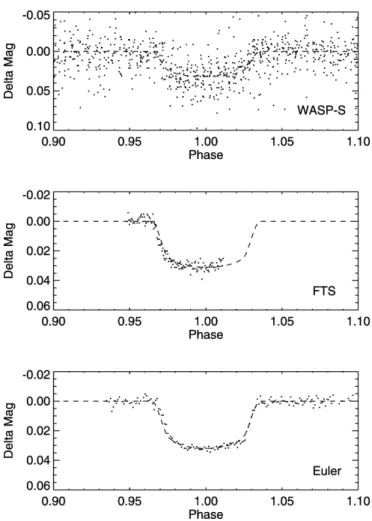
Fig. 2.—WASP-S, FTS, and EulerCam light curves showing the transit of WASP-4b. The data are shown folded on the orbital period together with the best-fitting model determined from a simultaneous MCMC fit of the photo-metric and radial velocity data. The rms scatter to the model fit of the WASP-S, FTWASP-S, and EulerCam light curves is 15.3, 2.7, and 1.8 mmag, respectively. Phase 1 for the EulerCam light curve occurred at HJD p 2,454,368.59121 UT and for the FTS light curve at HJD p 2,454,371.26766 UT.
TABLE 1
EulerCam Observations of the Transit of WASP-4b Centered at
HJD p 2,454,368.59121 UT
HJD Delta Mag Mag Error
2454368.50400 . . . 1.000557 0.000967 2454368.50632 . . . 0.999778 0.000939 2454368.50748 . . . 1.001936 0.000903 2454368.50863 . . . 0.993879 0.001131 2454368.50988 . . . 0.996599 0.001248 2454368.51120 . . . 1.000440 0.000949 2454368.51254 . . . 0.998934 0.000959 2454368.51387 . . . 1.001310 0.000945 2454368.51520 . . . 1.002759 0.000910 2454368.51788 . . . 0.999890 0.001004 Note.—Table 1 is published in its entirety in the electronic edition of the Astrophysical Journal. A portion is shown here for guidance regarding its form and content.
eron et al. [2007b] for an account of our selection of high-priority candidates). A catalog search within the 48⬙ photometric aperture of 1SWASP J233415.06⫺420341.1 revealed no bright blending companions or known variable/active stars, which could mimic the photometric signature of a transiting planet. The WASP-S discovery light curve is shown in Figure 1.
A full transit of WASP-4b was observed by EulerCAM on the 1.2 m Euler telescope on 2007 September 25. Observations were performed in R band and were heavily defocused to allow exposure times of∼2 minutes, achieving an rms scatter of 1.8 mmag despite poor transparency conditions. Part of a transit was also observed in SDSS i⬘ band by the 2.0 m Faulkes Telescope South (FTS) on 2007 September 27. The WASP-S, EulerCAM, and FTS light curves are shown in Figure 2 and the EulerCam photometric measurements are listed in Table 1.
3.SPECTROSCOPIC OBSERVATIONS WITH CORALIE
Spectroscopic measurements were obtained using the COR-ALIE spectrograph installed on the Euler telescope. CORCOR-ALIE was originally a twin copy of the ELODIE spectrograph (Bar-anne et al. 1996). However, triggered by the interest to carry out spectroscopic follow-up on transit candidates with this in-strument, in 2007 June we carried out major changes to COR-ALIE to increase its performance on fainter stars. The fiber link and the cross-disperser optics have been removed and replaced by a new design (D. Queloz et al., in preparation). The double scrambler has also been removed and the grism and prism cross-disperser component replaced by a series of 4 Schott F2 prisms of 32 angle each. The net outcome of this⬚ new design is to maintain the spectral range from 381 to 681 nm but with a large efficiency gain of about a factor of 6 (8 below 420 nm) and a spectroscopic resolution of 55,000– 60,000 (increased by 10%–20%). The overall instrumental pre-cision is also improved. All exposures are reduced by the au-tomated pipeline adapted to the new optical configuration. WASP-4 was observed from 2007 September to November and the radial velocity and the
v
sin icomputed using a G2-spectral template. Exposures were 30 minutes in length, achieving a signal-to-noise ratio of∼15. Radial velocity variations of sem-iamplitude 251 m s⫺1were detected consistent with a planetary-mass companion whose orbital period closely matches that from the WASP-S transit detections. The RV measurements are listed in Table 2 and are shown phase folded and overplotted withthe best-fitting orbital model in Figure 3. The rms of the RV measurements to the model fit is 15.3 m s .⫺1
3.1. Line-Bisector Analysis
Although the amplitude of the RV variation of this system is consistent with a planetary companion, the signal could be
No. 2, 2008 WASP-4b: SOUTHERN TRANSITING PLANET L115
TABLE 2
CORALIE RV Measurements for WASP-4b BJD⫺ 2,450,000 RV (km s⫺1) jRV (km s⫺1) 4359.71082 . . . 57.56557 0.01864 4362.63121 . . . 57.79551 0.01883 4364.65260 . . . 57.67271 0.02223 4365.73690 . . . 57.95703 0.01613 4372.75799 . . . 57.58619 0.01496 4376.68882 . . . 57.64642 0.01451 4378.66887 . . . 57.79207 0.01325 4379.73630 . . . 57.50846 0.01470 4380.61034 . . . 57.77411 0.01303 4382.79025 . . . 57.86396 0.01823 4383.55277 . . . 57.51000 0.01434 4387.61904 . . . 57.49524 0.01457 4408.66110 . . . 57.77556 0.01682 4409.51932 . . . 57.82666 0.02156
Fig. 4.—Line bisector spans for the CORALIE radial velocity measurements showing no significant variation.
Fig. 3.—CORALIE radial velocity measurements folded on the orbital pe-riod together with a radial velocity model which includes the expected Rossiter-McLaughlin effect for a star withvsin i p2 km s . The rms of the RV⫺1 measurements to the model fit is 15.3 m s .⫺1
TABLE 3
Stellar Parameters of WASP-4 Derived from a Spectral Analysis
of the CORALIE Data
Parameter Value R.A. (J2000.0) . . . 23h34m15.06s Decl. (J2000.0) . . . ⫺42⬚03⬘41.1⬙ Teff(K) . . . 5500Ⳳ 150 log g . . . . 4.3Ⳳ 0.2 [M/H] . . . 0.0Ⳳ 0.2 log n(Li) . . . . !1.0 (km s⫺1) . . . . vsin i 2.2⫹0.6⫺1.0 Mass (M,) . . . 0.90Ⳳ 0.07 Radius (R,) . . . 1.15Ⳳ 0.28 Spectral type . . . G7 V Distance (pc) . . . 300Ⳳ 50
mimicked by spectral line distortions caused by a blended eclipsing binary (e.g., Santos et al. 2002). To confirm the pres-ence of a transiting planet it is necessary to exclude this sce-nario. Blended eclipsing binaries can be identified from mul-ticolor photometry or through light curve modeling (Torres et al. 2004); however, the simplest and most reliable method is to search for variations in the spectral line profiles themselves. This has the added advantage of highlighting atmospheric dis-tortion effects which can also affect the measured radial ve-locities. If the detected radial velocity variations are the result of contamination of the spectrum by an eclipsing binary, we would expect to see distortions in the line profiles in phase with the photometric period. The CORALIE cross-correlation functions were analyzed using the line-bisector technique (Que-loz et al. 2001) and no evidence for variation in the bisector spans was found, confirming the planetary nature of this sys-tem. A plot of the bisector spans is shown in Figure 4.
4.STELLAR PARAMETERS
The individual CORALIE spectra have a low signal-to-noise ratio, but when co-added (and rebinned) give a S/N of around 30–40 which is suitable for a preliminary photospheric analysis of WASP-4. The analysis was performed using the UCLSYN spectral synthesis package and ATLAS9 models without
con-vective overshooting (Castelli et al. 1997). The Ha, Na i D, and Mg i b lines were used as diagnostics of both Tef f and . The metallicity was estimated using the photospheric log g
lines in the 6000–6200A˚ region. However, the co-added spec-trum is not of sufficient quality to perform a detailed abundance analysis. The parameters obtained from this analysis are listed in Table 3. In addition to the spectral analysis, we have also used Tycho B, V, and 2MASS magnitudes to estimate the ef-fective temperature using the infrared flux method (Blackwell & Shallis 1977). This givesTef fp5410Ⳳ 240K, which is in close agreement with that obtained from the spectroscopic anal-ysis. These results imply a spectral type of around G7.
In our spectra the Li i 6708A˚ line is not detected, allowing us to derive an upper limit on the lithium abundance of log n(Li/H) ⫹ 12 ! 1.0, which is slightly less than the solar photospheric
value. This implies a minimum age of around 2 Gyr (Sestito & Randich 2005). Comparison of the temperature and log g with the stellar evolution models of Girardi et al. (2000) gives maximum likelihood values M p 0.90∗ Ⳳ 0.07 M, and R p 1.15∗ Ⳳ
R . The distance of WASP-4 was calculated as 300Ⳳ 50
0.28 ,
pc using the angular diameter from the infrared flux method and the value of the radius of the star from Table 4.
5.PLANETARY PARAMETERS
The photometric and orbital parameters for WASP-4b were determined from a simultaneous Markov Chain Monte Carlo fit of both the photometric and spectroscopic data. The MCMC method is described in detail in Collier Cameron et al. (2007b)
L116 WILSON ET AL. Vol. 675
TABLE 4
Fitted System Parameters of WASP-4b
Parameter Value Period (days) . . . 1.3382282⫹0.000003⫺0.000003 Epoch (HJD) . . . 2454365.91464⫹0.00025⫺0.00023 Duration (days) . . . 0.0928⫹0.0009⫺0.0007 (RP/R*) 2. . . . 0.0241⫹0.0005 ⫺0.0002 b . . . . 0.13⫹0.13⫺0.12 i (deg) . . . . 88.59⫹1.36⫺1.50 K1(km s⫺1) . . . 0.24 ⫹0.01 ⫺0.01 g(km s⫺1) . . . 57.7326⫹0.002⫺0.001 a (AU) . . . . 0.0230⫹0.001⫺0.001 log g (cgs) . . . . 4.45⫹0.016⫺0.029 R*(R,) . . . 0.9370 ⫹0.04 ⫺0.03 M*(M,) . . . 0.8997 ⫹0.077 ⫺0.072 r*(r,) . . . 1.094 ⫹0.038 ⫺0.085 RP/RJup. . . 1.416 ⫹0.068 ⫺0.043 MP/MJup. . . 1.215 ⫹0.087 ⫺0.079 rP(rJup) . . . 0.428 ⫹0.032 ⫺0.044 log gP(cgs) . . . 3.142 ⫹0.023 ⫺0.034 TP(A p 0) (K) . . . . 1761 ⫹24 ⫺9 Note.—Fitted system parameters of WASP-4b from a simultaneous MCMC analysis of the WASP-S, FTS, and EulerCam light curves to-gether with the CORALIE RV data, assuming a circular orbit.
and is the same used for the fitting of the parameters of WASP-3b (Pollacco et al. 2007).
The transit light curve was modeled using the small-planet approximation of Mandel & Agol (2002). An initial fit of the radial velocity measurements showed no evidence for signifi-cant orbital eccentricity, as expected for such a short-period system. Accordingly the eccentricity was set to zero. This leaves seven parameters defining the system: epoch ( ), orbitalT0 period (P), duration of the transit ( ) from first to last contact,tT
the squared ratio of the planet to stellar radius [DF p ], the impact parameter ( ), the radial 2
(R /R )P ∗ b p a cos i/R∗
velocity amplitude (K1) and the stellar massM∗. Gaussian priors were imposed, as determined from the spectroscopic analysis, such that M∗ p 0.90 Ⳳ 0.07 and log p 4.3 Ⳳ 0.2. Tog balance the weight of the radial velocities with the photometry in the MCMC analysis we added 7 m s⫺1 of systematic error to the errors listed in Table 2, thus obtaining a reduced x2value of 1.
The resulting fitted parameters are listed, together with their 1 j uncertainties, in Table 4. The parameters derived for the host star are consistent with the spectral analysis from the COR-ALIE data. The precision of the transit photometry is sufficient
to constrain the stellar radius and impact parameter such that the uncertainties in the resultant planetary parameters are dom-inated by the uncertainty in the stellar mass.
6.DISCUSSION
A simultaneous fit of precision photometry and radial ve-locity measurements result in a planetary radius of 1.42 RJup and mass of 1.22 MJupfor WASP-4b. This is the second largest transiting planet discovered to date, second only to TrES-4b (Mandushev et al. 2007; for plots comparing WASP-4b with other transiting extrasolar planets see Pollacco et al. 2007).
WASP-4b, with an orbital period of 1.3 days, can be com-pared to other very short period planets such as OGLE-TR-56b (Konacki et al. 2003), TrES-3b (O’Donovan et al. 2007), and WASP-3b (Pollacco et al. 2007). The low rotation velocity of the host star WASP-4 is comparable with that of TrES-3; in contrast, OGLE-TR-56 and WASP-3 have much higher ro-tation velocities, which is thought to be due to the young age of these stars. The stars WASP-4 and TrES-3 are thought to be older; however, the synchronization time for WASP-4 would be longer still at 8 Gyr (using the method of Marcy et al. 1997), so their low rotational velocity is consistent with their not having been spun up by their planets.
A preliminary estimate of the stellar parameters indicates that the parent star is spectral type G7 V with solar metallicity. Together with the short orbital period of 1.34 days, this results in a blackbody planetary surface temperature, assuming zero albedo and isotropic reradiation, of 1760 K. The orbital distance of 0.023 AU places WASP-4b well within the criterion (a!
AU) for the proposed new class of pM planets (Fortney 0.04
et al. 2007). These planets display a temperature inversion due to low-pressure stellar absorption by gaseous TiO and VO. As a result they exhibit an unusually hot stratosphere which emits strongly in the mid-infrared. The WASP-4b system has a larger flux ratio than the very hot Jupiters WASP-3b and TrES-3b, and so is an ideal target for secondary eclipse studies by Spitzer. The study of more of these systems, including WASP-4b, should help constrain models for atmospheric dynamics and heat distribution.
The WASP Consortium includes the Universities of Keele, Leicester, and St. Andrews, Queen’s University Belfast, the Open University, and the Isaac Newton Group. WASP-S is hosted by the South African Astronomical Observatory (SAAO), and we are grateful for their support and assistance. Funding for WASP comes from Consortium Universities and the UK’s Science and Technology Facilities Council.
REFERENCES
Bakos, G. A` ., La`za`r, J., Papp, I., Sa`ri, P., & Green, E. M. 2002, PASP, 114, 974
Baranne, A., et al. 1996, A&AS, 119, 373
Blackwell, D. E., & Shallis, M. J. 1977, MNRAS, 180, 177 Castelli, F., Gratton, R. G., & Kurucz, R. L. 1997, A&A, 318, 841 Collier Cameron, A., et al. 2006, MNRAS, 373, 799
———. 2007a, MNRAS, 375, 951 ———. 2007b, MNRAS, 380, 1230
Fortney, J. J., Lodders, K., Marely, M. S., & Freedman, R. S. 2007, ApJ, submitted (arXiv:0710.2558)
Girardi, L., Bressan, A., Bertelli, G., & Chiosi, C. 2000, A&AS, 141, 371 Konacki, M., Torres, G., Jha, S., & Sasselov, D. D. 2003, Nature, 421, 507 Mandel, K., & Agol, E. 2002, ApJ, 580, L171
Mandushev, G., et al. 2007, ApJ, 667, L195 Marcy, G. W., et al. 1997, ApJ, 481, 926
McCullough, P. R., Stys, J., Valenti, J., Fleming, S., Janes, K., & Heasley, J. 2005, PASP, 117, 783
Melo, C., et al. 2006, A&A, 460, 251 O’Donovan, F. T., et al. 2006, ApJ, 651, L61 ———. 2007, ApJ, 663, L37
Pollacco, D., et al. 2006, PASP, 118, 1407
———. 2007, MNRAS, submitted (arXiv:0711.0126) Pont, F., et al. 2007, A&A, submitted (arXiv:0710.5278) Queloz, D., et al. 2001, A&A, 379, 279
Santos, N., et al. 2002, A&A, 392, 215 Sestito, P., & Randich, S. 2005, A&A, 442, 615
Torres, G., Konacki, M., Sasselov, D. D., & Jha, S. 2004, ApJ, 614, 979 Udalski, A., et al. 2002, Acta Astron., 52, 1
Weldrake, D. T. F., Bayliss, D. D. R., Sackett, P. D., Tingley, B. W., Gillon, M., & Setiawan, J. 2008, ApJL, in press (arXiv:0711.1746)