A Resource-based View of Firm Boundaries
by
Amit Jain
INSEAD and University Paris-Dauphine
and
Raymond-Alain Thietart
University Paris-Dauphine and Essec
ABSTRACT
The current paper explores the use of the Resource-Based View in the analysis of the firm boundary decision. It is proposed that resources that are valuable, rare, imperfectly imitable and non-substitutable are those that have the least likelihood of being outsourced. This proposition is tested through the analysis of the characteristics of 71 processes, from 42 firms in order to determine the distinguishing features between in-sourced and outsourced processes. The results provide empirical evidence for the resource-based view, and for its explicatory power in the context of the boundary decision.
INTRODUCTION
The firm boundary decision remains a question of significant interest for both scholars of management and practitioners, and has benefited from a continuous stream of empirical and theoretical research efforts. Diverse theoretical approaches have been proposed for the firm boundary decision including both economic (Coase, 1937; Williamson, 1975) and organizational approaches (Galbraith, 1977; Lawrence et al., 1967; Thompson, 1967). Thus, different economic theories have postulated that the information and coordination benefits associated with hierarchical governance gives rise to economies of scale and scope (Chandler et al., 1990; Chandler, 1962), economizes on transaction costs (Coase, 1937; Williamson, 1975, 1985), and aligns incentives (Grossman et al., 1986). In addition, the resource-dependence theory emanating from the organizational perspective argues that hierarchical governance allows firms to exploit powerful relationships and reduce their dependence on buyers and suppliers (Pfeffer et al., 1978).
Transaction cost economics z (Coase, 1937; Williamson, 1975, 1985), originating from the economic stream, remains the dominant paradigm for the firm boundary decision. Coase in his seminal article argues that uncertainty in the real world prevents the price mechanism from achieving the most efficient transactions in perfect markets. In this setting, firms economize by reducing both search costs and uncertainty by implementing long term labour contracts. However, according to Coase, firms offer cost savings over price mechanisms to a point. As a firm grows in size, internal coordination costs increase until the firm is eventually indifferent between integrating transactions and purchasing through the market. Williamson (Williamson, 1975, 1985) extends this line of thought by stressing the role of specific
limitedly so (Simon, 1961), such boundedly rational individuals, according to Williamson, are unable to write complete contracts for a given transaction. When an asset is specific to a given transaction and there is uncertainty with respect to demand, technology, or other transactional parameters, firms with incomplete comtracts become vulnerable to opportunism on the part of their transacting partners. The risk of opportunism leads to an increase in transaction costs. Williamson argues in the manner of Coase when he states that the vertical scope of the firm is determined by the trade-off between these transaction costs and the relative benefits of using the market mechanism.
Transaction cost economics as a determinant of firm boundaries has been the subject of a number of empirical studies (Rindfleisch et al., 1997). These studies provide mixed support for TCE. David and Han (2004, page 44) for instance, state that from 63 articles that they selected for analysis, including 308 empirical tests of core TCE, “144 (47%) were statistically supported, 133 (43%) produced statistically non-significant results, and 31 (10%) were statistically significant in the opposite direction to the theory.” David and Han argue that the relatively inconsistent results that one observes in the diverse research efforts on TCE may be attributed to a number of factors, and notably construct validity and problems of operationalization, the relative absence of scope conditions and moderating variables, and problems of model misspecification and operationalization. In the present article, and in this vein, it is argued that other factors in addition to those salient to TCE may also be instrumental in determining the governance mechanism used. In particular, it is proposed that a firm’s resources and capabilities have a role to play in the boundary decision.
It has been argued by certain scholars that the resource-based view (RBV) (Barney, 1991; Dierickx et al., 1989; Peteraf, 1993; Wernerfelt, 1984) can provide insights to the firm boundary decision (Argyres, 1996a, 1996b; Barney, 1999; Conner
et al., 1996; Jacobides, 2005; Jacobides et al., 2005; Kogut et al., 1992; Leiblein et al., 2003). According to the RBV (Barney, 1991; Peteraf, 1993), valuable, rare,
imperfectly imitable, and non-substitutable resources enable a firm to benefit from sustainable rents. The RBV thus suggests that resources with these four fundamental properties would be those that managers would strive to retain within their firm’s boundaries. In comparison to TCE, the resource-based view has benefited from limited empirical tests (Leiblein et al., 2003; Miller et al., 1996) due difficulties in operationalization and criticism of being a tautology (Priem et al., 2001).
This paper strives to empirically test the role of the RBV as a determinant of firm boundaries. To this end, the RBV in its original form (Barney, 1991; Peteraf, 1993) is operationalized to create a model for the boundary decision. The article is structured as follows. The first section provides a theoretical review of the RBV. The second section uses the RBV in order to develop a model for the firm boundary decision. The third section describes the data collection and econometric procedures used in order to test the model developed. A brief discussion of the key results is followed by the conclusions of the research, along with the limitations, possible extensions and managerial implications.
THE RESOURCE-BASED VIEW
The fundamental question that the Resource-Based View asks is why firms in the same industry vary systematically in their performance over time? The RBV’s proponents argue that heterogeneity in intra-industry firm performance is a result of the fact that firms have unique bundles of resources and capabilities (Barney, 1991;
Barney, 1986a, 1986b; Peteraf, 1993; Wernerfelt, 1984). Thus, contrary to the neoclassical view, the RBV assumes that firms are heterogeneous. Barney (1991, page 101) draws on Daft (1983) and defines resources as “all assets, capabilities, organizational processes, firm attributes, information, knowledge, etc. controlled by a firm to conceive of and implement strategies that improve its efficiency and
effectiveness.” Heterogeneity of resources implies the presence of different
productive factors across a cross-section of firms, and each productive factor having its unique level of productivity. If these efficient factors of production or resources are limited in supply, then according to the RBV, inefficient and inferior resources can also be utilized for production. Firms that possess scarce and efficient resources earn Ricardian rents, which are not dissimilar from monopolistic rents. While monopoly rents arise because of an intentional restriction of production, Ricardian rents arise because of scarcity in the efficient factors of production.
The RBV builds on the heterogeneity argument to identify the conditions in which the Ricardian rents may be preserved. The key to sustained rents is that the efficient resource remains efficient and scarce or in short supply. Efficiency is contingent on other firms, including both rivals and suppliers, to not possess
equivalent or superior resources. Rumelt (1984) elaborated on the role of “isolating mechanisms” that protect a given firm from imitation. Isolating mechanisms assume several forms including property rights to resources, learning and development costs, and frictions to imitation by competition (Rumelt, 1987) such as causal ambiguity. Causal ambiguity (Lippman et al., 1982; Rumelt, 1984) refers to the uncertainty regarding the causes of efficiency difference across firms, and is one barrier to the successful imitation of an efficient resource of a firm. Tacitness, complexity and specificity in a firm’s skills and resources have been identified as sources of causal
ambiguity (Reed et al., 1990). The final ingredient of sustained competitive advantage is that there are no strategically equivalent valuable resources that are themselves rare and inimitable (Barney, 1991). According to Barney (1991, page 111), “two valuable firm resources (or two bundles of firm resources) are strategically equivalent when they each can be exploited separately to implement the same
strategies…Substitutability can take at least two forms. First, though it may not be possible for a firm to imitate another firm’s resources exactly, it may be able to substitute a similar resource that enables it to conceive of and implement the same strategies. Second, very different firm resources can also be strategic substitutes.” Thus, according to the RBV, four conditions are essential for a firm to have a resource-based sustainable competitive advantage: resources should be valuable (efficient), rare, imperfectly imitable and non-substitutable.
In recent years, the RBV has been the subject of significant criticism. It has been criticized of being a tautology (Bromiley et al., 2002; Foss et al., 1995; Priem et
al., 2001). For instance, Priem and Butler bring to attention the fact that in the
original formulation of the RBV, Barney (1991, page 101-102) defines resources of a firm as “all assets, capabilities… that improve its efficiency and effectiveness”, and also states that a firm has a competitive advantage when “it implements a value creating strategy not simultaneously implemented by any current or potential competitors.” The tautology arises as efficient resources result in a value creation, where value is synonymous with efficiency. Thus, according to Priem et al., the RBV statement is analytic and not a lawlike generalization (Priem et al., 2001). It is as a consequence not falsifiable (Popper, 1959), and not a theory (Hunt, 1991; Rudner, 1966).
According to Hoopes, Masden and Walker (2003, page 889), “while the RBV re-emphasizes the importance of organizations in strategy research, it offers little guidance on the key questions that should move this research forward.” In effect, the tautology inherent in the statement of the RBV blocks further advancement till the RBV’s set of systematic statements could be reformulated in a falsifiable form. In this research, the tautology problem is resolved by investigating empirically the link of the four critical resource characteristics of the RBV on a dependent variable that is not defined in terms of value, efficiency, or competitive advantage. It is argued that valuable, rare, imperfectly imitable and non-substitutable resources which according to the RBV are key elements for the sustained competitive advantage of a firm would be the resources that managers would strive to maintain within the boundaries of their firms, and thus these resources would have the lowest likelihood of being outsourced.
DEVELOPMENT OF HYPOTHESES
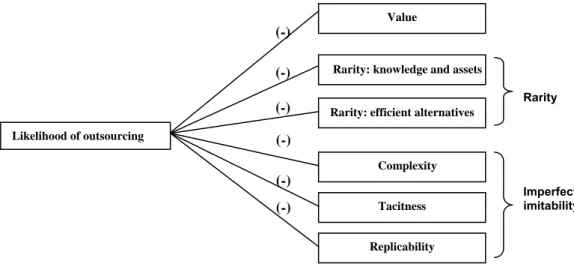
In this section, an empirically testable model (see figure 1) of vertical integration is developed that is grounded in the systematic statements of the resource-based view. The definition of a resource by Barney (1991, page 101) includes firm processes. For the purpose of this paper, the term process is used synonymously with resource, and the unit of analysis is a firm process.
INSERT FIGURE 1 HERE Valuable processes
According to the RBV, if a resource or process of a given firm is efficient as compared to a similar process of it’s competitors, then the firm earns Ricardian rents (Peteraf, 1993). In what has been criticized of being a tautology (Priem et al., 2001), these Ricardian rents are postulated to be the source of competitive advantage (Barney, 1991; Peteraf, 1993). Given that firms have limited investment possibilities,
a natural extension of the value argument is that a firm preserves (i.e. invests and maintains within its boundaries) relatively efficient resources, and outsources others. The question then arises as to whether this particular formulation of the RBV argument is also a tautology, as is the argument on resources and competitive advantage? Any measure of whether a given process is inside or outside the firm boundary is independent of the efficiency-based definition of valuable resources, as whether a resource is insourced or outsourced is an empirical observation rather than an analytic statement. Thus, the formulation of the RBV that states that “valuable” resources are maintained within firm boundaries is a lawlike generalization (Hunt, 1991; Rudner, 1966) and falsifiable (Popper, 1959). In short, the tautology is resolved in this formulation. This leads to the first hypothesis:
Hypothesis 1: The higher the contribution of a given process to the value of a product or service, the higher the likelihood of vertical integration into production.
Rare and non-substitutable processes
Barney (1991) argues that firms earning rents need to preserve the same. For this, it is vital for a firm earning rents that the valuable resources not be possessed by a large number of competitors. If such a resource were present with a number of competitors, then the rents earned would be competed away and thus disappear. For instance, firms implementing similar ERP systems shall not obtain rents from the same even though the ERP system is essential to their operations, unless they somehow better exploit the system as compared to their rivals. As Barney (1991) states: “Under conditions of competitive parity, though no firm has competitive advantage, firms do increase their probability of economic survival (McKelvey, 1982; Porter, 1980).” A firm using a superior ERP system that is not available (rare)
to its rivals would, for example, be able to derive rents out of the same. The level of rareness desirable is such that the competition taking place in the market is imperfect.
Another argument made by the RBV is that a given resource be non-substitutable (Barney, 1991, page 13). If substitute resources that have functional equivalence exist that are rare and valuable, then the firm that holds the property rights to those resources shall earn rents. However, if the substitute resources are not rare, then the rents shall be competed away. What is common to the rareness and substitution arguments thus is that for a given resource, not only should the resource itself be rare, but so should all possible functional alternatives.
Both a given resource and its possible substitutes need be rare in order to ensure imperfect competition. It is possible to generalize the rarity of resources to the rarity of the skills, competencies and knowledge underlying the given resource and its substitutes. The rarity of a resource is a subset of the rarity of the skills and
competences that are inherent in it. The availability of these skills and competencies in factor markets facilitates the imitation of the existing resource, and also its
substitution by alternatives. Thus, the skills, knowledge and competencies embedded on a given process need to be rare for a firm to earn rents. This leads to the second hypothesis:
Hypothesis 2a: The higher the level of skills and competences present in factor markets with respect to a given process relative to those of a given firm, the lower the likelihood of vertical integration into production.
The rarity of the underlying knowledge base and competencies of a given process are not sufficient. Processes may exist that contribute to the quality of a product or contribute to the cost effectiveness of the product, independent of the level of skills and knowledge embedded in the process. If the cost effectiveness and the
quality of a product are not rare, then even if the process is valuable for a given firm, it shall not be a source of rents. Thus:
Hypothesis 2b: The higher the cost and quality effectiveness of the supplier, the lower the likelihood of vertical integration into production.
Imperfect Imitability
The key to sustained earning of rents is that the resource remains both efficient and rare relative to alternatives. The condition of imperfect imitability ensures that rents derived from valuable and rare resources are preserved through non-replication of the resource by a competitor or by a firm in the factor markets. While the underlying technology behind the process or the resource may be available on the market, what makes the resource or routine valuable is its linkages with other resources and routines (Nelson et al., 1982). These inter-linkages of routines can make a process difficult to imitate as the causal forces behind it become difficult to establish. There are three main factors underlying causal ambiguity (Lippman et al., 1982), or the uncertainty regarding the causes of efficiency difference across firms: tacitness, complexity, and specificity.
According to Polyani (1967) tacitness refers to the implicit and non-codifiable accumulation of skills that result in learning by doing. Zander and Kogut (1995) investigate the “codifiability” and “teachability” aspects of knowledge. They find that the more codifiable and teachable a capability is the higher is the probability of rapid transfer of the knowledge to a subsidiary or partner organization. On the other hand, the greater the level of tacit knowledge associated with a process, the greater the barriers to transfer and imitation. Thus:
Hypothesis 3a: The higher the tacit knowledge component of a given process, the higher the likelihood of vertical integration into production.
The second factor contributing to the causal ambiguity of a process is its complexity (Barney, 1985; Nelson et al., 1982; Reed et al., 1990). The more complex a process, the more difficult it should be to transfer or to imitate. Reed et al. (1990) cite (Barney, 1985, page 12) who states that “in complex, highly inter-dependent human or technological systems, the causes of success and failure are often difficult to assign..[and]…the establishment of cause-effect relationships can be very difficult, and the concomitant assessment of performance may be highly ambiguous.” Thus,
Hypothesis 3b: The higher the complexity of a given process, the higher the likelihood of vertical integration into production.
In addition to the complexity and the tacit knowledge component of a given process, the process may be replicated by reverse engineering the finished product. While the complexity of a process and the tacitnesss of knowledge embedded in the process inhibit the process from being replicated due to causal ambiguity of the process, simply studying the final output of a given processes, or the output of a combination of processes might lower the barriers to imitation. Thus:
Hypothesis 3c: The easier a process is to replicate by studying the final output, the lower the likelihood of vertical integration into production.
The specificity of a resource refers to the transaction-specific skills and assets that are utilized in the production processes and provision of services for particular customers (Reed et al., 1990). For Reed et al.(1990), the specificity of a resource or process is synonymous with asset specificity in transaction cost economics (Williamson, 1975, 1985). Thus Reed et al. (1990, page 92) argue that “the business actions that result from resource and skill deployment (competencies) can be highly specific and interdependent with the firm’s internal or external transaction partners.” This specificity results in causal ambiguity. Caution is required while interpreting this
argument as asset specificity is a fundamental construct in transaction cost economics, and influences the likelihood of difficulties in contracting. For the RBV, however, specificity acts to create causal ambiguity, which in turn serves as an isolating mechanism that helps valuable and rare processes remain valuable and rare. Thus, asset specificity influences the boundary decision through two different mechanisms contingent on the theory taken into consideration, and the effects of one shall be confounded with that of the other. Taking into consideration the secondary role played by the specificity in the RBV, the current study does not investigate the role of specificity in the empirical investigation that follows.
Other variables affecting the make or buy decision
Although our research is driven by a resource based conceptualization, there may be other variables which could affect the decision of whether a process is conducted with the limits of firm boundaries, or whether it is outsourced. Four variables of particular interest are the presence of excess capacity, the extent of outsourcing prevalent at the time of the decision to outsource, the extent of competition in the industry, and the size of the business unit.
Irrespective of the level of skills and competences available with a firm for a given process, the firm might not have enough capacity to meet all demand. In instances, the demand for a product or service may be uncertain, leading to uncertainty in the demand of the processes contributing to the product or service in question. In these cases, although a process is rare and valuable, it may be outsourced in order maintain a buffer to respond to peaks in demand. Thus, the availability of sufficient product capacity needs to be controlled for. Second, it may be argued that highly competitive industries place greater pressures on firms to optimize their productive processes. Thus in industries where the level of competitive forces is high,
outsourcing may be more prevalent. Third, in some industries outsourcing may be commonly accepted, to the extent of being taken for granted and thus widely practiced. In such industries, the likelihood of any given process being outsourced may be higher. In an argument similar to that of the extent of competitiveness of a given industry, industries that have higher rates of outsourcing may put higher pressures on all players to outsource. Fourth, and according to Leiblein and Miller (2003, page 848), “larger firms may have both greater levels of fabrication experience and the necessary scale to invest in internal production than their smaller counterparts.” Thus, the size of a given outsourcing/ insourcing firm is controlled for.
METHODS
Sample and data collection
In a preliminary phase, 10 semi-directive interviews were conducted with senior executives of leading firms in order to obtain a better understanding of the managerial motivations for the firm boundary decision. These interviews provided insight into outsourcing of a wide range of processes such as manufacturing, information technology, customer care, logistics and warehousing, and telecommunications networks. The results of these interviews indicated that managers do strive to preserve key firm competences within a firm’s boundaries, whereby the motivation to elaborate an RBV based model of outsourcing.
In order to test the hypotheses empirically, primary data was collected using a self-administered survey instrument. This instrument was created in English language and was first extensively pre-tested with a number of senior executives familiar with outsourcing. The questionnaire was modified based on the feedback of executives in an iterative procedure. In this way, the survey gained in both clarity and was reduced in length. The final survey questionnaire required between fifteen and twenty minutes
to fill out. Each questionnaire collected data on two firm processes: one that was performed in-house, and one that was partially or completely outsourced.
Senior executives alumni of a leading business school, were randomly selected from the schools’ alumni book, and were invited to contribute to the research effort by proposing the names of two executives in their organizations that had experience with the outsourcing of firm processes. Of the over six hundred executives contacted, 85 complied by providing the names and contact information of 121 executives experienced in outsourcing. These 121 executives were in turn contacted and invited to participate in the research effort. 42 (34.7%) responded by filling out the survey questionnaire, which gave a total of 71 processes for which information on process characteristics salient to the boundary decision was available.
INSERT TABLE 1 HERE
16.9% of the executives participating were CEOs or Presidents of their organizations, and 79% were evenly divided between the positions of Vice Presidents, Directors, and General Managers (see table 1). Survey participants were asked to identify two processes with which they were actively involved. One of these two had to be a firm process that was being outsourced, and a second process that was being done within the firm boundaries. No restriction was placed on the type of process selected, although the survey questionnaire did suggest that the executives could pick information technology, manufacturing, or any other process as the unit of analysis. The executives had the option of providing information for only one process. Data was collected for 71 company processes, of which a complete dataset was available for 61 processes.
The constructs for the logistic model were operationalized using multiple item scales. Table 2 lists these scales, and also indicates the actual questionnaire items and reliability coefficients. Items were measured using 7-point semantic differential scales. These scales were submitted to factor analysis positing a single factor. This procedure was adopted for each measure, and only factors with eigenvalues greater than 1.0 were taken into consideration.
Process outsourced
The dependent variable is binary, taking the value of 1 when the process is outsourced and 0 when the process is not outsourced. The measure percentage of process outsourced is bi-modal, with 42.3% of the processes being completely insourced, and 19.7% of the processes being completely outsourced, and the remaining processes being partially outsourced. This binary choice variable was operationalised by asking the respondents the extent to which the given process had been outsourced.
INSERT TABLE 2 HERE (alphas) Value
The value of a process is measured on multiple dimensions extending beyond that of the economic value of the process. Thus, the value of a given process is comprised of a three-item scale with a coefficient alpha of 0.755. The scale assesses the value contribution of a given process based on the extent to which the process contributes to performance of the firm, the extent to which it is considered a strategic activity by the firm, and the extent to which the process helps the firm differentiate its products and services.
Rarity and substitutability is comprised of four items, which after factor analysis loaded onto two factors with eigenvalues greater than one. The first factor is comprised of two items, and measures the level of knowledge, skills and assets of suppliers relative to that of the firm, and has an alpha of 0.817. If a process and its underlying skills, knowledge and assets are rare, then suppliers will not compare favourably to the firm on this measure.
The second dimension of rarity is the cost effectiveness of suppliers. If an efficient alternatives are available for a given process, then the process cannot be considered rare (or non-substitutable) from the efficiency standpoint. This measure is comprised of two items. The first item measures whether the suppliers available benefit from economies of scale relative to the firm, and the second item measures whether suppliers benefit from lower costs of labour as compared to the firm. This dimension of rarity had an alpha of 0.56. The higher the relative economies of scale and the lower the costs of labour, the more viable are the alternatives present on the market and hence the less rare the process on these dimensions.
Imperfect imitability
Imperfect imitability was operationalized through four items, and has three distinct dimensions. The first two dimensions of imperfect imitability represent sources of causal ambiguity of the given process. Complexity is the first measure of causal ambiguity and is a scale comprised of two items. The first item measures complexity simply by asking respondents if they considered the process complex, whereas the second item measures whether the process is comprised of several different skills and technologies. The greater the number of different skills and technologies embedded in the process, the more it would be considered complex. Process complexity had an alpha of 0.70.
The second dimension of causal ambiguity is the tacitness of the process. The item representing this dimension measures the level of know-how and knowledge that is not documented and present in the minds of employees only.
The third dimension of imperfect imitability is the ease with which the process can be replicated based on the final output product or service. The easier it is to reverse engineer a product or service, the lower will be the barriers to imitation.
Competitive Intensity
Competitive intensity comprises of a four item scale, and has an alpha of 0.72. The scale assesses competitive intensity through the extent of price competition, the ease with which competitors can match a firm’s product or service offering, whether competitors are judged to be strong, and finally and more directly by asking respondents to rate the to be the level of competition in the industry.
Size
This measure, which is used as a control measure, is straightforward. Respondents provided the sales level of their division for the last fiscal year, and the logarithm of this value was used as a measure of firm size.
Outsourcing intensity
Outsourcing intensity was also used as a control measure and had two dimensions. Business unit outsourcing intensity measured the extent to which outsourcing was a common practice in the business unit whose process was under study. Industry outsourcing intensity on the other hand, measured the extent to which outsourcing was prevalent in the business units industry in general.
The productive capacity that a firm has with respect to a given process is controlled for using this measure. Respondents provided their opinion on the extent to which their firm had excess capacity in the given process.
Model Specification
Binary choice models have been extensively used in the make or buy literature in order to investigate the influence of independent variables on the binary dependent variable (Anderson et al., 1984; Gatignon et al., 1988; Monteverde et al., 1982; Pisano, 1990; Poppo et al., 1998). This research adopts this empirical approach. It is assumed that managers analyze a given strategic decision of make or buy taking into account the different factors that influence it, such as the value, rarity, imperfect imitability, and substitutability of a given resource. This decision can then be represented as a multivariate statistical model that takes the following form:
β β i i x x i e e P + = 1 (1) where i
P =probability that a process will be outsourced
β = vector of coefficients of the marginal utilities of each of the independent variables and control variables
Xi = vector of predictor variables of size 10, including
X0i = constant term representing an intrinsic preference for hierarchical
governance
X1i = process value
X2i = rarity: knowledge and assets
X3i = rarity: efficient alternatives
X5i = process tacitness
X6i = process replicability
X7i = competitive intensity
X8i = business unit outsourcing intensity
X9i = industry outsourcing intensity
X10i = firm size
X11i = excess capacity
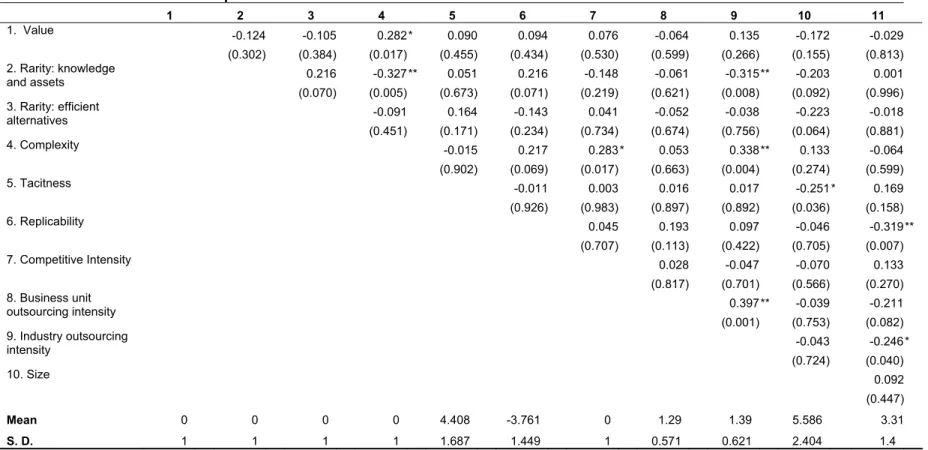
A correlation matrix is provided in table 3. The pattern displayed does not reveal a tendency towards collinearity among the measures. The highest correlation is between business unit outsourcing intensity and industry outsourcing intensity (0.397), and process complexity and business unit outsourcing intensity (0.352)
INSERT TABLE 3 HERE
The questionnaires contained data for 10 processes that was incomplete. Data for these observations was estimated using the other highly correlated partner variables present in the same construct. In case the variables were not part of a construct, they were estimated using highly correlated covariates in an estimation procedure using multivariate regression1. In all, 13 observations across five different
items were estimated.
RESULTS
1 Item
No. obs. estimated
1. Process has several skills and technologies… 1
2. Level of know-how and knowledge that is not documented… 1
3. Relative to your firm, the supplier is more equipped in plant, equipment and machinery 5
4. Relative to your firm, the supplier has greater economies of scale… 2
5. Relative to your firm, the supplier has lower costs of labour 4
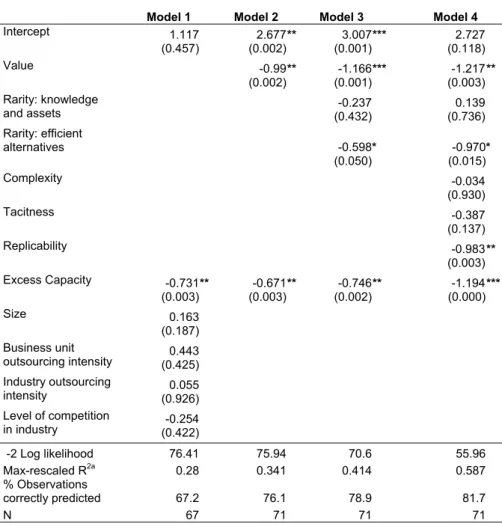
The parameters of the logit model described in Equation 1 were estimated using the full sample. Table 4 summarizes the coefficient estimates and goodness-of-fit measures for the logit models used to test the hypothesis. The logit model estimates the effects of the theoretical covariates on the likelihood that the process shall be insourced. Thus, a positive coefficient indicates that the variable is positively related to the likelihood of outsourcing. The results are reported for four different models in order to illustrate the consistency of estimates across the different specifications. 55% of the processes which are present in the sample are outsourced, and the remaining 45% completely insourced.
INSERT TABLE 4 HERE
Model 1 serves as a baseline model by including only the five control variables. In this model, only the measure excess capacity is highly significant (p<0.01) and the coefficient is negative, indicating that when a firm has excess capacity in a given process, the likelihood of outsourcing the process decreases. Model 2 includes to model 1 the measure for process value, and drops the non-significant control variables. The coefficient of the value measure is negative and highly significant, providing support for hypothesis 1, and indicating that as the value contribution of a process increases, the likelihood of it being outsourced decreases.
Model 3 includes the two constructs of rarity. As expected, both these constructs have negative coefficients. However, the coefficient of rarity is significant only for the rarity in the availability of efficient alternatives (p<0.05) to the process, providing support for hypothesis 2(b). Thus, when suppliers exist that can provide a cost effective alternative process to the process in question, then the likelihood of outsourcing increases. However, the rarity among suppliers of the knowledge, skills and other assets and equipment required to perform the process does not significantly
influence the likelihood of the make or buy decision, even though the negative coefficient indicates that rarity on this dimension would reduce the likelihood of outsourcing.
The last model (4) introduces the two constructs representing process rarity into the model. Both the rarity coefficients are negative, and only the rarity of efficient alternative process is significant (p<0.05), providing support for hypothesis 2b. The rarity of knowledge, skills and assets is not significant (p=0.137). The measures of process value, rarity of efficient alternatives and process replicability remain highly significant across the different model specifications, indicating a strong influence of these on the make or buy decision. It is also of note that process tacitness is weakly significant (p<0.1). In this model, the Nagelkerke R2 value improved
substantially to 0.587, and 81.7% of the processes are correctly classified as make or buy, a significant improvement from the base case where 55% of the observations were correctly classified.
The robustness of the effects of the estimated coefficients across the different model specifications suggests that resource-based effects substantially influence a firms’ make or buy decision. Likelihood ratio tests were conducted comparing each new model to its predecessor, by taking the difference of the log likelihood values. Progression to each subsequent model (except from model 2 to nwas significant (p<0.05). Similarly, the Nagelkerke R2 value and the percentage of correctly
classified observations substantially improve with the progressive addition of the resource-based measures.
The resource-based view proposes that valuable resources contribute to sustainable firm rents if they are rare, imperfectly imitable and non-substitutable. Consistent with the resource-based arguments, strong support is found for hypothesis
1 that resources that are valuable will have lower likelihood of being outsourced. Hypotheses 2a and 2b argued that rare resources will have lower likelihood of being outsourced. Strong support is found for hypotheses 2b in model 4 and across the other specifications. Thus, when a given cost efficient process is rare as suppliers that are relatively less efficient are unavailable to the firm, then the process will have a lower likelihood of being outsourced. Hypothesis 2a on the other hand is not supported though the coefficient of the measure of rarity of knowledge and assets is consistently negative across the models as expected. The resource-based view also postulates that resources that are valuable and rare need to be imperfectly imitable and non-substitutable in order for the rents earned to be sustainable. Hypotheses 3a-c address the imitability and substitutability of resources. The first dimension of causal ambiguity making resources less imitable is the tacitness of the knowledge and process. The influence of tacitness on the boundary decision (hypothesis 3a) was not supported. Hypothesis 3b investigated complexity, a dimension of causal ambiguity for the boundary decision. No support was found for the effect of complexity, though the coefficients were consistently negative as expected. The third dimension of imperfect imitability and non-substitutability was the difficulty to reverse engineer a given process, or the replicability based on process outputs such as finished products. Strong support (p<0.01) was found for hypothesis 3c that states that the more difficult it is to replicate a given process based on the final outputs, the higher the likelihood that the process would be maintained inside the firm.
Thus, across the different model specifications, strong support was found for the role of the resource-based view in the firm boundary decision. Resources that are valuable, rare, imperfectly imitable and non-substitutable are more likely to be retained with in a firms boundaries than to be outsourced.
Value
(-)
Table 1: Sample characteristics
Job Position Process Type
President/ CEO 12 Manufacturing 33
Vice President 18 Information Technology 31
Director 21 Other 7
(General) Manager 17
Other 3 Market ( ≥ 50% outsourced) 41
Hierarchy (< 50% outsourced) 30 Company (Average) No of firms 42 Total 71 Revenue $ 2 bn Employees 7906 Likelihood of outsourcing
Rarity: efficient alternatives
Complexity Tacitness Replicability (-) (-) (-) (-) (-)
Rarity: knowledge and assets
Rarity
Imperfect imitability
Table 2: Variables, Measures and coefficient alphas I. Dependent Variables
Process outsourced (binary)
Percentage of process outsourced (0-49% = 0, else 1) II. Independent variables
Process value (α = 0.755)
Process contributes to performance
Process permits your company to differentiate Process is considered a strategic activity of your firm Rarity and non-substitutability
Rarity: knowledge and assets (α = 0.817)
Relative to your firm, the supplier has superior skills and knowledge with respect to the process Relative to your firm, the supplier is more equipped in plant, equipment and machinery
Rarity: efficient alternatives (α = 0.564)
Relative to your firm, the supplier has greater economies of scale in the production process Relative to your firm, the supplier has lower costs of labour
Imperfect Imitability Complexity (α = 0.703) The process is complex
The process draws upon several different skills and technologies Tacitiness
The level of know-how and knowledge that is not documented and present in the minds of the employees
Replicability
The process can easily be reversed engineered by analyzing its inputs and the outputs III. Control Variables
Competitive intensity (α = 0.717) Competition in your industry is severe
Anything that one competitor can offer in your industry can be matched by others Price competition is intense
Competitors in your industry are relatively strong Excess capacity
Your company has excess capacity with respect to the process under consideration Size
Log (revenues)
Business unit outsourcing intensity
The level of outsourcing currently present in your business unit Industry outsourcing intensity
Table 3: Correlations between predictor variables 1 2 3 4 5 6 7 8 9 10 11 -0.124 -0.105 0.282* 0.090 0.094 0.076 -0.064 0.135 -0.172 -0.029 1. Value 0 46* 092 (0.302) (0.384) (0.017) (0.455) (0.434) (0.530) (0.599) (0.266) (0.155) (0.813) 0.216 -0.327** 0.051 0.216 -0.148 -0.061 -0.315** -0.203 0.001 2. Rarity: knowledge and assets (0.070) (0.005) (0.673) (0.071) (0.219) (0.621) (0.008) (0.092) (0.996) -0.091 0.164 -0.143 0.041 -0.052 -0.038 -0.223 -0.018 3. Rarity: efficient alternatives (0.451) (0.171) (0.234) (0.734) (0.674) (0.756) (0.064) (0.881) -0.015 0.217 0.283 * 0.053 0.338** 0.133 -0.064 4. Complexity (0.902) (0.069) (0.017) (0.663) (0.004) (0.274) (0.599) -0.011 0.003 0.016 0.017 -0.251* 0.169 5. Tacitness (0.926) (0.983) (0.897) (0.892) (0.036) (0.158) 0.045 0.193 0.097 -0.046 -0.319** 6. Replicability (0.707) (0.113) (0.422) (0.705) (0.007) 0.028 -0.047 -0.070 0.133 7. Competitive Intensity (0.817) (0.701) (0.566) (0.270) 0.397** -0.039 -0.211 8. Business unit outsourcing intensity (0.001) (0.753) (0.082) -0. 43 -0.2 9. Industry outsourcing intensity (0.724) (0.040) 10. Size 0. (0.447) Mean 0 0 0 0 4.408 -3.761 0 1.29 1.39 5.586 3.31 S. D. 1 1 1 1 1.687 1.449 1 0.571 0.621 2.404 1.4
Table 4: Logistic regressions on the RBV model
Model 1 Model 2 Model 3 Model 4
1.117 2.677** 3.007*** 2.727 Intercept (0.457) (0.002) (0.001) (0.118) -0.99** -1.166*** -1.217** Value (0.002) (0.001) (0.003) -0.237 0.139 Rarity: knowledge and assets (0.432) (0.736) Rarity: efficient alternatives -0.598* -0.970* (0.050) (0.015) -0.034 Complexity (0.930) -0.387 Tacitness (0.137) -0.983** Replicability (0.003) -0.731** -0.671** -0.746** -1.194*** Excess Capacity (0.003) (0.003) (0.002) (0.000) 0.163 Size (0.187) 0.443 Business unit outsourcing intensity (0.425) 0.055 Industry outsourcing intensity (0.926) -0.254 Level of competition in industry (0.422) -2 Log likelihood 76.41 75.94 70.6 55.96 Max-rescaled R2a 0.28 0.341 0.414 0.587 % Observations correctly predicted 67.2 76.1 78.9 81.7 N 67 71 71 71 ^ p < 0.1, * p < 0.05, ** p < 0.01. *** p < 0.001
a The Max-rescaled R2 comes is generated from the statistical package logistic regression
procedure, and comes from Nagelkerke (1991). It is based on the log-likelihood scale, and can have a minimum value of 0 and have a maximum value of 1.
REFERENCES
Anderson E., Schmittlein D. C. 1984. Integration of the Sales Force: An Empirical Examination. The Rand Journal of Economics 15(3): 385-395
Argyres N. 1996a. Capabilities, Technological Diversification and Divisionalization.
Strategic Management Journal 17(5): 395-410
Argyres N. 1996b. Evidence on the Role of Firm Capabilities in Vertical Integration Decisions. Strategic Management Journal 17(2): 129-150
Barney J. 1991. Firm Resources and Sustained Competitive Advantage. Journal of
Management 17(1): 99-120
Barney J. B. 1985. Information Cost and the Governance of Economic Transactions. In RD Nacamalli, A Rugiadini (Eds.), Organizations and Markets: 347-372. Societa Editrice it Milano: Milan, Italy
Barney J. B. 1986a. Organizational Culture: Can It Be a Source of Sustained Competitive Advantage? Academy of Management Review 11(3): 656-665 Barney J. B. 1986b. Strategic Factor Markets: Expectations, Luck, and Business Strategy. Management Science 32(10): 1231-1241
Barney J. B. 1999. How a Firm's Capabilities Affect Boundary Decisions. Sloan
Management Review 40(3): 137-146
Bromiley P., Fleming L. 2002. The Resource-Based View of Strategy: A Behavioral Critique. In M Augier, JG March (Eds.), Change, Choice, and Organization: Essays
in the Memory of Richard M. Cyert: 319-336. Edward Elgar: Cheltenham, U.K.
Chandler A., Hikino T. 1990. Scale and Scope: the Dynamics of Industrial
Capitalism. Belknap
Chandler A. D., Jr. 1962. Strategy and Structure: Chapters in the History of the
Industrial Enterprise. Harvard University Press: Cambridge, MA
Coase R. H. 1937. The Nature of the Firm. Economica 4(16): 386-405 Conner K. R., Prahalad C. K. 1996. A Resource-Based Theory of the Firm: Knowledge versus Opportunism. Organization Science 7(5): 477-501
Daft R. L. 1983. Organization Theory and Design. West Publishing: St. Paul David R. J., Han S. K. 2004. A Systematic Assessment of the Empirical Support for Transaction Cost Economics. Strategic Management Journal 25(1): 39-58
Dierickx I., Cool K. 1989. Asset Stock Accumulation and Sustainability of Competitive Advantage. Management Science 35(12): 1504-1511
Foss N. J., Knudsen C., Montgomery C. A. 1995. An Exploration of Common Ground: Integrating Evolutionary and Strategic Theories of the Firm. In CA
Montgomery (Ed.), Resource-Based and Evolutionary Theories of the Firm: Towards
a Synthesis: 1-18. Kluwer: Norwell, MA
Galbraith J. 1977. Organization Design. Addison-Wesley: Reading, Massachusetts Gatignon H., Anderson E. 1988. The Multinational Corporation's Degree of Control over Foreign Subsidiaries: An Empirical Test of a Transaction Cost Explanation.
Journal of Law, Economics, and Organization 4(2): 305-337
Grossman S. J., Hart O. D. 1986. The Costs and Benefits of Ownership: A Theory of Vertical and Lateral Integration. The Journal of Political Economy 94(4): 691-719 Hoopes D. G., Madsen T. L., Walker G. 2003. Guest Editors' Introduction to the Special Issue: Why is there a Resource-Based View? Toward a Theory of Competitive Heterogeneity. Strategic Management Journal 24: 889-902
Hunt S. D. 1991. Modern Marketing Theory: Critical Issues in the Philosophy of
Marketing Science. South-Western Publishing Company: Cincinnati, Ohio
Jacobides M. G. 2005. Industry change through vertical disintegration: how and why markets emerged in mortgage banking. Academy of Management Journal 48(3): 465-498
Jacobides M. G., Winter S. G. 2005. The co-evolution of capabilities and transaction costs: explaining the institutional structure of production. Strategic Management
Journal 26(5): 395-413
Kogut B., Zander U. 1992. Knowledge of the Firm, Combinative Capabilities, and the Replication of Technology. Organization Science 3(3, Focused Issue: Management of Technology): 383-397
Lawrence P. R., Lorsch J. 1967. Organization and Environment: Managing
Differentiation and Integration. Harvard Business School Press: Boston,
Massachusetts
Leiblein M. J., Miller D. J. 2003. An Empirical Examination of Transaction and Firm-Level Influences on the Vertical Boundaries of the Firm. Strategic Management
Journal 24: 839-859
Lippman S. A., Rumelt R. P. 1982. Uncertain Imitability: An Analysis of Interfirm Differences in Efficiency under Competition. The Bell Journal of Economics 13(2): 418-438
McKelvey W. 1982. Organizational Systematics: Taxonomy, Evolution, and
Classification. University of California Press: Los Angeles
Miller D., Shamsie J. 1996. The Resource-Based View of the Firm in Two Environments: The Hollywood Film Studios from 1936 to 1965. Academy of
Monteverde K., Teece D. J. 1982. Supplier Switching Costs and Vertical Integration in the Automobile Industry. The Bell Journal of Economics 13(1): 206-213
Nelson R., Winter S. 1982. An Evolutionary Theory of Economic Change. Belknap Press: Cambridge, MA
Peteraf M. A. 1993. The Cornerstones of Competitive Advantage: A Resource-Based View. Strategic Management Journal 14(3): 179-191
Pfeffer J., Salancick G. R. 1978. The External Control of Organizations: A resource
Dependence Perspective. Harper & Row: New York
Pisano G. P. 1990. The R&D Boundaries of the Firm: An Empirical Analysis.
Administrative Science Quarterly 35(1, Special Issue: Technology): 153-176
Polyani M. 1967. The Tacit Dimension. Anchor: Garden City, NY
Popper K. R. 1959. The Logic of Scientific Discovery. Routledge & Kegan Paul: London
Poppo L., Zenger T. 1998. Testing Altermative Theories of the Firm: Transaction Cost, Knowledge-Based, and Measurement Explanations for Make-or-Buy Decisions in Information Services. Strategic Management Journal 19(9): 853-877
Porter M. E. 1980. Competitive Strategy: Techniques for Analyzing Industries and
Competitors. The Free Press: New York
Priem R. L., Butler J. E. 2001. Is the Resource-Based "View" a Useful Perspective for Strategic Management Research? Academy of Management Review 26(1): 22-40 Reed R., DeFillippi R. J. 1990. Causal Ambiguity, Barriers to Imitation, and
Sustainable Competitive Advantage. Academy of Management Review 15(1): 88-102 Rindfleisch A., Heide J. B. 1997. Transaction cost analysis: Past, present, and future applications. Journal of Marketing 61(4): 30-55
Rudner R. S. 1966. Philosophy of Science. Prentice-Hall: Englewood Cliffs, NJ Rumelt R. P. 1984. Towards a Strategic Theory of the Firm. 556-570
Rumelt R. P. 1987. Theory, Strategy, and Entrepreneurship. In D Teece (Ed.), The
Competitive Challenge: 137-158. Ballinger: Cambridge, MA
Simon H. 1961. Administrative Behaviour. MacMillan: New York Thompson J. D. 1967. Organizations in Action. McGraw Hill: New York
Wernerfelt B. 1984. A Resource-Based View of the Firm. Strategic Management
Journal 5(2): 171-180
Williamson O. E. 1975. Markets and Hierarchies: Analysis and Antitrust
Williamson O. E. 1985. The Economic Institutions of Capitalism. Free Press: New York
Zander U., Kogut B. 1995. Knowledge and the Speed of the Transfer and Imitation of Organizational Capabilities: An Empirical Test. Organization Science 6(1, Focused Issue: European Perspective on Organization Theory): 76-92