HAL Id: hal-01926953
https://hal.archives-ouvertes.fr/hal-01926953
Submitted on 19 Nov 2018
HAL is a multi-disciplinary open access
archive for the deposit and dissemination of sci-entific research documents, whether they are pub-lished or not. The documents may come from teaching and research institutions in France or abroad, or from public or private research centers.
L’archive ouverte pluridisciplinaire HAL, est destinée au dépôt et à la diffusion de documents scientifiques de niveau recherche, publiés ou non, émanant des établissements d’enseignement et de recherche français ou étrangers, des laboratoires publics ou privés.
Feedback Stabilization of Switched Differential Algebraic
Systems
Eduardo Mojica-Nava, Naly Rakoto-Ravalontsalama
To cite this version:
Eduardo Mojica-Nava, Naly Rakoto-Ravalontsalama. Feedback Stabilization of Switched Differential Algebraic Systems. The 23rd International Symposium on Mathematical Theory of Networks and Systems (MTNS 2018), Jul 2018, Hong Kong, Hong Kong SAR China. �hal-01926953�
Feedback Stabilization of Switched Differential Algebraic Systems
Eduardo Mojica-Nava and Naly Rakoto-RavalontsalamaAbstract— A stabilization problem for a switched differential-algebraic system is investigated. We propose an approach for solving effectively the stabilization problem for an autonomous linear switched differential-algebraic system based on projector and flow matrices. In switched DAEs, the switches can induce jumps in certain state-variables, and it has been shown that the formulation as a switched DAE already implicitly defines these jumps, no additional jump map must be given. These jumps can be calculated in terms of the consistency projectors. The essence of this method is to design a stabilizing controller for switched differential-algebraic systems, i.e., the continuous dynamics of each subsystem are described by sets of differential-algebraic equations, using an averaging switched DAE model based on consistency projector and flow matrices to guarantee convergence towards an equilibrium point via fast switch-ing
Index Terms— Differential-algebraic equations, Mo-ments, Optimal Control, Switched Systems
I. INTRODUCTION
In most all areas of electrical, mechanical, or chem-ical engineering the modeling and control of the dy-namics of complex systems is nowadays highly modu-larized, thus allowing the efficient generation of mathe-matical models for substructures and link them together via constraints. Differential-algebraic equations (DAEs) arise in the modeling of physical systems where the state variables satisfy certain algebraic constraints alongside some differential equations that govern the evolution of these state variables. In complex systems naturally arise the switched control systems, which are characterized by a set of several continuous nonlinear state dynamics with a logic-based controller, which determines simultaneously a sequence of switching times and a sequence of modes [4], [11], [9].
In the last years several researchers have considered the control of switched systems (see, for example [3],
E. Mojica-Nava is with Electrical and Electronics Department, Universidad Nacional de Colombia, Bogot´a, Colombia,
[email protected], N. Rakoto-Ravalontsalama is with IMT
Atlan-tique and LS2N, Nantes, France. [email protected].
and [2], [16], [1], [8]). In switched systems, a switching signal and an external control input may be designed together to guarantee closed-loop asymptotically sta-bilization [11], [9]. In the particular case of switched linear systems, several effective techniques have been presented and summarized in books such as in [4], [11]. The research field of switched differential-algebraic systems has been growing in the last decade, some work has been done in stability analysis and numerical solutions, see e.g. [5], [6], [12], [13], and recently in [10] it is presented an averaging model for a switched DAEs and it is studied convergence and stability of the proposed model. In switched DAEs, the switches can induce jumps in certain state-variables, and it has been shown that the formulation as a switched DAE already implicitly defines these jumps, no additional jump map must be given. These jumps can be calcu-lated in terms of the consistency projectors. Control algorithm considering switched DAE systems has no been widely studied. In general, the work has been focus on constrained cases, such as switched DAEs with lower indexes (index-1 to index-3 DAE) [6] or stabilization via single switching signal based on a approximation parameter [7]. However, this condition is not satisfied because the averaging approach will result in switching signals depending on this parameter. The main limitation of the stabilizing algorithm proposed in [7] is the destabilizing effect of the consistency projectors, the nonexistence of an averaged model for the switched DAE is not considered [15].
The main contribution of this paper is to design a stabilizing controller for switched differential-algebraic systems, i.e., the continuous dynamics of each sub-system are described by sets of differential-algebraic equations in general, using an averaging switched DAE model based on consistency projector and flow matrices to guarantee convergence towards an equilibrium point via fast switching. The proposed approach overcomes the limitation of the destabilizing effect of the con-sistency projector using the properly defined averaged model.
The rest of the paper is organized as follows. Section II presents a brief description of the main concepts of switched DAEs. In Section III, some theoretical re-sults are shown for feedback stabilizing control design. Section IV presents simulation results and finally in Section V some conclusions and future work are drawn.
II. SWITCHED DIFFERENTIALALGEBRAIC
SYSTEMS
A. Basic Definitions
The switched differential algebraic system adopted in this work is described by sets of differential algebraic equations for each mode of operation and a switching signal that determines which mode is operating at each point of time. Consider a general mathematical model described by switched differential algebraic equations (DAE) of the form
Eσx(t) = A˙ σx1(t) + Bσu(t), (1)
where x is the state, the switching signal σ : [t0, tF]→
Q ∈ {1, 2, ..., q} is a piecewise constant function of
time, with t0 and tF as the initial and final times
re-spectively, and (q) is the number of subsystems. Every mode of operation corresponds to a specific subsystem (Ei, Ai), for some i ∈ Q, and the switching signal σ
determines which subsystem is followed at each point of time into the interval [t0, tF], Ei, Ai ∈ Rn×Rn,
Bi ∈Rn×Rm are constant matrices for each
subsys-tem, and x(0) = x0 are fixed initial values. In addition,
we consider a non-Zeno behavior, i.e., we exclude an infinite switching accumulation points in time. In order to obtain a solution in the new mode, the initial value obtained by the algorithm have to be consistent with the DAE in the next mode. For each subinterval of [t0, tF]
we assume that consistent initial values for the currently mode exist, such that a solution exists. Furthermore, we assume that the integration interval have nonzero measure, i.e., an instantaneous multiple mode change is not allowed [6]. Finally, we assume that the state does not have jump discontinuities. Moreover, for the interval [t0, tF], the control functions must be chosen
such that the initial and final conditions are satisfied.
Definition 1: A control for the switched
differential-algebraic system in (1) is a duplet consisting of (a) a finite sequence of modes, and
(b) a finite sequence of switching times such that
t0 < t1<· · · < tF.
Locally in each mode i ∈ Q and for every small subinterval of [t0, tF], we consider the classical
solu-tion concept. The solusolu-tion of a switched differential-algebraic system depends on the initial mode, ini-tial conditions, and mode switching control rule. We assume also that all solutions of each mode evolve within a consistency space [14]. An important issue when dealing with switched DAEs is the possible jumps after a switch, which makes necessary to allow solutions with jumps leading to problems in obtaining the solution of (1). To handle this behavior we use the distributional solution space introduced in [13] for switched DAEs.
Assumption 2: The matrix pairs (Ei, Ai) are
reg-ular in the sense that each matrix pair are of the same dimension n and the characteristic polynomial det(sEi− Ai)̸= 0.
In the next subsection, it is introduced the concept of regularity and consistency projector that are fundamen-tal to guarantee existence and uniqueness of solution of the switched DAEs.
B. Regularity and Consistency Projectors
In Assumption 2 is presented the regularity condi-tions needed for each matrix pair (Ei, Ai). Based on
this assumption, the following result presents the char-acterization of regularity in terms of Quasi-Weierstrass form (it is not assumed that the matrices Ni, and Ji are
in Jordan canonical form), which provides a decoupling of each DAE into purely differential and algebraic parts [13]
Proposition 3: If each matrix pairs (Ei, Ai)∈Rn×
Rnis regular, then there exist invertible matrices S i, Ti
∈Rn×Rn such that each (E
i, Ai) is transformed into a Quasi-Weierstrass form (SiEiTi, SiAiTi) = ([ I 0 0 Ni ] , [ Ji 0 0 I ]) (2) where I is the identity matrix of the appropriate di-mension, Ni are Nilpotent matrices, and Ji are some
matrices.
In [13], it is presented a useful method to obtain matrices Si and Ti using Wong sequences. Consider a
regular matrix pair (Ei, Ai) with index η, the associated
Wong sequences of subspaces are as follows
υ0:= Rn, υk+1 = A−1k (Ekυk), for k = 0, 1, ..., υ∗,
MTNS 2018, July 16-20, 2018 HKUST, Hong Kong
with υ∗:=∩ k υk ω0 :={0}, ωl+1 = El−1(Alωl), for l = 0, 1, ..., ω∗, with ω∗ :=∪ l ωl,
then we choose full rank matrices V and W , such that imV = υ∗ and imW = ω∗ and obtain invertible matrices
T := [V, W ], S := [EV, AW ]−1.
Wong sequences are nested and get stationary after exactly η steps. Once we have obtained the Quasi-Weierstrass form of regular matrices Ei, Ai, we can
define the consistency projectors and flow matrices as follows
Definition 4: For each pair (Ei, Ai), the consistency
projectors are given by
Mi = Ti [ I 0 0 0 ] Ti−1,
the flow matrices are given by
Adi = Ti [ Ji 0 0 0 ] Ti−1,
and the differential projectors are given by
Mid= Ti [ I 0 0 0 ] Si, .
It should be guaranteed that the design is impulse and jump free. Assume that the matrix pair (Ei, Ai)
are regular and that there is a switch at time t from mode σ(t−) = p to mode σ(t+) = r, with p, r ∈ Q. If for all p, r∈ Q
Er(I− Mr)Mp = 0
holds, then all distributional solutions x(t) of (1) are impulse-free for any switching signal. And if also
(I− Mr)Mp = 0
holds, then all solutions are jump and impulse free for any switching time, i.e, x(t+) = x(t−).
The solution of the switched DAE can now be characterized in terms of projectors and flow matrices as follows [10].
Theorem 5: Consider the system (1) with
Assump-tion 2 and consistency projectors, differential projec-tors, and flow matrices introduced in Definition 4. Then x(t) is the impulse free part of any distributional solution of (1) if and only if x(t) is a solution of the switched system with jumps given by
˙
x(t) = Adix(t) + MidBiu(t), (3)
x(t+k,i) = Mix(t−k,i),
where t−k,i and t+k,i are the instant time before and after the switch, respectively. The initial conditions before the switched DAE is activated x(0−) is assumed consistent and
x(0−) = x0.
Finally, the following projector assumptions are in-troduced. Consider the set of projectors {Mi}qi=1, then
we have the following Projector Assumptions
• imM∩⊆ imMi and
• ker M∩ ⊇ ker Mi,
∀i ∈ Q, where im and ker are the image and kernel
of matrices, respectively. The product projector M∩ is given by M∩ = q ∏ i=1 Mi. (4)
Theorem 5 provides tools to control design since using projectors and flow matrices we are able to use previous result for switched linear systems. In the next section, we extend available stabilization result for switched systems to switched DAEs systems.
III. STATEFEEDBACKSWITCHINGCONTROL
In this section, we present a state feedback switching control algorithm for switched DAEs system (1). The main objective is to design a feedback stabilizing con-trol law, which involves finding appropriate switching signals as well as continuous state feedback controllers to make the closed-loop system asymptotically stable.
Consider the switched DAEs system (1), we propose a definition of stabilizability as follows
Definition 6: System (1) is said to be linear feedback
stabilizable, if there exist a switching signal σ, and state feedback control inputs
such that the closed-loop switched DAEs system
Eσx(t) = (A˙ σ− BσKσ)x(t)
is well-posed and uniformly asymptotically stable. In order to develop a control algorithm to satisfy Definition 6, we apply the average technique to approx-imate the switching DAEs system based on Theorem 5. First, let us define the simplex set as
∆ = { αi ∈ R| q ∑ i=1 αi= 1, αi ≥ 0 } .
where q is the number of subsystems and the set of subsystems indexes is defined as i∈ Q = {1, 2, . . . , q}. The average matrices are defined as convex combi-nations of the subsystems matrices. Recall that the solutions of the switched DAE (1) can be expressed by solutions of a switched system with jumps (3). Recently in [10], it is proposed an averaged model that approx-imates the behavior of the switched DAE. Considering that a varying system can be viewed as a time-invariant averaged system with a small perturbation, an averaging model has been proposed. Consider a pe-riodic switching signal σ for the switched DAE system (1), the averaging model converges to the switched system for a fast switching with a small period. The proposed average model is as follows
˙ xα(t) = M∩ ( q ∑ i=1 αiAdi ) M∩+ M∩ ( q ∑ i=1 αiBdi ) xα(0) = M∩x0 (6)
where i∈ Q, αi are defined in the simplex, and M∩ is
defined in (4).
Consider that assumptions in Theorem 5 are satisfied and there exists an average model (6), then we can establish the quadratically stabilization conditions for switched DAE.
Lemma 7: System (1) is quadratically stabilizable if
there exist gain matrices Ki, i∈ Q such that the matrix
{ M∩ ( ∑ i∈Q αiMid(Ai− BiKi) ) M∩: αi∈ ∆ }
contains a Hurwitz matrix. Let us define AKα= M∩ ( ∑ i∈Q αiMid(Ai− BiKi) ) M∩
as the average closed-loop matrix. The following proposition presents the stabilizability condition.
Proposition 8: For system (Adi, Bdi), αi are given
convex combination parameters, with i∈ Q such that the pair (∑iαiAdi,
∑
iαiBid) is controllable. Then, the
switched affine system is quadratically stabilizable. We present a state-feedback switching signal based on an appropriate partition of the state space. As a first approach, we assume that the system is single-input
B1 = [1, 0, . . . , 0]⊤
and in the controllable form. Then the single-input system (∑iαiAdi, Bd1) is also quadratically
stabiliz-able. Considering the average matrix Aα and Bα =
α1B1d, we can find a feedback K1 such that
AKα= Aα− BαK1
is Hurwitz with u1 = u2 = −K1x. Supposing
as-sumptions in Lemma (7) holds, we solve the Lyapunov equation
A⊤KαP + P AKα=−In,
and we obtain a symmetric positive definite matrix
P , this matrix can be seen as a common Lyapunov
function for the switched DAEs system. For each subsystem we denote
∀i ∈ Q, Qi= [Mid(Ai− B1K1)]⊤P + P [Mid(Ai− B1K1)].
(7) which are positive definite matrices. The main result for the feedback switching algorithm is presented in the following theorem.
Theorem 9: Consider the switched DAEs system (1).
If there exist positive matrices Qi as in (7) such that
V = x⊤P x. Then the state switching control
σ(x) = arg min
i∈Q{x ⊤Q
ix}, (8)
and the feedback control
u(x) =−K1x,
asymptotically stabilize system (1). MTNS 2018, July 16-20, 2018
Notice that arg min stands for the index which attains the minimum among Q = {1, 2, · · · , q}, and that the eigenvalues of the average matrix AKα =
Aα−BαK1can be arbitrarily (symmetrically) assigned
by appropriately choosing K1 using techniques such as
pole placement.
In this section, we have presented the main theoret-ical results for stabilization of switched DAE (1). In the next section, some simulation results are presented to illustrate the implementation of Theorem 9 and particularly the switching control (8).
IV. NUMERICALEXAMPLE
A simple academic switched differential algebraic model is used as an example to illustrate the approach proposed in this paper. It is established that this system is asymptotically controllable and asymptotically stabi-lizable. The system has two operation modes described by the following matrices
A1= [ 1 −1 1 0 ] , E1 = [ 1 −1 0 0 ] , A2= [ 1 1 0 −1 ] , E2= [ 1 1 0 0 ] ,
and the consistency projectors obtained by some method using Wong sequences are given by
M1= Ad1 = [ 0 0 −1 1 ] , M2 = Ad2= [ 1 1 0 0 ] ,
the convex combination parameter are α1= 0.3, α2=
0.7. We obtain the product projector
M∩ =
[
0 0
−1 −1
]
With these matrices, we choose appropriate eigenval-ues for the closed loop system using a simple routine of pole placement following the indications of Theorem 9 and switching control (8).
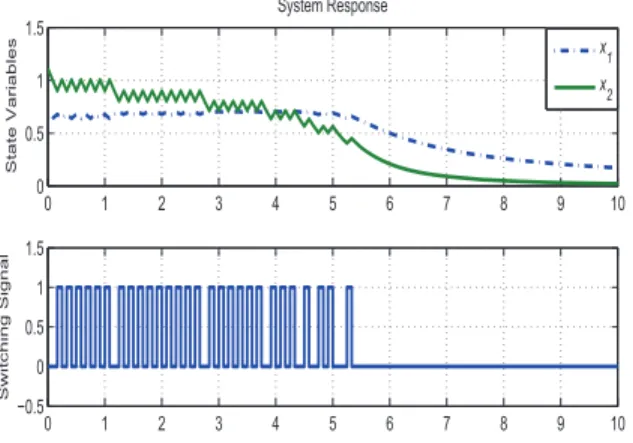
Fig. 1 shows the trajectories and the switching signal for the switched DAEs applying one single continuous control and a switching signal based on the proposed methodology. It is shown that both controllers acting simultaneously drive the switched DAEs system to the equilibrium point. 0 1 2 3 4 5 6 7 8 9 10 0 0.5 1 1.5 S ta te V a r ia b le s System Response x1 x2 0 1 2 3 4 5 6 7 8 9 10 í0.5 0 0.5 1 1.5 S w it c h in g S ig n a l
Fig. 1. States and switching signal
V. CONCLUSIONS ANDFUTUREWORK
We have presented preliminary results dealing with the stabilization problem of switched differential-algebraic systems. We have introduced a useful tool to solve this problem based on consistency projector and flow matrices to guarantee convergence towards an equilibrium point via fast switching. Some simulation results allow us to observe the effectiveness of the pro-posed algorithm. There are several possible extension of this work. One direction is towards non-linear sys-tems, in particular DAEs systems of polynomial form. On the other hand, the approach based on consistency projector can be used in linear optimal control problem such as a linear quadratic regulator for switched DAEs.
REFERENCES
[1] S. C. Bengea and R. A. DeCarlo. Optimal control of switching systems. Automatica, 41:11–27, 2005.
[2] M. Branicky, V. Borkar, and S. Mitter. A unified framework for hybrid control: Model and optimal control theory. IEEE
Transactions on Automatic Control, 43(1):31–45, 1998.
[3] M. Branicky and S. Mitter. Algorithms for optimal hybrid control. Proceedings of the 34th IEEE Conference on Decision
and Control, 3, 1995.
[4] D. Liberzon. Switching in systems and control. Springer Science & Business Media, 2003.
[5] D. Liberzon and S. Trenn. On stability of linear switched differential algebraic equations. In Proceedings of the 48th
IEEE Conference on Decision and Control, pages 2156–2161.
IEEE, 2009.
[6] V. Mehrmann and L. Wunderlich. Hybrid systems of differential-algebraic equations-Analysis and numerical solu-tion. Journal of Process Control, 19(8):1218–1228, 2009. [7] A. Mironchenko, F. Wirth, and K. Wulff. Stabilization
of switched linear differential algebraic equations and peri-odic switching. IEEE Transactions on Automatic Control,
60(8):2102–2113, Aug 2015.
[8] E. Mojica-Nava, N. Quijano, and N. Rakoto-Ravalontsalama. A polynomial approach for optimal control of switched non-linear systems. International Journal of Robust and Nonnon-linear
Control, 24(12):1797–1808, 2014.
[9] E. Mojica-Nava, N. Quijano, N. Rakoto-Ravalontsalama, and A. Gauthier. A polynomial approach for stability analysis of switched systems. Systems & Control Letters, 59(2):98–104, 2010.
[10] E. Mostacciuolo, S. Trenn, and F. Vasca. Averaging for switched daes: Convergence, partial averaging and stability.
Automatica, 82:145–157, 2017.
[11] Z. Sun and S. Ge. Switched linear systems: control and design. Springer Science & Business Media, 2005.
[12] A. Tanwani and S. Trenn. On observability of switched differential-algebraic equations. In Proceedings of the 49th
IEEE Conference on Decision and Control, 2010.
[13] S. Trenn. Switched differential algebraic equations. In
Dynamics and Control of Switched Electronic Systems, pages
189–216. Springer, 2012.
[14] S. Trenn. Solution concepts for linear daes: a survey. In
Surveys in Differential-Algebraic Equations I, pages 137–172.
Springer, 2013.
[15] S. Trenn. Stabilization of switched daes via fast switching.
PAMM, 16(1):827–828, 2016.
[16] X. Xu and P. Antsaklis. Optimal control of switched systems based on parameterization of the switching instants. IEEE
Trans. Automatic Control, 49:2–16, 2004.
MTNS 2018, July 16-20, 2018 HKUST, Hong Kong