HAL Id: inria-00476276
https://hal.inria.fr/inria-00476276
Submitted on 25 Apr 2010
HAL is a multi-disciplinary open access
archive for the deposit and dissemination of
sci-entific research documents, whether they are
pub-lished or not. The documents may come from
teaching and research institutions in France or
abroad, or from public or private research centers.
L’archive ouverte pluridisciplinaire HAL, est
destinée au dépôt et à la diffusion de documents
scientifiques de niveau recherche, publiés ou non,
émanant des établissements d’enseignement et de
recherche français ou étrangers, des laboratoires
publics ou privés.
Stefania Costache, Thomas Ropars, Christine Morin
To cite this version:
Stefania Costache, Thomas Ropars, Christine Morin. Towards Highly Available and Self-Healing Grid
Services. [Research Report] RR-7264, INRIA. 2010. �inria-00476276�
a p p o r t
d e r e c h e r c h e
ISRN
INRIA/RR--7264--FR+ENG
Towards Highly Available and Self-Healing Grid
Services
Stefania Costache — Thomas Ropars — Christine Morin
N° 7264
Stefania Costache
∗†, Thomas Ropars
∗†, Christine Morin
∗†Thème : Systèmes et services distribués Équipe-Projet MYRIADS
Rapport de recherche n° 7264 — April 2010 — 51 pages
Abstract: The volatility of nodes in large scale distributed systems endangers the availability of grid services and makes them difficult to use. In such a context, structured peer-to-peer overlays can be used to provide scalable and fault tolerant communication mechanisms. To ensure the availability of services, active replication can be used on top of the overlays. In this paper, we present Semias, a framework that is based on active replication on top of a structured overlay to provide high availability and self-healing for stateful grid services. The self-healing mechanisms of Semias ensure the high availability of the replicated services while minimizing the number of reconfigurations. We have used Semias to make Vigne grid middleware services highly available. Experiments run on Grid’5000 and PlanetLab show the performance and self-healing properties of the framework.
Key-words: Large scale distributed system, Grid Computing, High Availabil-ity, Self Healing
This report is based on the master thesis presented by Stefania Costache at Politehnica University of Bucharest, February 2010
∗INRIA Rennes-Bretagne Atlantique, Rennes, France
Résumé : La volatilité des nœuds dans les systèmes distribués de grande taille peut compromettre la disponibilité des services de grille et les rendre inutilis-ables. Dans ce contexte, les réseaux logiques structurés peuvent être utilisés pour fournir une solution de communication passant à l’échelle et tolérante aux fautes. Dupliquer activement les services au dessus du réseau logique permet d’assurer leur haute disponibilité. Dans cet article, nous présentons Semias, une solution fondée sur de la duplication active au dessus d’un réseau logique structuré pour assurer la haute disponibilité et l’auto-réparation de services de grille ayant un état. Les mécanismes d’auto-réparation de Semias assurent la haute disponibilité des services tout en limitant le nombre de reconfigurations. Nous avons utilisé Semias pour rendre des services de l’intergiciel de grille Vigne hautement disponibles. Les expériences menées sur Grid’5000 et PlanetLab dé-montrent les performances et les capacités d’auto-réparation de notre solution. Mots-clés : Système distribué de grande taille, Grilles de calcul, Haute disponibilité, Auto-réparation
1
Introduction
A grid gathers a large number of computing resources from different organi-zations or individuals, spread over a wide geographical area. It is a dynamic environment where resources can be connected or disconnected by their owners at any time. Due to the large scale of the system, the probability of resources failing is high. For example, the statistics made for Grid’5000 [1] by Iosup et. al [2] showed that the resource availability at grid level is around 69% on aver-age, with a mean time between failures of 12 minutes. Thus, the unavailability of resources could have a negative impact on applications that run for a long time and, overall, on the performance of the system. Also, the dynamicity and the large scale of the grid make it hard to use.
The access to grid resources is provided through a grid middleware. To ease grid usage, grid middlewares provide the user with different services, like execution management, data management and resource management [3]. For services to be useful, they have to be available despite the volatility of grid resources. Vigne [4] is such a grid middleware. To cope with the scalability and dynamicity issues, Vigne is based on a structured peer-to-peer overlay. One of Vigne’s core components is the application management service. All the applications are run under the control of this service. There is one instance of the service per application. The service instances, called application managers, are placed in a Distributed Hash Table (DHT). The DHT offers good load balancing properties and the peer-to-peer overlay provides fault tolerant key-based routing mechanisms. However, if any of the application managers fails, then the corresponding application runs without control and the information about it is lost. Thus, it is important for the service not to fail during the life of the application. For this, every application manager should be highly available and self-healing.
High availability is defined as the capacity of a system to satisfy its require-ments despite failures [5]. For a service to be highly available, it should have a degree of redundancy such that it is not interrupted when failures occur. En-suring the high availability can be done through replication. Self-healing is the capacity of a system to maintain its degree of fault tolerance. Self-healing is im-portant because in a large scale distributed system it cannot be assumed that a human intervention will quickly handle the consequences of a failure every time. Ensuring self-healing can be done by keeping a constant replication degree for the service.
To make Vigne’s application managers highly available, active replication can be used [4]. With this technique, the service is replaced with a group of service’s replicas that are all active and process the client’s requests. However, building active replication on top of a structured overlay is challenging. The replicas must be always kept consistent, despite node arrivals or failures in the overlay. Having efficient self-healing mechanisms is also something that must be dealt with. To keep the replication degree of the service constant, reconfigurations have to be done automatically. Any node addition, removal, or failure, may lead to a group reconfiguration. A group reconfiguration includes the creation of a replica and a state transfer to keep the created replica consistent with the others. In a dynamic system, there could be many reconfigurations, and many costly state transfers.
In this paper we present a solution to actively replicate stateful services dis-tributed on top of a peer-to-peer overlay. We propose the design of a framework, called Semias, based on the combination of the two techniques. To reconfigure the groups of replicas, we propose self-healing mechanisms based on a set of rules to ensure the availability of the services and to minimize the number of reconfigurations. Then, to replace the group configuration we present a proto-col that allows changing all replicas during one reconfiguration with no message loss. We implemented Semias as part of Vigne and used it to replicate Vigne’s application managers. We evaluated Semias and the replicated application man-ager on Grid’5000 and PlanetLab. We show how Semias takes reconfiguration decisions to ensure service’s availability despite node arrivals or failures. We also show how the total number of reconfiguration decisions is reduced when managing several application managers.
This paper is organized as follows. Section 2 presents the context of our work, gives an overview of the project, and details the related work. We describe the design of our prototype and detail the reconfiguration management in Section 3. In Section 4, we present our prototype and how we replicate the application management service of Vigne. Section 5 evaluates the performance of Semias. Finally we conclude and suggest some future directions in Section 6.
2
Overview
In this Section we detail the context and the goals of this work. Then, we give a brief overview of the two techniques on which Semias is based. We show how their combination provides services with high availability and we discuss the open issues related to an implementation of active replication on top of a structured peer-to-peer overlay. Finally, we outline the related projects that try to address the same problems as us.
2.1
Context and Motivation
In this Section we give a brief overview of the general context of our work. Then, for a better understanding of our motivation, we describe Vigne, the grid middleware in which we integrated Semias. We outline the main goals that we set for the design of our solution to make distributed services highly available through replication. Finally, we describe the system model that we considered when designing Semias.
2.1.1 Grid Computing
Our work has been carried out in the context of grid computing. A grid gathers a large number of heterogeneous resources owned by different organizations or individuals and it provides collaborative access to them. In general, two types of grids can be distinguished: computational and data grids. Computational grids provide access to great amounts of processing power. Data grids help control-ling, sharing and managing large amounts of distributed data. Computational grids can be composed of different distant clusters that belong to different orga-nizations. For example, Grid’5000 [1] or TeraGrid [6] are such grids. Or, they can gather the idle cycles provided by desktops from all the world to provide
large-scale computation and data storage. Folding@Home [7] or Seti@Home [8] are such examples. More generic architectures include both clusters and desk-tops, like in the case of NorduGrid [9]. Also, they can be composed of clusters and parallel computers, like EGEE [10].
Grid middlewares offer an uniform access to grid resources and a seam-less computing environment to the user. XtreemOS [11, 12] and the Globus toolkit [13] are some examples of grid middlewares. A grid middleware provides different capabilities, like security, resource discovery, data storage, execution management, scheduling, etc. These capabilities are provided through grid ser-vices, that can be seen as stateful web services [3]. Grid middlewares have to solve several challenges that are related to the grid features. Resources hetero-geneity is one of the main challenges. Another challenge is the management of resources spread over wide geographical areas and owned by different organiza-tions. The dynamic nature of the grid poses yet another challenge.
2.1.2 Failures in Grids
Studies have been made to characterize resource availability in grids and other large distributed systems. Parameters like availability time, mean time between failures or mean time to repair are often used to give a clear view regarding resource availability. Mean time to repair, or the failure duration, is the time between the occurrence of a failure and the recovery of the failed resource. Similar, the availability time is the time between the recovery of the resource and its failure. The mean time between failures is the average time between two inherent failures.
Iosup et. al [2] provide an accurate study on the availability of resources in Grid’5000 [1], using traces of Grid’5000 usage from 2005-2006. They found that the mean time between failures was 12 minutes at grid level. Moreover, the average availability of a node was around 45 hours, with an average failure duration of 14 hours. When considering the presence of correlated failures, they found that these failures do not usually expand beyond a site. Also, the authors specify that the chance for a node to become unavailable increases with the period the node stays in the system, thus preventing applications that run for a long time to complete. This fact outlines the need for providing high availability in large scale systems like grids.
2.1.3 Vigne
Vigne is a grid middleware that abstracts for the user the distributed physical resources. It is composed of a set of high-level services like application manage-ment, application monitoring, resource discovery, persistent data managemanage-ment, volatile data management, and low-level services like system membership [14]. The application management service controls application execution. The appli-cation monitoring service offers information about the execution of appliappli-cations. The volatile data management service offers distributed shared memory and the persistent data management service is used for storing and transferring files. The resource discovery service is in charge of finding a set of resources correspond-ing to the job specification. It uses an unstructured peer-to-peer overlay for distributed attribute searching. System membership service connects the nodes
of Vigne through a structured peer-to-peer overlay and is the base for the other services.
Application Management Service Each application is run under the su-pervision of the application management service. The application management service is a distributed service, with one instance per application. An instance of the service is called an application manager. The application manager has the task of running the application and ensuring that it terminates correctly despite nodes failing. For this, it interacts with other components like the client, the resource discovery service and the resource on which the application tasks are run. The application managers are distributed over the grid nodes using the structured peer-to-peer overlay. This provides fault tolerant message routing between applications managers and clients or grid applications. The structured overlay is based on Pastry [15] and uses Bamboo’s maintenance algorithms [16]. We describe in Section 2.2.2 the basic principles of Pastry and how is used to distribute the services.
To launch an application, a client contacts one node of Vigne and sends it the job specification. The specification is described in a JSDL [17] (Job Submission Description Language) file and includes the architecture requirements, number of nodes, memory, scheduler, etc. When the application is launched, a random key is associated to it, and an application manager is created for this application on the node whose id is the closest to the key at that moment. Afterward, a client can control the application by sending commands to the application manager, through the peer-to-peer overlay. In order to run an application, an application manager has to execute the following steps. First, it needs to select the nodes on which the application will run. For doing so, the application manager asks the resource discovery service to obtain the necessary resources. Then, if any input files are needed, the application manager asks the file transfer service to transfer them to the nodes on which the application will run. Finally, the tasks are started on the selected nodes and are monitored during their running to ensure their successful execution. If the task fails then the application manager restarts it from the beginning, or from a checkpoint if some checkpointing mechanisms are provided with the application. At the end the application manager cleans the task files, gets the output files and frees the allocated resources.
It is likely that the node on which the application manager resides fails. In this case, the client cannot control the application anymore and the user is not be able to get its results. Also, the resources used by the application will not be freed. Even worse, the nodes on which the application is run could also fail and in this case the application will not complete its execution. To avoid these problems, every application manager should be available even in case of failures. 2.1.4 Goals
We have seen why it is important for a service like Vigne’s application man-agement, presented in the previous section, to be highly available. To provide high availability for such a service we want to replicate it. Replicating a service is done by keeping multiple consistent copies (replicas) of it. When the service fails, one of its copies replaces it. However, replication can impact the perfor-mance of the system. Keeping multiple replicas leads to the utilisation of more resources and the management of the replicas implies an additional overhead
(the replicas need to be consistent, so they need to be updated when the state of the service changes). Considering these disadvantages, we define some general goals that we would like to address with our work:
• Because we don’t want to modify too much the client or the service, and to simplify the work that has to be done to replicate the service, the replication should be transparent. The service or the client should not know about the existence of multiple replicas or how they are managed. In case of failures, the client should not retransmit its requests.
• Because we want services to be usable, the response time of the replicated service should be kept low even in the event of some replica failures. • Because the number of service instances can be large in the case of a
dis-tributed service like Vigne’s application management service, the solution for replicating the services should be scalable. We should be able to man-age a large number of replicas and distribute their load over the nodes from the system.
2.1.5 System Model
We are considering a large scale distributed system, where nodes can fail or be added at any moment. We don’t assume any distribution of the node failure and arrival rate in the system. We assume that nodes crash in a fail-stop manner, i.e. no byzantine failures, and don’t recover afterward. Channels are FIFO and reliable but there is no bound on message transmission delay: if a process pi
sends a message to process pj, and none of them crash, then pj will eventually
receive the message. Regarding group membership, we consider the primary partition model because we want all non-failed replicas of a service to be always consistent.
2.2
Project Overview
Our solution to make distributed stateful services highly available is to use ac-tive replication on top of a structured peer-to-peer overlay. The idea of acac-tively replicating services in a DHT for high availability is not new. It was suggested in [4]. The architecture of Mena et. al [18] was proposed for the group com-munication system used for active replication. However, no further details were given on how this could be done and neither how reconfigurations of the replica groups could be managed. The feasibility of such a solution was investigated afterwards in [19], which gave a qualitative comparison of various replication techniques and outlined the possible open issues that are addressed in this pa-per.
We present next how this combination between active replication and a struc-tured peer-to-peer overlay meets our previously defined goals. We illustrate how active replication can be implemented in a DHT in the design of Semias. To implement active replication, we started with the existing group communication architecture for dynamic groups, proposed by Mena et.al [18] and we extended it with a reconfiguration protocol to make the groups self-healing.
2.2.1 Replication Techniques
Replication is a common technique for making services fault tolerant. Service replication consists of creating and distributing multiple identical copies (repli-cas) of the service across the system and keeping them consistent. The two main replication techniques are active and passive replication [20]. The basic principles for these techniques are described in Figure 1.
Client Replica 1 Replica 2 Replica 3 resp on se resp on se resp on se atomic broadcast process request process request process request Client Replica 1 Replica 2 Replica 3 se nd re qu est process request ack ack resp on se view synchronous broadcast (a) (b)
Figure 1: The interactions between the replicas and the client in (a) active replication and (b) passive replication.
In active replication, also called state-machine approach [21], every replica processes the client’s requests and returns the responses. When processing the requests, the following steps are taken: (i) the requests are sent to all the replicas; (ii) the replicas process them in the order they are delivered; (iii) all replicas send back the responses to the client, which can wait only for the first one, or for a majority. If the client cannot handle duplicate messages, care must be taken to send only one response.
Active replication assumes that if all replicas receive and process the same requests in the same order, they remain consistent. To achieve this consistency, an atomic broadcast group communication primitive [22] is used. Atomic broad-cast ensures that the message is delivered at most once and in the same order to all (non-failed) replicas. Active replication requires services to be determin-istic. A service is said to be deterministic if started from the same initial state and supplied with the same ordered sequence of messages, reaches the same final state and produces the same output. A strong advantage of the active replication technique is that it ensures the highest degree of availability for the service. In the event of a replica failure, the remaining available replicas con-tinue to process the requests. Thus, the failure is transparent for the clients and the response time of the service remains low.
In passive replication, also called primary-backup [23], only one replica, called the primary, receives and processes the client requests. After processing a request, the primary sends an update message to the other replicas, called backups. All backups update their state and send an acknowledgement message to the primary. After it receives all the acknowledgements, the primary sends the response to the client. If the primary fails, a new primary must be chosen from the available backups. To guarantee that the updates are processed in the same order, a view synchronous broadcast primitive is used. View synchronous
broadcast [24] is defined for dynamic groups. A dynamic group is a set of processes that changes during the system’s lifetime. The set of processes at a time t is called a view. When a process is seen as failed or a new process wants to join the group, a new view is installed. View synchronous broadcast ensures that all the processes from a view deliver the same set of messages before installing a new view.
One advantage of passive replication is that it requires less processing power than active replication since the requests are processed only once. Also, it can be used to replicate non-deterministic services. However, passive replication requires modifications of the service to implement the backup update mecha-nisms. Furthermore, the failure of the primary replica is not transparent for the clients. If the primary fails while processing a client request, the client has to re-send the request. Also, in case of primary’s failure there could be a signifi-cantly increased response time, due to the time it takes for one of the backups to become the primary and start processing the client’s requests again.
Besides active and passive replication, there are also various hybrid tech-niques, like semi-active [25] or semi-passive [26] replication. Semi-active repli-cationtries to accommodate the non-deterministic behavior of the services and to achieve the low recovery overhead of active replication. In semi-active repli-cation, all replicas process the requests but non-deterministic actions are taken only by a leader that notifies the other replicas (followers) of its decisions. Semi-passive replicationtries to reduce the response time in case of primary’s fail-ure. In semi-passive replication all the replicas receive the requests, but only the primary process it and then it updates the backups. Then, the responses are sent by all replicas.
To replicate services, Semias is using active replication. We have chosen active replication because it provides the highest degree of availability for the service. Also, the replicated service has a low response time in case of failures and the replication is made transparent to the client. Thus, we found it suit-able for our goals. Analyzing Vigne’s services, we considered that determinism was not an overly restrictive requirement. However, if we want to handle non-deterministic behaviors [27], we could replace active replication with semi-active replication.
2.2.2 Structured Peer-to-Peer Overlays
Structured peer-to-peer overlays provide key-based routing mechanism. They are used to implement Distributed Hash Tables (DHTs). A DHT is an ab-straction that provides a mapping (key, value), in a distributed manner over the nodes of the peer-to-peer network. Several implementations of DHT are described in the literature [28].
Semias is based on Pastry [15], but the design could be also adapted to other DHTs. Pastry provides scalable and fault tolerant routing mechanisms. It uses a ring topology with nodes ordered clockwise in the logical ring. The nodes are associated with a randomly chosen unique identifier (id) represented in hex-adecimal. An object in the DHT is identified by a key. A key is mapped to the node having the numerically closest id to that key. Reaching the corresponding object is made through that node. Pastry routes a message in O(logN) overlay hops, N being the number of nodes in the system. Each Pastry node main-tains a O(logN) size routing table. Every node in the system keeps a list of
its neighbors in a leafset and monitors them for failure detection. A leafset is represented by the set of its 2l closest neighbors (the l neighbors on its right and the l neighbors on its left). The neighbors periodically exchange leafsets in order to update the information in their leafset. An example of message routing in Pastry is described in Figure 2 (a). A message is sent to a key, and routed to the numerically closest node id to that key.
(a) (b)
Figure 2: Message routing (a) and service active replication (b) in Pastry. In Semias, the objects put in the DHT are services. By randomly choosing the services keys, we ensure that services are distributed over all the nodes in the system. Thanks to the DHT, a client can communicate with a service without knowing its physical position, simply by using the key that identifies the service. 2.2.3 Active Replication on Top of a DHT
By actively replicating services in a DHT, replication is made totally transparent for the clients. A client only needs to know the service key to send a request to it. It does not need to know the physical position of the service’s replicas and does not need to be aware of replication. Furthermore, the DHT provides scalability and good load balancing properties for the replicated services. Principles
To keep replication transparent to the client, we follow the natural choice of placing service’s replicas on the closest nodes to the service’s key1. Since
mes-sages in Pastry are always routed to the closest node to a service key, they always reach a node hosting a replica of the requested service, even in the event of a failure.
A detailed description of the rules that we use to select the replica positions is given in section 3.6.2. We illustrate the placement of the service replicas in Figure 2 (b). In this example, two services, respectively associated with key 58 and key AF, are replicated with a replication degree of 3. If node 5C fails,
1
requests to service 58 will be routed to node 43 which also hosts a replica of service 58. The node receiving a message for a service is in charge of atomically broadcasting the message to all replicas of that service.
Since node ids are chosen randomly, neighbors in the logical ring are, with a high degree of probability, uniformly distributed over the physical network. By placing the replicas of a service on neighbors in the logical network, we ensure that the risk of experiencing concurrent failures of multiple replicas is low. As we have seen in Section 2.1, there is a low risk of multiple random nodes failing together. Thus, the replication degree for a service can be small.
Possible Issues When reconfigurations in the overlay occur, replica sets have to be reconfigured accordingly. Two cases have to be carefully handled: node additions and node removals.
Node addition If a node joins the logical ring with an id closer to a service key than some of the nodes currently hosting a replica of that service, this new node is likely to receive messages for that service. One of the replicas has to be migrated so that the replicas remain on the n closest nodes to the service key. This is illustrated in Figure 3 (a). Here, a new node with id B3 joins the overlay (step (1)). If node AC fails, then the messages sent to key AF will be received by node B3. A replica is migrated to node B3 from node C9 (steps (2) and (3)).
Node removal When a node is detected as failed, it is removed from the logical network. If the failed node was hosting a replica of a service, a new replica should be created to keep the service’s replication degree constant. This is illustrated in Figure 3 (b). Here, node AC fails (step (1)) and a new replica is created on node 78 (step (2)). For now, Semias does not provide specific mechanisms for voluntary node disconnections. We handle them as failures.
Handling reconfigurations The basic solution is to reconfigure the replica sets every time a reconfiguration occurs in the peer to peer overlay. However, creating or migrating a replica involves a state transfer which can be costly, especially in a wide area network. Furthermore, in a dynamic environment, modifying the groups on every reconfiguration from the peer-to-peer overlay can lead to many useless reconfigurations. In Figure 3 (a) for instance, when a new node joins the system with the id B3, the replica set of service AF should be modified: the replica hosted by the node C9 should be migrated to the new node B3. If immediately after this reconfiguration, the node AC fails, a new replica will have to be created again on the node C9, to maintain a constant degree of replication for the service.
To avoid useless state transfers, we want Semias to delay non-critical recon-figurations and to make use of this time to gather information about the nodes in the system to take better reconfiguration decisions.
2.3
Related Work
In this section, we detail the related work. We first study high availability through service replication in existing grid middlewares. Then we briefly present
D6 C9 B3 AC 95 78 AF D6 C9 B3 AC 95 78 AF D6 C9 B3 AC 95 78 AF (1) (2) (3) (a) D6 C9 AC 95 78 AF D6 C9 95 78 AF (1) (2) (b)
Figure 3: Steps that should be taken to reconfigure the replica set due to changes in the overlay. In (a) the replica set is changed when a new node with the id closer to a key than some replicas arrives. In (b) the replica set is changed when a node hosting one replica fails. Grey nodes are hosting a replica. The black node is the failed replica and the dashed one is the newly arrived node. The state transfer between the replicas is represented by an arrow.
the characteristics of dynamic group communication systems for active replica-tion. Finally, we present works on active replication on top of a structured peer-to-peer overlay that address the problem of reconfigurations.
2.3.1 Services Replication in Grids
Few works have addressed the problem of grid services availability. In Migol [29] active replication is implemented for one of its core services. The replicas are distributed on different sites. Two different implementations are proposed. The first one is using a token-based protocol to provide the total ordering of the messages. The second protocol is sequencer based. They use timeouts to remove the failed replicas from the group. However, they do not mention if or how they maintain the replication degree.
XtreemOS proposes to combine active replication and mobile IPv6 [30] to make replication of services transparent for clients. This solution does not han-dle the problem of selecting replicas position and so, does not hanhan-dle load bal-ancing.
Zhang et. al [31] propose passive replication for non deterministic services. They use a heart-beat mechanism to detect the failure of the primary, which is changed whenever is detected as failed. Wrong suspicions are costly, because they imply a useless change of the primary. In wide-area networks failure detec-tion is unreliable and there could be many wrong suspicions, so their approach is more suitable for clusters. In XtremWeb, clients submit jobs to a coordination service which schedules them on a set of participating workers. The
coordina-tion service is important for the system and passive replicacoordina-tion is used to make it available despite failures [32].
Other grid middlewares use replication to improve the reliability of the ex-ecuted jobs [33, 34]. Vishwa [33] and Zorilla [34] are grid middlewares based on peer-to-peer overlays. Zorilla is using a structured peer-to-peer overlay for decentralized scheduling of jobs. Each job is associated with a distributed job object that contains the state of the job and its files. The job objects are replicated using a technique close to passive replication. Vishwa is storing the information related to the tasks in a DHT and replicates it over multiple nodes. However, they do not describe the replication technique that is used. In both cases, it is not specified if and how the replication degree is kept constant, so we assume they do not provide self-healing for their groups of replicas.
2.3.2 Active Replication in Dynamic Systems
To implement active replication a group communication system is required. Group communication systems provide group membership and group communi-cation primitives, like atomic broadcast. There are two types of architectures, based on the relation between group membership and atomic broadcast. The first type implements atomic broadcast by using group membership [35]. Many atomic broadcast algorithms require a perfect failure detector, i.e. a failure detector that does not make mistakes. This type of failure detector can be ob-tained by using the group membership: whenever a group member is suspected to have failed, the suspected member is removed from the group through a membership change. Thus, the atomic broadcast is implemented on top of the group membership. In this case, wrong suspicions have an important impact upon the group because they lead to many membership changes.
The second type of architecture implements group membership by using atomic broadcast [18]. The atomic broadcast is based on a consensus algorithm which can use an unreliable failure detector [36], i.e. a failure detector that can make mistakes by wrongly suspecting non-failed processes or not suspecting failed processes. In this way, the suspicion of a process does not lead necessarely to its removal from the group. This architecture dissociates the suspicions from node evictions and allows making the decision of removing the process separate from group membership. This is advantageous in dynamic systems where there could be many wrong suspicions. Also, it allows the implementation of multiple reconfiguration strategies that could cope with the dynamicity of the system. These advantages lead us to choose it as a base for Semias.
2.3.3 Active Replication on Top of a Peer-to-Peer Overlay
PaxonDHT [37] proposes a solution for implementing the Paxos [38] consensus algorithm on top of the Pastry DHT as a basic block for active replication. How-ever, PaxonDHT only ensure the safety of Paxos with some probality because group membership changes are not synchronized with the run of consensus in-stances. A high replication degree is required to ensure safety with a high probability. In [39] the autors propose active replication as the base for build-ing reliable peers, called virtual peers, in peer-to-peer networks. The virtual peers represent the groups of peer replicas. The replicas have fixed identifiers, therefore the reconfiguration is needed only at node failure. To ensure
consis-tency between them, they also use Paxos. However, messages sent to the virtual peer when the Paxos leader is failed and until the re-election of a new leader are lost. Therefore, a retransmision is required. They use a single timeout for detecting the failure of a node. The failed node is removed from the replica group. In wide-area networks, they could have many wrong failure detections, and therefore, many wrong reconfigurations.
Other recent works [40, 41] address the problem of implementing mutable replicated objects on top of a DHT. Thus they also need to solve the problem of handling reconfigurations. However, in their case, reconfigurations are not constrained by the same view delivery requirement of atomic broadcast: recon-figurations are not serialized with normal operations. In their case, the Paxos algorithm is used only to agree on the new configuration. The replicas are placed on the closest nodes to the object’s key and the immediate successor of the key is designated as a primary [40] or a master replica [41]. All the operations are serialized through this node.
Etna [40] is build on the Chord DHT. It reconfigures the set of replicas whenever it notices that it is different from the set of successors from Chord, i.e. when a replica leaves or when a new node joins. The reconfigurations are not transparent to the client. Etna returns an error if there are ongoing opperations during a reconfiguration. DhtFlex [41] is designed for a generic overlay. It does the reconfiguration periodically, with the risk of loosing some replicated objects in case of many failures.
In Scalaris [42] the Paxos commit protocol is used to solve the problem of atomic commit in transactional databases built on top of a DHT. For coordo-nating the transactions they are using a replicated Transaction Manager and the replicas have fixed logical identifiers. The node arrivals and failures in the DHT are treated synchronously: every change in the overlay leads to a change in the replica set.
2.4
Conclusions
The dynamic nature of large scale distributed systems like grids, has a negative impact on the usability of services and the overall performance of the system. To ease the grid usage, services provided by grid middlewares should be highly available.
Structured peer-to-peer overlays are an attractive solution to provide scala-bility, location-independent naming and fault-tolerant routing. Some grid mid-dlewares use them as a base for building distributed scalable services. To add high availability to such services, active replication can be used. The combi-nation of active replication with a structured peer-to-peer overlay makes the replication transparent for the clients. The overlay offers scalability and good load-balancing properties. Two problems have to be solved to implement such a solution: keeping the replicas consistent and dealing with the reconfiguration of the groups of replicas. A few projects addressed the problem of having highly available grid services or suggested active replication on structured peer-to-peer overlays, but none of them handled properly the reconfiguration of replica groups.
In this paper, we propose a new solution, called Semias, for active replica-tion of services on top of a structured peer-to-peer overlay. For active repli-cation, Semias is based on an existing architecture for dynamic group
com-munications [18] that dissasociates node suspicion from node removal from the group. As this solution does not completly ensure the availability of a service in a dynamic environment, we propose a self healing protocol that takes critical reconfiguration decisions based on a predefined set of safety rules.
3
Design
In this Section we present the architecture of Semias. The architecture is com-posed of four main modules (layers). This makes it modular and extensible. In the next sections, we present the architecture used for the active replication of services. We discuss the choices that we made in building these modules and how they interact with each other. Finally, in Section 3.6 we describe the self healing mecanism of Semias used to ensure the high availability of replicated services despite node failures and arrivals.
3.1
Overview
The basic modules of Semias are a peer-to-peer overlay and a group communica-tion system. This comes as a natural choice for providing active replicacommunica-tion for services distributed over a peer-to-peer overlay. The peer-to-peer overlay pro-vides fault-tolerant key-based routing mechanisms. The Group Communication System (GCS) implements atomic broadcast, used for active replication.
Also, the framework must be suitable for highly dynamic environments. One of its goals is to ensure the availability of the replicated services while minimizing the number of the group reconfigurations. Therefore, we added a third module in our design, called the Group Monitoring Layer (GML). The main task accom-plished by the GML is to gather information about the groups that include the replicas hosted by the node and the changes in the node’s neighborhood at the peer-to-peer overlay. It does so in order to take reconfiguration decisions. To ensure the service’s availability, the GML applies a set of basic self-healing rules (we define these in Section 3.6.2). To get the information about the changes in the node’s neighborhood, the GML receives a set of events from the overlay’s maintenance algorithms.
Finally, as we wanted to make the replication transparent for the clients, we added a fourth module, called Service Communication Layer (SCL). This is used for the communication between the clients and the replicated services.
While the GCS is instantiated for every replicated service that resides on one node from the system, the other modules are represented by only one instance per node. In this way, the GCS handles the management of replicas only for the service assigned to it, while the SCL and the GML can have a view of all the groups hosted by a node. Also, the GML could be extended in the future to perform other tasks, e.g. gather statistics about the dynamicity from the node’s neighborhood and adjust the self-healing rules based on that, so having it as a separate module allows to easily modify it in the future.
Figure 4 presents the interactions between the modules of our framework. When a client wants to send a request to a service, it routes a message containing this request to the service’s key in the P2P overlay. The message is received by the SCL of the node on which one of the service’s replicas reside. Then the SCL calls the abcast method provided by the GCS, to atomically broadcast
trigger reconfiguration
Peer-to-Peer Overlay
Group Monitoring Layer (GML) Service Communication Layer (SCL) Replicated Service Group Communication System (GCS) overlay events overlay events send answer input/output message abcast request deliver request
Figure 4: The interactions between the modules of Semias. The peer-to-peer overlay is a third party contribution.
the message to all the replicas. The GCS delivers the message to the service’s replicas. To maintain its group configuration, the GCS receives events from the GML to reconfigure itself. The structure of every module is described in more detail in the rest of this section.
3.2
The Peer-to-Peer Overlay
We require the P2P Overlay to provide the other modules with the following functionalities:
• methods for routing a message in the overlay to a key;
• methods for direct sending a message to a neighbor from the node’s leafset; • access to the node’s leafset;
• events that inform the other modules of the changes in the overlay. These events are generated at node joining, arrival, suspicion, non-suspicion and failure. Node suspicion must be disassociated from node failure. If such a mechanism does not exist, it could be implemented by using a separate timeout mechanism for node suspicion.
Our implementation of Semias uses an existing overlay that we slightly mod-ified to provide the last two functionalities previously described. The events are generated by the maintenance algorithms of the overlay and are handled by the GML. How these events are generated, is presented as following:
• Joining: To join the system, a node A needs to contact one existing node. A asks this node to route a joining message to the key A. When this message arrives on a node that has the closest id to A, lets call it B, B generates a joining event.
• Arrival: Other nodes become aware of A and update their leafset due to the periodic leafset exchange When another node from the system, C, adds A in it’s leafset it generates an arrival event.
Peer-to-Peer Overlay Service Communication Layer Group Communication System Service Communication Layer
Client
Input message Abcast input message
Output Peer-to-Peer Overlay Input message Input message Input message Service Replica 1 Output Service Replica n Output Output Service Replica 2 ... Client Input
Figure 5: The interaction between SCL and the other components of the frame-work.
• Suspicion: C periodically checks if its neighbors are alive by probing them. If A does not answer before a predefined timeout, called suspicionTimeout, Cgenerates a suspicion event and sends a second probe to A.
• Non-suspicion: If A answers before a second timeout, called failureTime-out, C generates a non-suspicion event.
• Failure: If the timeout failureT imeout expired and A did not answered, Cremoves A from its leafset and generates a failure event.
Because two timeouts are used to determine if a node is failed, their values can be independently tunned. The first one can be small to quickly detect delayed nodes while the second one can be big to limit the number of wrong failure suspicions. We describe in Section 3.5 how we make use of these two timeouts.
3.3
Service Communication Layer
The SCL provides a one-to-many and many-to-one communication between a client and a replicated service. The way this module is used is presented in Figure 5.
A message sent by a client to a replicated service is routed through the overlay to the node responsible for the service key. The SCL of this node checks if the node hosts a replica for the targeted group and calls the abcast primitive provided by the GCS to send the message to all the group members. If the node receiving the message does not host a replica of the group (it has just joined the
overlay and has not been included in the group yet), it is not able to abcast the message. In this case, the SCL forwards the message to one current member of the group, as described in Section 3.6.
Every replica processes the client’s request and outputs the same answer. We assume that the client cannot handle duplicate messages. Thus, the SCL of the node on which the client is connected delivers to the client only the first answer and rejects the others.
3.4
Group Monitoring Layer
The GML handles the events generated by the peer-to-peer overlay in order to take self-healing decisions for the groups hosted by a node. These decisions are based on a set of basic safety rules that define the minimum requirements for assuring the high availability of a replicated service. The GML also logs the failures received from the peer-to-peer overlay. This log is used by the GCS to avoid blocking during the reconfiguration process. The safety conditions and the reconfiguration process are described in Section 3.6.
3.5
Group Communication System
The GCS provides group membership management and an atomic broadcast (abcast) primitive. The components of GCS and their interactions are presented in Figure 6. The group membership management makes replication transparent for the services and the clients by hiding the degree of replication and the identities of the replicas. The client does not need to know the identities of service’s replicas or about service’s current replication degree. It can treat the group of replicas as one service. Also, the replicated service does not need to be aware of its other replicas. The abcast primitive hides the complexity of maintaining the consistency between the replicas. Thus, neither the client nor the service need to worry about replicas’ consistency.
The architecture is based on the protocol stack described in [18]. The pro-posed solution is designed for dynamic group communication and is well mod-ularized, allowing to modify each of its modules independently of the others. Its main characteristic is the use of atomic broadcast to build the group mem-bership component. In this way, the memmem-bership changes are ordered with the application messages by using atomic broadcast for both.
The abcast algorithm is based on consensus. The consensus protocol requires an ⋄S unreliable failure detector [36] in order to choose the coordinator of a round. This failure detector has two characteristics: (i) it ensures eventually the permanent suspicion of every failed process by every correct process; (ii) it guarantees the existence of a correct process that is eventually not suspected by any correct process.
This main feature of the framework allows dissociating node suspicion from group member eviction. Process suspicion events are used for the liveness of consensus. Process failure events are used to remove the process from the group. Thus, in the initial framework, the decision of excluding a group member could be taken separately from the group membership, from a monitoring module.
This design could take advantage of the existence of the two timeouts in the P2P overlay, suspicionTimeout and failureTimeout as mentioned in Section 3.2.
Group Membership Failure Detector Consensus elect leader propose decide
Group Monitoring Layer
suspicion/non-suspicion events add/remove Abcast reconf Start new reconfiguration Adeliver reconf Reconfiguration Atomic Broadcast
Figure 6: The protocol stack of the Group Communication System component. These are used for notifying the suspicion of a process, and afterward, its fail-ure. suspicionTimeout can be small to ensure the reactivity of the consensus algorithm, while failureTimeout can be large to be sure that a node is really failed before removing it. This is useful in wide area networks, where latency can be large and variable.
The GCS should be able to reconfigure itself in a dynamic environment. Adding/removing a process at every arrival/failure should be avoided, because it could lead to useless reconfigurations, as described in Section 2.2.3. A recon-figuration not only involves an abcast in the process group, which is costly, but also a state transfer to the new member of the group, so that it is consistent with the other members. So having too many useless reconfigurations could impact the performance of Semias. The decision to add or remove a process from the group is taken by a separate module, that we called the reconfiguration component. They are packed in a reconfiguration message that is ordered with the normal messages by the atomic broadcast module, and are processed when this message is delivered. The way in which the decisions are taken is described in Section 3.6.
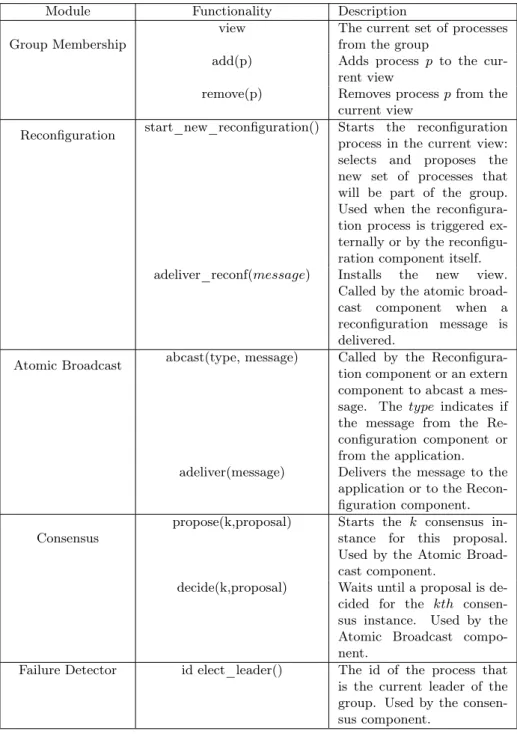
A summary of the functionalities offered by every module is described in Table 1. The group membership offers primitives for accessing and modifying the view. The reconfiguration component provides methods for starting the reconfiguration and handling the installation of the new view. The abcast and consensus components provide well-known primitives as described in literature. The failure detector provides the leader election capability. We describe every module in the rest of this section.
Module Functionality Description Group Membership
view The current set of processes
from the group
add(p) Adds process p to the
cur-rent view
remove(p) Removes process p from the
current view
Reconfiguration start_new_reconfiguration() Starts the reconfiguration
process in the current view: selects and proposes the new set of processes that will be part of the group. Used when the reconfigura-tion process is triggered ex-ternally or by the reconfigu-ration component itself.
adeliver_reconf(message) Installs the new view.
Called by the atomic
broad-cast component when a
reconfiguration message is delivered.
Atomic Broadcast abcast(type, message) Called by the
Reconfigura-tion component or an extern component to abcast a mes-sage. The type indicates if the message from the Re-configuration component or from the application.
adeliver(message) Delivers the message to the
application or to the Recon-figuration component. Consensus
propose(k,proposal) Starts the k consensus
in-stance for this proposal. Used by the Atomic Broad-cast component.
decide(k,proposal) Waits until a proposal is
de-cided for the kth
consen-sus instance. Used by the
Atomic Broadcast compo-nent.
Failure Detector id elect_leader() The id of the process that
is the current leader of the group. Used by the consen-sus component.
Table 1: Functionalities offered by every GCS component 3.5.1 Group Membership Component
The group membership component maintains the current list of group members, also called the group view. It offers a consistent access to the view for all the other components of the GCS and updates it by adding or removing members
when a new configuration is installed. Its role in the reconfiguration process is passive, because the decisions of adding or removing the members are taken by the reconfiguration component.
3.5.2 Reconfiguration Component
The reconfiguration component computes and installs a new group view when a reconfiguration event is triggered. To install the new configuration, the re-configuration component of a replica sends a message to all the others members of the group containing the new view. The configuration messages are totally ordered with the normal ones, by using the atomic broadcast primitive. We describe the process of reconfiguration and the conditions that are triggering it in Section 3.6.
3.5.3 Atomic Broadcast Component
To ensure the consistency of the replicas from the group we need a uniform atomic broadcast algorithm to provide the total order delivery of messages in the group. For this, we use the uniform atomic broadcast algorithm for dynamic groups proposed by [22]. We slightly alter the initial specification in order to integrate it with the reconfiguration component. We present the pseudocode for this algorithm in Figure 7.
The algorithm is based on a sequence of consensus instances. Every instance is used to decide on a batch of messages to be delivered (lines 21-24). Every consensus instance is executed by the processes that are part of the current view when the consensus has started. Therefore, a membership change cannot affect the safety of consensus. The messages from the batch are deterministically ordered, e.g. by using a unique incremental identifier for each message, and are classified in two types:
• Normal: the messages that are delivered to the service.
• Reconf : the messages from the reconfiguration component, that will mod-ify the group membership.
To atomically broadcast a message in the group, the replica that receives it calls the abcast method (line 8). After the abcast, the replica acknowledges the message at the peer-to-peer overlay. In case the message is not acknowledged, it is considered that the node receiving the message is failed and the message is re-routed in the overlay. This is done to ensure that a message sent to a replica group will be eventually received by all the group members.
To be sure that the message will be delivered by all the non-failed replicas, every replica needs to store the abcasted message in its undelivered queue (line 15). For doing so, when a replica receives a message for its replica group from the peer-to-peer overlay, it broadcasts the message in the group. Then, this replica waits for all the answers from the non-failed group members to be sure that they all have the message in their undelivered list (line 10). Afterwards, depending on the received answers, the replica decides if the message should be retrasmited or not (lines 11-12).
When a replica receives the broadcasted message, it replies with an ack or a nack (lines 16-19). The ack is sent if the replica receiving the message is in the
1: Variables:
2: v // Current set of replicas
3: vnb // Current view number
4: undelivered=∅ // List of received messages that are not delivered
5: adelivered=∅ // List of delivered messages
6: k=1 // The consensus instance used for deciding a batch of messages
7:
8: abcast(type, v′
nb, msg)
9: send message(type,vnb,msg) to all q ∈ v
10: wait for all answers from non-failed p ∈ v, either acks or nacks
11: if majority of nack and type=Normal then
12: route(message(type, vnb, msg))
13:
14: upon receive(type, v′
nb, msg) from q for the first time
15: undelivered ← undelivered ∪ {type, msg}
16: if p ∈ v and v′ nb= vnb then 17: send ack(type, v′ nb, msg)to q 18: else 19: send nack(type, v′ nb, msg)to p 20:
21: handle decide( adeliverk )
22: if type = N ORM AL from undelivered adeliverk
then
23: adeliver(message)
24: if type = RECON F from undelivered adeliverk
then
25: adeliver_reconf(v,message)
26: adelivered ← adelivered ∪ adeliverk
27:
28: upon undelivered − adelivered 6= ∅
29: proposal ← undelivered − adelivered
30: propose(k, v, proposal)
31: wait until decide(k, adeliverk
)
32: handle decide(adeliverk
)
33: k ← k + 1
34: pass_to_instance(k)
35: while has next decided adeliverk
do
36: handle decide(adeliverk
)
37: k ← k + 1
38: pass_to_instance(k)
Figure 7: Atomic broadcast algorithm for a process p.
same view as the replica that broadcasts the message. By doing so, the replica acknowledges that it has the message in its undelivered list and it is able to send it to any new replicas if a view change occurs. If there was a view change before the message is received, the replica sends a nack.
If the replica that broadcasted the message receives a majority of acks it means that there is a majority of replicas in the current view that have the message in their undelivered list and are able to initialize new replicas during a view change such that the message will be eventually delivered. Otherwise, it means that a view change took place and there is a risk that the message would not be delivered. Thus, the message is routed again in the peer-to-peer overlay,
such that it will be eventually broadcasted in the new view. However, Reconf messages are not routed again because they are outdated, since a view change is already occuring. This mechanism is part of our solution to avoid message loss during a replica group reconfiguration, as we proove in Section 3.7.
To ensure in a simple way that the processes from the new view will deliver the same messages from a batch as the ones from the old view, the reconfigura-tion messages are delivered after the applicareconfigura-tion ones (lines 22-25).
Another point that should be mentioned in the description of this algorithm, is presented in lines 35-38 of Figure 7. As the Atomic Broadcast and the Con-sensus are separate components, a decision on some batch of messages could be made by the Consensus component, while the Abcast component is handling the current one. So, after handling the messages from the current decided instance, a check could be done, so that the next batches can be processed immediately. 3.5.4 Consensus Component
Consensus allows processes to reach a common decision despite failures. To choose an efficient consensus algorithm, we considered the behavior of repre-sentative algorithms in an environment with multiple crashes and wrong failure suspicions. These consensus algorithms are designed for the asynchronous model with unreliable failure detectors and they tolerate up to f < n crash failures in a system with 2n + 1 processes. From these, we choose the Paxos protocol. Paxos [38, 43] is efficient in environments where there are frequent wrong sus-picions and multiple correlated failures [44]. However, it could be replaced by other consensus protocols.
Paxos Algorithm In the Paxos protocol, there are two types of participating processes: proposers and acceptors. The proposer proposes a value, that is accepted or rejected by the acceptors. In our implementation, we assume one process that has the role of the proposer and that is also the coordinator (leader) for the current instance. The coordinator proposes values to the set of acceptors until one is accepted. The set of acceptors is represented by all processes from the current view.
The process of trying to reach a decision is called a round. Only the process that is the leader can start a new round. However, processes can be wrongly suspected and there can be more than one leader at a time. The rounds execute asynchronously: not all the processes execute the same round; it depends if there are failures or if they suspect the current leader. In each round the leader tries to impose a decision value to all processes. If it succeeds then the protocol terminates, otherwise a new round is started. Thus, if there are no failures or wrong suspicions, only one round is necessary to decide a value. The execution of a round is divided in three phases:
• "Prepare" phase: the purpose is to update the leader’s estimate of the decision value with the current one. If the leader failed during a round, then a new leader is chosen and it needs to know if a value was already decided or not.
• "Accept" phase: the leader sends the value that he wants to be accepted to all the other processes. If a majority of processes approve this value, than the decision is being made.
• "Decide" phase: The leader broadcasts the decided value to all the pro-cesses.
A detailed description of the algorithm, including the handling of all failure cases, is presented in Appendix A.
When deciding sequences of values, the consensus protocol is called subse-quently. Each run of consensus is made in a consensus instance. For example, to agree on the k − th value, the k − th instance of Paxos is needed. During a run of consensus, only the processes from the view in which the instance was started participate.
3.5.5 Failure Detector
The failure detector is a module attached to each process, that gives some information about what processes have failed. Failure detectors are unreliable in asynchronous systems: they can suspect processes that have not failed or see failed processes as correct. This is because in an asynchronous system there are no timing assumptions on the delay of messages. So it is impossible to distinguish a slow process from a failed one.
The failure detector that we use is dependent on the consensus protocol. Paxos requires an Ω failure detector [45]. This failure detector provides the processes with an eventual leader election capability: it outputs only one trusted process.
To implement our failure detector, we use the Suspicion event received from the GML to build a list of non-suspected processes. Then, to select the leader, we choose the identifier of the node that is the closest to the group key from this list.
3.6
Dealing with Reconfigurations
To maintain the replication degree of a service constant and the same logical positions of the replicas despite changes in the overlay, the group configuration must be regularly updated. However, in a dynamic environment, where nodes can arrive and fail at any time, reconfiguring at every change in the overlay would be costly. Thus, Semias is periodically checking the overlay to trigger a reconfiguration if needed. Since the configuration can become invalid between two periodical checks, a set of safety conditions, described in Section 3.6.2, are verified by the GML at every node arrival or failure event. The new configuration is chosen and then proposed in the current group. If multiple configurations are proposed for the current view, only the first decided configuration is installed.
Next, we define the terms that we use when explaining the reconfiguration process. Then we outline the three safety conditions that we used to avoid invalid configurations and present the reconfiguration protocol.
Definitions For the sake of clarity, we define some terms that we use in the rest of this section.
new view: the set of nodes decided in the reconfiguration process that will replace the current one.
old view: the set of nodes that made the group view before the new configu-ration is installed.
new replica: a node that is added to the group when the reconfiguration oc-curs. Its state must be initialized to be consistent with the other replicas in the group.
old replica: a node that was included in the group before the reconfiguration occurred.
forwarding state: a special state in which the node that is not part of a group is aware of the set of group members and is able to forward messages to them.
forwarding node: a node that has the GCS component initialized in the for-warding state.
The forwarding nodes that are not included in the new view are classified in former and remaining forwarding nodes. The former ones don’t respect the condition of a forwarding node in the new view that is installed. The remaining ones comply with the condition but they were not included in the new view, probably because they joined during the reconfiguration process.
3.6.1 Forwarding nodes
Since we don’t change the configuration of a group at every node arrival and failure, we can reach a situation where a new node receives messages for a service but has not been included in the corresponding group of replicas. In this case, it cannot handle the message. To avoid this, when a node wants to join the overlay, the GML that receives the joining event checks if the new node is eligible to be included in an existing replica group, i.e. if its id is closer to a group’s key than some of the current replicas from that group. If the condition is true, the node becomes a forwarding node.
Figure 8: Example of a forwarding node that sends the messages to the closest replica. Grey nodes are hosting a replica. Dashed nodes are the forwarding nodes.
In this state, the node is able to forward any received messages to the closest node from the live replica set. Figure 8 illustrates this mechanism: 3 replicas of a service with key 58 are placed on the nodes with ids 4E, 4F and 61. Two nodes with ids 51 and 57 join the system. Because they have the ids closer to the key than the current replicas, they become forwarding nodes. If messages are sent to the key 58, they will arrive on node 57 which will forward them to replica 4F .
In order to put a node in a forwarding state, the GML sends to it an ini-tialization message containing the current list of non-failed replicas for each of those groups. When the joining node receives the message, it initializes the GCS
Figure 9: Cases avoided due to safety conditions. Grey nodes are hosting a replica. Black nodes represent the failed replicas. Dashed nodes are the newly arrived nodes.
state for those groups. At this point, the node is ready to announce its presence in the overlay.
Forwarding nodes mechanism requires to modify the rule for placing the replicas in the DHT: we select the closest node on both side of the key and n-2 other closest nodes to the key. This is illustrated by Figure 9 (a). In this Figure, replicas are placed on the 5 closest nodes to the key 58: 4B, 4C, 4E, 4F and 51. If a new node arrives with id 5D, it should be a forwarding node because it becomes the closest node to the key. But to join, it will contact node 66, which is the closest node id to 5D. Node 66 could not make 5D a forwarding node because it is not aware of group 58. Therefore, node 66 has to be included in the set of replicas.
3.6.2 Safety Conditions
Checking for new configurations periodically could lead to situations where the current configuration of a group becomes invalid. To avoid this problem, every member of the group can propose a new configuration when it notices that the current one is about to become invalid. The GML is in charge of detecting critical configurations and triggering a reconfiguration. We define three safety conditions that the GML checks at every failure and arrival event. They are illustrated in Figure 9. In this example, a service has a replication degree of five and is associated with key 58.
Condition 1: There must always be a majority of non-failed replicas. We set the failure limit at n where the size of the group is equal to 2n + 1. This limit represents the number of failures that the consensus protocol can
tolerate. In the example from Figure 9 (b), this limit is broken because the majority of replicas fails.
Condition 2: There must always be one replica on each side of the group key. This condition is required by the forwarding node mechanism, as described in Section 3.6.1.
Condition 3: A replica must have in its leafset all the nodes hosting the repli-cas from its group.
Every replica must be able to receive notifications for all the replicas of its group, in order to detect the suspected and the failed group members. But a node receives failure notifications only for the nodes that are in its leafset. If there are multiple node arrivals, old nodes could be removed from the leafset. In the example from Figure 9 (c), we assume that the leafset of node 51 is the one presented. The arrival of nodes 4D and 50 leads to the removal of node 4C from the leafset of node 51. To avoid this, we must install a new configuration before any replica is removed from the leafset.
When deciding these safety conditions, we assumed that reconfigurations are fast enough so that the risk of having a node arrival or failure impacting a group while a safety condition is not valid is very low. However, in highly dynamic systems, where these assumptions would not hold, the safety conditions would have to be strengthened.
3.6.3 The Reconfiguration Process
Because the reconfigurations in the overlay are not synchronized with the group reconfigurations, the current configuration of a replica group is replaced with a new one through a reconfiguration process. This process allows the change of multiple replicas in one reconfiguration with no message loss. We describe next the process of reconfiguring the replica group and we give a proof of how a replica configuration is successfuly changed, with no message loss.
The Reconfiguration Protocol
The reconfiguration process is divided in three phases: (i) configuration pro-posal; (ii) configuration installation; (iii) initialization of new replicas. During the reconfiguration process, the GML of the participating nodes keeps monitor-ing the failure events to avoid a deadlock in the process. A complete change of all the group members between two views is allowed.
The exchanges of messages between the new and the old replicas during this process is illustrated in Figure 10. In this example, replicas R1, R2 and R3
belong to the old view and replicas R2, R3 and Rnew compose the new view.
The configuration is proposed by R2 and abcasted to the other replicas. The
installation of the new view occurs when the message is handled by the replicas. Rnewis added to the group and it’s state is initialized. R1 is removed from the
group and its GCS state is cleared.
The types of messages exchanged during the protocol are the following: • Reconf(vnb, vnew) - Abcasted by a replica when it wants to propose a new