Université de Montréal
Criteria for the Validation
of Specialized Verb Equivalents:
Applications in Bilingual Terminography
par Janine Pimentel
Département de linguistique et traduction Faculté des arts et sciences
Thèse présentée à la Faculté des études supérieures en vue de l‘obtention du grade de Philosophiæ Doctor (Ph.D.)
en traduction option terminologie
mai 2012
Université de Montréal Faculté des études supérieures
Cette thèse intitulée :
Criteria for the Validation
of Specialized Verb Equivalents:
Applications in Bilingual Terminography
présentée par : Janine Pimentel
a été évaluée par un jury composé des personnes suivantes :
Patrick Drouin, Président-rapporteur Marie-Claude L‘Homme, Directrice de recherche
Rute Costa, Co-directrice Judith Lavoie, Membre du jury Carlos Subirats, Examinateur externe Lyne Da Sylva, Représentant du doyen de la FES
Abstract
Multilingual terminological resources do not always include valid equivalents of legal terms for two main reasons. Firstly, legal systems can differ from one language community to another and even from one country to another because each has its own history and traditions. As a result, the non-isomorphism between legal and linguistic systems may render the identification of equivalents a particularly challenging task. Secondly, by focusing primarily on the definition of equivalence, a notion widely discussed in translation but not in terminology, the literature does not offer solid and systematic methodologies for assigning terminological equivalents. As a result, there is a lack of criteria to guide both terminologists and translators in the search and validation of equivalent terms.
This problem is even more evident in the case of predicative units, such as verbs. Although some terminologists (L‘Homme 1998; Lerat 2002; Lorente 2007) have worked on specialized verbs, terminological equivalence between units that belong to this part of speech would benefit from a thorough study. By proposing a novel methodology to assign the equivalents of specialized verbs, this research aims at defining validation criteria for this kind of predicative units, so as to contribute to a better understanding of the phenomenon of terminological equivalence as well as to the development of multilingual terminography in general, and to the development of legal terminography, in particular.
The study uses a Portuguese-English comparable corpus that consists of a single genre of texts, i.e. Supreme Court judgments, from which 100 Portuguese and 100 English specialized verbs were selected. The description of the verbs is based on the theory of Frame Semantics (Fillmore 1976, 1977, 1982, 1985; Fillmore and Atkins 1992), on the FrameNet methodology (Ruppenhofer et al. 2010), as well as on the methodology for compiling specialized lexical resources, such as DiCoInfo (L‘Homme 2008), developed in the Observatoire de linguistique Sens-Texte at the Université de Montréal. The research reviews contributions that have adopted the same theoretical and methodological
framework to the compilation of lexical resources and proposes adaptations to the specific objectives of the project.
In contrast to the top-down approach adopted by FrameNet lexicographers, the approach described here is bottom-up, i.e. verbs are first analyzed and then grouped into frames for each language separately. Specialized verbs are said to evoke a semantic frame, a sort of conceptual scenario in which a number of mandatory elements (core Frame Elements) play specific roles (e.g. ARGUER, JUDGE, LAW), but specialized verbs are often
accompanied by other optional information (non-core Frame Elements), such as the criteria and reasons used by the judge to reach a decision (statutes, codes, previous decisions). The information concerning the semantic frame that each verb evokes was encoded in an xml editor and about twenty contexts illustrating the specific way each specialized verb evokes a given frame were semantically and syntactically annotated. The labels attributed to each semantic frame (e.g. [Compliance], [Verdict]) were used to group together certain synonyms, antonyms as well as equivalent terms.
The research identified 165 pairs of candidate equivalents among the 200 Portuguese and English terms that were grouped together into 76 frames. 71% of the pairs of equivalents were considered full equivalents because not only do the verbs evoke the same conceptual scenario but their actantial structures, the linguistic realizations of the actants and their syntactic patterns were similar. 29% of the pairs of equivalents did not entirely meet these criteria and were considered partial equivalents. Reasons for partial equivalence are provided along with illustrative examples. Finally, the study describes the semasiological and onomasiological entry points that JuriDiCo, the bilingual lexical resource compiled during the project, offers to future users.
Keywords: terminological equivalence, specialized verbs, Portuguese and Canadian
Résumé
Les ressources multilingues portant sur le domaine juridique n‘incluent pas toujours d‘équivalents valides pour deux raisons. D‘abord, les systèmes juridiques peuvent différer d‘une communauté linguistique à l‘autre et même d‘un pays à l‘autre, car chacun a son histoire et ses traditions. Par conséquent, le phénomène de la non-isomorphie entre les systèmes juridiques et linguistiques rend difficile la tâche d‘identification des équivalents. En deuxième lieu, en se concentrant surtout sur la définition de la notion d‘équivalence, notion largement débattue en traductologie, mais non suffisamment en terminologie, la littérature ne propose pas de méthodologies solides et systématiques pour identifier les équivalents. On assiste donc à une absence de critères pouvant guider tant les terminologues que les traducteurs dans la recherche et la validation des équivalents des termes. Ce problème est encore plus évident dans le cas d‘unités prédicatives comme les verbes. Bien que certains terminologues (L'Homme, 1998; Lorente et Bevilacqua 2000; Costa et Silva 2004) aient déjà travaillé sur les verbes spécialisés, l‘équivalence terminologique, en ce qui concerne ce type d‘unités, bénéficierait d‘une étude approfondie. En proposant une méthodologie originale pour identifier les équivalents des verbes spécialisés, cette recherche consiste donc à définir des critères de validation de ce type d‘unités prédicatives afin de mieux comprendre le phénomène de l‘équivalence et aussi améliorer les ressources terminologiques multilingues, en général, et les ressources terminologiques multilingues couvrant le domaine juridique, en particulier.
Cette étude utilise un corpus comparable portugais-anglais contenant un seul genre de textes, à savoir les décisions des cours suprêmes, à partir duquel 100 verbes spécialisés ont été sélectionnés pour chaque langue. La description des verbes se base sur la théorie de la sémantique des cadres (Fillmore 1976, 1977, 1982, 1985; Fillmore and Atkins 1992), sur la méthodologie de FrameNet (Ruppenhofer et al. 2010), ainsi que sur la méthodologie développée à l‘Observatoire de linguistique Sens-Texte pour compiler des ressources lexicales spécialisées, telles que le DiCoInfo (L‘Homme 2008). La recherche examine
d‘autres contributions ayant déjà utilisé ce cadre théorique et méthodologique et propose des adaptations objectives du projet. Au lieu de suivre une démarche descendante comme le font les lexicographes de FrameNet, la démarche que nous décrivons est ascendante, c‘est-à-dire, pour chaque langue séparément, les verbes sont d‘abord analysés puis regroupés par cadres sémantiques. Dans cette recherche, chacun des verbes « évoque » un cadre ou frame, une sorte de scénario conceptuel, dans lequel un certain nombre d‘acteurs obligatoires (core Frame Elements) jouent des rôles spécifiques (le rôle de juge, le rôle d‘appelant, le rôle de la loi). Mis en discours, les termes sont souvent accompagnés d‘autres renseignements optionnels (non-core Frame Elements) comme ceux des critères utilisés par le juge pour rendre une décision (des lois, des codes, d‘autres décisions antérieures). Tous les renseignements concernant les cadres sémantiques que chacun des verbes évoque ont été encodés dans un éditeur xml et une vingtaine de contextes illustrant la façon spécifique dont chacun des verbes évoque un cadre donné ont été annotés. Les étiquettes attribuées à chaque cadre sémantique (ex. [Compliance], [Verdict]) ont servi à relier certains termes synonymes, certains termes antonymes ainsi que des candidats équivalents.
Parmi les 200 termes portugais et anglais regroupés en 76 cadres, 165 paires de candidats équivalents ont été identifiés. 71% des paires d‘équivalents sont des équivalents parfaits parce que les verbes évoquent le même scénario conceptuel, leurs structures actancielles sont identiques, les réalisations linguistiques de chacun des actants sont équivalentes, et les patrons syntaxiques des verbes sont similaires. 29% des paires d‘équivalents correspondent à des équivalents partiels parce qu‘ils ne remplissent pas tous ces critères. Au moyen d‘exemples, l‘étude illustre tous les cas de figure observés et termine en présentant les différentes façons dont les futurs utilisateurs peuvent consulter le JuriDiCo, la ressource lexicale qui a été compilée pendant ce projet.
Mots-clés : équivalence terminologique, verbes spécialisés, jugements Canadiens et
Table of Contents
1. Introduction ... 1
1.1. Statement of the problem ... 1
1.2. Objectives of the research ... 3
1.3. Structure of the thesis ... 4
2. The state of the art ... 7
2.1. Legal language ... 8
2.1.1. Characteristics ... 9
2.1.1.1. Law and language ... 9
2.1.1.2. Law and culture ... 11
2.1.1.3. (Un)translatability ... 12
2.1.2. Genres ... 15
2.1.2.1. Definition of genre ... 15
2.1.2.2. Legal genres ... 18
2.1.2.3. Judgments ... 21
2.1.2.4. Genres, corpus design and terminology interpretation ... 26
2.2. Equivalence ... 28
2.2.1. Definitions of equivalence ... 29
2.2.1.1. Langue and parole ... 32
2.2.1.2. Concepts and designations ... 35
2.2.1.3. Similarity and interchangeability ... 36
2.2.1.4. Semantic content and collocational context ... 39
2.2.1.5. Equivalence types... 45
2.2.1.6. Creation and discovery ... 50
2.2.2. Equivalence problems ... 51
2.2.3. Qualitative and quantitative discrimination of equivalents ... 57
2.2.4. Methodologies for establishing equivalence ... 64
2.3.1. The theory of classes of objects ... 73
2.3.2. Explanatory and Combinatorial Lexicology ... 78
2.3.3. The Communicative Theory of Terminology ... 84
2.3.4. The ontology-oriented approach ... 100
2.3.5. The speech act theory ... 104
2.3.6. Specialized verb equivalents ... 106
3. Theoretical framework ... 112
3.1. Frame Semantics ... 112
3.1.1. The origins ... 112
3.1.2. Semantic frames ... 116
3.1.3. Frame elements and profiling... 120
3.2. Applications of Frame Semantics ... 124
3.2.1. FrameNet ... 124
3.2.1.1. Frame development ... 125
3.2.1.2. Annotation reports ... 128
3.2.1.3. Lexical entry reports ... 129
3.2.1.4. Frame relations ... 131 3.2.1.5. Lexicographic relevance ... 133 3.2.2. Terminology ... 133 3.2.2.1. Molecular biology ... 134 3.2.2.2. Environmental Science... 135 3.2.2.3. Law ... 140 3.2.2.4. Soccer ... 144
3.2.2.5. Computing and the Internet ... 148
3.3. Choice of the theoretical model ... 151
4. Methodology ... 156
4.1. Corpus design ... 156
4.1.2. The Portuguese judgments ... 158 4.1.2.1. Function ... 159 4.1.2.2. Institutional context ... 159 4.1.2.3. Experts... 160 4.1.2.4. Macrostructure ... 160 4.1.2.5. Content ... 166
4.1.3. The Canadian judgments ... 167
4.1.3.1. Function ... 168
4.1.3.2. Institutional context ... 168
4.1.3.3. Experts... 169
4.1.3.4. Macrostructure ... 169
4.1.3.5. Content ... 173
4.1.4. Comparability and representativeness... 173
4.1.4.1. Function ... 175 4.1.4.2. Institutional context ... 175 4.1.4.3. Experts... 175 4.1.4.4. Macrostructure ... 177 4.1.4.5. Content ... 178 4.2. Bottom-up workflow ... 178
4.3.1. Extraction of candidate terms... 179
4.3.2. Validation of candidate terms ... 180
4.3.3. Sense distinctions ... 185 4.3.4. Selection of contexts ... 190 4.3.5. Actantial structures... 193 4.3.6. Frame description ... 198 4.3.7. Data encoding... 201 4.3.8. Annotation of contexts ... 204 4.3.9. Data validation ... 215
4.3.10. Assignment of equivalents ... 218
5. Results ... 224
5.1. Terms observed ... 224
5.1.1. Portuguese terms ... 225
5.1.1.1. Eliminated candidate terms ... 225
5.1.1.2. Retained candidate terms ... 228
5.1.1.2.1. Verbs that meet all four criteria ... 228
5.1.1.2.2. Verbs without morphological derivatives ... 229
5.1.1.2.3. Verbs without paradigmatic relations ... 230
5.1.2. English terms ... 232
5.1.2.1. Eliminated candidate terms ... 232
5.1.2.2. Retained candidate terms ... 234
5.1.2.2.1. Verbs that meet all four criteria ... 235
5.1.2.2.2. Verbs without morphological derivatives ... 235
5.1.2.2.3. Verbs without paradigmatic relations ... 236
5.1.3. Discussion ... 237
5.2. Frames observed... 241
5.2.1. Number of terms grouped together into the frames ... 242
5.2.2. The relations between the terms grouped into the frames... 245
5.2.2.1. Frames grouping together synonyms ... 246
5.2.2.2. Frames grouping together near-synonyms ... 248
5.2.2.3. Frames grouping together opposite terms ... 251
5.2.3. Recurrent Frame Elements ... 252
5.2.3.1. ARGUER and PROTAGONIST ... 252
5.2.3.2. COURT and JUDGE ... 256
5.2.3.3. IRREGULARITY, ISSUE and LAW ... 259
5.2.4. Discussion ... 265
5.3.1. Full equivalents ... 268
5.3.2. Partial equivalents ... 273
5.3.1.1. Differences in the number of actants ... 274
5.3.1.2. Differences in the nature of the actants ... 277
5.3.1.2.1. Metonymies ... 277
5.3.1.2.2. Semantic preference ... 279
5.3.1.2.3. Semantic prosody ... 282
5.3.1.3. Differences in the valence patterns ... 285
5.3.2. Discussion ... 288
5.4. JuriDiCo ... 291
5.4.1. The macrostructure... 292
5.4.2. The microstructure of the term entries ... 295
5.4.2.1. Headword ... 296
5.4.2.2. Frame... 296
5.4.2.3. Actantial structure ... 296
5.4.2.4. Linguistic realizations of the FEs ... 297
5.4.2.5. Definition ... 298
5.4.2.6. Contexts ... 298
5.4.2.7. Equivalents ... 299
5.4.2.8. Additional information ... 299
5.4.2.9. Administrative information ... 299
5.4.3. The microstructure of the frame entries ... 300
5.4.3.1. Definition ... 300
5.4.3.2. FEs ... 301
5.4.3.3. Terms... 301
5.4.4. Future work ... 301
List of Tables
Table 1. Equivalent terms in DiCoInfo ... 44
Table 2. Anisomorphism: example of differences in the conceptual structures (adapted from Svensen 2009) ... 53
Table 3. Example of full equivalents ... 59
Table 4. Partial equivalence by inclusion ... 60
Table 5. Partial equivalence by intersection ... 61
Table 6. Ontological structure of condenar (Alves et al 2005a: 131). ... 104
Table 7. Elements of the frame evoked by buy ... 122
Table 8. Elements of the frame evoked by sell ... 123
Table 9. Confirming cross-linguistic correspondences and solving cross-linguistic divergences (based on Schmidt 2009: 107-110) ... 147
Table 10. Summary of the annotation of the contexts of the term install2 in DiCoInfo (2012) ... 149
Table 11. Features of the corpus used in the research... 158
Table 12. Example of the identification section of the acórdãos ... 161
Table 13. Example of the summary section of the acórdãos ... 162
Table 14. Beginning of the thematic part relatório with Roman numerals ... 163
Table 15. Beginning of the thematic part relatório with a header ... 163
Table 16. Mandatory elements in the identification section of Canadian judgments (adapted from Pelletier et al. (2002) and Pelletier et al. (2009)) ... 170
Table 17. Comparison of the Portuguese and Canadian judgments... 174
Table 18. comply1, infringe1, satisfy1 and violate1 evoke the [Constitutionality] frame .... 199
Table 19. comply2, exceed1, infringe1, and violate1 evoke the [Compliance] frame ... 200
Table 20. The [Compliance] frame groups together candidate equivalents... 218
Table 21. The pairs of candidate equivalents grouped together into the frame [Compliance] ... 222
Table 23. The frame [Proof] groups together synonym terms ... 246
Table 24. The [Remedy] frame grouping together near synonym terms ... 249
Table 25. The frame [Validity of proceeding] groups together antonym terms ... 252
Table 26. Linguistic realizations of the core FE ARGUER in the English corpus ... 254
Table 27. Linguistic realizations of the core FE PROTAGONIST in the English corpus. 255 Table 28. Linguistic realizations of the core FE COURT in the English corpus ... 257
Table 29. Linguistic realizations of the core FE JUDGE in the English corpus ... 258
Table 30. Linguistic realizations of the core FE JUDGE in the Portuguese corpus ... 259
Table 31. Linguistic realizations of the core FE IRREGULARITY in the English corpus 260 Table 32. Linguistic realizations of the core FE IRREGULARITY in the Portuguese corpus ... 261
Table 33. Linguistic realizations of the core FE ISSUE in the English corpus ... 262
Table 34. Linguistic realizations of the core FE LAW in the English corpus ... 264
Tabela 35. Linguistic realizations of the core FE LAW in the Portuguese corpus ... 265
Table 36. amend2 and revogar2: full equivalents ... 269
Table 37. The frame [Case transfer] groups together the partial equivalents remit1 and transitar2 ... 275
Table 38. The frame [Appellate procedure] groups together the partial equivalents remit1 and transitar2 ... 276
Table 39. The [Law applicability] frame groups together the partial equivalents apply2, aplicar2 and vincular1 ... 278
Table 40. The terms commit1 and praticar1 in the frame [Crime] are partial equivalents . 280 Table 41. The [Remedy] frame grouping together partial equivalents ... 283
List of Figures
Figure 1. Typology of legal texts based on Engberg (1993) ... 19
Figure 2. Taxonomy of legal language developed by Trosborg (1995) ... 19
Figure 3. Legal genres in Common Law (Orts Llopis 2009) ... 21
Figure 4. Progression of a law suit according to the Brazilian Criminal Proceedings (Fuzer and Barros 2009) ... 23
Figure 5. Wüster‘s four-word model (Picht and Draskau 1985: 93)... 33
Figure 6. Example of the importance of collocational patterns for evaluating equivalence (taken from Collins Robert French Dictionary: French-English/English-French (2006) in Atkins and Rundell 2008: 470) ... 40
Figure 7. Example of an entry in Wüster‘s English-French dictionary, The Machine Tool (1968) ... 54
Figure 8. Interlingual divergences in Wüster‘s English-French dictionary, The Machine Tool (1968) ... 56
Figure 9. Equivalence degrees in terminology based on the review of the literature ... 58
Figure 10. Example of zero equivalence between saudade and yearning ... 62
Figure 11. Entry of install2 in the DiCoInfo ... 82
Figure 12. Classification of verbs that occur in specialized discourse: proposal by Lorente (2000, 2002) ... 91
Figure 13. Classification of verbs that occur in specialized discourse: proposal by Lorente (2007) ... 93
Figure 14. Logic-semantic relations of the verb condenar (to condemn) (Alves et al. 2005a: 130) ... 102
Figure 15. Participants of the terms connecter and log on and their realizations ... 107
Figure 16. Chomsky‘s (1957) representation of sentences and Tesnière‘s (1959) representation of sentences ... 113
Figure 17. KWIC lines for the lemma argue (Fillmore and Atkins 1998: 2) ... 126
Figure 19. Annotation report of the LU argue (FrameNet 2012) ... 129
Figure 20. Lexical entry report of argue: FEs and their syntactic realizations (FrameNet 2012) ... 130
Figure 21. Lexical entry report of argue: valence patterns (FrameNet 2012) ... 131
Figure 22. [Quarreling]: frame relations (FrameNet 2012) ... 132
Figure 23. The Coastal Engineering Event (Faber et al. 2007) ... 137
Figure 24. Bottom-up approach ... 179
Figure 25. Concordances of the verb to satisfy ... 186
Figure 26. Encoding schema in DiCoInfo... 202
Figure 27. The frame layer included in the encoding model ... 203
Figure 28. Annotation of core and non-core FEs ... 205
Figure 29. Annotation of the syntactic functions ―Subject‖, ―Object‖ and ―Complement‖ ... 208
Figure 30. Annotation of the syntactic function ―Head‖... 208
Figure 31. Annotation of the syntactic functions ―Indirect link‖ and ―Modifier‖ ... 208
Figure 32. Annotation of target terms accompanied by modal verbs ... 209
Figure 33. Annotation of FEs that do not share a direct syntactic link with the target term ... 209
Figure 34. Annotation of subject pronouns and object pronouns ... 210
Figure 35. Annotation of complements introduced by connectors ... 210
Figure 36. Annotation of complements introduced by simple prepositions ... 211
Figure 37. Annotation of complements introduced by compound prepositions ... 211
Figure 38. Annotation of adverbs... 212
Figure 39. Annotation of adverbial phrases ... 212
Figure 40. Annotation of NPs containing non-compositional terms... 213
Figure 41. Annotation of NPs containing determiners and qualifiers ... 213
Figure 42. Annotation of NPs containing compositional terms ... 214
Figure 44. Annotation of antecedents ... 215
Figure 45. Alphabetical list of terms in JuriDiCo ... 293
Figure 46. Alphabetical list of frames in JuriDiCo ... 293
Figure 47. JuriDiCo‘s search engine ... 294
Figure 48. The term entry dismiss1 in JuriDiCo ... 295
Figure 49. The frame field in the entry of dismiss1 ... 297
Figure 50. Linguistic realizations of the FEs that were annotated in the contexts of the term dismiss1 ... 298
Figure 51. Contexts of the term dismiss1 ... 298
Figure 52. Annotated contexts of the term dismiss1 ... 299
List of Appendices
Appendix 1. A Portuguese judgment ... I Appendix 2. Indexing terms of the Portuguese judgments ... IV Appendix 3. A Canadian judgment ... VI Appendix 4. Indexing terms of the Canadian judgments ... X Appendix 5. Partial list of Portuguese candidate terms ... XI Appendix 6. Partial list of English candidate terms ... XII Appendix 7. Frames related to the subject field of law (FrameNet 2010) ... XIII Appendix 8. Partial list of the labels used in JuriDiCo ... XXXVI Appendix 9. Partial list of indirect links between target terms and FEs (Portuguese)... XLV Appendix 10. List of common indirect links between English target terms and FEs ... XLVI Appendix 11. Data validation ... XLVIII Appendix 12. Eliminated candidate terms (Portuguese) ... L Appendix 13. Eliminated candidate terms (English) ... LI Appendix 14. List of Portuguese terms ... LII Appendix 15. List of English terms ... LVI Appendix 16. List of frames grouping together candidate equivalents ... LX Appendix 17. List of equivalent terms ... LXI
Typographical conventions
Terms: italics plus sense number, e.g. violate2Concepts or notions: quotation marks, e.g. ―res judicata‖
Frame names: word beginning with a capital letter inside square brackets, e.g. [Verdict]
Frame Elements names: small capitals, e.g. JUDGE
Other lexical items referred to in the text: italics, e.g. defendant
English translations of terms in other languages: Eng. plus translation inside brackets, e.g. acusar (Eng. to accuse)
List of symbols and abbreviations
BLD Black Law‘s Dictionary – Free online edition BNC British National CorpusCEE Coastal Engineering Event
FE Frame Element
ISO International Standards Organisation L1 Language 1 (usually, source language) L2 Language 2 (usually, target language)
LU Lexical Unit
NLP Natural Language Processing
NP Noun Phrase
OED Oxford English Dictionary online OLST Observatoire de linguistique Sens-Texte PP Prepositional Phrase
[Q1] Question 1
SCC Supreme Court of Canada
SL Source language
STJ Supremo Tribunal de Justiça de Portugal
Acknowledgments
First and foremost, it is difficult to overstate my gratitude to my Ph.D. supervisor and mentor, Marie-Claude L‘Homme. With her good teaching, her good company, and her patience, she helped to make my doctorate fun for me. Merci infiniment! I would also like to thank my co-supervisor Rute Costa for encouraging me to study abroad and for letting me pursue my own path in terminology.
I am extremely grateful to Benoit Robichaud for his friendship, support and invaluable help with the design and implementation of JuriDico. I thank Patrick Drouin for allowing me to use TermoStat, Crhistian Martins de Aquino for the help with legal concepts and for the insightful discussions, Avelino Correia da Costa for the validation of the data, Patrick Forget for the clarifications he provided concerning several aspects of the subject field of law, Patrick Leroyer for the discussion on an earlier version of the project, and Carlos Subirats for his help with the theoretical framework.
I thank the Fundação para a Ciência e a Tecnologia and the Université de Montréal for their generous financial support.
I am also indebted to my friends, to my student colleagues, and to my former student colleagues in Portugal and in Québec for the support as well as for the fun we have had over the last years. I am especially grateful to the Magníficos and to my best friend Simona Sult who has supported me emotionally on a daily basis over the last four years. Mulţumesc!
I owe my deepest gratitude to my entire extended family in Montreal for helping me get through the difficult times and for the caring they provided. Lastly, I wish to thank my parents, Fátima Mendonça and João Pimentel, as well as my brother, João Pedro Pimentel, for supporting me throughout my life. To them I dedicate this thesis. Muito obrigada!
Gibt es eine andere Sprache, in der es für Warten und Hoffen nur ein Vokabel gibt wie esperar im Portugiesischen? Warten und Hoffen – hinter diesen zwei Worten verbirgt sich die portugiesische Einstellung zum Leben (Marco Polo-Lissabon, 5).
–esperar […] 1. v/t erwarten; fig auflautern (dat);
2. v/t warten (por auf ac); hoffen (por auf ac)
(Lang.-Twb. Port.-Dt./Dt.-Port. 2001) (cited in Wiegand 2005: 17)
Adaptation:
Is there any other language in which to wait and to hope for correspond to one word only, such as esperar in Portuguese? Waiting and hoping – the Portuguese attitude towards life is hidden behind these two words (Marco Polo-Lisbon).
esperar: […] 1. to hope for […]; 2. to wait (for) […]; 3. to look forward to […]; 4. to suppose […]; 5. to conjecture […]; 6. to count on […]; 7. to have hope […]. (Michaelis online 2012)
« Quem espera, sempre alcança. » ―Time brings everything to those who can wait for it.‖
1. Introduction
This research studies the equivalence relationship between specialized verbs that occur in a corpus of judgments produced by Portuguese and Canadian judges. By focussing on this specific genre of texts as well as on the Portuguese-English language pair, this study aims at contributing to a better understanding of terminological equivalence at the same time that it extends on previous work that has approached specialized verbs within a single language (L‘Homme 1998; Lorente 2000; Lerat 2002a; Costa and Silva 2004; Alves et al. 2005; De Vecchi and Eustachy 2008). Specifically, the study proposes a novel methodology to describe specialized verbs and to assign their equivalents based on the theoretical model of Frame Semantics (Fillmore 1976, 1977, 1982, 1985; Fillmore and Atkins 1992) and its application FrameNet (Ruppenhofer et al. 2010). The criteria for the assignment and validation of specialized verb equivalents that are presented in the research can be useful for the development of multilingual terminography, in general, for the development of legal terminography, in particular, as well as for the teaching and practice of specialized translation and terminology.
1.1. Statement of the problem
It is now a commonplace that translators have to work well and fast in a globalized world and that more and more often legal information has to be translated as a consequence of the increasing transnational cooperation. The translation of legal texts is particularly challenging because legal systems may differ from one linguistic community to another and even from one country to another because each has its own history and traditions (Gémar 2008). The creation of multilingual terminological resources, in general, and the creation of multilingual specialized lexical resources covering the specialized field of the law, in particular, raises the problem of linking lexical information from different languages because legal terminologies are said to be anisomorphic, i.e. the semantic scope of terms differs.
Up to the present, multilingual resources that describe legal terminology have not included all the equivalents that translators need to produce translations of legal texts. This is particularly true with regard to specialized lexical resources covering the specialized field of the law in language pairs, such as Portuguese-English-Portuguese. As de Groot and van Laer (2008) explain in their assessment of the quality of the different bilingual legal dictionaries between the languages of the Member States of the European Union European, the Portuguese-English legal dictionaries correspond to ―word list dictionaries‖, i.e. ―those bilingual or multilingual lists of terms offering unsubstantiated translations; equivalence is assumed; no explanation as to different meanings is offered‖ (de Groot and van Laer 2008: 9).
What is more, terminological resources have for a very long time neglected the description of predicative units, such as verbs. Over the years, however, some authors have sought to understand the lack of interest in terms belonging to parts of speech other than nouns as well as their weak presence in terminological resources (L‘Homme 1998; Lorente and Bevilacqua 2000; Costa and Silva 2004). One of the reasons why terminology has been mostly interested in nouns lies in the importance given in the Wüsterian approach to objects and their designations. Nevertheless, some researchers have argued that specialized knowledge is not limited to objects but that it also extends to actions (L‘Homme 2003; De Vecchi and Estachy 2008).
In fact, verbs should be included in multilingual terminological resources, in general, and in resources covering the specialized field of law, in particular, because they pose three different but intertwined types of problem: decoding, encoding and translation. For example, although a translator may know the general meaning of the verb absolver (Eng. to acquit) as in absolver o réu do crime (Eng. to acquit the defendant of the crime), s/he may not know the meaning and the equivalent of absolver when it occurs as absolver o réu da instância (Eng. literally, the defendant is acquitted from the court). In addition, a
translator can understand the meaning of the verb acordar (Eng. to agree), but s/he may not be aware that in the judgments of the Supreme Court of Portugal, this verb is very frequently followed by the preposition em (Eng. in) and never by the usual prepositions com (Eng. with) and entre (Eng. between).
For these reasons, translation-oriented terminography should concentrate on a high ―level of detail of cross-linguistic information without which it is difficult, if not impossible, to provide accurate resources for efficient communication across language boundaries‖ (Boas 2005: 445). Although it will be demonstrated that there are some theoretical frameworks that combine the description of the linguistic and extralinguistic characteristics of specialized verbs, it will be argued that the literature is silent when it comes to proposing sound methodologies for the search of equivalents.
1.2. Objectives of the research
The most important objective of the research is the definition of criteria for validating the equivalents of specialized verbs. In order to do so, the research proposes a methodology for describing specialized verbs that occur in a comparable corpus of Portuguese and English judgments as well as a methodology for assigning their equivalents. The findings of the study should bring about criteria for justifying why a specialized verb in one language is a more or less suitable equivalent of a specialized verb in a different language. Another specific objective of the research is to test the applicability of the theoretical model of Frame Semantics (Fillmore 1976, 1977, 1982, 1985; Fillmore and Atkins 1992) and of the FrameNet methodology (Ruppenhofer et al. 2010) to the aforementioned objectives as well as to the elaboration of multilingual lexical resources that describe legal terminology.
By knowing what causes a specialized verb in one language to be a more or less suitable equivalent of a specialized verb in another language, the research aims to better
understand the phenomenon of terminological equivalence and to contribute to the elaboration of multilingual terminological resources, in general, and to the elaboration of multilingual resources covering the subject field of law, in particular. Finally, the findings of the research should be useful for the teaching of specialized translation and terminology, for translators, terminologists and technical writers as well as for anyone interested in the multilingual aspects of terminology.
1.3. Structure of the thesis
In this first chapter we have outlined the challenges that the creation of multilingual specialized resources covering the subject field of law raise and identified the need to elaborate a methodology to assign the equivalents of specialized verbs that occur in legal texts. The various aspects of the thesis are developed in the following five chapters.
Chapter 2, ―The state of the art‖, reviews the literature on the topics of legal language, equivalence and specialized verbs. It starts by describing the main characteristics of legal language, in general, and of judgments as a legal genre, in particular. Here, the hypothesis is formulated that knowledge about judgments as a legal genre may be helpful for: the design of specialized corpora, the selection of candidate terms, the interpretation of terminological data, and the assignment of equivalents. Then, the chapter compares how the phenomenon of equivalence has been approached from the viewpoint of lexicography and from the viewpoint of terminology, namely by providing definitions and typologies of equivalence along with illustrative examples. The hypothesis is formulated that the feature according to which the relationship of equivalence should be established needs to be equated as an external entity or frames and that the extralinguistic (participants in the frames) as well as the linguistic (syntagmatic context of the terms) description of the terms should provide enough information to understand why a given term in one language is an equivalent of a term in another language. Finally, the chapter reviews the various
theoretical frameworks that have been applied to the description of specialized verbs and discusses the few contributions on the assignment of specialized verb equivalents. It will be argued that a unified, theoretical and methodological framework for the description of specialized verbs and for the assignment of their equivalents is still necessary.
Chapter 3, ―Theoretical framework‖, outlines the main principles of Frame Semantics (Fillmore 1976, 1977, 1982, 1985; Fillmore and Atkins 1992), it describes its most important application to English, i.e. FrameNet (Ruppenhofer et al. 2010), and it reviews the applications of Frame Semantics to terminology (e.g. Dolbey et al. 2006; Faber et al. 2006; Schmidt 2009). It will be argued that Frame Semantics and the FrameNet methodology seem particularly well suited to: the study of specialized verbs, because verbs are ―frame-evoking‖ or ―frame-bearing‖ words par excellence; the elaboration of terminological resources, because they offer the possibility of combining the analysis of the linguistic and extralinguistic properties of terms; and the management of the multilinguality aspect of terminology, because frames are considered to be language independent to a fair degree.
Chapter 4, ―Methodology‖, draws considerations on the corpus design as well as on the comparability of the Portuguese and Canadian texts. It then provides details on the bottom-up methodology of the research that consists in the following steps: extraction of candidate terms from the corpus; validation of the candidate terms; description of the terms; identification of the frames that group the terms together; data encoding; semantic and syntactic annotation of the contexts in which the terms occur; validation of the data; and assignment of equivalents.
Chapter 5, ―Results‖, describes and discusses the findings of the research concerning the three units of analysis: the selected terms, the frames that were identified and the equivalents that were assigned. It also presents the lexical resource called JuriDiCo
that was compiled, namely the semasiological and onomasiological entry points that it offers to future users.
Finally, in chapter 6 we review the theoretical and methodological aspects developed throughout the research and draw conclusions on how they can contribute to the state of the art. We also suggest a number of future research avenues following the work of the thesis.
2. The state of the art
In order to identify the equivalents of specialized verbs that occur in the Supreme Court judgments of Portugal and Canada, it is necessary to examine beforehand: 1) the main characteristics of legal discourse, in general, and of judgments, in particular; 2) the phenomenon and the typologies of equivalence as well as the methodologies for searching equivalents; 3) the theoretical and methodological approaches that have been applied to the description of specialized verbs; and, 4) the theoretical and methodological approaches that have been developed for identifying the equivalents of specialized verbs.
This chapter is organized as follows. Section 2.1 describes the specificities of legal language emphasizing its discursive dimension. One of the ways in which legal language has been approached consists in identifying the genres of discourse that constitute the broad subject field of law. Central attention will be given to judgments as a text genre because the corpus used in the research is composed of judgments produced by the Supreme Court of Canada and by the Supremo Tribunal de Justiça de Portugal and, therefore, it aims to be representative of the language of judges. Section 2.2 deals with the phenomenon of equivalence seen from two different viewpoints: lexicography and terminology. Here, definitions and typologies of equivalence are provided along with illustrative examples. It will be argued that the literature is silent when it comes to proposing sound methodologies for searching equivalents. Section 2.3 reviews different theoretical frameworks used to describe specialized verbs. Special focus is given to approaches that have studied verbs occurring in legal texts. Finally, section 2.4 discusses the few contributions on the assignment of specialized verb equivalents and justifies the necessity of the current research.
2.1. Legal language
Legal language has interested many scholars stemming from research communities as varied as Translation Studies, Discourse Analysis, Languages for Special Purposes, Terminology, Jurilinguistics, and even Artificial Intelligence. Some researchers are particularly interested in the lexical component of legal language, or terminology, whereas others concentrate on its discursive dimension. Some others consider it important to take into account both the lexical and discursive dimensions of legal language as if they were two sides of the same coin. For instance, for Cornu (2005) legal language is composed of both a ―vocabulaire juridique‖ (the group of terms that receive one or several meanings from the law) and a ―discours juridique‖ defined as ―la mise en oeuvre de la langue, par la parole, au service du droit‖ (Cornu 2005: 207).
Other researchers are more interested in the difficulties that the co-existence of different languages and legal systems in the same territory create at the same time they advocate the scientific study of legal language. Gémar (2011) explains that, in the bilingual and bijural Canadian system, translation has contributed to the understanding of the interplay between language and culture, this giving rise to Jurilinguistics. This discipline emerged with the publication of Langage du droit : Essais de Jurilinguistique (1982) directed by Jean-Claude Gémar and it has since been a fruitful framework of study with many contributions following on its footsteps in Canada and outside it: Jurilinguistique: entre langues et droits. Jurilinguistics: Between Law and Language (Gémar and Kasirer 2005), Langue et droit : terminologie et traduction (Gréciano and Humbley 2011), just to name a few.
As this research aims to describe the legal terminology used by a specific community of experts, i.e. Canadian and Portuguese judges, like Cornu (2005) we find it relevant to view legal language as a double-sided entity. The terminological dimension of it will be dealt in Chapters 4 and 5, in which we describe part of the
terminology of Canadian and Portuguese judgments. As for its discursive dimension, the following sections account for general and specific characteristics of what is called legal language (section 2.1.1) and argue for the notion of ―genre‖ as a necessary tool to the understanding of legal discourse and ultimately to the interpretation of terminology (section 2.1.2).
2.1.1. Characteristics
Legal language or legal discourse is often said to display a set of specificities that make it different from other specialized discourses such as medicine and computing. Law has an intimate relationship with language as well as with socio-cultural traditions.
2.1.1.1. Law and language
The relationship between law and language is considered sui generis because law needs language in a specific way: language is the means of expressing and making the law. This means that legal texts are at the same time law‘s main resource and object, i.e. ―language is the medium, process and product in the various arenas of the law‖ (Maley 1994: 11). Consequently, the linguistic and pragmatic mechanisms that generate the imperatives or effects of legal texts contribute both to expressing the conceptual universe of the domain and to expressing the legal operations necessary to the accomplishment of specific legal dispositions. Language as the medium, process and product of law explains, for instance, why legal writings of both practitioners and academics have an influence on any legal doctrine (Heutger 2004).
Legal language is also considered vague as it cannot predict all scenarios of human behaviour that the law attempts to regulate. It, therefore, needs to be reinterpreted and redefined by lawmakers, judges and scholars not only for specific cases but also for keeping up with social evolution (Kasirer 1994; Mellinkoff 1983).
Legal language is considered normative as it is related to norm creation. Law creates norms in different ways such as by means of legislation, judgments and legal acts. The instruments of norm creation can vary from one legal system to another as well as from one country to another. Laws are written not only to convey knowledge but also to guide human behaviour in society. This does not mean that legal language is the only specialized language that is normative and prescriptive (Harvey 2002), but most experts tend to agree that legal discourse typically exhibits this characteristic.
Legal language is considered performative insofar as legal effects are obtained by the use of speech acts (Cao 2007: 15). Legal experts call this performative function ―constitutive‖ (Garzone 2000: 4). Language can create legal relations where none existed before, e.g. wedding ceremonies. Verbs play an important role in this respect.
Finally, legal language is considered ―polysemous‖ (Šarčević 1991) because it is composed of a large set of seemingly non-specialized terms, i.e. units that have come to be used in everyday language, but that have a specialized meaning in legal texts due to the legal effects that they create or simply because they occupy a certain place in the conceptual system. The polysemy of legal language may be related to the vagueness that characterizes it. Lorente et al. (2008: 1) explain that:
El discurso jurídico es objeto de interés para la lingüística textual y la traducción, debido a que se suele caracterizar como un discurso estilísticamente opaco, codificado por y para expertos juristas, mientras que al mismo tiempo está dirigido a hablantes no expertos. […] Uno de los aspectos más interesantes del discurso jurídico, desde el punto de vista lingüístico, es la proximidad de sus recursos léxicos respecto del léxico general de la lengua. Palabras comunes como demanda, denuncia, pena, reglamento, adquieren en el discurso jurídico un significado y un valor pragmático estrictos por los efectos o consecuencias legales que pueden tener. Puede parecer paradójico, pero es precisamente a través de este léxico tan cercano al léxico común, inserido en estructuras complejas y fijadas en el uso, que el discurso jurídico consigue esa opacidad estilística a las nos referíamos.
Translation:
Legal discourse is interesting for text linguistics and translation because it is often characterized as a stylistically opaque discourse that is codified for and by legal experts at the same time that it targets non-expert speakers. [...] From the linguistic point of view, one of the most interesting aspects of legal discourse is the proximity of the lexicon to the general lexicon of the language. Common words like claim, complaint, sentence, regulation, acquire in legal discourse a specific meaning as well as a pragmatic value due to the legal effects or consequences that they can have. It may seem paradoxical, but it is precisely by means of this closeness to the common lexicon together with the use of fixed and complex structures that legal discourse obtains the stylistic opacity to which we referred.
Gémar (1991) gives an interesting example of the seemingly banality of certain terms that appear in legal texts: the English term information when put in the context of the article 785 of the Criminal Code of Canada does not mean a ―piece of information‖ but ―denunciation‖.
2.1.1.2. Law and culture
If law has an intimate relationship with language, this means that the ―legal language‖ used in one linguistic community may differ from the ―legal language‖ used in a different one. Legal language is, therefore, said to be culture-bound. Even though the abstract concept of law may be universal, legal language itself is not universal because different countries can have different legal systems with different institutions, procedures, etc., due to their varying legal histories. As Šarčević puts it: ―Each country has its own legal language representing the social reality of its specific legal order‖ (1985: 127).
Taking Gémar‘s example (2008: 329), although one easily understands the meaning of the terms Rule of Law and État de droit, these terms refer to different national traditions and therefore need to be understood in the light of the culture in which they are used. The French term necessarily means something different depending
on whether one is referring to France in the context of the Ve République (1958) or to the monarchical Belgium. In the same way, the English term refers to a principle applied differently in Great Britain, which unlike many other countries does not have a single core constitutional document, or in the United States of America, a country based on the oldest written constitution (1787).
For Gémar (2008: 328), the cultural and notional asymmetry of the subject field of law and the resulting culture-bound terminologies can be more or less visible depending on the genre of texts:
Le texte juridique porte une charge culturelle plus ou moins lourde selon que l‘on aura affaire à une production du législateur (constitution, charte, loi), du juge (décision de justice), de l‘homme de la loi (acte juridique en général, contrat en particulier) ou de l‘auteur de doctrine (traité de droit, article savant). In fact, law is unusual in being system-bound because even if many different countries use the same language to convey and make law, legal discourse and legal drafting may vary considerably from country to country. For instance, German is used in Germany, Austria, Luxemburg, Italy and Belgium as the language of law, but in each one of these countries legal language differs as far as terminology as well as legal texts are concerned (Sandrini 2004). However, as Harvey (2002) rightly points out, law is not unique in this respect because religion and political science, which are historically related to law, are inseparable from the notion of systems as well.
2.1.1.3. (Un)translatability
Given the specificities of legal language discussed so far, it is not surprising that the possibility of translating legal texts and terms has been heatedly questioned. The debate on the (un)translatability of law relates to one more general question that has been debated philosophically over the centuries: is translation (in general) theoretically
possible? The question of translatability (or untranslatability) has been traditionally approached from two different points of views: the universalist view and the monadist or relativist view. According to de Pedro (1999), supporters of the former approach (e.g. Chomsky) claim that the existence of linguistic universals ensures translatability, whereas those who endorse the latter (e.g. Leibniz, Humboldt, Schlegel and Schleiermacher) maintain that each linguistic community interprets reality in its own particular way and that this jeopardizes translatability. Like the untranslatability debate in general, in law, too, this issue has been addressed from two points of view. Poirier (2005: 553) explains that:
Appliquée au droit, cette notion signifie que les concepts de deux systèmes juridiques différents ne peuvent être comparés entre eux parce qu‘ils appartiennent à des cultures différentes et que pour cette raison ils ne peuvent pas être traduits d‘une culture à l‘autre.
At one end of the pole are those scholars who assert that law is incommensurable. Supporters of this position include scholars like David (1974) and Sacco (1991). In general, the main argument put forth is that law cannot be translated because it is consubstantial with language and therefore one of the most culturally impregnated domains. As a result, legal concepts alien to or non-existent in the target system are untranslatable. Criticisms of this point of view sustain that even terms such as law, direito and droit refer to different traditions depending on the reader being English, Portuguese or Québécois but are nevertheless translatable. Therefore, at the other end of the pole, many scholars consider that legal translation is feasible and highly productive because it is a socio-cultural need (Mounin 1965; Harvey 2002). Supporters of this position also argue that even though legal translation is not an easy task, it can take place by means of a continuum of equivalence (Cao 2007: 32). Contrary to the universalist approach of the translatability debate in general, which maintains that languages share universals, untranslatability is viewed here as an abstract concept that serves to highlight the degree of complexity of legal translation.
The (un)translatability debate of law is relevant for legal translation as well as for terminology, because the anisomorphism of legal languages raises challenges when it comes to finding equivalents of system-bound terms. One example of this is the polemics around the translation of the Portuguese legal term arguido, which was even given an entry in Wikipedia because of the ―Maddie case‖ that started in 2007. The story of the 3-year-old Madeleine McCann, who disappeared in May 2007 while on holiday with her parents and twin siblings in the south of Portugal, was known worldwide due to its huge media coverage. The investigation into her disappearance involved the co-operation of the British and Portuguese police and demonstrated the differing methodologies employed by each, with regard to such aspects as the amount of information released to the public and the legal status of those involved in the case. As the police investigation progressed, Maddie‘s parents, Kate and Gerry McCann, were granted the arguido status. British people following the case of their compatriots did not know what arguido meant.
Portuguese Criminal Law makes a distinction between arguido and suspeito (suspect). An arguido is someone who is being treated by the police as more than a witness but has not necessarily been arrested or charged. They can choose to enter this status of their own volition or by being nominated by the police. In contrast, a suspeito is someone who is thought of as having committed or participated in a crime or who is about to commit or participate in a crime and they cannot enter this status voluntarily (Antunes 2004). British Criminal Procedure does not make the same distinction due to its different criminal system. As a result, reporters writing on this case faced the problem of explaining what an arguido was because there is no perfect English equivalent for it. The equivalents proposed were suspect and formal suspect. We consider formal suspect closer to arguido than suspect which is the equivalent of suspeito. When the arguido has already been charged, then the equivalent is defendant. We will refer back to this in section 2.2.3.
2.1.2. Genres
According to Gémar (2008) legal texts have three characteristics that make them different from other kinds of texts: norms, legal terminology and genre-bound style of writing. Since the previous section addressed the most important characteristics of legal language, it is now necessary to concentrate on the discursive side of legal language and review the notion of ―genre‖ which has been considered relevant for corpus-building and terminology interpretation. The genre approach alongside with the sublanguage approach (Hoffmann 1985) can offer a perspective and a description apparatus to account for domain-specific communication. As Engberg (2010) explains, instead of looking at the subject of the text when defining the sublanguage, the point of departure in the genre analysis approach is primarily the situation and function of the text.
2.1.2.1. Definition of genre
The notion of ―genre‖ has been discussed in a wide range of areas, including folklore studies (Propp 1969), literary theory (Bakhtin 1986; Fowler 1982), the sociology of language (Bergmann and Luckmann 1995; Guenthner and Knoblauch 1995), applied linguistics (Adam 1999; Biber 1988; Biber 1993), discourse analysis (Bhatia 1993; Maingueneau 1998; Rastier 1989; Swales 1990), just to name a few. In the literature of applied linguistics and discourse analysis, the terms genre, discourse type and text type1 have sometimes been used interchangeably, this reflecting different theoretical perspectives as well as the development of the research in this area. For instance, Anglo-Saxon scholars did not usually differentiate between genre and text type until the work of Biber (1988).
1
German-speaking scholars have used an even wider range of terms: Textsorte, Gattung, Texttyp, Textform and Fachtextsorte (cf. Gläser 1990).
For Biber (1988, 1993), genre (e.g. guidebooks, poems, business letters, newspaper articles) refers to texts that are similar according to situational or external criteria and are defined on the basis of systematic non-linguistic criteria (e.g. intended audience, purpose, context), whereas text type refers to texts that are similar with respect to their linguistic form (e.g. argumentative texts, descriptive texts), irrespective of genre categories, and may be defined on the basis of cognitive categories or linguistic criteria (e.g. patterns in the use of verb tenses, lexical patterns, modals).
The French tradition has been dissonant with regard to this distinction. Rastier, who differentiates between text and discourse, argues that these two are linked by means of the notion of ―genre‖ and that ―text type‖ refers to the textual functions most common within a ―discourse genre‖ (Rastier 1989: 40). In contrast, Adam (1999), who does not draw a clear line between text and discourse, argues that genre refers to a type of socio-discursive practice and that the term text type is simply not appropriate because ―l‘unité « texte » est trop complexe et trop hétérogène pour présenter des régularités linguistiquement observables et codifiables‖ (Adam 1999: 82).
As for Costa (2005), text and discourse are interdependent entities, i.e. there is no text without discourse and discourse is usually instantiated by means of text (either orally or in written form). According to the author, text implies the notion of ―discourse‖ articulated by a given individual in a specific point in time and place. From this perspective, it can be inferred that one of the specificities of specialized discourse consists in it being used by experts in a socioprofessional and temporal context. This way, legal, commercial and medical discourses are examples of types of specialized discourse in that they refer to instructionalized and situational communication between experts of specific domains.
Genre studies are consensual in describing genre as the empirical category necessary for the production and reception of texts by discourse communities (of both subject field experts and lay people) that draw upon genre knowledge to perform effectively. It is an empirical category because members of a given discourse community possess what Gläser (1990) calls Textsortenkompetenz (genre competence), and, therefore, are able to identify and differentiate between several genres.
Interestingly, Paltridge (1997) views genres as frames (in the Fillmorean sense) because, he argues, anyone with a working knowledge of the appropriate conventions can tell whether a given text is a recipe, a novel or a judgment. This assumption is corroborated by the creator of the Frame Semantics theory when he writes that (Fillmore 1982: 117):
Knowing that a text is, say, an obituary, a proposal of marriage, a business contract, or a folktale, provides knowledge about how to interpret particular passages in it, how to expect the text to develop, and how to know when it is finished. It is frequently the case that such expectations combine with the actual material of the text to lead to the text‘s correct interpretation. And once again this is accomplished by having in mind an abstract structure of expectations which brings with it roles, purposes, natural and conventionalized sequences of event types, and all the rest of the apparatus that we wish to associate with the notion of ‗frame‘.
Genres are necessarily based on social conventions and on historical evolution. As products of dynamic societies, genres need to be contextualized in both time and place because they can change along with society. Genres are cultural products because genre conventions can vary from one society to another. Nevertheless, instantiations of genres are said to share similarities in the communicative function (or ―communicative event‖ to use Swales (1990) terminology), in the macrostructure and in the discursive mode of developing the macrostructure. In this research, it will be shown that texts of the same genre written by communities of experts working within two different national
and legal systems reveal similarities and differences in the way the genre frame is instantiated (cf. Chapter 4).
Genres are also usually attributed labels (e.g. judgment, contract, deed) that are recognized by at least some of the members of a given community if not all. Established members of a community will have a greater knowledge and understanding of the genres used in it than new members, outsiders or apprentices (Alcaraz and Hugues 2002; Bhatia 1993; Gläser 1990). For instance, in the academic context, Master‘s students will have more difficulties in writing scientific articles than post-doctoral researchers because the former typically dispose of less experience to produce this kind of text genre.
2.1.2.2. Legal genres
―Est juridique tout discours qui a pour objet la création ou la réalisation du droit‖ (Cornu 1990: 21). This point of view is also shared by Engberg (1993) who points out that newspaper articles on legal topics are not legal texts. However, unlike Cornu (1990), Engberg (1993) provides a tripartite classification of legal texts (Figure 1) in which texts that do not directly create law are considered as being part of legal discourse (i.e. descriptive texts).
For Engberg (1993) and for Trosborg (1995) too, legal discourse is identifiable against pragmatic criteria such as the legal institutions responsible for the production of texts, the experts involved in it and the communicative function of texts. Although Engberg‘s typology (1993) of legal texts is based here on the notion of ―text types‖ and not on ―genre‖, he mentions that sources and theories of law may constitute criteria for distinguishing legal genres that are grouped together into text types.
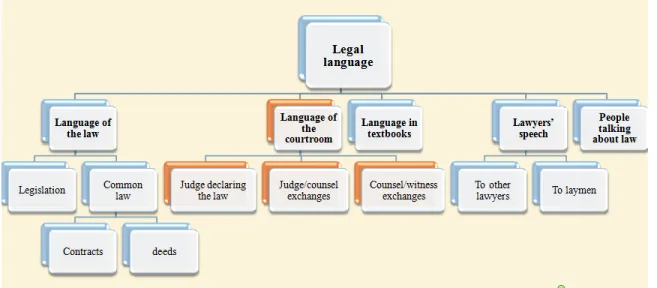
In contrast, Trosborg (1995) presents a taxonomy of legal language that illustrates how different communicative situations of texts give rise to different discourse and text genres (Figure 2).
Figure 1. Typology of legal texts based on Engberg (1993)
The author argues that the language of the law is to be distinguished from other types of legal language, as, for example, the language used in the courtroom, the language of legal textbooks, the language used to talk about the law in a formal as well as in an informal setting. According to this hypothesis, legislation, contracts and deeds are text genres that fit in a category other than the category to which judgments belong. Reasons for the differences between these kinds of texts reside in the socio-pragmatic aspects underlying the notion of genre. For instance, legislative texts (acts, statutes, bills) have higher regulative functions than deeds. Doctrinal texts (legal textbooks) have no regulative function, but rather an informative one. Judicial texts (judgments, orders, decisions) have verdictive functions (e.g. to acquit, to convict) which consist in ―the delivering of a finding, official or unofficial, upon evidence or reasons as to value or fact, so far as these are distinguishable‖ (Austin, 1962: 152 (cited by Trosborg 1995)).
More recently, legal discourse has been classified by taking into account the legal and linguistic system in which it is produced. Orts Llopis (2009) proposes the following classification of legal genres in the Common Law (Figure 3). According to the author, there are three types of written legal discourse that are related to the conceptual organization of the subject field of law: discourse on public law, discourse on private law and the discourse of doctrine and jurisprudence. Some text genres are typical of a given type of discourse and may only be produced in that context for pragmatic reasons related to the conceptualization of the subject field. For example, wills are a private legal instrument that cannot be enacted as statutes can. They can thus be said to be separate legal genres.
This kind of classification of legal genres is interesting because it is based on the legal system in which they are produced and, as a result, it allows one to identify differences in legal genres typologies across nations. The same author also presents a classification of legal genres used in Civil Law Spain and identifies differences between
the two typologies. For example, public law in Spain is not divided into ―unenacted‖ and ―enacted‖ law. Legal genres used in this type of discourse are: códigos (Eng. statutes), leyes parlamentarias (Eng. enactments), legislación delegada (Eng. delegated legislation) and jurisprudencia o sentencias (Eng. judgments).
2.1.2.3. Judgments
Judgments are one among many legal genres. If one considers Engberg‘s classification, judgments are both normative and performative texts (Figure 1). If one considers Trosborg‘s classification (Figure 2) judgments can be said to correspond to the broad category of ―the language of the courtroom‖ and more specifically to ―judges declaring law‖. If one considers Orts Llopis classification (2009), Common Law and Civil Law
judgments belong to the branch of public law which is, however, organized differently in the two legal systems.
Judgments are the final decision in a legal dispute which determines ―winners and losers‖ (Songer 2008: 78). They are written not only for the benefit of the parties involved in the case, but also for the benefit of legal profession, for the benefit of other judges and for the benefit of appellate Courts. In some jurisdictions (e.g. Canada), judgments may set a precedent which is always binding on lower courts. In all cases, they are written by judges working in tribunals or courts. For this reason, judgments as a legal genre are intimately related to the role of courts and, by implication, to the role of judges which is that of providing arbitration of particular disputes. According to the Canadian expert Gall (2004: 209):
[t]he role of our courts is to provide a fair and just resolution of the various problems and conflicts that are brought before them. The attainment of justice, through the instrumentality of fair and impartial proceedings, defines the essential nature of the function of our system of courts in Canada. [...] Essentially, that process is an exercise in the search for truth. Upon the discovery of the truth, through an application of our rules of procedure and rules of evidence, the courts then exercise a decision-making jurisdiction, after which the appropriate disposition is made. [...] our system of judicial decision-making is based on the assumption that the search for truth is best conducted in the context of an adversarial system.
In contrast, in Portugal, the judicial decision-making system is based on the assumption that the search for truth is best conducted in the context of an inquisitorial system. While in the adversarial system, two or more opposing parties gather evidence and present the evidence as well as their arguments to a judge or jury, in the inquisitorial system the judge is responsible for supervising the gathering of the evidence necessary to resolve the case by steering the search for evidence and questioning the witnesses, including the respondent or defendant.