MEASURES AND PROCEDURES TO MANAGE WILDFIRE RISK WITH APPLICATIONS TO THE SUSTAINABILITY OF TIMBER SUPPLY IN AN
EASTERN CANADIAN BOREAL FOREST
Thèse
Georgina Renée Rodriguez Baca
Doctorat en sciences forestières
Philosophiæ doctor (Ph.D.)
Québec, Canada
MEASURES AND PROCEDURES TO MANAGE WILDFIRE RISK WITH APPLICATIONS TO THE SUSTAINABILITY OF TIMBER SUPPLY IN AN
EASTERN CANADIAN BOREAL FOREST
Thèse
Georgina Renée Rodriguez Baca
Sous la direction de :
Frédéric Raulier, directeur de recherche
Alain Leduc, codirecteur de recherche
iii
Résumé
Bien que les stratégies de gestion du risque et de l'incertitude soient de plus en plus reconnues comme une dimension critique de l’aménagement des ressources naturelles, leur mise en œuvre reste encore à développer. Cependant la gravité du risque, les dommages potentiels qui y sont associés ainsi que sa probabilité d’occurrence demeurent souvent méconnus. Cette étude analyse différentes stratégies de gestion des risques utilisées dans la planification de l’aménagement forestier. Nous avons évalué des stratégies qui pouvaient protéger le niveau de récolte face aux risques de feu. Un modèle d'optimisation et de simulation a été conçu pour évaluer l'impact du risque de feu sur les calculs de possibilité forestière dans un contexte d’aménagement écosystémique de la zone boréale de la province de Québec au Canada. Nous avons comparé deux stratégies de mitigation des impacts. La stratégie dans laquelle les coûts d’une prime d'assurance sont pris en compte s’est révélée relativement meilleure que celle consistant à une mise en réserve de bois (chapitre I). Nous avons également évalué une stratégie menant à l’exclusion des peuplements les plus vulnérables au feu en raison de leur faible taux de croissance (chapitre II). Cette stratégie s’est également révélée meilleure que celle visant la mise en réserve de bois. Finalement, nous avons évalué le potentiel que présente la coupe partielle comme stratégie visant à réduire le temps d’exposition au risque. Combinée la mise en réserve de bois (fond de réserve), la coupe partielle s’avère un outil des plus utile (chapitre III). L’étude révèle qu’une stratégie ciblée telle que l’exclusion des peuplements vulnérables ou l’augmentation de la proportion des coupes partielles performe mieux qu’une stratégie non ciblée telle que le fond de réserve. Bien que nous ayons abordé différentes stratégies d’aménagement forestier dans cette thèse, des points importants restent
iv encore à éclaircir, en particulier la tolérance au risque et le contexte dans lequel il se développe.
v
Abstract
Although, management strategies dealing with risk and uncertainty have become a critical issue over the past several years, solutions are still to be developed. However, how can one judge the severity of risk when the potential damage and its probability are unknown? This study develops a framework for analyzing risk management strategies in forest management planning. We delineated how these management strategies could address the risk to protect timber harvest against disruptions. We tested optimization and simulation model to estimate the impact of risk associated with fire in timber supply calculations in an ecosystem context in boreal zone of the province of Quebec, Canada. Since paying, an insurance premium appeared to produce better results than partitioning buffer stock, (chapter I). The rating of wood volume available to harvest as a function of its vulnerability to fire can be used to reduce the impacts of fire on timber supply (chapter II). This idea was extended to test the adaptability of partial cutting coupled with buffer stock and accounting for the uncertainty induced by fire and projected climate scenarios (chapter III). As there are different levels of risk and different levels of tolerance to risk, the study results have shown that the process of risk evaluation itself needs to be accepted in its degree of uncertainties and its severity. As far as the insurance is concerned, it looks like a good strategy, but find an insurance company that is interested enough to believe there are enough potential customers to pay the premiums to make a profit could be required. The results also reveal that a targeted strategy such as excluding vulnerable stands from timber supply or adaptation of silvicultural treatment such as partial cutting may greatly interesting when facing risk scenario. Although, we covered different forest management strategies in this thesis, important issues still need to be
vi considered in order to improve the knowledge associated with risk of fire; especially the context in which it develops.
vii
Table of Contents
Résumé ...iii Abstract ... v List of tables ...x List of figures ... xi Acknowledgements ... xiv Preface ... xv General introduction ... 1Risk and uncertainty in timber supply analyses ... 2
Thesis outline ... 4
References ... 6
Chapter 1: Rating a Wildfire Mitigation Strategy with an Insurance Premium: A Boreal Forest Case Study... 10
Résumé ... 11
Abstract ... 12
Introduction ... 13
Materials and methods ... 17
Study Area ... 17
Timber supply model ... 18
Interaction between Harvest Scheduling and Stochastic Processes ... 20
Risk Management ... 21
Risk Characterization ... 22
Insurance Premium ... 23
Timber Supply Reduction ... 24
Comparison of Risk Management Strategies ... 24
Results ... 25
Risk Assessment... 25
Risk Management Strategies ... 28
Discussion ... 31
Conclusions ... 34
viii
References ... 36
Chapter 2: Forest vulnerability through fire risk and its potential impact on forest management planning ... 43
Résumé ... 44
Abstract ... 45
Introduction ... 46
Materials and method ... 48
Study area ... 48
Timber supply model ... 49
Integrating stochastic process in timber harvest model ... 51
Estimating the proportion of vulnerable stands considering fire ... 53
Timber supply reduction ... 54
Risk analysis... 55
Results ... 55
The assessment of timber vulnerability to wildfire ... 55
Excluding vulnerable stands from the timber supply to avoid fire risk ... 58
Discussion ... 60
Conclusions ... 62
References ... 64
Chapter 3: Sourcing Strategy to mitigate the impact of timber supply disruptions caused by fire . 69 Résumé ... 70
Abstract ... 71
Introduction ... 72
Materials and methods ... 73
Study area ... 73 Optimization model ... 75 Stochastic environment ... 77 Scenarios design ... 79 Managing risk ... 79 Results ... 80 Discussion ... 82 Conclusions ... 85
ix References ... 86 General Conclusion ... 91 References ... 95
x
List of tables
Table 1.1. Parameter values of piecewise linear models with one knot (threshold planned timber harvest (PTH)) (Equation (8)) relating PTH and periodic median realized harvest levels implemented with the landscape simulation model under current (400 years) and probable interval for future fire regimes (100 and 200 years).
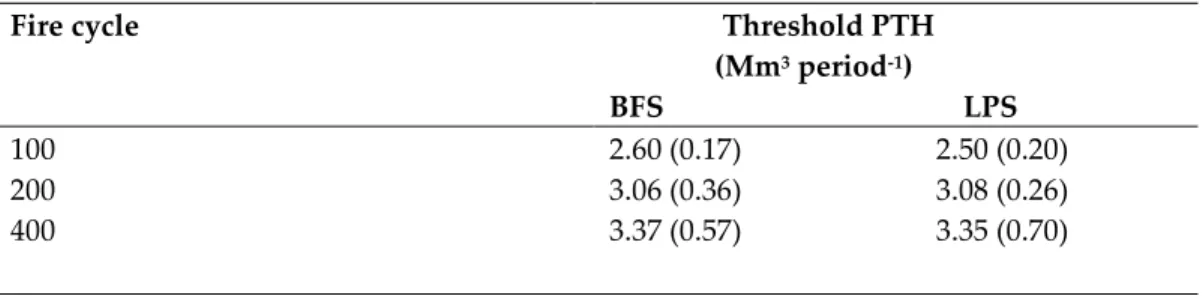
Table 2.1. Threshold relating PTH and periodic median realized harvest levels. Numbers in parentheses represent a half-confidence interval.
xi
List of figures
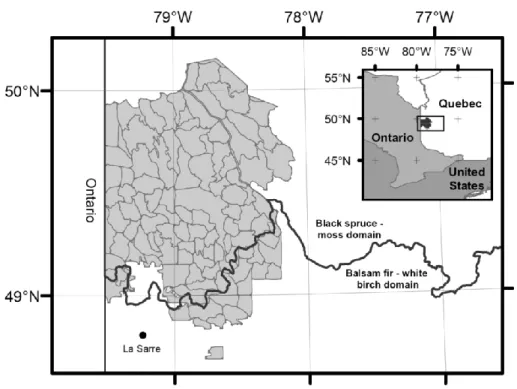
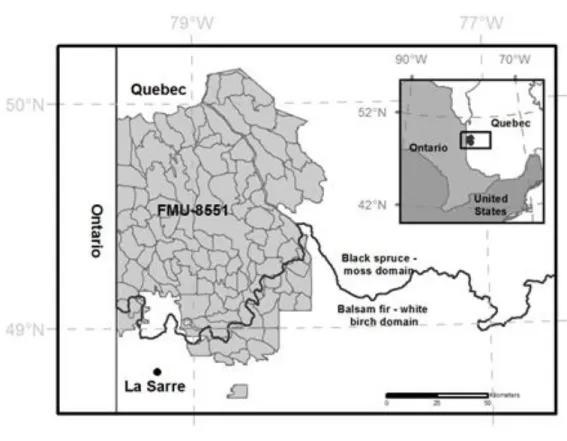
Figure 1.1. Location of study area Forest Management Unit 085-51. Grey polygons correspond to operating areas (Belleau et al. 2009).
Figure 1.2. Box and whiskers plots representing the probability distributions of the simulated implementation of the optimal solution (3.8 Mm3 period_1) provided by the timber supply model (Equations 1.1– 1.6) under current (400 years) and probable interval for future fire regimes (100 and 200 years).
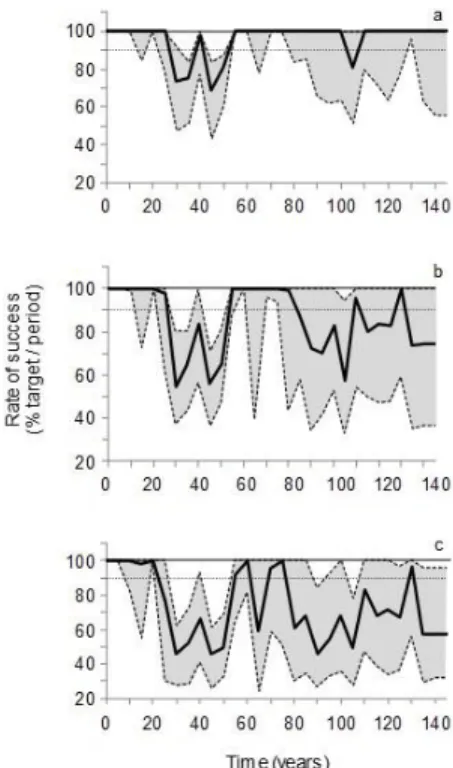
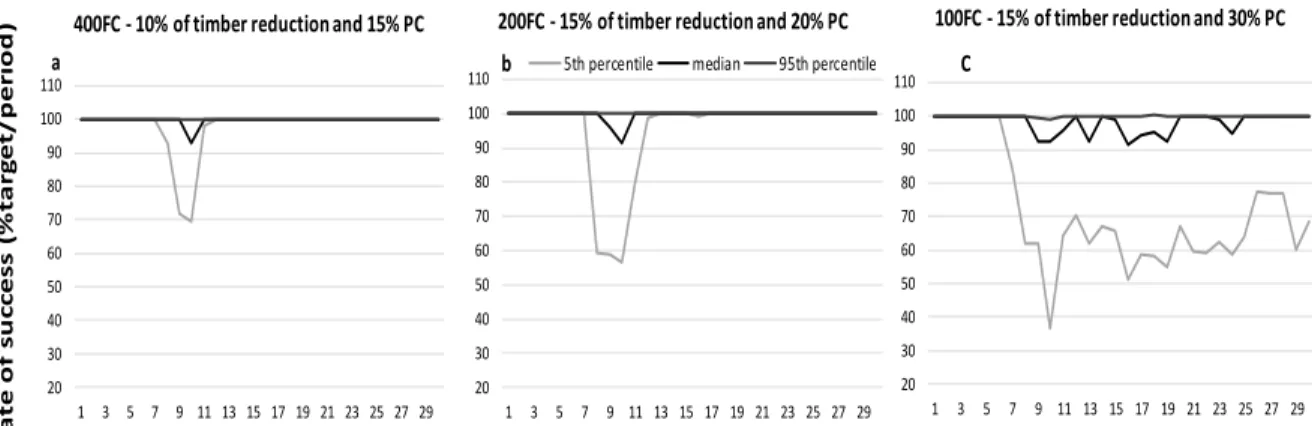
Figure 1.3. Probability distributions of the success rate of the simulated harvest schedule implementation under current ((a) 400 years) and probable future fire regimes ((b) 200 years; (c) 100 years). From bottom up, broken and bold lines represent the 5th, median and 95th percentiles. One hundred percent represents the target (continuous line) and ninety percent correspond to a cutoff value below which a timber supply disruption was considered to occur (Schruben 1979).
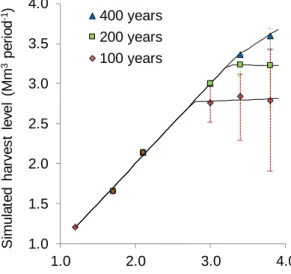
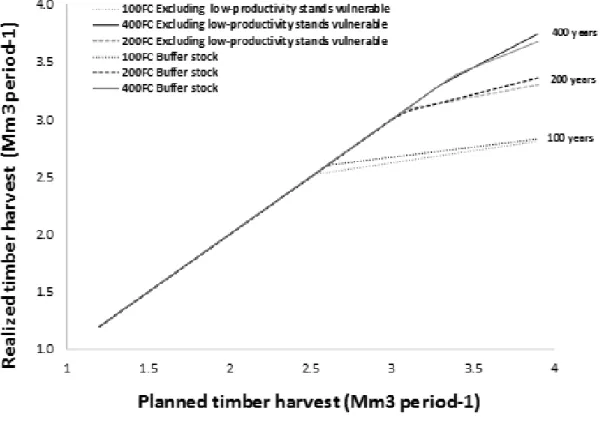
Figure 1.4. Relationship between planned timber harvest and its simulated implementation (median value) when considering the risk of fire for three fire cycles (100, 200 and 400 years). Parameters of the segmented linear models are provided in Table 1. Error bars represent the 5th and 95th percentiles of the probability distribution of simulated harvest levels.
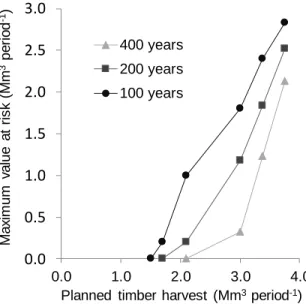
Figure 1.5. Relationship between planned timber harvest and maximum value at risk for three fire cycles.
Figure 1.6. Distribution of the planned timber harvest into: a part that is not entirely feasible (planning optimism, in white, see Figure 4), a part that should be used to build a buffer stock of timber (dark gray) (with a timber harvest reduction—THR, which should not be harvested, or with an insurance premium, which should be harvested and set apart, with an interest rate between 0% and 4%) (protection strategy), and a part available for harvest (light grey), considering three possible fire cycles.
xii
Figure 1.7. Relationship between median value-at-risk (VaR) and insurance premium as a function of interest rates (0% to 4%) and present (400 years) or probable fire cycles (100 and 200 years).
Figure 2.1. Study area, Forest Management Unit 85-51
Figure 2.2. Conceptual framework of optimize and simulation model scheme
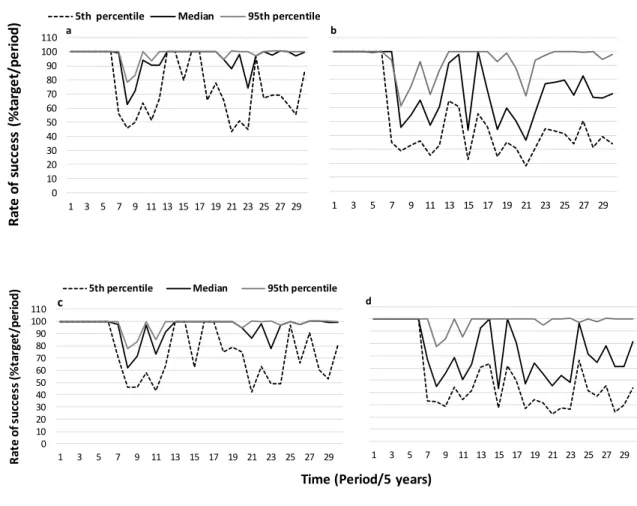
Figure 2.3. Rate of success for two protection strategies under current fire regime (Panels a or c) and possible worst-case scenario (Panels b or d) of increasing burn rate in the future (100years). Probability distributions of the planning success rate for excluding low-productivity stands vulnerable to fire (Panels a, b) and buffer stock (Panels c, d).
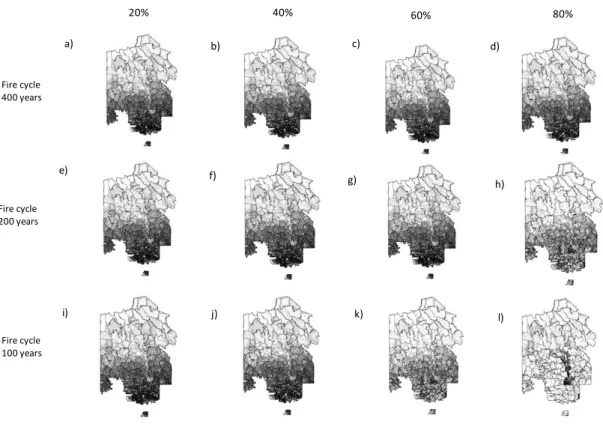
Figure 2.4. Proportion of operating areas considered productive which that reach the production threshold (Density of stand 50 m³/ha) under three different fire cycles 400,200,100) and four probability likelihood (20, 40, 60 and 80%).
Figure 2.5. Amount of productive area as a function of planned and realized timber supply under current (400 years Figure a) and future fire regimes (200 years Figure b; 100 years Figure c).
Figure 2.6. Relationship between planned timber harvest and realized harvest level (median value) for both strategies under three different fire cycles. The decrease in realized harvest is progressively increasing in shorter fire cycles.
Figure 3.1. Forest management unit (FMU)- 8551 Figure 3.2 Optimization and simulation approach
Figure 3.3. Successive implementation of a harvest target reduction (BFS) and increasing the amount of partial cutting required to protect the Median VaR implemented with no risks.
Figure 3.4. Median rate of success implemented with no risks for two protection strategies (indirect management of a buffer stock and combination with partial cutting).
xiii
Figure 3.5. Median value–at-risk for two protection strategies: indirect management of a buffer stock of timber (BFS) and silvicultural strategy coupled with timber harvest reductions (BFS+PC).
xiv
Acknowledgements
I wish to express my deep sense of thanks and gratitude to my mentor, philosopher and guide Dr. Frédéric Raulier for accepting me as a Ph.D. student and the opportunity to join his lab group, for his guidance, encouragement and patience over the years. “Fuerza”.
I would like to thank my co-supervisor Dr. Alain Leduc for guiding me, I really appreciate all the help he gave me, thank you so much for encouraging, your support was essential to my success. I also thank Dr. Sylvie Gauthier and Dr. Mathieu Bouchard who were part of my doctoral committee, thanks for all advice, for sharing knowledge and for very useful comments.
I will always be grateful to Hakim Ouzenou for helping me every time. I owe my gratitude to Patrick Soucy for help me in statistics and probability. Special thanks to my friend Guillaume Cyr for the help in simulations model and for the good times we shared.
Much of my experimental work would have not have been completed without the assistance of Patrick James, Carlos Ordas Criado, David Ardia, Steve Cumming. Of course, I would to thank the members of my department, a special thank to Pierre Racine, Natacha Lafontaine, Mireille Racine. Thanks to all my colleagues in the “Frédéric lab”, thanks for make the good times better and the hard times easier. I would like to thank “mi ñañita” for being such a wonderful friend. My thanks to all those with whom I have discussed the ideas expressed here and whose interest has sustained me while I was writing.
Ian Donnelly, Shona Taner, Charles Massey, Anik Cooke, Ayse Alemdar and Mitch Thompson, thanks very much for your help in my thesis editing.
xv
Preface
This thesis is submitted in partial fulfillment of the requirements for the degree of philosophiæ doctor (PhD) in forest science at Université Laval. The work presented here was directed by Professor Frédéric Raulier, co-directed by Professor Alain Leduc. This document has been prepared as an article insertion thesis, and includes one journal articles for which I have acted as the principal researcher and principal author. My contributions to these papers include the problem definition, literature review, experimental design, mathematical modelling, experimentation, validation, and the writing of the manuscripts. The co-authors contributed to these papers on several fronts, including problem definition, experimental design, mathematical modelling, and writing of manuscripts. This thesis consists of five sections; General Introduction, Chapter 1, Chapter 2, Chapter 3, and General Conclusion. Chapter 1 to 3 correspond to the following (published, submitted or under preparation) articles:
1. The first chapter entitled « Rating a wildfire mitigation strategy with an insurance
premium: a boreal forest case » was co-authored by Frédéric Raulier and Alain
Leduc. This paper has been published in Forests.
2. The second chapter entitled « Forest vulnerability through fire risk and its potential
impact on forest management planning» was co-authored by Frédéric Raulier, Alain
Leduc and Hakim Ouzennou (Manuscript under preparation).
3. The third chapter entitled « Sourcing strategy to mitigate the impact of timber supply
disruptions caused by fire » was co-authored by Frédéric Raulier, Alain Leduc and
1
General introduction
Forest management approach was defined by Haeussler and Kneeshaw (2003) as human intervention into the nature for obtaining desired goods and services. Canada's commitment to sustainable forest management involves social, economic and conservation issues for the benefit of present and future generations (Ferguson 1996). In Canada provincial governments, have the responsibility for managing protecting and developing public forests under sustainable practices which should not diminish the productive capacity of the forest (CCFM, 2008).
Weather and climate are the most important factors influencing fire activity in boreal forests (Flannigan et al. 2009). The Intergovernmental Panel on Climate Change (IPCC 2007) established different climate scenarios, which lead to predicted future climates (Randall et al. 2007). Forest fires are challenging for forest management. For example, in 2015, 7,068 forest fires burned about 3.9 million hectares in Canada. Meanwhile, in Quebec, the area burned was less than 2% of its 10-year average (CIFFC 2015). By the end of this century, the fire burn rate in the eastern Canadian boreal forest is projected to increase under future climate conditions (Bergeron et al. 2010; Flato et al. 2000), and it may have important implications in timber supply (Burton et al 2003; Flannigan et al. 2005). Wildfire is the main natural disturbance in boreal ecosystems (Rowe and Scotter 1973; Wein and MacLean 1983). The fire regime in a given region can be described by multiple attributes of the disturbance, among which are the fire interval, size, severity and spatial distribution (Belleau et al. 2007; Chabot et al. 2009). In black spruce-feather moss bioclimatic sub domains, most fires are
2 started by lightning (Robitaille and Saucier 1998), and are characterized by the annual area burned. This variable depends on fuel moisture which is a function of vegetation type, weather conditions during the passage of the fire, and the topography of the site burned (Kane et al. 2007; Payette et al. 2000; Stocks et al. 2002). Fire is the major natural disturbance driving forest succession and the spatial variations introduce heterogeneity in the vegetation mosaic of the boreal forest landscapes (Van Wagner 1978; Lecomte et al. 2005).
Landscapes are marked by different fire regimes and have different proportions of old uneven-aged stands and young stands dominated by pioneer species (Van Wagner 1978; Chabot et al. 2009). As, in the long term, forest management influences landscape stands composition and structure (Bormann et al. 1979). Ecosystem-based management is recommended to reduce ecological differences between natural and managed ecosystems (Seymour and Hunter 1999; Burton et al. 1999; Gauthier et al. 2004). Silvicultural strategies are developed to meet management objectives, based on knowledge and understanding of natural forest dynamics and site attributes (Bergeron et al. 2007; Belleau 2009). Therefore, partial cuts might be used to recreate or maintain old open forest structures (Lecomte and Bergeron et al. 2005). A forest mosaic is a complex system and is in constantly changing, and these changes could have a negative impact on planned timber harvest and production disruptions especially in long strategic planning extending over 150 years.
Risk and uncertainty in timber supply analyses
The concept of risk exists in many areas and different approaches can be used to define them. In forestry decision analysis Kangas and Kangas (2004) dealt with different definitions, sources, theories and classifications of uncertainty. In the decision-making process, risk
3 management is defined as a process, which combines risk assessment with knowledge and understanding on how to address the risk within the larger decision process (Annaert 2007; Käki et al. 2013.).
Risk assessments systemise the knowledge and uncertainties about the likelihood of threats to determine the magnitude of damage and establish whether measures are needed to mitigate or control risks to an acceptable or tolerable level or to support the decision-making process (Wynne 1992; Aven 2011). When a risk cannot be reduced, or eliminated, the focus must turn toward reducing vulnerabilities by describing the susceptibility of exposed elements to injury or damage due to hazardous events (Banks 2009). Under climate change scenarios, forests are considered more vulnerable over the long term (Lawrence 2011). In Canada climate, change will have an important impact on natural disturbances and may strongly affect the economic productivity and represent potential losses (Flannigan et al. 2009). A main issue is how to cope with such losses. Several options have been proposed to reduce the occurrence and the negative outcome of a natural disturbance, many of them focused on diversification and silvicultural strategies (Brunette and Couture, 2013). The theory of natural disturbances as sources of uncertainties in timber supply analyses was already included for several authors (Reed and Errico 1986; Armstrong 2004; Peter and Nelson 2005). A timber supply model is used to project long-term sustainable forest management providing schedule of harvesting in an uncertain environment (Regan et al. 2005; Raulier et al.2014).
Modelling developed by experts (Sheppard and Meitner 2005) can be used to predict and generate options that can help in the decision-making process of managers and other responsible persons. Forest managers are seeking to protect against wildfires by
4 incorporating mechanisms arranged in advance of a loss, including insurance, hedging, diversification, withdrawal, and so on that neutralize or offset the original risk (Banks 2009). Given this context, I compare different fire mitigation strategies in forest management planning.
Thesis outline
The aim of this thesis is to incorporate risk into timber harvest planning by optimization and simulation model. The three main chapters in this thesis have common objectives that link both the research related to forest management planning under risk in an uncertain environment.
This thesis is composed of three chapters.
In the first chapter an actuarial approach based on cumulative probability distributions was
developed to reduce the adverse effects of wildfire. To this effect, I developed spatially explicit landscape models to simulate the interactions between harvest, fire and forest succession over time in a boreal forest of eastern Canada. I estimated the amount of reduction of timber harvest necessary to build a buffer stock of sufficient size to cover fire losses and compared it to an insurance premium estimated in units of timber volume from the probability of occurrence and the amount of damage.
In the second chapter I examined the impact of uncertainty concerning current and future fire
cycles on timber supply management (Mm3/ period_1), the goal being to analyze the levels of vulnerability via the estimation of the production of timber, while excluding low-productivity stands considered vulnerable to wildfire and evaluating the likelihood that those loss event
5 will impact planned timber harvest. I combined fire occurrence processes alongside the harvest schedule to evaluate quantitative fire survival likelihood probabilities.
In the third chapter, using the same spatially explicit landscape model and forest
management planning model, I evaluated flexible approaches by combining a reduction of timber harvest necessary to build a buffer stock with alternative silvicultural practices (partial cutting) for managing forested ecosystem under an assumption that the future fire regime will increase, the efficacy of which being challenged by the rate of success of planned timber harvest.
6
References
Annaert, J., Deelstra, G., Heyman, D., and Vanmaele, M. 2007. Risk management of a bond portfolio using options. Insurance: Mathematics and Economics, 3: 299-316.
Armstrong, G.W. 2004. Sustainability of timber supply considering the risk of wildfire. For. Sci. 50: 626–639.
Aven, T. 2011. A risk concept applicable for both probabilistic and non-probabilistic perspectives. Safety science, 8: 1080-1086.
Banks, E. 2009. Risk and Financial Catastrophe; Finance and Capital Markets Series; Palgrave Macmillan: p. 213.
Belleau, A., Y. Bergeron, A. Leduc, S. Gauthier and A. Fall. 2007. Using spatially explicit simulations to explore size distribution and spacing of regenerating areas produced by wildfires: recommendations for designing harvest agglomerations for the Canadian boreal forest. The Forestry Chronicle 83: 72–83.
Belleau, A. and S. Légaré. 2009. Project Tembec: Towards the implementation of a forest management strategy based on the natural disturbance dynamics of the northern Abitibi region. In S. Gauthier, M.-A. Vaillancourt, A. Leduc, L. De Grandpré, D. Kneeshaw, H. Morin, P. Drapeau and Y. Bergeron (eds.). Ecosystem Management in the Boreal Forest. pp. 479–499. Presses de l’Université du Québec.
Burton, J., Kneeshaw D, and. Coates K. 1999. Managing forest harvesting to maintain old growth in boreal and sub-boreal forests. For. Chron. 75:623-631.
Bergeron, O., Margolis, H. Black, T., Coursolle, C., Dunn, A., Barr, A., and Wofsy, S. 2007. Comparison of carbon dioxide fluxes over three boreal black spruce forests in Canada. Global Change Biology, 1: 89-107.
Bergeron, Y., Cyr, D., Girardin, M.P., Carcaillet, C., 2010. Will climate change drive 21st century burn rates in Canadian boreal forest outside of its natural variability: collating global climate model experiments with sedimentary charcoal data. Int. J. Wildland Fire 19: 1127–1139.
Bormann, F., and Likens, G. 1979. Catastrophic disturbance and the steady state in northern hardwood forests: A new look at the role of disturbance in the development of forest ecosystems suggests important implications for land-use policies. American Scientist, 6: 660-669.
7 Brunette, M., Couture, S., 2013. Risk management behaviour of a forest owner against growth risk. Agric. Resour. Econ. Rev. 2: 349–364.
Burton, P., Messier, C., and Smith, D. 2003. Towards sustainable management of the boreal forest (pp. 1-40). W. L. Adamowicz (Ed.). Ottawa: NRC Research Press.
Canadian Interagency Forest Fire Centre (CIFFC). 2015. http://www.ciffc.ca/ Canadian Council of Forest Ministers CCFM. 2008. A Vision for Canadas Forests, 2008 and Beyond. Canadian Council of Forest Ministers. Ottawa, Canada. 16 pp.
Chabot, E., Blanchet, P. Drapeau, F. Fortin, S. Gauthier, L. Imbeau, G. Lacasse, G. Lemaire, Nappi A., Quenneville R., and Thiffault E. 2009. Le feu en milieu forestier. Pages 393–416 Manuel de Foresterie (2ème édition). Éditions M. Québec.
Flannigan M, Logan K, Amiro B, Skinner W., and Stocks B. 2005. Future area burned in Canada. Climatic Change 72: 1–16.
Flannigan, M., Stocks, B., Turetsky, M., and Wotton, M. 2009. Impacts of climate change on fire activity and fire management in the circumboreal forest. Global Change Biology, 15: 549-560.
Ferguson, I. S. 1996. Sustainable forest management. Oxford University Press Australia. Flato, G., Boer, G., Lee, W., McFarlane, N., Ramden, D., Reader, M., Weaver, A. 2000. The Canadian Centre for Climate Modelling and Analysis global coupled model and its climate. Clim. Dyn. 16: 451–467.
Gauthier, S., Nguyen, T., Bergeron, Y., Leduc, A., Drapeau, P., Grondin, P., 2004.
Developing forest management strategies based on fire regimes in northwestern Quebec. In: Perera, A.H., Buse, L.J.,Weber, M.G. (Eds.), Emulating Natural Forest Landscape
Disturbance. Columbia University Press, New York, pp. 219–229.
Haeussler, S., and Kneeshaw, D. 2003. Comparing forest management to natural processes. Chapter 9. In Towards sustainable management of the boreal forest, First Ed. Edited by P.J. Burton, C. Messier, D.W. Smith and W.L. Adamowicz. NRC Research Press. Otawa, Canada, pp. 307-368.
IPCC. 2007. Fourth Assessment Report (AR4) of the United Nations Intergovernmental Panel on Climate Change. Cambridge, UK; New-York, USA.
8 Käki, A., Salo, A., and Talluri, S. 2013. Disruptions in supply networks: a Probabilistic Risk Assessment approach.
Kane, E. S., E. S. Kasischke, D. W. Valentine, M. R. Turetsky, and A. D. McGuire. 2007. Topographic influences on wildfire consumption of soil organic carbon in interior Alaska: Implications for black carbon accumulation. Journal of Geophysical Research, 112: 1–11. Kangas, A., and Kangas, J. 2004. Probability, possibility and evidence: approaches to consider risk and uncertainty in forestry decision analysis. Forest policy and economics, 2: 169-188.
Lawrence, A. 2011. Human dimensions of adaptive forest management and climate change: a review of international experience.
Lecomte, N., and Bergeron, Y. 2005. Successional pathways on different surficial deposits in the coniferous boreal forest of the Quebec Clay Belt. Can. J. For. Res. (35), 1984-1995. Lecomte, N. 2005. Successional pathways on different surficial deposits in the coniferous boreal forest of the Quebec Clay Belt. Canadian Journal of Forest Research. 35: 1984–1995. Randall, D., Wood, R., Bony, S., Colman, R., Fichefet, T., Fyfe, J., and Stouffer, R. 2007. Climate models and their evaluation. In Climate change 2007: The physical science basis. Contribution of Working Group I to the Fourth Assessment Report of the IPCC (FAR) (pp. 589-662). Cambridge University Press.
Raulier F, Dhital N, Racine P, Tittler R, Fall A. 2014. Increasing resilience of timber supply: how a variable buffer stock of timber can efficiently reduce exposure to shortfalls caused by wildfires. For Policy Econ 46:47–55.
Reed, W.; Errico, D. 1986. Optimal harvest scheduling at the forest level in the presence of the risk of fire. Can. J. For. Res., 16: 266–278.
Regan, H., Ben-Haim, Y., Langford, B., Wilson, W., Lundberg, P., Andelman, S., and Burgman, M. 2005. Robust decision‐making under severe uncertainty for conservation management. Ecological applications, 4: 1471-1477.
Robitaille, A., Saucier, J.P., 1998. Paysages Régionaux du Québec Méridional. Les publications du Québec, Sainte-Foy, Québec, Canada.
9 Rowe, J. S., and G. W. Scotter. 1973. Fire in the boreal. Quaternary Research. 3 : 444–464. Seymour, R. and. Hunter M. Jr. 1999. Principles of ecological forestry. In M.L. Hunter Jr. (ed.). Maintaining Biodiversity in Forest Ecosystems. Cambridge University Press, Cambridge, UK. pp 22-61.
Sheppard, S., and Meitner, M. .2005. Using multi-criteria analysis and visualisation for sustainable forest management planning with stakeholder groups. Forest ecology and management, 1: 171-187.
Stocks, B., Mason, J., Todd, J., Bosch, E., Wotton, B., Amiro, B., Skinner, W. 2002. Large forest fires in Canada, 1959–1997. Journal of Geophysical Research 108: 1–12.
Van Wagner, C.E. 1978. Age-class distribution and the forest fire cycle. Canadian Journal of Forest Research. 8: 220-227.
Wein, R.W. and MacLean, D.A. 1983. An overview of fire in northern eco- systems [C]. In: The role of fire in northern circumpolar ecosystems. New York: John Wiley and Sons, pp 1−18.
Wynne, B. 1992. Uncertainty and environmental learning: reconceiving science and policy in the preventive paradigm. Global environmental change, 2: 111-127.
10
Chapter 1: Rating a Wildfire Mitigation Strategy with an
Insurance Premium: A Boreal Forest Case Study
Georgina Rodriguez-Baca, Frédéric Raulier, Alain Leduc This chapter has been published and can be cited as:
Rodriguez-Baca, G., Raulier, F., & Leduc, A. (2016). Rating a Wildfire Mitigation Strategy with an Insurance Premium: A Boreal Forest Case Study. Forests, 7(5), 107.
11
Résumé
Dans la forêt boréale d’Amérique du Nord, les feux de forêt sont un moteur clé de la dynamique forestière et peuvent entraîner des pertes économiques très importantes. Une approche actuarielle de l'analyse des risques fondée sur les distributions de probabilité cumulatives a été élaborée afin de réduire les effets négatifs des incendies de forêt. À cet effet, nous avons élaboré des scénarios spatialement explicites pour simuler les interactions entre la récolte, le feu et la succession forestière au fil du temps dans une forêt boréale de l'est du Canada. Nous avons estimé la réduction du volume de récolte de bois nécessaire à couvrir les pertes liées à un incendie forestier. Nous avons comparé cette réduction de récolte à une stratégie consistant en l’achat d’une prime d'assurance estimée en unités de volume de bois à partir de la probabilité d'occurrence et de l’importance des dommages. Dans l'ensemble, la réduction du volume de récolte de bois s’avérait plus coûteuse que la prime d'assurance, même avec un taux d'intérêt nul. Cela est dû au fait que la prime d'assurance est directement liée au risque alors que la réduction de récolte de bois ne l’est pas et est par conséquent moins efficace. Ces résultats, en particulier la comparaison avec un indicateur standard comme une prime d'assurance, ont des implications utiles au moment de choisir une stratégie d'atténuation pour protéger les approvisionnements en bois contre les risques de pertes sans diminuer de façon excessive les approvisionnements. Ils encouragent également le recours à des assurances contre les événements désastreux dans la planification de la gestion forestière.
12
Abstract
Risk analysis entails the systematic use of historical information to determine the frequency, magnitude and effects of unexpected events. Wildfire in boreal North America is a key driver of forest dynamics and may cause very significant economic losses. An actuarial approach to risk analysis based on cumulative probability distributions was developed to reduce the adverse effects of wildfire. To this effect, we developed spatially explicit landscape models to simulate the interactions between harvest, fire and forest succession over time in a boreal forest of eastern Canada. We estimated the amount of reduction of timber harvest necessary to build a buffer stock of sufficient size to cover fire losses and compared it to an insurance premium estimated in units of timber volume from the probability of occurrence and the amount of damage. Overall, the timber harvest reduction we applied was much more costly than the insurance premium even with a zero interest rate. This is due to the fact that the insurance premium is directly related to risk while the timber harvest reduction is not and, as a consequence, is much less efficient. These results, especially the comparison with a standard indicator such as an insurance premium, have useful implications at the time of choosing a mitigation strategy to protect timber supplies against risk without overly diminishing the provision of services from the forest. They are also promoting the use of insurance against disastrous events in forest management planning.
13
Introduction
Human activities depend on the sustainability of natural resources and proving sustainability requires making forecasts. In forest management, uncertainty is an important issue in the support of any planning decision and in evaluating the consequences of alternative strategies (Kangas et Kangas 2005). Uncertainty stems from known variability (risk), lack of knowledge (uncertainty), ignorance and indeterminacy (Wynne 1992). Ignorance and indeterminacy are difficult to account for, cannot be anticipated and require scenario planning (Peterson et al. 2003) or adaptive methods (Wynne 1992). Risk and uncertainty are somewhat easier to evaluate beforehand with risk analysis methods (Hoffman and Hammonds 1994). Such analyses are required when there is a possibility that the outcome of an event can deviate from expectations and have a negative effect on an objective (Bagajewicz and Uribe 2008). For instance, the negative effect of a disturbance on the profits from timber harvesting provides the cost of that disturbance (Armstrong and Cumming 2003).
Situations where risk and uncertainty are at the core of the problem as it is in risk management require different strategies and coherent risk measures (Bertsimas et al. 2004). The development of methods to account for risk and uncertainty has made considerable progress and they already play a role in environmental decision-making, particularly in cases of severe uncertainty due to extremely long planning horizons (Hildebrandt and Knoke 2011). Although the application of risk analysis in forest planning remains rare (Von Gadow and Hui 2001), attention to risk analysis in forestry should grow even more in the coming years (Yousefpour et al. 2012; Pasalodos-Tato et al. 2013).
Forest managers should account for many different sources of risk and uncertainty, one of them being wildfire. Fire is a critical component of terrestrial and atmospheric dynamics
14 (Flannigan et al. 2009) and is a primary driver of forest dynamics across the boreal forest region of North America. Fire is also a major source of risk and uncertainty that can cause important damages to timber resources (Taylor et al. 2006). Fire-dominated forests present challenges when designing forest management plans that maximize sustained and constant harvest volume flows because of the wide spatial and temporal variation in the frequency and severity of fire events (Martell et al. 1998). In Canada, each year, fire burns large portions of the forest area, which causes significant losses to management agencies (Boychuk and Martell 1996). Despite the uncertainty, that characterizes forest management planning; most planning models used for strategic planning remain deterministic in North America (Kaya et al. 2016; Bettinger and Chung 2004).
Linear mathematical programming (LP) is the approach most often applied in practice to such planning problems (Siry et al. 2015; Gunn 2007), despite the fact that many other techniques exist (Kaya et al. 2016 ), the assumption that all data are assumed to be known exactly and the fact that decisions made today with optimal solutions will probably be suboptimal in the future (Acuña et al. 2010). Incorporating a fire regime into timber harvest-level determination procedures leads to reductions in harvest harvest-levels when desiring a sustainable timber harvest (Boychuk and Martell 1996; Van Wagner 1983; Reed and Errico 1986). Such reductions help implement a timber buffer stock, providing a contingency inventory in the case of unexpected timber losses. The implementation of such measures therefore implies losses of short-term revenues that must be thoroughly justified and understood.
Successful methods of dealing with uncertainty and risk need to be simple and comprehensible enough to be useful in planning and decision-making in forestry practice
15 (Armstrong 2004). The best strategy for dealing with uncertainty depends on the risk preference of the decision makers, how much risk they are willing to face, and the degree of uncertainty involved. One example of a successful method is the cost-plus-loss analysis, which estimates the cost of sub-optimal decisions. It has been used effectively to justify the costs implied by sampling intensity in forest inventory (Eid 2000; Borders et al. 2008), the cost of fire-fighting (examples provided in (Martell et al. 1998) or the cost of forest planning (Duveno et al. 2014). In practice, the minimization of risk exposures and potential losses involves risk processes with one or more techniques considered in the context of financial and nonfinancial exposures (Banks 2009).
Financial risk modelling refers to the use of formal econometric techniques to determine the aggregate risk of a financial portfolio that depends on the probability distributions of losses that can arise from damage. Actuaries combine the likelihood and size information to provide average, or expected losses (Baranoff et al. 2204). For instance, Value at Risk (VaR) is a widely used risk measure (Jorion 2002), is easy to explain and easy to estimate (Ardia 2008; Hoogerheide and Van Dijk 2010). In portfolio management, Bagajewicz and Barbaro ( 2003) defined VaR as the worst expected loss under normal market conditions over a specific time interval and at a given confidence level. VaR has become a popular risk measure used by both regulated banks as well as investment practitioners. Although specific indicators such as VaR cannot guarantee the identification of the best risk-reduced solution, in many instances the use of different risk measures help identify potentially robust solutions. With financial risk management, the expected loss is expressed in monetary terms. One loss-adaptation option is insurance (Holecy and Hanewinkel 2006). Insurance transfers the cost of financing losses in exchange for a premium. For instance, a forest manager may seek to
16 protect his planning decisions against wildfire and he can purchase an insurance policy from an insurer by paying a premium to receive a compensatory payment that should cover the loss generated by fire (Banks 2009 ). The determination of the premium to pay for the cover requires evaluating risk as an actuarial process of valuing the insurable risk, i.e., by summing the values at risk compounded at the start of the planning horizon. Such an insurance strategy covering losses caused by fires may be interesting if the interest rate is higher than the mean volume increment rate of the forest under study.
The idea of insurance in forestry is not new, it was proposed decades ago by Shepard (1935; 1937) who noticed that the proper valuation of forest properties is a necessary prerequisite to any successful fire-insurance undertaking. Holecy and Hanewinkel (2006) proposed an actuarial model calculating appropriate probabilities to estimate insurance premiums. Lankoande et al. (2005) evaluated efficient wildfire insurance in the presence of government intervention through a subsidy for risk. Chen et al. (2014) proposed an insurance instrument to protect timber owners against wildfire risks as a management instrument. Although insurance is an effective mechanism to lessen the burden of loss by wildfire and is simple to explain, studies in wildfire insurance still remain limited.
The main objective of this study was therefore to provide a comparative analysis of the alternative advantages produced by two different risk management strategies: insurance premium and timber harvest reduction to build a buffer stock of timber. In the context of planning and scheduling forest harvesting, the first aim of our study was thus to quantify potential harvest losses due to wildfire under an ecosystem-based management scenario in an eastern Canadian boreal forest. We used a linear programming (LP)-based timber harvest scheduling model to determine the maximum even-flow harvest volume a forest area can
17 sustain over the planning horizon. Interaction between fire and harvest was simulated with a landscape dynamics model to evaluate harvest losses, insurance premium and amount of buffer stock required to cover such loss.
Materials and methods
Study AreaThe study area corresponds to the Forest Management Unit 085-51 located between 48˚ 50ʹ N and 50˚_09ʹ N latitude, and between 78˚ 05ʹ W and 79˚ 31ʹ W longitude in western Quebec, Canada (Figure 1.1). It belongs to the bioclimatic domain of balsam fir-white birch to the south (14%) and black spruce-feather mosses to the north (86%) (Robitaille and Saucier 1998). Mean annual temperature varies from -2.5˚ C to 0˚ C, and total precipitation from 700 to 800 mm. The area covers 1.08 million ha, of which 542,000 hectares are timber productive. Black spruce (Picea mariana (Mill.) B.S.P.), and jack pine (Pinus banksiana Lamb.) are the most abundant tree species and also the most economically important ones. Hardwoods such as trembling aspen (Populus tremuloides Michx) and white birch (Betula papyrifera Marsh.), and to a lesser extent, balsam poplar (Populus balsamifera) can also occur in mixture with black spruce. The forest dynamics in the region may be simplified into three main successional pathways either dominated by black spruce, jack pine or trembling aspen (Nguyen-Xuan 2002; Bergeron et al. 2002). Fire dominates the natural disturbance regime in the study area (Bergeron et al. 2002; Gauthier et al. 2004). Current (1920–2000) and past fire cycles (1850–1920) were estimated to be around 398 and 135 years (Kangas and Kangas 2005). Forest management planning should account for climate change as it should affect fire regimes in the boreal forest of North America (Bergeron et al. 2006). For our study area, fire
18 burn rate is projected to increase gradually over the period 2001–2100. Bergeron et al. (2010) estimated that under B1 (2 x CO2) and A2 (3 xCO2) climate scenarios, fire cycles should lower to around 254 and 79 years respectively, values lying either in between the current and historical fire cycles ( Cyr et al. 2009) or below the historical fire cycle.
Figure 1.1. Location of study area Forest Management Unit 085-51. Grey polygons correspond to operating areas (Belleau et al.2009).
Timber supply model
We formulated the timber supply model as an optimization problem solved with linear programming, as it is the current practice in Quebec. No mitigation strategies were included at first against potential fire losses. The planning horizon was set to 150 years and divided into 30 periods of 5 years. The objective function of this model maximized harvest volume (i.e., Mm3/period_1) (Equation 1.1). The first constraint provided an even flow of harvest
19 volume over time (Equation 1.2). For harvest planning purposes, the study area was divided into different spatially organized compartments (operating areas between 30 km2 and 150 km2) as a function of canopy closure and species composition (Belleau 2009) to emulate fire size distribution (Bergeron et al 2004). These operating areas are open to harvest when more than 30% of their timber productive area is eligible to harvest (Equation 1.3) ( Dhital et al. 2013). Planting of jack pine after a clear-cut was limited to less than the actual plantation level (7500 ha per period (Equation 1.4). A forest age structure was also targeted with a minimal abundance of three age classes (0–150 years: 63%, 150–275 years: 21% and more than 275 years: 16%) (Equation (1.5) (Gauthier et al. 2004). Two harvesting systems were implemented, careful logging around advanced regeneration (Groot et al. 2005) and irregular shelter-wood cuts (50% removal of merchantable volume; (Raymond et al. 2009). The areas planned to be harvested must be positive (Equation 1.6).
Let 𝑜: operational area (1 … 107) 𝑠: successional pathway (1 … 3) 𝑝: period (1 … 30) 𝑎: stand age ℎ: harvest type (1 … 2) 𝑐: cohort number (1 … 3)
𝑇𝐶: Timber production area belonging to cohort c, ∀ c, following the targeted forest structure Variables
𝑋𝑜𝑝= {
1, if operating area is open to harvest
0, otherwise ∀ 𝑜, 𝑝
𝐴𝑎𝑠ℎ𝑜𝑝∶ Area harvested (ha), ∀ 𝑎, 𝑠, ℎ, 𝑜, 𝑝 𝑒𝑎𝑠ℎ𝑜𝑝: Area eligible for harvest (ha), ∀ 𝑎, 𝑠, ℎ, 𝑜, 𝑝
𝐶𝑐𝑝: Area belonging to cohort c (ha), ∀ 𝑐, 𝑝 Parameters
20 Objective function 𝑍 = ∑ ∑ ∑ ∑ ∑ 𝑉𝑎𝑠𝑜ℎ𝑝𝐴𝑎𝑠𝑜ℎ𝑝, 30 𝑝=1 2 ℎ=1 107 𝑜=1 3 𝑠=1 30 𝑎=1 (1.1) Subject to ∑ ∑ ∑ ∑ 𝑉𝑎𝑠𝑜ℎ(𝑝−1)𝐴𝑎𝑠𝑜ℎ(𝑝−1) 2 ℎ=1 107 𝑜=1 3 𝑠=1 30 𝑎=1 − ∑ ∑ ∑ ∑ 𝑉𝑎𝑠𝑜ℎ𝑝𝐴𝑎𝑠𝑜ℎ𝑝 2 ℎ=1 107 𝑜=1 3 𝑠=1 30 𝑎=1 = 0 , (1.2) 𝐴𝑎𝑠𝑜ℎ𝑝≤ 𝑒𝑎𝑠𝑜ℎ𝑝𝑋𝑜𝑝 ∀ 𝑎, 𝑠, 𝑜, ℎ, 𝑝, (1.3)
𝐴ℎ𝑝<= 7500, ℎ being a clear cut followed by a jack pine plantation, ∀ 𝑝, (1.4)
𝐶𝑐𝑝≥ 𝑇𝑐, ∀ c; p ∈ [11; 30] , (1.5)
𝐴𝑎𝑠𝑜𝑝≥ 0 . (1.6)
To develop the timber supply model (Model II formulation— (Davis et al. 2001, pp. 608– 611)), we used the Remsoft Spatial Planning System (version 2013.12, Remsoft, Fredericton, NB, Canada) and solved it with Mosek 5.0. (Mosek ApS, Copenhagen, Denmark).
Interaction between Harvest Scheduling and Stochastic Processes
We simulated the interaction existing between harvest, fire and forest succession by adapting pre-existing modules of harvest, fire and succession already developed in the Spatially Explicit Landscape Event Simulator (SELES) (Fall and Fall 2001). Inputs are spatial rasters (forest type, stand age, operating areas), data tables (e.g., yield curves, harvested area planned by harvesting systems per operating area and per period, matrix of succession probabilities, other parameters such as a mean burn rate and a mean fire size).
Fire was modeled as a percolation process (Cumming 2001) parameterized from historical fire occurrence data (Gauthier et al. 2004) to reproduce basic characteristics of a fire regime ( Fall et al. 2004). The model uses a negative exponential distribution to determine the number of fires and a Weibull distribution to determine fire sizes (Bouchard and Pothier
21 2011). Simulated fires burn independently of terrain, and there is equal forest flammability regardless of stand age (Van Wagner 1983; Gauthier et al. 2015). The harvest module prioritized the harvest of salvageable volume (30% of pre-fire standing volume) and subsequently the harvest scheduled by the timber supply model. If the harvest module was not able to find the harvest volume planned in designed operating areas, then it selected productive stands (with a volume greater than 50 m3 ha_1) not prescribed in the harvest plan until it reached the targeted timber supply level.
Disturbance-specific changes in forest composition and age structure drive the interactions between fire, succession and harvest. Natural succession was modelled as a semi-Markov process (Fall et al. 2004) with probabilities of transition estimated from the proportions of each stratum by stand age class (20-year interval) observed in the forest map. The spatial resolution of the model was 10 ha per pixel and the temporal resolution five years. We performed 100 replications of each scenario, which provided stable estimates of indicators, especially VaR (Raulier et al. 2014). We used the technique of common random numbers (Schruben 1979) to reduce the variability generated by random effects between the scenarios (Law and Kelton 1982). Simulation outputs allowed us to quantify loss likelihood distributions and estimate insurance premiums as detailed below.
Risk Management
Simulation results with the landscape dynamics model served to estimate loss distributions (frequency distributions of differences between planned and harvested volumes per period). Value at Risk served to assess risk was estimated with the 5th percentile (α) of the loss (L) distribution for a given period p:
22
Prob (L𝑝 ≤ VaR𝑝 ) = α. (1.7)
VaR computation was performed using the R statistical software environment (R Foundation 2014).
Risk Characterization
If fire risk is indeed part of the risk of timber supply disruptions, another part results from the inadequate consideration of fire risk in the timber supply planning process ( Boychuk and Martell 1996). We have assumed with the timber supply model used in the present study that fire suppression is totally effective (i.e., no fire risk), which is not true (Flannigan et al. 2009) and, consequently, overly optimistic. Risk can therefore be subdivided into two different risk types, effective risk, when effectively implementing planned forest management strategies despite fire risk, and planning risk caused by the optimism of the planning procedure. To distinguish both sources of risk, we fixed a planned timber harvest (PTH) threshold below which PTH is equal to the median realized harvest level that has been simulated with the landscape dynamics model (Leduc et al. 2015) and above which PTH cannot fully be implemented anymore because of fire disturbances. Below this threshold, risk of losses (difference between median and 5th percentile) is caused by fire risk only. Above this threshold, risk of losses is a compound of risks caused by fire and planning optimism. To characterize risk, we therefore looked for three PTH values, one for which no risk exists (i.e., disruptions not occurring anymore, such that VaRp = 0, ∀ p), one for which risk is the
highest while respecting all the constraints of the timber supply model and one for which PTH is equal to the median realized harvest level. We used the landscape simulation model for this purpose by decreasing the PTH originally estimated with the timber supply model by
23 steps of 10% until no risk occurred anymore for three fire cycles. We then estimated the parameters of a piecewise linear model with one knot between realized harvest and planned timber supply values:
ℎ̃ = 𝑃𝑇𝐻 if 𝑃𝑇𝐻 ≤ 𝑃𝑇𝐻𝑡ℎ, ℎ̃ = 𝑃𝑇𝐻𝑡ℎ+ 𝛽(𝑃𝑇𝐻 − 𝑃𝑇𝐻𝑡ℎ) if 𝑃𝑇𝐻 > 𝑃𝑇𝐻𝑡ℎ, (1.8)
where ℎ̃ is the periodic median realized harvest implemented with the landscape simulation
model, 𝑃𝑇𝐻 is the timber harvest planned with the timber supply model and 𝛽 and 𝑃𝑇𝐻𝑡ℎ
are parameters estimated with the MODEL procedure (SAS Institute Inc., Cary, NC, USA).
Insurance Premium
A loss function proportional to the forest value may serve to characterize wildfire risk in a forest. Forest managers may seek to be protected against wildfire damages to timber supply by taking out an insurance contract. We therefore calculated the insurance premium with probabilities of the potential losses provided with periodic VaRs. Putting this into a formula, one needs to find the value of a periodic premium (P) such that (Equation (9)):
∑( 𝑃 − 𝑉𝑎𝑅𝑝) 1 (1 + 𝑖)5∗𝑝−2.5 30 𝑝=1 = 0, (1.9)
where p corresponds to a number of five-year periods, and i is an interest rate. Harvest is assumed to take place in the middle of the period (hence the term _2.5). We selected different interest rates (0%, 1%, 2%, and 4%) used for discount rates for public investment (Moore et al. 2004). Statistical computations were performed using the R statistical software environment (R Foundation 2014).
24
Timber Supply Reduction
To prevent operational disruptions, a reduction in periodic wood harvest can be used to build a buffer stock of timber (Boychuk and Martell 1996) serving as a back-up plan in the event that a supply disruption occurs. A supply disruption occurred whenever realized timber harvest was below 90% of the planned timber harvest volume (Peter and Nelson 2005). We were interested in estimating the harvest target reduction that helped deal with timber losses caused by only fire and therefore used the difference between the maximum PTH value equal to the median realized harvest level (PTHth in Equation 1.8) and the one for which disruptions
do not occur anymore (i.e., VaRp = 0, ∀ p).
Comparison of risk management strategies
At first, we estimated harvest loss distributions by simulating the implementation of the timber supply solution with the landscape simulation model for three fire cycles (100, 200 and 400 years). Simulations were then redone with the landscape simulation model for the three fire cycles by reducing the PTH value by steps of 10% until we found a PTH value that could be implemented with no risks. Periodic VaRp and median VaR values were computed from these loss distributions. We also used these simulation results to estimate the parameters of piecewise linear models (Equation (1.8)) in order to find the PTH value equal to the median realized harvest level for each considered fire cycle. Premium insurance was then computed (Equation (9)) for a range of interest rates used for public investments (0%, 1%, 2% and 4%) (Moore et al. 2004) at the threshold PTH value equal to the median realized harvest level. Finally, we compared the timber supply reductions required to cancel risk to insurance premiums for each fire cycle.
25
Results
Risk Assessment
Periodic timber harvest with an ecosystem management strategy may reach values up to approximately 3.8 Mm3 period−1 in an environment where no fire occurs (Equation 1.1). However, a blind implementation of such a strategy will not enable the procurement of expected timber levels (Figure 1.2) and timber supply disruptions caused by fire are expected (Figure 1.3). Despite the likely occurrence of such disruptions, the median rate of planning success reaches 97% (3.7 Mm3 period−1) of the optimal solution provided by the timber supply model with a fire cycle of 400 years and decreases only up to 73% (2.8 Mm3 period−1) with a fire cycle of 100 years (Figure 1.2). The chances of obtaining such a rate of success are, however, threatened by infrequent but possibly very significant disruptions. Timber supply disruptions may start to occur as soon as the 6th planning period (30 years) and, depending on the considered fire cycle, either tend to disappear after 50 years (and occur again approximately after one mean stand rotation) or maintain themselves for the rest of the planning horizon (Figure 1.3).
100 200 400
2.0 2.5 3.0 3.5
Fire cycle (years)
Si m u la te d h a rv e s t le ve l (M m 3p e ri o d -1)
26
Figure 1.2. Box and whiskers plots representing the probability distributions of the simulated implementation of the optimal solution (3.8 Mm3 period_1) provided by the timber supply model (Equations (1.1)–(1.6)) under current (400 years) and probable interval for future fire regimes (100 and 200 years).
Maximum periodic VaRs, which provide an indication of the expected vulnerability of timber supplies to wildfire, are substantial in our study area (2.1 to 2.8 Mm3 period−1) and represent 55 to 74% of the periodic timber harvest, depending on the fire regime that is considered. Median VaR across the planning horizon with the longest fire cycle (400) years is
substantially lower than the maximum VaR (0.9 vs. 2.2 Mm3 period−1) when compared to
that resulting from a fire cycle of 100 years (2.4 vs. 2.9 Mm3 period−1), indicating more frequent occurrences of important timber supply disruption throughout the planning horizon with a higher burn rate (Figure 1.3c).
Successive implementation of a portion (30% to 90%) of the optimized timber supply solution helped find a median realized harvest level equal to PTH values for timber harvest levels up of 2.8 to 3.3 Mm3 period_1, depending on the considered fire cycle (Figure 1.4, Table 1.1). At the threshold PTH value beyond which the implementation success decreases, median VaR values (0.02 to 1.12 Mm3 period_1 depending on the fire cycle) are much lower than those induced by the implementation of the entire optimized timber supply solution. They are in fact reduced by a factor varying between two and 20. Maximum VaR values are less reduced, by a factor between 1.6 (for a fire cycle of 100 years) and 1.9 (for a fire cycle of 400 years). This means that ignoring fire in the timber supply model and assuming that fire risk is totally controlled (planning optimism) increased the risk of supply disruptions by almost one order of magnitude, even with a fire cycle of 400 years. Such increased risk is,
27 however, accompanied by an increase in realized harvest level, the rate of which varies between 0% and 60% (= slope of the second segment of the piecewise regression) (Figure 1.4, Table 1.1). This increase is only significant with a fire cycle of 400 years (Table 1.1).
Figure 1.3. Probability distributions of the success rate of the simulated harvest schedule implementation under current ((a) 400 years) and probable future fire regimes ((b) 200 years; (c) 100 years). From bottom up, broken and bold lines represent the 5th, median and 95th percentiles. One hundred percent represents the target (continuous line) and ninety percent correspond to a cutoff value below which a timber supply disruption was considered to occur (Schruben 1979).
Table 1.1. Parameter values of piecewise linear models with one knot (threshold planned timber harvest (PTH)) (Equation (8)) relating PTH and periodic median realized harvest levels implemented with the landscape simulation model under current (400 years) and probable interval for future fire regimes (100 and 200 years).
Fire Cycle Threshold PTH (Mm3 Period−1) β
100 2.77 (0.18) 0.04 (0.26) a
28
400 3.34
(0.18) 0.60 (0.25)
a Not significantly different from 0 at α = 0.05 (p = 0.78 and p = 0.96, respectively).
Numbers in parentheses represent a half-confidence interval.
Figure 1.4. Relationship between planned timber harvest and its simulated implementation (median value) when considering the risk of fire for three fire cycles (100, 200 and 400 years). Parameters of the segmented linear models are provided in Table 1. Error bars represent the 5th and 95th percentiles of the probability distribution of simulated harvest levels.
Risk Management Strategies
Timber harvest reductions are required to deal with wildfire risk throughout the planning horizon: according to a timber harvest reduction strategy, a 23% of harvest reduction is necessary to avoid significant disruptions (i.e., VaRp = 0, ∀ p) with the current fire regime
(400 years, Figure 1.3), and such reductions increase to 40% and 52% for fire cycles of 200 and 100 years, respectively. Harvest reductions therefore seem to increase non-linearly with an increase of the fire cycle (i.e., +9%/100 years between 200 and 400 years and +12%/100
1.0 1.5 2.0 2.5 3.0 3.5 4.0 1.0 2.0 3.0 4.0 400 years 200 years 100 years Si m u la te d h a rv e s t le ve l (M m 3 p e ri o d -1)
29 years between 100 and 200 years). In fact, the sensitivity of maximum VaR to a timber harvest reduction decreases as maximum VaR tends to zero (Figure 1.5). Depending on the interest rate and the fire cycle, we looked at the changes in the amount of insurance premium an insurer should hold against unexpected losses as a function of fire risk (Figure 1.6). Insurance premiums represent between 0.6% and 1.0% of the level of supply for a fire cycle of 400 years (Figure 1.6), which are noticeably lower than for a timber harvest reduction strategy. With a change of fire cycle between 200 and 400 years, premium increases are also lower than those of a timber supply reduction strategy (between 3% and 10%/100 years depending on the interest rate), but increase more between 100 and 200 (between 4% and 16%/100 years). Such premium increases are more directly related to an increase in median VaR rather than to an increase in fire cycle (Figure 1.7).
Figure 1.5. Relationship between planned timber harvest and maximum value at risk for three fire cycles.
0.0 0.5 1.0 1.5 2.0 2.5 3.0 0.0 1.0 2.0 3.0 4.0 400 years 200 years 100 years M a xi m u m v a lu e a t ri s k (M m 3 p e ri o d -1)
30
Figure 1.6. Distribution of the planned timber harvest into: a part that is not entirely feasible (planning optimism, in white, see Figure 1.4), a part that should be used to build a buffer stock of timber (dark gray) (with a timber harvest reduction—THR, which should not be harvested, or with an insurance premium, which should be harvested and set apart, with an interest rate between 0% and 4%) (protection strategy), and a part available for harvest (light grey), considering three possible fire cycles. 0.0 0.5 1.0 1.5 2.0 2.5 3.0 3.5 4.0 T H R 0% 1% 2% 4% T H R 0% 1% 2% 4% T H R 0% 1% 2% 4% 100 200 400 P e ri o d ic h a rv e st l e ve l (M m 3p e ri o d -1)
Fire cycle (years) - protection strategy
Available for harvest Protection strategy Planning optimism
0.0 0.5 1.0 1.5 2.0 0.0 0.1 0.2 0.3 0.4 0.5 1% 0.0 0.5 1.0 1.5 2.0 0.0 0.1 0.2 0.3 0.4 0.5 4% 0.0 0.5 1.0 1.5 2.0 0.0 0.1 0.2 0.3 0.4 0.5 100 years 200 years 400 years 0% 0.0 0.5 1.0 1.5 2.0 0.0 0.1 0.2 0.3 0.4 0.5 2%
Median VaR (Mm3 period-1)
In s u ra n c e p re m iu m (M m 3 p e ri o d -1)
31
Figure 1.7. Relationship between median value-at-risk (VaR) and insurance premium as a function of interest rates (0% to 4%) and present (400 years) or probable fire cycles (100 and 200 years).
Discussion
We have evaluated two strategies to protect timber supply against disruptions with the objective of achieving over the planning horizon at least 90% of the planned harvest level: an insurance policy based on probabilities of potential losses and a reduction of timber harvest. Both mitigation strategies help build a buffer stock of available timber as a back-up plan. Our results show, however, that a constant reduction of timber harvest is costlier than an insurance policy (Figure 1.6) and is therefore less efficient. This result is linked to the fact that the premium insurance is directly related to risk (Equation 1.9), contrary to a timber harvest reduction strategy, which provides only an indirect way of managing a buffer stock (Raulier et al. 2014). The insurance premium also acts as an asset protected from fire. The consideration of fire impact and level of planned timber supply are the factors that most influence the planning success rate when implementing the optimized plan with a landscape dynamics model (Raulier et al. 2014). These two factors were varied in a systematic fashion in the present study. Both mitigation strategies were evaluated at the maximum PTH value that could be implemented in interaction with fire with the landscape simulation model, as proposed by (Leduc et al. 2015). We therefore succeeded in differentiating two types of risk, one due to fire only and another one due to the planning method used for the dimensioning of a sustainable timber supply.
32 Analysis of the risk related to the use of a specific planning method was discarded in the present study but deserves more consideration, especially in a real decision-making process: for the highest fire cycle that we have considered (400 years), the implementation of the timber supply optimal solution (3.8 Mm3 period−1) in interaction with fire had a success rate of 97%. The maximum PTH value that could be totally implemented with the landscape simulation model was 2.8 Mm3 period_1. This means that a timber harvest reduction of 36% would be required to increase the success rate up to 100%, which is clearly very expensive (Boychuk and Martell 1996; Gassmann 1989). In fact, since absolute protection against losses cannot be guaranteed, some level of acceptable loss expressed as a risk tolerance must be established, which can widely vary based on knowledge of exposures and proposed risk management solutions (Banks 2009). This points to the importance of choosing a level of tolerance to risk when facing a relatively low fire cycle, as already noted by Leduc et al. (2015). Increasing tolerance to risk requires the availability of other mitigation strategies, such as the diversification of procurement sources (Tomlin 2006), when supply disruptions occur.
Manley and Watt (2009) mentioned that the possible reasons why uncertainty might have been ignored in the design of optimal forest management strategies is that it has often been assumed that forest management is based upon purely risk-neutral preferences. Brumelle et
al. (1990) made a survey of the literature on optimal forest management that took into
account the presence of risk and found that 70% assumed risk neutral preferences and only 10% openly used risk averse preferences. A risk neutral forest manager would prefer adopting a strategy of passive acceptance whereas a risk adverse manager might prefer to adopt a risk mitigation strategy and continually revise his strategy in a dynamic replanning
33 process (Savage et al. 2010 ). Clearly, adopting a risk neutral strategy in the present case is an unsustainable strategy since important timber supply disruptions are to be expected (Figure 1.3), even with the present fire cycle of 400 years (Figure 1.3a) and despite an expected success rate of 97% of the harvest plan implementation. Furthermore, Gauthier et
al. (2015) showed that the increase in burn rates expected in the future, especially for the
2071 to 2100 period will impact the vulnerability of the harvest in most of western Quebec where our study area is located.
Inclusion of fire risk into the timber supply planning process has already been the subject of numerous research studies and different techniques are available for this purpose (Yousefpour et al. 2012; Pasalodos-Tato et al. 2013). However, the implementation of these techniques in a real decision-making situation remains limited in North America. For instance, inclusion of fire impact on timber supply models with linear programming requires a model structure seldom available in software designed for timber supply modeling (Gunn 2007; Bettinger et al. 2009). Other approaches (Boychuk and Martell 1996; Reed and Errico 1986; Gassmann 1989) remain too complex to implement with the typical problem size required to solve optimization problems of real timber supply models (Gunn 2010; Bettinger et al. 2009). Heuristic optimization methods may overcome these limitations but do not guarantee optimality, which restrains their use in practice (Kaya et al. 2016; Bettinger and Chung 2004). To the opposite, landscape simulation models are designed and therefore suited to analyze the interaction between harvest, natural succession and disturbances (Fall et al. 2004; Sturtevant et al. 2009; James et al. 2007). Clearly, such an approach offered two main advantages. First, simulation of the implementation of the optimized solution of a timber supply problem with such a landscape dynamics model helped assess the feasibility of the