HAL Id: hal-03013190
https://hal.archives-ouvertes.fr/hal-03013190
Submitted on 18 Nov 2020
HAL is a multi-disciplinary open access
archive for the deposit and dissemination of
sci-entific research documents, whether they are
pub-lished or not. The documents may come from
teaching and research institutions in France or
abroad, or from public or private research centers.
L’archive ouverte pluridisciplinaire HAL, est
destinée au dépôt et à la diffusion de documents
scientifiques de niveau recherche, publiés ou non,
émanant des établissements d’enseignement et de
recherche français ou étrangers, des laboratoires
publics ou privés.
Torch-Points3D: A modular multi-task framework for
reproducible deep learning on 3D point clouds
Thomas Chaton, Nicolas Chaulet, Sofiane Horache, Loic Landrieu
To cite this version:
Thomas Chaton, Nicolas Chaulet, Sofiane Horache, Loic Landrieu. Torch-Points3D: A modular
multi-task framework for reproducible deep learning on 3D point clouds. 3DV 2020 - International
Confer-ence on 3D Vision, Nov 2020, online, Japan. �hal-03013190�
Torch-Points3D: A Modular Multi-Task Framework
for Reproducible Deep Learning on 3D Point Clouds
Thomas Chaton
? [email protected]Nicolas Chaulet
?Principia Labs
[email protected]Sofiane Horache
Centre de Robotique, CAOR
Mines ParisTech, PSL university
Loic Landrieu
LASTIG, Univ Gustave Eiffel, ENSG
IGN, F-94160 Saint-Mande, France
Abstract
We introduce Torch-Points3D, an open-source frame-work designed to facilitate the use of deep netframe-works on 3D data. Its modular design, efficient implementation, and user-friendly interfaces make it a relevant tool for research and productization alike. Beyond multiple quality-of-life features, our goal is to standardize a higher level of trans-parency and reproducibility in 3D deep learning research, and to lower its barrier to entry.
In this paper, we present the design principles of Torch-Points3D, as well as extensive benchmarks of multiple state-of-the-art algorithms and inference schemes across several datasets and tasks. The modularity of Torch-Points3D al-lows us to design fair and rigorous experimental protocols in which all methods are evaluated in the same conditions.
The Torch-Points3D repository : https://github. com/nicolas-chaulet/torch-points3d.
1. Introduction
In recent years, the field of automated analysis of 3D data has been transformed by the development of new ded-icated neural network architectures. This sudden spur in methodological advancements is reminiscent of the revolu-tion undergone by image analysis in the early 2010s, initi-ated by AlexNet [23]. The number of methods and papers dedicated to 3D data presented at major vision conferences is now on par with images, and keeps growing each year.
The young field of deep learning for 3D has greatly pushed forward the state-of-the-art performance of auto-mated analysis of point clouds for numerous tasks. For ex-ample, the top performance on the indoor dataset S3DIS
?equal contribution
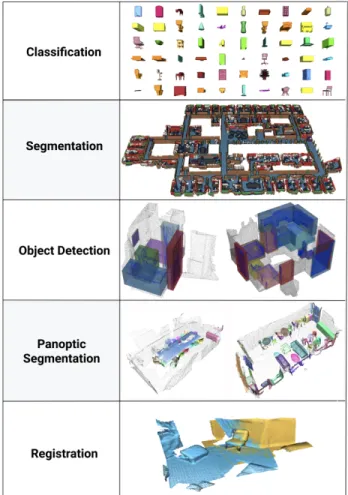
Figure 1: Torch-Points3D supports multiple tasks such as classification, segmentation, object detection, panoptic seg-mentation, and registration. All visuals have been produced by the framework.
1
[1] (6-fold) have gone from 41.7% mIoU points (mean In-tersection over Union) in 2017 [33], to 62.1% only a year later [25], and up to 70.6% in 2019 [38]. While this rapid methodological development is of course beneficial to the community, its fast pace comes with several shortcomings:
• Adding new datasets, tasks, or neural architec-tures to existing approaches requires a substantial commitment, often tantamount to a complete re-implementation. This limits the use of new networks, and prevents exhaustive comparisons.
• Handling large 3D datasets efficiently requires a sig-nificant time investment, and overcoming many imple-mentation pitfalls. This creates soft barriers to entry, restraining the diffusion of new ideas.
• There is no standard approach for inference scheme and metrics in research papers. This makes assessing the intrinsic performance of new algorithms difficult, and their reproducibility not always straightforward. In this paper, we introduce Torch-Points3D, a flexible and powerful development framework aiming to address these issues. In short, the purpose of our framework is to be-come for 3D point clouds what torchvision [31] or
pytorch-geometric[13] have become for images and graphs respectively. More generally, our goal is to address the growing technical debt pervasive to machine learning research codes. This is particularly crucial for 3D data, for which many steps require special care in order to not inval-idate investigations, from data loading and preprocessing to the computation of performance metrics. By proposing tried and tested implementations, which only get more ro-bust as the user community grows, we aim to further in-crease the rigor of 3D deep learning.
Torch-Points3D is intended for novices as much as ex-perts. It provides intuitive interfaces with most open-access 3D datasets, re-implementations of many of the top-performing networks, classic data augmentation schemes and validated performance metric. This allows researchers to focus on the development of core algorithms and test them on all available datasets with minimal effort. The dif-ferent components of Torch-Points3D are highly customiz-able and can be plugged into one another with a unified system of configuration files. Users can then easily swap backbone networks for a given task, leading to the efficient selection of the best-suited algorithms, as well as facilitat-ing comparison with new approaches. On this front, our framework makes it easy to standardize experimental pro-tocols, ensuring both reproducibility and that models’ per-formances are evaluated on equal footing.
Finally, we propose a multitude of quality-of-life fea-tures such as open logs with Weight and Biases [2], versatile model configuration handling with Hydra [41], and bespoke
visualization functions as illustrated in Figure1.
To illustrate the capabilities of Torch-Points3D, we pro-pose several numerical experiments:
• We evaluated the performance of different backbone networks in a recent object detection method.
• We benchmark different methods over several datasets with a unified protocol, aiming to assess their inherent performance.
• We quantify the benefit of implemented test-time en-hancers, such as voting schemes.
• We present our point clouds registration implementa-tion within our framework, combining recent papers and reaching state-of-the-art performance.
• We share key findings about speed enhancing proce-dures that can be leveraged on any model supported by the framework.
2. Related Work
The first deep learning methods for 3D point clouds analysis relied on image [3] or voxel-based representations [36, 37]. PointNet [33,34] was the first network whose architecture was specifically designed to handle unordered 3D point clouds. Since then, a multitude of approaches have been proposed, see the comprehensive review by Guo et al. [17]. Manipulating large 3D point clouds requires exten-sive implementations and to this end, several open-source frameworks have been proposed.
Kaolin Krishna Murthy J. et al. from Nvidia shared a Py-torch framework aiming to accelerate 3D deep learning re-search [19]. It implements boilerplate code for handling meshes, voxels, and point clouds.
Pytorch3D Nikhila Ravi et al. proposed another Pytorch-based framework, similar to Kaolin, for 3D computer vi-sion research [35]. Its key features include bespoke data structure for storing and manipulating meshes, a differen-tiable mesh renderer, camera position optimization, bundle adjustment, and several mesh-based deep models [16].
Det3D Zhu Benjin. et al. open-sourced a 3D Object Detection Pytorch toolbox [47], providing out-of-the-box implementations of many 3D object detection algorithms [26,42], as well as compatibility with several datasets such as KITTI [14] and nuScenes [4].
OpenPCDetand MMDetection3D [45] are open-source 3D object detection PyTorch toolboxes, part of the
Open-MMLab project developed by CUHK Multimedia Lab.
However, a unifying framework for tasks, multi-models, multi-datasets for reproducible 3D point clouds deep learning has yet to be proposed. In this paper, we in-troduce Torch-Points3D, which aims to answer this need.
3. The Framework
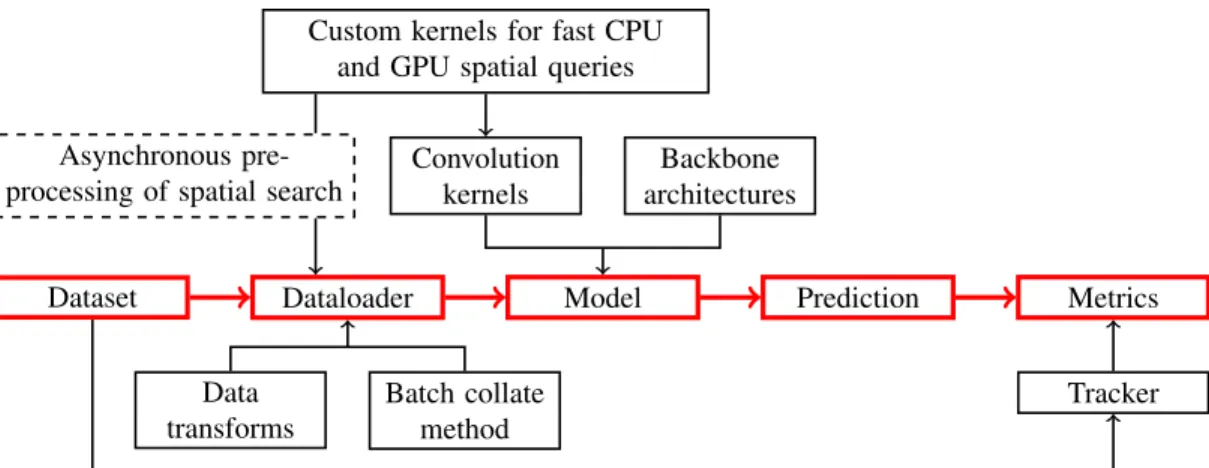
Torch-Points3D was written from scratch according to the following design principles: it should be modular, ex-tendible, and support multiple models, tasks, and datasets. Figure2illustrates the different components of our frame-work and how they interact together. A key design principle is that the components are independent from one another al-lowing users to plug and play their own contributions. This could be a dataset, a custom convolution or a new data aug-mentation strategy for example. In this section, we illustrate how these ideas translate into a versatile, easy-to-use inter-face.
3.1. Dataset Handling
The growing number of large-scale 3D public datasets has a beneficial effect on both the academic community and industrial actors interested in automated 3D point clouds analysis. While image formats have been standardized for years, this is not the case for 3D data. Hence, downloading, reading, cleaning, and processing data into a deep learning-ready format requires specific implementations, discourag-ing researchers to perform experiments on many datasets.
Building onpytorch-geometricimplementations, we propose an adapted interface for handling 3D datasets, from automatic downloading to data-augmentation. To en-sure maximum versatility, these operations can be set in a compact and modular configuration file system.In Sec-tion3.6, we present the different datasets currently imple-mented in Torch-Points3D.
3.2. Modular Model Configuration
The majority of competitive deep learning networks for 3D analysis rely on the 3-step, U-net like approach initially proposed by PointNet++ [34]:
(i) Encoding: The input point cloud is iteratively sub-sampled, and local features are computed for each point of a subsampling level based on neighboring points in the previous subsampling level. This step is built upon a down_conv operation, which varies for different networks.
(ii) InnerMost: A global descriptor per instance is com-puted by pooling the last subsampling level into a sin-gle vector. This embedding can be processed further with fully connected layers.
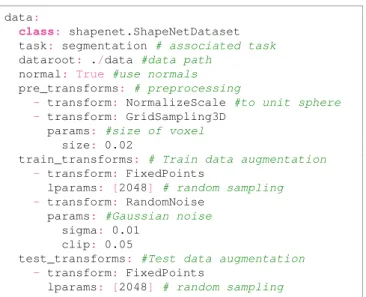
Listing 1: Configuration file shapeNet-fixed.yaml for the Shapenet dataset, with a fixed number of sampled points per object.
data:
class: shapenet.ShapeNetDataset
task: segmentation # associated task dataroot: ./data #data path
normal: True #use normals pre_transforms: # preprocessing
- transform: NormalizeScale #to unit sphere
- transform: GridSampling3D params: #size of voxel
size: 0.02
train_transforms: # Train data augmentation
- transform: FixedPoints
lparams: [2048] # random sampling
- transform: RandomNoise params: #Gaussian noise
sigma: 0.01 clip: 0.05
test_transforms: #Test data augmentation
- transform: FixedPoints
lparams: [2048] # random sampling
(iii) Decoding: The learned features are interpolated back from lower sub-samplings levels, up to the original point clouds, and processed based on their neighbors’ features, forming the up_conv operation. Features at mirror-level of subsampling for the encoder can be concatenated for additional spatial precision, through so-called skip connections. The result of the inner-most module can also be concatenated with point fea-tures at different subsampling level.
Based on this versatile architecture, we propose a system of configuration files able to encode most segmentation net-works. For example, the official single-scale PointNet++ is implemented by the configuration file in Listing2. The model pointnet2 described above can now be trained on any supported dataset such as Shapenet [5] with a simple command:
python train.py task=segmentation \
dataset=shapenet-fixed model_type=pointnet2 \ model_name=PointNet2
3.3. Implemented Networks
Torch-Points3D implements several convolution meth-ods which present an interest in terms of performance or versatility: PointNet, RandLANet, KPConv, RS-CNN, and Minkowski Engine. The PointNet-based architectures [33,34] are the simplest point convolution methods, making them both easy to use and understand. The convolution ker-nels for RandLANet [18] allows for efficient point clouds processing with a random sampling strategy. KPConv [38] proposes a kernel-based generalization of 2D convolution to
Dataset Dataloader Model Prediction Metrics Data transforms Batch collate method Convolution kernels Backbone architectures Custom kernels for fast CPU
and GPU spatial queries
Asynchronous pre-processing of spatial search
Tracker
Figure 2: Overall architecture of the framework, with data flow highlighted in red. Dataset implements the core loading mechanism of raw data and creates objects containing the points’ positions, relevant features, and labels. Those objects are then passed through data augmentation transforms and aggregated into batches in the Dataloader. They are finally passed to the Model, which outputs the prediction. A tracker evaluates the performance from predefined Metrics and publish results on the console and/or directly on Weight and Biases (wandb.ai).
Listing 2: Configuration file for PointNet++ [34].
pointnet2:
class: pointnet2.PointNet2 # Model class
conv_type: "DENSE" # Convolution type down_conv: #encoder
module_name: PointNetMSGDown
npoint: [512, 128] #subsampling levels radii: [[0.2], [0.4]] #neigh. radius nsamples: [[64], [64]] #neigh. count down_conv_nn: [[[FEAT+3, 64, 64, 128]],
[[128+3, 128, 128, 256]]] innermost: #process learned feature
module_name: GlobalDenseBaseModule nn: [256 + 3, 256, 512, 1024] up_conv: #decoder module_name: DenseFPModule up_conv_nn: [[1024 + 256, 256, 256], [256 + 128, 256, 128], [128 + FEAT, 128, 128, 128]] skip: True # use skip connection mlp_cls: #produce class scores
nn: [128, 128] dropout: 0.5
3D point clouds, and RS-CNN [29] capture the complexity of local shapes by modeling spatial relationships between points. Minkowski Engine [7] relies on a fine-grained vox-elization of point clouds, efficiently processed with sparse-convolutions.
These convolution schemes can be integrated into a backbone network architecture for semantic segmentation or object classification for example. We propose several such backbone, from a simple U-Net, to a multi-scale ar-chitecture, and more modern ResNet-like architectures as
proposed in [7] or [38].
Finally, the framework also implements task-specific heads for object detection and Panoptic segmentation. In aprticular, VoteNet [32] uses Hough voting to regress bounding boxes on 3D point clouds, and PointGroup [20] uses a clustering scheme to perform instance segmentation. While the compact configuration format described in the last section is designed to make U-Net-like networks easier, users can also easily define their own types of configura-tion file and model architectures in Torch-Points3D. For ex-ample, VoteNet and PointGroup use custom configurations. Our configuration system is meant to be flexible, and ex-isting configurations serve more as guides for newcomers than rigid templates. At the time of writing, superpoint-based [25,24] and multi-modal methods (eg. 3D points + images [11]) are not yet implemented. However, we plan to add both in the near-future.
3.4. Multi-Task Support
The ability of our framework to handle different tasks ensures its versatility and allows multi-source supervision [28]. We have currently implemented five tasks, illustrated in Figure1, and their associated losses and metrics: classifi-cation, semantic segmentation, panoptic segmentation [22], registration, and object detection.
Adding new tasks with their associated datasets and met-rics can be done in isolation from the rest of the project, al-lowing users to extend the framework without necessarily understanding its inner working in details.
3.5. Transparency and Reproducibility
Reproducibility of experiments is not only necessary when assessing the suitability of different networks to a
given task or dataset, but also to back scientific claims in academic papers. To this end, we have ensured the inte-grated compatibility of our framework with the Hydra con-figuration system [41] as well as the experiments tracker
Weight and Biases[2] (wandb.ai). This online tool can store training runs along with their logs, metric visualiza-tion, configuration files, git commit hash, and our custom
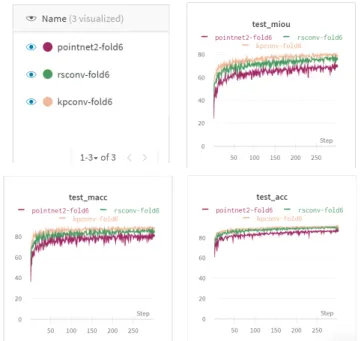
Pickle-based checkpoints. This total transparency allows users to compare their own experiments with our reference runs, and the models can be directly downloaded for fine-tuning tasks. In the Appendix, we reports an example of log visualization hosted onwandb.ai.
Another benefit of our unified approach is standardizing the learning and testing procedure. Indeed, the field of 3D analysis lacks a common ground when it comes to evalua-tion and augmentaevalua-tion strategies, both at test and training time. This makes experiments across different papers hard to compare, and could potentially obscur the intrinsic per-formance of new models. In Section4.2, we propose stan-dard protocols for different datasets and reproduce an array of experimental results.
3.6. Supported Datasets
Torch-Points3D supports multiple academic datasets with automatic data download, pre-processing, as well as automatic result submission when available.
• ScanNetis an indoor RGBD dataset containing 1 201 train scenes and 312 test scenes [10]. It can be used for semantic segmentation, object detection, and panoptic segmentation.
• S3DISis a large-scale indoor RGB point cloud dataset covering three separate office buildings, over 6 000m2,
and containing 278 million points with instance-level object and semantic annotations. We implement three different sampling for batch-training, based on rooms [1], cubes [34], or spheres [38].
• ModelNet10/40is a dataset composed of over 12 000 CAD models from 10 and 40 categories [39].
• Shapenetis a collection of over 200 000 CAD models annotated across a hierarchy of 3 135 classes [5]. On top of classification and semantic segmentation, Torch-Points3D also implements the task of hierarchical se-mantic segmentation, as well as adapted metrics. • 3DMatchis an RGBD dataset [44] widely used for 3D
reconstruction and point cloud registration.
• KITTI Odometry contains 21 sequences of LiDAR frames [15], with ground truth poses for the first ten. KITTI Odometry is commonly used as benchmmark for SLAM LIDAR, but can also be used to train and evaluate point cloud registration networks ([8]).
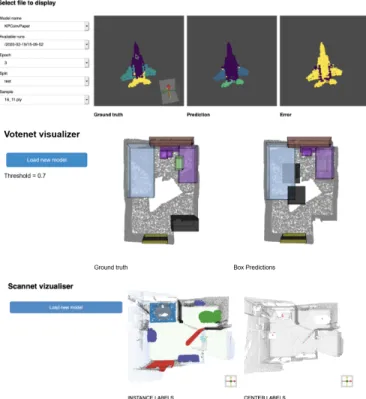
Figure 3: Several of the visualization tools available.
3.7. Built-in Visualization
Torch-Points3D provides several custom visualization tools directly available within notebooks and using the dashboarding librarypanel. This feature can be used to ex-plore datasets, debug models, or illustrate predictions, as shown in Figure3.
3.8. Ease-of-Use
As corroborated by the numerous pull-requests submit-ted by contributors, and testimonies from industrial part-ners, Torch-Points3D is accessible despite the quantity of code. Adding new datasets, new models or new base mod-ules can be done without interfering with the rest of the code base while benefiting from existing methods for data augmentation, metric evaluation or training procedures at zero cost. A convenient way to start familiarizing one self with the framework, is by running the proposed illustrative IPythonnotebooks. More details as well as installation in-structions are available in the Appendix.
4. Numerical Experiments
In this section, we present several case studies demon-strating some of the capabilities of Torch-Points3D , such as backbone swapping and fair benchmarking. The detailed configuration of the experiments, along with the evolution of metrics along the runs, are available as WandB projects
accessible through the framework GitHub repository.
4.1. VoteNet with Different Backbones
The VoteNet network, introduced by Qi et al. [32], per-forms end-to-end object detection in 3D point clouds. It re-lies on a PointNet++-like backbone network to extract point features, which are then used by an object-center voting module and a box-proposal module.
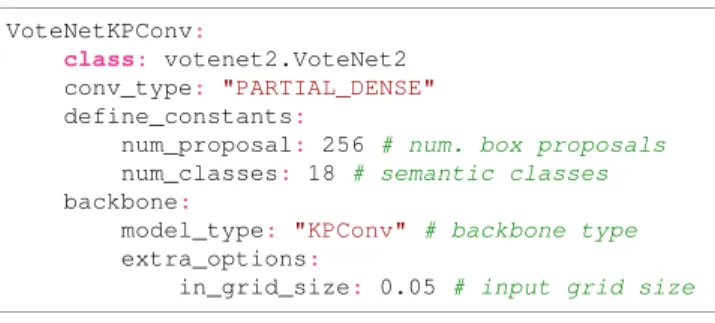
In Table1, we assess the performance of different net-works by replacing the PointNet++ backbone with more re-cent alternatives, such as RS-CNN [29], KPConv [38], and Minkowski Engine [7].We used the same architecture than the ones used in our semantic segmentation benchmark, see Section4.2. Further adaptation to the task, such as trun-cating the decoder as recommend in VoteNet, would cer-tainly be beneficial but are out of the scope of this paper. Otherwise, we use the hyper parameters, training and data augmentation procedures proposed in the original work. Changing the backbone is as simple as editing the model’s configuration file as presented in Listing3.
While the RS-CNN and KPConv backbones underper-formed, the mean average precision 50% IoU is improved slightly by switching to a Minkowski Engine network. Overall, the PointNet++ architecture seems particularly well-suited to the task of object detection, as also observed by Xi et al. [40].
Note that our results differ slightly from the original pa-per, as our metric implementation is slightly altered: suc-cessful box recoveries only count as positive for a given class if the predicted class is correctly inferred as well.
Listing 3: Model configuration used for switching the back-bone of VoteNet [32] to KPConv [38].
VoteNetKPConv:
class: votenet2.VoteNet2
conv_type: "PARTIAL_DENSE"
define_constants:
num_proposal: 256 # num. box proposals num_classes: 18 # semantic classes backbone:
model_type: "KPConv" # backbone type extra_options:
in_grid_size: 0.05 # input grid size
4.2. Benchmarking with Torch-Points3D
As one of the first and easiest to use datasets, S3DIS [1] has been used as a standard measure of the performance of state-of-the-art methods. However, there is a large discrep-ancy in how methods are evaluated, which makes it hard to compare their performance.We propose a common evalua-tion protocol, largely inspired by the one proposed by [38].
Table 1: Impact of the backbone choice on VoteNet per-formances. mAP@r stands for the interclass mean average precision with a detection threshold of r% IoU.
VoteNet Backbone mAP mAP @25 @50 PointNet ++ [34] 54.2 30.1 RS-CNN [29] 51.6 29.5 KPConv [38] 48.9 29.2 Mink. Engine [7] 53.8 30.2
• Pre-processing: S3DIS is comprised of 6 folds, each containing a collection of point clouds corresponding to single rooms. We aggregate these clouds to obtain one cloud per fold, each corresponding to one entire level of an office building. We sample this cloud with respect to a 4cm grid.
• Training: In each epoch, we sample 3 000 spheres of radius 2m, centered around random points picked with a probability inversely proportional to the square root of their class frequency.
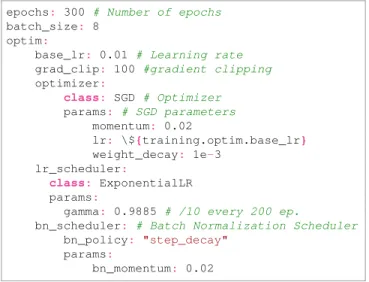
• Optimizers: The parameters of the optimizers are given in the configuration file presented in Listing4. In our experiments, Stochastic gradient Descent (SGD) had slower convergence but higher generalization than momentum-based optimizers such as [21].
• Inference: 2m-radius spheres are sampled along a 2 × 2 × 2m grid once. The class probability associated to points present in several spheres are averaged. To compute the final metrics on the original clouds, we perform nearest neighbor interpolation.
• Metrics: We report the Overall Accuracy (OA) and Mean Intersection over Union (mIoU) over classes ob-tained by cross-validating over the 6-folds. We add an early stopping scheme in which the model is evaluated on the epoch whose model has the highest mIoU on a validation set, obtained by withholding selected rooms from the training set.
We also devise a similar protocol for ScanNet [10]. The differing steps are as follows:
• Pre-processing: We subsample with a 5cm grid.
• Training: Batches are collections of rooms subsam-pled to 50 000 points.
• Metrics: We report the OA and mIoU on the validation set using the model of the last epoch.
Listing 4: Optimizer hyper-parameters used for training all models on S3DIS.
epochs: 300 # Number of epochs batch_size: 8
optim:
base_lr: 0.01 # Learning rate grad_clip: 100 #gradient clipping optimizer: class: SGD # Optimizer params: # SGD parameters momentum: 0.02 lr: \${training.optim.base_lr} weight_decay: 1e-3 lr_scheduler: class: ExponentialLR params:
gamma: 0.9885 # /10 every 200 ep.
bn_scheduler: # Batch Normalization Scheduler bn_policy: "step_decay"
params:
bn_momentum: 0.02
Table 2: Benchmarking of four different methods on the task of semantic segmentation for two different datasets: S3DIS [1] with 6-fold cross validation and ScanNet [5] evaluated on the valdiation set.
Model
S3DIS 6-folds
ScanNet
OA
mIoU
OA
mIoU
KPConv [
38
]
86.4
66.3
85.5
59.9
Mink. Engine [
7
]
86.0
65.9
87.2
65.0
RS-CNN [
29
]
83.2
62.9
79.8
47.2
PointNet++ [
34
]
81.06
56.7
80.7
49.3
In Table 2, we report the performance of four networks (PointNet++ [34], RS-CNN [29], Minkowski Engine [7], and KPConv [38]) on both S3DIS and ScanNet. Each of these algorithms share the exact same learning and infer-ence procedure. This allows us to appreciate their perfor-mances all other things being equal.
Ze Liu et al. [30] interestingly demonstrate in their recent investigation that the choice of convolution type (pointnet-like, pointCNN [27], KPConv, and their own PoolPos) have little impact when evaluated with a shared architecture. We can hence attribute the performance in Table2 to the difference in architectures, namely the depth and subsam-pling/upsampling operations. We also remark that Ze Liu et al.’s experiments are particularly easy to replicate with Torch-Points3D on any of the proposed dataset, as most convolution schemes are already implemented.
4.3. Inference Schemes
A common scheme to increase the performance of a model is to perform several inference runs—with data
aug-Table 3: Improvement in terms of mIoU provided by inference-time voting schemes on S3DIS 6-folds.
Models no voting with voting KPConv [38] 66.3 67.2 Mink. Engine [7] 65.9 69.1 RS-CNN [29] 62.9 64.6 PointNet++ [34] 56.7 59.0
Figure 4: Segmentation predictions with and without vot-ing. We can observe voting tends to create smoother, more accurate predictions.
mentation, and to output their average probability. While this method slows down inference, the increase in perfor-mance can be justified for non time-sensitive applications such as digital twin modeling.
In Table3, we report the performance of different mod-els with and without a 3-run average. The performance in-crease is noticeable, with an average inin-crease from 1 to 3 points of mIoU. Interestingly, we remark that the relative order of performance of KPConv and Minkowski Engine are reversed by a non-negligible margin when using this in-ference scheme. In Figure4, we illustrate the improvement provided by this inference scheme.
4.4. Registration
Registration is the task of finding a rigid transforma-tion aligning several 3D point clouds. Neural networks can be trained to compute point features whose pairing deter-mine the sought-after transformation, either end-to-end or with robust nondifferentiable estimators such as RANSAC, FGR[46], or the recent TEASER[43].
We implement a full registration pipeline within Torch-Points3D, using a Minkowski Engine backbone as
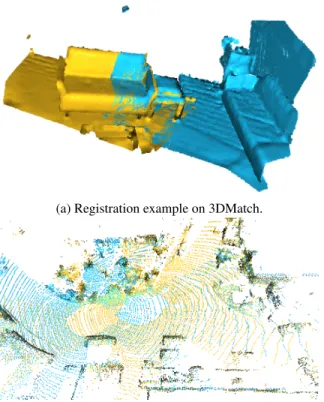
sug-(a) Registration example on 3DMatch.
(b) Registration example on KITTI odometry.
Figure 5: Qualitative registration results between two point clouds (in blue and yellow).
Table 4: Success rate (in %) on the 3DMatch and KITTI odometry datasets. Results obtained within TorchPoints3D. A success is defined by an error under 15 degree and 0.3 m for 3DMatch, and 2 degrees and 0.6 m for Kitti Odometry.
?model taken from the paper’s repository.
Methods 3DMatch KITTI DGR? 92.6 96.9
FCGF+ TEASER 93.6 99.8 FCGF+ RANSAC 94.3 99.6
gested by Choy et al. [8], and estimating transformations with TEASER[43] and RANSAC. As reported in Table4, our implementation reaches state-of-the-art performance of point cloud registration on two datasets available in Torch-Points3D: 3DMatch [44] and KITTI Odometry [15]. In Fig-ure5, we present some qualitative illustrations.
4.5. CPU-Based Preprocessing
When training point-based neural networks on large point clouds, the computation of neighbors and the sub-sampling operations become the computational bottlenecks rather than inference or backpropagation.
In modern deep learning frameworks such as PyTorch, background processes prepare new batches of data to be
run through the network while the GPU simultaneously per-forms tensor operations on previously prepared batches. As suggested in [38], we off-load the radius search and sub-sampling operations to those background processes oper-ating on CPUs. As reported in Table5, this allows us to achieve an 8-times overall speed-up compared to perform-ing all computations on the GPU. This particular implemen-tation trick—one of many—exemplifies the numerous pit-falls to overcome when implementing deep learning meth-ods operating on 3D data.
Table 5: Training speed of the KPconv model, in thousands of points processed per second (kpts/s) during training, with radius search performed on either the GPU (Tesla T4) or the CPUs (4 × 2.2GHz).
S3DIS ScanNet radius search on CPUs 199.9 197.4
radius search on GPU 38.6 29.2
5. Conclusion and Perspectives
We presented Torch-Points3D, a flexible and powerful framework aiming to make deep learning on 3D data both more accessible and rigorous. Our implementation al-lows users to evaluate, improve and combine state-of-the-art models on a growing number of tasks and datasets. The community emerging around our framework provides us with precious feedback, as well as much needed help in keeping up with a such a fast-paced domain. We welcome researchers, software engineers, and open-source enthusi-asts in this endeavor.
Encouraged by the recent results of Xie et al. [40], we believe in the potential of transfer learning across datasets and tasks for 3D data. Our next focus will be to provide a high-level API for pre-trained, self-supervised, self-trained, and unsupervised deep learning approaches operating on 3D point clouds.
6. Acknowledgments
Thomas Chaton and Nicolas Chaulet would like to ac-knowledge the great support provided by Fujitsu Laborato-ries of Europe, both financially and for useful feedback by being one of the first users.
This research was also supported in parts by the AI4GEO project:http://www.ai4geo.eu/
References
[1] I. Armeni, O. Sener, A. R. Zamir, H. Jiang, I. Brilakis, M. Fischer, and S. Savarese. 3D semantic parsing of large-scale indoor spaces. CVPR, 2016.2,5,6,7
[2] L. Biewald. Experiment tracking with weights and biases, 2020. Software available from wandb.com.2,5
[3] A. Boulch, B. L. Saux, and N. Audebert. Unstructured point cloud semantic labeling using deep segmentation networks. Eurographics Workshop on 3D Object Retrieval, 2017.2 [4] H. Caesar, V. Bankiti, A. H. Lang, S. Vora, V. E. Liong,
Q. Xu, A. Krishnan, Y. Pan, G. Baldan, and O. Beijbom. nuScenes: A multimodal dataset for autonomous driving. CVPR, 2020.2
[5] A. X. Chang, T. Funkhouser, L. Guibas, P. Hanrahan, Q. Huang, Z. Li, S. Savarese, M. Savva, S. Song, H. Su, J. Xiao, L. Yi, and F. Yu. ShapeNet: an information-rich 3D model repository. Technical report, Stanford Univer-sity ,Princeton UniverUniver-sity, Toyota Technological Institute at Chicago, 2015.3,5,7
[6] C. Choy, W. Dong, and V. Koltun. Deep global registration. CVPR, 2020.11
[7] C. Choy, J. Gwak, and S. Savarese. 4D spatio-temporal con-vnets: Minkowski convolutional neural networks. CVPR, 2019.4,6,7
[8] C. Choy, J. Park, and V. Koltun. Fully convolutional geomet-ric features. ICCV, 2019.5,8,11
[9] B. Curless and M. Levoy. A volumetric method for build-ing complex models from range images. In J. Fujii, editor, SIGGRAPH, pages 303–312. ACM, 1996.11
[10] A. Dai, A. X. Chang, M. Savva, M. Halber, T. Funkhouser, and M. Nießner. ScanNet: Richly-annotated 3D reconstruc-tions of indoor scenes. CVPR, 2017.5,6
[11] A. Dai and M. Nießner. 3DMV: Joint 3D-multi-view pre-diction for 3D semantic scene segmentation. ECCV, 2018. 4
[12] J. Deschaud. IMLS-SLAM: scan-to-model matching based on 3D data. CoRR, abs/1802.08633, 2018.11
[13] M. Fey and J. E. Lenssen. Fast graph representation learning with PyTorch Geometric. ICLR Workshop on Representation Learning on Graphs and Manifolds, 2019.2
[14] A. Geiger, P. Lenz, C. Stiller, and R. Urtasun. Vision meets robotics: The KITTI dataset. The International Journal of Robotics Research, 32(11):1231–1237, 2013.2
[15] A. Geiger, P. Lenz, and R. Urtasun. Are we ready for autonomous driving? The KITTI vision benchmark suite. CVPR, 2012.5,8
[16] G. Gkioxari, J. Malik, and J. Johnson. Mesh R-CNN. ICCV, 2019.2
[17] Y. Guo, H. Wang, Q. Hu, H. Liu, L. Liu, and M. Bennamoun. Deep learning for 3D point clouds: A survey. IEEE Trans-actions on Pattern Analysis and Machine Intelligence, 2020. 2
[18] Q. Hu, B. Yang, L. Xie, S. Rosa, Y. Guo, Z. Wang, N. Trigoni, and A. Markham. RandLA-Net: Efficient seman-tic segmentation of large-scale point clouds. CVPR, 2020.3 [19] K. J., E. Smith, J.-F. Lafleche, C. Fuji Tsang, A. Rozantsev, W. Chen, T. Xiang, R. Lebaredian, and S. Fidler. Kaolin: a
Pytorch library for accelerating 3D deep learning research. arXiv:1911.05063, 2019.2
[20] L. Jiang, H. Zhao, S. Shi, S. Liu, C.-W. Fu, and J. Jia. Point-Group: Dual-set point grouping for 3D instance segmenta-tion. CVPR, 2020.4
[21] D. P. Kingma and J. Ba. Adam: A method for stochastic optimization. ICLR, 2014.6
[22] A. Kirillov, K. He, R. Girshick, C. Rother, and P. Dollár. Panoptic segmentation. CVPR, 2019.4
[23] A. Krizhevsky, I. Sutskever, and G. E. Hinton. Ima-geNet classification with deep convolutional neural net-works. NeurIPS, 2012.1
[24] L. Landrieu and M. Boussaha. Point cloud oversegmentation with graph-structured deep metric learning. CVPR, 2019.4 [25] L. Landrieu and M. Simonovsky. Large-scale point cloud
semantic segmentation with superpoint graphs. CVPR, 2018. 2,4
[26] A. H. Lang, S. Vora, H. Caesar, L. Zhou, J. Yang, and O. Bei-jbom. Pointpillars: Fast encoders for object detection from point clouds. CVPR, 2019.2
[27] Y. Li, R. Bu, M. Sun, W. Wu, X. Di, and B. Chen. PointCNN: Convolution on X -transformed points. NeurIPS, 2018.7 [28] D. Lin, S. Fidler, and R. Urtasun. Holistic scene
understand-ing for 3D object detection with RGBD cameras. ICCV, 2013.4
[29] Y. Liu, B. Fan, S. Xiang, and C. Pan. Relation-shape con-volutional neural network for point cloud analysis. CVPR, 2019.4,6,7
[30] Z. Liu, H. Hu, Y. Cao, Z. Zhang, and X. Tong. A closer look at local aggregation operators in point cloud analysis. ECCV, 2020.7
[31] S. Marcel and Y. Rodriguez. Torchvision the machine-vision package of Torch. ACM international conference on Multi-media, 2010.2
[32] C. R. Qi, O. Litany, K. He, and L. J. Guibas. Deep Hough voting for 3D object detection in point clouds. ICCV, 2019. 4,6
[33] C. R. Qi, H. Su, K. Mo, and L. J. Guibas. PointNet: Deep learning on point sets for 3D classification and segmentation. CVPR, 2017.2,3
[34] C. R. Qi, L. Yi, H. Su, and L. J. Guibas. PointNet++: Deep hierarchical feature learning on point sets in a metric space. NeurIPS, 2017.2,3,4,5,6,7
[35] N. Ravi, J. Reizenstein, D. Novotny, T. Gordon, W.-Y. Lo, J. Johnson, and G. Gkioxari. Pytorch3D, 2020.2
[36] G. Riegler, A. O. Ulusoy, and A. Geiger. OctNet: Learning deep 3D representations at high resolutions. CVPR, 2017.2 [37] L. P. Tchapmi, C. B. Choy, I. Armeni, J. Gwak, and S. Savarese. SEGCloud: Semantic segmentation of 3D point clouds. ICCV, 2017.2
[38] H. Thomas, C. R. Qi, J.-E. Deschaud, B. Marcotegui, F. Goulette, and L. J. Guibas. KPconv: Flexible and de-formable convolution for point clouds. CVPR, 2019.2,3,4, 5,6,7,8
[39] Z. Wu, S. Song, A. Khosla, F. Yu, L. Zhang, X. Tang, and J. Xiao. 3D ShapeNets: A deep representation for volumetric shapes. CVPR, 2015.5
[40] S. Xie, J. Gu, D. Guo, C. R. Qi, L. J. Guibas, and O. Litany. PointContrast: Unsupervised pre-training for 3D point cloud understanding. ECCV, 2020.6,8
[41] O. Yadan. Hydra - a framework for elegantly configuring complex applications. Github, 2019.2,5
[42] B. Yang, W. Luo, and R. Urtasun. PIXOR: Real-time 3D object detection from point clouds. CVPR, 2018.2 [43] H. Yang, J. Shi, and L. Carlone. TEASER: Fast and
certifi-able point cloud registration, 2020.7,8
[44] A. Zeng, S. Song, M. Nießner, M. Fisher, J. Xiao, and T. Funkhouser. 3DMatch: Learning local geometric
descrip-tors from RGB-D reconstructions. CVPR, 2017.5,8 [45] W. Zhang, Y. Wu, T. Wang, Y. Li, K.-Y. Lin, Z. Wang,
J. Shi, C. Qian, K. Chen, D. Lin, and C. C. Loy. MMDe-tection3D. https://github.com/open-mmlab/ mmdetection3d, 2020.2
[46] Q.-Y. Zhou, J. Park, and V. Koltun. Fast Global Registration. ECCV, 2016.7
[47] B. Zhu, Z. Jiang, X. Zhou, Z. Li, and G. Yu. Class-balanced grouping and sampling for point cloud 3D object detection. arXiv preprint arXiv:1908.09492, 2019.2
APPENDIX
A. Illustrative Notebooks
We propose two IPython notebooks to illustrate some of the capacities of Torch-Points3D:
• A notebook illustrating the training of the Relation-Shape CNN model for object classification with Torch-Points3D:link.
• A notebook showing the inner working of encoding and decoding in a KPConv model for part segmenta-tion:link.
These notebook can be run on Google Colab from a browser without any installations. They are self-contained and will install automatically all required packages, as well as down-load the relevant datasets. Be warned that the installation of the necessary libraries and download of the datasets can take up to 30minutes. You can otherwise download the notebooks and run them locally, after installing the neces-sary libraries, namely torch torch-points3d and pyvista.
pip install torch torch-points3d pyvista
B. Details on the Registration Experiment
B.1. Implementation
As described in the main paper, we implemented FCGF model for point cloud registration. The encoder is composed of 4 residual blocks with output sizes of [32, 64, 128, 256]. Each block has a stride of 2 except for the first block. The decoder is composed of residual blocks of output sizes [64, 64, 64, 64]. We train with SGD with mo-mentum of 0.8, a learning rate of 0.1, and a weight decay of 10−4. The same parameters are used for both Kitti Odome-try and 3DMatch.
B.2. 3Dmatch
Since 3D match is a dataset of RGBD images, we need to fuse depth images to obtain 3D point clouds. We use a TSDF voxel grid as in [9] and obtain fragments. For the training set and the validation set, 50 depth images are fused to obtain each fragment. We use a voxel subsampling of size 0.02m in the FCGF network.
B.3. KITTI Odometry
Kitti Odometry contains LiDAR scans with their associ-ated poses, however these do not have the precision neces-sary to properly evaluate registration predictions. Choy et
al. [8] use these poses as initialization, and use ICP to re-fine the transformation between each pairs. The pairs are defined as LiDAR frames whose center is at least distant of 10m. We use IMLS SLAM [12] to compute the poses of all sequences. As in [8,6], the sequences 0, 1, 2, 3, 4, 5 are used for training, 6, 7 for validation and 8, 9, 10 for testing. For this dataset, we use a voxel subsampling of size 0.3m.
B.4. Evaluation
To evaluate registration, we measure the rotation error and the translation error as :
δtrans= ||test− t?||2 (1)
δrot = arccos
trace(RestR? T) − 1
2 (2)
where (test, Rest) is the estimated translation and rotation,
and (t?, R?) the associated ground truth. For 3DMatch, we
count a success when the rotation error is under 15 degrees, and the translation error is less than 0.3 m, as suggested by Choy et al. [6] For Kitti Odometry, the rotation error must be less than 2 degrees and the translation error must be under 0.6 m for a prediction to be considered successful.
Figure 6: Training logs hosted onwandb.aifor different models on a S3DIS fold. These logs, along their trained models and full configuration, are publicly available on the contributor’swandb.ai’s account (links provided on the repository).