HAL Id: hal-00800153
https://hal.inria.fr/hal-00800153
Submitted on 13 Mar 2013
HAL is a multi-disciplinary open access
archive for the deposit and dissemination of
sci-entific research documents, whether they are
pub-lished or not. The documents may come from
teaching and research institutions in France or
abroad, or from public or private research centers.
L’archive ouverte pluridisciplinaire HAL, est
destinée au dépôt et à la diffusion de documents
scientifiques de niveau recherche, publiés ou non,
émanant des établissements d’enseignement et de
recherche français ou étrangers, des laboratoires
publics ou privés.
From Object-Oriented Programming to Service-Oriented
Computing: How to Improve Interoperability by
Preserving Subtyping
Diana Allam, Hervé Grall, Jean-Claude Royer
To cite this version:
Diana Allam, Hervé Grall, Jean-Claude Royer. From Object-Oriented Programming to
Service-Oriented Computing: How to Improve Interoperability by Preserving Subtyping. WEBIST 2013
- 9th International Conference on Web Information Systems and Technologies, May 2013, Aachen,
Germany. pp.169-173. �hal-00800153�
From Object-Oriented Programming to Service-Oriented Computing:
How to Improve Interoperability by Preserving Subtyping
∗
Diana Allam, Herv´e Grall and Jean-Claude Royer
ASCOLA group; EMN-INRIA, LINA
D´epartement Informatique, ´Ecole des Mines de Nantes, Nantes, France {first name.last name}@emn.fr
Keywords: Service-Oriented Architecture, Object-Oriented Programming, Interoperability, Loose Coupling, Subtyping Abstract: The object-oriented paradigm is increasingly used in the implementation and the use of web services.
How-ever, the mismatch between objects and document structures in the wire has a negative impact over interoper-ability, more particularly when subtyping is involved. In this paper, we discuss how to improve interoperability in this context by preserving the subsumption property associated to subtyping. First we show the weaknesses of existing web service frameworks used for serialization and deserialization. Second we propose new foun-dations for serialization and deserialization, which leads to the specification of a new data binding between objects and document structures, compatible with subtyping.
1
Introduction
Web services are message-oriented systems based on document exchanges. But the development of web services on both client and server sides is increas-ingly based on object-oriented implementations. This raises the problem of impedance mismatch between objects and tree structures in XML or JSON (L¨ammel and Meijer, 2007): it is difficult to preserve object properties after serialization and deserialization. This is due to the differences in the data models and the type systems between the object-oriented paradigm and the structural one. Such problems are currently hidden because of restrictions imposed by the cur-rent practice for the implementation of web services. According to the current practice, interoperability is achieved by twining the required interface at the client with the provided one at the server. In that way, web services involve a tightly coupled architecture rather than a loosely coupled one, which contradicts the standard approach for Service Oriented Architecture (SOA).
Among the restrictions imposed in the current practice for web services, we find subtyping, which is useful for web service interoperability as noticed for instance by (Carpineti and Laneve, 2006), (Lee and Cheung, 2010) and (Kourtesis and Paraskakis, 2009). Currently, object-oriented frameworks fail to preserve
∗This work has been supported by the CESSA ANR
project (see http://cessa.gforge.inria.fr).
subtyping in its object definition. However it is possi-ble to remove this gap while considering current tech-niques for serialization and deserialization: an extra adaptation on the client side is then required to make the subtype and the supertype compatible. Thus, this solution is not consistent either with the principle of loose coupling: the client and the server cannot be considered as black boxes.
In order to preserve subtyping while being con-form to the loose coupling principle, we propose new foundations for serialization and deserialization, based on commutative diagrams as found in category theory (Pierce, 1991). The implementation will give rise to a new data binding framework for the two most common technologies for web services, RESTful and SOAP.
This paper is structured as follows: in Sec. 2, we present a general view of interoperability between a client and a server in existing object-oriented frame-works for RESTful and SOAP Web services. In Sec. 3, we present two problems related to subtyping in the case of a dynamic switching between services. In Sec. 4, we formalize the serialization and deserial-ization processes and provide their specification with commutative diagrams. In Sec. 5 we conclude this pa-per by proposing a solution to the subtyping problems in the formal framework proposed and by stating the position we will defend in future work.
2
Interoperability in object-oriented
frameworks for web services
In this section we show how the web service in-teroperability between a client and a server is ensured in object-oriented frameworks and how it can be im-proved with subtyping.
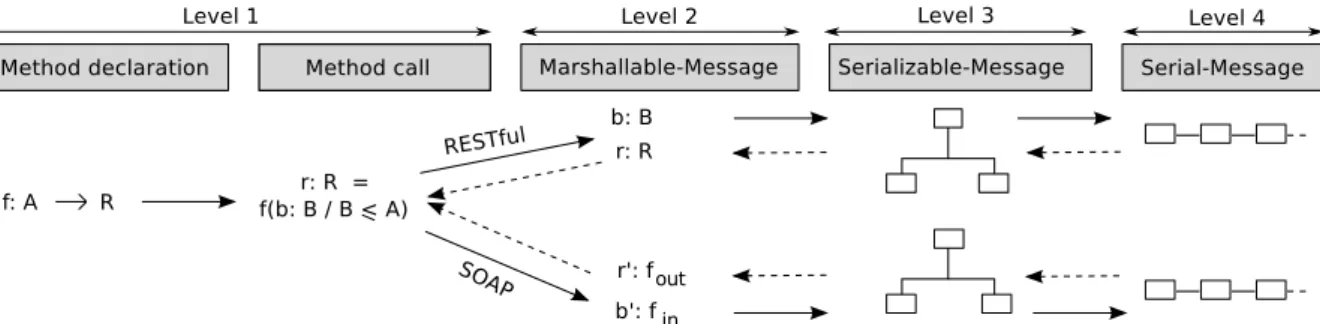
A view on document exchanges. Based on our ob-servations on some frameworks and standards, like JAX-WS, JAX-RS and Restlet, we deduce a general common exchange process of messages for existing object-oriented frameworks for web services. At each side, either the client side or the server one, mes-sages at emission and reception must cross four levels of message types. These four levels link the object-oriented environment to the serial environment in the wire. Starting from the object-oriented level, we dis-tinguish four levels:
1. Data level which refers to the input and output types of the service operations declared at the client (in the proxy interface) or at the server (in the service interface)
2. Marshallable level which refers to the reification format of Data. The marshallable message for-mat is the essential message transforfor-mation which makes the difference between the two web ser-vice models: SOAP and RESTful. As SOAP is an activity-oriented model, the marshallable mes-sage corresponds to an activity. Thus, two types are associated to each declared service operation. The first type is associated to the request on the operation, often named with the operation name, and has as attributes the input parameters of the operation. The other type is associated to the re-ply which contains an attribute having the return type of the operation. For the RESTful model, which is resource oriented, transmitted messages must be resources. Here, marshallable types are equal to Data types.
3. Serializable level which refers to the type of mes-sages ready to be serialized. These types corre-sponds to tree types associated to the marshallable types. In web service development practices, they are generated from the serialization annotations added into the marshallable types.
4. Serial level which refers to the message format ready to be sent in the wire. Serial messages are often represented in XML or JSON format. Message transformations across these four levels at the client side is illustrated in Figure 1. These four levels appear in a symmetric way at the server side.
This figure shows the different conversions applied on a message due to a function call f (b), where f has type A → R and b has type B, a subtype of A. The figure distinguishes the SOAP and RESTful cases at the marshallable level as we mentioned before. For RESTful, the marshallable message is the data b at emission and a data r, an instance of R, at reception. At emission in SOAP, the marshallable message is b0, instance of fin where fin is a reification format for function calls f (b). At reception in SOAP, the mar-shallable message is r0, an instance of foutwhere fout is a reification format for function results r.
Twining development interfaces. Building a serial message from a data at emission then building a data from the serial message at reception must lead to an equivalent instance. Therefore, an interoperability is required between the exchange levels at the client side and at the server side, as it is defined in Figure 1. According to the current practices of web service implementations, this interoperability is achieved by tightly coupling the client and the server. The object-oriented environment is associated to a structural in-terface expressed with Web Service Description guage (WSDL) or Web Application Description Lan-guage (WADL). Clients calling a web service must get this structural service interface and generate lo-cally the corresponding types. Therefore, the declared operations at the client and the server are equal. Con-sequently, for the request and the response, the four levels for messages at the client side and the server side respectively exactly match, defining each time a serialization process and an inverse deserialization process.
Interoperability and subtyping. From a type-theoretical point of view, the equality between de-clared operations at the client and the server is not required to ensure a correct interoperability. The pro-vided operation by a web service could be a subtype of the required one by the client, as recalled for in-stance by (Seco and Caires, 2000). Hence, according to the variance properties for subtyping, the argument type of the required operation must be a subtype of the argument type of the corresponding provided op-eration; and the return type of the required operation must be a supertype of the return type of the provided operation.
In the following section, we aim at showing weak-nesses in existing frameworks for serialization and de-serialization: they fail to preserve the subsumption property associated to subtyping when they respect the loose coupling principle.
Figure 1: Message transformations from object instances to serial messages and inversely at the client side
3
Subtyping problems
In order to test the preservation of subtyping while respecting the loose coupling principle, we propose a scenario where a client can switch between two web services related by subtyping. We assume that the client is initially configured according to a Web Ser-vice 1interface. Then, this client would switch to a Web Service 2, a compatible substitution of Web Ser-vice 1. Switching between serSer-vices having similar roles is more and more used in dynamic environments as in (Srirama et al., 2006) and (Zaplata et al., 2009). The ideal case would be by doing such a switch au-tomatically without involving any modification to the system because a web service is replaced by a com-patible one. That way, we ensure a perfect loose cou-pling because no modifications are required to ensure a correct interoperability. However, this ideal solution is out of the scope of existing frameworks for serial-ization and deserialserial-ization. In the following we will show the interoperability weaknesses in this context by considering two subtyping examples. The first ex-ample considers subtyping on provided and required operations. The second one considers subtyping be-tween Data types used as input arguments.
The tests are done using Apache CXF framework 2and JAXB Data Binding (the default one in CXF), which are popular standards and can be considered as paradigmatic. These tests consist to verify if an emitted instance could be rebuilt at reception as an instance of a supertype. The preservation of the dy-namic binding (proper to object-oriented languages) from the client side to the server side is out of our in-terest for these tests. In order to study interoperability in the two web service models, SOAP and RESTful, we consider examples that can be deployed with both models.
Subtyping between provided and required opera-tions. Figure 2 illustrates a view of the first example
2http://cxf.apache.org/
Figure 2: Interoperability and subtyping between re-quired/provided operations
in SOAP and RESTful. Here, the operation provided by Web Service 2 can replace the one provided by Web Service 1because the input type B is a subtype of the input type A, according to the object-oriented defini-tion. The client always sends B instances when call-ing the op service. An overview of the tests done be-tween Client and Web Service 2 is given in Table 1. In this table, we note B ≡ A if B has exactly the same attributes as A else it is noted B 6≡ A.
Table 1 shows that interoperability works per-fectly for RESTful while it works partially for SOAP.
SOAP REST Interoperability is preserved B ≡ A Yes Yes
B 6≡ A No Yes
Table 1: Results of tests on cxf framework for the example of Figure 2
SOAP REST
B is an external type B ≡ A Yes No
Interoperability is preserved B 6≡ A No No
B is an internal type Yes No
Table 2: Results of test on cxf framework for the example of Figure 3
Subtyping between Data types. Figure 3 illustrates a view of the second example in SOAP and RESTful. Here, Web Service 2 can replace Web Service 1 be-cause it declares exactly the same service. There is only one difference: Web Service 2 does not know subtype B, which is an implementation detail. We consider that the client sends B instances when calling the op service operation. Table 2 shows an overview of the tests done between Client and Web Service 2. In this table, a type is called external when its instances can be exposed to the external world. Thus, they can be serialized according to specific serialization anno-tations for this type. Otherwise, the type is called in-ternal. In that case, if an instance of such a type is sent to the external world, we consider the serializa-tion annotaserializa-tion of its external supertype.
Table 2 shows that interoperability fails for REST-ful while it works partially for SOAP.
4
Interoperability formalization
In order to fix the subtyping issues previously pre-sented, in this section we aim at giving a formalization of the problem by referring to commutative diagrams. The message exchange mechanism of Figure 1 can be summarized as follows: in object-oriented frame-works for web services, an emitted message is an in-stance of a marshallable type. It will be transformed to a serializable message which is then serialized into a serial message to be transmitted in the wire. At re-ception, the serial message is deserialized into a se-rializable message which is transformed into an in-stance of the expected marshallable type. This mech-anism can be formalized in a diagram by defining two categories, a functor and some transformations in or-der to go from one category to another:
1. Category of marshallable types: this category contains marshallable types as points and typed functions as arrows,
2. Category of serializable types: this category contains serializable types as points and typed
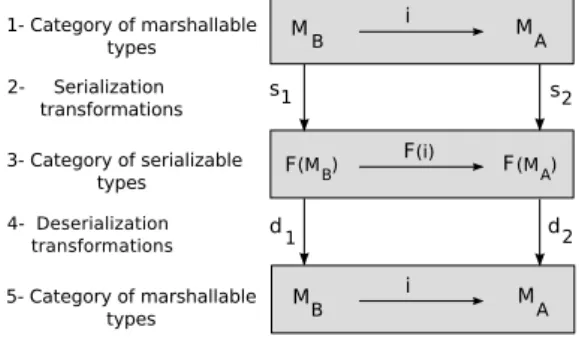
Figure 4: Fundamental Diagram for Serialization and Dese-rialization
functions as arrows,
3. Binding functor: a mapping from marshallable types to serializable types, extended to arrows, 4. Transformations: converting a message from a
marshallable type to a serializable type is achieved by a serialization transformation. Inversely, con-verting a message from a serializable type to a marshallable type is achieved by a deserialization transformation.
In such a formalization, we consider that it is uless to specify a category for serial types because se-rializable messages essentially are trees, which are fully serializable: by using a depth-first traversal and a parenthesis notation, we can convert a tree into a se-rial data and by using the inverse function, come back to the original tree.
In Figure 4, we illustrate our formalization by con-sidering that an instance of type B must be sent to a destination waiting an instance of supertype A. Two marshallable types, MA and MB, are associated re-spectively to A and B according to the definition given in Figure 1. These two marshallable types are re-lated by an embedding i which allows to convert an instance of type MBinto an instance of type MA, due to the subtyping relation between A and B. The bind-ing functor F allows two serializable types, F(MB) and F(MA), to be associated to MB and MA respec-tively. These two serializable types are related by the
corresponding embedding F(i) that allows to convert any instance in F(MB) into F(MA). In order to con-vert messages between categories, two serialization transformations, s1 and s2, transform the instances of MB and MA to their respective serializable forms in F(MB) and F(MA). Likewise, two deserialization transformations, d1 and d2, transform the instances of F(MB) and F(MA) to their respective marshallable forms in MBand MA.
In a diagram like this, what properties can we as-sume? First, it is natural to specify that the composi-tion of the serializacomposi-tion transformacomposi-tion with the dese-rialization transformation produces the identity trans-formation, modulo a natural equivalence over mar-shallable types asserting that two objects are equiv-alent if their serialization is equal. Second, the dia-gram in Figure 4 may be commutative: all paths with the same source and target define by composition the same function, modulo the natural equivalence over marshallable types.
Actually, these two assumptions are fundamental to solve the subtyping issues previously described as we will discuss in the next section.
5
Discussion and future work
In both examples described in Figures 2 and 3, the whole process is described by finding a path join-ing MB to MA by crossing the category of serializ-able types. Actually, the path that causes problems is: MB→ F(MB) → F(MA) → MA. The trouble comes from an erroneous conversion function from F(MB) to F(MA), namely F(i) : F(MB) → F(MA). It is con-sidered as equal to the identity function, which is a violation of the commutativity property. With this value, the composition of the different functions over the path is not well-defined in some cases, which gen-erates the errors observed. But with the commutativ-ity assumption, the problem can be tackled. Indeed, the conversion function can be easily computed:
F(i) = d1; i; s2.
It is obtained by composing the deserialization trans-formation with the embedding function and finally the serialization transformation.
Practically, F(i) corresponds to a projection and possibly a renaming for the serializable structures. For instance, assume that type A has one serializ-able attribute x, while its subtype B has another se-rializable attribute y. An instance of F(MB) could be represented by the structure B(x(valx), y(valy)) (using a parenthesis notation) while an instance of F(MA) could be represented by the structure A(x(valx)).
Then the conversion function F(i) renames the mes-sage root element from B to A and projects the couple of values (x, y) into x. Finally, the conversion function F(i) can be integrated in the framework for serializa-tion and deserializaserializa-tion at recepserializa-tion on both client and server sides, in a fully transparent way, which satisfies the loose coupling principle: this solution does not re-quire any extra adaptation on the client side when a switch is done between compatible services.
Finally, it turns out that the diagram, when as-sumed commutative, could become a well-founded specification for serialization and deserialization. Its implementation could lead to the definition of a new data binding between marshallable types and serializ-able types, preserving the subsumption property asso-ciated to subtyping, and therefore improving interop-erability.
REFERENCES
Carpineti, S. and Laneve, C. (2006). A basic contract lan-guage for web services. In Programming Lanlan-guages and Systems, 15th European Symposium on Program-ming (ESOP), volume 3924 of LNCS, pages 197–213. Springer.
Kourtesis, D. and Paraskakis, I. (2009). Semantic Enter-prise Application Integration for Business Processes: Service-Oriented Frameworks, chapter IV. Business Science Reference, Hersley.
L¨ammel, R. and Meijer, E. (2007). Revealing the x/o impedance mismatch: changing lead into gold. In Proceedings of the 2006 international conference on Datatype-generic programming, SSDGP’06, pages 285–367, Berlin, Heidelberg. Springer-Verlag. Lee, T. Y. L. and Cheung, D. W. (2010). Formal models
and algorithms for XML data interoperability. JCSE, 4(4):313–349.
Pierce, B. C. (1991). Basic Category Theory for Com-puter Scientists (Foundations of Computing). The MIT Press, 1 edition.
Seco, J. C. and Caires, L. (2000). A basic model of typed components. In ECOOP, pages 108–128.
Srirama, S. N., Jarke, M., and Prinz, W. (2006). Mobile web service provisioning. Advanced International Confer-ence on Telecommunications / Internet and Web Ap-plications and Services, International Conference on, 0:120.
Zaplata, S., Dreiling, V., and Lamersdorf, W. (2009). Re-alizing mobile web services for dynamic applications. In Godart, C., Gronau, N., Sharma, S., and Canals, G., editors, Proceedings of the 9th IFIP Conference on e-Business, e-Services, and e-Society (I3E 2009), pages 240–254. Springer.