DOCTORAT DE L'UNIVERSITÉ DE TOULOUSE
Délivré par :Institut National Polytechnique de Toulouse (Toulouse INP)
Discipline ou spécialité :
Genie industriel
Présentée et soutenue par :
M. RONALD LEANDRO ELIZONDOle mercredi 28 novembre 2018
Titre :
Unité de recherche : Ecole doctorale :
Méthodologie pour l'évaluation de la performance de l'amélioration
continue des processus industriels
Aéronautique-Astronautique (AA)
Laboratoire de Génie de Productions de l'ENIT (E.N.I.T-L.G.P.)
Directeur(s) de Thèse :
M. BERNARD GRABOT
Rapporteurs :
Mme VALÉRIE BOTTA-GENOULAZ, INSA LYON
M. SAMIR LAMOURI, ENSAM - ARTS ET METIERS PARISTECH
Membre(s) du jury :
M. BRUNO VALLESPIR, UNIVERSITE BORDEAUX 1, Président
M. BERNARD GRABOT, ECOLE NATIONALE D'INGENIEUR DE TARBES, Membre Mme CAROLINE THIERRY, UNIVERSITE TOULOUSE 2, Membre
M. RAYMOND HOUE NGOUNA, ECOLE NATIONALE D'INGENIEUR DE TARBES, Membre
Acknowledgement
At first I thank God, Almighty, for being my guide and strength in times of trial for my own growth. A family is first in giving us teachings. Thus, it is our first school, where the principles and values that shape us during our lives are inculcated. God has blessed me greatly by allowing me to have a wonderful family that has always supported me, and has given me all its love and encouragement to carry out this adventure. Thank you for everything.
This research work has been carried out within the partnership between the Laboratoire Génie de Production (LGP) of the Ecole Nationale d’Ingénieurs de Tarbes (ENIT) and the Tecnológico de Costa Rica (TEC), thanks to an assignment from the Ecole Doctorale Aéronautique-Astronautique. Working here has caused me to push myself positively, and I am all the better for it, and I hope that my research can contribute to the success of the laboratory in the long run as well. I would like to express my gratitude to all the people who supported me and who contributed to the completion of this dissertation.
Foremost, I would like to express my gratitude to my Ph.D. director, Bernard GRABOT, for giving me the opportunity to unfold my potential and he has opened up plenty of new avenues of thought for me. Also, to my co-director, Raymond HOUE-NGOUNA, for committing to me on such a fascinating subject as this. I would like to sincerely acknowledge the efforts and gratitude for all the valuable time devoted to this research. Without the guidance and competence in the different topics covered, as well as the availability, I would never have been able to do such a task. I appreciate the human and academic skills that have allowed me to develop my job.
Likewise, my gratitude to Mr. Bruno VALLESPIR for chairing the jury of my thesis. At the same time, I must thank Mrs. Caroline THIERRY for his courtesy in being the judge of my manuscript. Furthermore, I would like to recognize Mr. Samir LAMOURI and Mrs. Valérie BOTTA-GENOULAZ for giving me the honor of being reviewers of this work. They have also contributed with their many remarks and recommendations to improve the quality of this research, for which I am very grateful.
Furthermore, I would like to thank all the SDC team, not only for their availability and the help they gave me throughout the development of this research, but for the friendship they always offered me.
I want to express my gratitude and friendship to all the people, both administrative at ENIT as well as the PhD students who have accompanied me along this journey for making me feel part of a family and for all the moments we have shared and beyond.
Contents
Table of contents VI
Table of figures IX
List of tables XI
1. General Context . . . 1
2. Findings and Problem Statement . . . 2
3. Methodology and document structure . . . 3
1. State of the Art 5 1. Introduction . . . 5
2. What is Lean? . . . 6
3. Literature Review of the Lean Malfunctions . . . 10
3.1. Identification of Sources of Lean hurdles and failures . . . 10
3.2. Threefold Scenarios Critical to Lean Deployment . . . 13
3.2.1. Top Management Commitment Factor . . . 13
3.2.2. Socio-Technical Factor . . . 16
3.2.3. Difficulties with the assessment criteria on Lean impact . 20 4. Lessons learned from personal know-how with JMP . . . 23
4.1. Case A: Technology Transfer of Continuous Improvement for Productivity Culture Development . . . 23
4.1.2. Kaizen and 5S Activity . . . 24
4.1.3. Inventory Control Management . . . 25
4.1.4. Supervisor’s Training Course . . . 25
4.1.5. Quality Management . . . 27
4.2. Case B: Basic Continuous Improvement Strategies for production performance improvement . . . 27
4.2.1. 5S Program Implementation . . . 28
4.2.2. Kaizen Projects . . . 28
4.2.3. 5S Program supporting other projects . . . 29
4.3. Case C: Basic Continuous Improvement for Factory competitiveness improvement . . . 29
4.3.1. 5S Program application . . . 30
4.3.2. Kaizen Projects with positive impacts on the production plant . . . 31
4.3.3. Productivity Management bearing different domains . . . 32
4.3.4. Obstacles for continuous improvement initiatives . . . 33
5. Conclusion . . . 33
2. Evolution process and evaluation of the Lean deployment framework. 35 1. Introduction . . . 36
2. Summary of the inconsistencies . . . 36
3. Challenges of Knowledge Transfer . . . 37
4. Is Lean a set of tools alone or a strategy for competitive advantage? . . . 41
4.1. Beyond the persistent pattern of operational efficiency given to Lean . . . 42
4.2. Lean’s Value Chain – Towards a Competitive Advantage . . . 46
5. Productivity... does it support Lean initiative? Is it underestimated? . . . . 50
6. Why does Kaizen drift into strengthening the Productivity approach? . . . 58
6.1. KAIZEN or Kaizen: Is there any difference? . . . 59
6.2. 5S Program or "Housekeeping": What makes the difference? . . . 63
7. Measuring Lean: Contribution to Business Intelligence . . . 67
7.1. Rediscovering the impact of productivity into business plan . . . . 69
7.2. Bundles of Measuring Lean . . . 73
3. A methodology for applying Lean 81
1. Introduction . . . 82
2. Confronting the challenges involved in Lean . . . 82
2.1. Systems theory in management . . . 83
2.2. Systems theory in management . . . 85
2.3. Seeing Lean as a system of systems . . . 88
3. A Lean strategy: building a complex managerial system upon Productivity 90 3.1. Seeing Lean as a system of systems . . . 91
3.2. Level 2 ––Middle Loop Diagram . . . 93
3.3. Level 3 ––Operational Loop Diagram . . . 94
4. An Integrated Approach to Productivity Measurement . . . 96
4.1. Linkage between productivity and profitability . . . 98
4.2. Value Added Productivity Measurement (VAPM) . . . 100
4.3. Balance Scorecards (BSC) Structure to support the model . . . 104
5. Proposed Methodology for Performance Assessment of the Initial Stage of Lean . . . 107
5.1. Phase II –BSC structure to diagnose Lean deployment strategy . . 109
5.2. The other Phases – Continuously manage the Productivity improvement plan . . . 112
4. Validation of the Methodology for supporting decisions in Lean
implementation 117
1. Introduction . . . 117
2. Validation Cases for Lean implementation phase . . . 118
2.1. Validation cases for starting the behaviour change . . . 119
2.1.1. Step Deployment –Phase I 5S Program at Cement Plant . 120
2.1.2. Step Deployment – Phase I 5S Program Synergy to Safety 122
2.1.3. Step Deployment – Phase I 5S Program Synergy to Maintenance . . . 124
2.1.4. Step Deployment – Phase I Kaizen by analysis - Ball Mill Performance . . . 125
2.1.5. Step Deployment – Phase I Kaizen by analysis - Dispatch Process . . . 127
2.1.6. Step Deployment – Phase I Kaizen by analysis - Electric Consumption . . . 130
2.2. Validation Case for Lean assessment . . . 132
2.2.1. Step Sustainability – Phase II VAPM Diagnosis at the SME 132
2.2.2. Step Sustainability – Phase III Improvement Actions . . . 138
3. Conclusions . . . 139
General Conclusion 141
List of Figures
1.1. Relationship among research areas . . . 12
1.2. Causal relationship among barriers . . . 14
1.3. Survey overview showing linkage of HRM and OM practices . . . 17
1.4. Model of LP, non-financial manufacturing performance measures and profitability . . . 22
1.5. Example of 5S program . . . 31
1.6. Seiso Inspection - Packing process . . . 32
1.7. General Context and Findings Scheme . . . 34
2.1. General Scheme of the Thesis. . . 37
2.2. The High Voltage Analogy . . . 39
2.3. Types of Transfer Channels . . . 40
2.4. Knowledge Transfer Bias . . . 42
2.5. Cost reduction framework . . . 43
2.6. Types of Muda . . . 44
2.7. Cost Reduction Strategy, Hirano . . . 47
2.8. JIT strategy sequence, Hirano . . . 48
2.9. Hypothesis 2 Lean as a socio-technical strategy . . . 50
2.10. Productivity pillars . . . 51
2.11. Toyota’s history about Productivity . . . 52
2.13. Hypothesis 3: Holistic Productivity . . . 54
2.14. Deming’s Chain Reaction . . . 56
2.15. Deming Managerial Model . . . 57
2.16. Toyota’s 4P model . . . 58
2.17. Characterizes of Kaizen . . . 60
2.18. KAIZEN basic strategy . . . 61
2.19. Kaizen by analysis . . . 62
2.20. Kaizen by introduction new technology . . . 63
2.21. 5S critical issue oriented approach . . . 64
2.22. Overview towards Competitiveness . . . 64
2.23. Outline Waste and Cost Reduction . . . 65
2.24. Shimada’s Scheme - Humanware approach . . . 67
2.25. Hypothesis 4: KAIZEN basic strategy . . . 68
2.26. Factors affecting Labour Productivity . . . 71
2.27. Productivity Management and Measurement Systems . . . 72
2.28. Survey on Lean implementation at SMEs . . . 76
2.29. Hypothesis 5: Socio-technical assessment . . . 77
2.30. Distribution of the wealth within a firm . . . 77
2.31. Value Added Calculation Methods . . . 78
3.1. Biological system example . . . 83
3.2. Negative feedback system example . . . 85
3.3. Deming’s Systems Theory . . . 86
3.4. Hypothesis6: Lean is a system of systems . . . 90
3.5. Loop Diagram Macro level analysis of Lean . . . 91
3.6. Loop Diagram Middle level analysis of Lean . . . 93
3.8. Relationship among the Loop Levels . . . 97
3.9. Levels and functional areas . . . 98
3.10. Profitability - Productivity Scenarios . . . 98
3.11. Overview of productivity levers . . . 100
3.12. Relationship Production and Profitability . . . 101
3.13. Value Added Definition Scheme . . . 101
3.14. Comparison VA and Financial statements . . . 102
3.15. VAPM parameters . . . 104
3.16. Key elements in the Lean . . . 104
3.17. Lean Strategy based on Systemic Productivity . . . 105
3.18. Proposal scheme . . . 108
3.19. Productivity Levers and metrics . . . 109
3.20. Productivity Measurement Plan . . . 110
3.21. Objectives for the Lean strategy . . . 111
3.22. Lean Roadmap . . . 112
3.23. Lean Productivity relationship . . . 114
4.1. World Class Maintenance scheme . . . 119
4.2. Big Seiso Day . . . 120
4.3. 5S Audits Example . . . 121
4.4. Example of Safety improvement actions . . . 123
4.5. 5S program supporting Maintenance . . . 124
4.6. Cement Ball Mill situation . . . 125
4.7. Results at ball mill 3 . . . 127
4.8. Packaging actual situation . . . 128
4.9. Problem Analysis at Cepal . . . 129
4.10. Results at CEPAL . . . 130
4.11. Clinker Flow Diagrams . . . 131
4.12. Cold Air Diagram - Clinker . . . 132
4.13. Section I VA ratios . . . 134
4.14. Section II VA ratios . . . 135
4.15. Productivity and Profits relationship . . . 136
4.16. Productivity - Profitability graph . . . 138
List of Tables
1.1. Definitions of Lean concepts . . . 8
1.2. List of Technical and Human dimensions (Cravvford et al. 1988) . . . 11
1.3. Summary of the most important findings by Taylor et al. (2013) . . . 19
1.4. Calculation of net profit . . . 21
1.5. Examples of value stream reporting . . . 23
1.6. Experience as a CEFOF’s counterpart and obstacles observed . . . 26
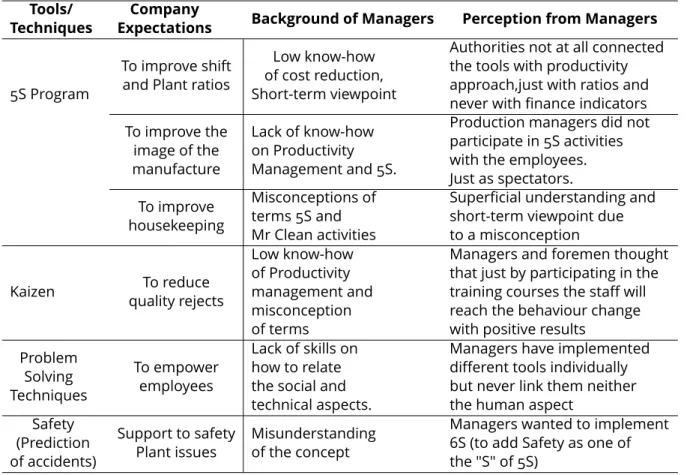
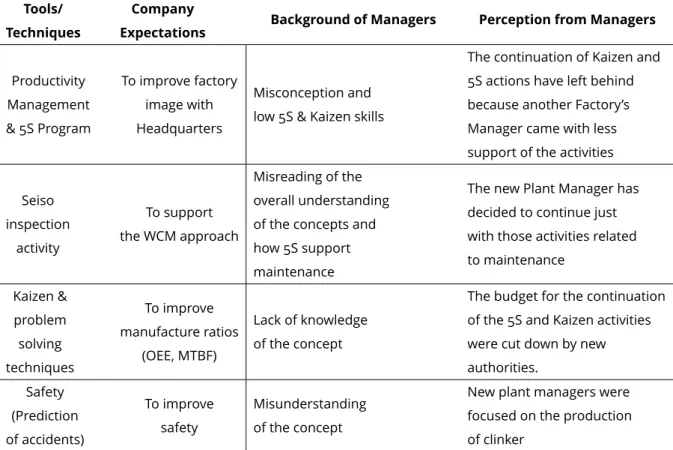
1.7. Implemented tools and obstacles observed at the manufacturing plant . 29 1.8. Continuous Improvement practices and obstacles at the Cement Plant . . 30
2.1. Discrepancies of concepts . . . 38
2.2. Author’s Assertion Comparison . . . 60
2.3. 5S Meanings and Purposes . . . 66
2.4. Translating CEO mandates . . . 70
2.5. Lean at present time . . . 75
3.1. VAPM parameters . . . 103
4.1. Validation through Case studies . . . 118
4.2. Safety Findings at the cement plant . . . 122
4.3. Ball Mill 3 current data . . . 126
4.4. CEPAL actual situation . . . 129
4.5. VA Indexes - textile company . . . 133
List of Acronym
BSC: Balance Scorecard
CEFOF: Technical Instructor and Personnel Training Centre for Industrial Development of Central America in the Republic of Costa Rica
HRM: Human Resource Management
JICA: Japan International Cooperation Agency
JIT: Just in Time
JMP: Japan Management Practices
JPC: Japan Productivity Centre for Socio-Economic Development
LP: Lean Practices
MTBF: Mean Time Between Failures
OEE: Overall Equipment Efficiency
Off-JT: Off the Job training
OJT: On the Job Training
OM: Operations Management
TQM: Total Quality Management
TPM: Total Productive Maintenance
TPS: Toyota Production System
SME: Small and Medium Enterprises
VA: Value Added
VAPM: Value Added Productivity Measurement
Introduction
After more than 15 years in consultancy activities and working within companies, mainly on lean deployment, I have seen how powerful the lean tools and techniques are, but also how fragile the results can be. The purpose of this thesis is to come back to the basics for looking what has been lost during the successive transfers of lean principles from Japan to US, then from US to Europe and to suggest a more comprehensive methodology allowing to improve lean implementation, based on my practical experiments and on theoretical developments.
1. General Context
In a prevailing globalization climate where change is the constant, businesses must seek new ways to capture more customers; this can be achieved via differentiated products and services, but also via the efficiency of the production system allowing to decrease the prices. Undoubtedly, companies must be competitive if they want to be profitable and survive. In that purpose, they need to dramatically increase their performance, which can be done by adopting long-term management "best practices". This is not an easy task for organizations, supply chains and especially for Small and Medium Enterprises. As a consequence, the pursuit for competitiveness has prompted an eye to Lean Practices (LP), which has proven to be an effective approach to improve the businesses (Browning and Heath, 2009,Crute et al., 2003).
Through the adoption of Lean Practices, firms look towards the elimination of waste and activities without value added to the customer. Also, they foster an organization more flexible for swift modifications. However, an organization must encompass changing paradigms, starting with a solid commitment from the leadership, to reap the advantages of Lean. Therefore, a manager’s success implementing LP depends on the organisation’s capability to adjust to change.
This requires a whole management philosophy behind it (Dombrowski and Mielke, 2014,Martinez-Jurado et al., 2014), in order to allow a long-term transformation process within the business.
2. Findings and Problem Statement
The effective application of Lean entails a shift in corporate culture, from upper echelons towards lower levels throughout the organization. Many experts and scholars agree on the LP benefits, as well as in its complex implementation and in the inability of some companies to maintain the results over time. The literature proposes different overlapping features and explanations about the void mentioned before, but two main causes can be identified.
Firstly, an unbalanced relationship between people (social side) and tools and techniques (technical side). Both of them have been widely studied, but independently, by Lean specialists. Nevertheless, still, the confusion remains on how to connect employee’s contributions to Lean and to recognize them as a key enhancer over Lean implementation process (de Menezes et al., 2010). There are not enough research studies that examine human resource management associated with the LP implementation phase (Martinez-Jurado and Moyano-Fuentes, 2014,Martinez-Jurado et al., 2014). In addition, there is no deep knowledge on employee involvement regarding Lean implementation (Schonberger, 2007).
Secondly, there is low leadership encouragement from senior management (Losonci et al., 2011, Taylor et al., 2013, Dombrowski and Mielke, 2014) as a result of a misconception of the purpose of Lean along with its responsibility and simplicity in addressing it. Managers also expect positive results in the short term. Given this, leaders must commit themselves to the organization’s intention of new and improved behaviour, setting the example and living the change (Dombrowski and Mielke, 2014). On the other hand, Lean is an evolved version of the Toyota Production System (TPS), which implies that Lean and TPS should be based upon the same foundation. Nevertheless, Lean implementation has often somehow omitted a critical component of the Japanese management perspective: the holistic Productivity approach, which is the pillar on which Japan had begun the attitudinal change and had also addressed the pitfalls associated with leadership. This approach balances purpose, people and process performance for continuous improvement.
Another point to be considered is that, traditionally, LP has been applied as a "deterministic system" with linear links between causes and effects, the whole system being broken down into individual elements. Then, those parts can be isolated and analysed to easily identify simple linear interactions to solve them. At that point, it is needed to put all the elements back together again to achieve the output planned.
Nonetheless, Lean is much more complex than that; it is a non-linear and dynamic system, whose elements constantly interact with each other. Therefore, the problem of LP implementation should be solved by considering it as a system of systems, in such a way to narrow the alignment gap between the firm’s purposes and the company’s improvement efforts. Clearly, both are correlated and are critical factors to support the new management mentality; simultaneously, they will influence the company’s performance over time.
• WHAT BASIC MIND SET TO STRENGTHEN THE EXISTING CULTURE COULD DRIVE THELEAN COMPLEX AND DYNAMIC TRANSFORMATION?
• HOW TO MEASURE THE BEHAVIOUR CHANGE AND COMMITMENT PROPOSED BY LEAN THINKING WHILE IMPROVING PERFORMANCE?
3. Methodology and document structure
The aim of the thesis is to contribute to the knowledge on proposing a model for deploying Lean, especially for Small and Medium Enterprises (SMEs), by proposing a methodology of implementation based on a strong foundation. More specifically, the thesis will discuss and propose how to integrate the Productivity approach with Lean to form such foundation. The document is therefore constructed upon the following structure:
Chapter 1. Conceptual Panorama: the context of Lean is analysed in the business context and its main characteristics are presented. These specificities are structured according to some drivers in the organization that can prevent the maintenance of results over time.
This chapter concludes with a description of the threats (limitations and barriers) that companies experience with a new management system. Another part of the state of the art considers the importance of the productivity management approach to support the sustainable performance of LP and its expected gains.
Chapter 2. Hypotheses: I suggest interpreting these difficulties in reference to some concepts lost during the stage of transfer of the lean principles from Japan to US, then to Europe. From this evaluation, one can recognize the complexity of Lean implementation and the main pitfalls mentioned above. Another part of the research considers the discussion of the criteria established around the restrictions of implementation and measurement of LP performance along the supply chain.
The second chapter concludes with a critical analysis of the approaches suggested in the scientific literature to identify why these gaps and constraints affect the use of Lean as a transformation methodology in an industrial context. The product of this is due to a simplistic way of addressing the challenges encountered.
Chapter 3. Methodology: I suggest basing lean implementation on a more solid theoretical basis grounded in the original approach of holistic productivity and its relationship to continuous improvement. More specifically, a methodology is proposed for evaluating the performance of continuous improvement processes among supply chain partners. Drawing on a complex systems approach, it can help companies discover patterns of how elementary concepts fit together, and then distinguish how the system behaves. In addition, these configurations could
help to create a decision-making structure that addresses change and adapts it within a learning organization.
This chapter concludes with a series of metrics to evaluate Lean, always under a dimension of complex thinking. It takes into account the strategic, tactical and operational levels to guide the correct decision-making process.
Chapter 4. Validation: Some of my past experiences are interpreted according to the suggested framework for first validation. A set of case studies is analysed to verify the validity and level of credibility of each phase of the proposed methodology. The first case is a global corporation in the cement sector, which qualitatively validates the first phase of the main foundations and tools of productivity and kaizen. The second is an SME in the Costa Rican textile industry that illustrates the use of value-added KPIs to monitor and diagnose gaps in the value chain.
Conclusion and Perspectives:
The conclusion presents the contributions and limitations of the project by opening research opportunities in the field of continuous improvement in business. Our scientific contribution includes:
- A conceptual framework for analysis to conduct a literature review.
- A conceptual framework for analysing the literature on lean improvement initiatives.
- A strategic framework for adopting and aligning performance that guides manufacturers through the early stages of a transformation process for their development processes based on a Lean incremental improvement approach.
Chapter 1
State of the Art on Lean
Production
Contents
1. Introduction . . . . 5
2. What is Lean? . . . . 6
3. Literature Review of the Lean Malfunctions . . . . 10
3.1. Identification of Sources of Lean hurdles and failures . . . 10
3.2. Threefold Scenarios Critical to Lean Deployment . . . 13
4. Lessons learned from personal know-how with JMP . . . . . 23
4.1. Case A: Technology Transfer of Continuous Improvement for Productivity Culture Development . . . 23
4.2. Case B: Basic Continuous Improvement Strategies for production performance improvement . . . 27
4.3. Case C: Basic Continuous Improvement for Factory competitiveness improvement . . . 29
5. Conclusion . . . . 33
1. Introduction
In the current global economic circumstances, a trend is discernible in businesses towards profitability and client-orientation (Hines et al., 2004,Mourtzis et al., 2016). Against this backdrop, any adoption within corporate governance has a critical impingement (Stainer, 1997,Sunaga, 2006). Numerous companies worldwide now have decided to launch Lean as a way to boost their performance and competitiveness (Bicheno and Holweg, 2016). Since the 90s, many specialists in the area have been influenced by its principles and are witnessing its benefits (Atkinson, 2010). Yet, these efforts that can be considered as "short-term victories", eventually come down since
they require hard work and support from the whole organisation (Almeida Marodin and Saurin, 2013,Fullerton et al., 2014). In addition, enterprises are facing many obstacles, which does not let them to sustain results in long-term (Almeida Marodin and Saurin, 2015).
Some people think that Lean Practices (LP) are a set of tools that adds value to the customer by eliminating waste (Atkinson, 2010, Rüttimann and Stöckli, 2016). Undeniably, this is an important aspect of it but very far from its real aim (Fullerton and Wempe, 2009,Bhasin, 2012). Additionally, in the literature, many proficient in the topic underestimate this management approach; its implementation is not an easy path to follow (Birdi et al., 2008). As Ohno (2012) has stated, each firm has to adapt it to its culture and requirements. Nevertheless, the general assumption is that Lean is a long-term strategy for improving performance within the whole organisation (Emiliani and Stec, 2005,Shah et al., 2008). Even more influential, it has complex managerial implications, so firms need to understand that there is a dramatic change involved; it is a new way to do things (Achanga et al., 2006,Seddon and Caulkin, 2007).
This chapter aims to provide a coherent framework of the current state of the art to study how LP has evolved in the face of challenges and complexity during its introduction. This review will be based on three major technical considerations combined with the LP findings. In the first place, technical transfer from Japanese experts given to the author; secondly, working experience acquired by the researcher and thirdly, documented knowledge from the literature review conducted in this field by many authors previously. These different points of view will allow identifying the constraints facing the Lean deployment endeavours.
2. What is Lean?
Today, this methodology has apparently become a well-known concept as it enhances management capability, delivers workflow reliability and generates profitability and competitiveness (Emiliani, 2000,Bicheno and Holweg, 2016). Many LP specialists have cited specific benefits, such as inventory turnover, reduced lead times for customers and more flexible production (Melton, 2005,Bhasin and Burcher, 2006). This is why it has influenced many organizations around the world (Åhlström, 1998,Dombrowski and Mielke, 2014). Inclusively, it has turned out to be a desired managerial style prompted by an abrupt expansion onto sectors including textiles, aeronautics, services, medicine, etc. along with its value chain (Crute et al., 2003,Browning and Heath, 2009,Martinez-Jurado and Moyano-Fuentes, 2014). Authors such as Gilbert (1990) for example, have considered that its application brings considerable cost reductions and cite success stories such as IBM, General Electric, Harley-Davidson, Westinghouse, Texas Instruments, Motorola, Hewlett-Packard and Intel.
The Lean term has begun when Womack, Jones and Roos wrote the book "The Machine that Changed the World" (1990). Its geneses can be traced back to the Toyota Production System (TPS) through a five-year investigation led by the writers. The origin is a request done by the automotive sector to the Massachusetts Institute of Technology seeking
to narrow the disparities among the Japanese and Western car industries (Womack et al., 1990). Daniel Jones (2013), chairman of Lean Enterprise Academy UK, has declared that "Lean did not derive from theory but through observing practices at Toyota that were delivering superior performance in terms of goods, quality, efficiency (hours per car) and time to market for new products, leading Toyota to eventually become the largest car maker in the world"1.
In accordance with the bibliographical references examined, further technical and technological components exist that merge together to support the initiative. The first one is that there is a consensus on two major pillars of lean: adding value and eliminating waste (Liker, 1997,Melton, 2005). Value added being a measure of the wealth created by an enterprise, waste has been considered as an activity providing no value to the product or service, that the customer is unwilling to pay (Asian Productivity Organisation, 2015). Another important point is that Lean comprises five Principles (Womack et al., 1990,Emiliani, 2000):
• To create value from the perspective of the customer,
• To recognize all the stages of value addition through the value stream,
• To establish activities that make value flow,
• To pull - responding to customer requirements,
• To seek perfection by creating value through elimination of waste.
The latter will be the incorporation of a series of adjacent toolkits commonly adopted by companies. Some definitions made by APICS 2 are outlined in table 1.1, including 5S, Kaizen, Kanban, Value Stream Mapping, etc. (Castle and Jacobs, 2011). So far, there is no clear definition of Lean, despite its popularity. Designations are ambiguous or confused; it can often be found close terms like "Lean Production", "Lean Management", "Lean Manufacturing", etc. (Mi Dahlgaard-Park and Pettersen, 2009,Taylor et al., 2013). A number of authors have intended to define it (Lewis, 2000,Shah and Ward, 2007,
Bortolotti et al., 2015); anyway the concept is constantly evolving (Hines et al., 2004,Shah and Ward, 2007). APICS, v3.11, has defined it as an "approach to management that focuses on reducing or eliminating waste in all facets of the system" (Castle and Jacobs, 2011).
Owing to the absence of a standard definition, several inconsistencies have been found in numerous publications where misleading definitions have been introduced (Emiliani, 2000, Bhasin, 2012). A typical sample is that practitioners have often confused managerial systems (e.g. Total Quality Management (TQM), Total Productive Maintenance (TPM) or Just in Time ( JIT)) and tools like 5S, Kanban or value stream mapping (Hines et al., 2004,Lodgaard et al., 2016). In turn, this leads to uneven attention spurred by managers on LP tools (Emiliani, 2000,Taylor et al., 2013). From the author’s angle, this is just a small portion of what is really achievable by the methodology and could jeopardize further development.
1Source: www.leanuk.org
Scope Tools/ Technology Definition by APICS
Tools
5S Program
3.11.5 Sort, set in order, shine, standardise and sustain are five terms beginning with the letter S used in creating a workplace suitable for lean production.
Kaizen
3.11.7 It is the Japanese term for improvement. Kaizen is continuing improvement involving everyone both managers and workers. In manufacturing, kaizen is finding and eliminating waste in machinery, labour, and production methods.
Kanban
6.5.4 It is a method of Just-in-Time production that uses standard containers or lot sizes with a single card attached to each. It is a pull system in which work centres signal with a card that they wish to withdraw parts from feeding operations or suppliers, indicating the need to replenish or produce more. A second card may be used to signal the movement of material.
Value Stream Mapping
3.11.2 It consists of all the activities or processes necessary to deliver a product or service to the customer. Value stream mapping is a technique using Flow charts to identify the key elements and activities in the process and flow of information. In value stream mapping, each activity is identified as either a value- or non-value-adding activity. Lean management seeks to minimize and eliminate nonvalue- adding activities from all processes.
Business Management
Strategies Just in Time
It is the most important components of the Toyota Production System, it is a production system that promotes productivity. The main aim is "to produce what is necessary for the proper amount and when needed" (Schonberger, 2007,Asian Productivity Organisation, 2015)
Total Quality Management
4.4.3 It is an approach to improving quality and ultimately customer satisfaction. The term was first used to describe Japanese-style management approaches to quality management. It relies on the participation of all members of the organization. The methods of implementing this approach are found in the works of Armand Feigenbaum, Philip Crosby, W. Edwards Deming, Joseph M. Juran, Kaoru Ishikawa and others. The overall goals of TQM are lower costs, higher revenues, satisfied customers, and empowered employees.
Total Productive Maintenance
It is a business managerial methodology to maintenance the equipment. It is encompassed activities to prevent quality defects in the goods and equipment breakdowns (Bhasin and Burcher, 2006,Asian Productivity Organisation, 2015).
Other Schemes as
complement of Lean Six Sigma
4.4.4 It is a methodology that emphasizes reducing process variability and product deficiencies to improve product quality and customer satisfaction. In the theory, at a six-sigma level of performance, only 3.4 defects occur for every one million opportunities, assuming the process is operating within 1.5 standard deviations of the centre of the process specification.
Supply Chain Management
3.0 Current ideology behind the supply chain is to apply a total systems approach to designing and managing the entire flow of information, materials and services from raw materials suppliers, through factories and warehouses and finally to the customer. The term "supply chain" comes from the visual representation of how organisations are linked together as viewed from a particular company. The chain has many service support operations that transform the inputs into products and services and the distribution and service providers that localize the product.
Table 1.1. Definitions of Lean concepts
With these differences in interpretation, it becomes evident that a closer look into the sources behind Lean is necessary. It is indeed grounded within notorious Japanese Management Practices ( JMP) ( JIT, TQM and TPM) (Holweg, 2007,Furlan et al., 2011,Taylor et al., 2013). These practices were all developed as corporate and entrepreneurial philosophical strategies in contrast against the traditional mass production framework, where the aim was to "push" the production (Atkinson, 2010,Furlan et al., 2011).
prosperity as a country and secondly to enable industrial competitiveness (Fukuda and Sase, 1994,Asian Productivity Organisation, 2015). In other words, upon the Japan Productivity Centre for Socio-Economic Development’s ( JPC) establishment, in 1955, this has led to a holistic perspective about Productivity (Shimada and MacDuffie, 1986,Fukuda and Sase, 1994,Leandro, 2007).
This philosophy served as a polyvalent and key axis for the resurgence of Nippon Industry (Stainer, 1995,Ohno et al., 2009). For the author, the TPS has emerged from this governmental post-war policy, which was a condition for strengthening competitiveness, in conjunction with Toyota Motor Company’s innovative capacity (Hampson, 1999,JICA, 2011). This scenario was neglected when US professionals pioneered the Lean model and then launched it to the rest of the World with this lack (Lillrank, 1995,Štrach and Everett, 2006); the thesis will discuss this later. Another underlying and decisive factor in the Toyota System is the importance of people, who constitute the source of production development (Emiliani, 2000,Schonberger, 2007). Therefore, what is discernible is that the course of action for all these approaches has been to do things differently, transforming the mentality within the organization in accordance to principles familiar to everybody (Bhasin and Burcher, 2006,Womack and Jones, 2010).
There have been many success confirmations over a JMP deployment in different companies and sectors worldwide (Stainer, 1995,Yacuzzi, 2007,Atkinson, 2010). It proves that these methodologies do not have a "cultural bond" exclusively to Japan (Liker, 1997, Holweg, 2007,Schonberger, 2007). Lately, some western academics have demonstrated that the combination of those initiatives will bring competitive advantage and enhance performance to the companies (Birdi et al., 2008,de Menezes et al., 2010,Bortolotti et al., 2015).
Undeniably, there is a close link and some similarities between Lean and JMP (Liker, 1997,Hines et al., 2004,Holweg, 2007); the root is the same. Thus, in light of this premise, such an approach would have to be conceived as a whole and not as a set of procedures and instruments (Lewis, 2000,Bicheno and Holweg, 2016). Nevertheless, many authors consider that the human resources component has been ignored (Birdi et al., 2008,Martinez-Jurado et al., 2014,Bortolotti et al., 2015).
Conversely, other researchers, including Holweg (2007) have seen Lean as a strategic management model underscoring the creation of "value" for customers by delivering high quality products and services over time with a low cost (through waste disposal), a "pulling" methodology. This thesis will further delve on such concepts.
So far, it has been acknowledged how popular LP is as well as the competitive advantage offered to companies (Bicheno and Holweg, 2016). Nonetheless, it also has its doubts, including the omission of the human resource aspect due to this "tooling" focus factor (Birdi et al., 2008,Martinez-Jurado et al., 2014,Bortolotti et al., 2015). Yet, enterprises still struggle on how to align Lean’s overall aims of behaviour change and profits with their organisational accomplishments and efforts (Lewis, 2000,de Menezes et al., 2010). The following sections will discuss factual evidences detected by the literature on the barriers that have been generated while introducing Lean.
3. Literature Review of the Lean Malfunctions
As already mentioned, when the market demands greater product differentiation, large companies exert huge pressure on their suppliers for efficiency improvements, particularly when SMEs face technological limitations in terms of flexibility (Grabot and Mayere, 2009,Moeuf et al., 2016). Therefore, flexibility seems to be an essential subject to ensure the firm’s adaptation to more aggressive markets. LP represents a highly competitive background to achieve it; nonetheless, a lot of academicals and empirical experiences confirm its complexity (Bicheno and Holweg, 2016,Rüttimann and Stöckli, 2016). Indeed, there is widespread recognition that JMP has helped boost the yield of operations, e.g. 20% fewer defects per year, over 100% higher asset throughput, 95% machine availability, 80% less floor space, 75% reduced lead times (Pavnaskar et al., 2003).
This may be one reason why this type of strategy provides a feasible alternative for competitiveness enhancement regardless of the type of organisation (Kono and Clegg, 2001,Ohno et al., 2009). Yet, for many managers, even today, Lean has been limited solely to short-term operational efficiency (Shah and Ward, 2003,Hines et al., 2004,
Joosten et al., 2009). Businesses are focused on tools that can provide some level of achievement to reach desirable outcomes and cutting the costs (Marcotte et al., 2008). Moreover, the good efficiency of large companies is conditioned by a good quality of processes, regardless of who the people are, but for SMEs, people are the main support behind greater performance (Grabot and Mayere, 2009). This brings another aspect from a sociotechnical angle; the application of business managerial methods inevitably generates further dynamics (Emiliani and Stec, 2005,de Menezes et al., 2010).
It is well known that those initiatives require hard work and discipline; even though, it is expected that many obstacles will appear (Kotter and Schlesinger, 1989,Khanchanapong et al., 2014). No business endures the long term unless it be able to reinvent itself (Emiliani, 2000,Halling and Wijk, 2013). What has already been said, the ultimate goal of these corporate schemes is to change the behaviour of the whole organisation; subsequently, the leader main task is to guide that transformation, however, it needs time (Kotter, 2007).
3.1. Identification of Sources of Lean hurdles and failures
Taylor et al. (2013) have broken down influential characteristics about LP from the employee’s standpoint, in UK enterprises. They have divided the analysis in five themes (firm success, workshop environment and management; recognition and empowerment) and have identified and summarised the main aspects mentioned by the workers on these topics:
• Company’s accomplishments are linked to attitudes, enthusiasm for change and leadership involvement giving confidence.
• Labour atmosphere looks towards to discipline for standards, flexibility-adaptability and failure not countenanced.
• The supervisor-employee relationship, hard targets and staff participation determine work management.
• Recognition and reward expectations are based on team gratification and non-financial acknowledgement.
• Empowerment refers to the importance of relevant training and regular reviews, continual assess and improvement.
We have previously remarked that, in the light of the fact that the JMP gave rise to Lean, it can be inferred that they have common characteristics (foundation, linkages and obstacles) (Emiliani, 2000,Holweg, 2007). Many performance shortcomings remain unresolved thereafter prompting a variety of authors who have given explanations about Lean’s painful execution (Lewis, 2000,Shah and Ward, 2003,Furlan et al., 2011).
Over the 90s, for example, whilst the spread of JIT has been extensively studied, several implementation constraints were explored. Cravvford et al., (1988) have conducted an evaluation of thirty-nine US companies. They were concerned about the early operational hurdles encountered during the implementation stages. Those drawbacks were ranked onto two dimensions, and the outcomes of the work force and technical difficulties are summarized in Table1.2.
Problem Resistance to Cultural Change Top management support Lack of organisational communication Scope Employee
Poor union support Lack of understanding
Bad communication
with the shop floor
Dearth to change by
supervisors, foremen
&,engineers
Unwillingness
to commitment
Problems with accounting
(both cost and reporting)
Success scepticism
of the programme
Misjudgement of the
magnitude of change
Technical
Deficit of resources Performance measurement Other problems
Lack of training or education Obsolete Performance measures Keeping quality during implementation
Too many changes
at a time
Individual incentives
precluded
Shortage of cross-trained
workers
Table 1.2. List of Technical and Human dimensions (Cravvford et al. 1988)
Nowadays, the LP has the same barriers within the organizations compared to JIT formerly. Numerous publications from different Journals dealt extensively with aspects like:
• Resistance to change (Shah and Ward, 2003,Melton, 2005,Scherrer-Rathje et al., 2009),
• Firms keep relying on consultants (Taylor et al., 2013,Dombrowski and Mielke, 2014,Martinez-Jurado and Moyano-Fuentes, 2014),
• Scarcity strategic vision (Achanga et al., 2006,Dombrowski and Mielke, 2014), • Short-term standpoint (Hines et al., 2004,Lodgaard et al., 2016),
• A weak or non-existence interaction between the employees and tools and techniques and low leadership recognition (Bonavia and Marin-Garcia, 2011,Taylor et al., 2013,Dombrowski and Mielke, 2014),
• Lack of top executives commitment (Bhasin and Burcher, 2006,Scherrer-Rathje et al., 2009,Losonci et al., 2011).
Besides, Almeida and Saurin (2013) have undertaken a systemic literature audit, between 1996 and 2012, on the basis of 102 published papers. There are six main areas of scanning in the deployment of Lean: structuring and scope; factors that influence the implementation; application methods; assessment procedures; results of execution and its adaptation to other sectors. Figure 1.1 positions these specific domains and their interdependency. It could help to identify possible obstacles, such as the difficulties when introducing this business system, due to the fact that in many cases, it has been limited to only certain practices and principles, the unsuitable awareness of its complexity or deficiency of theoretical and pragmatic knowledge of the socio-technical scopes.
Figure 1.1. Relationship among research areas (Almeida and Saurin 2013)
Underneath these perspectives, it reveals that the application of Lean has failed in its ultimate purposes −organisational culture and sustain results overtime−(Lewis, 2000,Meade et al., 2010), both objectives engaged to value creation for the customer by taking away wasteful activities (Hines et al., 2004). Indeed, the real advantage of
LP should be the whole strengthening of the organisation through behaviour change (Bhasin and Burcher, 2006,Mi Dahlgaard-Park and Pettersen, 2009,Lodgaard et al., 2016). In the same regard, the Lean principles must be implicitly applied under a complex system perspective that allows an understanding of the work in each element of the network, whose structure is uncertain and convoluted (Sterman, 2002,Jackson, 2003).
On the other hand, many firms have not been able to endure Lean accomplishments for the long term. 43 cases of Fortune 500 companies including Kodak or Unisys suffered from a breakdown in gains after three years to release Lean (Bhasin and Burcher, 2006). Likewise, Meade et al., (2010) have identified a drop of the net profit in the trend of its early phases of LP. Interestingly, Lean objectives have strategic and operational scopes (Hines et al., 2004) meaning that at the end all its weaknesses are the responsibility of the head. The barriers come mainly from Management issues. In this matter, there is a research opportunity in this area concerning the interaction between LP practices and principles.
Within the literature reviewed, there are some key academic papers that point cultural and organisational dilemmas (Shah and Ward, 2003,Taylor et al., 2013). Both quandaries are considered as the most challenging to avoid the programme to stall. However, it is clear that these points are still a problem that has not been solved since the 90s. The next section will emphasise the support of this assertion through articles and case studies.
3.2. Threefold Scenarios Critical to Lean Deployment
In the literature, there is a huge number of investigations about the impact of "Managerial topics". Kotter (2007) has asserted, "Too many managers do not recognise transformation is a process, not an event. It moves forward through steps that build on each other. Moreover, it takes years. Pressured to accelerate the job, top managers skip phases. But shortcuts never work". Some articles and case studies will help to validate the findings and interactions of the different obstacles mentioned earlier. They will be grouped in three main categories: authorities’ commitment, socio-technical factors and problems with Lean metrics.
3.2.1. Top Management Commitment Factor
The value of Lean depends on the authorities’ administration style, which inherently influences the culture of any business (Saad et al., 2006,Bicheno and Holweg, 2016). Some experts of the Japan Productivity Centre for Socio-Economic Development ( JPC) experts3 mentioned that top management engagement could be accomplished through providing budget and time for projects and working side by side with them at the gemba (workplace) (Shimada and Sonobe, 2016).
3Kenji Takemura and Hajime Susuki, JPC experts, have asserted that expression based on-the-job
This is a critical aspect that will directly influence the success of any business strategy. There is a chain reaction in the whole organisation when leader involvement is visible and real (Achanga et al., 2006,Lodgaard et al., 2016).
Almeida and Saurin (2015) gathered in a framework for managing LP obstacles a very interesting information based on a case study in a large hydraulic components manufacturer in Ohio, USA. The company adopted LP for more than 10 years. A summary of the Lean’s chronological context at the firm is shown as follows:
• In 2003: six kaizen events concentrated on standardised work and 5S both in the administrative areas and in the shop floor.
• From 2003 to 2008: implementation of Value Stream Mapping used to design improvements. In 2008, a new director was working full time to LP.
• In 2008: the last kaizen event took place with the worker’s participation. The head of the company has made the decision and he argued that the objective of that resolution was to boost the production manager contribution in LP.
• In 2011: another executive and a consultant employed to carry on a walk through the workplace; they pointed out ideas for improvements.
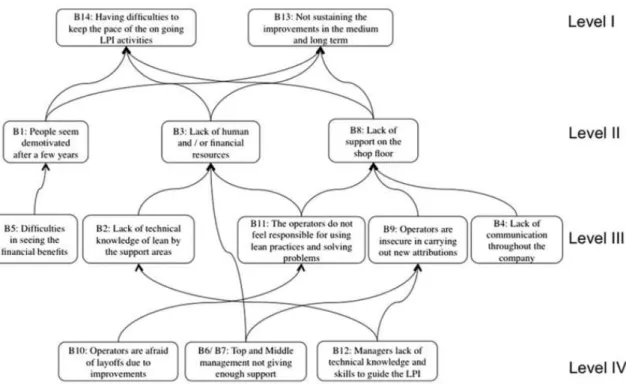
Based on the data gathered, they have identified the main obstacles found during the implementation phase. In Figure 1.2, the chart suggests a logical relationship to link hurdles that influenced each other. As an illustration, personnel have doubts to be responsible for new tasks (B9) this depends directly on the level of competence of authorities have on LP (B12). The magnitude of their findings supports the assertion associated with the importance of managerial commitment; since their influence is implied across Lean application and should be strengthened to enable feedback and decision making for greater profitability (Losonci et al., 2011,Dombrowski and Mielke, 2014).
Conversely, Achanga et al. (2006) considered four constrain factors (leadership, finance, know-how and culture) in the progress of the implementation process, within ten UK Small and Medium Enterprises (SME). The majority of these enterprises’ anxiety relies on the belief that applying Lean is expensive and time consuming. Their outputs have revealed a chain reaction deficiencies based on the need for adequate funding and leadership; specifically, on owner-manager’s expertise, support and commitment. Another concern is that personnel training requires financial sources help. In fact, for SMEs, head viewpoint is an unnecessary loss of resources. In this respect, the deficit of employee education means low competences for them and, thus, the aim for a change of culture, essential platform in the application of Lean. The study has established that many are sceptical about the advantages of LP to their business, which was expressed by a financial scarcity, which rejects the opportunity to implement different productive initiatives. There is a direct connection concerning the SMEs management styles and numerous outputs such as return on investments or number of employees or lead-time.
As another aircraft sector lecture, Holweg (2007) has noted about the "Lean Aerospace Initiative", made in 1993 by the US Air force that the industry has encountered similar troubles caused by a lack of a concise spotlight. Crute et al. (2003) have performed a research within a single company over two different manufacturing sites under equal pressure for a better yield.
In factory A, LP with clear target indicators was applied during one semester. On the other hand, Plant B has had an 18-months period during which it was implemented with less challenging objectives. The feedback given was that execution best practices at site "A" are not replicable. Adaptations to other factories would require different purposes, awareness and metrics based on a strategically tactical LP perspective by the senior executive and, also, on an autonomous learning culture.
Likewise, Taiichi Ohno has advised that the TPS thinking background is to answer Toyota’s own problems at that time; each plant is unique (Holweg, 2007,Ohno, 2012). Many Japanese experts have said "do not copy-adapt". Lean should not be as a "fashion recipe" matter (Leandro, 2007,Murata and Katayama, 2010).
Moreover, Browning and Heath (2009) have presented a paper about the F-22 Lockheed Martin’s Lean manufacturing experience and its efforts on waste dissipation and production expenses. The project came for a cost reduction pressure from clients. This made that the executives had a myopic attention in just efficiency and timing, instead of an innovative way of thinking. These managers, without much day-to-day attachment at the shop floor, believe that Lean is a simple concept (Cravvford et al., 1988,Taylor et al., 2013,Lodgaard et al., 2016). They look forward to immediate results from their underlings, and have therefore a short-term point of view. As it can be seen, accomplishing LP is not a trouble-free assignment. The new mind-set begins with the authorities’ commitment to generate big impacts (Emiliani and Stec, 2005,Pearce and Pons, 2013). Deming affirmed that "The problem is at the top; management is the problem". (Crute et al., 2003,Losonci et al., 2011,Dombrowski and Mielke, 2014)
The next case (Scherrer-Rathje et al., 2009) may clarify this assertion. In an international manufacturer of food processing machines and equipment, a first attempt failed in
1997 due to a lack of leaders’ determination with Lean. However, in 2006, a second project was a success (at this point a former Toyota Japanese expert was paid to support the implementation).
The lessons learned from these carried on experiences were clear top management involvement was necessary, to establish a Lean long-run strategic vision, to encourage autonomy, to communicate targets in a mid-to long-term basis, so that a LP follow up through periodic evaluations. Senior authority engagement unswervingly influences on the firm’s commitment, especially at the operational levels; it becomes a key part to Lean transition (Birdi et al., 2008). Breaking the normal resistance to transformations by working side-by-side with the employees in order to eliminate entropy (waste) in the process is a condition of success.
The main leader’s job is to allow change (Anderson and Anderson, 2010,Atkinson, 2010). As Deming (1982) has reiterated, firstly, it is imperative for decision makers to set an identity within the system; indeed, every basic belief and value embodies the corporate culture (Evans, 1996,Drucker, 1999). Given this desire to change, the following questions arise (which will be addressed in the next chapter): what is identity needed to be displayed by the organization regarding LP strategy? Which is the function required from senior executives for initiating the change stemming from its principles?
3.2.2. Socio-Technical Factor
A solid foundation lies on a learning Lean framework to bear employee empowerment through training, company infrastructure and culture maturity, to be able to sustain improvements over time (Worley and Doolen, 2006,Joosten et al., 2009). The critical concern here is how to link and to recognise the worker’s contributions as a key enhancer of the deployment process (de Menezes et al., 2010,Bernhauerova, 2013). In many firms, there is an uneven bond among the employee talent and techniques (Drucker, 1999,Cassell et al., 2006). People, organisational structure and culture are the social aspect; on the other hand, tools, methods and standards refer to the technical side (Martinez-Jurado and Moyano-Fuentes, 2014).
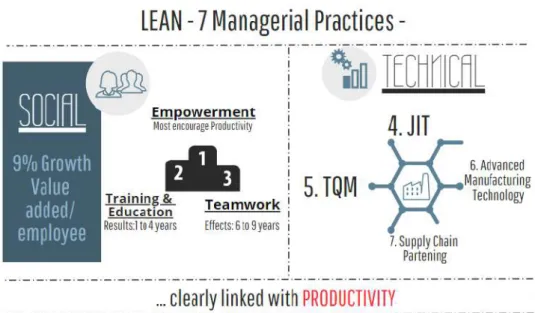
Such socio-technical considerations have been widely covered by the pundits (Hines et al., 2004, Taylor et al., 2013). Birdi et al. (2008) have for instance collected data on productivity achievement from 308 companies over 22 years. Figure
1.3 shows a summary of their findings, basically presenting the individual and collective impact of seven management practices related to yield (empowerment, training, teamwork, TQM, JIT, advanced manufacturing technology and supply chain alliances); fundamentally, such initiatives are also theoretically echoed in Lean. Their conclusions suggest that engagement roles detach as most probable to encourage firms’ productivity. The expected results could be shown between 1 and 4 years after its introduction. Consequently, investing in teaching and education along with teamwork will enhance company performance and the other practices as well. However, the effects are variable and were not evident until 6 to 9 years after the application. Overall, empowerment and training are clearly linked with productivity; both displayed a 9% growth in value added per employee (Birdi et al., 2008). Besides, there is a
Figure 1.3. Survey overview showing linkage of HRM and OM practices (Birdi et al. 2008)
robust argument that the implementation process will directly affect the result of those practices.
In that sense, the work of de Menezes et al. (2010) deals with the potential nexus between Operations Management (OM) and Human Resources Management (HRM). For 24 years, they gathered data from UK manufacturers (this study seems to be a sequel to Birdi’s research as it draws a similar pattern). This is reinforced in other writers (Gunasekaran and Ngai, 2012,Martinez-Jurado and Moyano-Fuentes, 2014,Bortolotti et al., 2015) all considering that productivity may measure performance instead of financial indexes. Their examination discloses that the amalgamation of outcome mapping and human resource management practices (socio-technical topics) are essential for the link between Lean and TQM and drives to better results.
Furthermore, their statement regarding that by having a consolidated and holistic system deployed reveals a managerial philosophy backed up by the data. Overall, the synergy between the socio-technical features has been acknowledged by academics and practitioners, as examples of together accomplishments and disappointments and their integration represents a key factor clearly linked with productivity and an enterprise’s competitive advantage (de Menezes et al., 2010). This is consistent with other studies recently made by other researchers based on 730 manufacturing firms surveyed in France, Germany, UK and USA (Bloom and Van Reenen, 2011).
Already cited, Taylor et al. (2013) have explored an assembly plant between 2008 and 2010 with 5000 workers. They have discovered the employee’s recognition connected with LP and the toughness for enterprises to uphold the "momentum" (results) overtime through commitment. Their interviews to staff were about the perception of the Lean system, specifically, in subjects like workplace atmosphere, labour development opportunities, effective workers managing, remuneration and recognition policies. Another factor measured was the Plant success with matters such as authorities’ leadership; personnel skills and assertiveness and infrastructure on Lean.
The final topic was about the confrontation of keeping performance objectives and maintaining the programme and more precisely, the change management expertise. Table 1.3 shows a summary on Taylor’s findings. This case study revealed some remarkable results; it can acknowledge that Lean is a business philosophy based on socio-technical practices. It is influenced by a complex interdependency between many different variables; particularly, the ability of the authorities to recognise the synergy of HRM into sustainable firm’s long-term results. Nevertheless, a simplistic understanding displayed by the managers combined with cosmetic hands-on participation are weaknesses in most organizations (Schonberger, 2007,Lodgaard et al., 2016). Lastly, some of these facts suggest that ’goals, measures and KPIs’ should be included as an alert in order to avoid complacency of short-term results.
To delve more aspects around Lean, Furlan et al. (2011) have analysed statistically the complementarity of the LP, JIT and TQM. The trial has relied on 266 factories (with a minimum of 100 employees) from Austria, Finland, Germany, Italy, Japan, Korea, Spain, Sweden and the USA, between 2005 and 2007. They have validated the synergy between JIT and TQM on operational achievement with the Edgeworth’s theory of complementarity. The concept defines the complementarity of activities as "if doing (more of) any one of them rises the returns to doing (more of) the others". They have revealed that the departments who carry out those approaches have increased in productivity and quality levels, management and employee commitment and participation of suppliers compared with those who do not implement it. Additionally, HRM practices like teamwork, training or empowerment have positive and direct relationship with JIT and TQM. Their conclusions were that HRM is a requirement to unfold the tool-oriented focusing on Lean; companies must invest in those practices, or else, they cannot reap all the benefits of the complementarity between TQM and JIT.
To develop this new mind-set, the firm must design management systems that build up people ’on the gemba’. It is just recently that some studies and surveys recognise the human talent as a key enhancer over Lean implementation (Birdi et al., 2008,Taylor et al., 2013). For that reason, the focus on the operational level is vital in order to apply the right tools and techniques to provide value to the customer (Hines et al., 2004,Browning and Heath, 2009,Taylor et al., 2013).
Birdi et al. (2008) asserted that "the effectiveness of operational practices depends on human resources". They continue saying that "adopting empowerment and extensive training was the key to productivity". Therefore, these socio-technical aspects are interconnected and will also influence directly the transformation needed, developing the objectives and enhancing process capability in the long term.
The conclusion from those cases is that it is a starring responsibility for authorities to coach their human resources in order to build a continuous improvement approach and, besides, to bring the opportunity to employees to develop their problem-solving proficiency. Hence, at that point, the organisation will be motivated; so, this is a reliable ’resistance to change’ disrupter (Dombrowski and Mielke, 2014). Nevertheless, the question of course is how to engage people with LP?
Area studied Criteria Percentage(%)
Perception of Lean system
Opportunities for personal development
Regular appraisal 95% Relevant training 81% Effective Labour management
Employee involvement 95% Demanding targets 90% Supervisor worker relations 86%
Giving workers a voice
Suggestion Scheme 81% Listing of concerns 76% Two Communication way 72% Reward & Recognition system
Non-financial recognition 90% Team based reward 86%
Plant success
Leadership from top management
Personally involved 81%
Credibility 76%
Workforce Attributes and Attitudes
Flexibility, adaptability 90% Failure not countenanced 86% Belief that lean works 81% Corporate Systems Infrastructure
Continual review & improvement 95% Best practice sharing 90% Director level responsibility 86%
Challenges of maintaining
performance levels and sustaining lean
Change Management proficiency
Attitude to change 95% Appetite to change 81% Maintaining momentum 76%
3.2.3. Difficulties with the assessment criteria on Lean impact
Despite the popularity of the LP, in the UK, less than 10% of companies have been proficient implementing it, owing to the fact that its advantages are not clearly perceivable in the financial outlook (Bhasin, 2008). A number of survey studies have indicated that LP capacity concentrated on production objectives such as quality, flexibility, lead-time or delivery (Lewis, 2000,Bhasin, 2008,Fullerton and Wempe, 2009). Additionally, another important discovery established advises that Lean’s performance goals should not focused merely on productivity indicators rather than profitability or financial KPIs measurements (Meade et al., 2010,de Menezes et al., 2010,Taylor et al., 2013).
Among Fortune 500 firms, a famous business journal has publicised that 43 out of 50 important companies from their list, including some such as Kodak and Unisys, suffered from a significant downturn in earnings after three years of implementing LP (Bhasin and Burcher, 2006,Lewis, 2000). Thereby, a good control structure turns out to be a vital aspect to provide feedback onto the outcomes concerning LP.
Meade et al. (2010) have observed the impact of Lean initiatives on the behaviour of the net profit (using four known accounting standards) during the implementation phase. A conclusion is that it may hard to balance in the short term between gemba savings carried by the LP. Especially, the inventory decrease drives to weakening fixed revenues because of a deficiency in financial and bookkeeping procedures.
In Table1.4, it is shown that the study has identified the negative impact on the income statement resulting from rapidly reducing stocks (approximately a drop off in net profit of 1/3), established on the conventional accounting systems. Normally, once the inventories have traded, they are accounted as assets on the balance sheet; then, the expenses become a cost of goods, which would be added in the income statement. Therefore, if Lean displays a drop of final inventories, it will be registered at the income statement and not in the balance sheet without recognising them in the current period. This means a decrease in gains until the stocktaking of the finished goods are stabled.
Their conclusions have shown that the financial statements methods may perceive a reduction in revenues as a result of efforts to bringing down the stock levels in the short term. This could damage the LP expectations from the top managers and stakeholders if this discovery is not properly interpreted; a long-term is a foremost consideration. Even so, knowing that fact about the net profit diminishment, at early stages, linked to inventories, the authorities avoid the programme resistance because of an apparent lack of results by recommending establishing some complementary metrics that allow bringing a follow up of the improvements made by the workforce.
Fullerton et al. (2014) have investigated 244 USA firms, 49% of them having implemented lean. Over a period of three-years, they have discovered the direct bond existing around Lean practices to both operational and financial performance, which is critical for in-house decision-making. Their results have also revealed that such complex organizational strategy can enhance yield. This is in line with researchers who have argued that conventional accounting systems motivate disruptive behaviour
Table 1.4. Calculation of net profit (Meade et al., 2010)
against LP’s success when focused solely on cost cutting without process or customer value improvement. Therefore, control systems need to be updated to reflect the underlying Lean vision. Lastly, they also have concluded that the support of other departments is of highest relevance (e.g. human resources, accounting and finance, etc.) and should become a principle for building the Lean team.
Fullerton and Wempe (2009) have considered 121 USA production directors from four sectors - chemical, industrial machinery, electronics and instrumentation- and have observed the magnitude of the liaison between LP and financial output with nonfinancial manufacturing performance measurements. They have depicted in a pattern, via Structural Equation Modelling (SEM) (Figure 1.4),their perception of the work force impact on production practices, which in turn indirectly influences the companies’ financial performance.
Their conclusions endorse the belief that worker talent engagement is a critical aspect of success during Lean implementation, and the use of HRM practices encourage this statement. Tests suggest that HRM practices increase the impact of LP on profitability. If managers do not combine these aspects, the company may suffer from unsatisfactory financial effects. Moreover, the results acquired have shown that the bond between LP and profitability is linked to the ability of the system to align behaviour with strategic goals.
Yet, researchers found that neither TQM, JIT nor Lean were associated with output in the financial statements (Lewis, 2000,Rauch et al., 2017). This means, implicitly, there are few KPIs that allow the comparison of figures to illustrate trends in a
Figure 1.4. Model of LP, non-financial manufacturing performance measures and profitability (Fullerton and Wempe, 2009)
company’s performance and their linkage to such managerial philosophies (Birdi et al., 2008,de Menezes et al., 2010). Consequently, many authors have underlined the need for a new structure to assess improvements made by LP, conventional accounting systems having several problems for informing those accomplishments (Maskell and Baggaley, 2006,Brosnahan, 2008).
In this matter, Brosnahan (2008) mentioned that Watlow Electric Manufacturing Co. has implemented a non-traditional method to evaluating and managing LP, called "Lean accounting". The concept was designed to better exhibit the business performance brought by the programme’s practices such as value stream management and adjustment of bookkeeping reports (organising cost procedures and incorporating nonfinancial data) (Maskell and Baggaley, 2006,Maskell et al., 2011). The company found that traditional methods have many difficulties for quantifying the impacts of Kaizen activities; for that reason, specific measurements were developed to assess e.g. safety, cost, quality or delivery.
Maskell and Baggaley (2006) have illustrated the lean accounting approach with the example of a weekly report based on the value stream yield. As it can be seen in Table
1.5, there are both OM ratios (on time shipment, average cost) and financial indexes (return on sales, profit or revenue) that the in-plant workers use over LP accounting systems.
In conclusion of this section, Lean projects must be monitored and require a suitable measurement system based on productivity metrics but displayed in profitability parameters. It is difficult for decision makers to respond to challenging situations appropriately without proper financial and technical information (Fullerton and Wempe, 2009,de Menezes et al., 2010). Maskell et al. (2011) have emphasized that traditional accounting methods do not express the economic benefits of LP; it is necessary to use other techniques to identify their financial impact of the company. Yield assessments within Lean companies are essential to the control and improvement of the organisation. The authors have also noted that LP manufacturers