OATAO is an open access repository that collects the work of Toulouse
researchers and makes it freely available over the web where possible
Any correspondence concerning this service should be sent
to the repository administrator:
[email protected]
This is an author’s version published in:
http://oatao.univ-toulouse.fr/21903
To cite this version:
Milanese, julien
and Andrieu, Eric
and Osio, Jean-Baptiste and Alexis,
Joël
and Bardel, Didier Study of the Oxidation Assisted Intergranular
Cracking Mechanism on a Ni-Base Superalloy. (2018) In: Proceedings of the 9th
International Symposium on Superalloy 718 & Derivatives: Energy, Aerospace,
and Industrial Applications. (The Minerals, Metals & Materials Series book
series (MMMS)). Springer, 805-815. ISBN 978-3-319-89480-5 (online)
Study of the Oxidation Assisted
Intergranular Cracking Mechanism
on a Ni-Base Superalloy
J. Milanese, E. Andrieu, J. B. Osio, J. Alexis and D. Bardel
Abstract In order to collect accurate information about the widely reported Oxi-dation Assisted Intergranular Cracking (OAIC) mechanism of the superalloy 718 at 650 °C in air environment, we investigated a new tensile test procedure which enables to have access to a quantitative semi-continuous assessment of the dam-aging process of the alloy 718 during a standard tensile test. Tensile tests were carried out on a solutionized and aged alloy 718 by varying the deformation mode of the alloy during the ongoing experiment. The semi-continuous quantification of the intergranular damage was performed after a fracture surface analysis of samples tested in both Dynamic Strain Ageing (DSA) domain and DSA-subdomain where Portevin-Le Chatelier (PLC) effect occurs. This innovative testing method allows to characterize the intergranular damage that occurs when the material is stressed with an unserrated DSA deformation mode as the alloy 718 is only sensitive to OAIC in this domain. In these conditions, the onset of the intergranular cracking process was found to be around 10% of total strain. An increase in the cracking kinetic when necking occurs was also noticed. A close connection between the intensity of the intergranular damage and the cumulated strain in DSA deformation mode before the onset of the damaging process was found. The gathered information represents a significant improvement in the understanding of still debated OAIC or Stress Corrosion Cracking (SCC) mechanisms.
J. Milanese (✉) ⋅ E. Andrieu
CIRIMAT, Université de Toulouse, CNRS/INPT/UPS, 4 allée Emile Monso, BP 44362, 31030 Toulouse cedex 4, France
e-mail: [email protected] J. Milanese ⋅ D. Bardel
AREVA NP, 10 rue Juliette Récamier, 69006 Lyon, France J. B. Osio
MIDIVAL, 8 avenue Pierre Georges Latécoère, 31570 Sainte-Foy d’Aigrefeuille, France J. Alexis
LGP, Université de Toulouse, INP/ENIT, 47 avenue d’Azereix, BP 1629, 65016 Tarbes, France
© The Minerals, Metals & Materials Society 2018
E. Ott et al. (Eds.), Proceedings of the 9th International Symposium on Superalloy 718 & Derivatives: Energy, Aerospace, and Industrial Applications, The Minerals, Metals & Materials Series, https://doi.org/10.1007/978-3-319-89480-5_54
Keywords Alloy 718
⋅
Oxidation⋅
Intergranular cracking⋅
Deformation modeIntroduction
The superalloy 718 is well known for possessing good mechanical properties and corrosion/oxidation resistance over a wide range of temperatures [1–3]. However, the alloy 718 is widely reported to be subject to an intergranular brittle fracture when loaded in particularly harsh environments [4–6]. The effect of the environ-ment is essential in the damaging process of the superalloy as no intergranular brittle fracture was observed on samples tested under vacuum or inert gas [7,8]. Whether in the water of Pressurized Water Reactors (PWRs) or in air at 650 °C, the resulting intergranular damage of the alloy (assimilated to an InterGranular Stress Corrosion Cracking “IGSCC” mechanism on one side and to an Oxidation Assisted Intergranular Cracking “OAIC” mechanism on the other side) depends on the de-formation mode of the alloy. The transition from an unserrated flow typically observed in the Dynamic Strain Aging (DSA) domain to a serrated flow observed when the Portevin-Le Chatelier (PLC) effect occurs in a DSA subdomain lead to a transition in the fracture mode from intergranular fragile to fully transgranular ductile [7–9]. Even if several still-debated mechanisms for the IGSCC or OAIC of the alloy 718 have been reported in literature [10–18], the particular flow induced by the plastic instabilities and the resultant modification of the interaction between dislocations and solutes inhibits the damaging mechanisms of the alloy in which a preferential loading of grain boundaries or segregating elements at grain boundaries are possibly involved [7–9,19].
The analysis of fractured samples after conventional tensile tests at high tem-perature in air environment is used to characterized and quantify the intergranular damage of the superalloy 718. However, only one information about the total intergranular damage at the breakage of the material can be deducted from this assessment. No information on the damaging process, as its onset or its develop-ment during the mechanical test, is available.
The objective of this study was to determine the occurrence and the evolution of the intergranular cracking of a superalloy 718 due to an OAIC mechanism during a tensile test at 650 °C in air environment by means of an innovative method. Tensile tests during which the deformation mode of the superalloy 718 is modified from a DSA mode to a PLC mode at a given strain level and vice versa were carried out. The intergranular damage which exclusively occurs over the section of the tensile curve performed in DSA can be therefore determined by a standard fractography analysis of the tensile samples. Thus, a semi-continuous assessment of the intergranular dam-aging process of the superalloy 718 at 650 °C in air environment was achieved.
Experimental Procedure
The material used for this research was a 0.260 mm thick nickel base superalloy 718 strip whose chemical composition is given in Table 1.
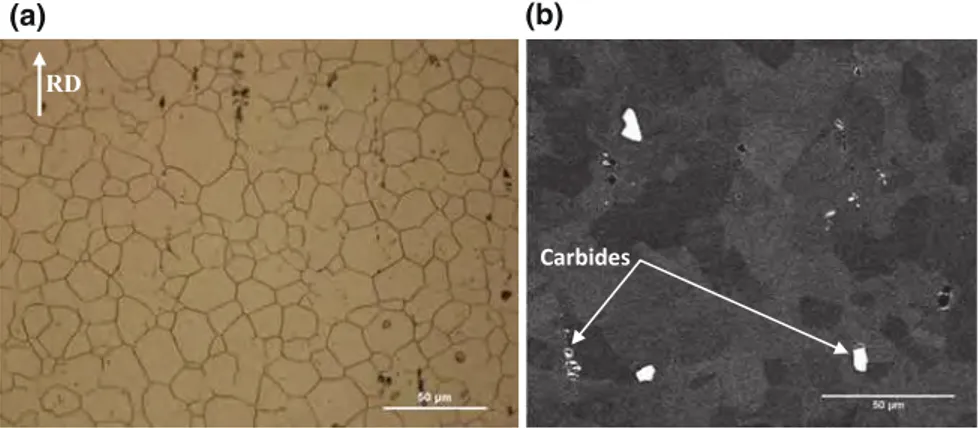
The alloy was fully solutionized at 1080 °C during 48 s and conventionally aged as follows: 720 °C for 8 h, cooled to 620 °C at 50 °C/h, 620 °C for 8 h then furnace cooled. From the manufacturing route described above, only remains a δ-free γ′/γ″-hardened fully recrystallized solid solution with an average grain size of about 13 µm. As shown in Fig. 1, carbides alignments in the rolling direction and dispersed isolated primary carbides which cannot be redissolved at these temper-atures are still observed in the proportions of ∼0.46 surf.%.
Tensile tests were realized under laboratory air testing conditions at a temper-ature of 650 °C with a strain rate controlled by the travel speed of the testing device. The mechanical testing procedure is automatically defined and allows to change the strain rate at a given deformation level during the ongoing test. Strain rates of 1.10−3 s−1 and 1.10−2 s−1 were used as they respectively result in a
conventional DSA deformation mode and in a PLC deformation mode for the used material at 650 °C. Immediately prior to the test, samples were hold at 650 °C for 10 min in order to homogenize the sample temperature and allow oxidation phe-nomena to occur. An exhaustive list of the carried out tests is given in Table 2.
Fractured tensile samples were then observed by secondary electron microscopy using a FEI INSPECT S50 microscope.
Results
Constant Strain Rate Tensile Tests
Stress-strain curves performed at a constant strain rate during the whole test are provided in Fig.2. As expected, the selected strain rates of 1.10−3s−1and 1.10−2
s−1lead respectively to a continuous and serrated flow of the material. A decrease
of about 20 MPa in the tensile strength and of 3% in the ultimate strain is observed when the PLC effect occurs.
A mixed transgranular ductile and intergranular fragile rupture mode is observed on the samples strained at 1.10−3 s−1 (Fig.3b, c) while the fracture mode of the
tensile samples strained at 1.10−2s−1in the PLC subdomain is fully transgranular
ductile (Fig.3a). As reported in literature [7–9], the effects of the combined environment and mechanical load on the damaging process of the superalloy 718 are enabled when the flow is unserrated whereas they are suppressed when the plastic instabilities related to the PLC effect occur.
Table 1 Chemical composition in wt% of the superalloy 718 heat used in this study
Ni Fe Cr Nb Mo Ti Al Mn
52.1 Bal. 18.3 5.14 2.91 1.02 0.54 0.06
Ta Si Co Cu C S B P
Carbides RD
(a) (b)
Fig. 1 Microstructure of the superalloy 718 used in this study. a Optical micrograph of an etched sample (RD: rolling direction), b SEM micrograph showing carbides
Table 2 Summary of the completed tensile tests
Test type Strain rate 1 (s−1) Transition strain (%) Strain rate 2 (s−1)
DSA 1.10−3 – – DSA → PLC 1.10−3 2.5 1.10−2 1.10−3 5 1.10−2 1.10−3 10 1.10−2 1.10−3 12.5 1.10−2 1.10−3 15 1.10−2 1.10−3 16.5 1.10−2 PLC 1.10−2 – – PLC → DSA 1.10−2 2.5 1.10−3 1.10−2 5 1.10−3 1.10−2 10 1.10−3 1.10−2 12.5 1.10−3
Fig. 2 Stress/Strain curve at 650 °C in air environment at 1.10−3and 1.10−2s−1
Two Strain Rate Tensile Tests
Curves of tensile tests realized by switching from DSA to PLC deformation modes and vice versa during the ongoing test are presented in Fig.4. It is important to note that the second part of the two strain rate test curves (black curves in Fig.4) fits well with the standard tensile test curves (grey curves in Fig. 4). Despite an important quantity of deformation cumulated under a different deformation mode, the material flow stress in the second part of the test is the same as the one of a constant strain rate tests. As the tensile test mechanical history does not affect the material flow stress, it is thus, possible to estimate that the damaging mechanisms noted above stay identical irrespective of the testing procedure. Therefore, the quantification of the intergranular damage occurring over the only section of the curve realized with a DSA deformation mode is possible.
Fig. 3 aFully transgranular ductile fracture of the sample strained at 1.10−2s−1in PLC mode at
650 °C in air environment, b mixed transgranular ductile and intergranular fragile fracture mode of the sample strained at 1.10−3 s−1 at 650 °C in air environment, c magnification of the area
enclosed in white in picture (b)
Fig. 4 Strain/Stress curves at 650 °C (black curves) for two strain rates tests and a transition total strain of 10%: a Transition from DSA (10−3 s−1) to PLC (10−2 s−1), b transition from PLC
Quantification of the Intergranular Damage
The intensity of the damage was evaluated by means of a fractograph analysis. As detailed in Fig.5, an Oxidation Assisted Intergranular Cracking Index (OAICI) is calculated as the ratio of the sum of the edging lengths of the intergranular fracture zones by the total perimeter of the analyzed specimen. Only is taken into account the intergranular fracture zones whose depth is strictly greater than one grain.
The Table3 shows the results of the OAICI determinations. Whatever the test sequence was, the intensity of the intergranular damage seems to be directly related to the deformation cumulated with an unserrated flow of the material (i.e. DSA deformation mode).
From DSA to PLC tests, an increase from 0 to 16.5% of the total strain cumulated in DSA mode leads to an increase in the intergranular sensitivity of the material from 0 to 9.0%. The same conclusion can be drawn from PLC to DSA tests as an increase from 0 to 12.5% in the cumulated strain in PLC mode (i.e. a decrease
Fig. 5 Detailed diagram of the OAICI determination method. Where LIGis the edging length of a
considered intergranular fracture zone greater than one grain (displayed as the arrows on the diagram) and LTotthe total perimeter of the tensile sample rupture surface
Table 3 Calculated OAICI values for the realized tensile tests
Deformation mode Transition strain (%) Deformation mode OAICI (%)
DSA 8.0 DSA 2.5 PLC 0 DSA 5 PLC 0 DSA 10 PLC 0 DSA 12.5 PLC 0.3 DSA 15 PLC 1.1 DSA 16.5 PLC 9.0 PLC 0 PLC 2.5 DSA 7.6 PLC 5 DSA 4.3 PLC 10 DSA 2.9 PLC 12.5 DSA 0
in the strain level cumulated in DSA mode for samples with a similar ultimate strain) leads to a decrease from 8.0 to 0% of the OAICI. Furthermore, tests switching from DSA to PLC show that no intergranular damage is generated before 12.5% of total strain.
Discussion
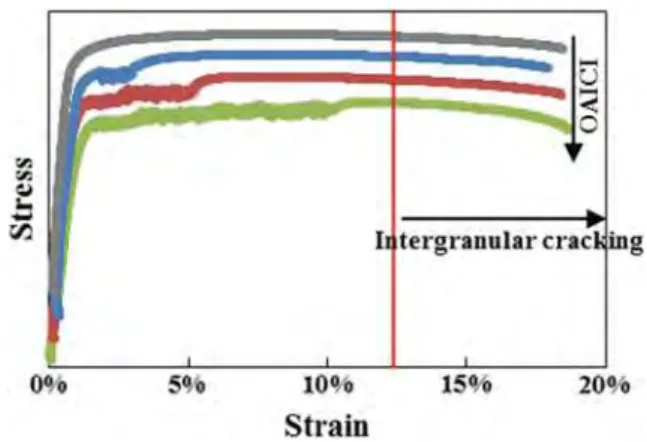
The Fig. 6a shows the evolution of the intergranular damage intensity calculated from the DSA to PLC tensile tests as a function of the total strain. Values are replaced over the standard DSA stress/strain curve of the studied alloy 718 at 650 °C in air environment. The onset of the intergranular damage occurs between 10 and 12.5% of total strain. It also corresponds to the strain when the material strength is maximal. The perceived maximal strength and necking on the stress/ strain curve of the material at 650 °C in air environment seems to be directly related to the appearance of the intergranular damage. It can potentially be considered that the decrease in the load-bearing cross section which occurs when intergranular cracks form is accountable to the perceived flow of the material. As they are widely influenced by the damaging effect of the environment, the noted material strength and elongation from a tensile test carried out at 650 °C in air environment do not correspond to the inherent mechanical properties of the alloy 718 but only reflect the particular behavior of the material in a particular environment.
An explosion of the OAICI at the very end of the tensile test/necking is also observed. The OAICI increases from 1% to around 8.5% as the total strain goes from 15% to 18.5%. The intergranular cracking of the alloy 718 is a very rapid
DSA PLC
(a) (b)
Fig. 6 aEvolution of the IGSSCI values versus strain and standard stress/strain curve of the experimented alloy 718 at 650 °C in air environment (from the DSA to PLC tensile test results).
bEvolution of the IGSSCI values versus cumulated strain in DSA mode (from the PLC to DSA tensile test results)
mechanism as the majority of the intergranular damage is generated in about 35 s. The average intergranular cracking propagation speed was calculated at 0.5 µm/s. The Fig.6b shows the evolution of the OAICI as a function of the cumulated strain in DSA mode calculated from the PLC to DSA tensile tests. As mentioned before, the intensity of the intergranular damage increase with the cumulated strain in DSA mode.
The Fig. 7 shows a standard DSA mode tensile test curve and several tensile tests carried out with a transition from a PLC deformation mode to a DSA defor-mation mode at various total strains. It was observed before that the intergranular damage occurs and develop after 10% of total strain. However, in the case of PLC to DSA tensile tests, no differences from one test curve to another is noticeable beyond 10% of total strain whereas the intensity of the intergranular damage generated during the same period decreases. This change in the intergranular damaging process can therefore be attributed to the quantity of deformation cumulated in DSA mode before 10% of total strain as longer this part of the curve is, greater the OAICI values are. During this period, deformation induced solute segregation and preferential loading of grain boundaries whose intensities depend on the deformation cumulated in DSA mode can potentially be implemented. Once the cohesion stress of grain boundaries is reached intergranular cracking occurs and only loaded and segregated grain boundary interfaces fail. Thus, the greater the strain cumulated before the onset of the intergranular cracking, the larger the weakened grain boundaries and the OAICI value. The time spent in DSA defor-mation mode before the onset of intergranular cracks can be assimilated to the “incubation period” of the intergranular cracking mechanism during which solute segregation or preferential loading at grain boundaries may potentially occur and express on the fracture surface of the material.
Fig. 7 Tensile curves of a full DSA mode tensile test and PLC to DSA tests with transition strains of 2.5, 5 and 10% at 650 °C in air environment (stress values are shifted for a clearer view)
Conclusions
In order to completely grasp the intergranular cracking process of the alloy 718 during a tensile test at 650 °C in air environment, the following conclusions can be gleaned from this work:
(1) A certain amount of deformation cumulated in the material in DSA deformation mode is needed for the intergranular damage of the superalloy 718 at 650 °C in air environment to occur. In this study, the onset of the intergranular cracking was found to be around 10% of total strain and affects the mechanical properties of the alloy.
(2) The intergranular cracking process of the alloy 718 is accelerating at the end of the tensile test and leads to the breakage of the material.
(3) The intensity of the intergranular damage is directly correlated to the cumulated strain in DSA mode before the onset of the material cracking during which preferential loading or solute segregation at grain boundaries can express their negative effect. However, additional work on this specific point needs to be carried out in order to confirm these assumptions.
Acknowledgements The financial support of this research project was provided by AREVA NP. Thanks are addressed to MIDIVAL for the provided welcome on its material testing site within this work.
References
1. Special Metals Corporation (2007) INCONEL alloy 718. http://www.specialmetals.com/ assets/smc/documents/inconel_alloy_718.pdf. Accessed from 05 Oct 2017
2. Ter-Ovanessian B, Deleume J, Cloué JM, Andrieu E (2013) Quantitative assessment of intergranular damage due to PWR primary water exposure in structural Ni-based alloys. Corros Sci 67:11–19
3. Miglin MT, Domian HA (1987) Microstructure and stress corrosion resistance of alloys X750, 718, and A286 in light water reactor environments. J Mater Eng 9:113–132 4. Kimmerle WL, Miglin MT, Nelson JL (1989) Stress corrosion cracking of alloy 718 in
pressurized-water-reactor primary water. In: Superalloy 718—Metallurgy and application, pp 417–426
5. Leonard KJ, Gussev MN, Stevens JN, Busby JT (2015) Analysis of stress corrosion cracking in alloy 718 following commercial reactor exposure. J Nucl Mater 466:443–459
6. Rezende MC, Araujo LS, Gabriel SB, Dille J, De Almeida LH (2015) Oxidation assisted intergranular cracking under loading at dynamic strain aging temperatures in Inconel 718 superalloy. J. Alloys Compd. 643:5256–5259
7. Garat V, Cloué JM, Poquillon D, Andrieu E (2008) Influence of Portevin-Le Chatelier effect on rupture mode of alloy 718 specimens. J Nucl Mater 375:95–101
8. Andrieu E, Max B, Viguier B (2015) Oxidation assisted intergranular cracking in alloy 718: effects of strain rate and temperature. Aerosp Lab J 9
9. Max B, Viguier B, Andrieu E, Cloué JM (2014) A re-examination of the Portevin-Le Chatelier effect in alloy 718 in connection with oxidation-assisted intergranular cracking. Metall Mater Trans A 45(12):5431–5441
10. Andrieu E, Molins R, Ghonem H, Pineau A (1992) Intergranular crack tip oxidation mechanism in a nickel-based superalloy. Mater Sci Eng A 154:21–28
11. Gao M, Dwyer DJ, Wei RP (1995) Niobium enrichment and environmental enhancement of creep crack growth in Nickel-base superalloys. Scr Metall 32(8):1169–1174
12. Molins R, Chassaigne JC, Andrieu E (1997) Oxidation assisted crack propagation of alloy 718. In: Superalloys 718, 625, 706 and various derivatives, pp 655–664
13. Miller CF, Simmons GW, Wei RP (2000) High temperature oxidation of Nb, NbC and Ni3Nb
and oxygen enhanced crack growth. Scr Mater 42:227–232
14. Miller CF, Simmons GW, Wei RP (2001) Mechanism for oxygen enhanced crack growth in Inconel 718. Scr Mater 44:2405–2410
15. Kameda J, Bevolo AJ (1993) High temperature brittle intergranular cracking in high strength alloys undoped and doped with S, Zr, and/or B-II. Solute segregation analysis. Acta Metall Mater 41(2):527–537
16. Bika D, McMahon CJJ (1992) A kinetic model for dynamic embrittlement. Phys Status Solidi Appl Res 131:639–649
17. Bika D, McMahon CJJ (1995) Sulfur-induced dynamic embrittlement in a low-alloy steel. Acta Metall Mater 43(5):1895–1908
18. Heuer JK, Okamoto PR, Lam NQ, Stubbins J (2002) Disorder-induced melting in nickel: implication to intergranular sulfur embrittlement. J Nucl Mater 301(2–3):129–141
19. Deleume J (2007) Facteurs métallurgiques et mécaniques contrôlant l’amorçage de défauts de corrosion sous contrainte dans l’alliage 718 en milieu primaire des réacteurs à eau sous pression. PhD thesis, INP de Toulouse