HAL Id: hal-00726861
https://hal.archives-ouvertes.fr/hal-00726861
Submitted on 10 Mar 2014
HAL is a multi-disciplinary open access
archive for the deposit and dissemination of
sci-entific research documents, whether they are
pub-lished or not. The documents may come from
teaching and research institutions in France or
abroad, or from public or private research centers.
L’archive ouverte pluridisciplinaire HAL, est
destinée au dépôt et à la diffusion de documents
scientifiques de niveau recherche, publiés ou non,
émanant des établissements d’enseignement et de
recherche français ou étrangers, des laboratoires
publics ou privés.
Theoretical and experimental study of (In,Ga)As/GaP
quantum dots
Cédric Robert, Thanh Tra Nguyen, Charles Cornet, Pascal Turban, Mathieu
Perrin, Andrea Balocchi, Hervé Folliot, Nicolas Bertru, Laurent Pedesseau,
Mikhail Nestoklon, et al.
To cite this version:
Cédric Robert, Thanh Tra Nguyen, Charles Cornet, Pascal Turban, Mathieu Perrin, et al.. Theoretical
and experimental study of (In,Ga)As/GaP quantum dots. International Conference on Superlattices,
Nanostructures, and Nanodevices (ICSNN 2012), Jul 2012, Dresden, Germany. pp.643,
�10.1186/1556-276X-7-643�. �hal-00726861�
N A N O E X P R E S S
Open Access
Theoretical and experimental studies of
(In,Ga)As/GaP quantum dots
Cedric Robert
1*, Tra Nguyen Thanh
1, Charles Cornet
1, Pascal Turban
2, Mathieu Perrin
1, Andrea Balocchi
3,
Herve Folliot
1, Nicolas Bertru
1, Laurent Pedesseau
1, Mikhail O Nestoklon
4, Jacky Even
1, Jean-Marc Jancu
1,
Sylvain Tricot
2, Olivier Durand
1, Xavier Marie
3and Alain Le Corre
1Abstract
(In,Ga)As/GaP(001) quantum dots (QDs) are grown by molecular beam epitaxy and studied both theoretically and experimentally. The electronic band structure is simulated using a combination of k·p and tight-binding models. These calculations predict an indirect to direct crossover with the In content and the size of the QDs. The optical properties are then studied in a low-In-content range through photoluminescence and time-resolved
photoluminescence experiments. It suggests the proximity of two optical transitions of indirect and direct types. Keywords: Quantum dots, Tight-binding, k·p simulation, Time-resolved photoluminescence
PACS: 78.55.Cr, 78.47.jd, 78.67.Hc
Background
In the context of the monolithic integration of photonics on silicon, the pseudomorphic approach, i.e., growing lattice-matched compounds on Si, is a promising route towards an efficient and long-term stable laser on Si [1]. It should overcome the issue of the dramatic number of crystalline defects due to the large lattice mismatch encountered in the growth of most III-V materials onto Si substrates [2]. Among binary III-V materials, GaP pre-sents the closest lattice constant to Si (0.37% at 300 K). The perfect lattice matching can even be obtained by introducing 2% of nitrogen in GaP. Recently, the epitax-ial growth on Si substrate of GaP and GaPN0.02has been
greatly improved by several groups [3-5]. Various active zones grown on GaP substrate or on GaPN0.02/GaP/Si
have been proposed. The best results have been achieved with compressive strained GaNAsP/GaP quantum wells (QWs) in electrically pumped lasers operating up to 150 K (Si substrate) [6] or at room temperature (GaP sub-strate) [7]. However, the electron wave function at the conduction band minimum has a special character [8]. It is expected to limit the performances of laser devices yielding high threshold current densities. Indeed, the
conduction band of the GaAsP host material has a mini-mum at the XXYpoint on the edge of the Brillouin zone,
and partially localized electronic levels related to nitro-gen incorporation lie at energies below this minimum. The conduction band minimum of GaNAsP/GaP QWs evidences a predominant localized N character [8]. Moreover, the maximum of the emission wavelength reported for such structures with reasonable N content is equal to 980 nm [7], which is not yet in the transpar-ency window of Si.
Quantum dot (QD) lasers grown on GaAs or InP sub-strate display lower threshold currents due to the 0D density of states when compared with QW lasers on the same substrates [9]. (In,Ga)P QDs grown on GaP sub-strate have already been studied, and room temperature electroluminescence has been obtained [10]. However, theoretical studies have shown that the electronic band lineups correspond to a borderline case between type I and type II [11]. The (In,Ga)As(N)/GaP QDs system has recently attracted much attention. Fukami et al. [12] have claimed that the transparency window of silicon may be reached with InGaAsN/GaP QDs when In com-position is 50% to approximately 60% and N compos-ition is 1% to approximately 2%. In the following, InGaAs/GaP QDs are studied as a step toward InGaAsN/GaP QDs system. Both room-temperature photoluminescence (PL) [13] and electroluminescence
* Correspondence:[email protected]
1Université Européenne de Bretagne, INSA Rennes, France CNRS, UMR 6082
Foton-Ohm, 20 Avenue des Buttes de Coësmes, Rennes 35708, France Full list of author information is available at the end of the article
© 2012 Robert et al.; licensee Springer. This is an Open Access article distributed under the terms of the Creative Commons Attribution License (http://creativecommons.org/licenses/by/2.0), which permits unrestricted use, distribution, and reproduction in any medium, provided the original work is properly cited.
[14] of InGaAs/GaP QDs have been recently reported. However, the description of the electronic band struc-ture of this QD system is still lacking.
In this paper, we investigate (In,Ga)As/GaP QDs in a low-indium-content range both from the theoretical and experimental points of view. The effects of both indium composition and QD geometry is analyzed through a combination of k·p and tight-binding (TB) simulations. Optical properties are then studied by temperature-dependent photoluminescence and time-resolved photo-luminescence (TRPL).
Methods
(In,Ga)As QDs are grown on n-doped GaP(001) sub-strate using gas-source molecular beam epitaxy. After the growth of a 450-nm buffer layer and a 4-monolayer (ML) (In,Ga)As deposition with 30 s of annealing under As (see the work of Nguyen Thanh et al. [13] for more information), a 30-nm GaP capping layer is finally deposited to prevent surface non-radiative recombina-tions. The growth temperature is set at 580°C. The nom-inal composition of indium is set at 30%, but because of high growth temperature, indium effective composition is assumed to be below or equal to 15%.
Temperature-dependent PL experiments are carried out by exciting samples with a 405-nm continuous-wave laser diode. Power density is roughly estimated at 80 W·cm−2. Samples are set in a helium bath closed-cycle
cryostat to study PL from 10 K to room temperature. Measurements are also performed above room tempera-ture using a hot plate. Attention is given to avoid the red luminescence of the deep centers in n-doped GaP substrates. Actually, the penetration length of the 405-nm beam is lower than the thickness of the GaP buffer layer, avoiding the substrate to be excited. Sec-ondly, similar PL spectra are obtained on the same structures on non-doped GaP substrate, thus excluding any significant contribution from the GaP deep center luminescence.
For TRPL measurements, the sample is excited by a frequency-doubled Ti/sapphire laser at the wavelength of 405 nm. The repetition rate is 80 MHz. The PL signal is analyzed by an S20 streak camera, and measurements are performed at 10 K to overcome non-radiative recom-binations channels.
Results and discussion
Band structure calculations
The eight-band k·p method has been extensively used to accurately simulate the electronic band structure of QDs with type I band alignment and direct optical transition (InAs/GaAs, InAs/InP. . .) [15,16]. The case of InGaAs/ GaP QDs in the low-In-content range is expected to be trickier because of the coupling of zone center conduction
band states with conduction band states located on the edge of the Brillouin zone [13]. To deal with this issue, we simulate the direct optical transition with the eight-band k·pmethod. To get an estimation of X-like and L-like state energies in the dot, we consider the TB sp3d5s* model [17] for a QW with a thickness equal to the height of the dot. Thus, the lateral quantum confinement effect is disre-garded but is assumed to have negligible effects on lateral valleys with large effective masses.
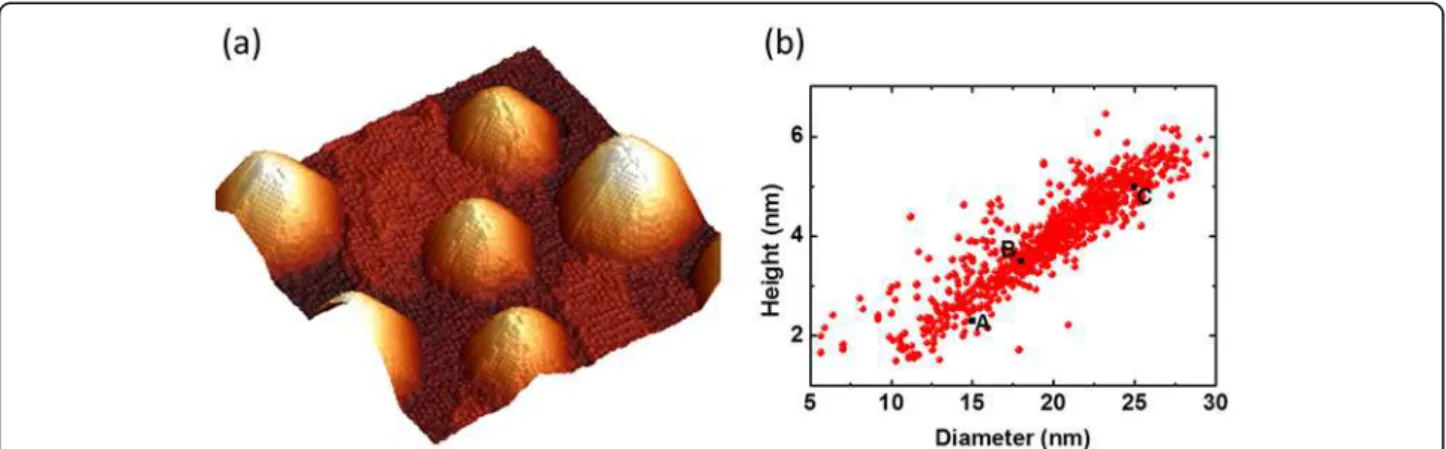
To consider realistic QD geometries for the simula-tion, the morphology of InGaAs/GaP QDs are imaged by plane-view scanning tunneling microscopy (STM). The 75 × 75-nm2STM image shown on Figure 1a exhi-bits InGaAs/GaP QDs with approximately a cone shape. The in-plane anisotropic ratio (between length and width) is indeed measured in the range of 1 to 1.5. The statistical analysis of diameter and height distributions is presented in Figure 1b. The k·p simulation is performed using the geometry defined on Figure 2. A C∞v
sym-metry is considered for QD geometries, and strain calcu-lations are performed using elasticity and parameters of Vurgaftman et al. [18] and the finite element method for numerical computation. Three typical dimension sets representative of the inhomogeneous size distributions are summarized in the table of Figure 2. The A, B, and C geometries correspond to real QDs typically found in the sample (see Figure 1b). The D geometry is chosen to study theoretically larger QDs in order to address the problem of lowering the emission energy. A typical wetting layer of 1-ML thick is added in the model to ac-count for the Stranski-Krastanov growth mode. Deform-ation potentials and Luttinger parameters used in the k·p model are those extracted from the TB calculation for bulk InGaAs and GaP [17]. The valence band offsets are taken from recent ab initio calculations [19].
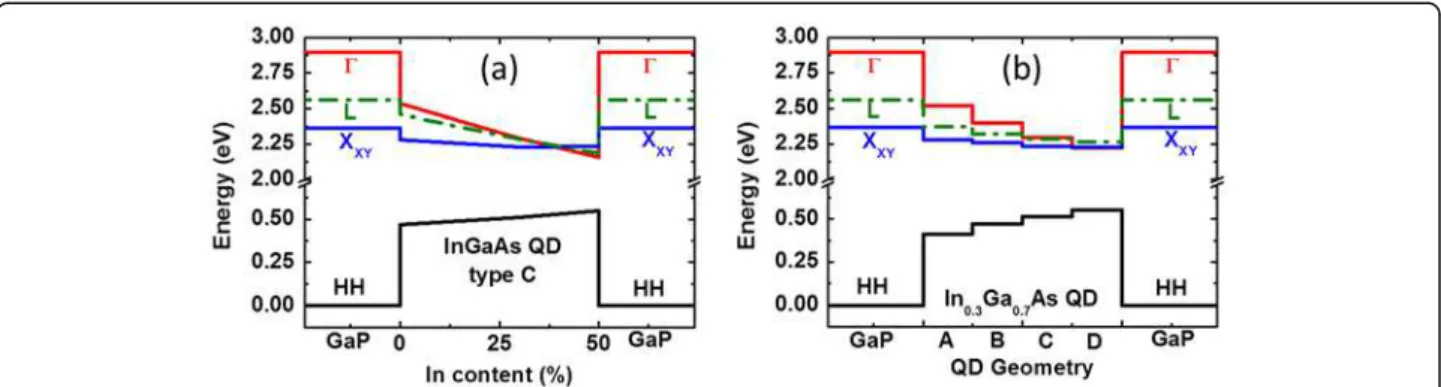
The influence of In content is presented on Figure 3a for a QD with the C geometry. The first electronic levels in the Γ, X, and L valleys and the first heavy-hole level of the QD are represented as a function of the In content. The electronic Γ and the heavy-hole levels are calculated with the k·p method, whereas the X and L electronic levels are calculated with the TB model. For low In con-tent (below 30%), the ground optical transition is type I but is indirect with the first electron level of the X type. For very low In content (below 15%), the Γ-type conduc-tion band level in the QD is even located at an energy above the one of the X-type conduction band of the GaP barrier. Nevertheless, a direct and type I ground state transition is predicted for In composition above 38%. This is a necessary condition in order to obtain a very efficient optical transition for such a QD geometry.
The influence of QD geometry is shown on Figure 3b for a medium In content of 30%. For small QDs, the first Γ electronic level undergoes an important quantum
Robert et al. Nanoscale Research Letters 2012, 7:643 Page 2 of 5
confinement effect which lifts up this level above both X and L levels, which are less affected by confinement effects. An indirect to direct type crossover is predicted for large QDs.
In conclusion, an increase of In content and an en-largement of QD size are expected to lower the first Γ-type conduction band level and thus yield an efficient optical transition. Moreover, the indirect to direct type crossover should be induced by strain relaxation asso-ciated to In content increase and QD enlargement.
Optical properties
Continuous-wave PL spectra are presented in Figure 4 for various temperatures. At 12 K, the PL spectrum exhibits a single peak centered at 1.78 eV. The peak shape undergoes a strong evolution from low to high temperatures. At 260 K, a shoulder appears on the high-energy side of the spectrum. At 300 K, a second
optical transition clearly appears. When increasing the temperature above 300 K, the maximum of PL intensity switches from the low-energy (LE) transition to the higher-energy (HE) transition. This behavior may indi-cate that the HE optical transition is more efficient than the LE one. At 300 K, the LE transition is reported at 1.74 eV and the HE transition at 1.84 eV.
To understand the nature of these two optical transi-tions, the dynamics of the recombination of carriers are investigated through TRPL spectroscopy. Experiments are performed at 10 K to overcome non-radiative recom-bination channels. The radiative lifetimes are deduced from the measured PL decay times. The sample is first excited with a low-incident power density equal to 70 W·cm−2. The LE optical transition is only detected in
ac-cordance with the spectrum shown on Figure 4 at low temperature. The evolution of the emission as a function of time is shown on Figure 5a. The LE optical transition exhibits a very long decay time which is greater than the repetition period of the laser (12 ns) and is not easily measurable with this experimental setup. Such a long lifetime can be interpreted on the basis of the theoretical results of the previous section. The energy position of the LE PL peak at low temperature (ELE = 1.78 eV)
is consistent with the calculated indirect transition (between 1.74 and 1.79 eV) for medium-sized dots in the 0% to 15% In content range.
The sample is then excited with a large power density equal to 4,000 W·cm−2 in order to fill the low-energy
electronic levels and allow the HE optical transition to occur. The PL dynamics at selected energies, ELE and
EHE, are respectively shown on Figure 5b,c. The
time-resolved emission related to the LE transition can be fit-ted by the sum of a shorter exponential decay with a lifetime of 770 ps and a constant associated with the very long lifetime of the indirect transition. Many-body Auger effects leading to an enhancement of intradot car-rier relaxation may lower the optical transition lifetime.
Figure 1(In,Ga)As QD image and statistical correlation. (a) A 75 × 75-nm2STM 3D plane view of (In,Ga)As QDs. (b) Statistical correlation
between diameter and height on a 800 × 800-nm2image.
Figure 2QD morphologies used for the eight-band k·p calculations.
The density of electron-hole pairs is indeed estimated to be high (above 10 per QD). Such effects have been observed in InAs/InP QDs [20]. For the HE transition, the emission shows a biexponential decay with short life-times of 340 and 1,700 ps, respectively. Both life-times are consistent with a direct type-I electronic transition in QDs and a better overlap of electron and hole wave functions. The EHE-ELE difference is also in reasonable
agreement with that of theoretical calculations. For large-sized dots and In content of 15%, an energy differ-ence of 100 meV is indeed calculated between both dir-ect and indirdir-ect optical transitions.
Conclusions
The (In,Ga)As/GaP QD system is studied both theoretic-ally and experimenttheoretic-ally. The simulation results of k·p and TB methods are coupled and predict an indirect to direct crossover with the increase of In content and the ripening of QDs. Optical properties are then studied in
the low-In-content range. In agreement with theoretical results, TRPL measurements are consistent with a ground optical transition of indirect type. A direct op-tical transition can be observed for high-power density or at room temperature where electrons get enough thermal energy to partially fill the Γ-type conduction band state.
Figure 3Influence of In content and QD geometry on the electronic levels. (a) Electronic levels of InxGa1−xAs QD with geometry C.
(b) Electronic levels of In0.3Ga0.7As QDs for the four geometries defined in Figure 2. The Γ electronic level and the heavy-hole level in the QD are
calculated with the k·p method. The X and L electronic levels are calculated with the TB model.
Figure 4Temperature-dependent PL spectra of (In,Ga)As/GaP QDs. The black thin dashed lines show the fit of the two transitions by two Gaussian peaks.
Figure 5PL dynamics at 10 K at selected energies, LE and HE. For power densities of (a) 70 and (b, c) 4,000 W·cm−2. Red lines
show biexponential fits.
Robert et al. Nanoscale Research Letters 2012, 7:643 Page 4 of 5
Competing interests
The authors declare that they have no competing interests. Authors' contributions
CR performed the optical property measurements and theoretical calculations. TNT, CC, and NB performed the MBE growth and the analyses of quantum dot geometry. PT and ST performed the STM measurements. MP, AB, HF, and XM supervised the measurements of optical properties. LP, MON, JE, and JMJ developed the simulation of electronic properties. OD and ALC managed the team. All authors read and approved the final manuscript. Acknowledgments
This research is supported by ‘Région Bretagne’ through the PONANT project including FEDER funds. This work was performed using HPC resources from GENCI CINES and IDRIS 2012-c2012096724. The work is also supported through the participation of the SINPHONIC JC JC ANR project N° 2011 JS03 006 and NANOTRANS C’NANO research program.
Author details
1Université Européenne de Bretagne, INSA Rennes, France CNRS, UMR 6082
Foton-Ohm, 20 Avenue des Buttes de Coësmes, Rennes 35708, France.
2
Equipe de Physique des Surfaces et Interfaces, Institut de Physique de Rennes UMR UR1-CNRS 6251, Université de Rennes 1, Rennes Cedex F-35042, France.3Université de Toulouse, INSA-CNRS-UPS, LPCNO, 135 avenue de
Rangueil, Toulouse 31077, France.4Ioffe Physico-Technical Institute, Russian
Academy of Sciences, St. Petersburg 194021, Russia.
Received: 19 July 2012 Accepted: 24 October 2012 Published: 23 November 2012
References
1. Liang D, Bowers JE: Recent progress in lasers on silicon. Nat Photon 2010, 4:511–517.
2. Egawa T, Murata Y, Jimbo T, Umeno M: Low-temperature continuous-wave operation of AlGaAs-GaAs vertical-cavity surface-emitting lasers on Si substrates. Photonics Technology Letters, IEEE 1997, 9:872–874. 3. Momose K, Yonezu H, Fujimoto Y, Furukawa Y, Motomura Y, Aiki K:
Dislocation-free and lattice-matched Si/GaP1−xNx/Si structure for
photo-electronic integrated systems. Appl Phys Lett 2001, 79:4151. 4. Volz K, Beyer A, Witte W, Ohlmann J, Németh I, Kunert B, Stolz W:
GaP-nucleation on exact Si (0 0 1) substrates for III/V device integration. J Cryst Growth 2011, 315:37–47.
5. Létoublon A, Guo W, Cornet C, Boulle A, Véron M, Bondi A, Durand O, Rohel T, Dehaese O, Chevalier N, Bertru N, Le Corre A: X-ray study of antiphase domains and their stability in MBE grown GaP on Si. J Cryst Growth 2011, 323:409–412.
6. Liebich S, Zimprich M, Beyer A, Lange C, Franzbach DJ, Chatterjee S, Hossain N, Sweeney SJ, Volz K, Kunert B, Stolz W: Laser operation of Ga(NAsP) lattice-matched to (001) silicon substrate. Appl Phys Lett 2011, 99:071109. 7. Hossain N, Sweeney SJ, Rogowsky S, Ostendorf R, Wagner J, Liebich S,
Zimprich M, Volz K, Kunert B, Stolz W: Reduced threshold current dilute nitride Ga(NAsP)/GaP quantum well lasers grown by MOVPE. Electron Lett 2011, 47:931–933.
8. Robert C, Perrin M, Cornet C, Even J, Jancu JM: Atomistic calculations of Ga(NAsP)/GaP(N) quantum wells on silicon substrate: band structure and optical gain. Appl Phys Lett 2012, 100:111901.
9. Ledentsov NN, Grundmann M, Heinrichsdorff F, Bimberg D, Ustinov VM, Zhukov AE, Maximov MV, Alferov ZI, Lott JA: Quantum-dot heterostructure lasers. IEEE Journal of Selected Topics in Quantum Electronics 2000, 6:439–451.
10. Hatami F, Lordi V, Harris JS, Kostial H, Masselink WT: Red light-emitting diodes based on InP/GaP quantum dots. J Appl Phys 2005, 97:096106. 11. Hatami F, Masselink WT, Schrottke L, Tomm JW, Talalaev V, Kristukat C, Goñi
AR: InP quantum dots embedded in GaP: optical properties and carrier dynamics. Phys Rev B 2003, 67:085306.
12. Fukami F, Umeno K, Furukawa Y, Urakami N, Mitsuyoshi S, Okada H, Yonezu H, Wakahara A: Analysis of quantum levels for self-‐assembled InGaAsN/GaP quantum dots. Physica Status Solidi (c) 2011, 8:322–324.
13. Nguyen Thanh T, Robert C, Cornet C, Perrin M, Jancu JM, Bertru N, Even J, Chevalier N, Folliot H, Durand O, Le Corre A: Room temperature
photoluminescence of high density (In,Ga)As/GaP quantum dots. Appl Phys Lett 2011, 99:143123.
14. Song Y, Larry Lee M: Room temperature electroluminescence from light-emitting diodes based on In0.5Ga0.5As/GaP self-assembled quantum
dots. Appl Phys Lett 2012, 100:251904.
15. Stier O, Grundmann M, Bimberg D: Electronic and optical properties of strained quantum dots modeled by 8-band k·p theory. Phys Rev B 1999, 59:5688–5701.
16. Cornet C, Schliwa A, Even J, Doré F, Celebi C, Létoublon A, Macé E, Paranthoën C, Simon A, Koenraad PM, Bertru N, Bimberg D, Loualiche S: Electronic and optical properties of InAs/InP quantum dots on InP(100) and InP(311)B substrates: theory and experiment. Phys Rev B 2006, 74:035312.
17. Jancu J-M, Scholz R, Beltram F, Bassani F: Empirical spds* tight-binding calculation for cubic semiconductors: general method and material parameters. Phys Rev B 1998, 57:6493.
18. Vurgaftman I, Meyer JR, Ram-Mohan LR: Band parameters for III-V compound semiconductors and their alloys. J Appl Phys 2001, 89:5815. 19. Li Y-H, Walsh A, Chen S, Yin W-J, Yang J-H, Li J, Da Silva JLF, Gong XG, Wei
S-H: Revised ab initio natural band offsets of all group IV, II-VI, and III-V semiconductors. Appl Phys Lett 2009, 94:212109.
20. Cornet C, Labbé C, Folliot H, Caroff P, Levallois C, Dehaese O, Even J, Le Corre A, Loualiche S: Time-resolved pump probe of 1.55 μm InAs/InP quantum dots under high resonant excitation. Appl Phys Lett 2006, 88:171502.
doi:10.1186/1556-276X-7-643
Cite this article as: Robert et al.: Theoretical and experimental studies of (In,Ga)As/GaP quantum dots. Nanoscale Research Letters 2012 7:643.
Submit your manuscript to a
journal and benefi t from:
7 Convenient online submission7 Rigorous peer review
7 Immediate publication on acceptance
7 Open access: articles freely available online
7 High visibility within the fi eld
7 Retaining the copyright to your article