HAL Id: hal-02408047
https://hal.archives-ouvertes.fr/hal-02408047
Submitted on 30 Jan 2020
HAL is a multi-disciplinary open access
archive for the deposit and dissemination of
sci-entific research documents, whether they are
pub-lished or not. The documents may come from
teaching and research institutions in France or
abroad, or from public or private research centers.
L’archive ouverte pluridisciplinaire HAL, est
destinée au dépôt et à la diffusion de documents
scientifiques de niveau recherche, publiés ou non,
émanant des établissements d’enseignement et de
recherche français ou étrangers, des laboratoires
publics ou privés.
A New Method And Tools to Scenarios Design for Crisis
Management Exercises
Philippe Limousin, Jérôme Tixier, Aurélia Bony-Dandrieux, Vincent
Chapurlat, Sophie Sauvagnargues
To cite this version:
Philippe Limousin, Jérôme Tixier, Aurélia Bony-Dandrieux, Vincent Chapurlat, Sophie
Sauvagnar-gues. A New Method And Tools to Scenarios Design for Crisis Management Exercises. CISAP7: 7TH
INTERNATIONAL CONFERENCE ON SAFETY AND ENVIRONMENT IN PROCESS
INDUS-TRY, Sep 2016, Ischia, Italy. pp.319-324, �10.3303/CET1653054�. �hal-02408047�
A New Method And Tools to Scenarios Design for Crisis
Management Exercises
Philippe Limousin*, Jérôme Tixier, Aurélia Bony-Dandrieux, Vincent Chapurlat,
Sophie Sauvagnargues
École des mines d’Alès, 6 avenue de Clavières 30100 Alès, France [email protected]
Manager must be prepared to cope with recent crises which are complex, unpredictable, and which need fast decision-making under stress. The improvement of crisis manager’s skills is mainly possible through training which requires efficient simulation scenarios. Scenarios are the chronological synopsis of events that occur during the exercises and which enable to call specific skills of trainees. The design of a crisis exercise scenario requires therefore respecting specific criteria in order to be in coherence with abilities and objectives of learners. Moreover, scenario must reproduce characteristics and effects of a crisis (like surprise or uncertainty). The design of a well-constructed scenario for crisis management exercise is therefore a challenge for instructors.
This paper deals with a new method created to help scenarists in the scenario design for crisis functional exercises. It means to make a simulated interactive exercise that tests the capability, the coordination, procedures and responsibilities of an organization to respond to an event as close to reality as possible. The approach exposed in this paper proposes to review how a model can help in the design of a scenario by reproducing the main components that lead to a crisis. It proposes a transdisciplinary and innovative approach based on crisis management knowledge, dramaturgy (theater, movies) tools, and modeling derived from system engineering method.
First, the paper describes a review of existing methods and mainlines of crisis specificities. Then fundamentals of the method created are detailed. Afterwards, an analogy is made with dramaturgy in order to adapt its way to create scenarios to our specific application and to inject crisis particularities. Finally, on the basis of the previous steps, we propose to model the scenario design by means of systems engineering approach. The final objective is to develop a tool that generates automatically the story line of innovative scenarios.
1. Introduction
1.1 ContextDuring crisis, organizations coordination and communication are essential to share knowledge about the situation and to be in capability to decrease crisis intensity. A crisis like Katrina in 2005 revealed numerous obstacles or difficulties at all the levels of the crisis cells of the government: confusion, delay, misdirection, inactivity, poor co-ordination, and lack of leadership (Lagadec, 2007). In the same idea, during the dramatic events of Fukushima accident in 2011, the actors of the crisis were overwhelmed by the abundance of chaotic events (Earthquake, Tsunami, network outage ...) that were unpredictable.
Thus, exercises are a necessity to improve, for this type of situations, the hazard identification, the use of specific emergency procedures or technical means and various other very important abilities (decision making in stressful situations, communication, collaborative skills,…)(McCreight, 2011; Fagel, 2014, Lachlan MacKinnon and Liz Bacon, 2012).
1.2 Scenario fundamentals
Exercises are based on scenarios that correspond to a sequence of facts organized in a specific space-time framework (Bouget et al., 2009). A scenario is initiated by an event, and is followed by a sequence of events (Rankin et al., 2011). A scenario is also a situation simulated during an exercise that must allow participants to develop their crisis management skills and abilities. Thus the scenario is the mechanism that provides to
participants a realistic method to validate their exercise objectives using their own decision making (Fagel, 2014). A scenario must also reproduce crisis characteristics (like surprise). The challenging work for a scenarist is to create scenario that responds to all these requirements.
A scenario is composed of several milestones. A milestone corresponds to a line of the Master Scenario Events List (MSEL) and is described by several elements as mentioned in Table 1 (D.S.C., 2011).
Table 1: An example of a MSEL
N° Real Time Scenario Time
Transmitter Receiver Communication vector
Injection Pedagogical objectives / Expected actions 1 14h14 0h00 Instructor 1 All participants Alarm Outbreak of
fire
Apply emergency response cards… A scenario is managed by animators who interfere with players through communication systems (phone, e-mail, radio news…) according to the MSEL. Two types of animators can participate: the ones who inject events from the operational level; others who simulate the upper decision level from the authorities (D.S.C., 2011).
The scenario design is the process that defines the objects and events making up the basis of the simulation content (Kleiboer, M., 1997). Several steps are defined in order to model a scenario: (Bouget et al., 2009; Cannon-Bowers and Bowers, 2007; D.S.C., 2011; Walker, 1995)
1) Write a synopsis
2) Create a possible events list and set the environment of the exercise
3) Collect data relative to the players and the exercise environment. (e.g. links between organizations) 4) Make a sequence of events: put in order the events
5) Link events by a script: add relevant details if necessary
6) Cut scenario by phases: regroup in the same space of time various events, unrelated to the objectives
7) Create sets of incidents / reactions expected
8) Check consistency / reactions with the pedagogical objectives and the chronology
9) Set up post-crisis elements disseminated throughout the scenario by incidents that will cover all societal spectrum (e.g. neighbour complaints)
A cross-impact analysis (CIA) methodology has been developed to determine how relationships between events may impact resulting events with subjective probabilities (Turoff, 1972). It can produce dynamic models where the probability of any events in the scenario is a potential of all the other events. Thus, it allows having a set of events linked together.
2. The mechanism of the method
2.1 Fundamentals of the methodFirst, the method is created to fill gaps identified by Lagadec (Lagadec, 2015) in the design of crisis exercise scenarios. The need is to inject surprise elements in scenarios while most of exercises simulations approach mainly the emergency. Secondly, the method must ensure the scenario includes the solicitation of skills that scenarists want either to test or to train. Moreover, there are crises characteristics that must be reproduced in scenarios.
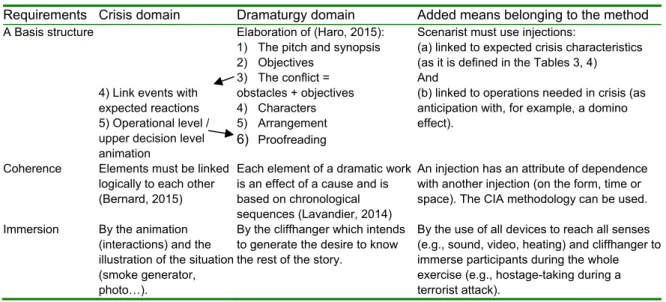
The objective of the method is to generate crisis management exercise scenarios. The method should guide the scenarist in the scenario design by choosing and order events in the script. This requires elaborating a typology of injections linked with pedagogical objectives (see part 3) and automating the arrangement of elements into the scenario. The method will be implemented in a tool in which scenarists fulfill exercise objectives, learners characteristics and answer questions to obtain crisis exercise scenarios (see part 4). To reach specific requirements, a non-exhaustive list of means is described in the Table 2 on the basis of the multidisciplinary approach (dramaturgy and crisis).
Table 2: Several means to elaborate a crisis exercise scenario with an analogy to drama
Requirements Crisis domain Dramaturgy domain Added means belonging to the method A Basis structure
4) Link events with expected reactions 5) Operational level / upper decision level animation
Elaboration of (Haro, 2015): 1) The pitch and synopsis 2) Objectives 3) The conflict = obstacles + objectives 4) Characters 5) Arrangement 6) Proofreading
Scenarist must use injections:
(a) linked to expected crisis characteristics (as it is defined in the Tables 3, 4) And
(b) linked to operations needed in crisis (as anticipation with, for example, a domino effect).
Coherence Elements must be linked logically to each other (Bernard, 2015)
Each element of a dramatic work is an effect of a cause and is based on chronological sequences (Lavandier, 2014)
An injection has an attribute of dependence with another injection (on the form, time or space). The CIA methodology can be used. Immersion By the animation
(interactions) and the illustration of the situation (smoke generator, photo…).
By the cliffhanger which intends to generate the desire to know the rest of the story.
By the use of all devices to reach all senses (e.g., sound, video, heating) and cliffhanger to immerse participants during the whole exercise (e.g., hostage-taking during a terrorist attack).
2.2 Main steps of the methodology
Global steps of the method, with associated tools, are summarized on Figure 1.
Figure 1: Method’s steps and associated tools
The first step of the method begins with the selection of the main hazard of the scenario. For this purpose, the method consists in identifying training needs (obtained through a preliminary investigation for example by means of questionnaire sent to trainees). Then several actions are automatically proposed to the scenarist: select objectives desired on a created data base of pedagogical objectives and answer to several questions (e.g., what kinds of organizations are involved in the exercise? Do you want to impact specific stakes?). Then, these needs and objectives selected by the scenarist are linked with several injections thanks to the matrix [objectives – injections] developed for the method. The model will choose randomly an injection for an objective but can also modify characteristics of one ever created. Subsequently the model arranges these injections, mainly on the basis of kinetics of past crises, to respond to objectives and to be coherent. Thus, the arrangement and the characterization of injections are needed. To respect the scenario requirements, the
3. The types of injections necessary to reach crisis exercise scenario requirements
A scenario is composed of several types of injections with different consequences. Indeed, the choice and the arrangement of injections will allow obtaining the expected crisis characteristics.
Crises are believed (1) to create urgency and time constraint (Guarnieri and Travadel, 2014; Quarantelli, 1988); (2) to have ambiguous and uncertain elements (Lagadec, 2005; Dautun, 2012); (3) to be unexpected (Portal, 2009; Robert, 2002) (4) to present a dilemma in need of decision or judgment that will result in change for better or worse (Sayegh et al., 2004).
A list of injections to obtain these features is proposed in Tables 3 and 4 in which an analogy is made between the crisis domain and dramaturgy. Thanks to this analogy, we propose as examples in following tables, a non-exhaustive list of possible injections to reach some of these essential features necessary to write a crisis scenario.
Table 3: Type of injections, which are levers for decision-making, in two domains: crisis and dramaturgy
Crisis domain Dramaturgy domain (a) By accelerating the flow of information and
resources (Mitroff and Pearson, 1993) to elaborate priorities.
(b) By requesting to evacuate or confine stakeholders (c) By injections that request to prioritize actions
(a) Dilemma: A situation in which a character must choose between two propositions of equal interest. It must induce a regret, culpability or pain. Example: The decision to evacuate or confine a stadium knowing that terrorists are close to it but managers don’t know where.
Table 4: Type of injections, which create unexpected/surprise, in two domains: crisis and dramaturgy
Crisis domain Dramaturgy domain In relation with the hazard:
(a) A level of gravity, complexity and a kinetic more extreme than the ones which are identified in available emergency plans (Robert and Weber, 2004)
(a) A hazard with an unprecedented nature
(b) A hazard with domino effects or identical event on several places From reactions of:
(a) The population (e.g. not tracking orders) (b) Field staff (e.g. leave their positions)
(c) Other organizations (e.g. willingness of actions different to those normally performed) (Guarnieri, 2015).
From disruption or dysfunction:
(a) Losses, non-adequacy or dysfunction of resources normally used in crisis management (Croq et al., 2009)
(b) Sudden inaccessible areas
(c) No immediate or planned solution: recurring processes do not work, no specific process or procedures are provided (Renaudin and Altemaire, 2007).
Unexpected situation:
(a) Failure of all actions undertaken by the cell (b) Request of actions against the principles or culture.
(c) Inadequacy of framework of the crisis management (Lagadec, 2005)
(a) Red herring: lead participants, without ambiguity, to believe something false. In order to bring another unexpected event (Lavandier, 2014). Crisis example: a call of a firefighter that says the situation is clear. This can mean that the problem is solved or that there is less smoke but the building is still in fire.
(b) A turn of events: it consists in revealing information to spectators at the adequate moment. Crisis example: the staff in charge of managing the evacuation has deserted since the beginning.
A crisis is characterized by numerous other features like flood: the surge of a lot of difficulties (disruption, victims...) on a really short time (Lagadec, 1991). The list of injections is developed through crisis characteristics found in the literature, through feedbacks of past crises and with needs of scenarists to call certain skills. The work made link all injections to specific objectives. An example is a call of an organizer of events to the local crisis organization to verify if good behaviors are enacted, if managers take into account elements given (e.g., 700 festival participants) and if information are shared to the entire crisis cell.
method must be automated thanks to links between injections and their arrangement in the scenario. The typology of injections used by the method is explained in the next part.
4. Modelling and automation of the method
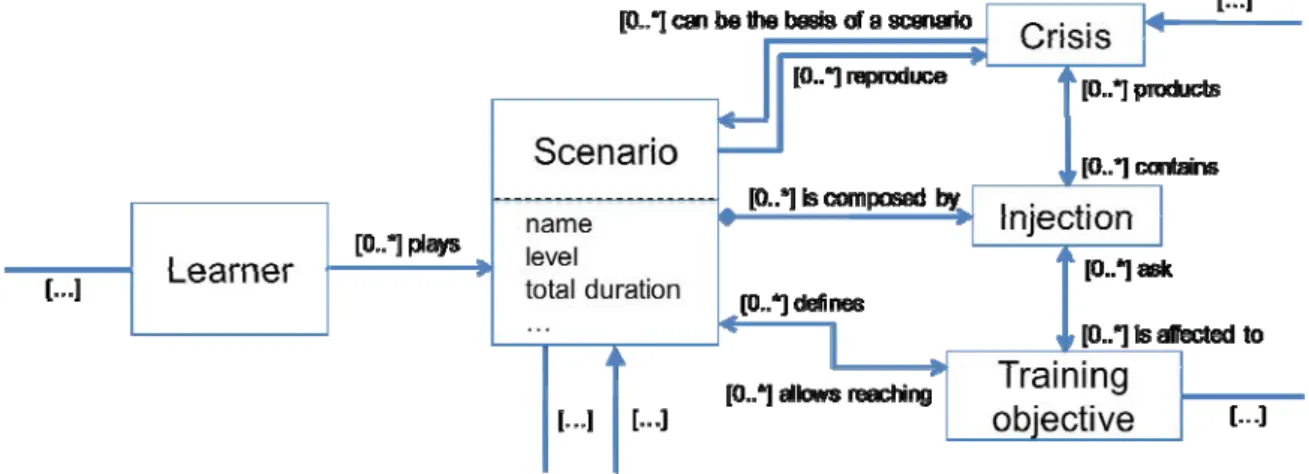
To model and automate the method, an engineering formalism is used. This will enable to elaborate interactions between all concepts and order injections in the scenario. This engineering formalism uses a class diagram in which several concepts are defined. Classes correspond either to milestone characteristics or all other elements that can be linked with (like association class between a learner and a function). Thus classes like the scenario, learners, organizations, functions, missions, objectives and injections are represented in the model.
These classes are described with attributes and operations which will enable to link them together. Figure 2 shows a part of the class diagram in development, only 5 classes with their links and some attributes are represented.
Figure 2: A part of the class diagram that describes typology of injections
For all elements involved in the method a class is created. This is the first part of the automation: define all concepts needed and their links to model the method. Moreover, other classes are created to elaborate the interface between scenarists and the tool. Then, it will be necessary to write, in computer language, rules of scenario generation to arrange and choose injections. The CIA method and past crisis analysis will help to define the kinetic of occurrence of injections in created scenario.
The result will be a graphic user interface that enables scenarists to fulfill the objectives of the training, to answer to a predefined list of questions and the model will be in charge to transform them in injections and order them to generate a scenario. Indeed, the use of engineering formalism enables to arrange these injections and create other injections to respond to all crisis exercise scenario requirements.
The model will help to choose randomly injections according to objectives and order these injections to generate a coherent and innovative scenario.
Conclusion
Crisis exercises are based on a scenario that must perform crisis management team competences. Several steps are necessary to elaborate a scenario enabling the injection of pedagogical levers. At the end of the process, scenarios must respect several requirements like coherence or flexibility.
The method presented in this paper deals with a way to elaborate crisis scenarios for simulation exercises. It identifies needs or gaps that must be filled to better develop skills and reproduce real situations of crisis. First, several concepts of the method are explained. Then, components are described to help and automate the method. The types of injections described previously and their arrangement in the scenario will be automated thanks to the formalism adopted (systems engineering approach).
Further research will continue with feedbacks of past crises to analyze the flow and types of scenario injections as well as components participating to development or decrease the crisis intensity.This work separates crisis following their type (fast or slow kinetic) and organisations studied (operational, tactic or decision level). Then, links between objectives and injections will be refined. The tool will be developed to order and arrange injections in the scenario using probability of events and quantitative methods. The process of scenarios evaluation is missing in the literature but a judgement could be made by script consultant (as crisis scriptwriter experts). Scenarios will be made with the tool developed and will be compared to crisis exercises scenarios already made. Similarly, several scenarios will be generated for the same exercise
(thanks to the random choice of injections in the database by the model). This allows us to see the benefits, weaknesses of the method, and especially the ability to generate synergies between scenarios. The comparison of scenario intensity could be based on the factor described by Dautun (Dautun, 2007). Moreover, the application of the method to several crisis exercises enables to test its operability and to keep improving it.
Reference
Bernard, L., 2015 Guide pratique de formation par la simulation, VA Press Editions, Paris, Versailles, 80. Bouget, G., Chapuis, J. and Vincent, J., 2009, Conception de scénarios d’attaque de systèmes complexes.
Available at: http://ws3sgs09.loria.fr/articles/vincent.pdf
Cannon-Bowers, J.A., Bowers, C.A, 2007, Synthetic Learning Environments. University of Central Florida, Orlando, Florida, 12.
Dautun, C., 2007, Contribution à l'étude des crises de grande ampleur: Connaissance et aide à la décision pour la Sécurité Civile, Ecole Nationale Supérieure des Mines, Paris, Saint-Etienne, 271.
D.S.C. (Direction de la Sécurité Civile), 2011, Exercices de Sécurité Civile : Guide méthodologique sur les exercices cadre et terrain, Ministère de l’intérieur, de l’outre-mer et des collectivités territoriales et de l’immigration, 70.
Fagel, M.J., 2014, Crisis Management and Emergency Planning: Preparing for Today’s Challenges, CRC Press Taylor and Francis Group, 502.
Guarnieri, F. and Travadel, S., 2014, Fukushima-Daiichi, le temps de l’ingénierie de l’urgence, Centre de recherche sur les risques et les crises, mines ParisTech, 23.
Guarnieri, F., Travadel, S., Martin, C., Portelli, A., Afrouss, A., 2015 L’accident de Fukushima-Daiichi, vol. 1, Presses des MINES, Paris, 342.
Haro, F., 2015, Ecrire un scénario pour le cinéma : Comédie, drame, policier, mélodrame, thriller, court métrage, fantastique, ed. Eyrolles, Paris, 316.
Kleiboer, M., 1997, Simulation methodology for crisis management support, Journal of Contingencies and Crisis Management, 5,4, 198–205.
Lagadec, P., 1991, La Gestion des Crises - Outils de réflexion à l'usage des décideurs, McGraw Hill, 1991, 300.
Lagadec, P., 2005, Crisis management in the 21st century "unthinkable" events in "inconceivable" contexts, CECO-219.
Lagadec, P., 2007, Katrina: Examen des rapports d’enquêtes Tome2: The Federal Response to Hurricane Katrina – Lessons learned», The White House, Cahier n°2007- 11, First version, 156 p.
Lagadec, P., 2015, Le continent des imprévus: Journal de bord des temps chaotiques, Manitoba / Les belles lettres, Paris, 266.
Lavandier, Y., 2014, La dramaturgie : l’art du récit, Le clown and l’enfant, 550.
MacKinnon, L., Bacon, L., 2012, Developing Realistic Crisis Management Training, Proceedings of the 9th International ISCRAM Conference, Vancouver, Canada.
McCreight, R., 2011, An introduction to emergency exercise design and evaluation, Government Institutes, The scarecrow press, Plymouth, UK, 169.
Portal, T., 2009, Crises et facteur humain, De Boeck, Bruxelles, 272.
Quarantelli, E. I., 1988, Disaster crisis management: A summary of research findings, Journal of Management Studies, 25, 373–385.
Rankin, A., Kovordanyi, R., Field, J., Morin, M., Jenvald, J., and Eriksson, H., 2011, Scenario-Based Modeling for Simulation Systems. In Proceedings of ISCRAM 2011, Lisbon, Portugal.
Renaudin, H., Altemaire, A., 2007, Gestion de crise : mode d'emploi, Liaisons, 176.
Robert, B., 2002, Nouvelles pratiques pour le pilotage des situations de crise : dix ruptures pour passer d'une logique de procédures à l'apprentissage de la surprise. Environnement, Risques and Santé, 1(1), 22-30. Robert B., Weber C., 2004, Esquisse d’un alphabet de la surprise – peut-on prévoir l’imprévisible ? Scrabble
antique pour temps modernes. Argillos, France.
Sayegh, L., Anthony, W.P., Perrewé, P.L., 2004, Managerial decision-making under crisis: the role of emotion in an intuitive decision process, Human Resource management Review, vol. 14, 179-199.
Turoff, M., 1972, An Alternative Approach to Cross Impact Analysis, Technological Forecasting and Social Change 3, 309-339
Walker, W. E., 1995, The use of scenarios and gaming in crisis management planning and training, RAND Ed., 1–18.