Science Arts & Métiers (SAM)
is an open access repository that collects the work of Arts et Métiers Institute of Technology researchers and makes it freely available over the web where possible.
This is an author-deposited version published in: https://sam.ensam.eu Handle ID: .http://hdl.handle.net/10985/10838
To cite this version :
Maxence BIGERELLE, Thomas MATHIA, Alain IOST, Thierry COOREVITS, Karine ANSELME -An expert system to characterize the surface morphological properties according to their
functionalities - In: 13th International Conference on Metrology and Properties of Engineering Surfaces, Royaume-Uni, 2015-07-12 - Journal of Physics: Conference Series - 2011
Any correspondence concerning this service should be sent to the repository Administrator : [email protected]
This content has been downloaded from IOPscience. Please scroll down to see the full text.
Download details:
IP Address: 193.51.48.34
This content was downloaded on 15/07/2015 at 16:25
Please note that terms and conditions apply.
An expert system to characterize the surface morphological properties according to their
functionalities
View the table of contents for this issue, or go to the journal homepage for more 2011 J. Phys.: Conf. Ser. 311 012010
(http://iopscience.iop.org/1742-6596/311/1/012010)
An expert system to characterize the surface morphological
properties according to their functionalities
M Bigerelle1, T Mathia2, A Iost3, T Correvits4 and K Anselme5
1
Laboratoire Roberval, UMR 6253, UTC/CNRS, UTC Centre de Recherches de Royallieu BP 20529, 60205 Compiègne France stol BS1 6BE, UK
2
Laboratoire de Tribologie et Dynamique des Systèmes, UMR 5513, Ecole Centrale de Lyon, 36 Av Guy de Collongue, 69134 Ecully Cedex, France
3
Laboratoire de Mécanique de Lille, UMR CNRS 8107, Arts et Métiers ParisTech - Lille, 8, boulevard Louis XIV 59046 Lille.
4
Laboratoire de Métrologie. Arts et Métiers ParisTech, ENSAM, 8 boulevard Louis XIV, 59046 LILLE Cedex, France.
5
Institut De Sciences Des Matériaux De Mulhouse, CNRS LRC 7228, 15, rue Jean Starcky, Université De Haute-Alsace, BP 2488, 68057 Mulhouse, France.
E-mail: [email protected]
Abstract. In this paper we propose a new methodology to characterize the morphological
properties of a surface in relation with its functionality (tribological properties, surface coating adhesion, brightness, wettability…). We create a software based on experimental design and surface profile recording. Using an appropriate database structure, the roughness parameters are automatically computed at different scales. The surface files are saved in a hard disk directory and roughness parameters are computed at different scales. Finally, a statistical analysis system proposes the roughness parameter (or the pair of roughness parameters) that better describe(s) the functionality of the surface and the spatial scales at which the parameter(s) is (are) the more relevant.
1.Introduction
The precise characterization of machined surfaces roughness is of a major interest in many engineering industries due to its influence on the functionality of manufactured products. For obvious reasons of costs minimization, manufacturers are interested in developing reliable and simple control methodologies suitable for use in routine production environments, with a high degree of quantitativeness and data repeatability. The topographic method is by far the most implanted ones in surface quality assessment of metallurgical or mechanical products. The roughness of machined surfaces is of prime importance across a very wide spectrum of technical and scientific activities;
1
To whom any correspondence should be addressed.
13th International Conference on Metrology and Properties of Engineering Surfaces IOP Publishing
Journal of Physics: Conference Series 311 (2011) 012010 doi:10.1088/1742-6596/311/1/012010
including not only tribologists and production engineers but also highway and aircraft engineers, hydrodynamicists and even bioengineers. Indeed, the morphology of machined surfaces often influences the properties that govern the application of the manufactured product. Consequently there still exists an increasing interest in developing reliable methodologies, suitable for quality control stage processes of surface products, in a manufacturing environment. Because of these various industrial and scientific interests, a proliferation of roughness parameters, possibly running into hundreds, has been triggered to describe the different kinds of surface morphology with regard to specific functions, properties or applications. In spite of this proliferation, termed by Whitehouse the "parameter rash", there is still no complete comprehensive account for the relevance of these roughness parameters. More, it becomes difficult to choose one parameter rather than another one. This probably comes from a lack of global methodology combined with the limits of the softwares used to characterize the surface morphology presently available on the market. In our opinion, the main objective of such a global methodology should be to determine quantitatively, and without preconception, the most relevant roughness parameter that characterizes the surface morphology of a manufactured product with regard to a correlation with a particular function, property or application [1]. Moreover one other important challenge we have to take up is to define the scale at which one parameter must be evaluated to be pertinent. This led us to observe and analyze the problems of existing software:
1. Are not adapted to deal with a data file.
2. Only a limited number of parameters.
3. Are unsuitable for statistical analysis.
4. Often a system designed for a specific measure.
5. Requires too many manipulations.
6. Reliability of certain procedures?
7. No non-linear algorithm.
8. Sustainability software.
9. Do not possess multiscale treatments.
These many questions have no answers at present. Indeed, software trade can not offer a solution to the raised issues. For these reasons, we decided to design our own surface status analysis system called “MesRug”
2.Presentation of MesRug
This environment for surface conditions analysis (so-called “MesRug”) is a software processing roughness files. The analysis starts with the experimental design construction. Each process parameter set is in relation with a measurement data file. The save of time in processing with MesRug is significant. We illustrate this by a simple example. Profile measurements are carried out on the sample. The purpose of this analysis is to answer to the question: what are the roughness parameters that best discriminate process parameters and at which scale must they be evaluated? We enter all necessary information in “MesRug” and launch calculation of roughness parameters. “MesRug” processes all files, creates text files for further subsequent analysis (spectrum, autocorrelation function…) and graphics files while preserving the coding performed by the operator. The result files are encoded to be used in Excel, Statistica and SAS (Statistical Analysis System). The statistical processing is done under the SAS language.
3.Structure and Construction
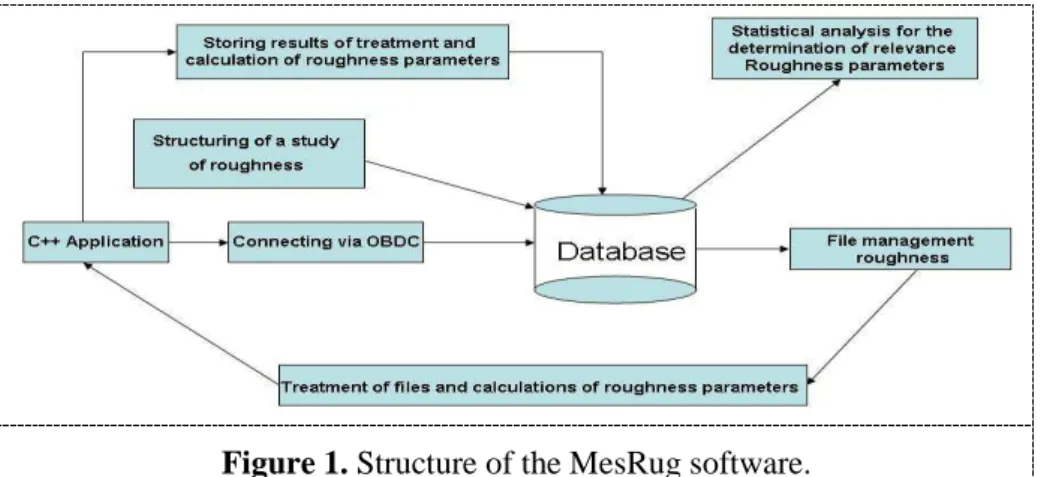
This system is built from a database which allows describing, manipulating, processing the data sets and can be used by non-scientists. Fig. 1 diagrams the links between the various parts of the data treatment.
13th International Conference on Metrology and Properties of Engineering Surfaces IOP Publishing
Journal of Physics: Conference Series 311 (2011) 012010 doi:10.1088/1742-6596/311/1/012010
Figure 1. Structure of the MesRug software.
3.1.Recovery profile and calculation of parameters
The database is programmed in C++. Open DataBase Connectivity (ODBC) enables to treat data files via Access, ActiveX Data Object (ADO) and SQL. We build a structure that allows to realize a multiscale pretreatment (polynomial interpolation, Gaussian filter, Bspline, wavelet transform…) to transform initial profile in order to calculate roughness parameters. This structure is constructed in an open source concept to allow in the future an easy integration of new procedures and pretreatment process.
3.2.The script language
The basic idea we developed is to use a script language that allows to detail the structure of the analyses treatment . Then all computations are applied to the set of roughness file without manipulation. To organize this structure, a recursive scheme of data is proposed. Rather to generalize our data structure, we will treat a simple case of profile. For a given profile, we process to the following treatment: first a low Gaussian pass filter and a high pass Gaussian filter are applied on the initial profile, then a multiscale analysis is processed on these filtered profiles with two characteristic lengths (10 and 100 intervals). As a consequence, one gets 1x2x2=profiles on which roughness parameters can be computed. Then a Ra and Rq and fractal dimension (by DF method (structure
method) with some scale parameters) are computed on these profiles.
Figure 2. Multiscale analyses on a tooled surface.
The recursive scheme can be formulated as follows: Possible de mettre la formule en plus grand?
1 I n i t i a l P r o f i l e G a u s s i a n F i l t e r c u t o f f 8 0 0 µ m M u l t i - s c a l e a n a l y s e s b y B s p l i n e o f d e g r e e 1 1 0 0 i n t e r v a l s 1 0 i n t e r v a l s 10 0 i nt e r v a l s 1 0 i n t e r v a l s L o w p a s s F i l t e r H i g h p a s s F i l t e r T[Mt][Y1,{Z1 1, Z12, Z13,...,Z1n1}]
Number of the treatment method Number of the structure Sub structure values
13th International Conference on Metrology and Properties of Engineering Surfaces IOP Publishing
Journal of Physics: Conference Series 311 (2011) 012010 doi:10.1088/1742-6596/311/1/012010
In our case, one gets the following script : // Gaussian Filtering (Vorburger algorythm) T[3][1,{800}]
T[3][2,{passe_haut,passe_bas}] // Bsplines analyses
T[2][1,{1}]
T[2][2,{10,100}]
// Ra, Rq and fractal dimension using 100 scales from 10 to 10000 R[Ra]
R[Rq] // windows following a geometrical progression ({2}). R[DF,{10},{10000},{1000},{2}]
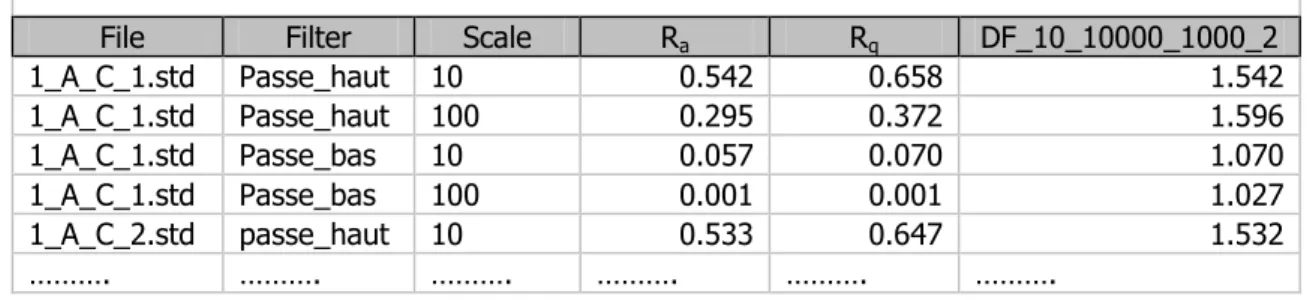
And the result is given is our database (table 1)
Table 1. Result of multi-scale analyses stored in our DataBase thanks to ODBC protocol
File Filter Scale Ra Rq DF_10_10000_1000_2
1_A_C_1.std Passe_haut 10 0.542 0.658 1.542 1_A_C_1.std Passe_haut 100 0.295 0.372 1.596 1_A_C_1.std Passe_bas 10 0.057 0.070 1.070 1_A_C_1.std Passe_bas 100 0.001 0.001 1.027 1_A_C_2.std passe_haut 10 0.533 0.647 1.532 ………. ………. ………. ………. ………. ……….
4.Evaluation of the relevance of the roughness parameters and their associated range
As the database is created with all values of multi-scale aspects, the main purpose is to analyze what are the best roughness parameters to describe physical phenomena and their associated scales. In fact, the answer to this question is not so obvious and must be formulated in a statistical sense. Several cases are presented and treated with appropriate statistical tools. In this paper, only two cases will be treated.
An experimental design is built to create some surfaces (as tooling …. ) and the question is :
What are the influence of the process parameters on surface topography ?
This question is reformulated as follow in surface topography formalism:
What are the best roughness parameters evaluated on an appropriate scale that allow to better discriminate the effect of the process on the surface topography ?
This question must be also reformulated in a statistical sense. In this case, the analyses of variance will be used. This method allows giving the influence of each ith process parameter
p
i (withi
∈
{
1
.
L
I
}
) on the value of the jth roughness parameters qj (withj
∈
{
1
.
L
J
}
) evaluated at the kth scaleε
k (k
∈
{
1
.
L
K
}
) that is noticed qj( )
ε
k . To test the relevance of qj( )
ε
k to well characterize the effect of the I process parameters pi, K×J analysis of variance are performed for all J roughnessparameters and all K discretized scales. The Fisher variate F is used to quantify the effect i.e. the relevancy and is noted
F
pj(
q
j( )
ε
k)
. IfF
pj(
q
j( )
ε
k)
>
1
then qj( )
ε
k roughness parameters is13th International Conference on Metrology and Properties of Engineering Surfaces IOP Publishing
Journal of Physics: Conference Series 311 (2011) 012010 doi:10.1088/1742-6596/311/1/012010
relevant to characterize the pj process parameter. The higher
F
pj(
q
j( )
ε
k)
>
1
is, the more relevant( )
k jq
ε
roughness parameter is. It can be specified that the interaction between process parametersq
iand
q
i' can also be computed and noticedF
p p(
q
j( )
k)
j
j, '
ε
.F value allows us to gather the roughness parameters that possess the same relevance on a range scale
[
ε
k,
ε
k']
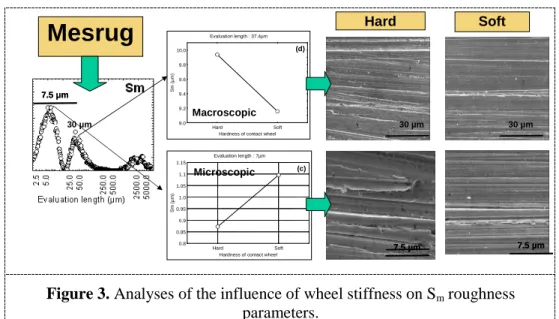
rather on a unique one. Let illustrate now our purpose by one example based on belt finishing process taking account 7 process parameters (wheel stiffness, pressure, oscillation, grit size…) [2]. For the wheel stiffness, the best roughness parameter is the Sm (distance between asperities). Let nowanalyze the results by plotting the
F
stiffness(
Sm
( )
ε
k)
versusε
k (figure Fig. 3 on the left). This curve presents 3 local maxima. One of the extreme is based on the very high scale (around 2500 µm). At this scale, Sm is higher for the softer wheel (result not shown). This tendency is due to the elasticdeformation of the wheel during contact that creates some waves of low frequency on roughness of
materials. At the scale of 7.5 µm (microscopic scale), Sm is higher for the softer wheel. At this scale,
roughness is analysed on a scale less that the mean size of the grooves and then the seen roughness is the groove. Into the groove, ploughing wear is higher with soft wheel (see fig. 3) and naturally
increases the mean size between asperities. On the contrary, at the scale of 30 µm, Sm is higher for the
higher stiffness. At this scale, roughness is analysed on a scale higher than the mean size of the grooves and then characterizes the groove’s width. When stiffness wheel increases, indentation depth increases and Sm naturally increases.
Figure 3. Analyses of the influence of wheel stiffness on Sm roughness
parameters.
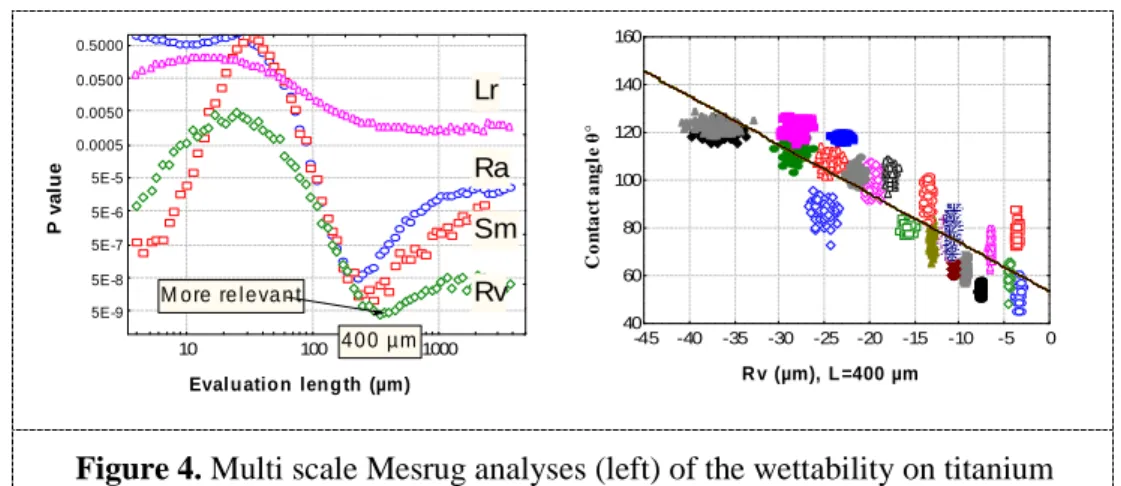
The second example is linked to the functionality of the surfaces and can be also treated by our software. Let answer to the question: what is the best roughness parameter that characterizes the wettability of titanium surfaces? This problem is reformulated in a statistical sense “what is the best relation between a roughness parameter evaluated at a given scale and the measure of wettability noted w i.e.
w
=f
(
q
j( )
ε
k)
where f is a given functional (as linear one). In this case, we find the best correlation by a linear one characterized by a Student variate (P value). With this result, it was found that the best parameter to characterize contact angle is Rv (valley amplitude) and that the functional f islinear and evaluated at 400 µm (fig. 4). This result was explained by the Cassie Baxter theory rather by the Wenzel one.
Evaluation length : 37.4µm
Hard Soft Hardness of contact wheel 9.0 9.2 9.4 9.6 9.8 10.0 S m ( µ m ) (d) Evaluation length : 7µm Hard Soft Hardness of contact wheel 0.8 0.85 0.9 0.95 1.0 1.05 1.1 1.15 S m (µ m ) (c) 7.5 µm 7.5 µm Hard 30 µm Soft 7.5 µm 7.5 µm 30 µm 30 µm 7.5 µm 7.5 µm Macroscopic Microscopic
Mesrug
13th International Conference on Metrology and Properties of Engineering Surfaces IOP Publishing
Journal of Physics: Conference Series 311 (2011) 012010 doi:10.1088/1742-6596/311/1/012010
Figure 4. Multi scale Mesrug analyses (left) of the wettability on titanium
surface roughness (right).
5.Conclusion
We have constructed a methodology to select roughness parameters with regard of surface functionalities. It was shown that relation between parameters can depend on the scale. Thanks to our expert system Mesrug, it was possible to quantify the different scales at which parameters must be evaluated. Applied on different surface engineering studies, it was then possible to explain how surface topography influences the integrity (abrasion) or functionality (wettability) of materials. A 3D version of Mesrug is under construction.
6.References
[1] Najjar D, Bigerelle M and Iost A 2003 Wear 254 450
[2] Van Gorp A, Bigerelle M, El Mansori M, Ghidossi P and Iost A 2010, Int. J. Mater. Prod. Tech. 38 66
Acknowledgments
This work was realized within the framework of the project “Functional Impacts of the three-dimensional rough surfaces” financed by the region “Picardie” and Europe. We want to thank Gildas Guillemot and Adrien Van Gorp for their contributions to the programming of Mesrug Software.
Evalu atio n len g th (µm)
P v a lu e 10 100 1000 5E-9 5E-8 5E-7 5E-6 5E-5 0.0005 0.0050 0.0500 0.5000 M o re re l e va n t 4 0 0 µ m Rv Sm Ra Lr R v (µm), L =400 µm C o n ta ct a n g le θ ° -45 -40 -35 -30 -25 -20 -15 -10 -5 0 40 60 80 100 120 140 160
13th International Conference on Metrology and Properties of Engineering Surfaces IOP Publishing
Journal of Physics: Conference Series 311 (2011) 012010 doi:10.1088/1742-6596/311/1/012010