HAL Id: hal-02142949
https://hal.archives-ouvertes.fr/hal-02142949
Submitted on 29 May 2019
HAL is a multi-disciplinary open access
archive for the deposit and dissemination of
sci-entific research documents, whether they are
pub-lished or not. The documents may come from
teaching and research institutions in France or
abroad, or from public or private research centers.
L’archive ouverte pluridisciplinaire HAL, est
destinée au dépôt et à la diffusion de documents
scientifiques de niveau recherche, publiés ou non,
émanant des établissements d’enseignement et de
recherche français ou étrangers, des laboratoires
publics ou privés.
Adaptive special reports for on-line newspapers
Sébastien Iksal, Serge Garlatti
To cite this version:
Sébastien Iksal, Serge Garlatti. Adaptive special reports for on-line newspapers. AH 2002 : Second
International Conference on Adaptive Hypermedia and Adaptive Web-Based Systems, Workshop on
Personalization Techniques in Electronic Publishing, May 29-31, Malaga, Spain, May 2002, Malaga,
Spain. pp.27 - 30. �hal-02142949�
Adaptive Special Reports for On-line Newspapers
Sébastien Iksal and Serge GarlattiDepartment of Artificial Intelligence and Cognitive Sciences ENST Bretagne - Technopôle de Brest Iroise
B.P. 832, 29285 Brest Cedex, France
{sebastien.iksal, serge.garlatti}@enst-bretagne.fr
Abstract. Internet may bring new opportunities for electronic documents and Press agencies. Numbers of daily newspapers in the world propose their elec-tronic version. The articles may be published in very different contexts which requires to be able to mix different sources, to provide different presentations, etc. Then, it is necessary to ensure reusability, sharing and exchange on the internet/intranet. Semantic web initiative can be an opportunity for on-line newspapers, news repositories or portals. Personalization/adaptation is an im-portant issue in the semantic web. Indeed, adaptive web services have the abil-ity to deal with different users’ needs for enhancing usabilabil-ity and comprehen-sion and for dealing with large repositories. Nowadays, it is not sufficient for a newspaper to provide raw information (news wires of Press Agencies). One of the most important task of journalists is to select, synthesize and analyze infor-mation and events for his readers. Special reports seem to be the most represen-tative journalists’ task. A special report offers news as well as analysis, debate, synthesis and/or development. A digital special report can be considered as an adaptive virtual document. The main goal of ICCARS is to assist the journalist in creating these adaptive special reports.
Keywords. Adaptive navigation, Adaptive presentation, Press, Semantic Com-position, Virtual Document
1 Introduction
Press institutions on television, radio as well as the printed Press have web services, news repositories and/or portals. Some daily newspapers propose their “printed” edi-tion and the digital one at the same time (Le Monde [1], Le Télégramme [2] …). Oth-ers like monthly magazines differ their editions (Linux Magazine [3]). The high avail-ability of Internet modifies the organization of newspaper’s offices, as well as the Press behavior. Now journalists work with electronic mail, chat, search engines …, and use Internet as a way for accessing information and getting contact with Press agencies. Numbers of daily newspapers in the world propose an electronic version. A lot of Web users (individuals, corporates, sme’s, administrations, …) are interested in
on-line newspapers and news repositories. So it’s easy to understand that Internet may bring new opportunities for electronic documents and Press agencies. Most of Press agencies have to or would like to retrieve and/or sell or buy articles. These articles may be published in very different contexts which requires to be able to mix different sources, to provide different layouts, etc. Then, it is necessary to ensure reusability, sharing and exchange on the internet/intranet, and these features require to have a precise search engine. Indeed, it is well known that keyword-based information access presents severe limitations concerning precision and recall. On the contrary, intelligent search engines, relying on semantic web initiative [4] and semantic metadata, over-come these limitations [5, 6]. Semantic web initiative can be an opportunity for on-line newspapers, news repositories or portals.
Nevertheless, information space is so huge that it is not sufficient to have a precise search engine. It is necessary to take into account user interests – at least – to be sure to focus on relevant pieces of information. Personalization/adaptation is an important issue in the semantic web, but also for electronic documents. Some web sites personal-ize the access to information and others the search engine. Internet increased the need to satisfy the reader, that is why numbers of sites provide personalized services. Adap-tation/personalization is one of the main issues for web services. But, it is not limited to filtering processes. Indeed, adaptive web services have the ability to deal with dif-ferent users’ needs for enhancing usability and comprehension and for dealing with large repositories. Indeed, adaptive web applications - also often called Adaptive Hypermedia Systems - can provide different kinds of information, different layouts, different navigation tools according to users’ needs [7]. Creating adaptive web ser-vices from news repositories or portals requires the following features: i) methods to facilitate web application creation and management and ii) reuse, sharing and ex-change of data through the internet/intranet. The notion of flexible hypermedia and more particularly that of virtual documents can lead to methods facilitating web appli-cation design and maintenance. According to Watters, “A virtual document is a docu-ment for which no persistent state exists and for which some or all each instance is generated at run time” [8]. Virtual documents have grown out of a need for interactiv-ity and individualization of documents, particularly on the web. Virtual document and adaptive hypermedia are closely related – they can be viewed as the two faces of the same coin.
Nowadays, it is not sufficient for a newspaper to provide raw information (news wires of Press Agencies). One of the most important task of journalists is to select, synthesize and analyze information and events for his readers. In such framework, special reports seem to be the most representative journalists’ task. A special report offers news as well as analysis, debate, synthesis and/or development. It can be viewed as an organized collection of articles offering a viewpoint on events. We con-sider the digital special reports as adaptive virtual documents. We are interested in adaptive virtual documents for author-oriented and reader-oriented web services pro-viding several reading strategies to readers. In this paper, we focus on organizations called narrative structure for author-oriented reading strategies. An author-oriented reading strategy have the following characteristics: authors have know-how which enables them to choose special report contents and to organize them in one or more consistent ways – author reading strategies.
First of all, adaptive special reports by means of the ICCARS Project are presented. Secondly, we will show why it is interesting to manage the different views of the spe-cial report separately. Thirdly, the adaptation will be analyzed via our adaptive seman-tic composition engine. Finally, we will conclude by some perspectives.
2 Adaptive Special Reports
ICCARS is the acronym for Integrated and Cooperative Computer Assisted Reporting System. It is a joined project between the IASC Laboratory, a SME called Atlantide and a regional daily newspaper called Le Télégramme. It is funded by Brittany Re-gional Council. The ICCARS prototype is a computer assisted reporting system. Its main goal is to assist the journalist in creating adaptive special reports. These docu-ments are able to include audio and video material, links, and they are no longer lim-ited in size.
Internet increased the need to satisfy the reader, that is why numbers of sites pro-vide personalized services. Someone propro-vide all the most interesting news according to your preferences through e-mail such as e-revue [9]. For a web site, an interesting solution is offered by Crayon [10] which assist the reader in organizing his own news-paper (it is possible to name it like “The MyNewsPaper Post” or “The MyNewsPaper Tribune”). The internet reader is able to modify his newspaper and to select who is allowed to read it. But it has been made by the reader, which is very limited. We need to have automatic or semi-automatic processes able to filter information space for readers. A lot of Web sites propose to personalize the access and the layout of the information written for the printed newspaper. Two projects work with personalized news which can be read through a Web site. Sistemi Telematici Adattativi [11] is a project which propose to filter and display news and ads according to user’s prefer-ences and characteristics. KMI Planet [12] is a kind of private on-line newspaper where all readers and writers are in a same group. It collects news through e-mail, processes and sends the result to the most interested readers. The tool is able to sort articles in order to fill in gaps, and after to inform the reader when the news is ready. It offers also an advanced interface for searching documents.
During a long time, local Press agencies were the main local news providers, but with Internet, new actors like “guides” propose local news. At the beginning, city-guides aimed at supplying information about public services, classified, association, weather … Today, they have their own team of journalists [13] and propose national and local news. Then, the local newspapers created their own city-guides such as http://www.vivabrest.com for Le Télégramme. National Press agencies are also con-cerned by the phenomenon because some sites such as Internet providers propose classified [14]. They receive all news wire from agencies like AFP (Agence France Presse), Reuters. The main challenge for Press agencies is not to only be information providers but also to offer new services on the web. The printed Press loses numbers of readers, so Internet is a new medium useful for increasing their readership and in fact their income with advertising, e-business … The Internet user is able to use vari-ous search engines to collect information. Nevertheless, this set of data needs to be
analyzed and synthesized. Due to internet features, numerous web sites proposed electronic special reports which are composed of a set of articles. Most of the time, they don’t provide a relevant organization of these articles, sometimes they don’t provide an organization. The structure proposed actually is a classification by the date of publishing and sometimes articles are grouped inside various headings. Our main objective is to propose various organizations for a same special report in order to increase the comprehension. It’s possible to offer personalized organizations for digi-tal special reports by considering virtual documents. We consider the digidigi-tal special reports as adaptive virtual documents, we define them as follows:
• An adaptive/personalized virtual document consists of a set of information frag-ments, ontologies and a semantic composition engine which is able to select the relevant information fragments, to assemble and to organize them accord-ing to an author's strategy or reader's goals by adaptaccord-ing various visible aspects of the document delivered to the reader.
We are interested in adaptive virtual documents for author-oriented and reader-oriented web services providing several reading strategies to readers. An author-oriented reading strategy have the following characteristics: authors have know-how which enables them to choose special reports contents and to organize them in one or more consistent ways – author reading strategies. A reader-oriented strategy is an overall document structure computed from reader’s goals. For instance, it can be based on geographic, history or topic criteria – a domain model – or a task model organizing the access to articles. Nevertheless, journalists have to be aware of such structures because they associate metadata with articles and special reports for these services. In this paper, we focus on organizations called narrative structure for author-oriented reading strategies. The reader has the ability to recognize – sometimes un-consciously – these structures. For instance, scientific papers, courseware, report, special report in journalism, etc., have each of them a distinct narrative structure. At present, the narrative structure is implicit in printed document, but also in digital one. Such author’s know-how and skills can be represented at knowledge level and then be shared and reused among authors, used for generating web documents dynamically and for enhancing reader comprehension. A narrative structure provides an overall document structure which is a declarative description of web documents which offers a particular view on a special report. In electronic documents, there are different views which can coexist.
3 Special Report Views
In a digital document, three different views coexist: semantic, logical and layout [15]. For each view we have a specific structure. The semantic structure of a document conveys the organization of the meaning of the content of a document. This view fits the semantic level of the semantic web architecture. Indeed, it can be represented by ontologies. Ontologies are used to model types of fragment as well as their relation-ships. The overall document structure modeled from an ontology is a narrative struc-ture designed by a writer for presenting a particular angle on a set of articles. A
narra-tive structure is composed of nodes and semantic relationships. Nodes are spans of texts. Relationships belong to those analyzed by Rhetorical Structure Theory (RST) [16]. RST defines relations between spans of text, each span have a role inside the relation (nucleus and satellite). Each relation is defined by some constraints on the nucleus, the satellite, the combination of the nucleus and the satellite, and an effect to the reader. Among these relations, we can find are antithesis, restatement, summary, interpretation and so on. For instance, “The fragment A which is an interview is the volitional cause of the fragment B which is an analysis”, the underlying relationship cannot be represented by a syntactic structure [17]. Interview and analysis are types of fragment. The interview is the satellite and the analysis is the nucleus of this rhetorical relation [16]. This relation is oriented and encode a particular reading guide. In this case, the fragment B will be better understood if the fragment A is read before. It could be interesting to show the type of relation to the reader as explanations or for increasing the comprehension.
The logical structure reflects the syntactic organization of a document. A document (for example books and magazines) can be broken down into components (chapters and articles). These can also be broken down into components (titles, paragraphs, figures and so forth). It turns out that just about every document can be viewed this way. The logical view fits the syntactic level of the semantic web architecture. A logi-cal structure can be encoded in XML [18]. The layout view describes how the docu-ments appear on a device and a layout structure describes it, (e.g. the size and color of headings, texts, etc). The layout view may be processed by an XSLT processor [19] for transforming an XML document into an HTML document that can be viewed by any web browser. It can also be processed by a java engine able to compute an XML document for presenting by a web browser.
In a printed document, these three views are intertwined and are not separable. There is no straightforward mapping between the semantic and the logical structure, that is to say, for instance, a paragraph does not correspond to a particular content’s meaning. On the other hand, the logical and layout structure are closely related. In-deed, the layout structure encodes the logical structure. For instance, each section element has a particular presentation – font, size, color, etc. The semantic structure is implicit and so it can be analyzed and/or recognized by a reader. Moreover, it is a key issue for reader comprehension. In a digital document, these three views may be rep-resented and managed.
A special report model can be computed on the fly by means of a semantic compo-sition engine using: i) an overall document structure – a narrative structure - represent-ing a readrepresent-ing strategy for which node contents are substituted at run time, accordrepresent-ing to reader’s needs for adaptation, ii) an intelligent search engine, iii) semantic metadata, and iv) a reader model. This semantic composition engine architecture relies on these three views. Each special report model is computed when it is necessary, we don’t store the delivered reports. An authoring tool is provided for creating narrative struc-tures, specifying their content and associating metadata.
4 Adaptive semantic composition engine
The semantic composition engine allows adaptive presentation and navigation. A reader chooses a particular special report and a corresponding reading strategy. Then, the system computes on the fly an adapted special report for this reader, web pages and their layouts. First of all, we present the semantic composition engine architecture. Secondly, our assumptions and design criteria are detailed. Finally, the adaptation process is described.
4.1 Semantic Composition Engine Architecture
Our semantic composition engine relies on OntoBroker for ontology management and intelligent search engine. OntoBroker is a knowledge management engine which is useful for filtering and information retrieval in a large amount of data as well as in the model specification – ontologies [6, 20, 21]. OntoBroker contains four ontologies [22] and facts closely related to them. These ontologies are: a domain ontology for repre-senting contents, a metadata ontology at the information level which describes the indexing structure of fragments, a user ontology which may define different stereo-types and individual features and a special report ontology which represents the au-thor’s competences and know-how for creating special report models [23]. The do-main ontology defines a shared vocabulary used in the metadata schema for the con-tent description of data. It will also be used by the semantic composition engine as an overall document structure, by the user as an information retrieval tool because the user often has difficulty in defining his/her interests, and it is easier for him/her to recognize required information in a domain model than to specify it.
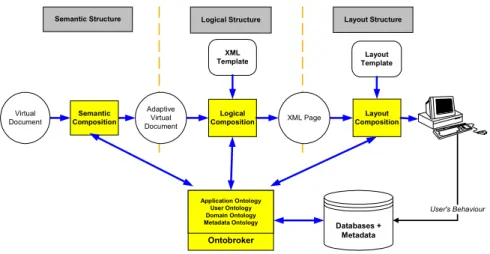
According to the three views of a document, our semantic composition engine ar-chitecture is described below (cf. fig. 1). One of the main ideas behind the notion of semantic composition engine is to declare as much as possible all the reader’s tasks and interactions. The semantic composition engine is composed of three different stages: a semantic composition which manages the semantic structure of a special report model for defining a reader adapted special report and selects its contents, a logical composition which computes an XML web page from the reader adapted spe-cial report and a layout composition which computes the current web page layout from the XML structure. This architecture is based on two different studies: ICCARS Pro-ject and CANDLE ProPro-ject [24] (Collaborative and Network Distributed Learning Environment) which is an European project.
Semantic Composition Logical Composition Databases + Metadata User's Behaviour
Semantic Structure Logical Structure Layout Structure
Ontobroker Application Ontology User Ontology Domain Ontology Metadata Ontology Adaptive Virtual Document Virtual Document XML Page Layout Composition XML
Template TemplateLayout
Fig. 1. The Semantic Composition Engine Architecture
4.2 Assumptions and Design Criteria
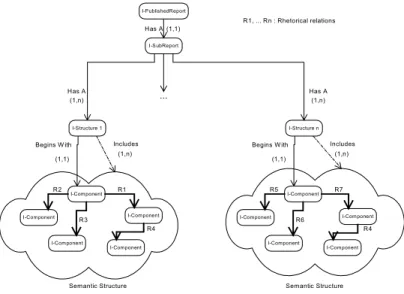
A special report model is composed of an information space - a set of fragments - and at least one narrative structure. We assume the structure is a directed acyclic graph. Each edge has a particular type which is a relation taken in the Rhetorical Structure Theory. Each node contains a specification which is used by an information retrieval process to find all relevant fragments. Fragments can be atomic or abstract informa-tion units. The latter are composed of atomic and abstract informainforma-tion units. Articles are atomic fragments and sub-reports are abstract fragments. A special report and corresponding reading strategies are modeled as follows in figure 2.
A sub-report is composed of a set of articles selected by the author – explicitly as-sociated with it to define its relevant information space -, and one or more narrative structures – reading strategies. A sub-report can be organized according to one or more structures. A structure is a collection of components among which one is the root of the structure. A component is an abstract object, which exists only inside a particu-lar structure. A component is linked to others through a semantic relation belonging to those of RST. This relationship gives the organization of the structure. That is to say, each component in the structure which is the source of a relationship, is a nucleus in RST and the corresponding destination (a component also) is a satellite. So, we use RST as a basis to build a narrative structure in which nodes are different categories of fragments. A component is a kind of information retrieval service which uses a de-scription given by the author according to a subset of the metadata schema, to send a query to the intelligent information broker. The outcome of this service can be one or several atomic fragments – articles -, one or several sub-reports or both. The special report model is an input for the semantic composition engine which computes an adapted/personalized special report for a given reader.
Has A
Has A
Begins W ith Includes
R1 (1,1) (1,n) (1,1) (1,n) I-PublishedReport I-SubReport I-Structure 1 I-Component Semantic Structure I-Component I-Component I-Component I-Component R2 R3 R4 Has A
Begins W ith Includes
R7 (1,n) (1,1) (1,n) I-Structure n I-Component Semantic Structure I-Component I-Component I-Component I-Component R5 R6 R4 ... R1, ... Rn : Rhetorical relations
Fig. 2. A special report model
4.2.1 Adaptation Policies
Adaptation policies falls into two main categories: adaptive presentation and adaptive navigation [7]. The idea of various adaptive presentation techniques is to adapt the content of a page accessed by a particular user to current knowledge, goals and other characteristics of the user. And, the idea of adaptive navigation support techniques is to help users to find their paths in hyperspace by adapting the way of presenting links to goals, knowledge and other characteristics of an individual user.
The system manages adaptive presentation and five adaptive navigation methods [7, 25]:
• Annotation is a technique that presents differently each link according to the re-sult of an evaluation (of the document pointed by the link). It is possible to use colors or pictures in order to differentiate the links.
• Direct Guidance means that the system determines which node is the next “best” node for the user to visit. What is best depends on the user’s knowledge and goal, both of which should be represented in the user model.
• Sorting is a technique that sorts all links according to their degree of relevance for the user. The system may use the user model and some user-valuable crite-ria, it will place the more relevant link at the top of the list.
• Hiding is a technique that displays only links which are the most relevant for the user.
• Partial Hiding is a technique that displays links which have a degree of rele-vance included in a particular interval.
An author can associate an adaptive navigation method to a special report model. Indeed, he can specify the methods available for a given reader stereotype. By default,
all methods are available for all readers. Otherwise, a reader stereotype is associate to each adaptive navigation method. For a given reader, methods for which the corre-sponding stereotypes are matched by his model are available. The reader stereotype is defined by a Boolean expression which is composed of reader’s characteristics taken in the reader model. For instance, the author can say : “Annotation is possible for adults who works in the fishing industry”. By means of the reader model, the reader can give his preferred adaptive navigation methods. But, author’s constraints have priority over reader’s preferences.
4.2.2 Adaptive Presentation
For adaptive presentation, we have to consider the special report model and the infor-mation retrieval service included in each component and then to take into account the adaptive navigation process.
Let A, B be components and R1 be a link from A to B. As soon as B has several fragments as an outcome of the information retrieval process, the link R1 is consid-ered as several links of the same type, one per fragments from the source A to each fragment. A fragment has a single state and the various possible states are used by the adaptive navigation processes in order to manage links.
Some adaptive navigation methods like hiding, partial hiding or direct guidance, if they are the only methods available, allows the filtering and the removal of the irrele-vant fragments and links. These methods have direct consequences on the special report content and structure and then on adaptive presentation.
4.2.3 Adaptive Navigation
The five adaptive navigation methods are based on the relevance states of fragments. It is possible to define up to five states (Very Good, Good, Interesting, Bad, Very Bad) which are ordered and mutually exclusive. A Boolean expression is associate to each state by an author. When the current fragment fits an expression, the related state is given to it. The Boolean expression uses some features of the fragment metadata and of the reader model (for instance his working area, his age or the knowledge model which is useful for counting the number of known concepts). Adaptive naviga-tion methods are managed like this :
• Annotation : The system is able to associate at links a different picture or color according to the state of the fragment (which is the link destination).
• Direct Guidance : The system highlights the (or all the) most relevant link(s) ac-cording to the state of the fragment destination.
• Sorting : The system sorts all links according to the state of each fragments (all states are ordered).
• Hiding : The system keeps only the links corresponding to the fragments with the best state.
• Partial Hiding : The author chooses the list of states to keep, and the system will remove the links (and the fragments) through the fragments which are evalu-ated with the other states.
These features are useful for filtering or ordering all possible organizations of the special report.
4.3 Adaptation Process
The architecture of the system is closed to the three views of a document. Each com-position level has its own adaptation features. The generation of the adapted special report begins with the management of the node content at the semantic level, next the logical level manages the adaptive navigation method fixed by the author or preferred by the reader and finally the layout level applies the adaptive navigation method on web pages.
4.3.1 At the semantic level
For an author’s reading strategy, the main role of the semantic composition is to de-fine the adapted special report content and to adapt the chosen structure to reader needs. Indeed, each node (component) has only a content specification. From this specification, one or more fragments may be selected from the relevant information space associated to the considered special report model. Indeed, only a subset of metadata entries are used for content specification by the authoring tool. The others are used for defining variants of fragments - according to adaptation policies. Our approach is very closed to the explanation variants of Brusilovsky [7]. With explana-tion variants, the page variants or fragment variants are clearly identified and the sys-tem choose one or another according to a stereotype. In our case the fragments con-tained in a node are selected from an information retrieval process. Then, in a same node we can only find fragment variants and the system can choose between them. Fragment variants in a node can be articles or sub-reports, it increases the richness of the content because the system can propose a sub-report to an expert of the domain and only an article for a reader who is in a hurry.
After the retrieval of nodes content, all the fragments obtained are evaluated with the authors rules. The system will associate a state to each fragment in order to filter the set of fragments at the other levels. When hiding, partial hiding and direct guid-ance are the only available methods, the system will manage adaptive presentation, that is to say adapting the content and the structure. Indeed, these adaptive navigation methods don’t take into account some fragments (which have an irrelevant state) and the corresponding links. So, the system can remove these fragments and links. The structure is also modified if a node contains only a sub-report, because the structure of the sub-report is added to those of the special report model. Finally, the result of this composition process is a reader adapted special report.
4.3.2 At the logical level
The logical composition aims at computing the current web page structure – XML - with a content and navigation tools for accessing the rest of the adapted special report. A web page, represented as an XML structure, is generated from a particular template according to the reader task – in our framework reading a special report. A template describes the logical structure of a web page but without any content or navigation tools. It contains queries for computing navigation tools and for loading the content via OntoBroker. The content is given by the selected fragment in the current node of the adapted special report. The navigation tools depend on the selected adaptive
navi-gation method. For the adaptive navinavi-gation method, author’s constraints have priority over reader’s preferences. Adaptive navigation methods which are available are fil-tered according to the author’s constraints and/or the reader model. Next, the reader model is used to select the preferred adaptive navigation method. For defining the hyperlinks in navigation tools, the logical composition engine has to browse the adapted special report. It has also to associate properties to hyperlinks for managing annotation, hiding, sorting and direct guidance. These properties come from the rele-vance states of fragments contained in nodes.
4.3.3 At the layout level
Finally, the layout composition has to map some presentation rules on the web page. The final process of this architecture is concerned by the design of the web pages of an adapted special report. The final layout of each page may be tailored to the reader's preferences: print size, color, and so on and/or use standardized styles from corporate, SMEs or institution style sheets. The layout composition has also to manage the adap-tive navigation. From author specification or reader stereotypes or reader preferences, he has to hide, to annotate, etc; the different types of hyperlinks in a web page. There is a style sheet for each template. At this stage, the system will consider pictures or colors for showing the different states. It will interpret the XML page given by the logical composition process. At the end of this process, the reader has his/her HTML Page on his browser.
5 Conclusion and Perspectives
In this paper, we have presented our framework which consists in delivering adaptive special report according to an author-oriented viewpoint. Authors have know-how which enables them to choose special reports contents and to organize them in one or more consistent ways by means of narrative structures. Authors can share and reuse these narrative structures. A cognitive approach, a knowledge elicitation method based on verbal protocols, was used to acquire journalist's skills and know-how [26].
An adaptive semantic composition engine has also been presented. According to the three different views of a special report, different types of adaptation may be ap-plied. At the semantic level, adaptive presentation and navigation can be apap-plied. Indeed, there are closely related because adaptive presentation is mainly based on fragment variants which are very closed to the explanation variants of Brusilovsky [7]. Fragments are selected by an information retrieval process using a subset of metadata features. Some others metadata are dedicated to the specification of fragment variants. According to the current adaptive navigation methods – hiding for instance, adaptive link removal can be applied because the related fragments are not relevant. The adap-tive semantic composition engine is able to manage up to five adapadap-tive navigation methods and five states for annotation, to define adaptation policies. At the logical level, different XML page templates can be defined in order to provide different ser-vices to readers. The logical level is also able to manage the different adaptive naviga-tion methods according to author constraints and reader preferences. Such an
proach could reused in very different areas. For instance, we are applying this ap-proach in the CANDLE European project about distance learning. Indeed, it seems to be very convenient to specify different adaptation policies for different categories of learners.
We plan to offer a kind of free browsing mode which will use a narrative structure as a guide. In other words, the intelligent search engine will not be limited to the in-formation space dedicated to the special report model. Indeed, the content specifica-tion of each component will be applied to the entire database. A reader will be able to access all articles fitting the different content specifications and then to get articles closely related the current component. The notion of special report has to be refined and extended in some way. Indeed, corporates or institutions are interested in different categories of articles. For instance, the Télégramme is selling articles by email to different institutions. Then, we can applied our approach to provide special reports according to different corporates or institutions needs. These special reports could be updated automatically or semi-automatically. And they could be based on readers’ strategies according to reader’s goals for instance and then could be processed and updated automatically.
References
1. Le Monde, http://www.lemonde.fr.
2. Le Télégramme, http://www.letelegramme.com. 3. Linux magazine, http://www.linuxmag-france.org.
4. Berners-lee, T., Weaving the Web. 1999, San Francisco: Harper.
5. Decker, S., et al., Knowledge Representation on the Web. 2000, On to Knowledge Project: http://www.ontoknowledge.org/oil/papers.shtml.
6. Decker, S., et al. Ontobroker: Ontology Based Access to Distributed and Semi-Structured
Information. in Conference on Database Semantics. 1999. Rotorua, New Zealand: Kluwer
Academic Publishers.
7. Brusilovsky, P., Methods and techniques of adaptive hypermedia. User Modeling and User-Adapted Interaction, 1996. 6(2-3): p. 87-129.
8. Watters, C. and M. Shepherd, Research Issues for Virtual Documents, in Proceedings of the
Workshop on Virtual Documents, Hypertext Functionality and the Web. 1999, Eighth
Inter-national World Wide Web Conference: Toronto, Canada. 9. E-revue, http://www.e-revue.com.
10. Crayon, http://www.crayon.net.
11. Ardissono, L., L. Console, and I. Torre. Exploiting user models for personalizing
news presentations. in 2nd Workshop on Adaptive Systems and User Modeling on the WWW, AH'99 and UM'99. 1999: Einhdoven University of Technology, Computer Science
Reports.
12. Domingue, J. and E. Motta. A Knowledge-Based News Server Supporting
Ontology-Driven Story Enrichment and Knowledge Retrieval. in 11th European Workshop on Knowl-edge Acquistion, Modelling, and Management (EKAW '99). 1999.
13. WebCity, http://www.webcity.com.
14. Tiscali, http://actu.tiscali.fr.
15. Christophides, V., Electronic Document Management Systems. 1998, UCH/FORTH:
16. Mann, W.C. and S.A. Thompson, Rhetorical Structure Theory: Toward a functional
theory of text organization. Text, 1988. 8(3): p. 243-281.
17. Decker, S., et al., The Semantic Web - on the respective Roles of XML and RDF.
1999. http://www.ontoknowledge.org/oil.
18. Bray, T., et al., Extensible Markup language (XML) 1.0, (Second Edition). 1998,
W3C: http://www.w3.org/TR/2000/REC-xml-20001006.
19. Adler, S., et al., Extensible Stylesheet Language (XSL) Version 1.0. 2000, W3C:
http://www.w3.org/TR/xsl/.
20. Fensel, D., et al. On2broker: Semantic-Based Access to Information Sources at the
WWW. in World Conference on the WWW and Internet, WebNet 99. 1999. Honolulu,
Ha-wai, USA.
21. Fensel, D., et al. On2broker in a Nutshell. in the 8th World Wide Web Conference.
1999. Toronto.
22. Iksal, S. and S. Garlatti. Documents Virtuels et Composition Sémantique : Une
Architecture Fondée sur des Ontologies. in NîmesTIC. 2001. Nîmes, France.
23. Iksal, S. and S. Garlatti. Revisiting and Versioning in Virtual Special Reports. in
Workshop Adaptive Hypermedia in Hypertext 2001. 2001. Aarhus, Denmark.
24. Candle, http://candle.eu.org.
25. De Bra, P. and L. Calvi, AHA! An open Adaptive Hypermedia Architecture, in The
New Review of Hypermedia and Multimedia. 1998, Taylor Graham. p. 115-139.
26. Iksal, S. and S. Garlatti. Semantic Composition of Special Reports on the Web : A
Cognitive Approach. in H2PTM'01 - Hypertextes et Hypermédia 2001. 2001. Valenciennes,