Science Arts & Métiers (SAM)
is an open access repository that collects the work of Arts et Métiers Institute of
Technology researchers and makes it freely available over the web where possible.
This is an author-deposited version published in: https://sam.ensam.eu
Handle ID: .http://hdl.handle.net/10985/19541
This document is available under CC BY license
To cite this version :
Eliot GRAEFF, Nicolas MARANZANA, Améziane AOUSSAT - Biological Practices and Fields, Missing Pieces of the Biomimetics’ Methodological Puzzle Biomimetics Vol. 5, n°4, p.126 -2020
Any correspondence concerning this service should be sent to the repository Administrator : [email protected]
Biomimetics’ Methodological Puzzle
Eliot Graeff * , Nicolas Maranzana and Améziane AoussatLaboratory of Product Design and Innovation, LCPI, Arts et Metiers Institute of Technology HESAM University, 151 Bd de l’Hôpital, 75013 Paris, France; [email protected] (N.M.);
[email protected] (A.A.)
* Correspondence: [email protected]
Abstract:Facing current biomimetics impediments, recent studies have supported the integration within biomimetic teams of a new actor having biological knowledge and know-how. This actor is referred to as the “biomimetician” in this article. However, whereas biology is often considered a homogenous whole in the methodological literature targeting biomimetics, it actually gathers fundamentally different fields. Each of these fields is structured around specific practices, tools, and reasoning. Based on this observation, we wondered which knowledge and know-how, and so biological fields, should characterize biomimeticians. Following the design research methodology, this article thus investigates the operational integration of two biological fields, namely ecology and phylogenetics, as a starting point in the establishment of the biomimetician’s biological tools and practices. After a descriptive phase identifying specific needs and potential conceptual bridges, we presented various ways of applying biological expertise during biomimetic processes in the prescriptive phase of the study. Finally, we discussed current limitations and future research axes.
Keywords: biomimetics; biomimicry; biological tools; pluridisciplinarity; innovation
1. Introduction
This introduction contextualizes our work before it describes a state of the art on the current methodological limitations, leading to the research question of this article.
1.1. Positioning of the Article
Biomimetics is defined as “the interdisciplinary cooperation of biology and technology or other fields of innovation with the goal of solving practical problems through the function analysis of biological systems, their abstraction into models, and the transfer into and application of these models to the solution” [1].
Over the past decades, biomimetics has established itself as one of the most promising strategies to support innovative [2] and environment-friendly products [3]. However, it is still at a development and structuration phase, and because of the intrinsic difficulty of combining biology and engineering, its implementation in the industrial world remains highly marginal [4]. Where engineering-centered steps [5] are well-known by engineers, and so well performed by design teams, steps centered on biological information (biology-centered steps) are entirely new and lack efficiency [6]. If we take engineering-centered steps as a point of comparison, we can identify three main aspects that enable their performance: defined fields of expertise (mechanical engineering, product design, etc.), defined actors (mechanical engineers, product designers, etc.) and a defined methodological framework. With biology-centered steps, none of those aspects are well-defined. Instead of determining which fields and which actors should perform these entirely new and highly specific steps, current approaches deal
Biomimetics 2020, 5, 62 2 of 26
with the provision and analysis of biological data to classic design team members (engineers, designers, ergonomists, etc.). Consequently, biological fields, practices and reasonings remain out of the biomimetic methodological scope. If biology is the subject of those steps, and biological data are used as a resource, biology isn’t considered as the engine of resolution.
Based on that logic, numerous articles have been published to support the integration of biologists within biomimetic design teams [7–10]. Wondering how, when, and for what purposes biologists should be integrated, these studies quickly underlined that the community wasn’t only referring to existing biologists, but also pointed to the need for a new profile, leading to the question of its definition.
Thanks to a pluridisciplinary team combining backgrounds in biology, biomimetics, and engineering design, and through exchanges with researchers of both communities, this article focuses on how to characterize this new actor’s biological knowledge, know-how, and tools.
Since each biological field encompasses a specific set of knowledge, know-how, and tools, this article hypothesizes that they are key elements to manipulate. Thus, through the formalization of conceptual bridges between biological fields and biology-centered steps, the hypothesis supports the idea that required knowledge, know-how, reasoning, and tools can be identified to better define the new team member having a background in biology.
In this respect, and based on the literature [11], ecology and phylogenetics are identified as key biological fields to integrate. Several characteristics of interest can then be underlined, they both (1) study all types of living beings (plants, animals, bacteria, fungi, etc.), (2) gather species into structured groups (in biocenosis or taxon), (3) reason at the level of organisms (as representants of species) allowing a combination of their respective concepts or reasonings, and (4) have a fundamental link with biological evolution. Through the presentation of these fields, their biological objectives, reasoning axes and tools, we managed to bring out conceptual bridges leading to practical applications. The impact of these contributions on the biomimetic process and on the definition of the new profile to integrate are discussed.
The final goal of this work is to point out a new area of research targeting the use of specific biological expertise in biomimetic projects. The work presented in this article only focuses on some of the numerous potential biological fields that could be integrated, raising exciting perspectives on biomimetic actors, practices, and a methodological framework.
1.2. State of the Art
This state of the art first presents the current scientific reflections regarding biomimetic practices and brings out the question of biological biomimetic practices through the prism of potential biological fields of expertise.
1.2.1. Biomimetics Methodological Framework
Biomimetic processes follow two types of approach. Either they are initiated by biological discoveries, the biology push approach [1], or biomimetics is used as a problem-solving process, the technology pull approach [1]. Because of the potential industrial applications, the problem-solving reasoning has been the main target of engineering design research so far. Indeed, as for any innovative design theory, biomimetics first needed a methodological framework to turn a theoretical idea, inspired by living beings, into a highly complex reality.
Thus, a great number of processes have been designed to help implement a technology pull approach, e.g., the procedural model of doing bionics [12], biomimetic design methodology [13], problem-driven analogical process [14], etc. Through a comparative analysis of these processes, Fayemi synthesized eight main steps representing an overall description of the technology pull biomimetic process [15]. Figure1presents the resulting process that will be considered as the process of reference in this article.
Figure 1. The unified problem-driven biomimetic process from Fayemi [5].
Along with these studies on biomimetic processes, the need for new tools soon emerged. Indeed, the lack of biological knowledge led engineers to face limitations during these processes. For instance, how to find, extract, and transfer biological models. Numerous tools were designed to deal with these issues [16], leading to the generation of tool-based processes, e.g., idea-inspire process [17] and biologically inspired concept generation [18], or to the improvement of existing ones.
Tools used in biomimetics have mainly three origins [19]: engineering, like the five whys [20] or technical contradictions [21]; biology, like 16 patterns of nature [22] or functional modelization [23], or are specifically designed for biomimetic purposes, like SAPPhIRE (State, Action, Part, Phenomenon, Input, oRgan, Effect) [17] or BIOTRIZ [24]. It must be specified that the tools that are said to come from biology, are neither biological tools nor tools designed to be used by biologists. They mainly allow engineers to learn about biological concepts and finding without considering inputs or perspectives from biology.
Despite these clear methodological progresses, some practical impediments still prevent biomimetics to reach its full potential.
1.2.2. Practical Impediments and Current Resolution Strategies
Three main obstacles regarding the use of biological data during the practice of biomimetics have been identified [6,25]. First, the findability of biological models, corresponding to the team’s ability to find biological models matching their abstracted technological problem during the 4th step of the process of reference above mentioned (Figure 1). This difficulty is multifactorial, since design teams need to identify what to search for, where to search, and how to search.
• What to search for? Overall, teams are asked to search for biological models. But again, what is a biological model in biomimetics? Is it a biological process? An organism? A biological system? This ill-define “biological model” represents a first difficulty.
• Where to search for? Most of the scientific findings are stored online on various types of platforms (scientific databases, popular science website, etc.). Facing these various possibilities, the question of where to search, depending on the teams’ expertise and objectives, appears crucial.
• Finally comes the “how”, namely how to identify the proper keywords leading to the searched information?
Secondly is the recognizability issue. It represents the difficulty of design teams to judge the relevancy of a model. Mainly associated with the 5th step of the process, recognizability is also a key
Figure 1.The unified problem-driven biomimetic process from Fayemi [5].
Along with these studies on biomimetic processes, the need for new tools soon emerged. Indeed, the lack of biological knowledge led engineers to face limitations during these processes. For instance, how to find, extract, and transfer biological models. Numerous tools were designed to deal with these issues [16], leading to the generation of tool-based processes, e.g., idea-inspire process [17] and biologically inspired concept generation [18], or to the improvement of existing ones.
Tools used in biomimetics have mainly three origins [19]: engineering, like the five whys [20] or technical contradictions [21]; biology, like 16 patterns of nature [22] or functional modelization [23], or are specifically designed for biomimetic purposes, like SAPPhIRE (State, Action, Part, Phenomenon, Input, oRgan, Effect) [17] or BIOTRIZ [24]. It must be specified that the tools that are said to come from biology, are neither biological tools nor tools designed to be used by biologists. They mainly allow engineers to learn about biological concepts and finding without considering inputs or perspectives from biology.
Despite these clear methodological progresses, some practical impediments still prevent biomimetics to reach its full potential.
1.2.2. Practical Impediments and Current Resolution Strategies
Three main obstacles regarding the use of biological data during the practice of biomimetics have been identified [6,25]. First, the findability of biological models, corresponding to the team’s ability to find biological models matching their abstracted technological problem during the 4th step of the process of reference above mentioned (Figure1). This difficulty is multifactorial, since design teams need to identify what to search for, where to search, and how to search.
• What to search for? Overall, teams are asked to search for biological models. But again, what is a biological model in biomimetics? Is it a biological process? An organism? A biological system? This ill-define “biological model” represents a first difficulty.
• Where to search for? Most of the scientific findings are stored online on various types of platforms (scientific databases, popular science website, etc.). Facing these various possibilities, the question of where to search, depending on the teams’ expertise and objectives, appears crucial.
• Finally comes the “how”, namely how to identify the proper keywords leading to the searched information?
Biomimetics 2020, 5, 62 4 of 26
Secondly is the recognizability issue. It represents the difficulty of design teams to judge the relevancy of a model. Mainly associated with the 5th step of the process, recognizability is also a key factor during the 4th step of the process. The association of an efficient search and a relevant set of choices, or judgement, (on keywords, on articles, etc.) may lead to a successful 4th step:
• How to identify selection criteria and perform evaluation on those criteria to sort the various models that are considered relevant?
• How to assess the quality of the biological data, whether it is enough to formulate a biological model, and its adequacy?
Finally, the third and most cross-cutting issue, is the understandability of biological data. It represents the ability of the team to interpret biological data into coherent information. It has a crucial impact during the abstraction of the biological data in the 6th step but appears fundamental in all biology-centered steps. Without knowledge in biology, relevant information, websites, keywords, or requests can be extremely hard to identify. Without a clear understanding of the data, choices made during the search and selection step can be based on irrelevant criteria, on fixations, or just on having a “good feeling”, which may lead the team to make some mistakes during the design process.
Where we focus on those three impediments in this article, various other axes can be considered at different phases of biomimetic projects, such as the technological feasibility [26] or the industrial-scale production and profitability of biomimetic product [27].
So far, three main resolution strategies have been considered to deal with biological data, databases of structured models [28–30], natural language web search [31–33] along with artificial intelligence (AI) [33,34] and finally approaches based on highly abstracted principles [35,36]. Each strategy has advantages and drawbacks that are synthesized in Table1for clarity.
Table 1.Comparison of the solving approaches identified in the state of the art.
Current Solutions Advantages Drawbacks References
Databases & associated approaches
Functionally structured information Pre-identified content Ergonomics & ease of use
Low number of models Unbalanced number of models depending on the functional fields
or the kingdom of life
[29,32,37,38]
Natural language web search (AI is still under
development)
Based on the total amount of published biological
information Very precise and scientific
content can be found Already daily used tools
(Google, etc.)
Difficulty of designing relevant requests
Ill-structured data Very unprecise and erroneous
content can be found A strong sorting step is required
[6,33,39–41]
Approaches based on highly abstracted
principles
Bridge engineering and biology Ergonomics & ease of findability by changing the
reasoning scale (highly abstracted solutions)
Difficulty of formulation of an abstracted request Difficulty of using raw abstracted solutions to generate technological
innovations Potential fixations
[24,35,36,42,43]
Regardless of their types, all these solutions have been designed from an engineering standpoint. None of these approaches use biology and its associated reasonings, practices, or tools as resolution engines. As a result, biology as a discipline and a science remains beyond the scope of these strategies. The next section will then present the theoretical and practical links existing between biology and biomimetics to underline the interest of considering the integration of biology as an alternative approach. 1.2.3. A Biological Approach, another Alternative
More and more biological concepts are used to optimize current biomimetic tools. First, the concept of “environment” has been studied because it is well understood by design teams which see in this
concept a synonym of “context” or “super-system”. They can look at it, experience it, and are easily convinced of its interest. The global tendency of supporting a more systemic, more holistic, approach of design also led engineers to be more comfortable integrating such concepts. Concretely, it is mainly used to generate keywords in tools such as BIOScrabble [44,45], represent and compare biological models like in the four-boxes model [46] or in Badarnah’s pinnacles analyzing matrix [47] or the adaptation of the functional causal model SAPPhIRE [17,48]. Yen et al. advise to consider extreme environments to find “high-performing biological systems” [10], also called “champion adapters” by Helms [49]. Kennedy et al. [50] worked on biological models’ search and identified four frames of inquiries: “similar context” and “extremes”, based on environmental consideration and “convergence” and “stasis”, associated with evolutionary concepts.
Moreover, various aspects have been identified to specifically characterize biological systems [51–54]. Those concepts (e.g., multiple systemic scales, multifunctionality, etc.) have been used to support the formalization [55,56], comparison, and selection [51] of biological systems through specific models. It also led to the formalization of design guidelines such as “life principles” [57,58], and can even be directly integrated within approaches using abstracted biological strategies through the concept of trade-offs [43] at the origins of the ontological approaches (Section1.2.3) [6,36].
Finally, the identification of biological concepts of interest enables the consideration of biological fields through extracted elements perceived as adjustment variables within algorithms and Artificial Intelligence. Thus, Kim et al. [48] considered taxonomic classification tool DELTA [59,60] along with ecological parameters (geography, resources and phylogeny) [61] as the source of criteria for search and association tools. Considering actual biological classifications in the design of computational approaches represent a real step forward in the integration of biology.
Where tools’ optimization is of great interest, one can argue that it only represents one side of the coin. The “interdisciplinary cooperation of biology and technology” calls for a broader synergy that might be reached through the integration and adaptation of biological practices. In the end it all comes down to expertise. Most current design team members have a limited knowledge and know-how in terms of biology and so, logically, will use tools and strategies they are comfortable with and trained for.
In an article discussing the oversimplification of considering biological evolution as a blind justification for biomimetics, Fish underlined various key aspects to consider and limitations to take into account [54]. More specifically, he pointed out key differences between biological and technological evolutionary processes (no conscious evolution, error as a key parameter, etc.) and drew attention on the danger of using shortcuts to generate certainties (organisms are not optimized, life doesn’t lead to perfect solutions [11], etc.). Natural selection thus is a highly complex process which relies on multifactorial constraints (see Section3.1.2) leading to the adaptation of multifunctional traits, as stated by Vincent about biological material, “many materials have more than one function” [62].
In her studies on BID (Bio-Inspired Design) pedagogy, Yen also reminds that “evolution is a historical process” [63] with reference to Darwin theory of natural selection which postulates that evolution is mainly gradual [64], meaning that it is constrained by evolutionary history, traits are adapted from existing ones. She also underlined the difficulty of finding an adequate level of abstraction for biological models, since at some level the all share the same “ultimate evolutionary objective, to survive, which is so universal that it gives no additional guidance” [10].
Altogether these observations represent fundamental pitfalls for practitioners wanting to use biology without proper training during biomimetic projects. One solution that quickly appeared in the literature is the cooperation of actors from both biology and technology. More recently, the integration of a new team member, trained in biology for biomimetics purposes, also emerged and is discussed in the next section.
1.2.4. Integration of Stakeholders with a Background in Biology
Recent studies have investigated such research axis, to legitimate the integration of stakeholders from biology through quantitative and qualitative studies [8,9,65], to point out the need for new
Biomimetics 2020, 5, 62 6 of 26
communication support [66] and to properly define the actual needs and expectation of design teams towards biologists [10,67].
The design of specifications surrounding this interdisciplinary collaboration led to the characterization of two different profiles to consider. A first one having a vertical, specific and deep biological knowledge, mainly embodied by researchers in biology, and a new profile having a horizontal and broad biological knowledge specifically adapted for biomimetics, which is not currently formalized and so do not properly exist yet [51,68].
The integration of biological researchers appears of great interest specifically during the abstraction of biological strategies (step 6) which requires deep knowledge on the strategy [69] before the rise of the abstraction level can occur [68]. Their practice in biomimetics is then well-defined since their role is essentially the same one than their usual jobs, explaining how does a biological model work. Still, small but crucial differences can be underlined. First, they will have to make their knowledge available to design teams, whose biological knowledge is often low. Secondly, they might look at their studies from a new prism since the questions emerging from biomimetic needs can be different from the ones faced in biological research. Finally, where their role is rather determined, their incentives aren’t and remain a subject to address.
The integration of horizontal biologists is recognized to be of great potential all along the process but more specifically during the biology-centered steps (steps 3–5) [68]. During those steps, they may help design teams to enter biology, explore the biological diversity, select pertinent models and properly transfer this information to the rest of the team [7,8,10,70]. However, even if they are described in terms of potential contributions, objectives, and involvement steps, the literature doesn’t properly prescribe how will they be able to reach those objectives. For example, Yen stated that “advanced students (in biology) may even learn to find relevant examples based on phylogenetic relatedness” [10], already pointing out the potentialities of phylogenetics presented in this article but without further information. Therefore, they remain ill-defined regarding their practice, skills, and field of expertise. The main reason explaining that situation is that steps 3–5 have no direct equivalent in biology. Thus, conceptual bridges need to be formalized to allow a proper adaptation of biological practices, tools, and reasoning to biomimetics.
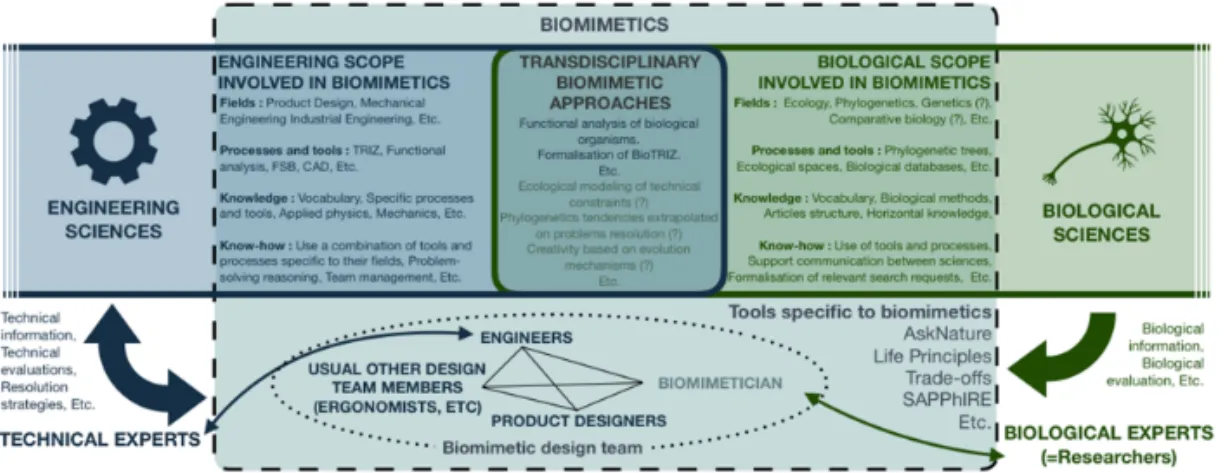
Facing the observation made in this section, determining which part of biology, and so which biological fields, to integrate in the context of biomimetics would naturally bring answers on the characterization of this new profile’s know-how, knowledge, practices, and tools (Figure2).
Biomimetics 2020, 5, x FOR PEER REVIEW 6 of 26
1.2.4. Integration of Stakeholders with a Background in Biology
Recent studies have investigated such research axis, to legitimate the integration of stakeholders from biology through quantitative and qualitative studies [8,9,65], to point out the need for new communication support [66] and to properly define the actual needs and expectation of design teams towards biologists [10,67].
The design of specifications surrounding this interdisciplinary collaboration led to the characterization of two different profiles to consider. A first one having a vertical, specific and deep biological knowledge, mainly embodied by researchers in biology, and a new profile having a horizontal and broad biological knowledge specifically adapted for biomimetics, which is not currently formalized and so do not properly exist yet [51,68].
The integration of biological researchers appears of great interest specifically during the abstraction of biological strategies (step 6) which requires deep knowledge on the strategy [69] before the rise of the abstraction level can occur [68]. Their practice in biomimetics is then well-defined since their role is essentially the same one than their usual jobs, explaining how does a biological model work. Still, small but crucial differences can be underlined. First, they will have to make their knowledge available to design teams, whose biological knowledge is often low. Secondly, they might look at their studies from a new prism since the questions emerging from biomimetic needs can be different from the ones faced in biological research. Finally, where their role is rather determined, their incentives aren’t and remain a subject to address.
The integration of horizontal biologists is recognized to be of great potential all along the process but more specifically during the biology-centered steps (steps 3–5) [68]. During those steps, they may help design teams to enter biology, explore the biological diversity, select pertinent models and properly transfer this information to the rest of the team [7,8,10,70]. However, even if they are described in terms of potential contributions, objectives, and involvement steps, the literature doesn’t properly prescribe how will they be able to reach those objectives. For example, Yen stated that “advanced students (in biology) may even learn to find relevant examples based on phylogenetic relatedness” [10], already pointing out the potentialities of phylogenetics presented in this article but without further information. Therefore, they remain ill-defined regarding their practice, skills, and field of expertise. The main reason explaining that situation is that steps 3–5 have no direct equivalent in biology. Thus, conceptual bridges need to be formalized to allow a proper adaptation of biological practices, tools, and reasoning to biomimetics.
Facing the observation made in this section, determining which part of biology, and so which biological fields, to integrate in the context of biomimetics would naturally bring answers on the characterization of this new profile’s know-how, knowledge, practices, and tools (Figure 2).
Figure 2. Diagram representing a summary of the currently identified fields, methods, tools and
actors involved in biomimetics.
Figure 2.Diagram representing a summary of the currently identified fields, methods, tools and actors involved in biomimetics.
This state of the art on biomimetics’ methodological framework and practical impediments lead us to consider the integration of new team member trained in biology as a relevant solution. The next
section will then synthesize the observation made in the state of the art to formalize the research question addressed in this article.
1.3. Synthesis and Research Question
From the observations presented in the state of the art, we have pointed out that despite great methodological progress, biomimetic practice still faces biology-related impediments. Various approaches have been designed to solve these issues and their advantages and drawbacks have been summarized in Table1.
However, as previously pointed-out, the current situation is rather paradoxical since mainly engineering-centered answers are designed to solve biology-centered problems. The integration of biological practices is then considered in this article as an alternative solution. So far, those new practitioners were referred to has horizontal biologists because of their broad biological knowledge but since these profiles need to be specialized in biomimetics, the term “biologists” appears reductive. This new team member therefore needs a specific name and, as such, will be referred to as a “biomimetician”.
This article then deals with the following research question: what are biomimeticians’ specific biological knowledge, know-how, and tools?
The hypothesis of this article presents a partial answer through the formalization of skills based on two biological fields, namely ecology and phylogenetics, as the first key fields of interest for biomimeticians to face above-mentioned impediments. Focusing on the findability issue, this article explores those two fields and various concepts, reasoning or tools that can be integrated through a biological expertise, are thus presented. The needs emerging from the adaptation of biological practice to biomimetic practice, and the fact that numerous biological fields remain to include, are underlined, raising significant research perspectives. Potential impacts of the integration of those first two biological fields on the biomimetic process are then discussed.
At an overall scale, we want to approach the practice of biomimetics with the standpoint of practitioners having a background in biology and underline their potential specific contributions.
2. Material and Methods
This section presents the guiding themes of this article and the approach we chose to structure our reasoning. The aim of our global study is to formalize the use of biological fields during biomimetic practices, starting with biological-centered steps. This article mainly deals with the two first biology-centered steps, steps 3 and 4.
To make our reasoning as clear as possible, we used the first three steps of the design research methodology [71] to structure our exploratory work on these two steps:
1. Research clarification: This phase corresponds to the Section1.
2. Descriptive phase: Based on the literature, we pointed out specific impediments on the targeted steps. This phase is divided between Section3.1.1(for the 3rd step) and Section3.2.1(for the 4th step).
3. Prescriptive phase: We exposed conceptual bridges linking those pitfalls with biological fields and prescribed practical contributions. We also underlined the potential impact on the process to anticipate and better integrate these new practices. This phase is divided between Section3.1.2 (for the 3rd step) and Section3.2.2(for the 4th step).
Finally, we described the impact of our contributions on the characterization of the biomimetician’s expertise (Section3.3and discussed the limitations and numerous perspectives of our work (Section4).
Biomimetics 2020, 5, 62 8 of 26
3. Results
3.1. Findability and the Ill-Defined “Transposition to Biology”
3.1.1. First Descriptive Step: the 3rd Step, the Initial Grain of Sand
If we study the different steps of the biomimetic cognitive reasoning, practitioners need to get from abstracted design issues (end of step 2) to transposed biological issues (end of step 3), to the identification of biological models (step 4). As this identification is based on the output generated during the 3rd step, it seems logical to look at this step before going any further.
In the problem-driven unified process formalized by Fayemi (Figure1), the 3rd step was explained in those few lines: “the establishment of a generic model combined with the identification of the functions of interest makes possible the transposition of the problem and its environment to biology. At this step, practitioners usually formulate a request. The purpose of this request is to explore Nature’s ways to perform one or several functions. This 3rd step is crucial since the overall biomimetic results is deeply impacted by the request formulation.” (from Fayemi [19] translated by the authors). In the above-mentioned definition, three main aspects emerge:
• The required inputs from the second step: generic models and associated functions of interest. • The goal of the 3rd step: to transpose technical problems and their environments to biology. • The form of the 3rd step’s outputs: requests to be used as bridges between the abstracted model
and the biological solutions.
However, in practice, this theoretical ground can be overtaken by the tools used for the 4th step. For example, if a team usually performs the 4th step with IDEA-INSPIRE than they will use the SAPPhIRE formalization during the 2nd and 3rd step, those who use AskNature will design requests based on the Biomimicry Taxonomy framework, etc.
A fundamental shift then emerges. The goal of the 3rd step doesn’t appear as the “transposition of the problem and its environment to biology” but as the formalization of problems into a format fitting the requirement of the 4th step’s tools. The notion of biology fades away as practitioners struggle to apprehend the biological world and so rely on tools made by and for engineers (Section1.2.3). Even with thesaurus and translation tools, this transposition step may shift from reflected decisions made thanks to a change of conceptual and cognitive framework, to the direct consequences of semantics association made through the tools.
As a result, we argue that this theoretical drift between the initial goal and the practical implementation may represent a key lever to consider. One reason behind this drift, might be the concept of transposition that isn’t unambiguous and applicable by itself. Whereas some will hear translate, others will hear apply or adapt, and most people may have trouble performing the action even if they understand its sense. As an example, the Cambridge Dictionary defines transposition as “the act or process of changing something from one position to another, or of exchanging the positions of two things”. Applying this definition in the context of transposition to biology isn’t an easy task. Consequently, practitioners interpret this step without a real coherence regarding the initial goal of the 3rd step, but rather with the obvious need of fitting the 4th step’s requirements.
The second reason that may explain this drift derived from the first. Since transposition, as well as biological concepts, aren’t clear for design teams, practitioners may fall back on their design habits, leading to a bias of fixation effect on the traditional engineering process. Hence, requests are formalized to represent functional requirements through a mix of biological, “biologized” and engineering concepts, while keeping an engineering standpoint. Practitioners lack knowledge and skills regarding biology and so the door on the biological world often remains closed.
3.1.2. Prescriptive Step: Ecology and Solution Spaces
More than only an interface between engineering and biology, the goal of this 3rd step is to define, within biology, the scope of the search occurring during the 4th step. Thus, the 3rd step’s goal is to perform an analogical reasoning based on problems not directly on solutions, in the words of Fu, to generate “innovative design problem formulation” [72].
As a result, we propose to rename the 3rd step “project problems into biology to identify solution spaces”. If various other studies have proposed semantics to represent this step, like “reframe”, “biologize” the problem [49] or “problem definition phase” [13], this new reformulation clarifies the activity to perform, “project problems”, but also specifies the scientific field to reach, “biology”, and the expected output, “solution spaces”.
Facing this new definition, the underlying cognitive process can also be better understood. The 3rd step is thus performed through the projection of abstracted problems into biology to identified biological embodiments of the abstracted problems. These embodiments are then mapping problem spaces within biology. Thus, in those spaces, biological organisms are facing problems analogous to the ones faced in our technical model. Taking the side of these organisms, problem spaces represent solution spaces. The choice of using the concept of solution space over problem space is to focus on the idea that those spaces are encompassing numerous, sometimes highly diverse, solutions for a given combination of problems. The 4th step will then lead biomimetic teams to search and identify models within these solution spaces. Solution spaces thus form a map delimiting the scopes of high potentialities from those that may be less relevant.
Along with this conceptual formalization, it also appears crucial for solution spaces to be characterized through specific criteria (= keywords) along with their associated conceptual network. These criteria will then allow design teams to find pathways (= requests) and to manipulate solution spaces to identify the biological models they contained. The interest of this formalization is that it should be perfectly compatible with the current approaches while also allowing the team to switch toward a more biological standpoint.
In current practices, biomimetic practitioners are used to focus on functions, and so solution spaces appear functional (FSS). Functional problems are abstracted and projected to identify a space gathering biological models that perform a given function. Spaces are then characterized through functional keywords as described in the state of the art.
In biology, the space containing a given organism, and so all biological models it might involve, is called its environment. As presented in the state of the art, considering the environment for the generation of keywords is supported in the literature (Section1.2.4), but again, from an engineering perspective, as a new tool to increase engineers’ ability to reach biology. In the case where a biomimetician is integrated in the team, biological tools, reasoning, and concepts may potentially be directly used as engines of resolution. Taking a biological standpoint, the field studying the “interactions among living things and their environment” is called ecology [73].
In ecology, ecosystem represents the association above described between a biotope (non-living elements like climatic context, soil chemistry, etc.), a biocenosis also called an ecological community (network of living beings associated with a biotope), and their interactions [74]. In order to underline the interest of these concepts in biomimetics, this sub-section presents, at an overall scale, the link between ecology and the biological evolutionary process.
The evolutionary process, engine of the emergence of biological solving strategies, is somewhat reminiscent of the double diamond process describing the design process of innovation [75]. For a given population, divergent phases lead to an increase of the genetic diversity, through various mechanisms such as independent assortment during sexual reproduction, crossing-over during meiosis or genetic mutation in germ cells, and convergent phases lead to the selection of organisms having specific genetic sequences. Over time, the proportion of the genetic material in the population evolves, leading to the adaptation of the population. It must be clearly underlined that, where organisms are selected,
Biomimetics 2020, 5, 62 10 of 26
they however do not adapt in a genetic, evolutionary sense, only populations adapt in a dynamic way, as the resultant of numerous organisms’ selection.
Multiple blind mechanisms (not oriented by choices or will of any kind) explain this selection step. One of them, known as natural selection, is further developed in this section leaving aside other mechanisms such as genetic drift, population bottleneck, etc. This section only presented the overall mechanism of this complex biological phenomenon. Thus, for more information about evolutionary processes we refer the reader to the literature [76].
The main engine of natural selection is called evolutionary pressure and depends on factors impacting the ability of organisms to produce offspring. These factors can be biotic (have a biological source) or abiotic (have a non-biological source) and can have an impact on various parameter such as the organism’s ability to mate (selection of sexual traits for example), its fertility (the organism mates but doesn’t produce any offspring) or its ability to survive (limiting the time during which it will be able to reproduce) [77]. In the context of our study, we will focus on the last aspect, survival, to link evolution and adaptation to environmental constraints.
Overall, the chance of survival of an organism depends on the adequacy between its traits and its environment. This adequacy is referred to as fitness in biology [77]. To illustrate this process, let’s consider a fishing net as part of an environment. The organisms which size (selected trait) is bigger than the size of the mesh (environmental constraints) will be eliminated, and so can’t reproduce with other organisms remaining in the environment. On the contrary, organisms that are smaller than the mesh of the net aren’t sensitive to this environmental constraint and so survive and can have offspring. Environmental constraints combined with specifically inadequate traits thus lead a given organisms to their death, preventing them to reproduce and so to pass on their genes. Hence, in a rather stable environment, the fitness of the organisms composing the population increases through generations. This phenomenon, also known as the “survival of the fittest”, is one of the main mechanisms of natural selection [77].
This example illustrates the selection process through a single environmental constraint, the size of the mesh. Based on such a constraint, some traits are strongly selected, leaving little room for variability (like the size of the organism in our example), others are moderately selected (like the species of organisms in our example), and others aren’t correlated with a change in the survival ability, leading to a stable diversity (for example the various color patterns of fishes in our example).
However, it must be underlined that in nature, this mechanism simultaneously involves numerous constraints coming from both the biotope (abiotic constraints like temperature, humidity, mesh size of a net, etc.) and the biocenosis (biotic constraints like predation, sexual traits, etc.) of the ecosystems. For example, where we pointed out that color patterns aren’t a trait selected by a fishing net, it can be strongly selected as a sexual trait (impacting the mating probabilities) and so still lead to specific evolutionary paths. Moreover, since organisms live in a constraining environment, evolution has limits and selection thus appears to deeply rely on balance, explaining the approach based on trade-offs supported by Vincent [43]. This notion is crucial to understand, as stated by Yen, that evolution is a process towards “a good solution, as opposed to the best solution” as the result of “multiple, sometimes conflicting, demands or constraints” [63].
Based on the biological processes above mentioned, the development of a biological model of interest ultimately rely on environmental constraints of interest. However, in current biomimetic practices technical problems are mainly formulated with abstracted functions for the product to perform (see Section1.2.2). While searching for biological models, practitioners then generate the following generic request: “Which organisms perform + a function?” leading them to identify functional solution spaces (FSS). The question that emerges is then: how to project abstracted technical problem (outputs of the 2nd step) into environmental spaces encompassing adapted biological organisms?
So far, articles of the literature that consider these environmental spaces to search, compare or select biological models approach environment as a new parameter to consider, without explaining how these spaces are determined from the design problem. Thus, when ESS are easy to determine,
design teams might instinctively use ESS as presented in Yen or Kennedy’s studies (see Section1.2.3). For example, if a team wonders “which biological entities perform the extraction of oxygen from water?” or “which biological entities resist high temperature?”, an aquatic habitat and a high temperature environment (deserts, submarine volcanos, hot water springs, etc.) respectively appear as clear ESS.
However, in other cases, ESS aren’t easily deductible and biomimetic teams then lack a systematic approach to project design problems to identify ESS. As an example, if practitioners wonder “which biological entities manage mechanical wear?” or “which biological entities optimize space/material?” ESS are less intuitive and might then be completely ignored during the search phase. Thus, we designed various guidelines in order to guide biomimeticians during the projection into biology.
Firstly, they have to realize that, from a biological perspective, a functional formulation focuses on solutions, not on problems [43]. For example, the extraction of oxygen from water is a solution to the problem of living under severe lack of oxygen because of an aquatic habitat. Consequently, extracting oxygen from water isn’t the only solution to this problem. Indeed, some evolutionary paths led organisms to deal with this constraint by periodically surfacing in order to breathe, like dolphins. Therefore, by focusing on the formulation of problems from the point of view of a living being, a cognitive shift can occur. A biomimetician may wonder “under which constraints does the extraction of oxygen from the environment become a strongly selected trait?” and so “what would be the problems leading to a biological adaptation towards oxygen extraction?”. Various characteristics defining solution spaces can then be identified. Among those, the oxygen concentration in the environment can be scarce, like in high altitude or in the soil, but oxygen can also be dissolved in a medium and so hardly accessible.
Thus, biomimetician should be able to identify environmental constraints for most design problem, resulting in a switch from functional paths to ecological paths of projection, “Which organisms (+ perform a function) + to deal with given environmental constraints?”.
Secondly, based on ESS, design teams should then be able to consider and combine both types of reasoning (functional and ecological) and so to increase the team’s ability to face the findability issue. As a result, a study targeting the decontaminate on of polluted water (abstracted into high concentrated fluid) in deep-sea facilities (abstracted into a parameter of high pressure) can reach biology through the projection into functional solution space “how does nature filter liquid?”, ecological solution space “which biological organisms survive in a high pressure, high concentrated fluid?” or a solution space combining these approaches, i.e., “which biological organisms filter high pressure, high concentrated fluids?”. Once a ESS is identified, previously published articles also offer guidelines to identified alternative ESS [10,50], such as spaces that represent reverse constraints and spaces that are only presenting one constraint pushed to an extreme (see Section1.2.3).
Finally, more than only determining ESS, our work aims at considering ESS as inputs for biological tools and reasonings to be used by biomimeticians. To do so, ESS must match existing biological approaches. Various biological concepts can be used as ESS from an ecological standpoint. Depending on the studied environmental constraints, several classifications, such as the Köppen–Geiger classification [78] or the Holdridge life zones [79], have been designed to divide the earth into ecological spaces. Regardless of the chosen classification, the ideas developed below will apply.
In this article, one classification is taken as reference: the Olson classification better known under the name of WWF classification [80]. It has been chosen because it is known to be based not only on climatic parameters but also on parameters originating from biogeography. Biogeography is defined as “the study of the geographic distribution of plants and animals. It is concerned not only with habitation patterns but also with the factors responsible for variations in distribution.” [81].
Depending on the considered scale, this classification splits the earth into 20 ecozones (eight terrestrial and 12 marine), 28 biomes (14 terrestrial, seven marine and seven freshwater), and 1525 ecoregions (867 terrestrial, 232 marine and 426 freshwater). These various ecological concepts are defined as follows:
Biomimetics 2020, 5, 62 12 of 26
• Biomes are described as “different areas of the world that share similar environmental conditions, habitat structure and patterns of biological complexity (e.g., beta diversity) and that contain communities with similar guild structures and species adaptation” [80].
• A terrestrial ecoregion is defined as “relatively large units of land containing a distinct assemblage of natural communities and species, with boundaries that approximate the original extent of natural communities prior to major land-use change.” [80].
To illustrate these concepts, the example of the Australasian ecozone is taken (Figure 3). This ecozone is composed of 10 biomes (Figure3) and 82 ecoregions (not represented on the figure), among which the Australian “Kimberly tropical savanna” can be identified as an example.
Biomimetics 2020, 5, x FOR PEER REVIEW 12 of 26
• A terrestrial ecoregion is defined as “relatively large units of land containing a distinct assemblage of natural communities and species, with boundaries that approximate the original extent of natural communities prior to major land-use change.” [80].
To illustrate these concepts, the example of the Australasian ecozone is taken (Figure 3). This ecozone is composed of 10 biomes (Figure 3) and 82 ecoregions (not represented on the figure), among which the Australian “Kimberly tropical savanna” can be identified as an example.
Figure 3. Map of the Australasian ecozone and biomes. Each color represents a biome of the Ecozone:
(1) Tropical and subtropical moist broadleaf forests, (2) Tropical and subtropical dry broadleaf forests, (3) Temperate broadleaf and mixed forests, (4) Tropical and subtropical grasslands, savannas, and shrublands, (5) Temperate grasslands, savannas, and shrublands, (6) Montane grasslands and shrublands, (7) Tundra, (8) Mediterranean forests, woodlands, and shrub, (9) Deserts and xeric shrublands, (10) Mangrove. From [83].
Facing the definition of the ecological concepts above mentioned, it appears that ecozones are deeply linked with the historical evolution of geographically separated areas (mainly from the super-continent Gondwana dispersion) and ecoregions are intrinsically linked with a geographic component.
During this step of ESS identification, focusing on geographic boundaries or geological movements doesn’t seem to be particularly relevant. Thus, biomes are prescribed as an adequate level to perform a first association between environmental constraints and ESS. The interest of focusing on biomes is that they precisely synthesize the interaction between the environmental constraints and the associated species, which is the core of our strategy.
Moreover, since a given biotope can be associated with different biocenoses depending on the geographic location, considering an iterative phase of divergence based on geographic parameters can allow biomimetician to potentially access more specific ESS. Thus, where geographic areas appeared as a bias in the initial phase, using the ecological concept of biome as an initial step leads biomimetician to access the list of all the geographic areas presenting the association of biocenosis with a given biotope of interest: ecoregion.
For example, the biome “deserts and xeric shrublands” corresponds to 99 ecoregions around the globe (Figure 4).
Figure 3. Map of the Australasian ecozone and biomes. Each color represents a biome of the Ecozone: (1) Tropical and subtropical moist broadleaf forests, (2) Tropical and subtropical dry broadleaf forests, (3) Temperate broadleaf and mixed forests, (4) Tropical and subtropical grasslands, savannas, and shrublands, (5) Temperate grasslands, savannas, and shrublands, (6) Montane grasslands and shrublands, (7) Tundra, (8) Mediterranean forests, woodlands, and shrub, (9) Deserts and xeric shrublands, (10) Mangrove. From [83].
Facing the definition of the ecological concepts above mentioned, it appears that ecozones are deeply linked with the historical evolution of geographically separated areas (mainly from the super-continent Gondwana dispersion) and ecoregions are intrinsically linked with a geographic component.
During this step of ESS identification, focusing on geographic boundaries or geological movements doesn’t seem to be particularly relevant. Thus, biomes are prescribed as an adequate level to perform a first association between environmental constraints and ESS. The interest of focusing on biomes is that they precisely synthesize the interaction between the environmental constraints and the associated species, which is the core of our strategy.
Moreover, since a given biotope can be associated with different biocenoses depending on the geographic location, considering an iterative phase of divergence based on geographic parameters can allow biomimetician to potentially access more specific ESS. Thus, where geographic areas appeared as a bias in the initial phase, using the ecological concept of biome as an initial step leads biomimetician to access the list of all the geographic areas presenting the association of biocenosis with a given biotope of interest: ecoregion.
For example, the biome “deserts and xeric shrublands” corresponds to 99 ecoregions around the globe (Figure4).
Figure 4. Map of the 99 ecoregions (in yellow) presenting a “Deserts and xeric shrublands” biome.
From [84].
In this context, ESS are defined as the final environmental space chosen by the team to perform the search of biological models. Depending on the project, the resources or the expertise of the team, biomes, ecoregion, or even highly specific ecosystems can be considered as ESS.
3.2. Findability and the Identification of Biological Models of Interest
The 4th step of the biomimetic process is an exploration step aiming at searching for biological solutions to solve given abstracted problems. However, as previously presented, the 3rd step can lead to various type of output. Either the process is performed following the approach proposed in Section 3.1.2. leading to FSS or ESS, or the team doesn’t, and the inputs of the 4th step are only FSS, formalized as adequate requests for their various search tools. Either way, the idea is to keep on formalizing the biomimetician’s specific contributions.
3.2.1. First Descriptive Step: Concepts Associated with the 4th Step
As it was the case for the 3rd step, the terminology can also appear quite ambiguous during the 4th step. Therefore, this section presents existing concept in phylogenetics and defines a few new concepts specific to biomimetics that will be used in the rest of the article.
As previously presented, organisms aren’t only linked by their abiotic constraints, and inter-organism relationships can also be a way to extend the search. We won’t deal with ecological relationships, even if we deeply encourage practitioners to consider it, since we already made our case on the interest of integrating ecology as a biological field of interest.
This section then rather focuses on another biological field, the study of the ancestral relatedness of groups of organisms, whether alive or extinct [85]: phylogenetics. Its main biological objectives and concepts are thus quickly presented before one of its potential application in biomimetics is detailed.
In biology, the concept of phylogenetics refers to the study of species’ evolution and leads to their classification (taxonomy). Species evolutionary relationships are then represented through phylogenetic trees (Figure 5).
Figure 4.Map of the 99 ecoregions (in yellow) presenting a “Deserts and xeric shrublands” biome. From [84].
In this context, ESS are defined as the final environmental space chosen by the team to perform the search of biological models. Depending on the project, the resources or the expertise of the team, biomes, ecoregion, or even highly specific ecosystems can be considered as ESS.
3.2. Findability and the Identification of Biological Models of Interest
The 4th step of the biomimetic process is an exploration step aiming at searching for biological solutions to solve given abstracted problems. However, as previously presented, the 3rd step can lead to various type of output. Either the process is performed following the approach proposed in Section3.1.2. leading to FSS or ESS, or the team doesn’t, and the inputs of the 4th step are only FSS, formalized as adequate requests for their various search tools. Either way, the idea is to keep on formalizing the biomimetician’s specific contributions.
3.2.1. First Descriptive Step: Concepts Associated with the 4th Step
As it was the case for the 3rd step, the terminology can also appear quite ambiguous during the 4th step. Therefore, this section presents existing concept in phylogenetics and defines a few new concepts specific to biomimetics that will be used in the rest of the article.
As previously presented, organisms aren’t only linked by their abiotic constraints, and inter-organism relationships can also be a way to extend the search. We won’t deal with ecological relationships, even if we deeply encourage practitioners to consider it, since we already made our case on the interest of integrating ecology as a biological field of interest.
This section then rather focuses on another biological field, the study of the ancestral relatedness of groups of organisms, whether alive or extinct [85]: phylogenetics. Its main biological objectives and concepts are thus quickly presented before one of its potential application in biomimetics is detailed. In biology, the concept of phylogenetics refers to the study of species’ evolution and leads to their classification (taxonomy). Species evolutionary relationships are then represented through phylogenetic trees (Figure5).
Biomimetics 2020, 5, 62 14 of 26
Biomimetics 2020, 5, x FOR PEER REVIEW 13 of 26
Figure 4. Map of the 99 ecoregions (in yellow) presenting a “Deserts and xeric shrublands” biome.
From [84].
In this context, ESS are defined as the final environmental space chosen by the team to perform the search of biological models. Depending on the project, the resources or the expertise of the team, biomes, ecoregion, or even highly specific ecosystems can be considered as ESS.
3.2. Findability and the Identification of Biological Models of Interest
The 4th step of the biomimetic process is an exploration step aiming at searching for biological solutions to solve given abstracted problems. However, as previously presented, the 3rd step can lead to various type of output. Either the process is performed following the approach proposed in Section 3.1.2. leading to FSS or ESS, or the team doesn’t, and the inputs of the 4th step are only FSS, formalized as adequate requests for their various search tools. Either way, the idea is to keep on formalizing the biomimetician’s specific contributions.
3.2.1. First Descriptive Step: Concepts Associated with the 4th Step
As it was the case for the 3rd step, the terminology can also appear quite ambiguous during the 4th step. Therefore, this section presents existing concept in phylogenetics and defines a few new concepts specific to biomimetics that will be used in the rest of the article.
As previously presented, organisms aren’t only linked by their abiotic constraints, and inter-organism relationships can also be a way to extend the search. We won’t deal with ecological relationships, even if we deeply encourage practitioners to consider it, since we already made our case on the interest of integrating ecology as a biological field of interest.
This section then rather focuses on another biological field, the study of the ancestral relatedness of groups of organisms, whether alive or extinct [85]: phylogenetics. Its main biological objectives and concepts are thus quickly presented before one of its potential application in biomimetics is detailed.
In biology, the concept of phylogenetics refers to the study of species’ evolution and leads to their classification (taxonomy). Species evolutionary relationships are then represented through phylogenetic trees (Figure 5).
Figure 5.Example of a simplified phylogenetic tree of vertebrate. Adapted from Yamamoto 2017 [86]. Before modern advances in genetics, classifications were mainly based on morphological or ecological traits. For example, the phylum Mollusca gathers soft (morphological trait) marine (ecological trait) invertebrate (morphological trait) organisms called mollusks. The advent of genetics led to an unmatched level of precision, allowing classifications not only based on given morphological or environmental traits, but on species’ genome.
For biomimetician to extract and manipulate information made available in those trees, the concepts of mono, para and polyphyletic groups are illustrated (Figure6) and their definitions are presented.
Biomimetics 2020, 5, x FOR PEER REVIEW 14 of 26
Figure 5. Example of a simplified phylogenetic tree of vertebrate. Adapted from Yamamoto 2017 [86]. Before modern advances in genetics, classifications were mainly based on morphological or ecological traits. For example, the phylum Mollusca gathers soft (morphological trait) marine (ecological trait) invertebrate (morphological trait) organisms called mollusks. The advent of genetics led to an unmatched level of precision, allowing classifications not only based on given morphological or environmental traits, but on species’ genome.
For biomimetician to extract and manipulate information made available in those trees, the concepts of mono, para and polyphyletic groups are illustrated (Figure 6) and their definitions are presented.
Figure 6. Illustration of the concepts of (A) monophyletic, (B) paraphyletic and (C) polyphyletic
groups.
A monophyletic group is a cluster of species composed of a common ancestor and all its descendants, regardless of the evolutionary paths they followed past their common ancestor. The taxa composing a monophyletic group share synapomorphy, which are traits derived from their common ancestor.
A paraphyletic group is a cluster of species composed of a common ancestor and some of its descendants sharing common traits called a plesiomorphy. For example, if we study an ancestral trait A which was lost by some descendants, then the common ancestor and all its descendants still bearing the trait A will form a paraphyletic group with respect to those which have lost the trait. As a result, various paraphyletic groups can be defined within a monophyletic one, depending on the considered trait. The emergence, modification or loss of traits then represent the source of paraphyletic groups.
A polyphyletic group is a cluster of species which doesn’t share an immediate common ancestor. If these taxa share similitude of traits that don’t originate from a common ancestor, then these similarities are called homoplasies, or analogies if those traits are functions. They result from an independent evolutionary path: the convergent evolution process. For example, a bird and a butterfly both have wings leading to the function of flight, but their common ancestor doesn’t have wings and so both taxa have independently developed wings during their respective evolutionary process.
From a biomimetic standpoint, the 4th step is called identification of biological models, but the term model, even if it appears to refer to its analogical sense in the context of biomimetics, doesn’t specify by itself its biological nature.
To prevent any misunderstanding biological models are defined in this article as the specific biological construct that allows a given problem to be solved. For example, the lotus’ leaf surface represents a biological model. It protects the plant from bacterial and fungus and maintains its ability to harvest sunlight through super-hydrophobicity and self-cleaning properties.
In this context, we also defined the concept of a biological carrier as an organism carrying all or part of a biological model. In this context, organisms can appear as intermediate solutions.
Figure 6.Illustration of the concepts of (A) monophyletic, (B) paraphyletic and (C) polyphyletic groups.
A monophyletic group is a cluster of species composed of a common ancestor and all its descendants, regardless of the evolutionary paths they followed past their common ancestor. The taxa composing a monophyletic group share synapomorphy, which are traits derived from their common ancestor.
A paraphyletic group is a cluster of species composed of a common ancestor and some of its descendants sharing common traits called a plesiomorphy. For example, if we study an ancestral trait A which was lost by some descendants, then the common ancestor and all its descendants still bearing the trait A will form a paraphyletic group with respect to those which have lost the trait. As a result, various paraphyletic groups can be defined within a monophyletic one, depending on the considered trait. The emergence, modification or loss of traits then represent the source of paraphyletic groups.
A polyphyletic group is a cluster of species which doesn’t share an immediate common ancestor. If these taxa share similitude of traits that don’t originate from a common ancestor, then these similarities are called homoplasies, or analogies if those traits are functions. They result from an independent evolutionary path: the convergent evolution process. For example, a bird and a butterfly both have wings leading to the function of flight, but their common ancestor doesn’t have wings and so both taxa have independently developed wings during their respective evolutionary process.
From a biomimetic standpoint, the 4th step is called identification of biological models, but the term model, even if it appears to refer to its analogical sense in the context of biomimetics, doesn’t specify by itself its biological nature.
To prevent any misunderstanding biological models are defined in this article as the specific biological construct that allows a given problem to be solved. For example, the lotus’ leaf surface represents a biological model. It protects the plant from bacterial and fungus and maintains its ability to harvest sunlight through super-hydrophobicity and self-cleaning properties.
In this context, we also defined the concept of a biological carrier as an organism carrying all or part of a biological model. In this context, organisms can appear as intermediate solutions.
In some cases, the biological carrier presents the whole biological model. For example, any desert organisms have a biological model for extreme heat resistance, but organisms only represent a first step towards the identification of these solutions.
In other cases, the biological carrier presents only part the biological model. The biological model is thus composed of a network of organisms and again identifying one organism appear as a first step towards the identification of the solutions.
Finally, a biological carrier can also be an equivalent to a biological model. For example, if the biological strategy appears to be of behavioral nature.
Based on these various concepts, the next sub-section presents the impact of phylogenetics on the 4th step of the biomimetic process.
3.2.2. Prescriptive Step: From Solution Spaces to Biological Models
During the 4th step of the process, current tools face the impediment presented in the state of the art (Section1.2.3). We propose other approaches through first the identification of biological carriers before identifying biological models in a second time. Thanks to biology-centered knowledge and know-how, a design team should then be able to complement the use of current tools and uncover whole new paths for models’ identification.
From an Ecological standpoint, numerous biodiversity databases are specialized in gathering the various species present in specific geographic areas. These databases can focus on specific taxon, like Avibase on birds [87], or specific region, like the biodiversity database of the Scientific Committee on Antarctic Research [88], or gather a wide range of species distributed worldwide like the database designed by the GBIF, Global Biodiversity Information Facility [89].Various functionalities, such as the interactive map on the GBIF database (gathering 6,586,578 species on the 29.02.20), can then allow biomimetician to identify biological carriers from ESS.
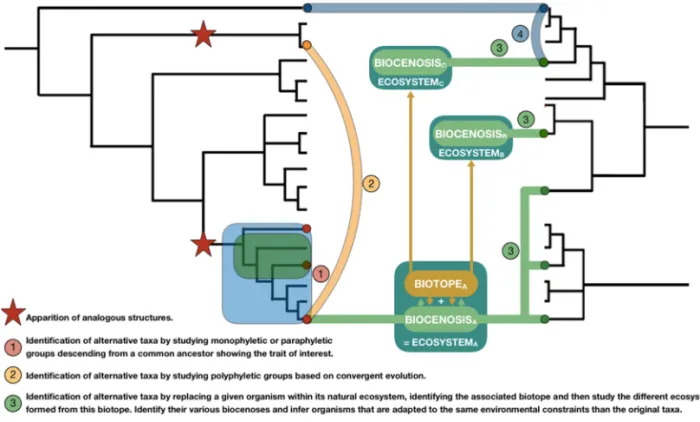
Phylogenetic tools then offer a way to use biological data as raw material in order to find more biological data through a cascading effect. Thus, from a single species identified using classic biomimetic tool, like existing databases, phylogenetic tool may lead to the identification of related groups of species. Indeed, a phylogenic tree presenting enough information may allow biomimetician to track the emergence of a trait of interest back to its source, i.e., a common ancestor, and identify its associated descendants.
As a result, taxa composing this group are susceptible to possess the trait of interest. Within this group, some species may have evolved, and the trait of interest may have mutated or even disappeared. Through their variability, these groups should present various versions of the original trait but adapted to different contexts. Even species which have lost the trait can be of interest since we can wonder why the trait disappeared and if it has been replaced by another structure, then representing another resolution strategy. Depending on the studied taxonomic level, the search will reveal close solutions as a result of shared evolutionary history (search focusing on close taxonomic groups such as shared genus) or different biological models with different solutions (search focusing on higher taxonomic level such as shared order) [63].
The use of biological tools and reasoning based on organisms then offers new ways of performing the 4th step of the process. It aims at allowing teams to reach a second phase of search amplification,
![Figure 1. The unified problem-driven biomimetic process from Fayemi [5].](https://thumb-eu.123doks.com/thumbv2/123doknet/7408099.218022/4.892.84.786.18.405/figure-unified-problem-driven-biomimetic-process-fayemi.webp)