4
Agriculture and the United Nations Framework
Convention on Climate Change
Technical and financial support
Technical and financial support
Climate Technology
Centre and Network
What is it?
The Climate Technology Centre and Network (CTCN) is the operational arm of the UNFCCC Technology Mechanism. Its mandate is to stimulate technology cooperation and enhance the development and transfer of low carbon, climate resilient technologies to developing countries at their request. The CTCN seeks to lower the barriers to investment in climate technologies.
It is hosted by the United Nations Environment Programme (UNEP) in coordination with the United Nations Industrial Development Organization (UNIDO) and with support from a group of members of the CTCN Consortium. It also has an advisory board that decides how it will operate and sets the rules of procedure.
What does it offer?
The CTCN provides financing for high-quali-ty technical assistance and training (up to USD 250,000 per request) at no cost to developing countries. It fosters cooperation and access to information and knowledge to accelerate cli-mate technology transfer through south-south, north-south and triangular cooperation. It pro-vides a means to strengthen existing networks and partnerships and capacity building for cli-mate technology transfer, working with national stakeholders to build or enhance endogenous capacities. The CTCN also links needs for climate technologies with funding opportunities. As part of its knowledge management work, the CTCN organizes topical workshops and webinars.
How does it work?
The Centre works at the urging of the countries in response to requests submitted through the National Designated Entities (NDEs). The NDEs serve two purposes: a) ensure that requests submitted to the CTCN reflect national circumstances and priorities, and b) ensure that CTCN support is well coordinated at the national level with other climate change processes, such as those involving government ministries, focal points for other UNFCCC mechanisms, the private sector, civil society and academia as appropriate. Most of the countries in this region have now designated their NDE1.
1 The full list of NDE’s can be found at
http://goo.gl/9FbGqc
This note outlines some of the opportunities that exist for countries to obtain resources for their work on climate change adaptation and mitigation in agriculture.
The CTCN responds to requests received in cooperation with registered members of the network (knowledge centers) and the standing consortium of regional and international organizations. The Western Hemisphere had 37 network members as of January, 2016, including eight in the Caribbean, five in Central America, 13 in South America and 11 in North America. Those working with the agricultural sector include the Fundación Torcuato di Tella (Argentina); Centro de Gestión de la Información y Desarrollo de la Energía (Cuba); Libélula Comunicación, Ambiente y Desarrollo (Peru); CIAT (Colombia), and CATIE (Costa Rica).
The advisory board approved an annual budget of USD 25 million. Eight proposals from four countries in the region had been approved as of February, 2016. Colombia, for example, is working on the design of a national system to monitor climate change adaptation, while Chile is designing a system to monitor biodiversity in the context of climate change. Approximately 17% of requests received have been from Latin America. Applications are processed expeditiously and generally take less than three months to be approved.
Approach
The CTCN takes a very broad approach, always associated with climate technologies and capacity building. It covers all sectors, including agriculture, forestry, coastal regions, cities, health, water, etc. It also covers all phases of the technology cycle, from screening and testing technologies to scaling up, monitoring and evaluation. It provides support in the following five categories:
• Technical assessments (identification of technologies, technology barriers, piloting and scaling up technologies, etc.)
• Technical support for developing policy and planning documents
• Training
• Tools and methodologies • Implementation plans
Who may apply?
Applications must be made through each country’s chosen NDE. Any government agency, nongovernmental organization (NGO) or private sector institution working at the local, national or regional level may apply for technical support or training through the NDE.
Academia, government, NGOs and private sector representatives work with the NDE to identify the type of technical assistance they need in order to implement the relevant technology. Upon receipt of such requests, the Center quickly mobilizes its global Network of climate technology experts to design and deliver a customized solution tailored to local needs.
There is no limit to the number of requests that each country may submit, but as the CTCN reaches its capacity for responding, the number of requests per country/year may be limited. The CTCN does not provide funding directly to countries, but instead supports the provision of technical assistance provided by experts on specific climate technology sectors. However, in some cases the CTCN can help to play a matchmaking role with funding sources.
What opportunities are open
to the agricultural sector in the
CTCN?
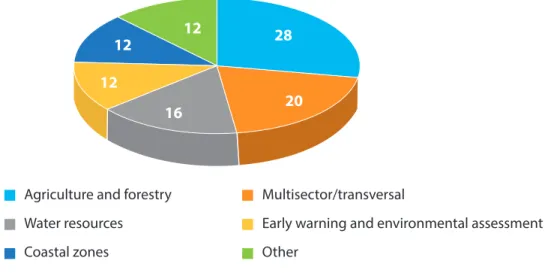
Developing countries may request climate technologies and information or training resources to develop climate change mitigation and adaptation strategies in the agricultural sector. As of April 2016, 28% of adaptation requests targeted the agricultural and forestry sector. However, only 3% of mitigation
applications touched on agriculture. Because the program has considerable room to increase the number of requests for the sector, the countries
Technical and financial support
12 12 12 28 20 16Agriculture and forestry Water resources Coastal zones
Multisector/transversal
Early warning and environmental assessment Other
Figure 1.
Distribution of requests related to adaptation, by sector.
Source: Developed by the authors with data from CTCN. https://goo.gl/yY1vlv
Recommendations for accessing the CTCN
• Identify and contact your country’s NDE.• Take part in CTCN workshops and webinars to learn more about its approach and the opportunities it has to offer. • Align the sector’s priorities with the national climate
strategy and identify technology needs.
• Draw a clear linkage between your technical assistance request and the problem, the technology to be used and the benefits to be derived from it.
must position their needs and priorities for technical support. This positioning includes close coordination with the NDEs to develop joint, consensus-based proposals.
More information:
Green
Climate Fund
What is it?
The Green Climate Fund (GCF) is an operating entity of the financial mechanism of the Unit-ed Nations Framework Convention for Climate Change (UNFCCC) created in 2010 at COP16 in Cancún, Mexico. Its mandate is to promote low-emission, climate-resilient development in developing countries.
Mandate
The Fund was designed to facilitate the main objective of the UNFCCC and works to sup-port a paradigm switch to low-emission and climate-resilient development. It supports developing countries working to reduce their greenhouse gas emissions and adapt to the impacts of climate change. The Fund considers local needs, especially support for countries and sectors that are vulnerable to the adverse effects of climate change.
Governance
The Green Climate Fund is governed by a Board of 24 members. They are drawn equally from developed (12) and developing (12) countries. The Fund has three regular and alternate mem-bers from the countries of Latin America and the Caribbean. Regular and alternate members serve for a term of three years with the possi-bility for a single extension. The Board meets three times a year to make major decisions on Fund operations.
Management
The International Secretariat is located in the Green City of Songdo, South Korea, and is led by an Executive Director.
The GCF also has regional advisers to help the countries manage the resources. The regional advi-sor for Latin America and the Caribbean is located in El Salvador. The Fund is structured into four divisions:
• The Country Programming Division is re-sponsible for engagement with the countries, readiness support and accreditation
• The Mitigation and Adaptation Division re-views relevant program and project funding proposals
• The Private Sector Facility
• The Division of Support Services is the admin-istrative department that includes the finan-cial and legal section of the GCF
The Fund maintains direct communication with the countries through national designated authori-ties (NDAs) or focal points2.
Available resources
As of December 2015, there were USD 10.3 billion pledged to the Fund.
Approach
The aim is to divide the funds equally (50%-50%) between mitigation and adaptation investments. Financing for adaptation is allocated according to an equal geographic distribution, so that 50% goes to the least developed countries, small island developing states and Africa, and the remaining 50% to developing countries. This distribution should provide significant resources for the Pri-vate Sector Facility and for activities in the frame-work of the Readiness Program.
2 The list of NDAs can be found at
Technical and financial support
Opportunities for agriculture
The GCF funds projects and programs submitted by public and private entities accredited by its Board, that will contribute to at least one of the Fund’s eight strategic impacts. Four of the eight areas of impact offer opportunities for the sector:^
• Reduced emissions from forests and land use.
• Increased resilience of health, food and water security.
• Increased resilience of livelihoods of people and communities. • Increased resilience of ecosystems and ecosystem services.
The Fund also has five investment priorities, one of which is specifically for agriculture: “Encouraging low-emission and climate-resilient agriculture.”* The Fund can support mitigation and adaptation activities that contribute to both agricultural development and food security.
The Fund is also interested in joint adaptation and mitigation programs. Agriculture is one of the sectors that can achieve this effectively in many different ways.
^ GCF (Green Climate Fund). (2015). Elements 01: Engaging with the Green Climate Fund. Consulted on 14 April 2016 at http://goo.gl/ztC7xP
* GCF (Green Climate Fund). Funding. Consulted on 14 April 2016 at http://goo.gl/ztC7xP
Table 1. Scale of projects.
Type
Amount*
Micro projects
USD 0-10 million
Small projects
USD 10-50 million
Medium projects
USD 50-250 million
Large projects
Over USD250 million
* Total amount projected at the time the submission is filed, regardless of the amount to be funded by the GCF, and if relevant, other resources for an individual project or activity within a program.
Mitigation outcomes target emissions reductions achieved through:
• Low-emission energy access and power gen-eration.
• Low-emission transport.
• Buildings, cities, industries and appliances. • Forests and land use: prevent land-use
changes, deforestation and degradation. Adaptation outcomes seek to improve resilience in:
• Livelihoods of people and communities. • Health and well-being, food and water
security.
• Infrastructure and the built environment. • Ecosystems and ecosystem services. The Fund uses five different types of financial instruments: grants, loans, guarantees, equity and payment for results.
How can submissions be presented
to the GCF?
There are two ways to submit proposals and projects:
1. Through invitations (the Fund extends invitations to submit proposals on particular topics).
2. An open call to submit proposals (submis-sions can be made to the GCF at any time of the year).
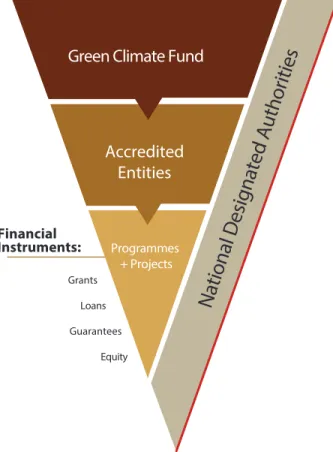
Invitations are posted on the GCF website. Pro-posals should be submitted through the accred-ited entities3. All proposals must be backed by
the relevant NDA, which grants a no-objection letter for each project or program to be consid-ered by the Fund. No projects will be reviewed
until they have a no-objection letter. Regional initiatives should be submitted through accred-ited regional or multilateral entities. All coun-tries taking part in the initiative need to issue a no-objection letter.4
The NDA, which is the contact point between the Fund and the country, defines the country’s priorities for the GCF, promotes consultation
Figure 2. Architecture of the GCF.
Source: GCF (Green Climate Fund). Funding. Consulted
on 14 April 2106 at http://goo.gl/WfsXIv
3 The full list of accredited entities is available through the following link: http://goo.gl/MtcZM7
4 See http://goo.gl/tWp3jd
Green Climate Fund
Accredited
Entities
Programmes + ProjectsN
at
io
na
l D
es
ig
na
te
d
Au
th
or
iti
es
Grants Loans Guarantees Equity Financial Instruments:Technical and financial support
5 See http://goo.gl/UOSwdq
and participation by different stakeholders and helps the accredited entity formulate or de-sign its program consistent with the country’s priorities.
The accredited entity works hand in hand with the Fund Secretariat to provide feedback on the proposal in an optional step that is generally recommended: preparing a concept note, which is later developed into a full proposal submit-ted with additional studies (environmental, feasibility, financial, etc.). Proposals submitted by the accredited entities, together with the no-objection letter from the NDA, undergo detailed review by the Secretariat and a tech-nical advisory panel, which makes an approval recommendation to the Fund Board. The Board of Directors makes the final decision in one of its three annual meetings.
Once the proposal is approved, legal arrange-ments can be made with the GCF and its trustee (World Bank), and funds are disbursed as de-scribed in the project or program.
The following criteria are used for assessing pro-posals and projects:
1. Impact potential: potential of the program/ project to contribute to the achievement of the Fund’s objectives and results
2. Paradigm shift potential: degree to which the proposed activity can achieve impact beyond the investment.
3. Sustainable development potential: provi-sion of wider benefits and priorities, envi-ronmental, social and gender co-benefits. 4. Responsive to the needs of recipients: degree
to which the proposal considers the vulner-abilities and financing needs of the country and the target population.
5. Country ownership and capacity to imple-ment funded activities.
6. Efficiency and effectiveness: Economic and financial soundness of the program or project.5
Accreditation.
All international, regional, national and sub-na-tional entities, whether public or private, that fulfill certain fiduciary standards, that have social and environmental safeguards based on the international performance standards of the International Finance Corporation (IFC) and that have a gender policy may apply for accreditation as implementing entities or intermediaries, under two modalities:
• Direct access: through subnational, national and regional entities.
• International access: traditional partners such as the World Bank, Inter-American Development Bank (IDB), United Nations Development Programme (UNDP) or the
Kreditanstalt für Wiederaufbau (KfW).
Programs or projects in Latin America and the Caribbean can now be developed with the following accredited entities: the Caribbean Community Climate Change Center (CCCCC), the Corporación Andina de Fomento (CAF) and the Peruvian Trust Fund for National Parks and Protected Areas (PROFONANPE). The countries can also cooperate with a number of regional or international organizations that are working in this region and have been accredited as imple-menting entities, including: UNDP, the KfW, the World Bank, IDB, Acumen Fund, Conservation International Foundation and the United Nations Environment Programme (UNEP).
The Fund has designed a readiness support pro-gram as well, to help the countries build capacity for gaining effective access to GCF resources; this support can be requested by the NDAs or focal points in the countries for amounts of up to USD 1 million per country per year.
Current state
The first funding proposals were approved by the Board of Directors in October, 2015. Eight projects were approved, including two from this region. A project to be implemented by PROFONANPE in Peru over the next five years received USD 6.24 million (out of a total USD 9.11 million) to enhance the climate resilience and livelihoods of indigenous wetlands communities in the Peruvian Amazon basin, while reducing greenhouse gas emissions from deforestation. The second project funded by the GCF in the region was submitted by the IDB, and the purpose is to address demand-side energy efficiency through green bonds to mobilize IDB funds at scale toward small and medium-sized energy service companies. The total project cost is USD 780 million, and the GCF committed USD 215 million as a loan or a guarantee, out of which USD 20 million in guarantee was approved for the first phase, a pilot program in Mexico. An additional USD 2 million was extended as a program development grant.6
More information:
GCF website: http: www.gcfund.org
Engaging with the Green Climate Fund:
https://goo.gl/2wj3KY
More details on funding:
http://goo.gl/B1h1l9
Recommendations for
applying for GCF funds
• Identify and meet with your country’sNDA; keep communication smooth and frequent.
• Understand how your country will define its priorities to the Fund and take part in the process.
• Familiarize yourself with GCF-accredited regional and national entities working in the region.
• Identify pre-investment resources as needed for developing the baseline, feasibility studies, consultation with stakeholders, etc. The GCF offers proposal readiness funding in the
framework of the Readiness Program and the Proposal Development Window. • Establish a linkage between your
project ideas and your country’s priorities as established in various public policy instruments, such as the National Adaptation Plan, the Climate Change Strategy, a sectoral policy, and the like.
· Leverage the sector’s own ability to achieve simultaneous progress in mitigation and adaptation.
· Think of innovative, transformative ideas.
• Seek out strategic partners whose abilities supplement those of the sector. • Before sending your completed
submission, take a moment to file a concept note with the GCF Secretariat to make sure the submission as formulated is consistent with the Fund’s areas of interest for financing.
6 See Green Climate Fund. 2015. Project Briefs (online).
Technical and financial support
Global Environment
Facility
What is it?
The Global Environment Facility (GEF) was created in 1992 as the financial mechanism for international environmental conventions and agreements, including the United Nations Con-vention on Biological Diversity (CDB), the United Nations Framework Convention on Climate Change (UNFCCC), the Stockholm Convention on Persistent Organic Pollutants (POPs), the UN Convention to Combat Desertification (UNCCD) and the Minamata Convention on Mercury. The GEF has provided USD 14.5 billion in grants and mobilized USD 75.4 billion in additional financing for almost 4,000 projects since it was established. The Fund is managed by the World Bank and is in its sixth replenishment period.
How does it work?
Because the GEF represents several international agreements and conventions, it facilitates the effec-tive use of resources and helps prevent duplication of effort. It funds projects that are consistent with national priorities for sustainable development in countries that have ratified the relevant conven-tions and are eligible to receive convention-based funding, or developing countries that are eligible to receive World Bank loans or technical assistance from the United Nations Development Programme (UNDP).
Most of the funding in each focal area is allocated to a country or to a group of countries, with at least USD 4 million (USD 2 million for biodiversity, USD 1.5 million for climate change and USD 0.5 million for land degradation) earmarked for each eligible country.
The GEF funds only incremental or additional costs of baseline projects or investments as needed to scale up benefits; for example, a project providing benefits at the national level may begin offering global environmental benefits.
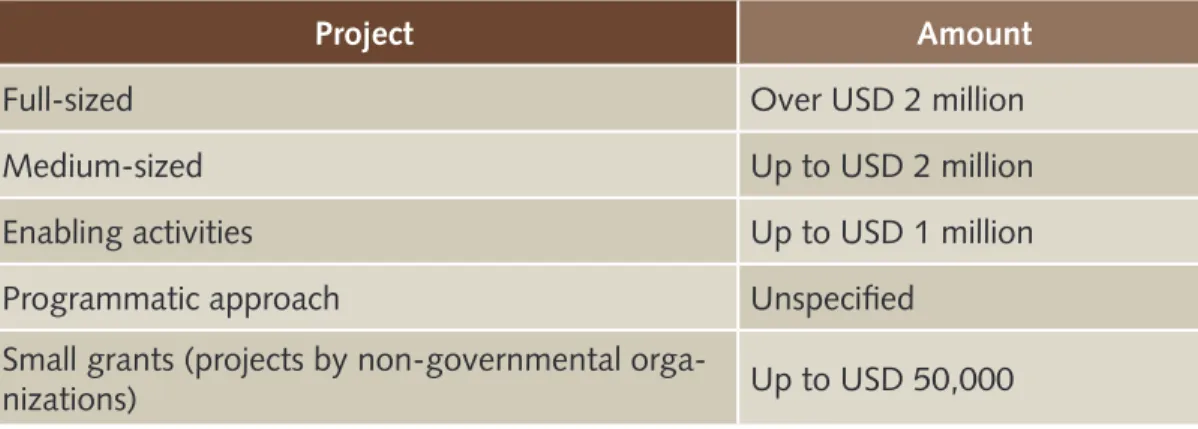
There are several financing modalities, as can be seen in the following table:
Table 2. Scale of projects.
Project Amount
Full-sized Over USD 2 million
Medium-sized Up to USD 2 million
Enabling activities Up to USD 1 million
Programmatic approach Unspecified
Small grants (projects by non-governmental
GEF opportunities
for agriculture
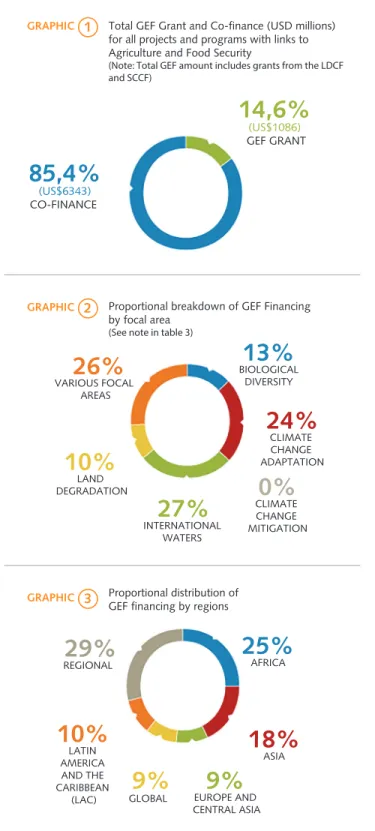
The GEF has been investing resources to support agriculture for over 20 years, con-tributing to food security through climate adaptation and the conservation of the natural resources that provide ecosystem services; even so, only 10% of all financing for the agricultural sector has been invest-ed in Latin America and the Caribbean (see Figure 3).
Several different focal areas offer extensive opportunities for the agricultural sector, especially, but not exclusively, the focal area on land degradation.
The GEF project areas for financing include three major production practices: sustain-able agriculture (crop-livestock systems), sustainable rangeland/pasture management (agro-pastoral systems), and sustainable forest and woodland management.
• Sustainable agriculture: The GEF investment in sustainable agriculture focuses on maintaining or improving the productivity of both rain-fed and irrigated systems. The support mainly targets sustainable land management practices such as crop diversification, crop rotation, conservation agriculture, agroforestry, water harvesting, and small-scale irrigation schemes. • Rangeland Management: The GEF
supports sustainable management of rangelands through the strengthening of viable traditional systems and other measures that improve soil and water conservation. Interventions include the resolution of wildlife-livestock-crop conflicts, conservation of indigenous genetic resources, and reducing water and wind erosion in rangelands.
Source: GEF (Global Environment Facility) 2016. Land degradation (online). Washington, D. C., United States.
Available at https://goo.gl/fUTrsy
The GEF works through an operational focal point in each country. The focal point serves as a liaison to the Fund, coordinates consultations with stakeholders to set priorities, and reviews and endorses projects sent to the GEF to make sure they are consistent with national priorities. The Fund operates through 18 implementing agencies that serve as partners in the design and implementation of projects and programs. Twelve of the agencies have operations in Latin America and the Caribbean: the Corporación Andina de Fomento (CAF), Conservation Inter-national (CI), the Food and Agriculture Organi-zation of the United Nations (FAO), the Fundo Brasileiro para a Biodiversidade (FUNBIO), the Inter-American Development Bank (IDB), the International Fund for Agricultural Development (IFAD), the International Union for Conser-vation of Nature (IUCN), the United Nations Environment Programme (UNEP), the United Nations Industrial Development Organization (UNIDO), the World Bank, the World Wildlife Fund (WWF) and UNDP.
Approach
The main focal areas and resource programming targets for GEF-67 are:
• Biodiversity: USD 1.30 billion • Climate change: USD 1.26 billion • Chemicals and waste: USD 554 million • International waters: USD 456 million • Land degradation: USD 431 million • Sustainable forest management/REDD+:
USD 250 million + USD 500 million from other focal areas if used for forests (that is if they provide a catalyzing effect to leverage more resources for beneficiary countries).
7 The GEF-6 is the sixth replenishment of the Fund’s financial resources, and also included changes to the priorities and programming directions.
Technical and financial support
Recommendations for
requesting GEF funding
• Make and maintain contact with yourcountry’s operational focal point, bearing in mind the project ideas and the national priorities for GEF funding. Engage the focal point’s political will to support and endorse the project. • Identify and work with the focal points
for the different conventions in your country (UNFCCC, CDB, UNCCD, etc.). • Ensure the proposal is consistent with
national and regional plans, strategies and priorities and meets GEF eligibility criteria (for example, the country must be eligible and must have ratified the applicable convention, the proposal must be consistent with national priorities and the GEF strategy for the focal area, etc.).
• Identify ongoing strategies, plans and programs, or those in the planning stage for coming years, on which a GEF project could be built. Consider making use of already existing data or baselines. • Think about strategic partners with
similar or complementary objectives. Consider involving the private sector to have greater impact.
• Make sure the project has a good baseline and clear global environmental benefits. Highlight the global
environmental benefits that will derive from the project.
Adapted from Erath, R. 2014. Oportunidades del ciclo GEF 6 para el sector agropecuario en Centroamérica. (slides). Webinar. 30 slides, sound, color. Consulted February 15, 2016 at
http://goo.gl/HWKsL7 .
The GEF, with its comprehensive view, also has a number multi-focal and cross-cutting issues and programs: • Food security • Sustainable cities • Commodities vs. deforestation • Public-private partnerships • Capacity development • Small grants program • Country support program • Gender mainstreaming • Small island developing states • Indigenous peoples
• Forest restoration
• Amazon sustainable landscapes
Who may apply?
Any organization (government agencies, civil society organizations, private sector, research institutions, etc.), always through the GEF focal points and in cooperation with one of the 18 implementing agencies.
More information:
GEF website: www.thegef.org
Report on the Sixth Replenishment of the GEF Trust Fund: https://goo.gl/3Tf96X
Two decades of experience: Investing in Ecosystem Ser-vices and Adaptation for Food Security:
Source: GEF (Global Environment Facility) 2013. Two decades of experience: Investing in Ecosystem Ser-vices and Adaptation for Food Security. https://goo.gl/u1SR5Y . Washington, D. C., United States. p. 5.
Figure 3.
Distribution of GEF financing and co-financing for projects and programs with
links to agriculture and food security from 1991 to 2011.
14,6%
(US$1086) GEF GRANT13%
BIOLOGICAL DIVERSITY26%
VARIOUS FOCAL AREAS10%
LAND DEGRADATION27%
INTERNATIONAL WATERS0%
CLIMATE CHANGE MITIGATION29%
REGIONAL10%
LATIN AMERICA AND THE CARIBBEAN (LAC)25%
AFRICA18%
ASIA9%
EUROPE AND CENTRAL ASIA9%
GLOBAL24%
CLIMATE CHANGE ADAPTATION85,4%
(US$6343) CO-FINANCE GRAPHIC 1 GRAPHIC 2 GRAPHIC 3Total GEF Grant and Co-finance (USD millions) for all projects and programs with links to Agriculture and Food Security
(Note: Total GEF amount includes grants from the LDCF and SCCF)
Proportional breakdown of GEF Financing by focal area
(See note in table 3)
Proportional distribution of GEF financing by regions
Technical and financial support
Note: The text given below will be useful inidentifying entry points for GEF funding of actions involving the agricultural sector. It was extracted from the report on the sixth replenishment of the GEF trust fund, which lists detailed goals and funding priorities. The numbering has been kept intact to facilitate consultation with the original document, found at https://goo.gl/3Tf96X .
Biodiversity focal area
strategy
Goal: Maintain globally significant biodiversity and the ecosystem goods and services that it
provides to society.
BD-3: Sustainably use biodiversity
• Program 7: Securing Agriculture’s Future:
Sustainable Use of Plant and Animal Genetic Resources (USD 75 million = GEF-6 pro-gramming target)
- Outcome 7.1: Increased genetic diver-sity of globally significant cultivated plants and domesticated animals that are sustainably used within production systems.
• Program 8: Implement the Nagoya Protocol
on Access and Benefit Sharing (ABS) (USD 50 million)
- Outcome 8.1: Legal and regulatory frameworks, and administrative proce-dures established that enable access to genetic resources and benefit sharing in accordance with the provisions of the Nagoya Protocol.
BD-4: Mainstream biodiversity
conservation and sustainable use into
production landscapes and seascapes and
sectors
• Program 9: Managing the
human-biodiver-sity interface (USD 338 million)
- Outcome 9.1: Increased area of pro-duction landscapes and seascapes that integrate conservation and sustainable use of biodiversity into management. - Outcome 9.2: Sector policies and
regu-latory frameworks incorporate biodiver-sity considerations.
• Program 10: Integration of Biodiversity
and Ecosystem Services into Development & Finance Planning (USD 78 million)
- Outcome 10.1: Biodiversity values and ecosystem service values integrated into accounting systems and internalized in development and finance policy and land-use planning and decision-making.
8 See: GEF (Global Environment Facility) 2014. Report on the Sixth Replenishment of the GEF Trust Fund.
Available at https://goo.gl/3Tf96X .
Strategies for the focal areas, programs and results most
relevant to the agricultural sector
8Climate change mitigation
focal area strategy
Goal: Support developing countries and economies in transition to make
transformational shifts towards a low emission development path and
climate adaptation.
CC-2. Demonstrate systemic impacts of
mitigation options
• Program 4: Promote conservation and
enhancement of carbon stocks in forest, and other land-use, and support climate-smart agriculture (USD 206 million)
- Outcome A. Accelerated adoption of innovative technologies and management practices for greenhouse gas (GHG) emis-sion reduction and carbon sequestration. - Outcome B. Policy, planning and
reg-ulatory frameworks foster accelerated low GHG development and emissions mitigation.
CC-3: Foster enabling conditions to
mainstream mitigation concerns into
sustainable development strategies
• Program 5: Integrate findings of
Conven-tion obligaConven-tions and enabling activities into national planning processes and mitigation contributions (USD 95 million)
- Outcome B: Policy, planning and reg-ulatory frameworks foster accelerated low GHG development and emissions mitigation.
International waters
focal area strategy
Goal: To promote collective management for transboundary water systems and implementation
of the full range of policy, legal and institutional reforms and
investments contributing to sustainable use and maintenance of
ecosystem services.
IW-2: Balance competing water uses
in the management of surface and
groundwater
• Program 4: Water/Food/Energy/Ecosystem
Security Nexus (USD 145 million)
- Outcome 4.1: Increased water/food/en-ergy/ecosystem security and sharing of benefits on basin/sub-basin scale under-pinned by adequate regional legal/insti-tutional frameworks for cooperation.
Technical and financial support
Land degradation focal
area strategy
Goal: Arrest and reverse current global trends in land degradation,
specifically desertification and deforestation. By focusing on sustainable land management (SLM), the focal area strategy addresses the need to sustain the flow of ecosystem services that underpin the productivity of agricultural and pastoral systems.
LD-1. Agriculture and rangeland
systems: maintain or improve flow of
agro-ecosystem services to sustain food
production and livelihoods
• Program 1: Agro-ecological Intensification
• Program 2: SLM for Climate Smart
Agri-culture
- Outcome 1.1: Improved agricultural, rangeland and pastoral management. - Outcome 1.2: Functionality and cover
of agro-ecosystems maintained. - Outcome 1.3: Increased investments in
SLM.
LD-2. Forest landscapes: Generate
sustainable flows of forest ecosystem
services, including sustaining livelihoods
of forest dependent people
• Program 3: Landscape Management and
Restoration
- Outcome 2.1: Support mechanisms for forest landscape management and restoration established
- Outcome 2.2: Improved forest manage-ment and/or restoration
- Outcome 2.3: Increased investments in SFM and restoration.
LD-3. Integrated landscapes: reduce
pressures on natural resources from
competing land uses in the wider
landscape
• Program 4: Scaling-up sustainable land
management through the Landscape Ap-proach
- Outcome 3.1: Support mechanisms for SLM in wider landscapes established. - Outcome 3.2: Integrated landscape
management practices adopted by local communities based on gender sensitive needs.
- Outcome 3.3: Increased investments in integrated landscape management.
LD-4. Maximizing transformational
impact: maintain land resources and
agroecosystem services through
mainstreaming at scale
• Program 5: SLM Mainstreaming in
Devel-opment
- Outcome 4.1: SLM mainstreamed in development investments and value chains across multiple scales.
- Outcome 4.2: Innovative mechanisms for multi-stakeholder planning and investments in SLM at scale.
management (SFM)
strategy
Goal: Achieve multiple environmental benefits from improved management of all types
of forests and trees outside of forests.
SFM-1: Maintained forest resources:
reduce the pressures on high conservation
value forests by addressing the drivers of
deforestation
• Program 1: PIntegrated land use planning
- Outcome 1: Cross-sector policy and planning approaches at appropriate governance scales, avoid loss of high conservation value forests.
ue forest.
SFM-3: Restored forest ecosystems:
reverse the loss of ecosystem services
within degraded forest landscapes.
• Program 7: Building technical and
institu-tional capacities to identify degraded forest landscapes and monitor forest restoration • Program 8: Integrating SFM in landscape
restoration
- Outcome 5: Integrated landscape restoration plans to maintain forest ecosystem services are implemented at appropriate scales by government, pri-vate sector and local community actors, both women and men.
Inter-American Institute for Cooperation on Agriculture
Headquarters. P.O. Box 55-2200
San Jose, Vazquez de Coronado, San Isidro 11101 - Costa Rica
Resilience and
comprehensive risk management in agriculture