CHARACTERIZATION AND TRANSFECTION EXPERIMENTS OF
POLYPLEXES TARGETING HDAC7
Antoine Frère
1, Michal Kawalec
3,
Laurence Collard
1, Nicolas Mathéus
2,
Paul Peixoto
2, Brigitte Evrard
1,
Philippe Dubois
3, Laetitia Mespouille
3, Denis Mottet
2, Geraldine Piel
11 Laboratory of Pharmaceutical Technology - CIRM, 2 Metastasis Research Laboratory – GIGA Cancer, University of Liege,
Liege, Belgium; 3 Laboratory of Polymeric and Composite Materials, University of Mons, Mons, Belgium
E-mail: [email protected]
PURPOSE
• To develop polyplexes with new cationic biodegradable aliphatic
polycarbonate polymers bearing or not polyethyleneoxide (PEO) and
guanidinium functions: C93, C98, C106 and C122.
• These polymers are applied to the complexation of siRNA directed
specifically against the histone deacetylase 7 (HDAC7). HDAC7 is a
rational target for anti-angiogenic therapy.
• The aim of this study is to determine the best N/P ratio according to
the size, the charge and the incorporation level of polyplexes. Tests on
HeLa cells are performed with the selected ratio to evaluate cellular
internalization and transfection efficiency.
CONCLUSION
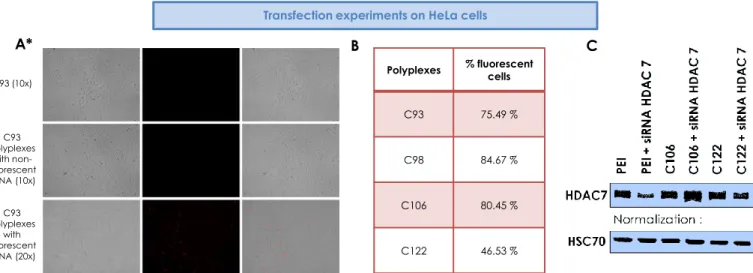
These results show that C93, C98, C106 and C122 polycarbonates are able to form polyplexes with good physicochemical parameters and high cellular internalization. C93, C98 (results not shown) and C106 polyplexes were not able to shut down the expression of HDAC7. C122 polyplexes show a promising partial decrease in the protein expression despite a lower % of transfected cells measured. This result may be explained by a better configuration of the polymer. Future studies will try to further improve the decrease in HDAC7 expression by an optimization of the polyplex characteristics and of the cell culture conditions.
Polycarbonate
polymers siRNA Polyplexes
Mn (nmol/µg) N
C93 Triblock P(MTC-guanidine)-PEO-P(MTC-guanidine) 44362 2.66 C98 3-miktoarm star PEO-P(MTC-guanidine) 30102 2.59 C106 Bz-O-P(MTC-guanidine∙TFA) 28720 2.78 C122 H-shape PEO2k
-co-P(MTC-guanidine∙TFA) 20250 2.47
Polyplexes characterization according to the N/P ratio
-25,0 -15,0 -5,0 5,0 15,0 0 5 10 15 20 25 30 35
Ze
ta
po
te
nt
ial
(
m
V)
N/P
0 100 200 300 400 500 600 0 5 10 15 20 25 30 35Si
ze
(
nm
)
N/P
Transfection experiments on HeLa cells
0 20 40 60 80 100 0 5 10 15 20 25 30 35
Inc
o
rpo
rat
io
n
le
ve
l (
%)
N/P
Figure 1: Effect of N/P ratio on the size (A); charge (zeta potential) (B); and the percentage of siRNA incorporated (C) in C93, C98, C106 and C122 polyplexes. Polyplexes were prepared at a siRNA concentration of 100nM in TE buffer with 5% mannitol; n=3, s.d. are not shown on the
graphs for more clarity.
N/P 15 was selected for each polyplex.
A
B
C
C93 (10x) C93 polyplexes with non-fluorescent siRNA (10x) C93 polyplexes with fluorescent siRNA (20x)A*
Polyplexes % fluorescent cells
C93 75.49 %
C98 84.67 %
C106 80.45 %
C122 46.53 %
B
Figure 2: Optical microscopy images of HeLa cells treated with C93 or C93 polyplexes (A); percentage of fluorescent cells determined by the FACS method after treatment with polyplexes (B); and Western Blot results showing HDAC7 expression 72h after polyplexes addition in cell culture media for
C106 and C122. Polyethyleneimine (PEI) is used as a control transfection agent (C). *Similar images were obtained with C98, C106 and C122.