HAL Id: hal-03002118
https://hal.archives-ouvertes.fr/hal-03002118
Submitted on 16 Nov 2020HAL is a multi-disciplinary open access archive for the deposit and dissemination of sci-entific research documents, whether they are pub-lished or not. The documents may come from teaching and research institutions in France or abroad, or from public or private research centers.
L’archive ouverte pluridisciplinaire HAL, est destinée au dépôt et à la diffusion de documents scientifiques de niveau recherche, publiés ou non, émanant des établissements d’enseignement et de recherche français ou étrangers, des laboratoires publics ou privés.
Enhancing intergranular conductivity in polycrystalline
semiconductor assembly via polythiophene use
Jacinthe Gamon, Carine Robert, Thierry Le Mercier, Philippe Barboux,
Christophe Thomas, Domitille Giaume
To cite this version:
Jacinthe Gamon, Carine Robert, Thierry Le Mercier, Philippe Barboux, Christophe Thomas, et al.. Enhancing intergranular conductivity in polycrystalline semiconductor assembly via polythiophene use. Materials Chemistry and Physics, Elsevier, 2019, 232, pp.400-408. �10.1016/j.matchemphys.2019.05.013�. �hal-03002118�
1
Enhancing intergranular conductivity in polycrystalline
semiconductor assembly via polythiophene use
Jacinthe Gamon,a Carine Robert,a Thierry Le Mercier,b Philippe Barboux, a Christophe M. Thomas,a*
and Domitille Giaume,a*
a
Chimie ParisTech, PSL Research University, CNRS, Institut de Recherche de Chimie Paris, 75005 Paris, France
b
Solvay, Research and Innovation Center Paris, 52 rue de La Haie Coq, 93308 Aubervilliers Cedex, France
* Corresponding authors: E-mail: domitille.giaume @chimie-paristech.fr ; ENSCP, 11 rue Pierre et Marie Curie, 75005 Paris, France
Abstract. We report here the synthesis and grafting of easily accessible catechol-terminated
poly(3-hexylthiophenes) onto Al-doped ZnO particles (ZnO:Al) to obtain a performance-improved polycrystalline assembly. These macromolecular binding species favor electronic conduction from one grain to another. Resistivity measurements of the grafted ZnO:Al powders performed under compression show an increased conductivity as compared to the pure ZnO:Al powders. The catechol function terminating the polymer appears to play an important role on its effect by forming a strong covalent bond with the surface of the zinc oxide. In particular, the conductivity obtained under characteristic pressures of lamination processes gives 1-10 Ω·cm, evidencing the great potential of such an approach for preparation of flexible or thermoreactive films.
Keywords. zinc oxide; catechol; Poly(3-hexylthiophene); grafting onto semiconductors;
2
1. INTRODUCTION
The development of polycrystalline inorganic films with specific electronic conduction properties is required for many modern technologies, such as display industries (using transparent conducting oxides, TCOs),[1,2] photoelectric devices (e.g., photovoltaic layers),[3–5]
thermoelectric devices,[6,7] superconducting films,[8–10] or electrochemical storage devices (e.g. batteries[11,12] or solid oxide fuel cells[13,14]). Nowadays, vacuum-based deposition techniques are widely used to deposit thin films in industrial processes.[15,16] However, these methods are neither suited for the deposition of complex materials and unstable phases under vacuum conditions, nor for the deposition on flexible substrates or hybrid films
fabrication.[17,18] For the latter, liquid-based deposition techniques represent an interesting alternative since the process relies on coating the substrate with an ink (i.e., a colloidal
suspension of the active material) followed by solvent evaporation.[19,20] For applications in which ionic or electronic conduction is required, the critical point to overcome with ink-based deposited thin films is the restitution of the bulk material conduction properties to the
polycrystalline film. The resulting granular films are often porous and the presence of residual impurities contributes to their low conductivity.[21–24] In this regard, the best way to improve the intergranular transfer is to densify the film through high temperature annealing.[25–29] However, as for vacuum-based deposition routes, thermal sintering also prevents the use of poorly stable materials, such as polymeric substrates. Although this issue has been already addressed for nanocrystal-based thin films,[1,21–24,30,30–37]a great challenge remains in optimizing liquid-based deposited thin films using low temperature processes.
Al-doped ZnO is an interesting example of doped conducting oxide and it was recently
3
the electronic connectivity between the grains.[38] In that case, it has been shown that the conductivity can be further increased when using a conjugated molecule, suggesting that the lower the difference between the HOMO and LUMO level (ΔH-L), the better the grain boundary
conductivity. This can be explained by a charge transfer between the organic molecule and the semiconductor, which would lead to the HOMO pinning at the Fermi level of ZnO.[39,40]
In order to test the influence of a covalent grafting on the oxide electronic conductivity, we decided to use a custom-made macromolecule, with a conjugated chain, a small ΔH-L and a
grafting function. The low bandgap values conferred to conducting polymers such as polyaniline (3.2 eV, 102 S cm-1), polyacetylene (1.5 eV, 105 S cm-1) and polythiophene (2 eV, 103 S cm-1) make them attractive molecules to further improve the intergranular conductivity of granular powder [41]. Among them, polythiophene shows one of the lowest bandgap along with a reasonably good electronic conductivity [42],[43]. We thus chose polythiophene conducting polymers, as the HOMO-LUMO energy gap of which is as low as 2 eV.
As early as 1981, Waite, Tanzer et al. were the first to demonstrate the unique properties of catechol in the adhesion of mussels.[44] Inspired by this pioneering work, several research groups used catechol derivatives to graft a wide range of polymers (e.g., polypeptides,[45] glycopolymers,[46] polyethers[47] or polynorbornene[48]) onto various inorganic surfaces (e.g., iron,[49] silver,[50] zinc oxide,[51] titanium oxide[52,53]). In this regard, we envisaged that the direct incorporation of a catechol functionality in poly(3-hexylthiophene) (P3HT) will enable a simpler and efficient procedure of grafting. In order to avoid the formation of a self-percolating network of polymer inside the ZnO:Al powder, we limited the study to low molecular weight polymers. The adsorption of polymers was thereafter analyzed before testing the effect of the polymer grafting on the intergranular conductivity of ZnO:Al.
4
2. MATERIALS AND METHODS
2.1. Materials
Dibromo-3-hexylthiophene (> 97 %, TCI), isopropylmagnesium solution 2 M in THF (Sigma-Aldrich), [1,3-Bis(diphenylphosphino)propane]dichloronickel(II) (Sigma-(Sigma-Aldrich), 3,4-(methylenedioxy)phenylmagnesium bromide solution 1 M in THF:Toluene (1:1)
(Sigma-Aldrich), tris(pentafluorophenyl)borane B(C6F5)3 (95 %, Sigma-(Sigma-Aldrich), triethylsilane (98+%, Alfa Aesar), tetrabutylammonium fluoride trihydrate (≥97.0%, Sigma-Aldrich), dibasic
potassium phosphate (Prolabo), methanol (≥99.5%, GPR RECTAPUR, VWR), dichloromethane (99% stabilized, GPR RECTAPUR, VWR), THF (RP-NORMAPUR, VWR), ZnO aluminum doped 3 w% (Zano® Al-10, Umicore) were used as raw materials.
Trans-2-[3-(4-ter-Butylphenyl)-2-propenylidene] malonitrile (DCTB, used as the matrix for MALDI-TOF MS, was of the highest grade available and used without further purification) was purchased from Sigma Aldrich Co.
2.2.Typical procedure for the GRIM polymerization[54,55]
Polymerization reaction is carried out in a dried 100 ml round-bottom flask under inert
atmosphere at room temperature. 650 μL (3.06 mmol) of dibromo-3-hexylthiophene diluted in 10 ml of distilled THF is added. After several minutes, 1.53 ml of an isopropylmagnesium solution 2 M in THF is added thanks to a syringe and the mixture is stirred for two hours. Then the solution is diluted by adding 50 ml of THF. [1,3-Bis(diphenylphosphino)
propane]dichloronickel(II) (the amount depending on P1, P2, P3) is added and the mixture is stirred for 10 min before the addition of the 3,4-(methylenedioxy)phenylmagnesium bromide solution (1,53 mmol, 1,53 mL, 1.0 M in THF-toluene solution 1:1). After 30 min, the mixture is
5
poured in methanol and the polymer is separated by filtration. The polymer is then dried under vacuum.
2.3.Typical procedure for the deprotection[56,57]
The polymer (100 mg) and tris(pentafluorophenyl)borane B(C6F5)3 (48 mg) are poured in a 100 ml dried round-bottom flask with 50 ml of dichloromethane under an inert atmosphere. 300 μL of triethylsilane is then added and the mixture is stirred for eight days. The solution is then poured in methanol to precipitate the polymer. After filtration, the polymer is dissolved in 50 ml of THF and 500 μL of TBAF buffer. The mixture is stirred 6 hours and the polymer is isolated by precipitation and filtration.
2.4.Functionalization procedure for the conductivity measurements
All conductivity measurements with organic additives were performed with a batch of ZnO:Al powder produced by heating the commercial powder (Zano® Al-10) in a tubular furnace under an H2/Ar (4 %) atmosphere at 900 °C for 1 hour with heating and cooling ramps of 5 °C·min-1. After annealing, the surface area of the powder decreased down to 2 m2·g-1.
Polythiophenes P3HT-Cat (named P1-Cat, P2-Cat and P3-Cat) where grafted in THF, solvent in which the polymers are soluble, by dispersing 800 mg of ZnO:Al powder into 80 mL of P3HT-Cat 0,1 g·L-1 in THF. The suspension is agitated under magnetic stirring for 12 hours and filtered without washing. The powder is then dried in oven at 65 °C overnight.
2.5.Techniques and equipment
NMR. All NMR spectra were recorder either on Bruker Avance 300 MHz or 400 MHz
spectrometer at Chimie ParisTech at 20 °C in CDCl3.
SEC. In order to determine the number average molecular weight (Mn) and the polydispersity
6
performed in THF at 35 °C using an Agilent 1260 Infinity Series GPC (ResiPore 3 μm, 300 x 7.5 mm, 1.0 ml/min, UV (250 nm) and RI (PLGPC 220) detectors). The number average molecular masses (Mn) and polydispersity index (Mw/Mn) of the polymers were calculated with reference to
a universal calibration vs. polystyrene standards (limits Mw = 200 to 400000 g·mol-1).
MALDI-TOF. MS analyses were performed using an Axima Confidence mass spectrometer
(Shimadzu). Acquisitions were performed in linear positive ion mode. The laser intensity was set just above the ion generation threshold to obtain peaks with the highest possible signal-to-noise (S/N) ratio without significant peak broadening. The acceleration voltage was 20 kV. The mass spectrometer was externally calibrated using PEG2000. Polymer sample for MALDI analysis was prepared at a concentration of 60 µM in THF. The DCTB (T-2-[3-(4-t-butylphenyl)-2-methyl-2-propenylidene]malonitrile) solution was prepared at a concentration of 6 mM in THF. The sample was prepared by mixing the polymer solution with matrix solution at a volume ratio of 1:9.
BET. The specific surface area of the powders was measured from gas adsorption analysis
performed with a Belsorp-max (Bel Japan), and calculated thanks to the Brunauer, Emmett and Teller (BET) method. The surface area of the as-purchased Umicore (Zano® Al-10) powder is 30 m2·g-1.
Scanning electron microscope (SEM-FEG). The SEM images were performed thanks to a LEO
1530 (Zeiss) apparatus, working at 15 keV and equipped with an In-Lens detector.
X-Ray diffraction (XRD) experiments were carried out in Bragg-Brentano geometry on a
Panalytical X’Pert Pro apparatus with monochromated CuKα1 beam in the 20 ≤ 2θ ≤ 80 °
scan range.
Infrared spectroscopy. The ATR-FTIR spectra were collected with a dry-air-purged Thermo
7
and spectra were averaged from 256 scans. For the study of the P3HT adsorption, the horizontal ZnSe crystal with a single reflection (A = 2.54 mm2) and an angle of incidence of 45 ° (Smart Pike) was coated with 1 μL of the ZnO:Al suspension (1 g·L-1), which was dried under a flow of N2. A background spectrum was recorded after the pure THF solvent was added. After 1 hour of stabilization, the background was recorded and a droplet of the polymer P3HT dissolved in THF was added before recording the spectra.
UV-visible spectrometry. A UV-Visible Cary 100 Scan (Varian) spectrometer was used in order
to record absorption spectra of the polymer (P1-Cat and P2-Cat) dissolved in THF in a standard quartz cell (10*10*45 mm) and with a blank cell containing a pure THF solution. Standard curves were performed at concentrations of 1, 2, 4, 5, 10, 12, 15,and 20.10-3 mol·L-1 and the regression coefficient was 0.999 and 0.991 for P1-Cat and P2-Cat respectively. For the
quantitative determination of the adsorption, 800 mg of ZnO:Al powder (beforehand annealed under H2/Ar 4 % atmosphere) are dispersed in 80 mL of a 1 g·L-1 solution of polymer in THF. After immersion of the powder in the solution for 12 hours and dispersion in an ultrasonic bath for 2*15 min, the suspension is filtered thanks to a Büchner device without washing. The filtrate and the residue are collected. Thanks to the calibration curves, the concentration of the filtrates could be determined, and by substraction, the amount of polymer left at the surface of the powder in the residue was deduced. This corresponds to a mass percentage, rm, of polymer of 0.95 %. By using molar masses of P1-Cat and P2-Cat, MPi, as well as the specific surface, as, it was possible to estimate the mean coverage:
8
2.6.Experimental set-up for resistivity measurements under pressure.
The set-up used for the resistivity measurements is similar to that of Celzard et al [58] and is identical to previously reported description [59,60]. It is schematized on Figure 1 and consists of a 13 mm-diameter stainless steel cylindrical Swagelok cell equipped with two stainless steel plungers insulated from internal walls by Mylar sheet. An appropriate mass of powder fills the internal cyclindrical space. The whole cell is placed between two compression moving platens of a numerically monitored Instron 5966 testing system. The two plungers are connected to a Keithley 2400 ohmmeter, which records the two probes resistance between the plungers during the compression cycle. Preliminary calibration performed with varying weights of material allowed us to estimate the junction resistance to be 0.4 ohms, which was then neglected in further experiments.
Figure 1: scheme of the experimental set-up for resistivity measurement under pressure . The
monitoring of the two plungers displacement combined with connexion to the ohmmeter allow the measurement of pressure, resistance and thickness during the experiment.
To determine the thickness of the pellet during the experiment, measurement of the platens displacement is performed. This displacement combines both the powder compaction and the plungers deformation under pressure. This last effect is annealed by applying a correction of the deformation obtained on an empty cell.
9
3. RESULTS AND DISCUSSION
3.1. Polymer synthesis
As catechol derivatives have already been shown to graft conjugated polymers onto ZnO nanoparticles, we chose to use the same type of procedure in this study.[51] A four-step synthesis was therefore investigated to introduce two catechol terminal groups on P3HT and to study the effect of the average molecular weight of P3HT (Scheme 1). Polymerizations were carried out with various proportions of catalyst to obtain three different targeted polymerization degrees: 25 (P1), 35 (P2) and 55 (P3).
Scheme 1. ZnO:Al@P3HT synthetic strategy using two catechol anchoring groups.
Firstly, an in situ functionalization method via GRIM was used to obtain bifunctional (methylenedioxy)phenyl-terminated P3HT called Pn-Met (with n = {1, 2, 3} referring to the
10
degree of polymerization of 25, 35 or 55 respectively).[51] Indeed, the GRIM polymerization employs 2,5-dibromo-3-hexylthiophene which reacts with isopropyl magnesium bromide by transmetallation to generate 2-bromo-3-hexyl-5-thienyl magnesium bromide. Secondly, the subsequent addition of Ni(dppp)Cl2 coupling catalyst produces regioregular head-to-tail
P3HT.[61] Finally, the addition of a 3,4-(methylenedioxy)phenylmagnesium bromide solution yields a protected catechol bis-substituted P3HT. NMR spectroscopy analysis confirms the presence of catechol group(s) in terminal positions (singlet at δ 6.02 ppm in 1H NMR and 101.3 ppm in 13C NMR spectra corresponding to the CH2 of the catechol) and a regioregularity higher
than 80 % was calculated by comparing the integration of the signals at 2.8 (I = 22.8) and 2.6 ppm (I = 5.5) (Supporting Information Figure S1-S8). Deprotection was achieved by a B(C6F5)3-catalyzed cleavage of alkyl ethers linkage with hydrosilanes procedure described by
Yamamoto and Philipps.[57,62] Signal of the methoxy group at δ 6.02 ppm in NMR 1H spectrum disappears. The final deprotected polymer is noted Pn-Cat.
P3HT synthesized before and after deprotection were analyzed by steric exclusion
chromatography (SEC) and MALDI-TOF mass spectrometry to evaluate the control of the
polymerization. SEC of P3HT showed monomodal signals with narrow dispersity index, but with higher Mn,exp values compared with NMR results. This is consistent with the fact that SEC in
these experimental conditions (THF, PS calibration) is known to overestimate P3HT molar mass by a factor around 1.5-2 (Table 1 and Supporting Information).[63,64] MALDI-TOF analysis confirms the monomodal distribution, and the success of the deprotection (Figure 2 and Figure S9-S14), while allowing a determination of the P3HT molar mass. For example, in the case of P3-Cat after deprotection: the peak at 3546.43 accounts for 20 repeating units, two catechol groups and a proton adduct (theoretical mass (+H+) = 3544.94, Supporting Information Figure
11
S13). Using this procedure, we successfully synthesized three polymers, doubly terminated with catechol, presenting various number average molecular weights: Mn (g·mol-1) = 1800 (P1), 2600
(P2), 4500 (P3).
Table 1. Number average molecular weights observed for synthesized P3HT derivatives
Entry Polymers (targeted DPn) Mn,exp (g·mol-1) RMN Mn,exp[a] (g·mol-1) SEC Mn,exp[b] (g·mol-1) MALDI-TOF (DPn) Mw/Mn[a] 1 P1-Met (25) 2550 3160 nd - 2 P1-Cat (25) 2550 nd 1800 (10) 1.1 3 P2-Met (35) 4200 4846 nd - 4 P2-Cat (35) 4200 nd 2600 (15) 1.1 5 P3-Met (55) 7530 9234 4400 (26) 1.1 6 P3-Cat (55) 7530 nd 4500 (26) 1.1 [a]
Mn,exp and Mw/Mn of polymer determined by SEC-RI calibrated with polystyrene standards at 35 °C and reported
12
Figure 2. MALDI-TOF of P3HT P3-Cat after deprotection. Linear chains: e.g., peak at 3546.43
accounts for 20 repeating units + two catechols + H+
3.2.Grafting
Grafting of the synthesized polymers has been studied on a commercially available aluminum-doped zinc oxide powder (Umicore Zinc Chemicals : Zano® Al-10), composed of very well crystallized nanometric particles of approximately 25 nm [38] (Figure 3). This raw powder was specifically selected in order to conduct the infrared spectroscopy study. Indeed, its high specific surface (30 m2.g-1) induces a high number of anchoring sites, and therefore will lead to a more intense infrared signal. The effect of an annealing treatment under a reducing
13
Figure 3. Characterization of commercial ZnO:Al powder : (a) FE-SEM-image showing 30nm
nanoparticles before annealing and (b) after annealing (b), and (c) XRD diagram. All the peaks are attributed to würtzite phase and the insert on (c) shows the decrease of the peak broadening after annealing du to the larger particle size.
The synthesized polythiophenes before and after deprotection (Pn-Met and Pn-Cat, n = 1, 2, 3 respectively) are all soluble in THF. Their specific interaction with the ZnO:Al surface was analyzed by ATR-FTIR spectroscopy (Attenuated Total reflectance Fourier Transform Infrared spectroscopy) using ZnSe as the ATR crystal. For such an experiment, a small droplet of the ZnO:Al powder suspension in THF was first deposited onto the ZnSe crystal and dried. The IR signal obtained on this dried ZnO:Al powder was used as the baseline and subtracted from the signal obtained after the deposition of a droplet of the solution containing the polymer. We
14
eliminated from our ATR-FTIR analysis the region between 1100 and 900 cm-1 in which the IR signal of the THF solvent appears. The performed analysis limited to the 1550-1150 cm-1 thus reveals the vibrations of the sole polymer close to the crystal surface (Figure 4). We performed the study only for the P1 polymer, for a reason of clarity of the FTIR signals and aimed to study the effect of the end-function of the polymer (catechol or protected).
Figure 4. ATR-FTIR analysis of (a) a THF solution of concentrated P1-Cat (>10 g.L-1); (b) a
THF solution of 0.1 g.L-1 P1-Cat deposited onto ZnO:Al powder previously deposited onto the ZnSe crystal; (c) a THF solution of 0.1 g.L-1 P1-Met deposited onto ZnO:Al powder previously deposited onto the ZnSe crystal.
Figure 4a presents the spectrum of the polymer P1-Cat solubilized in THF at high concentration (>10 g.L-1). Vibrations between 1400-1500 cm-1 are attributed to υc=c from aromatic carbons,
deformation at 1375 cm-1 to δc-h from alkyl chains, 1292 and 1269 cm-1 vibrations show
elongation υc-O and deformation of O-H bonds. Finally, the vibration at 1202 cm-1 characterizes
15
completely disappears in the ATR geometry (Figure S15b). Thus, characterization of the polymer – oxide interaction can be performed by using 0.1 g.L-1
of polymer in THF above ZnO:Al particles. The adsorption of molecules at the surface of the solid should locally concentrate the polymer and therefore amplify the signal, which then becomes detectable again.
When a droplet of THF containing 0.1 g.L-1 of the protected methoxy-terminated polymer (P1-Met) is deposited onto the ZnO:Al particles, no signal appears (Figure 4c) indicating the absence of any significant interaction. When the catechol-terminated polymer (P1-Cat) is deposited onto the ZnO:Al particles, the IR signature of the polymer clearly appears (Figure 4b), revealing a polymer concentration in the close surrounding of the particles. This spectrum differs from the signature of the free polymer solution. The aromatic carbon vibrations at 1400-1500 cm-1widen and change in intensity, although the peak positions do not change. However, the 1514 cm-1 band disappears. The three vibrations corresponding to elongation and deformation υCO / δOH are
strongly modified to give a major band at 1254 cm-1. These changes can be attributed to the formation of C-O-Zn bond. Indeed, Savic et al. thoroughly studied catechol and derivated product adsorption on titanium dioxide by in situ ATR-FTIR spectroscopy, completed by DFT calculi.[65] They observed evolution of the υCO / δOH signals which was attributed to C-O-Ti
formation.[66,67] The adsorption mode could be mainly attributed to a bidentate chelation (1254 cm-1 band), rather than a bridging binuclear chelation (1302 cm-1).[68,69]Therefore, the ATR-FTIR experiment clearly evidences that specific adsorption occurs between the catechol function and the ZnO:Al surface, most probably due to a bidentate chelation.
Moreover, as no grafting of the protected polymer takes place on the surface (Figure 4c), only catechol reacts with the ZnO:Al surface. This specific interaction is confirmed by the color
16
change of the ZnO:Al powder obtained after stirring in a THF solution of P3HT-Cat and filtering, while no color change occurs when using protected polymer P1-Met (Figure S16).
3.3.Quantitative analysis of the adsorption and optical properties of Pn-Cat
After validating the covalent bonding of the synthesized Pn-Cat onto the surface of ZnO:Al, we prepared the actual ZnO:Al@Pn-Cat grafted particles for the conductivity measurements. For this study, the raw ZnO:Al powder was first annealed under a reducing atmosphere in order to first increase and stabilize its bulk conductivity.[38,70,71] Once the desired high electronic conductivity was achieved and the influence of surface proton
conductivity was negligible, the polymer was grafted onto its surface. The effect of annealing on the particles morphologies is presented on Figure 3: grain size increases from 30 to 100 nm as shown by the SEM images as well as by the smaller broadening of the diffraction peaks after annealing.
As the polymers are colored, quantitative analysis of their grafting on ZnO:Al was further performed by UV-Visible spectrometry. For the three synthesized polymers, an adsorption peak is observed in the 440 nm range (Figure 5). The maximum position is bathochromic shifted as the chain length increases (moving from 433 nm to 445 nm, from P1-Cat to P3-Cat).
17
Figure 5. Absorption spectra of catechol functionalized polythiophenes P1-Cat (squares), P2-Cat
(triangles), P3-Cat (circles). The peak position on each spectrum is given on the graph.
Using Beer-Lambert’s law, standard curves performed on dissolved polymer in THF at controlled concentrations, allow to determine the extinction coefficient ε(433nm) = (83.1 ± 0.7) · 103 L·mol -1
·cm-1 and ε(441nm) = (143 ± 3) · 103 L·mol-1·cm-1 for P1-Cat and P2-Cat respectively (Figure
S17). Reported to a monomer chain unit, this corresponds to ε(433nm) = (8.31 ± 0.07) 103 L·mol -1
·cm-1 for P1 and ε (441nm) = (9.553 ± 0.2) · 103 L·mol-1·cm-1 for P2, which is in accordance with
the literature.[72] Knowing the ZnO:Al particle size and concentration, we determined a mean coverage of 0.1 molecules per nm2. This value lies in the range of typical surface coverages for polymers[73] and is below that of monomers-grafted ZnO.[74,75] This can be explained by higher steric interactions of the polymers compared to smaller molecules.
3.4.Electronic resistivity
The effect of such surface modification on the intergranular conductivity of the ZnO:Al powder was studied under compression. This setup is very useful for reproducing pressure ranges
18
typically obtained in liquid-based deposited thin films either through capillary effects or calendaring [76,77]. Moreover, it yields highly reproducible results enabling a precise comparison between the samples.[38,59]
At low pressure, the presence of organic molecules at the grain surface slightly increases compacity revealing stronger adhesion between the grains (relative compacity increase of 20 % at 10 Pa). However, at high pressure (>107 Pa) the grafting of organic molecules at the grain surface has no effect on the relative density of the powder, dR, (Figure S18) because all grains are in hard
contact and the increase of relative density is due to packing effect. So, the surface treatment does not modify the compacity of a ZnO:Al pellet at pressures above 107 Pa. Nevertheless, it should slightly improve the compacity of films made by liquid-based deposition techniques, for which the typical capillary pressure induced during film drying is in the 104-106 Pa range.[76,77]
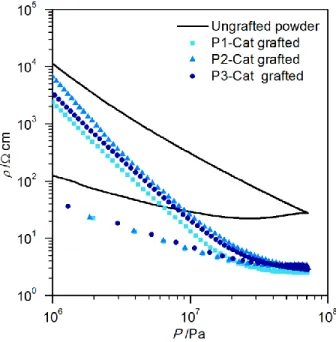
The change of the electrical resistivity with the applied pressure is represented on a logarithmic scale on Figure 6. At low pressure (below 106 Pa) the grains of the powder are weakly connected and the value of the resistivity is very irreproducible. Up to a pressure of 5.107 Pa, log(ρ) varies linearly with log(P). The powder compacts and the grains increase their coordination number. The decrease of the resistivity is associated with an increased connectivity of the particles with each other (increased number of connections). This dramatic decrease of the resistivity corresponds to a domain where inelastic deformation dominates. The inelastic
contribution, on the other hand, is attested by the fact that after one cycle, the powder forms a cohesive pellet, which can only go back to a powder form when ground in a mortar. At higher pressure (i.e., above 107 Pa) the resistivity decreases more slowly. The change in resistivity is attributed to an increased contact surface between grains because of their elastic deformation as described by the contact theory developed by Hertz.[78] Indeed, the resistivity slightly increases
19
when the pressure is released. Therefore, this experiment enables to explore if grafted molecules have an impact on the intergranular contact, on the way particles compact and connect with each other, and on the maintaining of these parameters when the pressure is released.
Figure 6. Resistivity in function of the applied pressure on the ZnO:Al powder pure (full line)
and grafted with P1-Cat (squares), P2-Cat (triangles), P3-Cat (circles).
The three grafted polymers have a positive impact on the resistivity over the whole applied pressure range. The resistivity is decreased by a factor of 10 for an applied pressure around 3 MPa. We cannot see any effect of the chain length on the conductivity within the experimental error that we estimate to 10%.
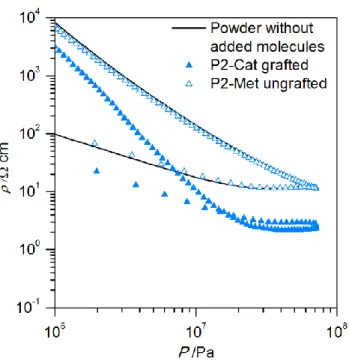
In order to determine the influence of the bond-type on the powder conductivity, a comparison between the addition of the protected (P2-Met) and deprotected polymer (P2-Cat) was made. As demonstrated in the grafting section, the Pn-Cat strongly binds to the zinc oxide surface through a covalent bond of the catechol group, whereas Pn-Met does not adsorb. In order
20
to compare the effect of P2-Met et P2-Cat, the same proportion of polymer must be present in the pellets. This proportion of polymer is therefore controlled through a simple evaporation of the solvent (THF), after immersion of the ZnO:Al powder in the polymer solution. The resulting powder is then ground to ensure a good dispersion of the polymer (cf. experimental section). The resistivity of the powder containing the ungrafted polymer (P2-Met) is identical to that of the powder without any polymer (Figure 7), whereas the resistivity of the powder with the grafted P2-Cat polymer is strongly decreased as shown in the previous paragraph. This result clearly demonstrates the importance of a strong covalent interaction between the polymer and the semiconductor in order to increase the electronic transfer between the particles.
Figure 7. Resistivity in function of applied pressure on pure ZnO:Al powder (full line); with the
presence of P2-Cat (filled triangles) and P2-Met (empty triangles) at the interface showing the importance of the grafting thanks to the catechol function.
21
4. CONCLUSION
We reported here the new synthesis of a catechol-terminated P3HT and the grafting procedure onto ZnO:Al particles in order to obtain hybrid ZnO:Al powders with improved conductivity through a room temperature process.
Polymers with different chain lengths have been prepared, and fully characterized by NMR spectroscopy and mass spectrometry. Such polymers can be grafted onto ZnO:Al nanoparticles
via the catechol function. The influence of grafting on the intergranular conductivity of the
powder has been tested. The resistivity obtained under pressures of 107 Pa decreased down to 1-10 Ω·cm, showing an increase in the electronic conductivity by a decade compared to untreated ZnO:Al powder. A mixture of the polymer and ZnO:Al nanoparticles did not improve the conductivity, proving the necessity of the covalent bonding via the catechol function. This effect can be attributed both to a better dispersion of the catechol-functionalized polymer within the zinc oxide powder, and to the improvement of the electronic transfer from one ZnO:Al grain to another, due to an increase of the electronic orbital overlap between the polymer and the solid particles.
The performance of the molecule grafting technique does not reach that of temperature annealing (sintering increases the conductivity by more than 3 orders of magnitude for
ZnO[38,79]). However, improving the conductivity of one order of magnitude thanks to molecule grafting will be of high interest when temperature annealing cannot be performed. This process, performed here on thick pellets, shows the great potential of such an approach for preparation of flexible or thermoreactive films at room temperature. This study therefore paves the way for the use of P3HT oligomer grafting as an alternative to high temperature annealing for the
22
Acknowledgements
We thank, the Structural Metallurgy team at the Institut de Recherche de Chimie de Paris (IRCP, Chimie ParisTech, PSL Research University, France) for giving us access and time to their Ingstrom Press used for the conductivity measurements. We also thank T. Barbier, S. Goyard, S. Croyeau and W. Win (Solvay, Research and Innovation Center of Paris, France) for performing ICP and CHNS analysis.
Funding: This work has been funded by the French National Research and Technology Agency
(ANRT), as well as by Solvay, Research and Innovation Center of Paris, France.
Declarations of interest: none
Supporting Information
NRM spectroscopy, MALDI-TOF, Infrared spectroscopy and grafting study details can be found in the supplementary information file.
References
[1] R.M. Pasquarelli, D.S. Ginley, R. O’Hayre, Solution processing of transparent conductors: from flask to film, Chem. Soc. Rev. 40 (2011) 5406–5441. doi:10.1039/C1CS15065K. [2] S. Faÿ, J. Steinhauser, S. Nicolay, C. Ballif, Polycrystalline ZnO: B grown by LPCVD as
TCO for thin film silicon solar cells, Thin Solid Films. 518 (2010) 2961–2966. doi:10.1016/j.tsf.2009.09.189.
[3] A. Bosio, N. Romeo, S. Mazzamuto, V. Canevari, Polycrystalline CdTe thin films for photovoltaic applications, Prog. Cryst. Growth Charact. Mater. 52 (2006) 247–279. doi:10.1016/j.pcrysgrow.2006.09.001.
[4] D.B. Mitzi, M. Yuan, W. Liu, A.J. Kellock, S.J. Chey, V. Deline, A.G. Schrott, A High-Efficiency Solution-Deposited Thin-Film Photovoltaic Device, Adv. Mater. 20 (2008) 3657–3662. doi:10.1002/adma.200800555.
[5] T. Matsui, M. Tsukiji, H. Saika, T. Toyama, H. Okamoto, Correlation between
Microstructure and Photovoltaic Performance of Polycrystalline Silicon Thin Film Solar Cells, Jpn. J. Appl. Phys. 41 (2002) 20. doi:10.1143/JJAP.41.20.
23
[6] A. Boulouz, S. Chakraborty, A. Giani, F.P. Delannoy, A. Boyer, J. Schumann, Transport properties of V–VI semiconducting thermoelectric BiSbTe alloy thin films and their application to micromodule Peltier devices, J. Appl. Phys. 89 (2001) 5009–5014. doi:10.1063/1.1360701.
[7] A. Boukai, K. Xu, J.R. Heath, Size-Dependent Transport and Thermoelectric Properties of Individual Polycrystalline Bismuth Nanowires, Adv. Mater. 18 (2006) 864–869.
doi:10.1002/adma.200502194.
[8] P.P. Nguyen, D.E. Oates, G. Dresselhaus, M.S. Dresselhaus, Nonlinear surface impedance for thin films: Measurements and a coupled-grain model, Phys. Rev. B. 48 (1993) 6400– 6412. doi:10.1103/PhysRevB.48.6400.
[9] Y. Kozuka, M. Kim, C. Bell, B.G. Kim, Y. Hikita, H.Y. Hwang, Two-dimensional normal-state quantum oscillations in a superconducting heterostructure, Nature. 462 (2009) 487– 490. doi:10.1038/nature08566.
[10] A.E. Dane, A.N. McCaughan, D. Zhu, Q. Zhao, C.-S. Kim, N. Calandri, A. Agarwal, F. Bellei, K.K. Berggren, Bias sputtered NbN and superconducting nanowire devices, Appl. Phys. Lett. 111 (2017) 122601. doi:10.1063/1.4990066.
[11] C. Julien, M.A. Camacho-Lopez, L. Escobar-Alarcon, E. Haro-Poniatowski, Fabrication of LiCoO2 thin-film cathodes for rechargeable lithium microbatteries, Mater. Chem. Phys. 68 (2001) 210–216. doi:10.1016/S0254-0584(00)00372-2.
[12] B. Wang, J.B. Bates, F.X. Hart, B.C. Sales, R.A. Zuhr, J.D. Robertson, Characterization of Thin‐ Film Rechargeable Lithium Batteries with Lithium Cobalt Oxide Cathodes, J. Electrochem. Soc. 143 (1996) 3203–3213. doi:10.1149/1.1837188.
[13] J. Santiso, M. Burriel, Deposition and characterisation of epitaxial oxide thin films for SOFCs, J. Solid State Electrochem. 15 (2011) 985–1006. doi:10.1007/s10008-010-1214-6. [14] K. Kerman, B.-K. Lai, S. Ramanathan, Thin film nanocrystalline Ba0.5Sr0.5Co0.8Fe0.2O3:
Synthesis, conductivity, and micro-solid oxide fuel cells, J. Power Sources. 196 (2011) 6214–6218. doi:10.1016/j.jpowsour.2011.03.049.
[15] P.M. Martin, ed., Chapter 1 - Deposition Technologies: An Overview, in: Handb. Depos. Technol. Films Coat. Third Ed., Third Edition, William Andrew Publishing, Boston, 2010: pp. 1–31. doi:10.1016/B978-0-8155-2031-3.00001-6.
[16] C.B. Carter, M.G. Norton, eds., Thin Films and Vapor Deposition, in: Ceram. Mater. Sci. Eng., Springer New York, New York, NY, 2007: pp. 494–506. doi:10.1007/978-0-387-46271-4_28.
[17] M. Caironi, Y.-Y. Noh, Large Area and Flexible Electronics, Wiley, 2015.
[18] A. Blayo, B. Pineaux, Printing processes and their potential for RFID printing, in: Proc. 2005 Jt. Conf. Smart Objects Ambient Intell. Innov. Context-Aware Serv. Usages Technol., ACM, 2005: pp. 27–30. http://dl.acm.org/citation.cfm?id=1107559 (accessed March 18, 2015).
[19] J. Alex, ed., Konrad Zuse: der Vater des Computers, Parzeller, Fulda, 2000.
[20] S.E. Habas, H.A.S. Platt, M.F.A.M. van Hest, D.S. Ginley, Low-Cost Inorganic Solar Cells: From Ink To Printed Device, Chem. Rev. 110 (2010) 6571–6594. doi:10.1021/cr100191d. [21] D.V. Talapin, J.-S. Lee, M.V. Kovalenko, E.V. Shevchenko, Prospects of Colloidal
Nanocrystals for Electronic and Optoelectronic Applications, Chem. Rev. 110 (2010) 389– 458. doi:10.1021/cr900137k.
[22] M. Grouchko, A. Kamyshny, C.F. Mihailescu, D.F. Anghel, S. Magdassi, Conductive Inks with a “Built-In” Mechanism That Enables Sintering at Room Temperature, ACS Nano. 5 (2011) 3354–3359. doi:10.1021/nn2005848.
24
[23] E.L. Rosen, R. Buonsanti, A. Llordes, A.M. Sawvel, D.J. Milliron, B.A. Helms,
Exceptionally Mild Reactive Stripping of Native Ligands from Nanocrystal Surfaces by Using Meerwein’s Salt, Angew. Chem. Int. Ed. 51 (2012) 684–689.
doi:10.1002/anie.201105996.
[24] M.V. Kovalenko, M. Scheele, D.V. Talapin, Colloidal Nanocrystals with Molecular Metal Chalcogenide Surface Ligands, Science. 324 (2009) 1417–1420.
doi:10.1126/science.1170524.
[25] Y. Kajikawa, Effects of grain-boundary potential barrier height and its fluctuation on
conductivity of polycrystalline semiconductors in the ionized-impurity-scattering dominated case, J. Appl. Phys. 114 (2013) 043719. doi:10.1063/1.4816795.
[26] V. Šnejdar, J. Jerhot, Electrical conductivity of polycrystalline semiconductors, Thin Solid Films. 37 (1976) 303–316.
[27] F. Greuter, G. Blatter, Electrical properties of grain boundaries in polycrystalline compound semiconductors, Semicond. Sci. Technol. 5 (1990) 111.
[28] A. Zabet-Khosousi, P.-E. Trudeau, Y. Suganuma, A.-A. Dhirani, B. Statt, Metal to Insulator Transition in Films of Molecularly Linked Gold Nanoparticles, Phys. Rev. Lett. 96 (2006) 156403. doi:10.1103/PhysRevLett.96.156403.
[29] C.R.M. Grovenor, Grain boundaries in semiconductors, J. Phys. C Solid State Phys. 18 (1985) 4079.
[30] M.V. Jarosz, V.J. Porter, B.R. Fisher, M.A. Kastner, M.G. Bawendi, Photoconductivity studies of treated CdSe quantum dot films exhibiting increased exciton ionization efficiency, Phys. Rev. B. 70 (2004) 195327. doi:10.1103/PhysRevB.70.195327.
[31] J.M. Luther, M. Law, Q. Song, C.L. Perkins, M.C. Beard, A.J. Nozik, Structural, Optical, and Electrical Properties of Self-Assembled Films of PbSe Nanocrystals Treated with 1,2-Ethanedithiol, ACS Nano. 2 (2008) 271–280. doi:10.1021/nn7003348.
[32] E.J.D. Klem, D.D. MacNeil, P.W. Cyr, L. Levina, E.H. Sargent, Efficient
solution-processed infrared photovoltaic cells: Planarized all-inorganic bulk heterojunction devices via inter-quantum-dot bridging during growth from solution, Appl. Phys. Lett. 90 (2007) 183113. doi:10.1063/1.2735674.
[33] T. Kameyama, T. Osaki, K. Okazaki, T. Shibayama, A. Kudo, S. Kuwabata, T. Torimoto, Preparation and photoelectrochemical properties of densely immobilized Cu2ZnSnS4 nanoparticle films, J. Mater. Chem. 20 (2010) 5319–5324. doi:10.1039/C0JM00454E. [34] G. Konstantatos, I. Howard, A. Fischer, S. Hoogland, J. Clifford, E. Klem, L. Levina, E.H.
Sargent, Ultrasensitive solution-cast quantum dot photodetectors, Nature. 442 (2006) 180– 183. doi:10.1038/nature04855.
[35] D.C. Oertel, M.G. Bawendi, A.C. Arango, V. Bulović, Photodetectors based on treated CdSe quantum-dot films, Appl. Phys. Lett. 87 (2005) 213505. doi:10.1063/1.2136227. [36] G.I. Koleilat, L. Levina, H. Shukla, S.H. Myrskog, S. Hinds, A.G. Pattantyus-Abraham,
E.H. Sargent, Efficient, Stable Infrared Photovoltaics Based on Solution-Cast Colloidal Quantum Dots, ACS Nano. 2 (2008) 833–840. doi:10.1021/nn800093v.
[37] C. Murray, E. Shevchenko, D. Talapin, Nanomaterials with tetrazole-based removable stabilizing agents, 2007. http://www.google.sc/patents/US20070057255.
[38] J. Gamon, D. Giaume, G. Lefevre, T. Le Mercier, P. Barboux, The effect of organic additives on the intergranular conductivity of Al-doped ZnO, RSC Adv. 7 (2017) 38019– 38027. doi:10.1039/C7RA02975F.
25
[39] M.T. Greiner, M.G. Helander, W.-M. Tang, Z.-B. Wang, J. Qiu, Z.-H. Lu, Universal energy-level alignment of molecules on metal oxides, Nat. Mater. 11 (2011) 76–81. doi:10.1038/nmat3159.
[40] G. Heimel, L. Romaner, E. Zojer, J.-L. Bredas, The interface energetics of self-assembled monolayers on metals, Acc. Chem. Res. 41 (2008) 721–729.
[41] T.A. Skotheim, J.R. Reynolds, Handbook of Conducting Polymers, CRC Press Taylor & Francis Group, 1998.
[42] J. Roncali, Conjugated poly (thiophenes): synthesis, functionalization, and applications, Chem. Rev. 92 (1992) 711–738.
[43] P. Lubis, M. Saito, Band gap design of thiophene polymers based on density functional theory, Jpn. J. Appl. Phys. 53 (2014) 071602. doi:10.7567/JJAP.53.071602.
[44] J.H. Waite, M.L. Tanzer, Polyphenolic Substance of Mytilus edulis: Novel Adhesive Containing L-Dopa and Hydroxyproline, Science. 212 (1981) 1038–1040.
doi:10.1126/science.212.4498.1038.
[45] G. Marcelo, A. Muñoz-Bonilla, J. Rodríguez-Hernández, M. Fernández-García, Hybrid materials achieved by polypeptide grafted magnetite nanoparticles through a dopamine biomimetic surface anchored initiator, Polym. Chem. 4 (2013) 558–567.
doi:10.1039/C2PY20514A.
[46] A. Muñoz-Bonilla, G. Marcelo, C. Casado, F.J. Teran, M. Fernández-García, Preparation of glycopolymer-coated magnetite nanoparticles for hyperthermia treatment, J. Polym. Sci. Part Polym. Chem. 50 (2012) 5087–5096. doi:10.1002/pola.26367.
[47] C.M. Preuss, A.S. Goldmann, V. Trouillet, A. Walther, C. Barner-Kowollik, Biomimetic Dopamine-Diels–Alder Switches, Macromol. Rapid Commun. 34 (2013) 640–644. doi:10.1002/marc.201300094.
[48] Q. Ye, X. Wang, S. Li, F. Zhou, Surface-Initiated Ring-Opening Metathesis Polymerization of Pentadecafluorooctyl-5-norbornene-2-carboxylate from Variable Substrates Modified with Sticky Biomimic Initiator, Macromolecules. 43 (2010) 5554–5560.
doi:10.1021/ma100479x.
[49] A.S. Goldmann, C. Schödel, A. Walther, J. Yuan, K. Loos, A.H.E. Müller, Biomimetic Mussel Adhesive Inspired Clickable Anchors Applied to the Functionalization of Fe3O4 Nanoparticles, Macromol. Rapid Commun. 31 (2010) 1608–1615.
doi:10.1002/marc.201000193.
[50] J. Xiong, B. Yang, J. Yuan, L. Fan, X. Hu, H. Xie, L. Lyu, R. Cui, Y. Zou, C. Zhou, D. Niu, Y. Gao, J. Yang, Efficient organic photovoltaics using solution-processed, annealing-free TiO2 nanocrystalline particles as an interface modification layer, Org. Electron. 17 (2015) 253–261. doi:10.1016/j.orgel.2014.12.023.
[51] H. Awada, L. Mezzasalma, S. Blanc, D. Flahaut, C. Dagron-Lartigau, J. Lyskawa, P. Woisel, A. Bousquet, L. Billon, Biomimetic Mussel Adhesive Inspired Anchor to Design ZnO@Poly(3-Hexylthiophene) Hybrid Core@Corona Nanoparticles, Macromol. Rapid Commun. 36 (2015) 1486–1491. doi:10.1002/marc.201500184.
[52] C. Zobrist, J. Sobocinski, J. Lyskawa, D. Fournier, V. Miri, M. Traisnel, M. Jimenez, P. Woisel, Functionalization of Titanium Surfaces with Polymer Brushes Prepared from a Biomimetic RAFT Agent, Macromolecules. 44 (2011) 5883–5892.
doi:10.1021/ma200853w.
[53] X. Fan, L. Lin, J.L. Dalsin, P.B. Messersmith, Biomimetic Anchor for Surface-Initiated Polymerization from Metal Substrates, J. Am. Chem. Soc. 127 (2005) 15843–15847. doi:10.1021/ja0532638.
26
[54] S. Xiong, Y. Wang, J. Zhu, J. Yu, Z. Hu, Mussel-Adhesive-Inspired Fabrication of Multifunctional Silver Nanoparticle Assemblies, Langmuir. 31 (2015) 5504–5512. doi:10.1021/acs.langmuir.5b00820.
[55] H. Awada, L. Mezzasalma, S. Blanc, D. Flahaut, C. Dagron-Lartigau, J. Lyskawa, P. Woisel, A. Bousquet, L. Billon, Biomimetic Mussel Adhesive Inspired Anchor to Design ZnO@Poly(3-Hexylthiophene) Hybrid Core@Corona Nanoparticles, Macromol. Rapid Commun. 36 (2015) 1486–1491. doi:10.1002/marc.201500184.
[56] V. Gevorgyan, M. Rubin, S. Benson, J.-X. Liu, Y. Yamamoto, A Novel B(C 6 F 5 ) 3
-Catalyzed Reduction of Alcohols and Cleavage of Aryl and Alkyl Ethers with Hydrosilanes
†
, J. Org. Chem. 65 (2000) 6179–6186. doi:10.1021/jo000726d.
[57] A.M. DiLauro, W. Seo, S.T. Phillips, Use of Catalytic Fluoride under Neutral Conditions for Cleaving Silicon–Oxygen Bonds, J. Org. Chem. 76 (2011) 7352–7358.
doi:10.1021/jo200848j.
[58] A. Celzard, J.F. Marêché, F. Payot, G. Furdin, Electrical conductivity of carbonaceous powders, Carbon. 40 (2002) 2801–2815.
[59] D. Giaume, X. Pétrissans, P. Barboux, Effect of pressure on capacitor electrodes formed with oxide nanoparticles, J. Power Sources. 272 (2014) 100–106.
doi:10.1016/j.jpowsour.2014.07.177.
[60] J. Gamon, D. Giaume, G. Lefevre, T. Le Mercier, P. Barboux, The effect of organic additives on the intergranular conductivity of Al-doped ZnO, RSC Adv. 7 (2017) 38019– 38027. doi:10.1039/C7RA02975F.
[61] R.S. Loewe, S.M. Khersonsky, R.D. McCullough, A Simple Method to Prepare Head-to-Tail Coupled, Regioregular Poly(3-alkylthiophenes) Using Grignard Metathesis, Adv. Mater. 11 (1999) 250–253. doi:10.1002/(SICI)1521-4095(199903)11:3<250::AID-ADMA250>3.0.CO;2-J.
[62] V. Gevorgyan, M. Rubin, S. Benson, J.-X. Liu, Y. Yamamoto, A Novel B(C 6 F 5 ) 3
-Catalyzed Reduction of Alcohols and Cleavage of Aryl and Alkyl Ethers with Hydrosilanes
†
, J. Org. Chem. 65 (2000) 6179–6186. doi:10.1021/jo000726d.
[63] B.M.W. Langeveld-Voss, R.A.J. Janssen, A.J.H. Spiering, J.L.J. van Dongen, E.C. Vonk, H.A. Claessens, End-group modification of regioregular poly(3-alkylthiophene)s, Chem. Commun. 0 (2000) 81–82. doi:10.1039/A908848B.
[64] J. Liu, R.S. Loewe, R.D. McCullough, Employing MALDI-MS on Poly(alkylthiophenes): Analysis of Molecular Weights, Molecular Weight Distributions, End-Group Structures, and End-Group Modifications, Macromolecules. 32 (1999) 5777–5785.
doi:10.1021/ma9905324.
[65] T.D. Savic, M.I. Comor, J.M. Nedeljkovic, D.Z. Veljkovic, S.D. Zaric, V.M. Rakic, I.A. Jankovic, The effect of substituents on the surface modification of anatase nanoparticles with catecholate-type ligands: a combined DFT and experimental study, Phys Chem Chem Phys. 16 (2014) 20796–805. doi:10.1039/c4cp02197e.
[66] H. Gulley-Stahl, P.A. Hogan, W.L. Schmidt, S.J. Wall, A. Buhrlage, H.A. Bullen, Surface Complexation of Catechol to Metal Oxides: An ATR-FTIR, Adsorption, and Dissolution Study, Environ. Sci. Technol. 44 (2010) 4116–4121. doi:10.1021/es902040u.
[67] P.Z. Araujo, P.J. Morando, M.A. Blesa, Interaction of Catechol and Gallic Acid with Titanium Dioxide in Aqueous Suspensions. 1. Equilibrium Studies, Langmuir. 21 (2005) 3470–3474. doi:10.1021/la0476985.
[68] S.P. Pujari, L. Scheres, A.T.M. Marcelis, H. Zuilhof, Covalent Surface Modification of Oxide Surfaces, Angew. Chem. Int. Ed. 53 (2014) 6322–6356. doi:10.1002/anie.201306709.
27
[69] T. Le Bahers, T. Pauporté, F. Odobel, F. Labat, I. Ciofini, Promising anchoring groups for ZnO-based hybrid materials: A periodic density functional theory investigation, Int. J. Quantum Chem. 112 (2012) 2062–2071. doi:10.1002/qua.23134.
[70] J.F. Chang, W.C. Lin, M.H. Hon, Effects of post-annealing on the structure and properties of Al-doped zinc oxide films, Appl. Surf. Sci. 183 (2001) 18–25. doi:10.1016/S0169-4332(01)00541-4.
[71] S.N. Guin, S. Banerjee, D. Sanya, S.K. Pati, K. Biswas, Nanoscale Stabilization of
Nonequilibrium Rock Salt BiAgSeS: Colloidal Synthesis and Temperature Driven Unusual Phase Transition, Chem. Mater. 29 (2017) 3769–3777.
doi:10.1021/acs.chemmater.7b00862.
[72] S. Cook, A. Furube, R. Katoh, Analysis of the excited states of regioregular polythiophene P3HT, Energy Environ. Sci. 1 (2008) 294–299. doi:10.1039/B805643A.
[73] X. Xia, M. Yang, Y. Wang, Y. Zheng, Q. Li, J. Chen, Y. Xia, Quantifying the Coverage Density of Poly(ethylene glycol) Chains on the Surface of Gold Nanostructures, ACS Nano. 6 (2012) 512–522. doi:10.1021/nn2038516.
[74] A.N. Oehrlein, A. Sanchez-Diaz, P.C. Goff, G.M. Ziegler, T.M. Pappenfus, K.R. Mann, D.A. Blank, W.L. Gladfelter, Effects of a phosphonate anchoring group on the excited state electron transfer rates from a terthiophene chromophore to a ZnO nanocrystal, Phys. Chem. Chem. Phys. 19 (2017) 24294–24303. doi:10.1039/C7CP03784H.
[75] J. Düring, F. Gröhn, ZnO nanorods assembled with different porphyrins – size-tunable hybrid particles, RSC Adv. 7 (2017) 3321–3330. doi:10.1039/C6RA26964H.
[76] V. Slowik, M. Schmidt, R. Fritzsch, Capillary pressure in fresh cement-based materials and identification of the air entry value, Cem. Concr. Compos. 30 (2008) 557–565.
doi:10.1016/j.cemconcomp.2008.03.002.
[77] K. Khristov, D. Exerowa, G. Minkov, Critical capillary pressure for destruction of single foam films and foam: effect of foam film size, Colloids Surf. Physicochem. Eng. Asp. 210 (2002) 159–166. doi:10.1016/S0927-7757(02)00377-1.
[78] Hertz, Ueber die Berührung fester elastischer Körper., J. Für Reine Angew. Math. Crelles J. 1882 (2009) 156–171. doi:10.1515/crll.1882.92.156.
[79] S. Hartner, M. Ali, C. Schulz, M. Winterer, H. Wiggers, Electrical properties of aluminum-doped zinc oxide (AZO) nanoparticles synthesized by chemical vapor synthesis,