1
Introduction
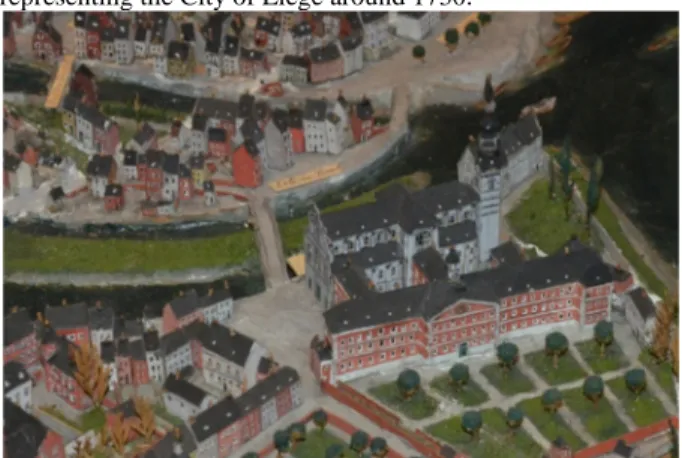
Since 1907, the University of Liège houses, among its Art Collection, a scale model representing the city of Liège in the 1730s (see Figure 1). Due to the conservation and preservation conditions, the access to this masterpiece has long been restricted. In 2009, the Virtual Leodium Project [1,2] set up to promote access to a larger public and assuring the conservation of the scale model. A 3D scan of the scale model was the starting point of the interdisciplinary project gathering competence of geomatics, archaeology and physics. The main aim of the project is to develop an urban archaeological information system. The development of an archaeological information system responds to the increasing demands from archaeologists and historians for a powerful set of tools to manage, archive and explore large archaeological data sets in order to yield new elements, which could respond to archaeological problems [3].
Figure 1: Photography of Gustave Ruhl’s scale model representing the City of Liege around 1730.
2
Workflow of the Virtual Leodium project
The main objective of this project is to gather historical information from several sources and to combine them in an urban archaeological information system
2.1 Archaeological input data
The scale model, entitled La noble Cité de Liège en 1730, was completed in 1911. Its author Gustave Ruhl, a studied lawyer and a passionate amateur of archaeology, took more than ten years to realize this masterpiece of Art. After his death, nearly all his numerous scale models, as well as a collection of more than 600 documents including notes, plans, sketches, drawings, and photographs, joined the Art Collection of the University of Liège [4]. In this project, the scale model is considered as an archaeological data by itself as well as all the related documents provided by Ruhl and other documents connected to the city structure in the XVIIIth century.
2.2 3D data
The scale model has been scanned using an optical inspection technique producing a 3D point cloud. The cloud has been transformed into surfaces with the 3D software Geomagic Studio1. Based on this, the reconstruction of the 3D object was performed with the 3D graphics software Maya2 using the digital surface model and pictures of every building face of the scale model (see Figure 2). The images have been rectified
1 Geomagic, Geomagic Studio, 3D software,
http://www.geomagic.com/en/products/studio/overview/, March 27, 2013
2 Autodesk, Autodesk Maya, 3D software,
http://www.autodesk.com/products/autodesk-maya/overview/, March 27, 2013
Virtual Leodium: Development of an archaeological information
system, a case study on an historical 3D city scale model
Michelle Pfeiffer Geomatics Unit University of Liege Allée du 6 Août, B5 Liege, Belgium [email protected] Cyril Carré Geomatics Unit University of Liege Allée du 6 Août, B5 Liege, Belgium [email protected] Vincent Delfosse Geomatics Unit University of Liege Allée du 6 Août, B5 Liege, Belgium [email protected] Roland Billen Geomatics Unit University of Liege Allée du 6 Août, B5 Liege, Belgium [email protected] Abstract
Virtual Leodium is an interdisciplinary project aiming to develop an archaeological information system based on a city scale model. This
paper addresses the workflow of the project. We present the current prototype of the Archaeological Information System and the new urban archaeological model under development.
AGILE 2013 – Leuven, May 14-17, 2013
by Photoshop3 and used as draping textures. Currently, about 20% of the entire model has been modelled in 3D.
Figure 2: Snapshot of the 3D reconstruction in Maya. This subset of the 3D model shows the textured building modelled from the 3D point cloud.
2.3 Archaeological information model
Our research is situated at the city level. To our knowledge, there is no standard information system to manage archaeological data in an urban context. The development of the archaeological data model has been based on the examination of the Ruhl’s collection. The archeological model has been coupled to the OGC4 city model standard CityGML
[5], chosen mainly for interoperability purposes. It has been used to develop the prototype (2.4) and is described in previous papers [1, 2].
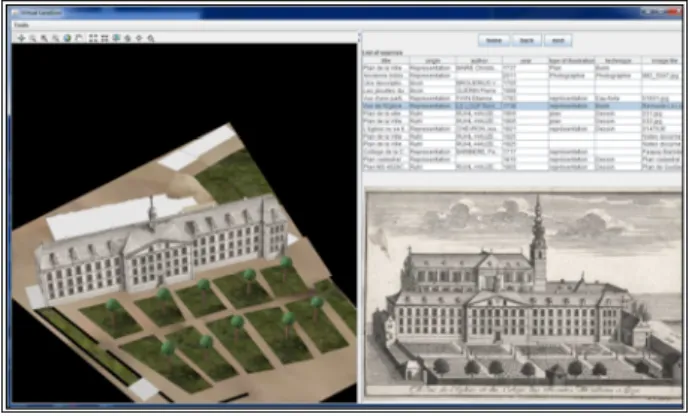
2.4 Archaeological Information System prototype The prototype is developed in Java5 and relies on ArcGIS Engine10 [11] which provides database capabilities as well as 3D visualization tools via the ArcScene API6. Spatial and sematic data are stored in an ArcGIS Geodatabse. The UML data model has been mapped into this relational database. The virtual information system is based on a client-server architecture.
The client interface is divided in two parts (see Figure 3). The first one allows the user to visualize and navigate in a 3D virtual world. The second one allows the user to browse the large collection of semantic information. It shows the historical sources themselves and any specific information about the building, like its function or the architect’s name. Both parts are synchronized. Selecting a building in the 3D scene will display its semantic information and browsing the semantic information will highlight the relevant 3D elements in the scene. Also, by selecting a specific version in the
3
Adobe System, Adobe Photoshop, graphics editing program, http://www.adobe.com/en/products/photoshop.html, March 27, 2013
4 Open Geospatial Consortium (OGC),
http://www.opengeospatial.org, March 27, 2013
5 Oracle, Java, programming language, http://www.java.com,
March 27, 2013
6 Esri, ArcGIS Engine, collection of GIS components and developer
resources, http://www.esri.com/software/arcgis/arcgisengine, March 27, 2013
semantic view, its geometric 3D representation will be displayed and immersed in the 3D scene.
Multiple 3D versions of the same building element are supported in the data model. This allows the handling of ambiguity or incompleteness (see Figure 4). Archaeologists can mix different versions from multiple historical representations of a same building. This produces new original 3D scenes based on decisions motivated by the historical documents which are archived in the system.
Figure 3: Snapshot of the current version of the Virtual Leodium prototype.
Figure 4: Remacle Le Loup’s version of a building facade is displayed in place of Ruhl’s version.
3
Improvement of the archaeological data
model
After the realization of the prototype, it has been decided to develop a new data model more archaeologically centred rather than geographically centred.
3.1 Particularity of the archaeological data In archaeology, three different types of sources are usually considered: iconographic sources, written sources and archaeological remains [6]. Archaeological information is characterized by its spatiality, temporality and multimodality as well as by its inherent imperfection [7]. De Runz [8] distinguishes four different (but non-exhaustive) types of imperfection of the archaeological data, namely: the
AGILE 2013 – Leuven, May 14-17, 2013
uncertainty, the imprecision, the ambiguity and the incompleteness. For Rodier [9], the archaeological object is defined by its spatiality, its temporality and its function. These three components are not specific to archaeological objects. Indeed, they are used to describe the objects of today’s urban data models like CityGML. CityGML defines the building object by the “usage” (functional component), “the date of creation and destruction” (temporal component) and “the geometry” (spatial component). However, CityGML does not fully cover the needs expressed by archaeologists; imperfection as defined above is not supported while being crucial for modeling archaeological objects. Moreover, CityGML does not support complex building modifications or fuzzy data sets. It is not suitable for studying urban dynamics in a long term.
3.2 New model proposition
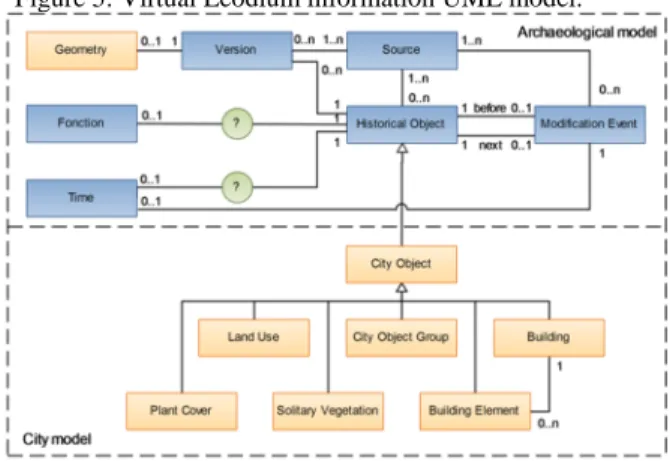
We are currently developing a new model to encompass the complexity of the archaeological information (see Figure 5). One characteristic of this new model is the possibility to manage the dynamics of the archaeological object, with the notion of “Modification Event” [10, 11, 12]. Event-based modeling allows keeping the tracks of the evolutions of an archaeological object. Thus each modification on the “Historical Object” is recorded.
The identity of the archaeological object is based on the definition proposed by Rodier which includes necessarily the temporal, functional and spatial entity [6, 13]. In contrast to Rodier, who does not handle the imperfect nature of archaeological data [7], our model has been developed in order to integrate and partly manage the imperfect archaeological data. To manage the incompleteness of the object the presence of the three entities has been made optional.
Figure 5: Virtual Leodium information UML model.
We have integrated the notion of “Version”, which allows us to represent multiple spatial representations for a same object. For example, one building frontage has two possible representations: one “Version” was represented by Ruhl and the second by a drawing of Le Loup. Note that we wish to extend this concept of version to the function and the time (represented by question marks in the UML model of figure 5).
The “Source” stores all historical documents which may have multiple and sometimes contradictory interpretations. The implemented system manages iconographic and written sources. A source can describe the “Historical Object” itself or inform about a modification owing to its relation to the “Modification Event”.
The “City Object” and its subtypes are taken from CityGML. Each “City Object” inherits from the class “Historical Object” and becomes itself an historical object. The “Source” could be related to a building, a building element or a group of buildings (“City Object Group”), in order to document the proper object.
The geometry comes from the CityGML, the “Building Element”, the “Plan Cover”, “Solidary Vegetation” and “Land Use” are directly link to their respective geometry. In order to ensure the readability, these relations are hided in the UML model (figure 5).
4
Perspectives
In the long term the Virtual Leodium project aims to develop an archaeological information system dedicated to urban archaeology. Although the proposed data model is still in development, we identified several modelling ways providing a useful framework for archaeological modelling. The concept of identity, the management of archaeological data imperfection and the modelling event management still need to be improved. The system will focus as much as possible on international standards.
The next research step will be to get out proprietary software and to implement our model directly in the open-source graph database Neo4j7.
We also continue our cooperation with the CERMA8 and
IRCCYN9 teams from the Ecole Centrale Nantes, France, especially in order to develop automatic building reconstruction and segmentation.
References
[1] R. Billen, C. Carré, V. Delfosse, B. Hervy, F. Laroche, D. Lefevre, M. Servieres, M. Van Ruymbeke, 3D historical models: the case studies of Liege and Nantes, 3D issues in urban and environmental systems, COST Action TU801: Semantic Enrichment of 3D city models for sustainable urban development - Workshop, Madrid, 2012.
[2] B. Hervy, R. Billen, F. Laroche, C. Carré, M. Servières, M. Van Ruymbeke, V. Tourre, V. Delfosse and J.-L. Kerouanton, A generalized approach for historical mock-up acquisition and data modelling: Towards historically
7 Neo Technology, Neo4j, open-source graph database,
http://www.neo4j.org
8 Centre de recherche méthodologique d'architecture (CERMA),
Ecole Centrale de Nantes, http://www.cerma.archi.fr
9 Institut de recherche en communication et cybernétique de Nantes
AGILE 2013 – Leuven, May 14-17, 2013
enriched 3D city models, 3U3D2012: Usage, Usability and Utility of 3D City models, Nantes, 2012.
[3] Burrough, P.A., McDonnell, R., Principle of Geographical Information Systems. Oxford University Press, Oxford, 1998.
[4] M. Pfeiffer, Approche critique de « La noble Cité de Liège en 1730 » à travers l’étude du collège des Jésuites en Île. Évaluation par application d’un outil archéomatique, University of Liege, Liège, 2011. [5] OGC City Geography Markup Language (CityGML)
Encoding Standard - Version: 2.0.0, Open Geospatial Consortium, 2012.
[6] X. Rodier (dir.), Information spatiale et archéologie, Paris, 2011.
[7] C. de Runz, Imperfection, temps et espace : modélisation, analyse et visualisation dans un SIG archéologique, Université de Reims Champagne-Ardenne, 2008.
[8] E. Desjardin, O. Nocent, C. de Runz, 2012. Prise en compte de l’imperfection des connaissances depuis la saisie des données jusqu’à la restitution 3D. Archeologia e Calcolatori supplemento 3 - 2012, pages 385-396, 2012.
[9] X. Rodier, L. Saligny, B. Lefebvre, La modélisation de l’information spatio-temporelle pour l’étude de la fabrique urbaine sur le temps long, École thématique MoDys 2012, Fréjus, 2012.
[10] M. Worboys and K. Hornsby, From objects to events: GEM, the geospatial event model, Geographic information science, Harvey J. (Ed.) pages 327-343, 2004.
[11] M. Worboys, Modelling changes and events in dynamic spatial systems with reference to socio-economic units, Life and Motion of Socio-Economic Units, pages 129– 138, 2001.
[12] P. Hallot and R. Billen, Reengineering du PICC - Délivrable 3 - Etude de la région Wallone - S0.04.01-11PNSP-01, Université de Liège, Liège, 2013.
[13] H. Galinié, X. Rodier and L.Saligny, Entités fonctionnelles, entités spatiales et dynamique urbaine dans la longue durée, Histoire & mesure, XIX - 3/4, pages 223-242, 2004.