HAL Id: hal-01087740
https://hal.inria.fr/hal-01087740
Submitted on 2 Dec 2014
HAL is a multi-disciplinary open access
archive for the deposit and dissemination of
sci-entific research documents, whether they are
pub-lished or not. The documents may come from
L’archive ouverte pluridisciplinaire HAL, est
destinée au dépôt et à la diffusion de documents
scientifiques de niveau recherche, publiés ou non,
émanant des établissements d’enseignement et de
Computing Semicommutation Closures: a Machine
Learning Approach
Maxime Bride, Pierre-Cyrille Héam, Isabelle Jacques
To cite this version:
Maxime Bride, Pierre-Cyrille Héam, Isabelle Jacques. Computing Semicommutation Closures: a
Machine Learning Approach. [Research Report] FEMTO-ST. 2014. �hal-01087740�
Computing Semicommutation Closures:
a Machine Learning Approach
Maxime Bride
Pierre-Cyrille Héam
Isabelle Jacques
LORIA, INRIA, CNRS UMR 7503, Université de Lorraine FEMTO-ST, INRIA, CNRS UMR 6174, Université de Franche-Comté
Abstract
Semicommutation relations are simple rewriting relation on finite words using rules of the form ab → ba. In this paper we present how to use An-gluin style machine learning algorithms to compute the image of regular language by the transitive closure of a semicommutation relation.
1
Introduction
Semicommutation relations are simple rewriting relations on finite words using rules of the form ab → ba. Computing the image of a language by the transitive closure by a semicommutation relation is a challenging problem connected to regular-model-checking [6, 7, 10], trace theory issues [28, 21, 22, 17] or language theory [12, 15, 16, 18]. Several works in the literature investigate the problem of pointing out classes of regular languages whose closure under semicommutation are still regular [6, 7, 10, 17, 16, 1].
In this paper we address the general problem of computing the closure of a regular language under a semicommutation relation using a machine learn-ing approach. Indeed, several recent works show that uslearn-ing a machine learnlearn-ing algorithm is frequently an efficient pratical way to compute unkown regular lan-guages, particularly in a software analysis context (test, verification,...); see, for example, [31, 5, 3, 26, 8, 30]. General tool implementing some learning algo-rithms have been developped [4, 19] for this purpose. Online machine learning algorithms require an oracle (providing counter-examples) to work. The main contribution of this paper is to develop such an oracle for the computation of closures under semicommutation relations and to experiment it on several examples.
The paper is organised as follows: the useful formal background is defined in Section 1.1. Next, Section 1.2 presents the online machine learning approach for computing semicommutations closures. Section 2 is dedicated to the main contributions of the article by presenting the algorithms defining an oracle. Sec-tion 3 presents experimental results on several classes of examples. Conclusion and future works are exposed in Section 4.
1.1
Formal Background
The reader is assumed to be familiar with basic language theory notions [29]. In this paper, Σ denotes a finite alphabet and Σ∗ the set of finite words over Σ.
A language is a subset of Σ∗. The cardinal of a finite set X is denoted |X|.
A finite automaton on Σ is a tuple (Q, Σ, E, I, F ), where Q is a finite set of states, Σ is a finite alphabet, E ⊆ Q × Σ × Q is the set of transitions, I ⊆ Q is the set of initial states and F ⊆ Q is the set of final states. A finite automaton is determinisitic if there is a unique initial state and if for each state p and each letter a there is at most one state q such that (p, a, q) ∈ E. A successful path in a finite automaton is a sequence (p0, a1, q1), . . . , (pn−1, an, qn) of transitions
such that p0 is an initial state, qn is a final state and for every 1 ≤ i ≤ n − 1,
qi = pi. The word a1. . . an is called the label of the path. A word is accepted
by a finite automaton if it is the label of a successful path. The set of accepted (or recognized) words of an automaton A is denoted L(A).
A letter-to-letter transducer or simply a transducer is a tuple (Q, Σ, E, I, F ), where Q, Σ, I, F are defined as for finite automata. The set E is a subset of Q× (Σ× Σ) × Q. Successful paths are defined as for finite automata but their labels are of the form (a1, b1) . . . (an, bn), which is also denoted (a1. . . an, b1. . . bn).
Therefore a transducer accepts a subset of Σ∗× Σ∗, which is a relation on Σ∗.
If T is a transducer and A a finite automaton, one can construct in polynomial time (by a product) a finite automaton T (A) accepting the set of words w such that there exists a word u ∈ L(A) satisfying that (u, w) is accepted by T [29].
A semicommuation relation I is a subset of Σ × Σ such that for every a, (a, a) /∈ I. Each semicommutation relation I induces a relation RI on Σ∗
defined by (u, v) ∈ RI iff there exists two words x, y and two letters a, b such
that u = xaby and v = xbay and (a, b) ∈ I. The reflexive-transitive closure of any relation R on Σ∗ is denoted R∗. For any language L on Σ, any relation
R, R(L) denotes the set of words v such that there exists u ∈ L satisfying (u, v)∈ R. A semicommutation relation is antisymetric if there is no a, b such that (a, b) ∈ I and (b, a) ∈ I.
1.2
Machine Learning for Computing Closures under
Semi-commutation
There exists two main kinds of algorithms to learn regular languages: offline algorithms working from sets of positive and negative examples [24, 11]; and online algorithms based on an oracle guessing whether the learned language is correct and providing counter-examples if not [2, 20, 27]. Our work is based on the online approach, using the libalf tool [4] for the experiments.
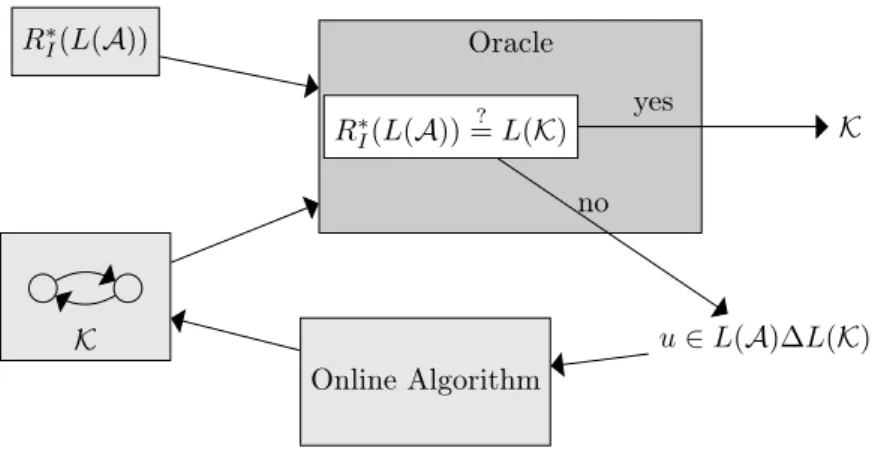
The general working way of the online approach is depicted in Fig. 1 in the context of our problem: the goal is to find a finite automaton K such that L(K) = R∗
I(L(A)). It is required to have an Oracle that can say if L(K) =
R∗
I(L(A)). If this equality holds, K is returned and it’s finished. If not, the
oracle points out a counter-example u ∈ L(A) \ L(K) ∪ L(K) \ L(A). With this counter-example, the online algorithm produces a new K such that u is no more
R∗ I(L(A)) K Oracle R∗ I(L(A)) ? = L(K) K u∈ L(A)∆L(K) yes no Online Algorithm
Figure 1: Online Machine Learning
a counter-example for L(K) = R∗
I(L(A)) (if the equality still doesn’t hold). In
this paper, online algorithms are used in a blackbox way and we only address the problem of developping an oracle. Testing if L(K) = R∗
I(L(A)) is done using
the following result which is a particular case of a result of [14].
Theorem 1 Let L, K be languages on Σ and R an antisymetric semicommu-tation relation. One has R∗(L) = K if and only if R(K)
∪ L = K. Now the remaining questions to build an oracle are:
1. How to check whether R∗
I(L(A)) = L(K), when RI is not antisymetric?
2. How to efficiently provides u ∈ L(A)∆L(K) if K is not the good one? 3. How the approach practically works?
Section 2 is dedicated to the presentation of some algorithmst to answer this question. The overall approach with the proposed oracle is experimented in Section 3.
2
Oracle for Learning Semicommutation Closures
2.1
General Scheme for Antisymetric Relations
Algorithm 1 is the oracle algorithm presented in a general way. Several algo-rithmic issues raised in this description are solved in Sections 2.2 to 2.5. Notice that testing inclusion or equality of regular languages, computing intersection and union of regular languages are done using classical construction of finite automata [29].
Input If RI(L(A)) ⊆ L(A), then L(A) is RI-closed and R∗I(L(A)) = L(A): the
problem of computing R∗
I(L(A)) is solved. Therefore one can assume,
without loss of generality, that RI(L(A)) 6⊆ L(A).
Lines 1-3 For an antisymetric relation I, checking whether the conjecture is correct (i.e. R∗
I(L(A)) = L(K)?) is solved using Theorem 1 with L = L(A) and
K = L(K). The way to construct a finite automaton recognizing RI(L(K))
will be described in Section 2.3. Therefore, lines 1-3 of Algorithm 1 check whether the conjecture is correct. In this case null is returned.
Algorithm 1 Oracle Algorithm(antisymetric relation)
Input: I an antisymetric semicommutation relation, A and K two finite au-tomata such that RI(L(A)) 6⊆ L(A)
Output: null if R∗
I(L(A)) = L(K), u ∈ R∗I(L(A))∆L(K) otherwise.
1: if RI(L(K)) ∪ L(A) = L(K) then 2: returnnull 3: end if 4: if L(A) 6⊆ L(K) then 5: returnu∈ L(A) \ L(K) 6: end if 7: if L(K) ⊆ L(A) then
8: returnu∈ RI(L(A)) \ L(A)
9: end if
10: if RI(L(K)) ⊆ L(K) then
11: return Search1(I,A,K)
12: else
13: return Search2(I,A,K) 14: end if
Lines 4-6 If R∗I(L(A)) 6= L(K), one first checks (line 4) whether L(A) 6⊆ L(K). If
this condition is satisfied, since L(A) ⊆ R∗
I(L(A)), any u ∈ L(A) \ L(K)
is a counter-example in R∗
I(L(A))∆L(K). Such a u is obtained using a
breadth-first search algorithm working on a finite automaton recognizing L(A) ∩ L(K)c (note that any search algorithm can be used).
Lines 7-9 Now if L(K) ⊆ L(A), any u ∈ RI(L(A)) \ L(A) is in R∗I(L(A))∆L(K).
Since it is assume that RI(L(A)) 6⊆ L(A), such a u exists and can be also
found by a Breadth-first search algorithm working on a finite automaton recognizing RI(L(A)) ∩ L(A)c (how to compute RI(L(A) is described in
Section 2.3).
Lines 10-14 To finish, it is tested (line 10) whether L(K) is RI-closed. Since L(A) ⊆
L(K) (line 4), if L(K) is RI-closed, then, by a direct induction, RI∗(L(A)) ⊆
L(K). The Algorithm 2, called Search1 and described in Section 2.2, re-turns u ∈ L(K) \ R∗
Notice that the Search2 algorithm would be used directly at the first step of the oracle, but since it has an ugly complexity, the described particular cases (lines 5,8,11) are dedicated to simpler cases in order to speed up the procedure.
2.2
Searching Counter-Examples
When L(K) \ R∗(L)6= ∅, Algorithm 2 (Search1) points out an element u of L(K) \ R∗(L). This algorithm looks for a word of minimal length belonging
to L(K) \ R∗
I(L) by a brute force approach. How to test whether u /∈ RI∗(L)
is described in Section 2.4. Enumerating the words in L(K) ∩ Σn can be done
by computing a finite automaton recognizing L(K) ∩ Σn. This automaton will
be acyclic since it recognizes a finite language. Notice that the automaton recognizing L(K) ∩ Σn+1can be construct from the one recognizing L(K) ∩ Σn,
reducing computation times. Algorithm 2 Search1
Input: I an antisymetric semicommutation relation, A and K two finite au-tomata such that L(K) \ R∗
I(L). Output: u∈ L(K) \ R∗ I(L(A)). 1: n=0 2: whiletrue do 3: foru∈ L(K) ∩ Σn do 4: if u /∈ R∗ I(L) then 5: returnu 6: end if 7: end for 8: n=n+1 9: end while When L(K)∆R∗
I(L) 6= ∅, Algorithm 2 (Search1) points out an element u
of L(K)∆R∗
I(L). This is also a brute force approach looking for a
counter-example of the minimal length. Once again, all constructions in the algorithm are classical but the computation of R∗
I(u) (line 9) described in Section 2.4.
2.3
Computing R
I(L(
A))
Computing RI(L(A)) can be easily done using a transducer: RI is recignized
by a transducer. Consider for instance the automaton A1 depicted on Fig. 2
and the relation RI associated to I = {(a, b)}. A transducer recognizing RI is
depicted in Fig. 2. In general case, this transducer has |I|+2 states. Computing a product of TRI and A1 provides (after trimming) the automaton TRI(A1)
Algorithm 3 Search2
Input: I an antisymetric semicommutation relation, A and K two finite au-tomata such that L(K)∆R∗
I(L)6= ∅. Output: u∈ L(K)∆R∗ I(L(A)) 6= ∅. 1: n=0 2: whiletrue do 3: foru∈ L(K) ∩ Σn do 4: if u /∈ R∗ I(L) then 5: returnu 6: end if 7: end for 8: foru∈ L(A) ∩ Σn do 9: if R∗ I(u)∩ L(K) c 6= ∅ then 10: returnv∈ R∗ I(u)∩ L(K) c 11: end if 12: end for 13: n=n+1 14: end while 0 1 b a (a) A1 α β γ (a| a), (b | b) (a| a), (b | b) a| b b| a (b) TR I 0, α 1, β 1, γ b a b (c) TR I(A1)
2.4
Testing whether u
∈ R
∗I(L(
A))
Let I be a semicommutation relation and u ∈ Σ∗. One has u ∈ R∗
I(L(A)) iff
(R−1I )∗(u)∩ L(A) 6= ∅. Since (R −1
I )∗(u) ⊆ Σ|u|, it is a finite set. Therefore
(R−1I )
∗(u) can be calculated using finitely many time the algorithm of
Sec-tion 2.3. However, it is more efficient to use a saturaSec-tion approach to compute a finite automaton accepting (R−1
I ) ∗(u).
2.5
Non antisymetric Relations
For non antisymetric I’s, there is no known criterion (as far as we know) to check whether L(K) = R∗
I(L(A)). In this case, let I1and I2be two antisymetric
semicommutation relations such that I = I1∪ I2. Let K1 = RI∗
1(L(A)), K
′ 1 =
R∗
I2(K1), and for every n≥ 2, Kn = R∗I1(Kn′−1) and Kn′ = R∗I2(Kn). Next, all
the Ki’s and Ki′’s are computed until reaching a fixed point using Algorithm 1.
Notice that it may be a non terminating computation, but if it terminates, the fixed point is R∗
I(L(A)).
2.6
Complexity Issues
Theoretical complexity of Algorithm 1 is exponential due to the brute force approaches of Algorithms 2 and 3. However, in practice we may hope to find quite short counter-examples. Computing intersections and unions of regular languages can be done in polynomial by classical product based constructions. Testing the inclusion (or the equality) of regular languages given by non deter-ministic automata is PSPACE-complete, but several practically efficient algo-rithms are known, as [13]. Inclusion and equality are polynomial time decidable for deterministic automata using classical constructions.
3
Experiments
All the algorithms have been implemented in a Java tool and all the tests have been performed on a personal computer Intel Core 2 Duo T7300 2.00GHz with 2 GBytes of memory, running on a Fedora distribution.
3.1
Partially Ordered Automata and Related Languages
All the reported test values of this section were obtained with |Σ| = 5 and |I| = 6 (randomly generated for each test) and by generating 100 examples each time.A partially ordered automaton is a finite automaton in which there is no simple loop of length greater or equal to 2: if (p1, a1, q1) . . . (pn, an, qn) is a
path such that p1= qn, then all the pi’s and qi’s are equal. Automata A1 and
TR
I(A1) on Fig. 2 are partially ordered. An alphabetic pattern constraint, APC
for short, is a regular expression which is a finite union of expressions of the form e1e2. . . ek where ek is either a letter or of the form B∗ where B ⊆ Σ. For
(a) Machine Learning (ms) n 2 3 4 5 6 7 Gen1 2 (3+6) 3 (5+15) 5 (8+23) 10 (13+42) 20 (20+67) 57 (27+93) Gen2 5 (3+8) 4 (5+15) 7 (9+29) 15 (13+39) 33 (19+63) 59 (36+133) Gen3 2 (2+6) 2 (3+10) 5 (3+12) 12 (4+17) 108 (5+20) 209 (5+23) Gen4 3 (23+9) 17 (6+20) 591 (8+32) 1688 (15+61) 3859 (18+75) 36459 (32+136) (b) Specific Algorithm [10] (ms) n 2 3 4 5 6 7 Gen1 0 (5+13) 1 (16+40) 2 (35+84) 6 (86+207) 14 (144+335) 34 (277+681) Gen2 1 (6+18) 3 (20+48) 4 (55+126) 10 (113+255) 28 (253+506) 48 (445+952) Gen3 0 (3+11) 0 (6+32) 1 (10+63) 1 (17+131) 1 (24+211) 2 (36+351) Gen4 0 (4+13) 1 (8+31) 1 (14+61) 2 (23+107) 3 (29+140) 8 (41+204)
Table 1: Results for APC languages
instance a{a, b}∗
{b, c}∗is an APC, but (ab)∗is not. It can be easily checked that
a language is accepted by a partially ordered automaton iff it can be expressed by an APC.
For this class of languages the approach was experimented on four random generators. The Generator1, randomly (and uniformly) generates a word u of a given length n, build the minimal automaton recognizing {u} and randomly add
3n
2 transitions without introducing any loop. The Generator2 randomly
gener-ates a deterministic partially ordered automaton using a Markov Chain based algorithm closed to the one in [9]. The Generator3 uniformly generates an APC of the form B∗
0B1∗. . . B∗n where the Bi’s are subset of the alphabet. Finally, the
Generator4uniformly generates an APC of the form B0∗a1B1∗. . . anBn∗ where
the Bi’s are subsets of the alphabet and the ai’s are letters.
Table 1 reports the average time (ms) to compute the closure under RI of
the generated languages, both with the machine learning approach and with a specific algorithm [10]. The average size (number of states + number of transitions) of the computed automata (for R∗
I(L(A)) is reported under braces).
Note that the specific algorithm is quite better, what is not surprising. How-ever, the machine learning approach is tractable. It should be emphasized that the specific algorithm produces larger automata. Therefore, if the computed results are used in conjunction with another algorithm (as for a model-checking problem for instance), it may be interesting to have smaller automata and to use the machine learning approach.
Moreover, it can be efficiently tested whether a language (given by its min-imal automaton) can be recognized by an APC but there is no known efficient algorithm to build such an expression. Therefore, if such a language is given by its minimal automaton, using the specific algorithm [10] will require a possibly ugly pre-processing step. For instance, the automaton depicted in Fig. 3 can be
1 2 3 4 a, c c b a b a b c b a c
Figure 3: Minimal automaton of an APC language.
n 2 3 4 5 6
GroupGen 0.002 (2+6) 0.01 (12+35) 0.04 (40+120) 29.0 (67.3+202) 247.2 (143+430) Table 2: Results for group languages (seconds), |Σ| = 3, |I| = 6
represented by the APC (see [7] for the complexity of the test): ({a, b, c}∗a{a, c}∗∪ {a, c}∗) b{b, c}∗b{a, b}∗.
The Machine Learning Algorithm finds its RI closure (with I = {(a, b), (b, c)})
in few milliseconds; finding the above expression from the automaton is not an easy problem since the test is not constructive.
3.2
Languages of PolG and PolC
A regular language is a group language if there exists a finite automaton ac-cepting it and for which each letter induces a one-to-one function from the set of states into itself. Equivalently, it is a language accepted by a complete de-terministic automaton such that there is no pair of transitions labelled by the same letter pointing the same state. One can prove that a language is a group language iff its minimal automaton has this property. Under some simple con-ditions on I, if L is a group language, then R∗
I(L) is regular [1]. Notice that
the proof of this theoretical result is constructive but lies on Ramsey like re-sults: transforming it into an algorithm is possible but the complexity would be intractable.
We have generated group languages accepted by a n-state automaton in the following way: (1) generate uniformly for each letter of Σ a permutation of {1, . . . , n}; 1 is the initial state and each state is final with a probability 1/2 (the reader interested by the random generation of group languages is referred to [23]). The results are reported in Table 2.
PolG is the class of regular languages that are a finite union of languages of the form Loa1L1. . . akLk (*), where the Li’s are group languages and the ai’s
are letters. It is know that if L is in PolG, then, under certain hypothesis on I, R∗
I(L) is regular [1]. We have implemented two generators of elements of PolG:
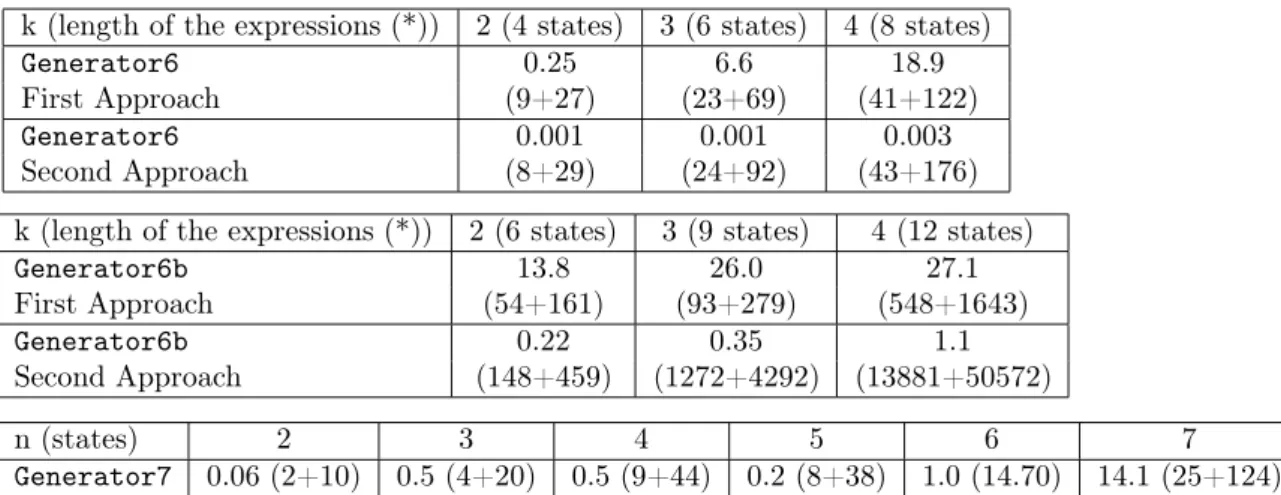
k (length of the expressions (*)) 2 (4 states) 3 (6 states) 4 (8 states)
Generator6 0.25 6.6 18.9
First Approach (9+27) (23+69) (41+122) Generator6 0.001 0.001 0.003 Second Approach (8+29) (24+92) (43+176) k (length of the expressions (*)) 2 (6 states) 3 (9 states) 4 (12 states)
Generator6b 13.8 26.0 27.1 First Approach (54+161) (93+279) (548+1643) Generator6b 0.22 0.35 1.1 Second Approach (148+459) (1272+4292) (13881+50572) n (states) 2 3 4 5 6 7 Generator7 0.06 (2+10) 0.5 (4+20) 0.5 (9+44) 0.2 (8+38) 1.0 (14.70) 14.1 (25+124)
Table 3: Results for PolG (seconds), |Σ| = 3, |I| = 6
are arbitrarily chosen and the Li’s are generated with the GroupGen algorithm
described above (with n = 2; the generated automaton has 2k states). This generator is called Generator6. Generator6b is similar except that n = 3; the generated automaton has 3k states. The Generator7 works as follows: (1) an automaton with n states is generated using GroupGen; (2) √n transitions are uniformly removed, providing a deterministic automaton recognizing a language L0; (3) using classical automata constructions, an automaton recognizing Lc0is
returned. Results of [25] ensure that this language is in PolG, even if there is no known tractable algorithm to compute a related expression of the form (*).
For Generator6 two approaches have been experimented: first R∗ I(L) is
computed by the proposed machine learning technique. Secondly, each R∗ I(Li)
is computed using the machine learning algorithm. Next R∗
I(L) is computed
using the R-shuffle algorithm [10]. The results are reported in Table 3. For Generator7only the first approach can be applied.
The results show that it is possible to compute the closure under semicom-mutation of group languages or of languages of PolG when finite automata have few states.
A commutative language is a language closed under all semicommutation relations. The class PolC is the class of regular languages which are a finite union of languages of the form Loa1L1. . . akLk (**), where the Li’s are commutative
regular languages and the ai’s are letters. Regular commutative languages can
be generated by generating a n-state automaton having the diamond property: for any pair of states p, q and any pair of letters a, b, if (p, a, q) and (q, b, r) are transitions, then there exists a state s such that (p, b, s) and (q, a, s) are transitions. Using this generator of commutative languages, the Generator8 produces expressions of the form (**) in the same way as Generator6, with n = 3. In Table 4, the results of the proposed approach are compared to the results obtained by the dedicated algorithm [10].
k (length of the expressions (**)) 2 3 4
Generator8 5.8 14.2 26.3
Machine Learning Approach (14+51) (35+133) (34+113) Generator8 0.002 0.003 0.01 Specific Approach [10] (19+69) (63+239) (169+712)
Table 4: Results for PolC (seconds), |Σ| = 5, |I| = 6
Like APC, the results show that the specific approach runs faster than the machine learning approach. However the latter is tractable and produces quite smaller automata.
4
Conclusion
In this paper we proposed an algorithm to use online machine learning algorithm to compute the image of a regular language by the transitive closure of a semi-commutation relation. Practical experiments show that this approach is slower than specific algorithms for the APC and PolC class of languages. However, for this two classes the computed automata are smaller (and deterministic) making the approach fruitful for combining it with others model-checking techniques. Moreover, it was possible to compute several closures of regular languages for which there is no known efficient algorithm. In the future we plan to develop specific machine learning algorithm dedicated to the computation of semicom-mutation closures and to improve the efficiency of involved procedures.
References
[1] G. Guaiana A. Cano and J.-E. Pin. Regular languages and partial commu-tations. Information and Computation, 230:76–96, 2013.
[2] Dana Angluin. Learning regular sets from queries and counterexamples. Inf. Comput., 75(2):87–106, 1987.
[3] Benedikt Bollig, Joost-Pieter Katoen, Carsten Kern, and Martin Leucker. Learning communicating automata from MSCs. IEEE Transactions on Software Engineering, 36(3):390–408, May-June 2010.
[4] Benedikt Bollig, Joost-Pieter Katoen, Carsten Kern, Martin Leucker, Daniel Neider, and David R. Piegdon. libalf: The automata learning frame-work. In Tayssir Touili, Byron Cook, and Paul Jackson, editors, Computer Aided Verification, 22nd International Conference, CAV 2010. Proceed-ings, volume 6174 of Lecture Notes in Computer Science, pages 360–364. Springer, 2010.
[5] Benedikt Bollig and Dietrich Kuske. Muller message-passing automata and logics. In Zoltán Ésik, Carlos Martín-Vide, and Victor Mitrana, editors, Preliminary Proceedings of the 1st International Conference on Language and Automata Theory and Applications (LATA’07), Tarragona, Spain, March-April 2007.
[6] Ahmed Bouajjani, Anca Muscholl, and Tayssir Touili. Permutation rewrit-ing and algorithmic verification. In LICS, 2001.
[7] Ahmed Bouajjani, Anca Muscholl, and Tayssir Touili. Permutation rewrit-ing and algorithmic verification. Inf. Comput., 205(2):199–224, 2007. [8] Pierre-Christophe Bué, Frédéric Dadeau, and Pierre-Cyrille Héam.
Model-based testing using symbolic animation and machine learning. In Third International Conference on Software Testing, Verification and Validation, ICST 2010, Workshops Proceedings, pages 355–360. IEEE Computer Soci-ety, 2010.
[9] Vincent Carnino and Sven De Felice. Sampling different kinds of acyclic automata using markov chains. Theor. Comput. Sci., 450:31–42, 2012. [10] Gérard Cécé, Pierre-Cyrille Héam, and Yann Mainier. Efficiency of
au-tomata in semi-commutation verification techniques. ITA, 42(2):197–215, 2008.
[11] François Denis, Aurélien Lemay, and Alain Terlutte. Learning regular lan-guages using rfsas. Theor. Comput. Sci., 313(2):267–294, 2004.
[12] Volker Diekert and Yves Metivier. Handbook of Formal Languages, vol-ume 3, chapter Partial Commutation and Traces. Springer-Verlag, 1997. [13] Laurent Doyen and Jean-François Raskin. Antichain algorithms for finite
automata. In Javier Esparza and Rupak Majumdar, editors, Tools and Al-gorithms for the Construction and Analysis of Systems, 16th International Conference, TACAS 2010. Proceedings, volume 6015 of Lecture Notes in Computer Science, pages 2–22. Springer, 2010.
[14] Laurent Fribourg and Hans Olsén. Reachability sets of parameterized rings as regular languages. Electr. Notes Theor. Comput. Sci., 9:40, 1997. [15] Seymour Ginsburg and Edwin Spanier. Semigroups, presburger formulas,
and languages. Pac. J. Math., 16(2):285–296, 1966.
[16] Antonio Cano Gómez, Giovanna Guaiana, and Jean-Eric Pin. When does partial commutative closure preserve regularity? In Luca Aceto, Ivan Damgård, Leslie Ann Goldberg, Magnús M. Halldórsson, Anna Ingólfs-dóttir, and Igor Walukiewicz, editors, ICALP (2), volume 5126 of Lecture Notes in Computer Science, pages 209–220. Springer, 2008.
[17] Giovanna Guaiana, Antonio Restivo, and Sergio Salemi. On the trace product and some families of languages closed under partial commutations. Journal of Automata, Languages and Combinatorics, 9(1):61–79, 2004. [18] Pierre-Cyrille Héam. A note on partially ordered tree automata. Inf.
Pro-cess. Lett., 108(4):242–246, 2008.
[19] Falk Howar, Malte Isberner, Maik Merten, and Bernhard Steffen. Learnlib tutorial: From finite automata to register interface programs. In Tiziana Margaria and Bernhard Steffen, editors, Leveraging Applications of Formal Methods, Verification and Validation. Technologies for Mastering Change -5th International Symposium, ISoLA 2012, Part I, volume 7609 of Lecture Notes in Computer Science, pages 587–590. Springer, 2012.
[20] Micahel J. Kearns and Umesh V. Vazirani. An Introduction to Computa-tional Learning Theory. MIT Press, 1994.
[21] Yves Métivier, Gwénaël Richomme, and Pierre-André Wacrenier. Com-puting the closure of sets of words under partial commutations. In Zoltán Fülöp and Ferenc Gécseg, editors, ICALP, volume 944 of Lecture Notes in Computer Science, pages 75–86. Springer, 1995.
[22] Anca Muscholl and Holger Petersen. A note on the commutative closure of star-free languages. Inf. Process. Lett., 57(2):71–74, 1996.
[23] Cyril Nicaud. Etude du comportement en moyenne des automates finis et des langages rationnels. PhD thesis, Università c Paris 7, 2000.
[24] J. Oncina and P. Garcia. Inferring regular languages in polynomial update time. In Pattern Recognition and Image Analysis, pages 49–61, 1992. [25] Jean-Eric Pin. Polynomial closure of group languages and open sets of the
hall topology. Theor. Comput. Sci., 169(2):185–200, 1996.
[26] Harald Raffelt, Maik Merten, Bernhard Steffen, and Tiziana Margaria. Dy-namic testing via automata learning. STTT, 11(4):307–324, 2009.
[27] Ronald L. Rivest and Robert E. Schapire. Inference of finite automata using homing sequences (extended abstract). In David S. Johnson, editor, Proceedings of the 21st Annual ACM Symposium on Theory of Computing, May 14-17, 1989, Seattle, Washigton, USA, pages 411–420. ACM, 1989. [28] Jacques Sakarovitch. The "last" decision problem for rational trace
lan-guages. In Imre Simon, editor, LATIN, volume 583 of Lecture Notes in Computer Science, pages 460–473. Springer, 1992.
[29] Jacques Sakarovitch. Elements of Automata Theory. Cambridge University Press, 2013.
[30] Muzammil Shahbaz and Roland Groz. Analysis and testing of black-box component-based systems by inferring partial models. Softw. Test., Verif. Reliab., 24(4):253–288, 2014.
[31] Abhay Vardhan and Mahesh Viswanathan. Learning to verify branch-ing time properties. In David F. Redmiles, Thomas Ellman, and Andrea Zisman, editors, 20th IEEE/ACM International Conference on Automated Software Engineering (ASE 2005), November 7-11, 2005, Long Beach, CA, USA, pages 325–328. ACM, 2005.