INFLUENCES OF TROPICAL TREE DIVERSITY ON TREE ROOT DECOMPOSITION
TYLASTER DISSERTATION
PRESENTED
AS A Pl\RTIAL REQUIREMENT FOR
THE Mi\STER OF BIOLOGY
BY
NA THAL Y R. GUERRERO RAMIREZ
UNIVERSITÉ DU QUÉBEC À MONTRÉAL Service des bibliothèques
Avertissement
La diffusion de ce mémoire se fait dans le' respect des droits de son auteur, qui a signé le formulaire Autorisation de reproduire et de diffuser un travail de recherche de cycles supérieurs (SDU-522- Rév.01-2006). Cette autorisation stipule que «conformément
à
l'article 11 du Règlement no 8 des études de cycles supérieurs, [l'auteur] concèdeà
l'Université du Québecà
Montréal une licence non exclusive d'utilisation et de publication .de la totalité ou d'une partie importante de [son] travail de recherche pour des fins pédagogiques et non commerciales. Plus précisément, [l'auteur] autorise l'Université du Québecà
Montréal à reproduire, diffuser, prêter, distribuer ou vendre des copies de. [son] travail de rechercheà
des fins non commerciales sur quelque support que ce soit, y compris l'Internet. Cette licence et cette autorisation n'entraînent pas une ·renonciation de [la] part [de l'auteur]à
[ses] droits moraux nià
[ses] droits de propriété intellectuelle. Sauf ententé contraire, [l'auteur] conserve la liberté de diffuser et de commercialiser ou non ce travail dont [il] possède un exemplaire.»,'
INFLUENCES DElA DIVERSITÉ DES ARBRES TROPICAUX SURIADÉCOMPOSillON
DES RACINES DES ARBRES
MÉMOllŒ
PRÉSENTÉ
COMME EXIGENCE PARTIEUE
DElA MAÎTRISE EN BIOLCGIE
BY
NA1HALY
ROKSSAN GUERRERO RAMIREZ
Siempre has confiado en mi, hasta en los momentos que ni yo creia, has sido mi motivaci6n y el recuerdo de tu perseverancia hace que en los momentos que estoy por percier la esperanza, recupere la fuerza y siga luchando. A pesar de la distancia que implicaba perseguir mis suenos, estuviste hay para ayudarme a dar el paso, para hacerme respirar profundo, secar mis lagrimas y dejarme volar. Por esa gran mujer que llevo en mi coraz6n, la que me ayudo a ser la mujer que soy, persona! y profesionalmente, este es nuestro nuevo triunfo y es todo para y por ti, marna.
-where they helped me to grow personally and professionally. Tanya, I would like to thank you for supporting me in each moment, for highlighting my strengths and helping me overcome my difficulties. At UQAM, I made a lot of friends and colleagues that helped me along the way: Mario, Jorge, Elia na, Robin, Pedro Marco, Eugenie, Conny, Sara, Kim, Mélanie, and Daniel. Also, I want to thank the people and facilities at the Smithsonian Tropical Research Institute (STRI), especially Jefferson Hall and his team in Agua Salud (Daniela, Ana bel, Federico), Ben Turner and his team in the soil !ab (Tania, Dayana, Luis), and Catherine Potvin and her team in Sardinilla Gose, Lady, Abdiel). Catherine, I am especially grateful to you for welcoming me to Montreal; I learned a lot from our conversations over Colombian hot chocolate and almond croissants. I would also like to thank Alison Munson (Université Laval), Sarah Dale (STRI), Bill Parsons (Université de Sherbrooke), and Jorge Ceballos (STRI) for their support at differences stages of my research. I am thankful for my family in Colombia and Miami, for giving me their love and believing in me unconditionally in spite of the distance. I also would like to express my sincere gratitude to Dylan, who helped me scientifically and emotionally during these two years, he made me laugh in critical moments, but more importantly he gave me his love. This project was funded predominantly by a Young Researcher's start-up grant given to Tanya Handa by the Fonds de Recherche, Nature et Technologie du Québec. Complementary financial support for Nathaly Guerrero was received from a NSERC Discovery grant to Christian Messier, an exchange fellowship from the Centre de la science de la biodiversité du Québec and a FARE fellowship from the Université du Québec à Montréal.
TABLE OF CONTENTS
LIST OF FIGURES ... vii
LIST OF TABLES ... vüi LIST OF ABBREVIATIONS AND ACRONYMS ... x
RÉSUME ... xii
ABSTRACT. ... xiv
GENERAL INTRODUCTION ... 1
CHAPTERI INFLUENCES OF TREE DIVERSITY ON TROPICAL TREE COARSE ROOT DECOMPOSITION AT MICRO-AND MESO- SCALES ... 6
1.1 Résumé ... 7 1.2 Abstract ... 9 1.3 Introduction ... 10 1.4 Methods ... 14 1.4.1 Study sites ... 14 1. 4.2 Experimental design ... 15
1.4.3 Root selection and installation ... 20
1.4.4 Root harvest and measurements ... 21
1.4.5 nzymatic activity at 485 days ... 21
1.4.6 Roof functional traits measurements ... 22
1.4.7 Analysis ... 23
1.4.7.1 Tree diversity effects on root decomposition ... 23
1.4.7.2 Functional species identity effects on decomposition ... 25
1.5 Results ... 25
1.5.1 Root decomposition rates ... 25
1.5.3
Net cliver
s
ity effects on
coar
se
root decomposition ...
.
...
.
....
27
1.5.4
Functional
s
pecie
s
ro
o
t identi
ty
effects on decompo
s
iti
o
n
...
..
30
1.6
Di
sc
u
ss
i
o
n
...
..
...
...
...
..
..
.
.
.
...
...
....
..
..
...
..
..
34
1.6.1
Tree cli
ve
r
s
ity
effect
s
on coarse root decomposition
...
.
...
....
35
1.6.2
Net cli
versity
effects
o
n coar
se
root decomposition
...
...
36
1
.
6.3
Effects
of
functional comp
os
ition on coar
se
root dec
o
mpositi
o
n
..
.
...
37
1.7
Conclu
sio
n
s
.
..
....
....
...
.
....
.
...
...
.
...
.
...
.
...
...
40
1.8
R
e
f
e
rence
s
...
..
..
.
...
..
..
...
...
.
...
...
....
.
...
41
1.9
Supplementary m
ate
rial.
00
.
... 00 ... 00.
00
00
..
...
00
..
.
...
00.
00 ....
50
CHAPTERII
EXPANDING THE USE OF ENZYMATIC ACTIVITY IN COARSE ROOT
D
ECOM
POSITION STUDIES IN TROPICAL FORESTS
.
...
.
...
...
..
...
55
2.1
R
és
umé
..
....
.
..
..
.
.
...
...
.
.
.
..
..
.
...
...
.
..
..
...
..
.
....
..
.
...
..
.
.
..
56
2.2
Abstract ...
.
.
..
....
... .'
...
.
..
.
...
.
.
...
57
2.3
Intr
o
duction
...
...
.
...
.
.
....
...
...
..
.
.
...
59
2.4
Meth
o
d
s ....
...
...
...
...
...
·
.
.
....
..
...
.
...
....
..
.
63
2.4.1
Study sites
a
nd species
se
lecti
o
n
.
00 ...
...
00 00
.00
... 00
..
00
..
00 00 00
.. 00 .. 63
2.4.2
Root m
a
terial and experimental de
s
ign
...
.
..
..
.
.
...
..
.
....
63
2.4.3
Determination of
parameter
s
to mea
s
ure
e
n
zy
me activity durin
g
coarse
root d
ecom
position .
.
..
..
.
...
..
...
.
...
.
...
64
2.4.3.1
Enzymatic
activity assay. 00 00 00 ...
00
00 00
00
..
00. 00 00
..
00 00 00
..
. 00
...
00 ... 00 .
.. 65
2.4.3.2
Kinetic
parameter m
eas
urem
en
t
s
and calculations
.
..
.
...
.
...
...
66
2.4.3.3 Optimal pH
va
lu
es
and incub
a
tion time
... 00 ... 00 ... 00.00 00
00
00 ... 0067
2.4.4
Enzymatic activity and
root
decomposition
...
...
.
...
.
.
...
...
67
2.4.
4.1
Data
analysis
.. 00. 00
.
... 00
... 00
...
00 ....
00.
00
.
00
....
00
...
.
00
..
00
00
...
00
...
68
2.5
Results
...
.
.
00
..
.. 00.00 ....
00
..
00
..
...
...
..
.
.... 00
...
00 ...
00 ...
.
...
69
2.5.1
Determination
of
parameters to measure enzyme activity
during
coarse
root
decomposition
...
.
...
...
...
69
Vl
2.5
.
1
.
2 Optima
l
pH va
l
ues and incubatio
n
time
.
.
.
.
..
.
.
...
...
.
...
.
...
..
.
.
73
2.5
.
2
Enzymatic activity
and root decomposition
...
....
...
.
...
.
.
...
.
. 77
2
.
5.2
.
1
Effects of
s
pecie
s
and
site on enzymatic activity
during root
decompo
s
ition
....
.
...
..
...
...
... _. ..
....
...
...
.
79
2.6
Disc
u
ssion
...
..
...
..
...
...
...
..
.
..
.
.
.
.
.
...
...
...
..
....
..
.
...
85
2.6.
1
Parameters to measure enz
y
matic activity in coarse root
decomposition
...
.
.
....
...
.
..
....
..
.
..
..
.
...
...
.
..
.
.. 85
2
.
6
.1.
1 Recommendations for mea
s
uring enzymatic
activity
in coarse root
decomposition
.
...
...
...
..
·
...
.
...
..
....
.
86
2.6.2
Enzymatic activity and
coarse root decomposition
.
.
...
.
...
.
..
87
2
.
6.2
.
1
Enzymatic activity associated with
C degradation
...
...
...
.
...
87
2.6.2.2
The ro
le of
enz
y
matic
a
cti
v
ity related to N
and
P
acquisition on
co
a
r
se
root decomposition
...
.
...
..
..
...
..
....
...
.
...
..
...
88
2.7
Conclusion
.
.
...
,
...
.
.
...
.
..
...
....
...
...
..
...
...
...
..
..
90
2.8
References
...
..
...
.
....
.
.
...
..
...
.
.
...
...
.
...
92
2.9
Suppl
ementary materia
l. ...
97
GENERAL
CONCLUSIONS ...
.
..
.
..
...
.
.
.
.
.
..
.
...
.
...
...
.
...
...
.
.
..
..
.
.
..
.
....
101
REFERENCES ...
..
..
.
....
..
...
...
...
...
...
.
...
.
....
1
05
1.2 Decomposition bag and installation ... 21 1.3 Net diversity effects in five root species mixtures using the annual k ......... ... 28 1.4 Net diversity effects in five root species mixtures for enzymatic activity
after 485 da ys ... 29 1.5 Principal component analysis using ali root functional traits ... 31 1.6 Coefficients of fitted PLSR models testing relationships between root
functional traits and root litter decomposition ... 33 1. 7 Correlation between differences in k values between sites and initial root
lignin content. ... 34 2.1 Michaelis-Menten kinetics plots ... 70 2.2 Hanes Woolf kinetics plot showing rates of reaction under low and high
substrate concentrations of phosphomonoesterase for Hura crepitans and f3-xyl?.nase for Tabebuia rosea .............................. .... 73 2.3 Enzymatic activity of roots after 50 days of decomposition under va1ying
buffer pH conditions ... 75 2.4 Enzymatic activity measures after 15, 30, 60 and 180 minutes of
inc-..;bation ... 76 2.5 Relationships between decomposition and enzym~.tic activit:y associ:Hed
with carbon ... 78 2.6 Rehtionships between decomposition and enzymztic activity associ;-ted
with nitrogen and phosphorus acquisition ... 79 2.7 Principal component analysis using cumulative enzymatic activity and
decomposition rates ... 81 2.8 Sta:1dardized coefficient size of partialleast squares regression models
using root traits and soi! enzymatic activity to explain NAG and PME
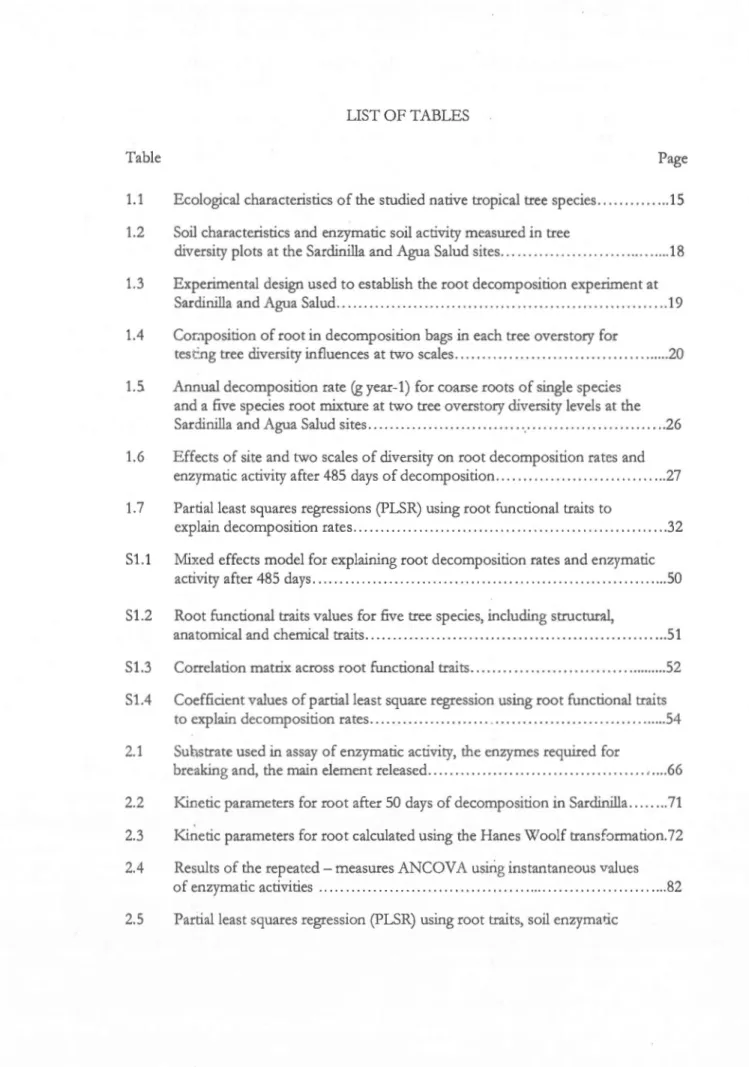
LIST OF TABLES
Table Page
1.1 Ecological characteristics of the studied native tropical tree species ... 15 1.2 Sail characteristics and enzymatic soi! activity measured in tree
diversity plots at the Sardinilla and Agua Salud sites ... 18 1.3 Experimental design used to establish the root decomposition experiment at
Sardinilla and A gua Salud ... 19 1.4 Cor.•position of root in decomposition bags in each tree overstmy for
tes~;.ng tree diversity influences at two scales ... 20 1.5. Annual decomposition rate (g year-1) for coarse roots of single species
and a five species root mixture at two tree overstory diversity levels at the Sardinilla and Agua Salud sites ... 26 1.6 Effects of site and two scales of diversity on root decomposition rates and
enzymatic activity after 485 days of decomposition ... 27 1. 7 Part.ialleast squares regressions (PLSR) using root functional traits to
explain decomposition rates ... 32 S 1.1 Ivf.i}:ed effects mode! for explaining root decomposition rates and enzymatic
activity after 485 days ... 50 S1.2 Root functional traits values for five tree species, including stmctural,
anatornical and chernical traits ... 51 S1.3 Correlation matrix across root functional traits ... 52 S1.4 Coefficient values of partialleast square regression using root functional traits
to cxplain decomposition rates ... 54 2.1 Suhstrate used in assay of enzymatic activity, the enzymes required for
breaking and, the main element released ... 66 2.2 Kir;etic parameters for root after 50 days of decomposition in Sardinilla ... 71 2.3 Kinetic parameters for root calculated using the Hanes Woolf transf::mnation.72 2.4 Results of the repeated- measures ANCOVA usiti.g instantaneous values
of enzymatic activities ... 82 2.5 Partialleast squares regression (PLSR) using root traits, sail enzyma1:ic
activity, and their combined effects for explaining cumulative enzymatic
activity ... 83 S2.1 PLSR models using cumulative enzymatic activity during decomposition to
exp lain root decomposition rates ... 97 S2.2 Standardized coefficients for PLSR models explaining decomposition
rates ... 97 S2.3 Standardized coefficients for PLSR models explaining
cumulative enzymatic activity ... 98 S2.4 Percentage of mass loss and enzymatic values (f..lmol MU dry g min-1)
nun h mg g
kg
mL rn cm mm M mM f.!M nm f.!IDO[ % logv
Kms
k AG f3G CEL XYL NAG PME ASLIST OF ABBREVIATIONS AND ACRONYMS
Degree Celsius Minutes Hour Milligram Gram Kilo gram Milliliter Me ter Centime ter Millimeter Mol ar Millimolar Micromolar Nanomolar Micromole Percent Logarithmic V eloci ty of reaction Michaelis constant Substrate concentration
Decomposition rate
o:-glucosidase f3-glucosidase Cellobiohydrolase 13-}..'Ylanase
N-acetyl-13-D-glucosaminidase
Phosp homonoes terase
SRL Specifie root lengh RDMC Root dry matter content NDF N eutral detergent fi ber ADF Acid detergent fiber HerniCell Hemicellulose Cell Cellulose
c
Carbon N Nitrogen p Phosphorus Al Aluminum B Boron Ca Calcium Cu Copper Fe IronNaN3 Sodium azide Na OH · Sodiumhydroxide MU 4-methylumbelliferyl
7
1.1 Résumé
Les processus écologiques à l'échelle de l'écosystème, comme la décomposition, peuvent être affectés par des modifications dans la composition des arbres du couvert forestier résultant du climat et de l'usage des terres au sein des écosystèmes tropicaux. Le principal objectif de ce premier chapitre était d'examiner l'influence de la diversité des arbres tropicaux sur la décomposition de racines à deux échelles spatiales distinctes. Ceci a été réalisé en mesurant les taux de décomposition et l'activité enzymatique des décomposeurs à l'échelle de l'unité d'échantillonnage (sac de litière 0.002m2
) ou
a
l'échelle de la parcelle (taille de parcelle 2000m2), soit deux échelles et qui sont liées directement (transfert de nutriments) ou indirectement (microclimat) à la diversité des arbres. Nous avons également évalué 1) comment, à l'échelle de l'unité d'échantillonnage, les effets nets de la diversité seraient influencés par l'hétérogénéité biotique et abiotique et 2) à quel point la variation interspécifique des traits fonctionnels racinaires des arbres tropicaux explique la décomposition racinaire grossière. Les sacs de litière ont été disposés sur deux sites au Panama, Sardinilla et Agua Salud caractérisés par des propriétés de sol contrastées. Les sacs de litière comprenant différents mélanges d'espèces ont été placés pour décomposition sous couvert forestier soit de faible ou de forte diversité. L'influence de la diversité des arbres, à l'échelle de l'unité d'échantillonnage et de la parcelle, a été étudiée en plaçant une espèce seule ou cinq espèces locales d'arbres tropicaux mélangés dans différentes conditions de diversité du couvert forestier. Les sacs de litière ont été mis à décomposer en juillet 2011 et collectés après 50,160/195 (Agua Salud/Sardinilla), 310, et485 jours afin de déterminer les taux de décomposition en utilisant la perte en masse. En plus, l'activité des enzymes impliqués dans les cycles du carbone, de l'azote et du phosphore a été mesurée après 485 jours de décomposition. Nos résultats ont montré que la diversité des arbres n'influence pas significativement la décomposition des racines, et ce peu importe l'échelle spatiale étudiée. Cependant, une importante variance des réponses à l'échelle de l'unité d'échantillonnage a été observée, suggérant une forte hétérogénéité spatiale. L'importance des effets du site, surtout associés aux caractéristiques du sol ainsi que la densité des espèces de décomposeurs de racines ont contribué à une variation intraspécifique des taux de décomposition. Les variations interspécifiques des traits racinaires expliquaient entre 35 (Sardinilla) et 80% (Agua Salud) des taux de décomposition des racines. Notre étude suggère que les changements en termes de décomposition ne sont pas uniquement influencés par la diversité des arbres du couvert forestier mais plutôt par des changements dans la composition fonctionnelle des forêts tropicales qui peuvent altérer la quantité et la qualité des entrées de litières racinaires.
Mots-clés: racine, effets de diversité, processus souterrain, échelles spatiales, activités enzymatiques, sol, traits fonctionnels racinaires, cycle des nutriments, Panama.
9
1.2 Abstract
Ecosystem-level ecological processes, such as decomposition, may be affected by changes in tree overstory composition that may result from climate and land-use change in tropical ecosystems. Thus, our objective in this chapter was to examine the influence of diversity of tropical trees on coarse root decomposition by measuring decomposition rates and enzymatic activity at two spatial scales, micro- (within bag: 0.02m2
) and meso- (within plot: 2000 m2
) scales, that are related to direct, e.g. nutrient transfer, and indirect effects, e.g. microclimate, of tree diversity on this ecosystem process, respectively. As well, we evaluated: 1) how net diversity effects at the micro-scale could be affected by abiotic and biotic heterogeneity and 2) the extent to which interspecific variation in root functional traits of tropical species explained coarse root decomposition. We established coarse root decomposition bags that varied in species composition in two sites in central Panama with contrasting soil properties, Sardinilla and Agua Salud. The influence of tree diversity at both spatial scales was examined using tree overstory plots of either low or high diversity (meso-scale) and decomposition bags with low, i.e. single-species coarse roots, and high, i.e. a five species coarse root mixture, diversity levels (micro-scale). Decomposition bags were established in July 2011 and collected after 50, 160/195 (Agua Salud/Sardinilla), 310, and 485 days to determine decomposition rates using mass loss. In addition, activity of enzymes involved in carbon, nitrogen, and phosphorus cycles were measured after
485 days of decomposition. Our results showed that tree diversity did not significantly
influence coarse root decomposition and enzymatic activity at either of the studied spatial scales. However, considerable variation of net diversity effects at the micro-scale was observed, suggesting a strong effect of environmental heterogeneity. The importance of site effects, predominantly differences in soil characteristics, and species identity of the decomposer root material contributed to intraspecific variation in decomposition rates. Interspecific variation in root traits explained 35 and 80 % of variation in coarse root decomposition rates in Sardinilla and Agua Salud, respectively. Our study suggests that changes in decomposition is not mediated by tree overstory diversity perse, but rather by changes in the functional composition of tropical forests that may alter the quantity and quality of root litter input.
Keywords: coarse roots, diversity effects, below-ground processes, spatial scales, enzymatic activities, soil, root functional traits, nutrient cycle, Panama
plant biom%s is transferred to the soil as leaf, wood, or root litter anc'. released by decomposer communities (Malhi and Grace 2000, Gessner et al. 2010). Studies in boreal; ten:?erate, and tropical forests report that large portions of assirr.:lated carbon are transfer:ed belowground (Vogt et al. 1986, Grays ton et al. 1996, MalL. et al. 1999),
yet little rer::1.ains known about the turnover of belowgrou:1d components, f·:.ch as coarse roots of tr(.::s, particularly in tropical regions (Giardina e:: al. 2005, Meiste:: et al. 2012). Tropical fo--:ests play an important role in the global nu trient cycle (Vitouse!< and Sanford
1986, Mall"i et al. 1999) to which they con tri bute ~70 % of terres trial nitr ::)gen fixation (TownsenC: et al. 2011) and stock an estimated 40 % of terrestrial carbo·:; (Soepadmo 1993). Hcwever, nutrient cycles in tropical ecosystems are being altered by land use change (Fc~ey et al. 2003, Townsend et al. 2011), principally through the transformation of vegetati·:ms covers, e.g. forest to agricultural and pastt.::.re fields, and the establishment of native c;~ exotic tree plantations (Achard et al. 2002, Lambin et al. 2003, Piotto et al. 2010), brin;;ing uncertainty to global estimates of terrestr:al carbon. This ::.hesis aims to improve ot:;r knowledge of coarse root decomposition ic tropical forests i::-o the context
of multi-spF:cies plantations with the hope of improving cur estima tes of tlùs component of the carb::~n cycle for global models.
Dei.pite their important contribution to the nutrient cycle ~.n terrestrial ecosystems~ belowground processes have been less studid than abovegroccd processes, mostly due to logistical challenges. Belowground carbon could be undere~'::imated by as much as 4C' % globally (Robinson 2007), increasing estimates of belowgw(::'1d carbon in tropical foiests from 74 to 123 Pg and total tropical forest carbon stocks' from 553 to 602 Pg (Robinson 2007). In a meta-analysis on global :patterns of root ':::.Jrnover that included g;_;aminoids, shmbs and fine tree roots, Gill and Jackson (2000) f.:mnd a steady increase with decreasing latitude in annual turnover of maximum root biomass ranging
2
'·
.i
on average··. from 13% in boreal ecosystems to 73% El tropical ecosys~~ms. When contras ting. tree root diameter classes, fine root litter had an annual tur:J.over rate of 56%, while larger tree root sizes had an annual turnover rate of only 10%, cxhibiting
considerabl~ variation (Gill and Jackson 2000). Across ecosystems globally, the fastest
decomposi-:.i.on rates of aggregated litter types was found .'n tropical rain forests with 1.3 g g·' yr·1 ar.d the slowest rates were. found in tundra w;th 0.18 g g·1 yr·' (Zhang et al. 2008). However, only seven studies on root decomposition were includeè in the meta-analysis, while for other groups, such as broad-leaved litter, as many as 154 studies were i.ncluded (Z:l1ang et al. 2008). Contributions of root turnover to the carbon cycle may be currently Ué~der-or overestimated si.mply due to the lack cf available inform:::tion.
To :iate, tl1e dominant focus in decomposition stt;dies has been on ~~af litter and on the de~:~rmination of which factors influence their decomposition r<.tes, such as climatic cc1ditions (Aerts 1997, Hattenschwiler et al. ::.011), decompose.'.: community compositio::1 (Schmidt et al. 2008, Gessner et al. 2010, Hznda et al. submit':~d) and litter quality (Cc.rnwell et al. 2008, Zhang et al. 2008). Whether these ;~.ctors affect belowgrou!',d decomposition similarly remains to be detei:~in.ined. In the me~:a-analysis by Silver and Miya (2001), studies on root decomposition were limited mostly to fine root decomposition in temperate forests and · grasslands. Contrary to ·expectations,
comparati,l"! studies on leaf litter and root litter decomposition have reported
contradictèëy results (Cusack et al. 2009, Hobbie et al. 20'".0). Cusack et al. (2009) found no differences between leaf and root decomposition rates in a tropical forest; although different dzivers explained iliei.r respective decomposition. Root decomposition was explained r.1ainly by temperature and lignin concentratio::t, hile leaf deco::nposition by seasonality'(Cusack et al. 2009). On the other hand, Hob::tie et al. (2010) f(ind that leaf decomposi';ion rates were not correlated with root decunposition rates. :Jne possible explanatior: for de-coupled leaf and. root decomposition rates is related tc litter quality
·' '
(Silver anè,,Miya 2001). The same species could have 1iifferent leaf, wc?d, and root
chemical c:;:mposition, likely reflecting different physioL(gical functions Ç{!estoby and Wright 20C6, Baraloto et al. 2010). Furthermore, different traits poss;.Jly influence
above and 'iJelowground decomposition across species, v-rhich would resul': in root and leaf deconL?osition rates with contrastirtg directions and magnitudes (P~obbie et al. 2010). In ~temperate tree species, fast leaf decompositi·::m was associatec' with higher hemicellulde content and thinner leaves, while fas ter roo~~ decomposition \"las associated with higher calcium and lower lignin content (Hobbie et al. 2010).
The majority of studies on decomposition have been limited to singi.e species leaf litter (Prescott 2010). Still, studies on decomposition of l~af litter mixtures from various biomes ar:'.i ecosystems have highlighted the importance of considering species interactionf in arder to detect additive or non-additive effects of species co::nposition on ecosystem function (e.g., Bail etal. 2008, Schindler and Gessner 2009, Gie[,elmann et al. 2010). Add.itive effects occur when the decomposition rate in mixtures is equal to the sum of litt~r decay rates of each species, while non-aè,ditive effects occlt when the decomposi :ion rate of the mixture is grea ter or less than the sum of decay rates of individual ~?ecies (Gartner and Cardon 2004, Hattenschwiler et al. 2005). \X'hile additive effects
h
av
~
emphasized, in part, the importance of specie's identity andh
o"~
species with divergent e:·~composition rates can cancel each other out ·!rhen 1TILxed toget:~·er (Bali et al. 2008), non-additive effects have illustrated the impo
r
ta
nc
~
of species interal_tjons in litter mixtures, s'howing either synergistic (positive) or antdgonistic (negativt) effects on decomposi:ion (Gartner and Cardon 2004). Using a plant communit<; perspective enables diversity or species composition effects on decomposition to be evaluated (Hattensch-viler et al. 2005). I-Iowever, studies where ~tter mixtures deo mpose in a 'common €~arden' type environment could limit the spatial scale at which cliversity effects opera te to , he scale of the litter bag, as they exclude the, potential influenc.~ of di ersity of the surrçunding plant community.Decomposer communities, comprised of detritivores and microbial decomposers, play a vital role in the decomposition ptocess (Gessner et al. 2010). Microbial '~ecomposers break clown lignocellulose and r.~tycle detrital nut.!ients such as nitrogen, f'hosphorus, and sulfur making use of enzy:nes (Sinsabaugh · et al. 1991,
4
Sinsabaugh' et al. 2002). These enzymes are used to catalyze the degradation of plant biomass, b:,_eaking clown complex chemical compounds irlto simpler compo;.mds that are more reacl'y assimilated (Sinsabaugh et al. 1991, Sinsab:mgh et al. 2002). Enzymatic activity has. been used as a biochemical measure of insta~taneous degrada bon rates and as a robust indicator of microbial activity at different stages of degradatior. (Sinsabaugh et al. 1991, Sinsabaugh et al. 2002). Given the varia tien of enzymatic 2. :tivity a cross
decomposi~g plant species (Allison and Vitousek 2004), measuring the a::tivity of key
enzymes ir:.volved in C, N and P degradation may help to understand :he observed variation ir: decomposition rates in species-rich tropical fcrests.
This thesis presents two chapters that explore v2::ious factors that influence the decomposi:ion of coarse roots in tropical forest plantations and a natc:ral forest in central Panama. In the fust chapter, the effects cf tree diversity ::.n tree root decomposit-ion rates and enzymatic activity are studied at two spatial so:ales and in contrasting decomposition environments. More specifically, we ask 1) how does tree species div~rsity influence decomposition of tree roots at mesa-scale (witL.in plot: 2000 m~, e.g. ir'direct effects of tree overstory on decomposer communities, r:1icro-climate conditions. :and soil properties, and the decomposition at' micro- scale (wieun bag: 0.02 m~, e.g. è~rect effects due to nutrients transfer amor:.g litters and cot;~plementarity resources b r decomposers and
2)
will species functiorial identity, i.e. rc··:)t functional traits, conl:':ibute to understanding root decomposition' rates? In the se<:•:)11d chapter, enzymatic ~.ctivity, a method typically used in sail scienœ, is adapted for ui;e in the root decomposiSon study presented in the previous chapter for use as an inCicator of the m.icrobial decomposer community. Specifically, we as~{ 1) to what ex<-=nt does the activity of particular enzymes sampled on decomposed1 roots exp lain ch·,~nges in root decomposiüon over cime and 2) is this enzymatic activity influencer:] by species compositiqn of litter mixtures and decomposition enviror:.ment?
Thi3 thesis attempts to offer several novel contributions to ~he scientific commUluty. Firstly, few studies on tree diversity effects have focused on belowground
componen~s such as coarse root decomposition and micr~;bial decomposers, even Jess in tropical ecosystems. Secondly, in contrast tb most st:udies on diversity effects on decomposition, the use of multiple spatial scales pro7ides a more complete plant community perspective and the comparison of different forest sites allows for observing the influen ::e of site-specifie external factors on the diversity and root decomposition relationshit= (Chapter 1). Thirdly, we assess the relai:ivc importance of particular structural, chemical and anatomical functional traits that are rela,<!d to root decomposi::ion (Chapter 1). Given that root decomposition is a complex process, the exploratior:, of contrasting and promising approachcs th~t provide a link 1:. :!tween plant componen~s and microbial decomposer communities is rcquired. The ada;:·tation of the
method of soil enzymatic activity to decomposed roots in our study (chapt-'~r 2) provides
a fourth nsvel contribution whcrc wc dcscribe clear pa':ameters to quant'fy enzymatic activity on dead roots. We also show the relationship between root decor:.~position and various enzymes involved in the C, N, and P nutrient cycles over cime and identify factors that could influence enzymatic activity during root decomposition (chapter 2).
To address these various questions, we conducted a root decomposition field experiment during 485 days using coarse roots from five native tropical tree species that encompass a broad range of life histories strategies. Eoots decomposed in two tree overstoty t~.iversity levels, low or high diversity, at two sites, Sardinilla anè. Agua Salud, under different soil conditions. Two diversity levels were also used within ;:oot bags and consisted of either low (single species) or high (five species mixtures) dive~sity. A suite
of various 'structural, chemical and anatomical functiocal traits was measured on ail
species. Etzymatic acti ity of key enzymes in ol ed ir~ C, N or P d g:1~dation wer measured ~·1 the beginning, middle and at the end of the ex periment in :~ ifferent root decomposüion treatments. Collectively, we aim that thcse two chapters' :mprove our understanc:::ng on the role of tree diversity for co:;rse root decorr:Sosition and decomposer activity in tropical forests.
:1
CHAPTERI
INFLUENCES OF TREE DIVERSITY ON TROPICAL TREE COARSE ROOT
Les processus écologiques à l'échelle de l'écosystème, comme la décomposition,
peuvent être affectés par des modifications dans la composition des arbres du couvert forestier résultant du climat et de l'usage des terres au seiD des écosystèmes .:ropicaux. Le principal o~jectif de ce premier chapitre était d'examine! l'influence de la diversité des arbres trop<caux sur la décomposition de racines à deux é:::helles spatiales distinctes. Ceci
a été réali:é en mesurant les taux de décomposition et l'activité enz7::natique des décompose~rs
à
l'échelle de l'unité d'échantillonnage (sac de litière o.:)02m2) ou
a
l'échelle de la parcelle (taille de parcelle 2000m2
), soit deux échelles et ~~ sont liées directemen~ (transfert de nutriments) ou indirectement (microclimat) à la diversité des
arbres. N:1us avons également évalué 1) commr::nt, à l'échelle de l'unité
d'échantillcnnage, les effets nets de la diversité seraient influencés par l'~1étérogénéité
biotique et abiotique et 2) à quel point la variation intersrécifique des traits fonctionnels
racinaires ces arbres tropicaux explique la décomposition racinaire grossière. Les sacs de
litière ont été disposés sur deux sites au Panama, Sardinilk et Agua Salud q~·actérisés par des propri~tés de sol contrastées. Les sacs de litière comprenant différe:1ts mélanges
d'espèces c :1t été placés pour décomposition sous couvert forestier soit de faible ou de forte divc:sité. L'influence de la diversité des arbres, à l'échelle de l'unité d'échantillc:nnage et de la parcelle, a été étudiée en plaçant une espèce ~cule ou cinq
espèces lo,aJes d'arbres tropicaux mélangés dans différentes conditions dr:. diversité du couvert fo: estier. Les sacs de litière ont été mis à décomroser en juillet 20~~ 1 et collectés après 50, 1.50/195 (Agua Salud/Sardinilla), 310, et485 jc·:ùfs afin de déterr1.iner les taux de décom2osition en utilisant la perte en masse. Er. plus, l'activité :-:les enzymes
impliqués dans les cycles du carbone, de l'azote ct du phcsphore a été mesu~·ée après 485 jours de dt::omposition. Nos résultats ont montré que la.' diversité des arbi':.s n'influence pas signific.ativement la décomposition des racines, et c: peu importe l'é:·helle spatiale
étudiée. Cependant, une importante variance des réponses à l'échû.e de l'unité d'échantillonnage a ete observée, suggérant une forte hétérogénéité spatiale. L'importatJ.ce des effets du site, surtout associés aux caractéristiques du sel ainsi que la
densité des espèces de décomposeurs de racines ont contribué à une variation intraspéciGque des taux de décomposition. Les variations interspécifiq~es des traits racinaires .expliquaient entre 35 (Sardinilla) et 80%' (Agua Salud) des taux de
décomposi":ion des racines. Notre étude suggère que les changements en termes de décomposi:jon ne sont pas uniquement influencés par la diversité des arbres du couvert forestier rr.:ais plutôt par des changements dans la composition fonctionn~lle des forêts tropicales
;i.ll
peuvent altérer la quantité et la qualité des entrées de litières n:cinaires.Mots-clés: racine, effets de diversité, processus souterrain, échelles spatiales, activités
enzymatiqu~s, sol, traits fonctionnels racinaires, cycle des nutriments, Panama.
1.2 Abstract
Ecosystem-level ecological processes, such as decomposition, may he affected by changes in tree overstory composition that may result from climate and land-use change in tropical ecosystems. Thus, our objective in this chapter was to examine ':he influence of diversity of tropical trees on coarse root decomposition by measuring decomposition rates and enzymatic activity at two spatial scales, micro- (within
bag: 0.02m2
) and meso- (within plot: 2000 rr?) scales, that are related to direct, e.g. nutrient transfer, and indirect effects, e.g. microclimate, of tree diversity on this ecosystem process, respectively. As weil, we evaluated:
1
)
how net •Jiversity effects at the micro-scale could be affected by abioticand biotic heterogeneity and 2) the extent to which interspecific variation in root functional traits of tropical species explained coa.~se root decomrosition. We established coarse root decomposition bags th at varied ir: species composition in two sites in cer:tral Panama with contrasting soil properties, Sardinilla and Agu<. Salud. The influence o'. tree diversity at both spatial scales was exarr:.ined using tree o·.rerstory plots of either lcw or high diversity (meso-scale) and decompcsition bags with lc·w, i.e. single-species co~.::se roots, and high, i.e. a five species coars"- root mixture, è.~rersity levels (micro-scak). Decomposition bags were established in J;.ly 2011 and collected after 50, 160/195 (ltgua Salud/Sardinilla), 310, and 485 days to c'.etermine decomposition rates
. using mass loss. In addition, activity of enzymes involved in carbon, :litrogen, and phosphorus cycles were measured after 485 days of decomposition. Our results showed that tree diversity did not significantly influence coarse root ·decomposition and enzymatic activity at either of the studied spatial scales. However, considerable variation o~· net diversity effects at the micro-scale was observed, suggesting a strong effect of e:lVironmental heterogeneity. The importance of site effects, Fedominantly differences: in soil characteristics, and species identity of the decomposer root material contributed to intraspecific variation in decomposition rates. Interspecific variation in
root traits explained 35 and 80 % of variation in coarse root decomposition rates in Sardinilla . ~nd Agua Salud, respectively. Our study suggests that changes in
decompos1· ion is not mediated by tree overstory diversity per se, but rathc:.r by changes in the func::ional composition of tropical forests that may alter the quanti;y and quality of root litt~r input.
Keywords: coarse roots, diversity effects, below-grc.Jnd processes, spatial scales, enzymatic ?ctivities, soil, root functional traits, nutrient cyde, Panama
10
1.3 Introduction
Globally, natural and anthropogenic climate and land-use change are altering
drastically plant community diversity and composition. These altera':i.ons, mainly
biodiversity loss, are affecting ecological processes such as prod'.lctivity and
decomposition and, hence, ecosystem functions (Cardinale et al. 2012, Hooper et al.
2012). Tropical ecosystems are rich in biodiversity and play a vital role in global nutrient
cycles. Th.ese ecosystems are estimated to store 40% of global carbon
(C)
stocks,although bdowground C stocks, which have been poorly characterized du~ to logistical
constraintf, are likely underestimated (Robinson 2007). Despite the importance of
tropical fc:.·est ecosystems in terms of the global C cyde and biodiversity, there are
relatively few studies that have exarnined diversity effects on belowgrounô processesin
these ecosystems.
Or.;anic matter decomposition
i
s
driven by the li~~er quality of the -:lecomposingsubstrate, c .. ~iotic factors of the decomposition environnent and bio tic fa ~tors su ch as the decorn;)oser community diversity (Gessner et al. 201 0). Decomposer :ommunities,
comprising of both mesa- and macrofauna, as well as rnicrobial decompo,~rs, may also
be affected· by land-use change (Heijden et al. 2008). ':r:hese organisms :ontribute to
decomposi~ion through different mechanisms. While macrodetritivores act as litter
fragmenters making litter more accessible to smaller decomposers (David & Handa
2010), mic:obial communities degrade lignocellulose and recycle detrital n::ltrients using different e:i.zymes that break clown complex chemical compounds into simplet, more readily assLnilated compounds (Sinsabaugh et al. 1991, Sinsabaugh et al. '2002). As a result of tl-:~ diverse functions of contrasting enzymes during decomposition, enzymatic activity ha.~ been used as a good indicator of degradation (Sinsabaugh ·et al. 2002), varying m~::kedly across plant species (Allison and Vitousek 2004) likely due to speci
es-specific differences in traits that are related to litter quality.
Furctional plant traits, which include chemical, stLuctural and anatd:nical traits in plant litter;·have been useful in general to understand e!:osystem processe·3 and to link
above- and belowground dynamics (Cusack et al. 2009, H.")bbie et al. 2010, Birouste et al. 2011 ). Leaf traits th at determine leaf litter quality, su ch as total p~îenolics and nonstructu:t'al carbohydrates, influence decomposition rares in tropical fore~ts (Coq et al. 2010, I-Iattenschwiler et al. 2011). While studies on wood.and root decomposition in the tropics are :;carce, traits such as vesse! area proportion and diameter have ceen found to be strong predictors of decomposition rates (Cusack et al. 2009, Geffen et al. 2010). Due to th~ importance of functional traits in processes like decompositi.::m, diversity lasses associated with particular traits could generate complex responses across ecosystems (Cardinale et al. 2012).
Tre~ overstmy diversity may influence belowground properties and processes, as weil as the surrounding plant community. The "home field advantage" hypothesis (Gholz et d. 2000) posits that a particular tree overstory composition c~.;.-J. promote a decompose: community that is more efficient in breaking clown local types of litter. However, evidence for this hypothesis remains limited. A recent reciprocal transplant experirnent across multiple biomes showed that plant litter traits were mere important than local 0ecomposer communities in predicting decorr~?osition rates (Mz'Kkonen et al. 2012). Srecies identity of the tree overstory also co~lld influence soi: biochemical processes c:irectly by modifying the availability of resourc~s, such as water,"soil nutrients and light, 1:o competitors while, at the same rime irnproving their own 'fitness (tight weave hyp~thesis). Indirectly, tree overstory could change sail properties a:1d processes, e.g. decomposition, through mechanisms that improve a species' own perfcrmance, such as the production of recalcitrant, flammable litter in response to herbivore pressure
(loose weave hypothesis); or by affecting sail processes due to tree-soil interactions, e.g.
mycorrhiu.l fungi (frayed hypothesis) (Binkley and Giard.ina 1998). In tropical forests, tree overs:ory composition affects sail processes su:h as carbon mineralization, phosphow1 acquisition, litter quality input, and carbon pools (Potvin et aL 2011, Keller et al. 2013). e.g. sail carbon fluxes changes due to root ex·;dations (Graysto~: et al. 1996). Despite tl-.~ possible influences of tree overstmy on decomposition, h':'w overstory
12
diversity aëd composition may affect root decomposition in tropical forests remruns unknown. '
As decomposition in natural ecosystems is a product of litter com?rised of co-occurring species in a particular plant community (Gartner and Cardon 2004, Hattenschwiler et al. 2005), the use of litter mixtures t::> evaluate diversity effects on decomposiion has become increasingly frequent (Gartner and Ca:cdon 2004). Comparisons of litter mixture decomposition rates . ·vith decompositon rates of individual '-?ecies can be used to assess whether the effects of increasing species diversity is additive or non-additive. Additive effects on decompcsition reflect the neutral result of mixing various species together (Gartner and Cardon 2004). Non-aè.:iitive effects (referred tc also as positive diversity effects) on litter mixtures can be explained by:
1
)
complemer~tarity effects mediated by decomposer cot-:1munities, e.g. litter mixtures create more diverse micro-habitats and, thus, change the abundance and activity of decomposers (Hansen and Coleman 1998, Gief3elmann et al. 2010) and 2) nutrient transfer or ?resence of inhibitory components by leaching or biological mediation (Fyles and Fyles 1993, Schimel and Hattenschwiler 2007). Non-additive d fects when observed, show in general a much weaker response in leaf litter d~composition
experimen:s than what has been observed for plan: productivity ir. biodiversity experiments (Handa et al. submitted). However, the spatial scale at which Etter mixtures have been. studied has been limited generally at the ~cro scale, i.e. the. mechanisms related to i:-1teractions inside the litter bag listed (Fyles a::d Fyles 1993). V:oreover, few
• • 1
studies mal~e use of multi-site comparisons, which test the sensitivity of di~rersity effects on litter Enxtures to environmental biotic and abiotic heterogeneity (I..fadritch and Cardinale 2007).
Div'::rsity effects in natural ecosystems could vai.y across tempor~.l and spatial scales (Duffy 2009). Across temporal scales, diversity eŒ~cts on productivity change due to increasir.g species complementarity (Cardinale et al. 2007) and due to cl1.anges in the magnitude of negative and positive plant-soi! feedbacks (Eisenhauer et al. 2012). Across
spatial sc~les, belowground processes could be affected by tree overstory
compositions/ diversity due to changes in the distribution of soil comrnunities: soil
microbial communities are affected by trees at fine scales, e.g. by root traits and
exudation, by plant community composition at intermediate- scales, and by vegetation
types at large scales (Ettema and Wardle 2002). In the tropics, evidence. of cliversity
effects ope::ating at extremely local spatial scales, i.e. fe-v meters, bas been found for
productivity (Uriarte et al. 2004b, Potvin and Dutilleul 2009). Potvin and Dutilleul
(2009) found that the individual tree productivity, i.e. tree diameter and height, was more
strongly af;cected by the size of neighbors than by diversity. While tl:.e effects of
neighbors on tree growth decreases with distance, the !afluence of tne ~~ .ighborhood
depends st::ongly on the target species in tropical forests (Uriarte et aL 2004a, Uriarte et
aL 2004b). In spire of the importance of spatial scales in. explaining diver~:ty effects on ecological processes in tropical ecosystems, the infbence of diversir-; effects on
belowground processes in the tropics, such as root decomposition, h0.s yet to be
determinee:. Hence, to understand if similar spatial sc2:les that apply to productivity
(Weigelt et aL 2007) also apply to decomposition in the tropics, we used a multi-scale
approach to evalua te direct and indirect cliversity on root decomposition.
Ou: study aimed to determine how the diversity of tropical trees influenced the
decomposi:!ion rate of coarse roots and the enzymatic activity of decomposer
communiti ~s at two spatial scales during 485 days. We 'tested a) the indirect effect of
tree overstory cliversity on decomposition at the meso- scale (within plot: 2000 m~ and b) the direct effect of tree root diversity at micro- 2:ale (within the decomposition
bag: 0.02 :h~. At the meso- scale, we expected tha~ where tree ove::story species diversity \Vas higher, there would be faster root decomposition rates du~ to positive, indirect effects on the abiotic decomposition environmen.t (Prescott 2002, : hapin 2003, Keller et :.:1. 2013). We also hypothesized that tree diversity at both scales would accelerate decomposition, mediated by the biotic ·'decomposer anô detritivore communities, due to complementary resource availability in mixtures (Hatt~nschwiler et aL 2005, Wardle 2006, Thorns et aL 2010, Eisenhauer 2('12). Finally, we expected that
14
spee1es fun::tional identity based on root functional trai!s (Hobbie et al. 2010) would explain coase root decomposition rates across sites, as found in leaf decomposition studies (Comwell et al. 2008, Hattenschwiler et al. 2011, Freschet et al. 2012).
1.4 Methods
1.4.1 Stnr!J siteJ
The. study was clone in two experimental forest sites in central Panama, Sardinilla (9°19' N- 79°38' W) and Agua Salud (9°13' N -79°47'
\
'V'), with
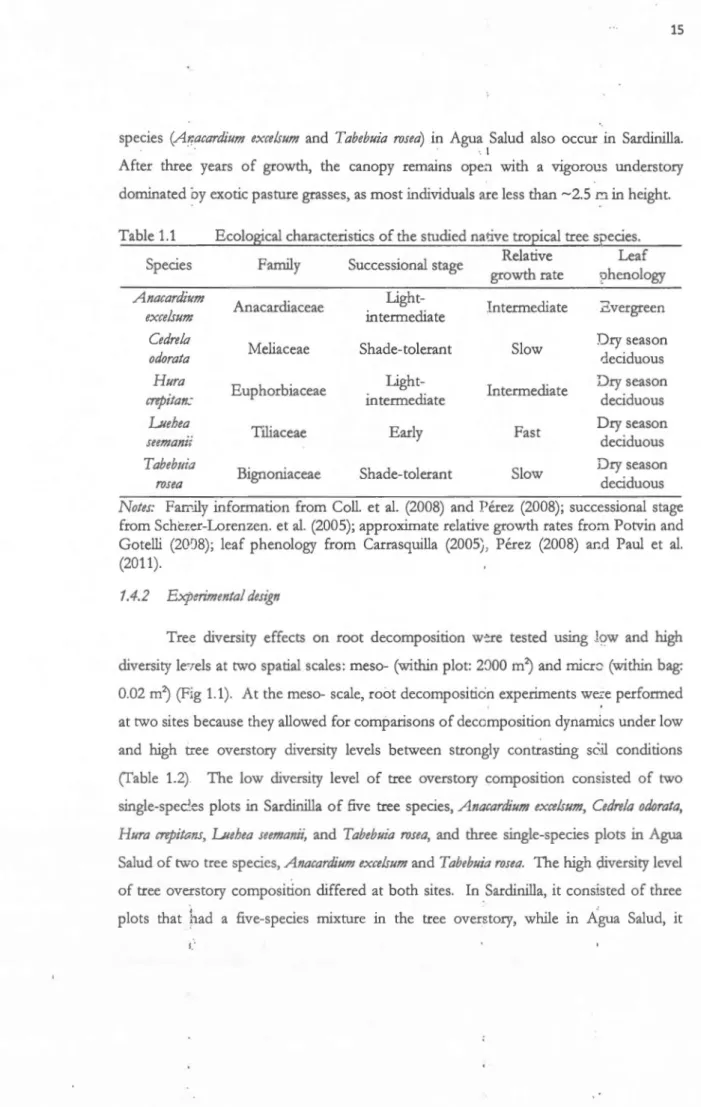
annual precipitations of 2350 mm ~n.d 2300 mm, respectively (Scherer-Lorenzen et al. 2007, Breugel et al. 2011). The Sardinilla site is an experimental diversity tree plantation established in 2001 where former pas:ure land was planted in plots of 45 x 45 tL with either one, three or six species of native tree species (Scherer-Lorenzen. et al. 2005, Scherer-Lo::enzen et al. 2007). The tree species used in the Sardinilla plantation were selected to have a gradient of relative growth rates (Table 1.1) of slow growing spec.ies, Cedrela odorata and Tabebuia rosea, modéate growing species, Anacardium excelsum and Httra crepitans, and fast growing species, Col.dia alliodora and Luebea seemanii (Scherer-Lorenzen et al. 2007).: Mortality of one species, Cordia allidora, was high in the early years such that it is no long.:r considered to be represented within the tree diversity treatments at the site (Potvi=: and Gotelli 2008). After 10 years of growth, the Sardinilla plantation has a closed, str~~tified canopy (Kunert et al. 2011). Understory vegetation is varied and is dominated by grasses and herbaceous. species (Potvin et al. 2011). Soils originated from sedimentary rocks and tertiary limestone, presenting Alfisols dominated by clay (Potvin et al. 2004).Th~ Agua Salud forest sites include young native tree plantations established in 2008 on fœmer catde pastures and agricultural fields and secondary forest; of different ages, rangi~~g from one to eighty years old (Breugel and'Hall 2008, Breugel et al. 2011, Paul et al. 2011). In contrast to Sardinilla, the Agua SaluC: plantation plots are 45 mx 39 m (Breugel and Hall 2008) and are characterized by short; steep slopes with soils derived from prete;:tiary basait plateau (Hassler et al. 2011 ). A subset of the plantçd native tree
spee1es (Anacardittm excelsttm and T abebuia rose a) in Agua Salud also occur in Sardinilla.
. . 1
After three years of growth, the canopy remains ope-.:1 with a vigorous understory dominated oy exotic pasture grasses, as most individuals are less than ~2.5 r.'l in height.
Table 1.1 Ecolo~cal characteristics of the studied na1jve troEical tree species.
Species Fa mil y Successional stage Relative Leaf
growth rate '?henology
Anacardium
Anacardiaceae Light- Intermediate :2vergreen
exce!Sflm intermediate
Cedrela
Meliaceae Shade-tolerant Slow Dry season
odorata deciduous
.Hum
Euphorbiaceae Light- Intermediate Dry season
trepitan: intermediate deciduous
Lue bea
Tiliaceae Earl y Fast Dry season
seemcmii deciduous
Tabebuia
Bignoniaceae Shade-tolerant Slow Dry season
rose a deciduous
Notes: Far.ily information from Coll. et al. (2008) and Pérez (2008); successional stage
from Scheter-Lorenzen. et al. (2005); approximate relative growth rates fro:n Potvin and Gotelli (20:)8); leaf phenology from Carrasquilla (2005); Pérez (2008) ar;d PaLÙ et al.
(2011).
1.4.2 Exjl8rimental de.rign
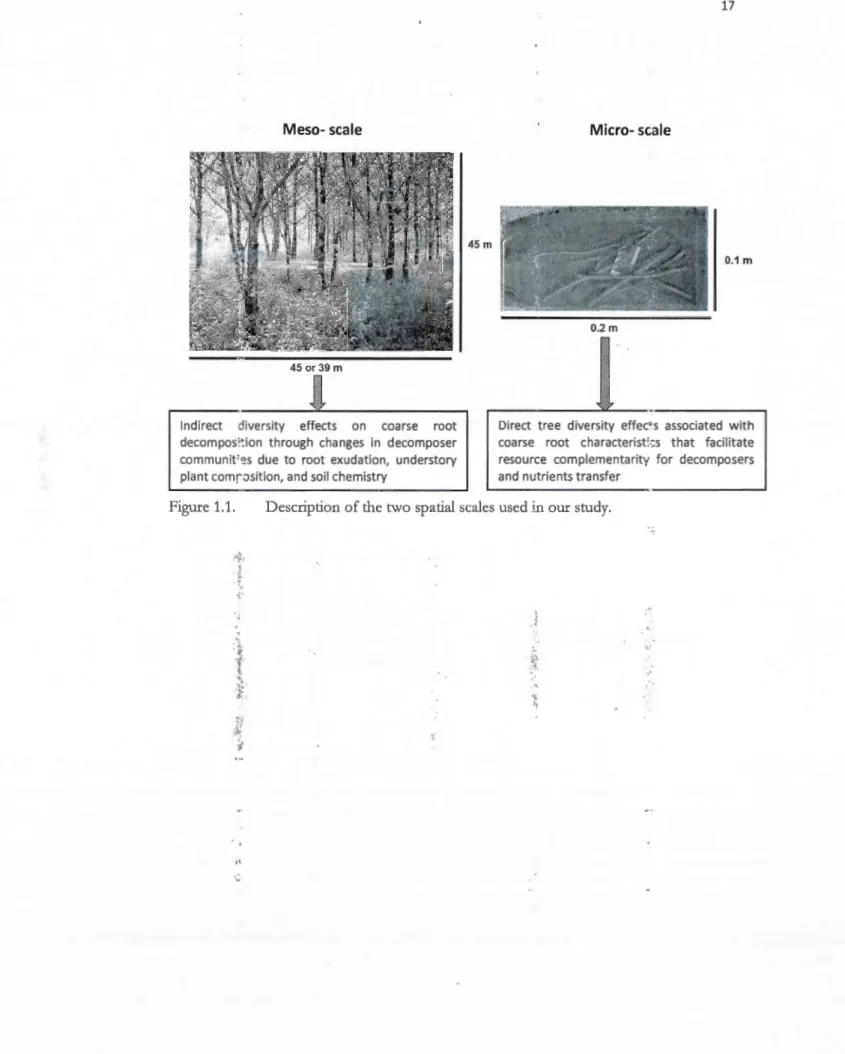
Tree diversity effects on root decomposition w::re tested using Jaw and high diversity le-rels at two spatial scales: meso- (within plot: 2CJOO rn~ and micr:- (within bag:
0.02 m~ (Fig 1.1). At the meso-scale, root decompositicn experiments weze performed
at two sites because they allowed for comparisons of decomposition dynamics under low
and high tree overstory diversity levels between strongly contrasting sè.i1 conditions (Table 1.2) The low diversity level of tree overstory composition consisted of two single-spec:1es plots in Sardinilla of five tree species, Anamrdium exœl.rum, Cedrela odorata, Hum crepitans, Lmhea seemanii, and Tabebuia ro.rea, and three single-species plots in Agua
Salud of two tree species, Anacardium excel.rum and Tabebuia rvsea. The h.igh d.iversity leve!
of tree overstory composition differed at both sites. In Sardinilla, it consi.sted of three plots that :1ad a five-species mixture in the tree overstory, while in Agua Salud, it
16
consisted cf three plots of secondary forests older than 50 years (Table 1.3). At the
micro- scah, the low and high diversity levels refer to the species composition of the
coarse root~ inside each bag. The low diversity leve! consisted of single-species coarse
roots for e::.ch of the five studied tree species, while the h:gh diversity leve! consisted of a
five species coarse root mixture containing ali five of the studied species. To avoid
confusion, we will use low and high diversity to refer to tree overstory diversity at the
meso- scale and single-species and five-species coarse root mixture to refer to low and
high root d.iversity at the micro scale.
In each plot of low tree overstory diversity, five 1::-ags with coarse rc'Jts matching
the composition of the tree overstory and five bags with the five species ::oot mixture
were established (summarized in Table 1.3). In total, ten plots with one hundred coarse
root bags were used at the low overstory diversity in Sardinilla, while in Agua Salud,
six
plots with sixty decomposition bags were used. For the high overstory diversity levels in
both Sardinilla and Agua Salud, 30 decomposition bags were established p~r plot (three
plots per s1_te), including five single-species bags per species and five bags with a
five-species root mixture (90 bags per site). This design allowed us to assess beth direct and
indirect efFects of tree diversity on root decompositior:, as weil as any potential net
diversity e.:fects associated with root diversity inside ÜJ.e bag (single-species vs five
species root mixture) under heterogeneous biotic and abiotic conditions. The influence
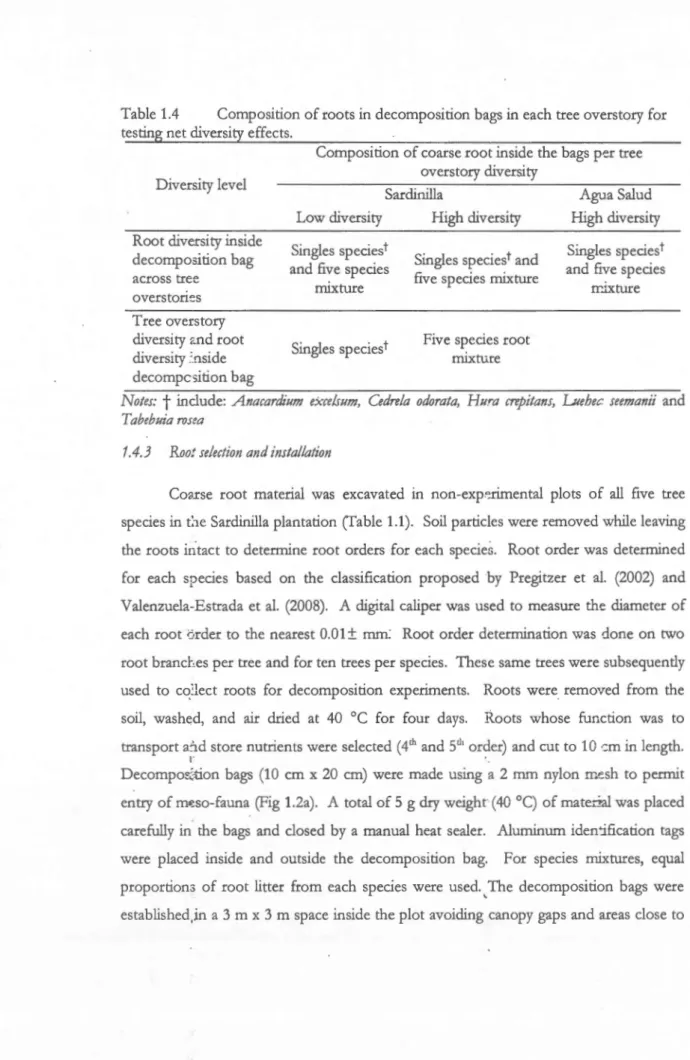
of tree overstory on net diversity effects was tested in two ways using the five species
root mixtu::e (Table 1.4). First, this mixture was established in low and high diversity
plots in Sadinilla and high diversity plots in Agua Sah1d to evaluate if net diversity
effects due to root interactions inside the decomposi~;)D bag were aff::,_ted by tree
overstory c_omposition (Wardle et al. 1997, Loreau 1998} Secondly, sing:e-species and
five root rrüxtures bags were established in plots with the same overstory composition
(i.e. Tabebti!a rosea roots in a Tabebuia rosea plots) to calculate the net cE-.rersity effect
integra ting ,the effect of tree overstory composition with that of root interactions inside
the bags.
Meso- scale
Indirect diversity effects on coarse root
decompos'':ion through changes in decomposer
communit;<:s due to root exudation, understory plant comp sition, and soil chemistry
45 m
Micro- scale
0.1 m
0.2m
Direct tree diversity effec'·s associated with coarse root characterist'-:s that facilitate resource complementarity for decomposers and nutrients transfer
Figure 1.1. Description of the two spatial scales used .i.n our study .
. ·;,
18
Table 1.2 Soi! characteristics and enzymatic soi! actvity measured in tree diversity elots at the Sardinilla and Agua Salud sites.
Sei! variable Sardinilla Tree overs~ory diversi!_y Agua Sahd
W::ean ±SE
Low High Low High
Humidity (%) 44.4 ± 2.3 43.5 ± 1.7 45.5 ± 2.8 Li.~.o ± 3.8 pH (H20) 5.7 ± 0.04 5.4 ± 0.03 5.5 ± 0.07 Carbon(%) 5.5 ± 0.2 6.2 ± 0.7 3.1 ± 0.2 3.5 ± 0.2 Nitrogen
(%
)
0.5 ± 0.01 0.6 ± 0.06 0.3 ± 0.01 0.3 ± 0.03 Extractable phosphorus 3.53 ± 1.1 ± 0.05 J .. 5 ± 0.1 (mg kg.1 ) + 0.38Potassiuc (mmolc kg.1
) t 6.5 ± 0.3 3.12 ±0.7 Calcium (mmolc kg.1 ) t 290 ± 8.1 70.2 ± 20.4 Magnesium (mmolc kg.1 ) 1 32 ± 1.0 3"7.6 ± 6.8 Aluminum (mmolc kg.1 ) t 4.0 ±0.1 73.7 ± 10.0 !3-Glucos;dase (f3G) t 8.0 ± 1.0 7.3 ± 0.5 2.9 ± 0.5 1 .. 5±0.1 CellobioLydrolase (CEL) t 1.5 ± 0.2 1.6 ± 0.2 0.6 ± 0.2 0.3 ± 0.04 !3-Xylanase (XYL) t 2.3 ± 0.2 2.4 ± 0.3 1.3 ± 0.2 0.8 ± 0.1
N-acetyl-·3-
D-7.5 ± 1.2 8.5 ± 0.6 3.2 ± 0.4 L .. 5 ± 0.4
glucosarninidase (NAG) t Phospho:.-..1.onoesterase
28.1 ± 1.9 29.0 ± 3.8 64.5 ± 7.2 9~.4 ± 15.1
(PME)t ;
NoteJ: "fvabes including the entire plantation in Sardi....·ülla (low and high diversity), :j:values rer: ")rted in fliDOl MU g dry min·1
• Sardinilla: total carbon, nitrogeP-'<!nd pH from Healy. et
ü
(2008); extractable phosphorus from Ze'..lgin. et al. (2010), potassium, calcium, rr.agnesium and aluminum from Oelmann et al. (2010), and clay loam texture (Abraham 2004). Agua Salud: pH, total carbon, nitrogen, phosphorus, potassium, calcium, magnesium and aluminum persona! communication (Hall and Breugel 2012). Soil texture in Agua Salud varied between silty clay to clay from Hassler et ;_~j_ (2011).Table 1. 3 Ex p er im e ntal d es i g n u se d to establish the root decompo s ition experiment at Sardini. ll a and Agua Salud sites. b ags (low and high coarse root di vers ity levels) es t a bli s hed und e r low or hi g h tree over s tory diver s ity plots are s hawn. In tota b ags were in sta lled in l ow tree ov er s tory diver s ity plots in Sardinilla and Agua Sa lud re s pectivel y . In hi g h tree overstory div e b ags were in stalle d in eac h s tud y s it e. Micro-scale ( Coa rse root composition) A n aca rdium exce/sum Cedrela odora ta Low Hura crepitans Luehea seemanii Tab ebuia Ros ea - -· -· -· - ----·-· - - -- ---Me~~ ~~ l e (Tr~~-\1:~!' -~!:":".tL __________ _ ____ Sardinilla .Agua Salud Low di ve r s ity (2 plot s p e r s p ecies) Hi g h Low (3 plots ) (3 plot s p er s pecie s) A nacardium Cedrela H u ra Lu ehea T abebuia excelsum odora ta crepitans seemamz rose a Five s peci es Anacardium T. b b . mixture t excel sum a e uza ros ea 5 5 5 5 5 5 5 5 5 5 5 5 Hig h F iv e species mixture 5 5 5 5 5 5 5 5 · N ot e s:
t
include: Anacar dium excelsum, Ced re!a odorata , Hura crepit ans, Lu e h e a seemanii and Tabebuia rosea . species ri chness o f 155 sp p . 0.2 h a -J, p erso na! communication Breu ge l ( 2012 ). :j: O ld Secondary forest ( >Table 1.4 Composition of roots in decomposition bags in each tree overstory for
testing net diversity effects.
Diversity leve!
Root diversity inside
decomposition bag across tree
avers tari ~s Tree overstory
diversity :::.nd root
diversity :'!1side
decompcsition bag
Composition of coarse root inside the bags p'=r tree overstmy diversity
Sardinilla Agua Salud
Low diversity
Singles species t
and five species
mixture
Singles speciest
High diversity
Singles speciest and
five species mixture
Five species root mixture
High diversity
Singles species t and five species
rrixture
Notes:
t
include: Anacardium excels11m, Cedrela odorata, Hura crepitans, Luebec seemanii and Tabebttia ros&a1.4.3 Roo: selutiort artd installation
Co~.rse root material was excavated in non-expc<:rimental plots of ail five tree
species in r:-1e Sardinilla plantation (Table 1.1 ). Soil partiel es were removed while leaving
the roots intact to determine root orders for each species. Root arder was determined for each s2ecies based on the classification proposed by Pregitzer et al. (2002) and Valenzuela-Estrada et al. (2008). A digital caliper was used to measure the diameter of each root c·rder to the nearest 0.01
±
mm:
Root arder determination was done on two root branches per tree and for ten trees per species. These same trees were subsequentlyused to c~:lect roots for decomposition experiments. Roots were removed from the
soi!, washed, and air dried at 40 °C for four days. Roots whose function was to
transport 3:1d store nutrients were selected ( 4'h and S'h order) and eut to 10 :min length.
1 • .
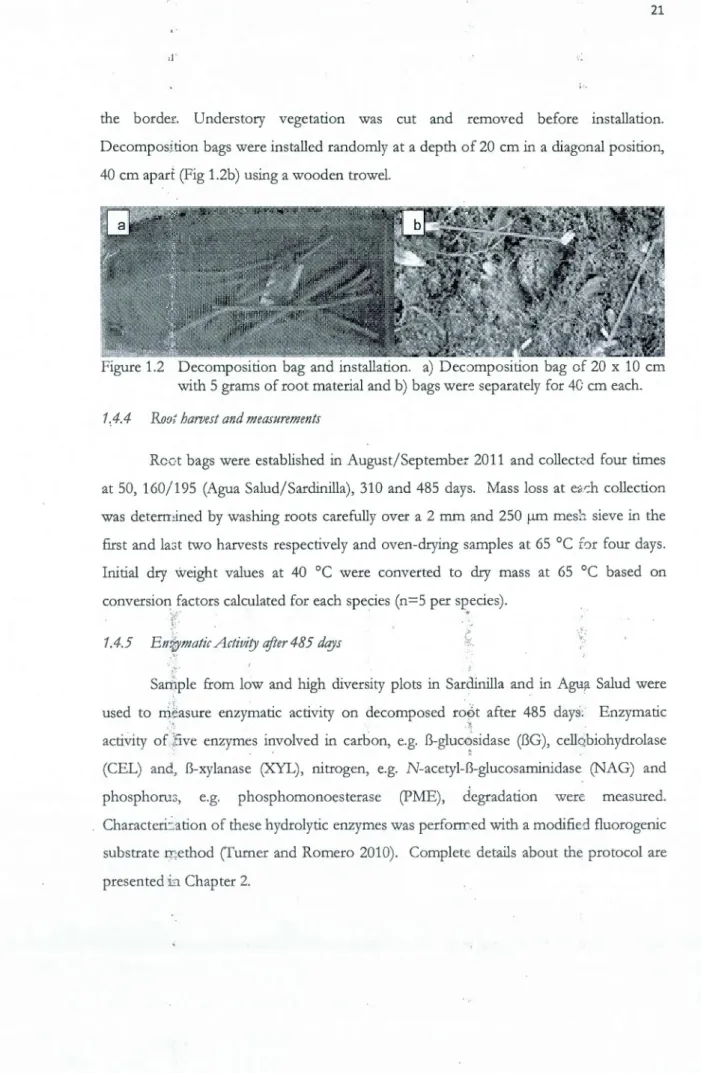
Decompoo.~tion bags (10 cm x 20 cm) were made using a 2 mm nylon n:·::sh to permit
entry of m~::so-fauna (Fig 1.2a). A total of 5 g dry weight (40 °C) of mate::Yal was placed carefully in the bags and closed by a manual heat sealer. Aluminum iden'ification tags were placed inside and outside the decomposition bag. For species mixtures, equal proportiom of root litter from each species were used. ,The decomposition bags were
the border. Understory vegetation was eut and removed before installation.
Decomposi.tion bags were installed randomly at a depth of 20 cm in a diagonal position, 40 cm apart (Fig 1.2b) using a wooden trowel.
Figure 1.2 Decomposition bag and installation. a) Decomposition bag of 20 x 10 cm with 5 grams of root material and b) bags wer~ separately for 4G cm each. 1.4.4 Rou( harvest and measurements
Reet bags were established in August/September 2011 and collected four times
at 50, 160/195 (Agua Salud/Sardinilla), 310 and 485 days. Mass loss at e;;.sh collection
was deterŒined by washing roots carefully over a 2 mm and 250 f.lm mesl-~ sieve in the ftrst and la:;t two harvests respectively and oven-drying samples at 65 °C f0r four days.
Initial dry weight values at 40 °C were converted to dry mass at 65 °C based on conversio~ factors calculated for each species (n=S per species).
•,;· w
1. 4.5 En:tymatic Attiviry cifter 485 dqys
Sample from low and high diversity plots in Sardinilla and in Aguf! Salud were
~ . .
used to rriiasure enzymatic activity on decomposed
r~ot
after 485 days. Enzymatic"'
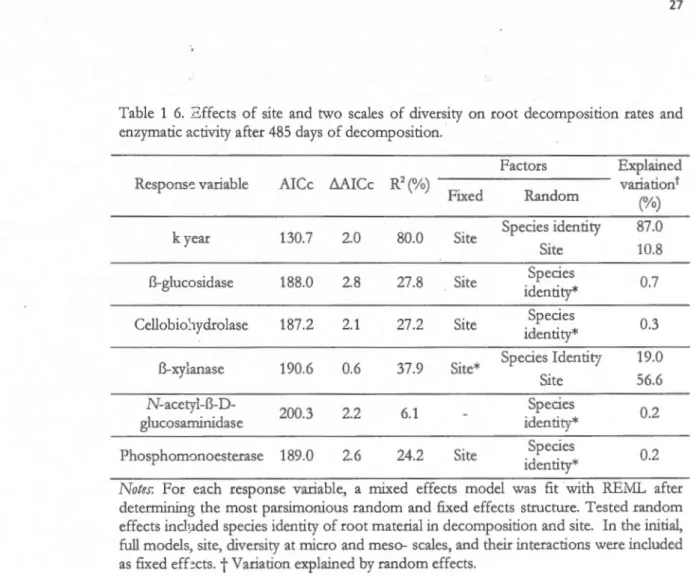
actiVity o($ve enzymes involved in carbon, e.g. 13-gluco,sidase (13G), cellc,:biohydrolase (CEL) and, 13-J\.)'lanase (XYL), nitrogen, e.g. N~acetyl-13-glucosarninidase (NAG) and phosphorU3, e.g. phosphomonoesterase (PME), degradation were measured.
Characteri:.ation of these hydrolytic enzymes was perforrred with a modified fluorogenic
substrate rr;ethod (Turner and Romero 2010). Complete details about the protocol are