O
pen
A
rchive
T
OULOUSE
A
rchive
O
uverte (
OATAO
)
OATAO is an open access repository that collects the work of Toulouse researchers and
makes it freely available over the web where possible.
This is an author-deposited version published in :
http://oatao.univ-toulouse.fr/
Eprints ID : 12657
To link to this article : DOI :10.1016/j.future.2013.07.010
URL :
http://dx.doi.org/10.1016/j.future.2013.07.010
To cite this version : Tsafack Chetsa, Ghislain Landry and Lefevre,
Laurent and Pierson, Jean-Marc and Stolf, Patricia and Da Costa,
Georges
Exploiting performance counters to predict and improve
energy performance of HPC systems
. (2014) Future Generation
Computer Systems, vol. 36. pp. 287-298. ISSN 0167-739X
Any correspondance concerning this service should be sent to the repository
administrator:
[email protected]
Exploiting performance counters to predict and improve energy
performance of HPC systems
G.L. Tsafack Chetsa
a,b,∗,
L. Lefèvre
a,
J.M. Pierson
b,
P. Stolf
b,
G. Da Costa
baINRIA - Avalon, Ecole Normale Supérieure de Lyon, University of Lyon, France bIRIT, University of Toulouse, France
h i g h l i g h t s
• We present two generic approaches for tracking high performance computing systems’ behaviour.
• We demonstrate that energy performance can be improved without a priori knowledge of application.
• We demonstrate that HPC systems can benefit from more than CPU frequency scaling.
• We introduce an approach to estimating the energy consumption of HPC applications.
a b s t r a c t
Hardware monitoring through performance counters is available on almost all modern processors. Al-though these counters are originally designed for performance tuning, they have also been used for eval-uating power consumption. We propose two approaches for modelling and understanding the behaviour of high performance computing (HPC) systems relying on hardware monitoring counters. We evaluate the effectiveness of our system modelling approach considering both optimizing the energy usage of HPC systems and predicting HPC applications’ energy consumption as target objectives. Although hardware monitoring counters are used for modelling the system, other methods – including partial phase recogni-tion and cross platform energy predicrecogni-tion – are used for energy optimizarecogni-tion and predicrecogni-tion. Experimental results for energy prediction demonstrate that we can accurately predict the peak energy consumption of an application on a target platform; whereas, results for energy optimization indicate that with no a priori knowledge of workloads sharing the platform we can save up to 24% of the overall HPC system’s energy consumption under benchmarks and real-life workloads.
1. Introduction
The increasing need for performance for the many computa-tional problems in science and engineering has taken high per-formance computing (HPC) systems to the set of indispensable tools in modern industries and scientific research. HPC systems de-liver tremendous raw performance for solving real-life problems. These problems include: turbulence, combustion, genomics, as-trophysics, geosciences, molecular dynamics, homeland security, imaging and biomedicine, etc. HPC systems consume a large amount of electrical power, almost all of which is converted in heat requiring cooling. For example, Tianhe-1A consumes 4.04 MW of
∗Corresponding author at: INRIA - Avalon, Ecole Normale Supérieure de Lyon,
University of Lyon, France. Tel.: +33 670403550.
E-mail addresses:[email protected],
[email protected](G.L. Tsafack Chetsa).
electricity [1]; a simple calculation at $0.10/KWh yields a power-ing and coolpower-ing cost of about $3.5 million per year, which is signif-icant. Beyond the operating cost, some data-centres are also being limited by the peak power that electric facilities can provide. Con-sequently, it is necessary to reduce their power consumption; how-ever, this must not result in significant performance degradation. The term significant performance degradation is a relative term; nevertheless, up to 10% performance degradation is often accept-able. Note: throughout this paper, (i) an HPC system is considered as a set of computing and storage nodes excluding network equip-ments such as routers and switches; whereas, (ii) the term ‘‘sys-tem’’ designates a single node of the HPC system.
The importance of power efficiency in HPC systems has at-tracted enormous attention from both the industrial and the research communities. This is evidenced by the multitude of tech-niques aiming to understand and reduce the energy consumption of HPC systems. These techniques generally break into hardware and software approaches. Hardware approaches led by
manufac-turers focus on designing power aware hardware while their soft-ware counterpart focus on designing protocols and/or services capable of adapting HPC subsystems – including processor, mem-ory, communications, and storage subsystems – to meet applica-tions’ requirements.
Embedded hardware event counters of modern micropro-cessors, or simply hardware performance/monitoring counters, monitor the occurrence of hardware events in a microproces-sor with almost no performance penalty. These counters in-clude: the number of cycles, instructions, cache references and hits/misses, main memory writebacks and references, and branch miss-predictions counts. Although originally designed for perfor-mance tuning/adaptation, hardware perforperfor-mance counters have been used in the past for estimating the power usage (or the en-ergy consumption) of both HPC and desktop applications.
Performance tuning mechanisms rely on hardware perfor-mance counters along with application’s specific metrics (Message Passing Interface – MPI – calls in an MPI program for example) to adapt the system accordingly. This can be accomplished by insert-ing specific code segments in the source program (often referred to as code instrumentation) or by tracking application’s specific rou-tine calls at runtime.
Adapting the processor’s frequency to meet workloads’ de-mands is the commonly used hardware adaptation approach for reducing energy consumption. This is eased by the use of Dynamic Voltage and Frequency Scaling (DVFS) [2,3] technology available on modern processors. A fundamental requirement for such adap-tation is defining how DVFS control should be performed. In other words, the application designer must decide when and for how long the processor should be kept in a given performance state (P-state). In the performance optimization jargon, a specific part of the program which is defined to run at a given performance state is referred to as region or phase. Although these approaches for adapting HPC systems are efficient, they may fail for two main rea-sons.
1. HPC systems are often shared (the whole infrastructure is not dedicated to a single workload) by multiple workloads each having its own characteristics, in which case optimizing the energy performance considering some applications is likely to impact the performance of others.
2. In spite of the fact that HPC codes are actively maintained their increasing complexity makes code instrumentation impracti-cal and sometimes require extensive knowledge: a platform provider can dedicate some engineers to ‘‘code instrumenta-tion’’ or ask the programmer to write programs with these con-straints in mind, which not only being unacceptable is not likely to happen.
An effective way to overcome these limitations is to optimize energy performance of the HPC system from the infrastructure stand point. This implies understanding the behaviour of the HPC system rather than that of individual applications sharing the platform.
In this paper, we introduce two complementary general pur-pose approaches for modelling and understanding the runtime be-haviours of HPC systems. These approaches rely upon hardware performance counters and break into on-line and off-line depend-ing on their use. Information gathered from the off-line approach can be of benefit to its on-line counterpart, which makes them complementary. The off-line approach which we refer to as ‘‘DNA-like description’’ of the system attempts to depict the HPC system as a graph in which each state describes its behaviour (that of the HPC system) over a time interval [4].
The on-line approach which we refer to as ‘‘Execution vectors based system behaviour tracking’’ detects and characterizes the runtime behaviour of the HPC system at runtime [5]. To accom-plish this, phase changes are detected in the execution pattern of
individual nodes in the HPC system; detected phases are character-ized afterwards. Given that HPC workloads generally fall into com-pute intensive, memory intensive, and communication intensive, we define three types of behaviours including: compute intensive, memory intensive, and communication intensive. Communication intensive behaviour can further be divided into network transmit and receive.
To demonstrate the effectiveness of HPC system’s behaviour tracking approaches just mentioned, we explore several use cases. These use cases show how the energy performance of an applica-tion can be predicted using the DNA-like descripapplica-tion on one the hand and how energy performance of an HPC system can be im-proved through behavioural characterization on the other hand. Our work differs from the state of the art in many ways: we ad-dress the power/energy consumption issue of HPC systems consid-ering all HPC subsystems (processor, memory, disk and network). In addition, our system modelling approaches does not rely on any application specific metric, i.e., our approaches do not require any a priori knowledge of applications running on the system.
The major contributions of this work are the following: 1. We present two different (on-line and off-line) approaches
en-abling a fine-grained control of HPC systems and a better un-derstanding of application’s energy performance. Their strength resides in the fact that they do not need any a priori knowledge of applications/workloads sharing the HPC infrastructure. 2. We present an approach for optimizing/improving energy
per-formance of HPC systems considering HPC subsystems, includ-ing the processor, memory, disk and network.
3. We introduce the concepts of cross platform energy prediction and partial phase recognition. Cross platform energy prediction can help choosing the appropriate execution platform for an ap-plication; whereas partial phase recognition is an alternative to phase prediction, it has the advantage of not being application or architecture specific.
The remainder of this article is organized as follows. Sec-tion2gives account of previous work. Our system’s modelling ap-proaches are presented in Section3. Section4presents several use cases of our modelling approaches. Implementation of the two use cases along with experimental results is discussed in Section5. Fi-nally, Section6concludes and gives future directions.
2. Related work
A large body of work investigates the use of hardware perfor-mance counters for modelling the power consumption of applica-tions ranging form desktop to HPC applicaapplica-tions. In this section, we first detail work using hardware performance counters for estimat-ing the power or energy consumption of individual applications. We next present several work addressing HPC systems’ energy per-formance and their limitations.
2.1. Power/energy estimation using hardware performance counters
In studies such as [6–12] efforts have been devoted to model or estimate the power usage of individual applications or workloads. These studies monitor the use of system’s component (in partic-ular the processor and memory) during the workload execution via hardware performance counters and correlate them with the power consumed by the system when running that workload to derive a power model. Kadayif et al. [7] propose a model for esti-mating the energy consumption of the UltraSPARC CPU [13]. Au-thors estimate the UltraSPARC CPU memory energy consumption considering the following performance counters: Data cache read hits, Data cache read references, Data cache write hits, Data cache
Table 1
Performance events selected to estimate CPU and memory power consumption for Intel PXA255 processor.
CPU performance events Memory performance events Instructions executed Instruction fetch misses Data dependencies Data dependencies Instruction cache misses
TLB misses
write references, Instructions cache hits, Instructions cache refer-ences, Extended cache misses with writebacks. They claim their energy model to be 2.4% accurate as compared to circuit level sim-ulation. Similarly, Contreras et al. [8] present a first order linear power estimation model that uses hardware performance counters to estimate run-time CPU and memory power consumption of the Intel PXA255 [14]. According to the authors, the proposed model exhibits an average estimation error of 4%. During their analyses, authors considered events listed in the first column ofTable 1for the CPU and those listed in the second column of that very table for the memory.
Energy consumption of the high-performance processor AMD Phenom is estimated in [9]. In their work, authors categorize AMD Phenom performance counters into four buckets: FP Units, Memory, Stalls, and Instruction Retired and consider perfor-mance events which express best their power consumption. These performance events include: L2_cache_miss:all, Retire_uops, Re-tire_mmx_and_fp_instruction:all, and Dispatch_stalls.
More recently, Da Costa et al. [6] have presented a methodology of measurement of the energy consumption of a single process application running on a standard PC. They defined a set of per process and system-wide variables to demonstrate their accuracy in measuring the energy consumption of a given process using multivariate regression.
To summarize, the above researches tell us that performance counters can accurately estimate the power usage of an applica-tion, however it is worthwhile to mention that the accuracy of a power/energy model depends on the workload. In other words, a power model designed for estimating the power consumption of a compute-bound workload may not fit well with a memory-bound workload. This is obvious for communication intensive workloads.
2.2. Energy reduction approaches for HPC systems
In the past few years, HPC systems have witnessed the emer-gence of energy consumption reduction techniques from the hard-ware level to the softhard-ware level. At the hardhard-ware level, the majority of Information Technology (IT) equipment vendors works either from bottom up, by using the more efficient components in their equipments, and/or by providing their equipments with technolo-gies that can be leveraged to reduce energy consumption of HPC subsystems – such as processor, network, memory, and I/O – dur-ing their operation. For example, the majority of modern proces-sors is provided with Dynamic Resource Sleeping (DRS) which makes components hibernate to save energy and then wakes them on demand. Although major progress has been made, improve-ments in hardware solutions to energy reduction problem have been slow, due to the high cost of designing equipments with energy-saving technologies and the increasing demand of raw per-formance. Our work takes advantage of hardware technologies to reduce HPC systems’ energy consumption.
Unlike hardware approaches, software solutions for reducing HPC systems’ energy usage have received extensive attention over time. Rountree et al. [15] use node imbalance to reduce the over-all energy consumption of a parover-allel application in an HPC system. They track successive MPI communication calls to divide the ap-plication into tasks composed of a communication portion and a
computation portion. A slack occurs when a processor is waiting for data to arrive during the execution of a task. This leaves the pos-sibility to slow the processor with almost no impact on the overall execution time of the application. Rountree et al. developed Adagio which tracks task execution slacks and computes the appropriate frequency at which it should run. Although the first instance of a task is always run at the highest frequency, further instances of the same task are executed at the frequency that was computed after it is first seen. Authors of [16] propose a tool called Jitter, which de-tects slack periods in performance to performance inter-node im-balance and uses DVFS to adjust the CPU frequency accordingly.
Our approach differs from that implemented in Adagio in that our fine-grained data collection offers the possibility to differenti-ate not only compute-intensive and communication-intensive ex-ecution portions (these portions are referred to as phases/regions) but also memory-intensive phases. Memory-intensive phases can be run on a slower core without significant performance penalty [17].
Isci et al. [18] and Choi et al. [19] use on-line techniques to detect applications execution phases, characterize them and set the appropriate CPU frequency accordingly. They rely on hardware monitoring counters to compute runtime statistics such as cache hit/miss ratio, memory access counts, retired instructions counts, etc. which are then used for phase detection and characterization. Policies developed in [18,19] tend to be designed for single task environments. We overcome that limitation by considering each node of the cluster as a black box, which means that we do not focus on any applications, but instead on the platform. The flexi-bility provided by this assumption enables us to track not appli-cations/workloads execution phases, but node’s execution phases. Our work also differs from previous works in that we use partial phase recognition instead of phase prediction, which is not applica-tion specific and does not require multiple execuapplica-tions of the same application. On-line recognition of communication phases in MPI application was investigated by Lim et al. [20]. Once a communica-tion phase is recognized, authors apply CPU DVFS to save energy. They intercept and record the sequence of MPI calls during pro-gram execution and consider a segment of propro-gram code to be re-ducible if there are high concentrated MPI calls or if an MPI call is long enough. The CPU is then set to run at the appropriate fre-quency when the reducible region is recognized again.
Our work differs from those above in two major ways. First, our phase detection approach does not rely on a specific HPC subsys-tem or MPI communication calls. Second, unlike previous research efforts, our model goes beyond the processor, since it also takes advantage of power saving capabilities available on all HPC subsys-tems. For example slowing down networks interfaces using Adap-tive Link Rate, putting disks in low power-mode, and switching off memory banks are power saving schemes which are not directly linked to the processor.
3. Understanding HPC systems’ behaviour: on-line and off-line models
In this section, we present two effective approaches for tracking HPC systems’ behaviours. The first approach which we refer to as ‘‘DNA-like representation’’ of the HPC system attempts to describe an HPC system as a state graph in which each state represents its behaviour over a time interval; whereas the second approach per-forms on-line detection and characterization of execution phases of an HPC system at runtime. As mentioned earlier, we assume that an HPC system is a set of computing and storage nodes and will use the term ‘‘system’’ to designate a single node of the HPC system. Network equipments such as routers and switches are not taken into account because of their nearly constant power consumption. In the rest of this paper, unless otherwise expressly stated, we use
the term ‘‘sensors’’ to designate performance counters along with network bytes sent/received counts and disk read/write counts. Sensors related to hardware performance counters provide insight into the processor and memory activities. Likewise, disk and net-work related sensors provide insight into disk and netnet-work activi-ties respectively.
3.1. DNA-like system modelling
The DNA-like system modelling models each node of an HPC system as a graph whose states represent the execution behaviour of the system over fixed length time intervals. We made the as-sumption that initial and final states of the graph are states or con-figuration in which the system is idle. A transition from a state S1
to a state S2of the graph is weighted by the conditional probability
that the system goes from S1to S2. We refer to successive states
through which a system goes throughout its life cycle as its ‘‘DNA-like’’ structure. Since not all states of the graph have the same be-haviour, the DNA-like structure of a system can be thought of as a succession of behaviours through which the system went over time. From this, we define the terms ‘‘letter’’ and ‘‘system descrip-tion alphabet’’ as follows: a letter or phase is defined as a behaviour in the DNA-like structure of a system (a state of the graph mod-elling that system); whereas, the system description alphabet is the set of possible behaviours.
With the description just given, the runtime behaviour of a system can roughly be represented by a sequence of the form
Li
. . .
Xj. . .
Lk; where the Liare elements of the system descriptionalphabet. It is possible that some states do not appear in the system description alphabet, those are represented by the Xjnotation.
A letter is modelled as a column vector of sensors. Details regarding their construction are provided later in this paper. The choice of sensors for representing letters is constrained by the fact that a letter must provide information about the computational behaviour of the workload (is it memory intensive, processor intensive or communication intensive?) and its energy/power consumption.
3.1.1. Letter modelling and representation
The literature corroborates our observation that sensors relevant to power consumption estimation model depend upon workloads/applications being executed (see Section2for details). Considering that a finite set of sensors is used to estimate the power consumption of a given category of workloads; this suggest that changes in the set of sensors relevant to power consumption estimation over a time interval T reflect changes in the system’s behaviour over that very time interval.
Relying on the above assumption, we propose Algorithm 1 which partitions the runtime of a system into different behaviours according to changes in the set of sensors relevant to power esti-mation. For the selection of relevant sensors we use this very sim-ple power model Power
∼
P
ni=1α
i∗
Ciin whichα
iand Ciare modelcoefficients and sensors respectively. We conduct a multivariable linear regression to obtain coefficients
α
iand retain sensors Cjex-hibiting a 5% level of statistical significance to power consumption estimation given the previous power model. For the sake of sim-plicity, we limit these sensors to four (i.e., 4 sensors for represent-ing a letter).
Once letters are defined, we use the following formalism for their encoding: Let us assign each sensor to a four-bit aggregation or half byte. Our quadruplet (each letter is a vector of four sensors) is therefore of the form
(
X1,
X2,
X3,
X4); where each X
ivalues is ahalf byte. Now, deleting commas in between the Xigives a
sixteen-bit aggregation which converted into decimal is an unsigned inte-ger. The unsigned integer obtained from the above transformation is then the final representation of a letter.
Data: A: a set of units, where a unit is composed of values of
sensors collected at a given time; units are sampled on a per second basis. Note that they are arranged in their order of occurrence in time.
Result: P
= {
ti} where tiare points in time at which changesin the behaviour of the system were detected.
Initialization: consider a set S made up of k successive units
along the execution time-line; let us denote by Supperthe
time at which the last unit of S was sampled. k is chosen such that k
>
p+
1, where p is the number of sensors.Add the time at which the first unit of S was sampled to P Compute the set R0of sensors relevant to power
consumption estimation using the dataset composed of units in S
while units available do
Add k units to S and update Supperto Supper
+
kCompute the set Rtof relevant sensors from S
if Rt−1
6=
RtthenFind the point in time j
∈ [
Supper−
k,
Supper]
such thatthe set of relevant sensors R computed from the set whose last unit was sampled at time j is the same as
Rt−1
Go to Initialization
Algorithm 1: Algorithm to detect application phases.
3.1.2. Example
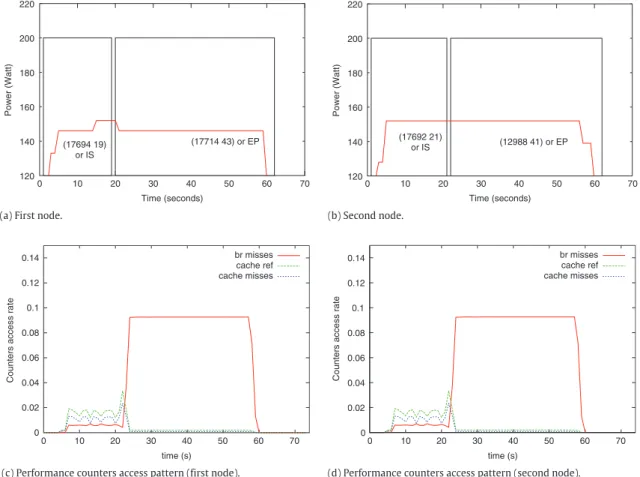
This example investigates how close to reality is our approach for partitioning a system’s runtime into different computational behaviours (or simply phases). To accomplish this, we successively run two applications IS and EP from the NAS Parallel Benchmark (NPB) suite [21]. These applications are opposite from their compu-tational stand point in the sense that IS is communication intensive whereas EP is mainly computing. Data collected during their exe-cution are used as input to the algorithm.Fig. 1(b) and (a) (where the curve gives the variation of the power consumption of the sys-tem over time and rectangles delimit detected phase) indicates that using a simple power model it is possible to detect phases the system went through. The couple of integers appearing in each rectangle on the figure gives for each phase the corresponding let-ter coded as an unsigned integer and the amount of time the sys-tem spent in that particular phase. For this example, the DNA-like structure of each node is straightforward, for the first node, it is:
Idle(17694 19)(17714 43)Idle.
3.2. Execution vectors based system behaviour tracking
It can be seen fromFig. 1(c) and (d) – where the y-axis repre-sents the access rate of performance counters and the x-axis the execution time-line – that the access pattern of hardware perfor-mance counters or sensors in general strongly reflects changes in the behaviour of the application/system. We speak of sensors’ ac-cess rate because they are normalized with respect to the number of cycles. From the observation just made, the concept of execu-tion vector which is similar to power vector (PV) [22] seems ade-quate for phase detection. An execution vector (EV) is defined as a column vector whose entries are system’s metrics, including hard-ware performance counters, network byte sent/received and disk read/write counts. To remain consistent with previous sections, we shall refer to these system metrics as sensors.
The sampling rate corresponding to the time interval after which sensors’ values are read depends on the granularity. While a larger sampling rate may hide information regarding the system’s behaviour, a smaller sampling rate may incur a non negligible overhead. In this paper, we use a sampling rate of one second and
Power (Watt) Time (seconds) (17694 19) or IS (17714 43) or EP 120 140 160 180 200 220 10 20 30 40 50 60 70 0 Time (seconds) (17692 21) or IS (12988 41) or EP Power (Watt) 120 140 160 180 200 220 10 20 30 40 50 60 70 0
(a) First node. (b) Second node.
Counters access rate
time (s) br misses cache ref cache misses 0 0.02 0.04 0.06 0.08 0.1 0.12 0.14 0 10 20 30 40 50 60 70 0 0.02 0.04 0.06 0.08 0.1 0.12 0.14
Counters access rate
br misses cache ref cache misses
time (s)
0 10 20 30 40 50 60 70
(c) Performance counters access pattern (first node). (d) Performance counters access pattern (second node).
Fig. 1. Dividing NAS benchmarks IS and EP ran successively into two different computational behaviours using their power usage and sensors.
further normalize sensors with respect to the number of cycles to get their access rate.
We define the resemblance or similarity metric between two EVs as the Manhattan distance between them. The Manhattan dis-tance suits the case since it weighs more heavily differences.
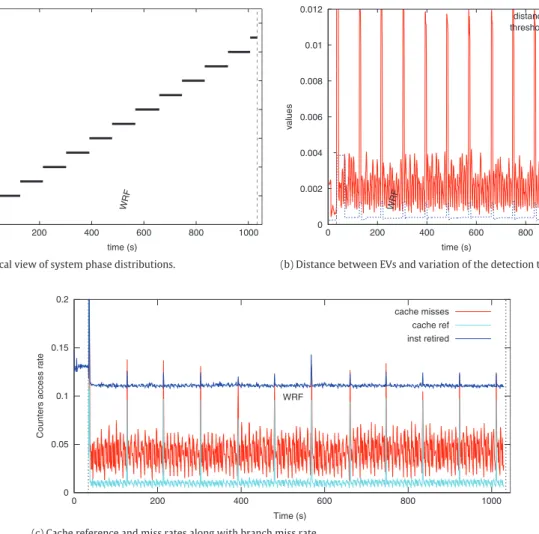
A phase change is detected when the Manhattan distance between consecutive EVs exceeds a preset threshold. The thresh-old is fixed in the sense that it is always the same percentage – we refer to that percentage as the detection threshold – of the maximum distance between consecutive EVs (e.g., if the detection threshold is X %, then the threshold is X % of the maximum distance between consecutive EVs). However, the maximum distance be-tween consecutive EVs is zeroed once a phase change is detected. So, technically, the threshold varies throughout the systems life cy-cle. The maximum existing distance between consecutive EVs is continuously updated until a phase change is detected where it is zeroed. The idea behind zeroing the maximum existing distance when a phase change occurs is to allow detecting phase changes when changing from a phase where distances between consecu-tive EVs are big to a phase where they are not and vice versa. For example, given a 10% similarity threshold, two consecutive EVs be-long to the same group if the Manhattan distance between them is less than 10% of the maximum existing distance between all con-secutive execution vectors.Fig. 2(b) shows the distance between consecutive execution vectors and the variation of the threshold along the execution time-line when the system was running the Advance Research Weather Research and Forecasting (WRF-ARW) model [23]. A graphical view of our phase detection mechanism is provided inFig. 2(a), where dashed vertical lines indicate the start and end times of WRF-ARW. The left extremity of horizontal solid lines indicates the point (in the execution time-line) at which phase changes are detected and their length indicate the duration
or length of corresponding phases. The x-axis represents the execu-tion time-line and the y-axis represents IDs associated to detected phases. Note that IDs of phases are non zero integers ordered by their appearance order. It can be seen fromFig. 2(c) that detected phases are corroborated by the access pattern of sensors.
The key motivation behind phase tracking is the use of charac-teristics of known phases for optimizing similar phases. Depend-ing on the needs, optimizations aim to reduce the execution time of workloads, and/or their energy consumption. An effective phase characterization is therefore needed. To accomplish this, once a phase is detected, we apply principal component analyses (PCA) on the dataset composed of EVs pertaining to that phase. We next select five sensors among those contributing the least to the first principal axis of PCA for phase characterization. This choice is moti-vated by the assumption that information regarding what the sys-tem did not do during a phase is captured by sensors contributing the least to the first principal axis of PCA. These 5 sensors serve as the characteristic of the phase. Since data collected during a phase can be too large for efficient representation and comparison in hardware, we summarize a phase by the EV at the centroid of the group made up of EVs sampled during that phase. We refer to the EV summarizing a phase as the reference vector of that phase.
3.2.1. Partial phase recognition
Phase identification is an interesting property of phase detec-tion mechanisms, since it allows reuse of system reconfiguradetec-tion information for reoccurring phases. However, a phase cannot be identified with a known phase before its completion. The literature suggests using phase prediction, which predicts the next phase of an application before it gets started; however, it might not work very well when you do not have any a priori information about ap-plications sharing your platform. Therefore, instead of identifying
phase id time (s) 0 2 4 6 8 10 12 14 0 200 400 600 800 1000 WRF values time (s) 0 0.002 0.004 0.006 0.008 0.01 0.012 200 400 600 800 0 1000 distance threshold WRF
(a) Graphical view of system phase distributions. (b) Distance between EVs and variation of the detection threshold.
WRF Counters access r ate Time (s) cache misses cache ref inst retired 0 0.05 0.1 0.15 0.2 0 200 400 600 800 1000
(c) Cache reference and miss rates along with branch miss rate.
Fig. 2. Phase changes detection using the similarity between consecutive execution vector as similarity metric.
a whole phase with a known, we propose to only identify a part of that phase with the known phase and extrapolate the result to the remaining part. We refer to that process as partial phase
recogni-tion; further details are provided in the next paragraph.
Partial phase recognition actually consists of identifying an on-going phase (the phase has started and is not yet finished) Piwith
a known phase Pjonly considering the already executed part of Pi. The already executed part of Pi expressed as a percentage of
the length (duration) of Pjis referred to as the recognition
thresh-old RT . Thus, with a RT % recognition threshthresh-old, and assuming that the reference vector of Pjis EVPj and that its length is mj, an
on-going phase Piis identified with Pjif the Manhattan distance
be-tween EVPjand each EV pertaining to the already executed part of
Pi(corresponding in length to RT % of mj) are within the
similar-ity threshold ST . The pseudo algorithm below summarizes partial phase recognition.
•
let Pjbe a completed phase, EVPjits reference vector, and mjitsduration
•
Piis partially recognized as Pjif–
∀v
EV in the already executed part of Pi(that is, EVs sampledbetween the time stamp corresponding to the start time of Pi
and the time stamp start time of Pi
+
RT % of mj), the distancebetween
v
and EVPjis within threshold.4. Model use cases: system adaptation and energy consumption prediction
Understanding the different behaviours of a high performance computing (HPC) system goes through throughout its life cycle can
lead to a multitude of optimization opportunities. In this section, we shall investigate how one can leverage those behaviours for re-ducing the energy consumption of its infrastructure. Platform as a service becoming more and more attractive users often face the dilemma of choosing between multiple platforms for their appli-cations. This section also investigates how users can determine the least energy consuming platform for their applications. In the fol-lowing, we first show how our DNA-like modelling approach can be used for predicting the energy consumption of an application on a given platform. We next use our phase tracking methodology for reducing the energy consumption of applications without a priori knowledge.
4.1. Use case 1: cross platform energy prediction
The main motivation behind this use case is that users often have more than one candidate platform for running their jobs, in which case choosing the least energy consuming platform may be beneficial both for them and the platform provider. For simplicity, we assume that the application whose energy consumption is being predicted is the only application running on the platform under consideration. In other words, the DNA-like structure of the system at hand is that of the application.
The prediction model implicitly uses two sets of data, one from a reference platform provided by the DNA-like structure of the application, and one from a target platform which is the platform on which we want to estimate the overall energy consumption of the application. The aforementioned reference platform is the platform on which the application was first run and where its DNA-like structure was built. In most cases, the reference platform will
be the platform on which the application was tested (nearly all the information – including the application’s energy consumption – in regard to the reference platform is known).
Knowing the DNA-like structure of an application, one can eas-ily identify applications with the same computational require-ments. We accomplish this by comparing the DNA-like structure of the ongoing application to known DNA-like structures. A match is found when the already executed part of the ongoing application matches with a given percentage of the known DNA-like structure. Let us denote Etarthe energy consumed by the already executed
part of the application of which we want to estimate the energy consumption and Eref the energy consumed by the corresponding
part of the application whose DNA-like matches with the already executed part of the application at hand (the application that we want to estimate the energy consumption). For example, consid-ering an application that lasts 60 min on its reference platform, let us assume that Etarrepresents the energy consumed by the same
application on the target platform after 10 min run; therefore, Eref
represents the proportion of energy consumed by the application on the reference platform during the first 10 min of its execution. Denoted as Erel, the relative energy consumption between the two
platforms is given by the following equation:
Erel
=
Etar Eref.
(1)With the above relative energy, the estimated energy consump-tion of the applicaconsump-tion on the target platform is given by Eq.(2):
Eest
=
Z
X % 0 P(
t)
i,tardt+
Erel∗
Z
end X % P′(
t)
j,refdt.
(2)Where Eestis the estimated energy consumption on the target
platform; Erelthe relative energy consumption between the
tar-get platform and the reference platform. In the above equation,
R
X %0 P
(
t)
i,tardt represents the energy consumed by the applicationbefore a match is found with a known DNA-like structure. Either measured or estimated, P(t
)
i,tar is the instantaneous powerus-age of the application on the target platform. Likewise, P′
(
t)
j,ref is
the instantaneous power usage of the application on the reference platform and can be obtained from its DNA-like structure. In cases where the power consumption may radically change after the X % threshold, if the change in power consumption does not imply any change in the set of sensors used to estimate the power consump-tion, then we still assume it is the same application otherwise we attempt to find another match.
We define the estimation accuracy as the ratio between esti-mated and measured energy on the target platform, i.e,
Accuracy
=
Eest_tarEtar
(3) where Eest_tar is the estimated energy consumption on the target
platform.
Although comparing two DNA-like structures boils down to comparing two strings, the overhead associated with matching the DNA-like structure of a running application with previously seen known applications is proportional to the size of already known applications times the size of the DNA-like structure of the running application. We simplify this with the assumption that our profile database only contains one application which is that of the applica-tion of which we want to predict the energy consumpapplica-tion. We also assume that the application follow a very simple pattern which starts with an initialization phase and finishes which a finalization phase. Between the initialization and the finalization phases, there are some iterative computations and optional communications. Finally, assuming that the instantaneous power usage of the ap-plication is approximately the same during each of its iterations;
meaning that the energy consumed by the application in each it-eration throughout its life cycle is nearly the same, Eq.(2)can be simplified to Eq.(4); where Einit represents the energy consumed
by the application on the target platform during its initialization phase; Eref−initis the energy consumed by the application on the
reference platform from the end of the initialization phase to the end of its whole execution; and Eref−exeis the measured energy
con-sumption (resulting from complete execution) of the application on the reference platform.
Eest
=
Einit+
Erel∗ (
Eref−exe−
Eref−init).
(4) 4.2. Use case 2: optimizing energy performance of HPC systemsThe methodology described in Section3.2permits online de-tection and characterization of different runtime behaviours of the system. We use the coupling with partial phase recognition to guide on-the-fly system adaptation considering three HPC subsys-tems: processor, disk and network interconnect. The power con-sumption of these HPC subsystems along with that of the memory is about 55% [24] of the total power consumption of a typical HPC system. For the processor, we define three computational levels ac-cording to the characteristics of the workload:
•
High or CPU-bound: the CPU-bound computational level corre-sponds to the maximum available CPU frequency, and is used for CPU-bound workloads.•
Medium or memory-bound: corresponds to an average in be-tween the maximum and the minimum available frequencies; it is mainly used for memory-bound workloads.•
Low: the system is in the low computational level when the CPU frequency is set to the minimum available.For the disk, we define two states: active and sleep; where active includes both the disk’s active and standby modes. Finally, for the network interconnect we define two data transfer speeds:
•
The communication-intensive speed: corresponds to the high-est available transfer rate of the network card.•
Low-communication speed: where the speed of the network interconnect is set to the lowest speed.As mentioned earlier in this paper, principal component anal-ysis (PCA) is applied to vectors belonging to any newly created phase for selecting five sensors which are used as phase charac-teristics. These characteristics are translated into system adapta-tion as detailed inTable 2. Let us comment the first row of that table. Workloads/applications with frequent cache references and misses are likely to be memory bound. In our case, having these sensors (cache_reference and cache_misses) selected from PCA in-dicates that the workload is not memory bound. If in addition that workload does not issue a high I/O rate (presence of I/O related sensors in the first column), then we assume that it is CPU-bound; consequently, the frequency of the processor can be scaled to its maximum, the disk sent to sleep and the speed of the interconnect scaled down. For the second row ofTable 2, the characteristics do not include any I/O related sensor, this implies that the system was running and I/O intensive workload; thus, the processor’s speed can be set to its minimum. Note in passing that changing the disk’s state from sleep to active does not appear inTable 2, this is because the disk automatically enters the active state when it is accessed.
5. Experimentation and validation
5.1. Evaluation for energy consumption prediction
We evaluate our energy estimation model considering two workloads: the first workload (workload_1) iteratively computes the inverse of a 10×10 matrix and copies a large file from a remote repository; the second workload is GeneHunter a real life program for linkage analysis [25].
Table 2
Translation of phase characteristics into system adaptation (I/O related sensors includes network and disk activities). Sensors selected from PCA for phase characterization Decisions
Cache_references & cache_misses & I/O related sensors CPU frequency set to its maximum; spin down the disk; network speed scaled down
No I/O related sensors CPU frequency set to its lowest; network speed scaled up
Instructions & last level cache misses (llc) CPU frequency set to its minimum; network speed scaled up
Instructions or llc & I/O related sensors CPU frequency set to its average value; network speed scaled down; spin down the disk I/O related sensors (low computation and communication-intensive) CPU frequency set to its maximum; network speed scaled up
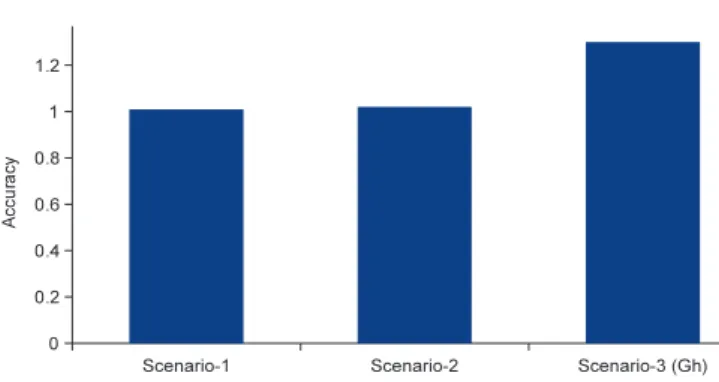
Fig. 3. Per scenario energy estimation accuracy.
We further consider three scenarios: (i) the first scenario es-timates the energy consumption of workload_1 on a node run-ning at 2.13 GHz using the same node runrun-ning at 1.6 GHz as the reference platform; (ii) scenario 2 still estimates the energy usage of workload_1, but uses a Dell Power Edge server and a Sun Fire V20z as reference and target platforms respectively; (iii) in the third and last scenario we attempt to estimate the en-ergy consumption of GeneHunter. For this specific case, our refer-ence platform is an Intel Xeon E5506 Quad-core with 8 cores and 12 GB of RAM while the target platform is an Intel Xeon X3440 with 4 cores and 16 GB of RAM. For all three scenarios, an empiric par-tial execution threshold of 20% is used. This means that, a match with an existing DNA-like structure DS is found if the already ex-ecuted part of our synthetic application matches with 20% of DS, i.e., assuming DS lasted 60 s, a match will be found if the already executed part of the synthetic application matches with the DNA-like structure describing the first 12 s of DS.
We compute for each scenario the expected energy consump-tion based on Eq.(4); results are summarized inFig. 3. We can see from those results that the accuracy is very good. Notice that the accuracy is higher because it is computed considering the aver-age energy consumption. We believe that overestimating the ac-tual energy consumption (asFig. 3indicates) is acceptable since the peak energy consumption is typically greater than the average. We can also notice that the accuracy for Gene Hunter is extremely high, this can be attributed to the fact that we were unable to divide the application into phases reflecting its actual behaviour.
5.2. Execution vectors based system behaviour tracking guided system adaptation
In this section, we analyse and discuss experimental results for our energy performance optimization use case.
5.2.1. Evaluation platform
Our evaluation support is a twenty five node cluster set up on the Grid5000 [26] French large scale experimental platform. Each node is an Intel Xeon X3440 with 4 cores and 16 GB of RAM. Avail-able frequency steps for each core are: 2.53, 2.40, 2.27, 2.13, 2.00, 1.87, 1.73, 1.60, 1.47, 1.33 and 1.20 GHz. In our experiments, low
computational level always sets the CPU frequency to the lowest available which is 1.20 GHz, whereas high and medium computa-tional levels set the CPU frequency to the highest available (2.53 GHz) and 2.00 GHz respectively. Each node uses its own hard drive which supports active, ready and standby states. InfiniBand-20G is used for interconnecting nodes. The Linux kernel 2.6.35 is in-stalled on each node where perf event is used to read the hard-ware monitoring counters. MPICH is used as MPI library. For the experiments, we use three benchmarks (LU, BT and SP) from NPB suite and two real-life applications: Molecular Dynamics Simula-tion (MDS) [27] and the Advance Research Weather Research and Forecasting (WRF-ARW) model [28,23]. WRF-ARW is a fully com-pressible conservative-form non-hydrostatic atmospheric model. It uses an explicit time-splitting integration technique to efficiently integrate the Euler equation. The classical Molecular Dynamics solves numerical Newton’s equations of motion for the interaction of the many particles system. We monitored each node’s power usage with one sample per second using a power distribution unit.
5.2.2. Results analyses and discussion
To evaluate our system adaptation policy, we consider 3 ba-sic configurations of the monitored cluster: the first configuration which we refer to as on-demand is the configuration in which the default Linux’s on-demand governor is enabled on all the nodes of the cluster; the second configuration called performance is the con-figuration in which the Linux’s performance governor is enabled on each node of the cluster; and finally the third configuration which we refer to as managed is the configuration in which our system adaptation policy is applied. We also consider two levels of system adaptation:
•
System adaptation level one: It corresponds to the situation in which only processor related optimization is made.•
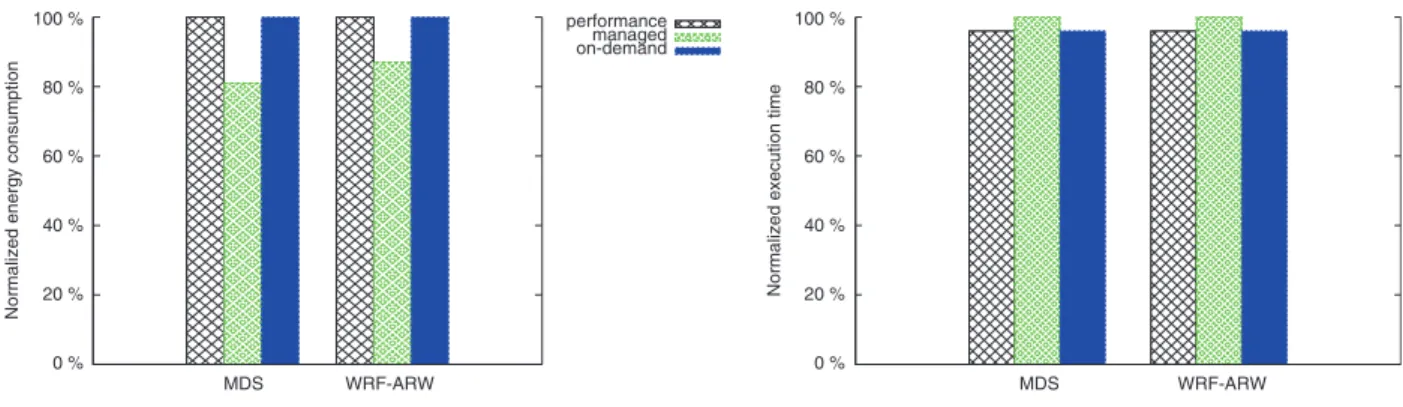
System adaptation level two: It embraces level one, and addi-tionally considers optimizing the interconnect and the disk. Results we present here are obtained using an empirical simi-larity threshold ST of 5%. The same goes for the recognition thresh-old RT which is set to 10%.(a) System adaptation level one: Processor’s only optimization: when an ongoing phase is identified with an existing phase, the characteristics of the existing phase are used to adapt the pro-cessor’s frequency accordingly. Diagrams ofFig. 4show the aver-age energy consumption (Fig. 4(a)) and execution time (Fig. 4(b)) of MDS and WRF-AWR under the three system’s configurations. These diagrams indicate that our management policy can save up to 19% of the total energy consumption with less than 4% perfor-mance loss.
Fig. 4(b) shows that on-demand and performance governors nearly achieve the same performance. This is because Linux’s on-demand governor do not lower the CPU frequency unless the system load decreases below a given threshold. Traces of CPU load under WRF-AWR for one node of our cluster are shown inFig. 5, where the y-axis represents the percentage of load. The plot in-dicates that the CPU load remains above 85%, in which case the
Normalized energy consumption 20 % 40 % 60 % 80 % 0 % 100 % MDS WRF-ARW performance managed on-demand 20 % 40 % 60 % 80 %
Normalized execution time
0 % 100 %
MDS WRF-ARW
(a) Average energy consumed by each application under different configurations.
(b) Average execution time of each application under different configurations.
Fig. 4. Phase tracking and partial recognition guided CPU optimization results.
core1 core2 core3 core4
load per core
time (s) 200 400 600 800 1000 1200 1400 0 1600 90 95 100 105
Fig. 5. Load traces for one of the nodes running WRF-AWR under the on-demand configuration.
MDS WRF-ARW
Normalized energy consumption
0 % 20 % 40 % 60 % 80 % 100 % performance managed on-demand MDS WRF-ARW
Normalized execution time
0 % 20 % 40 % 60 % 80 % 100 %
(a) Energy performance. (b) Performance (execution time).
Fig. 6. Phase tracking and partial recognition guided processor, disk and network interconnect optimization results: the chart shows average energy consumed by each
application under different configurations.
on-demand and performance governors almost have the same be-haviour. With processor’s only optimization, our management pol-icy differs from that of the Linux’s on-demand governor in that we do not use the system’s load as system adaptation metric, which enable us to consume less energy.
(b) System adaptation level two: Processor, disk and network
op-timization:Fig. 6presents the energy performance considering the processor, along with disk and network. These graphs indicate that considering the processor along with disk and network intercon-nect improves energy performance up to 24% with the same perfor-mance degradation as with processor’s only optimization. In other words, the disk and the network also contribute in improving en-ergy performance.
5.2.3. Threshold selection and energy performance
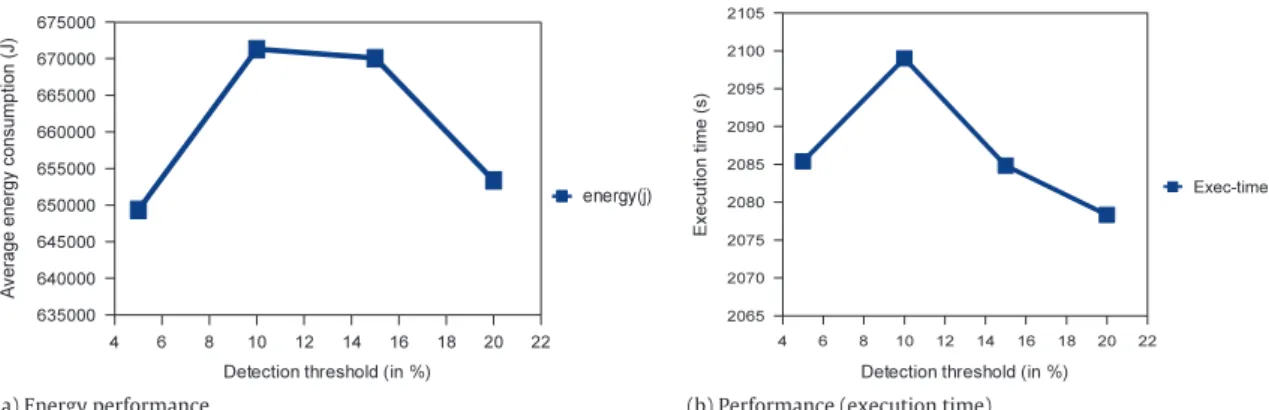
In this section, we investigate the influence of phase detec-tion parameters ST and RT on applicadetec-tion performance and energy consumption. Firstly, we set the detection threshold and vary the
partial recognition threshold. Secondly, we set the partial recogni-tion threshold and vary the detecrecogni-tion threshold.Fig. 7— where the
y-axis represents either the average energy consumption (Fig. 7(a)) or the average execution time (Fig. 7(b)) and the x-axis the detec-tion threshold — shows the impact of the detecdetec-tion threshold on the execution time and energy consumption of WRF-AWR. It can be seen from that figure that for WRF-AWR, a detection thresh-old either of 5% or 20% could be a good choice. However, 5% could be preferable since there is a difference in energy consumption of up to 5000 J, for a less than 10 s difference in execution time. Fig. 7also reveals that the detection threshold might have a signif-icant impact on performance (both in terms of energy consumption and execution time). For these experiments, the partial recognition threshold was fixed to 10%.
The influence of the recognition threshold RT on energy per-formance is summarized byFig. 8, where the x-axis represents the recognition threshold and the y-axis either the average energy consumption (Fig. 8(a)) or the average execution time (Fig. 8(b)).
(a) Energy performance. (b) Performance (execution time).
Fig. 7. Impact of the detection threshold on energy performance for WRF-AWR.
(a) Energy performance. (b) Performance (execution time).
Fig. 8. Influence of the partial recognition threshold on energy performance for WRF-AWR.
According toFig. 8, a partial recognition threshold of 15% is conve-nient both in terms of energy and execution time.
What we can learn fromFigs. 7and8is that these values must be chosen depending on the target objective. A small recognition threshold may limit the impact of wrong decisions; however it may also have an influence on right decisions. For, making the right decision earlier allows saving more energy, in reverse, making a wrong decision earlier can result in significant energy waste and/or performance degradation.
5.3. Performance analyses of multiple applications
Earlier herein, we talked about the usefulness to look at a whole system; however, our evaluations has so far focused on only one application at a time. In this section, we evaluate our strategy with multiple applications running at the same time. We consider as test applications the WRF-AWR model and BT from the NAS Parallel Benchmark (NPB) suite. WRF-AWR spans 48 processes and run on 48 cores (in other words 12 nodes) whereas BT spans 48 processes on 12 nodes. The two applications do not share any resources ex-cept the network that interconnect them. We measure the power consumption of each of our 24-node cluster using a power distribu-tion unit (PDU).Fig. 9, where the x-axis represents the average per-centage of energy improvement or performance loss, indicates that our methodology still function when there are multiple applica-tions sharing the platform; however, we also notice a performance degradation of up to 15% for BT. We are currently investigating the reason of BT performance degradation. Nevertheless, we be-lieve this can be attributed to the fact that some phases might have been considered as memory intensive or communication intensive while they were actually compute intensive. In addition, applica-tions (BT for example) which do not implement load imbalance are
Fig. 9. Energy and performance (execution time) when BT and WRF-AWR are
sharing the cluster.
likely to experience higher performance degradation than those which implement load imbalance (WRF-AWR for example) [29,30].
6. Conclusion and future works
In this paper, we present two generic approaches for tracking high performance computing systems’ behaviour regardless of the applications being executed. We show through two use cases how they can be used for improving energy performance of a HPC sys-tem at runtime on the one hand and on the other hand how they can be used for estimating the energy consumption of an appli-cation given a target platform. Experimental results reveal the ef-fectiveness of these two methodologies under real-life workloads and benchmarks. Comparison of our system adaptation policy with baseline unmanaged execution shows that we can save up to 19% of energy with less than 4% performance loss considering the pro-cessor only and up to 24% considering the disk, propro-cessor and net-work. As our methodology for improving energy performance does not depend on any application specific metric, we expect it to be
extended to a large number of power-aware HPC systems. Future works include combining the two system’s behaviour tracking to enable live feedback on whether a system adaptation will be effec-tive or not. This can help improve the energy performance while reducing performance loss. We also plan on adding memory opti-mization to processor, disk and network optiopti-mization and integrat-ing workload consolidation and migration as core functionalities of the system management policy.
Acknowledgments
This work is supported by the INRIA large scale initiative Hemera focused on ‘‘developing large scale parallel and distributed experiments’’. Experiments presented in this paper were carried out using the Grid’5000 experimental testbed, being developed under the INRIA ALADDIN development action with support from CNRS, RENATER and several Universities as well as other funding bodies (seehttps://www.grid5000.fr).
References
[1] NVDIA, Nvidia tesla gpus power world’s fastest supercomputer, 2010. Press release.
[2] INTEL, Developer’s manual: Intel 80200 processor based on Intel xscale microarchitecture, 1998.
[3] AMD, Mobile AMD Duron processor model 7 data sheet, 2001.
[4]G.L.T. Chetsa, L. Lefèvre, J.-M. Pierson, P. Stolf, G.D. Costa, DNA-inspired scheme for building the energy profile of HPC systems, in: E2DC, in: Lecture Notes in Computer Science, vol. 7396, Springer, 2012, pp. 141–152.
[5]G.L. Tsafack, L. Lefevre, J.-M. Pierson, P. Stolf, G. Da Costa, Beyond CPU frequency scaling for a fine-grained energy control of HPC systems, in: SBAC-PAD 2012: 24th International Symposium on Computer Architecture and High Performance Computing, IEEE, New York City, USA, 2012, pp. 132–138.
[6]G.D. Costa, H. Hlavacs, Methodology of measurement for energy consumption of applications, in: GRID, IEEE, 2010, pp. 290–297.
[7]I. Kadayif, T. Chinoda, M. Kandemir, N. Vijaykirsnan, M.J. Irwin, A. Sivasubrama-niam, VEC: virtual energy counters, in: Proceedings of the 2001 ACM SIGPLAN-SIGSOFT Workshop on Program Analysis for Software Tools and Engineering, PASTE ’01, ACM, New York, NY, USA, 2001, pp. 28–31.
[8]G. Contreras, Power prediction for Intel xscale processors using performance monitoring unit events, in: Proceedings of the International Symposium on Low Power Electronics and Design (ISLPED), ACM Press, 2005, pp. 221–226.
[9]K. Singh, M. Bhadauria, S.A. McKee, Real time power estimation and thread scheduling via performance counters, SIGARCH Comput. Archit. News 37 (2009) 46–55.
[10]D. Bautista, J. Sahuquillo, H. Hassan, S. Petit, J. Duato, A simple power-aware scheduling for multicore systems when running real-time applications, in: IPDPS, IEEE, 2008, pp. 1–7.
[11] R. Joseph, M. Martonosi, Run-time power estimation in high performance microprocessors, in: International Symposium on Low Power Electronics and Design, pp. 135–140.
[12] W. Wu, L. Jin, J. Yang, P. Liu, S.X.D. Tan, A systematic method for functional unit power estimation in microprocessors, in: Design Automation Conference. [13] SUN, The UltraSPARC processor—technology white paper: the UltraSPARC
architecture, 1995.
[14] INTEL, Intel xscale microarchitecture for the PXA255 processor: User’s manual Intel corporation, 2003.
[15]B. Rountree, D.K. Lownenthal, B.R. de Supinski, M. Schulz, V.W. Freeh, T. Bletsch, Adagio: making dvs practical for complex HPC applications, in: Pro-ceedings of the 23rd International Conference on Supercomputing, ICS ’09, ACM, New York, NY, USA, 2009, pp. 460–469.
[16]V.W. Freeh, N. Kappiah, D.K. Lowenthal, T.K. Bletsch, Just-in-time dynamic voltage scaling: exploiting inter-node slack to save energy in MPI programs, J. Parallel Distrib. Comput. 68 (2008) 1175–1185.
[17] R. Kotla, A. Devgan, S. Ghiasi, T. Keller, F. Rawson, Characterizing the impact of different memory-intensity levels, in: IEEE 7th Annual Workshop on Workload Characterization (WWC-7).
[18]C. Isci, G. Contreras, M. Martonosi, Live, runtime phase monitoring and prediction on real systems with application to dynamic power management, in: Proceedings of the 39th Annual IEEE/ACM International Symposium on Microarchitecture, MICRO 39, IEEE Computer Society, Washington, DC, USA, 2006, pp. 359–370.
[19]K. Choi, R. Soma, M. Pedram, Fine-grained dynamic voltage and frequency scaling for precise energy and performance tradeoff based on the ratio of off-chip access to on-off-chip computation times, Trans. Comp.-Aided Des. Integ. Cir. Sys. 24 (2006) 18–28.
[20]M.Y. Lim, V.W. Freeh, D.K. Lowenthal, Adaptive, transparent frequency and voltage scaling of communication phases in MPI programs, in: Proceedings of the 2006 ACM/IEEE Conference on Supercomputing, SC ’06, ACM, New York, NY, USA, 2006.
[21]D.H. Bailey, E. Barszcz, J.T. Barton, D.S. Browning, R.L. Carter, R.A. Fatoohi, P.O. Frederickson, T.A. Lasinski, H.D. Simon, V. Venkatakrishnan, S.K. Weer-atunga, The NAS Parallel Benchmarks, Technical Report, Int. J. Supercomput. Appl. (1991).
[22] C. Isci, M. Martonosi, Identifying program power phase behavior using power vectors, in: Workshop on Workload Characterization.
[23] W.C. Skamarock, J.B. Klemp, J. Dudhia, D.O. Gill, D.M. Barker, W. Wang, J.G. Powers, A description of the advanced research WRF version 2. Available from Ncar; P.O. Box 3000; Boulder, CO 88 (2001) 7–25.
[24]Y. Liu, H. Zhu, A survey of the research on power management techniques for high-performance systems, Softw.-Pract. Exp. 40 (2010) 943–964.
[25] G. Conant, S. Plimpton, W. Old, A. Wagner, P. Fain, Parallel GeneHunter: implementation of a linkage analysis package for distributed-memory architectures, in: Proceedings of the First IEEE Workshop on High Performance Computational Biology, International Parallel and Distributed Computing Symposium, p. electronic.
[26]R. Bolze, F. Cappello, E. Caron, M. Daydé, F. Desprez, E. Jeannot, Y. Jégou, S. Lanteri, J. Leduc, N. Melab, G. Mornet, R. Namyst, P. Primet, B. Quetier, O. Richard, E.-G. Talbi, I. Touche, Grid’5000: a large scale and highly recon-figurable experimental grid testbed, Int. J. High Perform. Comput. Appl. 20 (2006) 481–494.
[27]K. Binder, J. Horbach, W. Kob, W. Paul, F. Varnik, Molecular dynamics simulations, J. Phys.: Condens. Matter 16 (2004) S429.
[28] WRF-AWR, The weather research and forecasting model, 2012.
[29]G. Chen, K. Malkowski, M.T. Kandemir, P. Raghavan, Reducing power with performance constraints for parallel sparse applications, in: IPDPS, IEEE Computer Society, 2005.
[30]H. Kimura, M. Sato, Y. Hotta, T. Boku, D. Takahashi, Emprical study on reducing energy of parallel programs using slack reclamation by DVFS in a power-scalable high performance cluster, in: CLUSTER, IEEE, 2006.
Tsafack C. Ghislain Landry received the B.S. degree in
mathematics and computer science from Dschang Uni-versity, Cameroon, in 2006, and the M.S. degree from the Francophone Institute for Computer Science, Viet Nam, in 2010. Prior to receiving the M.S. degree, he received a Maîtrise in computer science from the University of Yaoundé I, Cameroon, in 2007. He has been working to-wards the Ph.D. degree in computer science at Ecole Normale Superieure of Lyon, LIP lab. and Paul Sabatier University, IRIT lab. His major research interests include power-aware computing and communication in high per-formance computing infrastructures, delay/disruption-tolerant networking and network services.
Laurent Lefèvre obtained his Ph.D. in Computer Science in
January 1997 at LIP Laboratory (Laboratoire Informatique du Parallelisme) in ENS-Lyon (Ecole Normale Superieure), France. From 1997 to 2001, he was assistant professor in computer science in Lyon 1 University and a member of the RESAM Laboratory (High Performance Networks and Multimedia Application Support Lab.) Since 2001, he is research associate in computer science at INRIA (the French Institute for Research in Computer Science and Control). He is a member of the INRIA AVALON team (Algorithms and Software Architectures for Distributed and HPC systems) from the LIP laboratory in Lyon, France. His research interests focus on Green and Energy Efficient Computing and Networking. He has organized several conferences in high performance networking and computing and he is a member of several program committees. He has co-authored more than 100 papers published in refereed journals and conference proceedings. He participates in several national and european projects on energy efficiency. For more information, visit:http://perso.ens-lyon.fr/laurent.lefevre/.
Jean-Marc Pierson serves as a Full Professor in Computer
Science at the University of Toulouse (France) since 2006. He received his Ph.D. from the ENS-Lyon, France in1996. He was an Associate Professor at the University Littoral Cote-d’Opale (1997–2001) in Calais, then at INSA-Lyon (2001–2006). He is a member of the IRIT Laboratory and Chair of the SEPIA Team on distributed systems. His main interests are related to large-scale distributed systems. He serves on several PCs and editorial boards in the Cloud, Grid, Pervasive, and Energy-aware computing area. Since the last years, his researches focus on energy aware distributed systems, in particular monitoring, job placement and scheduling, virtual machines techniques, green networking, autonomic computing, mathematical modeling. He is chairing the EU funded COST IC804 Action on ‘‘Energy Efficiency in Large Scale Distributed Systems’’ and participates in several national and
european projects on energy efficiency. For more information, please visit
http://www.irit.fr/~Jean-Marc.Pierson/.
Patricia Stolf is an assistant professor since 2005. She
teaches at the Toulouse University (France). She obtained a Ph.D. in 2004 in the LAAS-CNRS laboratory (Toulouse-France) on Tasks scheduling on clusters for remote services with quality of service. She now works in the IRIT laboratory in the SEPIA team and is currently working in the field of distributed algorithms and autonomic computing in large scale distributed systems like grid and clouds. She studies resources management, load-balancing, energy aware autonomic systems and energy and thermal-aware task scheduling. She is involved in different research projects : in the ACTION COST IC0804 ‘‘Energy Efficiency in Large Scale Distributed Systems’’, in the European CoolEmAll project and in the national ANR SOP project.
Georges Da Costa is a permanent Assistant Professor
in Computer Science at the University of Toulouse. He received his Ph.D. from the LIG HPC research labo-ratory (Grenoble, France) in 2005. He is member of the IRIT Laboratory. His main interests are related to large-scale distributed systems, algorithmic, performance evaluation and energy-aware systems. He is Work Pack-age leader of the European project CoolEmAll which aims at providing advanced simulation, visualization and decision support tools along with blueprints of com-puting building blocks for modular data center envi-ronment. He is working group chair of the European COST0804 Action on ‘Energy efficiency in large scale distributed systems’. His research currently fo-cus on energy aware distributed systems. He serves on several PCs in the Energy aware systems, Cluster, Grid, Cloud and Peer to Peer fields. His research high-lights are grid cluster & cloud computing, hybrid computing (CPU/GPU), large scale energy aware distributed systems, performance evaluation and ambient systems.