HAL Id: hal-00469973
https://hal.archives-ouvertes.fr/hal-00469973
Submitted on 29 Jul 2010
HAL is a multi-disciplinary open access
archive for the deposit and dissemination of
sci-entific research documents, whether they are
pub-lished or not. The documents may come from
teaching and research institutions in France or
abroad, or from public or private research centers.
L’archive ouverte pluridisciplinaire HAL, est
destinée au dépôt et à la diffusion de documents
scientifiques de niveau recherche, publiés ou non,
émanant des établissements d’enseignement et de
recherche français ou étrangers, des laboratoires
publics ou privés.
All optical solition-based 2R regeneration at 170 Gbps
Julien Fatome, Christophe Finot, Mathilde Gay, Marcia Costa E Silva, Thanh
Nam Nguyen, Laurent Bramerie, Thierry Chartier, Michel Joindot,
Jean-Claude Simon, Jean-Louis Oudar
To cite this version:
Julien Fatome, Christophe Finot, Mathilde Gay, Marcia Costa E Silva, Thanh Nam Nguyen, et al..
All optical solition-based 2R regeneration at 170 Gbps. OSA Advanced Photonics Congress 2010, Jun
2010, Karlsruhe, Germany. pp.NMB4, �10.1364/NP.2010.NMB4�. �hal-00469973�
All optical soliton-based 2R regeneration at 170 Gbps
J. Fatome, C. Finot
Laboratoire Interdisciplinaire Carnot de Bourgogne, UMR 5209 CNRS-Université de Bourgogne, Dijon, France [email protected]
M. Gay, M. Costa e Silva, T. N. Nguyen, L. Bramerie, T. Chartier, M. Joindot, J.C. Simon
CNRS Foton, ENSSAT/Université Rennes 1, 6 rue de Kerampont, 22305 Lannion, France
J.-L. Oudar
Laboratoire Photonique et Nanostructures (LPN) CNRS, Route de Nozay, 91460 Marcoussis, France
Abstract: We report the numerical and experimental studies of a spectrally filtered-based
all-optical 2R regenerator at 170 Gbps. The fiber device is combined with a fast saturable absorber. BER assessment exhibits a receiver sensitivity improvement.
OCIS codes: (060.4370) Nonlinear optics, fibers (060.7140) Ultrafast processes in fibers.
1. Introduction
With the development of long haul optical telecommunication systems working at increasing repetition rates (40 Gbps and beyond), performing an all-optical regeneration has become of a great interest to combat the cumulative impairments occurring during the signal propagation and to overcome the electronics bandwidth limitations of the current devices [1]. Consequently, it is required to limit amplitude jitter and to improve extinction ratio, which can be achieved by using various optical methods taking advantage of the Kerr non-linear response of optical fibers : non-linear optical loop mirrors, four-wave mixing, or self-phase modulation in normally [2] or anomalous [3] dispersive fibers (the two latest methods being known as “Mamyshev” (MR) and “spectrally filtered solitons” respectively). Whereas many works, both experimental and theoretical, have recently dealt with the possibilities of MR devices, much less studies have investigated the performances of soliton-based regenerators.
In the present contribution, we try to partially address this lack by reporting some general theoretical guidelines to optimize the choice of the device parameters, i.e. the choice of the fiber length and initial power. The conclusions are applied to the regeneration of a 170 Gbps data stream. In order to simultaneously improve the extinction ratio (ER) of the signal, a fast saturable absorber (SA) [1] is also used and BER measurements finally demonstrate a receiver sensitivity improvement.
2. All-optical fiber-based limiter design
The optical limiting function is provided by the non-linear propagation of the amplified incoming data stream in a highly-nonlinear anomalous dispersive fiber (HNLF). The expanded spectrum is then spectrally filtered by means of a centered optical bandpass filter (OBPF) having a spectral bandwidth directly related to the input pulses [3]. The performance of the resulting device is highly affected by the initial peak power P0 of the pulse as well as the fiber
length L. In this context, it is of interest to propose general guidelines that can be applicable to a wide range of experimental situations (involving various temporal widths T0 as well as various nonlinear −γ − and dispersive –
β2 - fiber parameters). A crucial stage is the non-linear propagation that can be modeled by the standard non-linear
Schrödinger equation. In order to have a general overview of the dynamics, it is beneficial to introduce two normalized quantities : the usual dispersive length LD and the soliton number N defined respectively as LD = T02 /
|β2| and N2 = LD γ P0 [4, 5]. Considering initial Gaussian pulse train with a relative amplitude jitter of ± 7.5 %, we
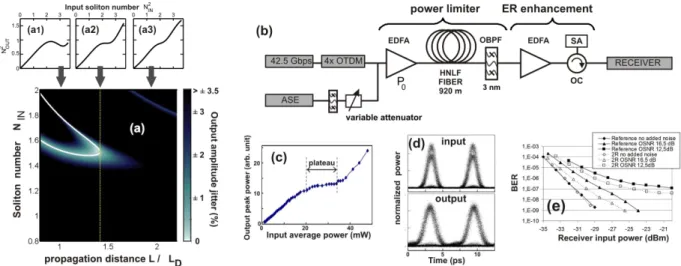
have carried out intensive numerical simulations to obtain the two dimension map of Fig. 1a. It is readily apparent that the amplitude jitter reduction is optimized for an initial N of 1.5 and a fiber length of 1.41 LD. For this choice of
parameters, the transfer function linking the output peak power to the input peak power exhibits a plateau (Fig. 1a1). For longer fiber lengths (Fig. 1a2), the transfer function is monotonously increasing and consequently is not suitable for the targeted regeneration. For shorter fiber lengths (Fig. 1a3), a non monotonous transfer function can be achieved, which could be of potential interest for high initial amplitude jitters.
Normalized quantities are also helpful to carry a fair comparison between the proposed solution and the MR scheme. A crucial point is that working with frequency centered filters does not lead to any improvement of the extinction ratio. However, this potential drawback is compensated by several major advantages such as wavelength preserving operation, absence of additional timing jitter, no sequence patterning due to pulse to pulse interaction and an improved energy yield [4, 5].
3. Experimental results
In order to validate our proposed design rules, we have tested the optical limiter at a repetition rate of 170-Gbps. The experimental set-up is sketched in Fig. 1b. The initial PRBS data stream is made of four temporally multiplexed 1.5-ps pulse trains at 42.5 Gbps. The input optical signal-to-noise-ratio is adjusted by means of an additional amplified spontaneous emission noise source. The signal is then amplified by a 23-dBm erbium doped fiber amplifier (EDFA) before being injected in a commercially available highly non-linear fiber (920 m, second order dispersion D = 0.7 ps/nm/km and a nonlinear coefficient γ of 11 W-1.km-1). After being filtered by a 3 nm supergaussian filter, the signal is amplified before being reflected on the ultrafast saturable absorber [6] through an optical circulator (OC) with an input power of 8 dBm. This second stage ensures the enhancement of the extinction ratio. At the output of the regenerator, the 170 Gbps data stream is optically demultiplexed down to 42.5 Gbps and bit error rate (BER) assessments are made on the signal obtained after electrical time division demultiplexing.
Fig. 1. (a) Output amplitude jitter according to the normalized propagation length and the initial soliton number. (a1,a2,a3) Typical transfer functions. (b) Experimental set-up. (c) Experimental transfer function of the all-optical limiter stage. (d) Eye diagrams before and after the power limiter (e) Receiver sensitivity with and without the 2R regenerator.
Experimentally measured transfer function of the fiber-based stage is plotted of Fig. 1c and exhibits the expected plateau required for an optimal power limiting behavior. The ability to efficiently limit the amplitude jitter is confirmed by eye-diagrams measured on ultrafast optical-sampling oscilloscope (Fig. 1d). BER measurements (Fig. 1e) confirm the receiver sensitivity improvement brought by the optical 2R regenerator.
4. Conclusion
We have numerically and experimentally studied the performance of a regenerator based on the spectral centered filtering of a signal propagating in an anomalous dispersive fiber. We have proposed general guidelines to find the optimum fiber length and initial power of the regenerator and we have quantitatively pointed out the optical limiting features of the device enabling a significant reduction of the amplitude jitter of a degraded signal. Results have been assessed by experiments carried out at a repetition rate of 170 Gbps. The combination with a fast saturable absorber enables extinction ratio enhancement so that the two stage regenerator has been experimentally found to improve the receiver sensitivity by 2 dB for a BER of 10-8 with an OSNR of 16.5 dB at the input of the regenerator [7].
5. References
1. O. Leclerc, B. Lavigne, E. Balmefrezol, P. Brindel, L. Pierre, D. Rouvillain, and F. Seguineau, "Optical regeneration at 40 Gb/s and beyond," J. Lightw. Technol. 21, 2779-2790 (2003).
2. P. V. Mamyshev, "All-optical data regeneration based on self-phase modulation effect," in European Conference on Optical
Communication, ECOC'98, 1998), 475-476.
3. M. Asobe, A. Hirano, Y. Miyamoto, K. Sato, K. Hagimoto, and Y. Yamabayashi, "Noise reduction of 20 Gbit/s pulse train using spectrally filtered optical solitons," Electron. Lett. 34, 1135-1136 (1988).
4. L. Provost, C. Finot, K. Mukasa, P. Petropoulos, and D. J. Richardson, "Design scaling rules for 2R-Optical Self-Phase Modulation-based regenerators 2R regeneration," Opt. Express 15, 5100-5113 (2007).
5. J. Fatome and C. Finot, "Scaling guidelines of a soliton-based power limiter for 2R-optical regeneration applications," in 11th International
Conference on Transparent Optical Networks, Ponta Delgada, Portugal (2009),
6. D. Massoudre, J. L. Oudar, J. Fatome, S. Pitois, G. Millot, J. Decobert, and J. Landreau, "All-optical extinction-ratio enhancement of a 160 GHz pulse train by a saturable-absorber vertical microcavity," Opt. Lett. 31, 537-539 (2006).
7. M. Gay et al, "170 Gbit/s bit error rate assessment of regeneration using a saturable absorber and a nonlinear fiber based power limiter," IEEE Photon. Technol. Lett. 22, 158-160 (2010).