HAL Id: hal-00763852
https://hal.archives-ouvertes.fr/hal-00763852
Submitted on 11 Dec 2012
HAL is a multi-disciplinary open access
archive for the deposit and dissemination of
sci-entific research documents, whether they are
pub-lished or not. The documents may come from
teaching and research institutions in France or
abroad, or from public or private research centers.
L’archive ouverte pluridisciplinaire HAL, est
destinée au dépôt et à la diffusion de documents
scientifiques de niveau recherche, publiés ou non,
émanant des établissements d’enseignement et de
recherche français ou étrangers, des laboratoires
publics ou privés.
Implementation of Stereo Matching Using High Level
Compiler for Parallel Computing Acceleration
Jinglin Zhang, Jean François Nezan, Jean-Gabriel Cousin, Erwan Raffin
To cite this version:
Jinglin Zhang, Jean François Nezan, Jean-Gabriel Cousin, Erwan Raffin. Implementation of Stereo
Matching Using High Level Compiler for Parallel Computing Acceleration. 27th Image and Vision
Computing New Zealand (IVCNZ), Nov 2012, Dunedin, New Zealand. pp.NC. �hal-00763852�
Implementation of Stereo Matching Using High Level
Compiler for Parallel Computing Acceleration
Jinglin ZHANG
UniversitéEuropéenne de Bretagne, France
INSA, IETR, UMR CNRS 6164 20, Avenue des Buttes de Coesmes, 35708 RENNES , France
[email protected]
Jean-Francois NEZAN
Université Européenne de Bretagne, France INSA, IETR, UMR CNRS 616420, Avenue des Buttes de Coesmes, 35708 RENNES , France
[email protected]
Jean-Gabriel COUSIN
Université Européenne de Bretagne, France INSA, IETR, UMR CNRS 616420, Avenue des Buttes de Coesmes, 35708 RENNES ,
France
[email protected]
xxx
Université Européennede Bretagne, France INSA, IETR, UMR CNRS 6164
20, Avenue des Buttes de Coesmes, 35708 RENNES ,
France
[email protected]
ABSTRACT
Heterogeneous computing system increases the performance of parallel computing in many domain of general purpose computing with CPU, GPU and other accelerators. With Hardware developments, the software developments like pute Unified Device Architecture(CUDA) and Open Com-puting Language (OpenCL) try to offer a simple and visu-alized tool for parallel computing. But it turn out to be more difficult than programming on CPU platform for opti-mization of performance. For one kind of parallel computing application, there are different configuration and parameter-s for variouparameter-s hardware platformparameter-s. In thiparameter-s paper, we apply the Hybrid Multi-cores Parallel Programming(HMPP)[1][2] to automatic-generates tunable code for GPU platform and show the result of implementation of Stereo Matching with detailed comparison with C code version and manual CUD-A version. The experimental results show that the default and optimized HMPP have the approximative 1 compared with CUDA implementation. And the HMPP workbench can greatly reduce the time of application development us-ing parallel computus-ing device.
Keywords
HMPP, CUDA, OpenCL, Stereo Matching
1.
INTRODUCTION
Permission to make digital or hard copies of all or part of this work for personal or classroom use is granted without fee provided that copies are not made or distributed for profit or commercial advantage and that copies bear this notice and the full citation on the first page. To copy otherwise, to republish, to post on servers or to redistribute to lists, requires prior specific permission and/or a fee.
Copyright 20XX ACM X-XXXXX-XX-X/XX/XX ...$15.00.
Stereo vision is a well suited technology which offer a pre-cise description of 3D information[3]. Stereo Matching uses only two cameras and a processing unit to do the dispari-ty matching and 3D reconstruction. In the same time, the exploitation of parallel programming tool on heterogenous system and architectures such as GPU, APU, FPGA and so on. For the GPU, there are great number of community em-ploying the CUDA which proposed by Nvidia in 2007. Com-paring with CUDA, Open Computing Language (OpenCL) provide better portable feature on multi hardware platform, make the heterogenous parallel computing possible not on-ly on GPU platform[4]. Recenton-ly, Altera also propose their OpenCL solutions for FPGA in order to get the low power and quick to market[5]. In order to achieve the best per-formance in different platforms, we must follow some stric-t rules stric-to stric-transform stric-the code form single core sysstric-tems stric-to heterogeneous or multi-core systems. All the procedures of transformation is complicated and much more redundancy. In our work, we use HMPP Workbench 3.0, a directive-based compiler targeted to GPUs and CPUs. Based on HMPP, programmers transform sequential code using paired direc-tives to automatically generate CUDA or OpenCL kernels for various applications.
• codelet: routine implementation • callsite: routine invocation
Basicly with HMPP, using only these two paired directives can replace the procedure of manual writing the complex CUDA or OpenCL kernel code. Scott proposed a method of auto-tuning and optimize the code with several applicable transformation configurations and then pick the optimized version of the code with the best performance[2]. Jianbin propose an auto-tuning solution to data streams clustering with OpenCL[6]. In our work, we convert the sequential C code to parallel versions of Stereo Matching kernel with optimized HMPP directives in order to obtain better
per-formance compared with those default HMPP and manual CUDA kernels. These contributions of our work are:
• showing that automatic optimizing HMPP complier
HMPP can be used to effectively parallelize and gen-erate the GPU kernels.
• analyzing difference of performance of the HMPP
CU-DA (CUCU-DA kernel generated by HMPP) and manual CUDA kernel
Section 2 elaborate the optimization strategies of convert C code to CUDA / OpenCL kernel code. Section 3 presents the Parallel Computing with HMPP. Section 4 presents the stereo matching algorithm and the implementation of HMP-P. Section 5 illustrate the experiments results between the manual CUDA and HMPP CUDA. A brief conclusion is giv-en in section 6.
2.
TRANSFORMATION RULES
Before we use HMPP to transform C code to CUDA / OpenCL kernel code, we must acquaint the rules about pro-gramming with the parallel computing device. we present some optimization strategies for transformation used in our work.
2.1
Data Transferring
In the image or video processing, there are several hun-dreds even thousand MB data to process. So we should avoid the unnecessary data transferring between host and device. The best choice is transfer as much as possible date at one time to fully utilize the bandwidth of GPU.
2.2
Fully Saturate The Computing Resource
Using parallel computing language, programmers should think about the practical infrastructure of different plat-forms. Because no one cannot ensure that the same ker-nel has the best performance on different platforms. Sup-posing that NVIDIA’s GPU support 512 active threads per Compute Unit and ATI’s GPU support 1024 active thread-s per Compute Unit, our experimentthread-s uthread-se 256 threadthread-s athread-s one group which means only 33.3% and 25% capability of Compute Unit be used in NVIDIA’s and ATI’s GPU sep-arately. Therefore Programmers should organize as much as possible threads to fully employ the compute resource of device. In the Section 5, we illustrate the occupancy of our experimental device in different conditions.
2.3
Use shared memory
Because of on chip, the shared memory is much faster than the device memory. In fact, accessing the shared memory is as faster as accessing a register, and the shared memo-ry latency is roughly 100x lower than the device memomemo-ry latency tested in our experiments. To get maximum perfor-mance, the most important point is to use shared memory but avoid banks conflict. In order to run faster and avoid re-fetching from device memory, programmers should put the data into the local memory ahead of complex and repeated computing.
3.
PARALLEL COMPUTING WITH HMPP
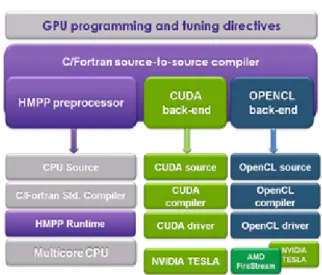
Figure 1: HMPP Workbench framework.
Recently more and more powerful multi-core intergraded architecture like Nvidia tegra3(Quad-Core CPU, 12 core G-PU supporting 3D stereo)[7], Snapdragon S4 APQ8064(Quad-Core CPU, Adreno 320 GPU supporting OpenCL)[8] sup-port the parallel programming model like OpenCL. In such All-in-one chips, GPU is not only play the part of rending and display, it also can be responsible for the general scien-tific computing based on their powerful computing capaci-ty and the greater bandwidth. The HMPP directive-based programming model offers a powerful syntax to efficiently offload computations on hardware accelerators and keep the original C or Fortran codes. Figure 2 show the HMPP Work-bench framework.
The basic paired directives syntax of HMPP are as follow: . . . //HMPP c o d e l e t #pragma hmpp l a b e l 1 c o d e l e t , t a r g e t=CUDA void t e s t ( i n t n , i n t A[ n ] , i n t B [ n ] ){ f o r ( i n t i = 0 ; i < n ; i ++){ B [ i ] = A[ i ] ∗ A[ i ] ; } } . . .
i n t main ( i n t a r g c , char ∗∗ argv )
{ . . . //HMPP c a l l s i t e #pragma hmpp t e s t c a l l s i t e t e s t ( 9 9 , A, B ) ; . . . }
Codelet is used before the definition of C functions which could be transformed in to parallel kernels. Callsite is the HMPP directive for invocation on such an accelerator device.
4.
STEREO MATCHING ALGORITHMS
Stereo vision aim to reconstruct a disparity map (depth information) from two views. For real-time stereo systems both speed and accuracy are crucial criterions. In order to satisfy the demand of real time, it must be with the benefit of
hardware acceleration, especially data parallel architectures-GPU. After analyzing the sequential C code of stereo vision, the most stereo matching algorithms spent a large percent of workload data parallel computing around every pixels. So the stereo matching is suitable for CUDA or HMPP accel-erating. Here we adopt the ESAW (exponential step size adaptive weight)[9] and ESMP (exponential step size mes-sage propagation)[10]stereo algorithm, because the author offer the source code of CUDA to download and we can compare the performance of the manual CUDA and CUDA generated by HMPP directly.
4.1
Default HMPP Transformation
For the version of HMPP CUDA, we only insert these two lines directives into the source C code without any modifi-cation like that:
. . .
#pragma hmpp s t e r e o c o d e l e t , t a r g e t=CUDA,
extern void s t e r e o ( )
{ . . . }
. . .
i n t main ( i n t a r g c , char ∗∗ argv )
{ . . . #pragma hmpp s t e r e o c a l l s i t e s t e r e o ( ) ; . . . }
Only two lines HMPP directives codelet and callsite can replace writing complicated manual CUDA code. And the difference of performance between the manual CUDA and HMPP CUDA will be described in the section 5.
4.2
Optimized HMPP Transformation
As we illustrated in the Section2, we should use the shared memory and even L1 cache to optimize the HMPP code. In our Optimized version of HMPP code:
1. we use the hmppcg directives to determine which loop should be parallelized. // Exemple : HMPP d i r e c t i v e s : u n r o l l f o r l o o p #pragma hmppcg g r i d i f y ( j , i ) f o r ( j = 0 ; j < HEIGHT ; j ++){ f o r ( i = 0 ; i < WIDTH; i ++){ . . . } }
2. we use the hmppcg grid to allcate the buffer to shared memory.
#pragma hmppcg g r i d s h a r e d b u f f e r n a m e
3. Through the configuration of L1 cache preference, there is obvious improvement of performance as described in the section 5.
c u d a D e v i c e S e t C a c h e C o n f i g ( a r g s ) ; a r g s = cudaFuncCachePreferL1 ;
5.
EXPERIMENTAL RESULTS
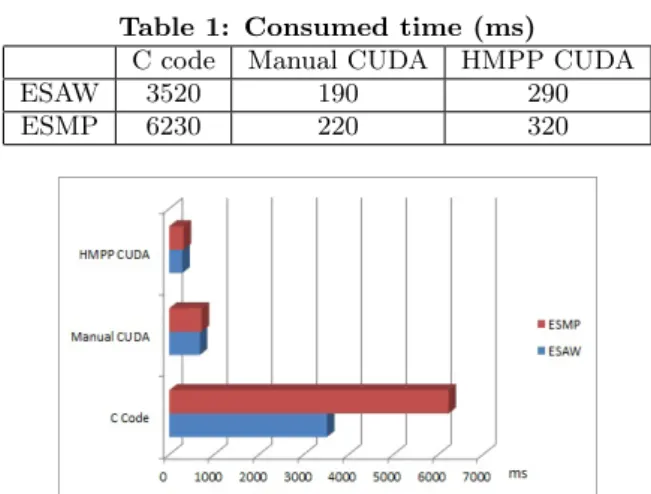
Table 1: Consumed time (ms)
C code Manual CUDA HMPP CUDA ESAW 3520 190 290 ESMP 6230 220 320
Figure 2: Performance of ESAW and ESMP.
5.1
Experiment Environment
Our experiment environment is configured as follow:
• CPU: Inter Xeon W3540 (8 cores, 2.93GHz)
• GPU: Nvidia Quadro FX 3700 (128 cuda cores, 1 GB
memory)
• OS: ubuntu 12.04 LTS • CUDA: v4.2.9
• HMPP-Workbench: v3.2.1
5.2
Consumed Time Measure
We test the ESAW and ESMP algorithms in such three implementations:
• C code
• Manual written CUDA code • HMPP CUDA code
And we set the the iteration times = 9 in both ESAW and ESMP algorithms, keep the others parameters default. From the experimental results as described in the Table 1 and Figure 2, we can see that both manual CUDA and HMPP CUDA have the obvious speed-up compared with C code im-plementation of ESAW and ESMP algorithms. The manual CUDA obtains 18.5x to 28.3x speed-up, corresponding with HMPP CUDA’s 12.1x to 19.5x speed-up. After analyzing the difference performance between the manual CUDA and HMPP CUDA, there are two main factors:
• Different transferring between GPU and host • Different occupancy of GPU
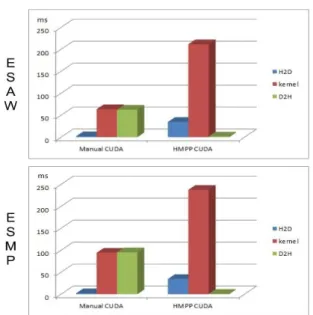
By the Nvidia CUDA profiler, both the time consumed of manual CUDA implementation and HMPP CUDA imple-mentation are classified into three groups: 1. H2D (trans-ferring data from host to device like GPU), 2. kernel (func-tions executed on GPU to realize the algorithms), 3. D2H (transferring data from device to host). As described in the Figure 3, we can see that the manual CUDA cost two much time on D2H(almost 50% time consumed total) which even close to the kernel consumed time.
Figure 3: Performance Details (H2D (transferring data from host to device like GPU), kernel (func-tions executed on GPU to realize the algorithms), D2H (transferring data from device to host))
5.3
Occupancy
As discussed in the Section 2, occupancy is the key fac-tor to determine whether these kernels can fully saturate the computing device. According to the Nvidia profiler, the manual CUDA didn’t make use of the GPU computing unit very well as shown in the Figure 4 and 5. Most of time, the manual CUDA only take 33% or 66% occupancy of our GPU device. And the HMPP CUDA take 66% occupancy in the most time which is better than the manual CUDA. And the same kernel maybe has the different occupancy on different device. This is the problems of determining the best code transformation at a high level compiler like HMPP.
5.4
Optimized HMPP Transformation
Because the configuration of L1 cache preference need the compute capability 2.x, but our GPU-Quadro FX 3700 only has compute capability 1.1. So we change to another GPU platform GeForce GTX 550 Ti for the esperiment of Opti-mized HMPP. For the ESAW algorithm, we get the result of 60ms for manual CUDA and 80ms for HMPP CUDA. It mean that the HMPP CUDA can obtain the close perfor-mance as manual CUDA even have the chance to exceed it. The millions of disparity per second(MDS) is another crite-rion of real-time stereo vision system. The optimized HMPP CUDA can achieve 79.5 MDS which meets the demand of real-time stereo vision.
5.5
Comparison of Disparity Map
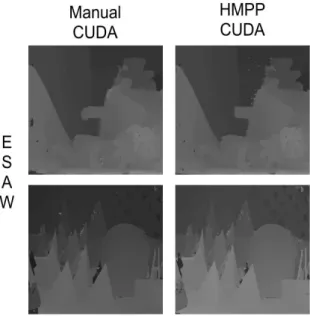
We use the two series image: Cones and Teddy for the test as shown in the Figure 6, and executed using GPU, we get the final visual disparity map of the manual CUDA and HMPP CUDA separately as shown in the Figure 7. There are little difference between the two version Disparity Map and the error rate of Disparity Map are as follow:(waiting the result)
Figure 4: Occupancy details of manual and HMPP CUDA for ESAW.
Figure 5: Occupancy details of manual and HMPP CUDA for ESMP.
6.
CONCLUSION
In this work, we use the directive-based HMPP Work-bench to generate the CUDA kernel code and optimized the HMPP directive for bettter performance. With HMP-P, we were able to quickly generate different versions of portable code on different device NVIDIA GPU (CUDA tar-get), AMD GPU (OpenCL), Intel MIC(coming soon). The experimental results show that the default and optimized HMPP have the approximative performance compared with CUDA implementation. And the HMPP workbench can greatly reduce the time of application development using parallel computing device.
Figure 6: Source image of Cones and Teddy.
Figure 7: ESAW.
7.
REFERENCES
[1] CAPS. Hmpp.
http://www.caps-entreprise.com/technology/hmpp/. [2] S. Grauer-Gray, L. Xu, R. Searles,
S. Ayalasomayajula, and J. Cavazos. Auto-tuning a high-level language targeted to gpu codes. 2012. [3] Jian Sun, Nan-Ning Zheng, and Heung-Yeung Shum.
Stereo matching using belief propagation. Pattern
Analysis and Machine Intelligence, IEEE Transactions on, 25(7):787 – 800, july 2003.
[4] Jinglin ZHANG, Jean-Francois NEZAN, and Jean-Gabriel COUSIN. Parallel implementation of motion estimation based on heterogeneous parallel computing with opencl. In High Performance
Computing And Communications (HPCC), 2012 IEEE 14th International Conference on, 2012.
[5] Altera. Opencl.
http://www.altera.com/b/opencl.html.
[6] Jianbin Fang, A.L. Varbanescu, and H. Sips. An auto-tuning solution to data streams clustering in opencl. In Computational Science and Engineering
(CSE), 2011 IEEE 14th International Conference on,
pages 587 –594, aug. 2011. [7] Nvidia. Tegra3.
http://www.nvidia.com/object/tegra.html. [8] Qualcomm. snapdragon.
http://www.qualcomm.com.au/products/snapdragon. [9] Wei Yu, Tsuhan Chen, and J.C. Hoe. Real time stereo
vision using exponential step cost aggregation on gpu. In Image Processing (ICIP), 2009 16th IEEE
International Conference on, pages 4281 –4284, nov.
2009.
[10] Wei Yu, Tsuhan Chen, F. Franchetti, and J.C. Hoe. High performance stereo vision designed for massively data parallel platforms. Circuits and Systems for
Video Technology, IEEE Transactions on, 20(11):1509