AVIS
Ce document a été numérisé par la Division de la gestion des documents et des archives de l’Université de Montréal.
L’auteur a autorisé l’Université de Montréal à reproduire et diffuser, en totalité ou en partie, par quelque moyen que ce soit et sur quelque support que ce soit, et exclusivement à des fins non lucratives d’enseignement et de recherche, des copies de ce mémoire ou de cette thèse.
L’auteur et les coauteurs le cas échéant conservent la propriété du droit d’auteur et des droits moraux qui protègent ce document. Ni la thèse ou le mémoire, ni des extraits substantiels de ce document, ne doivent être imprimés ou autrement reproduits sans l’autorisation de l’auteur.
Afin de se conformer à la Loi canadienne sur la protection des renseignements personnels, quelques formulaires secondaires, coordonnées ou signatures intégrées au texte ont pu être enlevés de ce document. Bien que cela ait pu affecter la pagination, il n’y a aucun contenu manquant.
NOTICE
This document was digitized by the Records Management & Archives Division of Université de Montréal.
The author of this thesis or dissertation has granted a nonexclusive license allowing Université de Montréal to reproduce and publish the document, in part or in whole, and in any format, solely for noncommercial educational and research purposes.
The author and co-authors if applicable retain copyright ownership and moral rights in this document. Neither the whole thesis or dissertation, nor substantial extracts from it, may be printed or otherwise reproduced without the author’s permission.
In compliance with the Canadian Privacy Act some supporting forms, contact information or signatures may have been removed from the document. While this may affect the document page count, it does not represent any loss of content from the document.
From coordination complexes to coordination polymers
par
Viviane A. Richter
Département de chimie Faculté des arts et des sciences
Mémoire présenté à la Faculté des études supérieures en vue de l'obtention
du
grade de M. Sc. en chimieAvril, 2008
Ce mémoire intitulé
From coordination complexes to coordination polymers
présenté par : Viviane A. Richter
a été évalué par un jury composé des personnes suivantes:
Prof. Dr. André L. Beauchamp président-rapporteur
Prof. Dr. Frank Schaper directeur de recherche
Prof. Dr. Garry S. Hanan codirecteur
Prof. Dr. Davit Zargarian membre du jury
RÉsuMÉ
Dans le premier chapitre de ce travailla synthèse d'un nouveau ligand carbene et de ses complexes homoléptique et heteroléptique est examinée. Les composés ont été caractérisé par RMN IH_ et 13C, spectroscopie de masse et l'analyse élémentaire. Le ligand et les deux complexes ont été analysés par électrochimie et photophysique, et leurs propriétés sont discutées. De plus, les structures cristallines du ligand, d'un dimère formé par celui-ci et du complexe homoleptique ont été obtenues et discutées.
Le deuxième chapitre porte sur les propriétés magnétiques des complexes de coordination de Fe(II) et ils sont comparées avec les polymères de Fe(II) correspondant. On a vérifié que les complexes mono-métalliques
correspondants montrent les mêmes propriétés magnétiques et structurelles que le polymère de Fe(II). Plus précisément, les complexes mono-métalliques
présentent la même structure et ceci explique la transition de spin observée pour le polymère et les complexes mono-métalliques correspondants.
Le dernier chapitre traite de la synthèse d'un nouveau ligand N-oxyde soluble dans l'eau, formé à partir du ligand tpy-ph-tpy. On a analysé ce ligand par RMN IH, spectroscopie de masse ainsi que par analyse élémentaire. En plus du
nouveau ligand N-oxyde, un nouveau complexe platine polypyridine a été
synthétisé et analysé. Le point important ici est lque par fort échauffement, le complexe change de couleur en passant du jaune brillant à rouge profond.
MOTS CLES
Complexes des métaux de transition, propriétés photophysiques, structure cristaline, magnétisme moléculaire, analyse structurale, polymères de coordination
r
ABSTRACT
ln the first chapter of this work the synthesis of a new ligand, containing a six-membered heterocyclic carbene ring, and its homoleptic and heteroleptic Ru(II) complexes are examined. The compounds have been analyzed by IH and 13C NMR, mass spectrometry and elemental analysis. The ligand and the two complexes have been analyzed electrochemically and photophysically and their properties are discussed. In addition to that, crystal structures of the ligand, a dimer formed by it and the homoleptic complex have been obtained and are discussed.
The second chapter deals with the magnetic properties of a Fe(II) coordination polymer and its corresponding mono-metallic complexes. It is examined if they show the same magnetic and structural properties as the aIready known Fe(ll) coordination polymer. In effect, the mono-metallic complexes do show similar structural behavior and it could be figured that this is the reason for the spin-transition observed for the Fe(ll) coordination polymer and the corresponding mono-metallic complexes.
The last chapter deals with the synthesis of a new water soluble N-oxide ligand formed from the tpy-ph-tpy ligand. It has been analyzed by IH NMR, mass
spectrometry and elemental analysis.
ln addition to the new N-oxide ligand, a new platinum polypyridine complex was synthesized. It also was analyzed by IH NMR, mass spectrometry and elemental analysis. Interesting here is, that this complex changes its color from bright yellow to deep red upon heating.
KEYWORDS
Transition metal complexes, photophysical properties, crystal structures, molecular magnetism, structural analysis, coordination polymers
Table of Contents
Index of Tables ... vii
Index of Figures ... viii
Index of Schemes ... x
Abbreviations ... xi
Acknowledgments ... xiv
1 Introduction ... 1
1.1 Coordination Complexes - The Precursors of Coordination Polymers ... 3
1.2 Transfer of Properties from Coordination Complexes to Coordination Polymers ... 6
1.2.1 Photophysical Properties ... 6
1.2.2 Magnetic Properties ... 9
2 Synthesis and Characterization of a Novel Six- membered N-heterocyclic Carbene Ligand and its Homoleptic and Heteroleptic Ru(ll) Complexes ... 13
2.1 Introduction ... 13
2.2 Results and Discussion ... 17
2.2.1 Properties ... 27
2.2.1.1 Electrochemistry ... 27
2.2.1.2 Spectroscopie properties ... 30
2.3 Conclusion ... 33
2.4 Experimental Section ... 34
3 Structural and Magnetic Properties of Fe(ll) Terpyridine Coordination Complexes and Polymers ... 41
3.1 Introduction ... 41
3.2 Results and Discussion ... ; ... 49
3.2.1 Structural Analysis ... 54
3.2.2 Magnetic Properties ... 62
3.2.2.1 SQUID ... 62
3.2.2.2 Faraday Balance ... 65
3.2.2.3 Magnetic Measurements ... 67
3.3 MEPE with Flexible Spacer ... 72
3.3.1 Structural Analysis ... 73
3.4 Conclusion ... 78
3.5 Experimental Section ... 79
4 First Steps to new Coordination Polymers ... 84
4.1 Synthesis of [bis (di-N-oxide-terpyridine)]. ... 84
4.2 Synthesis of [Pt(py-tpy)CI]CI, (2) ... 88
4.3 Conclusion ... 99
4.4 Experimental Section ... 100
A References ... i B Crystal Data ... vü C Tables for Diamagnetic Contribution ... xxxü D Checkcif reports ... xxxiü
Index of Tables
Table 1. Table IT. Table ITI. Table IV. Table V. Table VI. Table VIT. Table VITI. Table IX. Table X. Table XI. Table XIT. Table XITI. Table XlV. Table XV. Table XVI.Half-wave potentials for [lH+][PF6'], 2 and 3 ... 27
UV-Vis data for ([lU+][PF6']), (2) and (3) ... 33
Crystallographic data for [lU+][PF6'], [lh and 2 ·CH3CN ... .40
Compounds investigated together with their denotation ... .49
SAXS data for compounds MAC_2 and MAC_ 4 ... 59
SAXS data for compounds PAC_ 4 and PAC_6 ... 76
IH NMR assignment for bis-(tri-N-oxide) ... 87
UV-vis data for the yellow and red form of [Pt(py-tpy)CI]CL .. 93
Crystal data for [lU+][PF 6·]. ... vii
Final coordinates for [lH+][PF6·] ... viii
Hydrogen atom positions for [lu+][PF6·] ... .ix
(An)isotropie displacement parameters for [lu+][PF6
1 ...
.ixBond distances for [lu+][PF6·] ... xi
Bond angles for [lH+][PF6"]. ... ; ... xi
Crystal data for 2 ... xiii
Final coordinates and equivalent isotropie displacement parameters for 2 ... xiv
Table XVIT. Hydrogen atom positions and isotropie displacement parameters for 2 ... xvi
Table XVITI. (An)isotropie displacement parameters for 2 ... xvii
Table XIX. Bond distances for 2 ... xix
Table XX. Bond Angles for 2 ... xxi
Table XXI. Crystal data and structure refinement for
h ...
xxivTable XXIT. Atomic coordinates and equivalent isotropie displacement parameters for lz ... xxvi
Table XXllI. Bond lengths and angles for lz ... xxvii
Table XXIV. Anisotropie displacement parameters for
h ...
xxxiTable XXv. Correction values for the diamagnetic susceptibility ... xxxii
Index of Figures
Figure 1. Different types of coordination polymers ... 4
Figure 2. State level diagram for Ru(II)terpyridine complex ... 7
Figure 3. Coordination polymer from a polytopic ligand and Fe(II) metal-ions . ... 8
Figure 4. UV NIS-Absorption spectra of Fe(II)-terpyridine complexes in methanol ... 8
Figure 5. High spin and low spin arrangement in iron(II) ... lO Figure 6. Pyridylcarbene precusor as synthesized by Chen and co-workers .. 15
Figure 7. Ruthenium(II) complex incorporating triazine and carbene ligands . ... 15
Figure 8. Crystal structure of the protonated ligand precursor [lH+][PF 6-]'" .18 Figure 9. 'H NMR spectrum the carbene and either its dimer ... 20
Figure 10. Crystal Structure of the dimerized carbene ligand 12 ... 21
Figure 11. Crystal structure of the homoleptic complex 2 ... 24
Figure 12. Heteroleptic carbene complex 3 ... 25
Figure 13. Cyclic voltammogram of 3 ... 28
Figure 14. Possible electron transfer in complex 3 ... 29
Figure 15. Absorption of [lH+][PF6-], 2 and 3 ... 30
Figure 16. Emission of [lH+][pF6-], 2 and 3 ... 32
Figure 17. Examples for supramolecular polymerie systems ... 42
Figure 18. Self-assembly of MEPE's and PAC's ... .47
Figure 19. 'H NMR spectra of the iron(II) complex with OAc (red) and DHP (blue) counter ions ... 53
Figure 20. Schematic representation of the investigated compounds ... 54
Figure 21. Scheme of the of the EDR beamline ... 56
Figure 22. Images of the experimental set-up at BESSY II ... 57
Figure 23. SAXS curves of MNC_OAc, MAC_2 and MAC_ 4 ... 58
Figure 24. Amphiphile structure ... 60
Figure 25. Quantum Design SQUID ... 63
Figure 26. Exploring coil and voltage signal of a SQUID ... 64
Figure 27. Schematic representation of a SQUID ... 64
Figure 29. Faraday balance and zoom of an MNC sample ... 66
Figure 30. Magnetie susceptibility and DSC measurements for MNC_OAc, MAC_2 and MAC_ 4 ... 67
Figure 31. Magnetie susceptibility measurements for Fe(ph-tpyh ... 70
Figure 32. Structure of bis-terpyridine ligand (tpy-opropo-tpy) ... 72
Figure 33. TGA measurements for MEPE and PAC_6 ... 73
Figure 34. SAXS eurves ofPAC_4 and PAC_6 ... 74
Figure 35. Magnetie susceptibility measurements for PAC_6 ... 77
Figure 36. The eolor of PAC_6 in low spin and high spin state ... 78
Figure 37. The two resonance forms of an N-oxide ... 85
Figure 38. Bis-N-oxide ligand ... 86
Figure 39. lH NMR assignment. ... 87
Figure 40. The red and the yellow form of the Pt-eomplex ... 91
Figure 41. UV-vis speetra of the yellow and the red form of the Pt-eomplex .. 92
Figure 42. lH NMR speetra of the yellow and the red form of the platinum eomplex ... 94
Figure 43. SFM pietures of the red form of the platinum eomplex ... 95
Figure 44. Preliminary SFM images from the polymerie Pt-speeies ... 97
Index of Schemes
Scheme 1. Preparation of the protonated carbene precursor ([lH+][PF 6-])- _____ 17 Scheme 2_ Proposed reaction mechanism for the formation of [lW][PF
6"1-- ___
17Scheme 3_ Attempt to prepare the free carbene ______________________________________ ... 22
Scheme 4. Preparation of the homoleptic carbene complex 2 ... 23
Scheme 5. Preparation of complex 3 ... 26
Scheme 6. Assembly of MNC_OAc and MAC_2 ... 50
Scheme 7. Synthesis of the N-oxide analogue to the tpy-ph-tpy ligand ... 87
Scheme 8. Synthesis of the 4'-pyridyl-2,2":6',2"-terpyridine ligand ... 89
Scheme 9. Synthesis of the [Pt(py-tpy)Cl]Cl complex (2) ... 90
Abbreviations
'LMCT Singlet ligand-to-metal charge transfer state
'MLCT /3MLCT Singlet ligand charge transfer / triplet metal-to-ligand charge transfer state
3MC AUC BESSY Br-ph-tpy CP CT DCP DHP DMSO DSC EDR ELSA FWHM GS HS ISC LS m-cpba MAC
Triplet metal centered state Analytical ultra centrifuge
Berliner Elektronenspeicherring-Gesellschaft für Synchrotronstrahlung
4' -( 4-Bromophenyl)-2,2':6'2"-terpyridine Coordination polymer
Charge transfer
Dynamic coordination polymer Dihexadecyl phosphate
Dimethyl sulfoxide
DifferentiaI scanning calorimetry Energy dispersive reflectometer
Electrostatic layer-by-layer self-assembly Triethylamine
Full width at half maximum Ground state
High spin
Inter system crossing Low spin
3-chloroperoxybenzoic acid Mononuclear amphiphile complex
MEPE PAC ph-tpy py-tpy r.t. SAXS Squid SFM TGA tpy tpy-opropo-tpy tpy-ph-tpy Metallo-supramolecular polyelectrolyte Polyelectrolyte amphiphile complex 4'-phenyl-2,2':6', 2"-terpyridine 4'-pyridyl-2,2':6'2"-terpyridine Room temperature
Small angle X-ray scattering
Superconducting quantum interference device Tapping-mode scanning force microscopy d-orbitals of a transition metal ion in octahedral coordination
Thermo Gravimetric Analysis 2,2':6'2"-terpyridine
1,3-Bis[4'-oxa (2,2':6',2"-terpyridinyl)]propane 1,4-bis(2,2":6',2"-terpyridine-4'-yl)benzene
To my children, Felix, Lucas & Casimir
and my hushand, Stephan.
Acknowledgments
1 thank Garry S. Hanan and Frank Hein Schaper for the possibility to carry out my M.Sc. thesis in their groups. 1 also want to thank Hein for bis support, especiaUy during writing up, and all the helpful discussions we had.
1 also want to thank Dirk G. Kurth for the opportunity to pursue the second half of my thesis in bis group at the MPIKG at Potsdam.
Prof. Dr. Moehwald from the MPIKG was always there to discuss my results and he helped me to get a deeper insight into sciences.
1 also want to thank Francine Bélanger, from the Université de Montréal, for helping me with my crystal structures and all her moral support.
Guntram, my officemate, who helped me with the structural analysis and the magnetic measurements, was a big help either; he was always there with a good advice.
And first of all, 1 would like to thank my family, my husband Stephan and my cbildren Felix, Lucas and Casimir, for all their patience. They made tbis work possible.
"Logic is the cement of our civilization with which we ascend from chaos using reason as our guide."
T'Plana-Hath
The miniaturization of electrical and optical circuits is currently pursued by the
top-down approach, which is mainly the domain of engineers and physicists.
However, using this approach to obtain components that are progressively
smaller and smaller in size is limited by physical parameters and, on the other
hand, the production costs. So the idea of the molecular machine was born, in
other words, the bottom-up approach, which consists of the use of single
moIecuIes to build-up nanosized components. But even though the idea of the
molecular machine is a very tempting one, such systems are far too complex to
be obtained by means of well-established synthetic methods. This might be one
of the reasons why the concept of self-assembly has become of enormous
interest over the last decades. It also means that the intelligent design of the
different components that self-assemble by weak: interactions to form a desired
system is the most promising way Ieading to molecular machines.
non-covalent interactions. There are several different inter- and intramolecular
interactions covering forces ranging from 1-120 kJ/mol with van der Waals
forces at the weak: end and coordinative bonds at the strong end of the scale. Comparing the strengths of the different interactions, the dative bond can be
considered to lie in the middle between weak: non-covalent interactions and
covalent bonding. But in addition to being the strongestone of the non-covalent
interactions, the coordinative bond possesses another particularity: it is highly
directional. This kind of directionality is a component, which is needed for the
assembly of hierarchical structures. This entire process evolves through
multi-step self-assembly with interactions at severallevels and length scales including
metal ion coordination, electrostatics, and van der Waals forces. In addition to
that, the incorporation of metal ions into a polymeric system is a way to exploit
the metal ions' rich properties, such as their magnetic [1, 2], electric [3,4] and
optical [5-7] properties.
The possibility to modify those polymer properties - as well as its morphology
- willingly by the choice of the involved metal ions and the manipulation of, for
example, its redox properties opens pathways to a completely new class of
As most of the knowledge concerning the properties that are exploited by metal ion coordination polymers are based on experiences from the broad field of coordination chemistry, a chapter dealing with sorne of the rich properties of self-assembling coordination complexes in view of theii influence on the chemistry of coordination polymers will be part of this chapter. We will then discuss to what extent the knowledge gained about coordination complexes can be carried forward to coordination polymers.
1.1 Coordination Complexes - The Precursors of Coordination
Polymers
AlI the interesting optical, electric and magnetic properties of coordination complexes can be incorporated into coordination polymers as weIl. One straightforward strategy for desigrung coordination polymers with specifie properties is therefore the study of the appropriate monomeric coordination complex and - if it shows the desired properties - its incorporation into a coordination polymer. Once incorporated, these coordination complexes can be part of the polymers backbone or also pending to it (Figure 1).
Figure 1. Metals can be pendant to (left) or they can be present (center) in the polymer backbone or the metal is embedded in a polymeric chelate (right). In the coordination polymer (center) the coordinative bond is an integral part of the polymer backbone [8].
Of course, the different positions of the coordination complex in the polymer will result in different outcomes. Incorporation into the polymer backbone with sufficiently short spacer units in between the metal centers will for example allow for an electronic coupling of the metal centers resulting in a vast variety of interesting new properties while a coordination complex pending to the polymer backbone will have a much milder influence on the properties of the whole polymeric system as, for example, simply changing the color of the compound, and therefore its wavelength of absorption, while leaving its other properties, such as its mechanical properties unchanged. In general, we will consider only those coordination polymers in which the coordination complex is an integral part of the polymer backbone. This means however, that the
choice of the metal will have an enormous impact on the new coordination polymers' properties. Therefore, it is important to have a pool of information available for the compound in question and this is the huge advantage of using coordination complexes: the enormous amount of information gathered about them during the last century. There are binding constants available for all sorts of different metal ions and ligands that can be used for calculating equilibrium positions of dynamic polymerie systems [9]; the optical properties of
polypyridyl coordination compounds are already intensdy studied and could now be used to ob tain CP's suit able for light harvesting, which is an important issue nowadays due to the depletion of fossil fuel sources. On the other hand, coordination polymers can be used as a sort of carrier package, meaning that a coordination polymer can be deliberately switched from its polymeric to its monomerie state by an external stimulus, the monomeric state having specific properties as, e.g., significant catalytic properties.
1.2 Transfer of Properties from Coordination Complexes to
Coordination Polymers
1.2.1 Photophysical Properties
The very appealing photophysical properties of polypyridyl coordination complexes are an illustrative ex ample of how to incorporate a coordination complex's properties ioto a polymer. Polypyridyl coordination complexes usually absorb in the UV-vis region of the electromagnetic spectrum by means of their singlet metal to ligand (or ligand to metal) charge transfer CMLCT / ILMCT) state. They can then undergo an intersystem crossing (ISC) into their relatively long-lived triplet CT state from which the major deactivation pathways are either emission to the ground state (GS) or thermal access to the triplet metal centered state CMC) which deactivates primarily via non-radiative decay (Figure 2) [10].
l:MLCT
E
os
Figure 2. Simplified state level diagram of a Ru(lI)terpyridine complex.
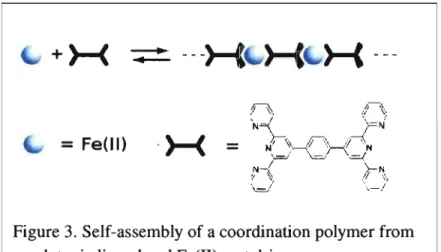
The energy of the se states can be tuned by varying the polypyridylligands by means of electrondonating or -withdrawing substituents. With the help of a suitable polytopic ligand, a complex so obtained can be incorporated into a coordination polymer. An exemplary case is the Fe(lI) coordination polymer used by our group (Figure 3). The [Fe(tpY)2]2+ complex is a well studied
compound: values like terpyridine binding constants with this metal ion as well as electrochemical and photophysical properties are easily accessible from literature sources. As suitable polytopic ligand, the tpy-ph-tpy ligand shown by Figure 3 was used in this case.
+H
H H H
---=
Fe(ll)·H
=
Figure 3. Self-assembly of a coordination polymer from a polytopic ligand and Fe(ll) metal-ions.
The UV-Vis spectra in Figure 4 show how the photophysical properties of the parent compound and the final coordination polymer are related [11].
0,8
0,7
0,6
300 400 500 600 700 BOO
1./ nm
Figure 4. UV NIS-Absorption spectra of Fe(ll)-terpyridine complexes in methanol. Line: CP-Fe tpy-ph-tpy, Dashes: [Fe(me-ph-tpy)2f+' Dots: [Fe(tpY)2f+. Reproduced from Ref.[ll].
The absorption maxima for the ligand centered absorptions in the UV part stay
in the same range for aIl three compounds, while a slight redshift is observed
from [Fe(tpY)2f+ to [Fe(me-ph-tpY)2]2+ and the Fe(II) coordination polymer
CP-Fe tpy-ph-tpy. This is as expected and is due to the progressively more extended
II-system that leads to the lower energies of the absorbing states ..
1.2.2 Magnetic Properties
The presence of semi-occupied d-orbitals in transition metal complexes gives
rise to several interesting phenomena including strong absorption, high
quantum yields, suitable excited state lifetimes luminescence, tunable redox
states and last but not least, spin cross-over [12]. The spin crossover
phenomenon is typically observed for transition metal compounds having a 3dn
(4 :s;; n ~ 7) electron configuration, with iron(I1) being the most widely studied
metal ion [13]. Iron(lI)complexes in an octahedralligand field can thus adopt
the low spin 1A,g conformation as weIl as the high spin 5T2g conformation. The low spin compounds can undergo a thermal spin crossover from low spin to
high spin (Figure 5), resulting in a number of possible applications like, e.g., as
optical elements in spin display devices.
-- --- ++
12g*** _______
*++
Figure 5. Low spin (left) and high spin (right) arrangement in the iron (ll) metal ion.
There are several approaches to control the spin state of coordinated metal ions,
one of which is the manipulation of the steric bulk or strain of the ligand
system. It is known that the 2,2':6',2" terpyridine induces a strong ligand field
and as a result, [Fe(ll)(tpYh] X2 complexes are generally low spin [14].
However, it has recently been suggested that bulky substituents in the 6- and
6"-position of the tpy-ligand influence the spin state by distorting the octahedral
coordination sphere and, therefore resulting in a change of the field splitting
[12].
Since for any metal ion in an octahedral field there is a 'cross-over' point at
which the change from low spin to high spin occurs, careful control of the
ligand-field splitting parameter A wou Id allow the choice of a ligand with a
between the two spin states. If now the energy separation Li between the hg and eg orbital sets is of the order of kT, there will be a pronounced effect of the
temperature on the position of this equilibrium.
The Fe (II) systems are of particular interest, since the low spin state is
diamagnetic and the change in the number of unpaired electrons when going to high spin is four. This also means, that the change in the magnetic moment of the complex will be a relatively pronounced one, thus allowing easy detection of the cross-over point and the determination of the field splitting parameter Li.
A remarkable ex ample for this kind of system is the spin cross-over induced by an amphiphilic phase transition introduced by Kurth and co-workers in 2005 [12]. Here the concepts used in the design of Fe (II) coordination complexes featuring a spin transition are carried forward to a coordination polymer. However, in this case the steric strain is not induced by bulky substituents as they would hinder the formation of high molecular weight chains by their steric dernands. Instead of introducing bulky substituents onto the ligands, the systems counter ions have been replaced by charged amphiphiles which can then induce a spin cross-over by an amphiphilic phase transition once the system has been applied onto a solid substrate in form of a Langmuir-Blodgett multilayer [12].
The first chapter of this thesis will deal with the manipulation of the properties of carbene-transition metal complexes in order to improve their photophysical properties, while the second one is occupied with the reasons for the spin transition of the aforementioned Fe(ll)-coordination polymer and the effects of the phase transition of the amphiphiles on the appropriate mono-metallic complexes. Finally, the last chapter will deal with ongoing work on the
synthesis of a new Pt-containing species and the possibility to form Pt-polymers with it.
Homoleptic and Heteroleptic Ru(II) Complexes
"As 1 turned, and my eyes beheld you, 1 displayed emotion ... 1 ask forgiveness. "
Surak
2.1 Introduction
During the Iast four decades, interest in moIecuIes showlng unusual binding modes has increased in synthetic inorganic chemistry [15]. Carbenes are neutral compounds with a divalent carbon atom having a free electron pair. As strong a-donors, they form stable carbon-metal bonds with transition metals [16]. Of special interest are electron-rich carbenes incorporating additional Lewis bases, as they are considered to have Lewis basicity towards metal centers with a strength comparable to phosphines [15]. N-heterocyc1ic carbenes have received increasing attention during the Iast years, due to the interesting catalytic
properties of their transition metal complexes [15]. They have been used in cross-coupling reactions and in polymerization chemistry, a recent paper reporting on N-heterocyclic palladium carbene complex as catalyst for Suzuki
cotIpling reactions at ambient temperature [17, 18].
More recently, attention was drawn onto Ru(lI) complexes incorporating carbene-based polypyridine ligands due to their improved photophysical properties as compared to the well-known and extensively studied [Ru(tpY)2]2+ motive [19]. These improved photophysical properties result from the
destabilization of the met al centered molecular orbitaIs by the strong
(J-donating ability of the carbenes, which raises the metal-centered states in energy relative to the 3MLCT state of the complex and finally leads to an increase in the excited state lifetime of the metal complex [20, 21].
Another rather recent development is the interest in dynamic polymers based on carbene dimerization equilibria. Due to the dynamic nature of the bond, it is possible by altering the ambient conditions to change the systems properties, such as its chain length. Most important here is the reversibility of the
interactions, leading to dynamic systems whose properties depend on the extent of the reversibility. This reversibility could than be a means to control /
manipulate features like chain length and geometry, thus allowing for subsequent rearrangement at the molecular level or self-healing abilities [9].
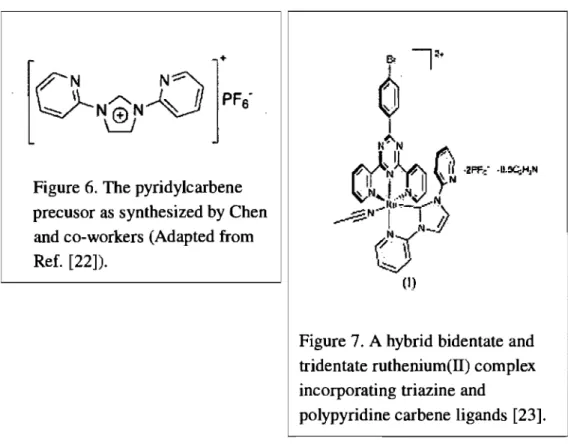
Figure 6. The pyridylcarbene precusor as synthesized by Chen and co-workers (Adapted from Ref. [22]).
Figure 7. A hybrid bidentate and tridentate ruthenium(II) complex incorporating triazine and
polypyridine carbene ligands [23].
The aim here was to synthesize a tridentate carbene ligand as a structural analogue to the well-known terpyridine ligand for complexation to Ru(II). This was meant to improve the photophysical properties of the resulting complexes by the destabilization of the metal-centered 3MC states, and this due to the strong cr -donating abilities of the carbene ligand. As it is already known, this destabilization, e.g. raise in energy, of the metal-centered states should cut of one of the major deactivation pathways, namely the thermal access to the 3MC state from the 3MLCT, which deactivates via non-radiative decay and, therefore, should lead to a long-lived 3MLCT excited state [24]. There are already sorne examples of heterocyclic carbenes forming complexes with ruthenium and other
transition rnetals, sorne of thern showing very promising photophysical properties [19, 22].
The 1,3-bis(2-pyridyl)imidazol-2-ylidene (pyirnypy) ligand (Figure 6),
synthesized by Chen and co-workers [22], was used by rnernbers of our group in order to synthesize a carbene containing rutheniurn(II) cornplex.
Unfortunately, this ligand does not coordinate in a tridentate fashion to Ru(II): one pyridine ring flips off; a solvent rnolecule is coordinated instead as sixth ligand. This is due to the ring strain in the five-rnernbered carbene ring and the resulting unsuitable bite angle for tridentate terpyridine-like coordination (Figure 7) [23].
To obtain a tridentate carbene analogue of the well-known terpyridine ligand, a six-rnernbered carbene-precursor with two pyridine substituents has been synthesized. In the following, the synthe sis of the hornoleptic as weIl as a heteroleptic Ru(II) cornplex of the corresponding carbene-ligand was envisioned.
2.2 Results and Discussion
The carbene-precursor 1 was obtained by refluxing 1,4,5,6-tetrahydro-pyrimidine in an excess 1-bromopyridine for 48 h. It was then isolated by filtration after precipitation as its PF6-salt from a saturated methanolic NHJ>F6
solution (Scheme 1).
Scheme 1. Preparation of the protonated carbene precursor ([lH+][PF 6]).
The ligand is probably formed by an aromatic nucleophilic reaction mechanism, involving an intermediate Meisenheimer-complex (Scheme 2) [25] .
..
..
(
"o,~
e
~J
Hr
The l3C NMR spectrum of the product does not show the peak for the carbene-precursor center carbon at a standard relaxation delay of one or two seconds. However, after several attempts with successively longer relaxation delays, the peak could finally be observed using a relaxation delay of 8 seconds, and this at a chemical shift of 152 ppm which is in the same range as other examples reported in literature [26, 27].
The crystal structure in Figure 8 shows how the two pyridine rings together with the carbene precursors N2 - C14 - N3 are essentially co-planar, showing the partial aromaticity of this part of the molecule, while the C6-C7-C8 part of the central non-aromatic ring is bent by 129°.
C11
Figure 8. Crystal structure of the protonated ligand precursor
[lH+][PF 6"]. Thermal ellipsoids are drawn at the 50% probability
level. Hydrogen atoms, with the exception of H14, and the anion were omitted for c1arity. N3-C14 1.3193(2) Â, N2-C14 1.3172(2) Â.
Extensive hydrogen bonding between H14 and the anion PF6-is observed,
probably due to the acidic nature of this proton.
For the synthesis of homo- and heteroleptic Ru(II) complexes with our carbene ligand, we aimed for the generation of the free carbene to facilitate the ligand's complexation to the metal. Unfortunately, attempts to obtain the free carbene by deprotonation failed. Even though several different bases under various
conditions were used, the free carbene could not be isolated.
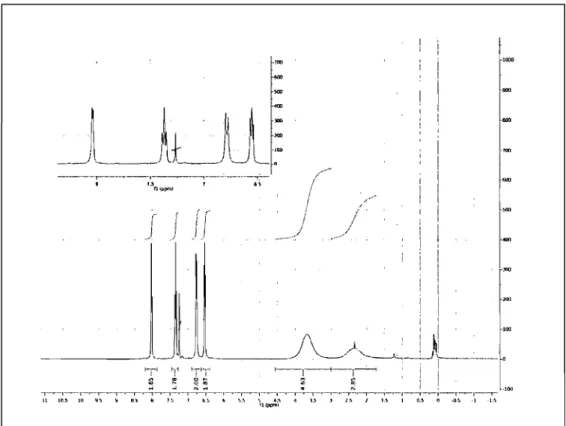
Massspectra of the reaction mixtures obtained in deprotonation attempts frequently contained species of a molecular weight higher than the postulated carbene, which might indicate coordination of the formed carbene ligand to the alkali metal cation of the base employed. Similar coordination of carbenes to alkali cations have been described by AIder et al. [28]. 'H NMR data of an isolated sample seemed to support this theory, as the peaks in the aliphatic region, which should be most affected by a complexation of the carbene center, were largely broadened as would be expected for an equilibrium between the complexed species and the free carbene (Figure 9).
·1000 ---.-r--.----.. -··,--.,--~:·-~--····-T·-· Il F.3 1 6 ~ n;~) //'~-/ i i
!
j( r
Ir .11' ) )[
I~
i 11·"
___
.~,JJ
'-
JL/,~_JJ~tf~
~"C 11fI. l'
~. -l--+-.t-~ : i ! ::1 :: N'" : : ! ; 1 ! .100 ··I .... · ... l .... ~ .. ·"'I· .... l .. ···T .... V .. • .. ,· .... ,· .... r .... ~ .... T .... , .... ·; .... r .... T .... ·, .. · .. r .... v .. ··l .. ··~ .. ·-f"·-.... -T ... l .... ,. .... l ... T· .. · .. ··-T·-~· .. ·'!"-- ... ·-t·-.. ·· .. 1--·' .. ···r·_· ... '··_·' .. _·r---l'-"--'--v , , -n 111.:1 111 .. ~ Il II~ ti 1'. , ~~ t. ' •. ~ .. 4." 4 I.~ J l~ J I . " 1 0.:\ Il ·0.·.. ·1 .1.'> 111",,",iFigure 9. IH NMR spectrum of the possible equilibrium between the carbene and either its dimer or its potassium complex.
A single crystal obtained from the reaction mixtures of the deprotonation
experiments, however, showed the formation of a dimerized carbene ligand 12
(Figure 10 and Scheme 3) despite the steric hinderance of the four pyridine
rings at the N atoms next to the carbene center. The C-C double bond of 12 of
1.350(3) Â is comparable to those of other tetraamino ethenes (1.31-1.46 Â,
based on 12 structures in the Cambridge Structural Database) and does not
bond.
Figure 10. Crystal Structure of the dimerized carbene ligand
h
Thermal ellipsoids are drawn at the 50% probability level. Hydrogen atoms were ornitted for c1arity. CI4-CI4A 1.350(3) Â, N3-C14 1.421(2) Â, N2-C141.414(2) Â.
The obtained crystal structure of the dimer 12 also explains the broadening of the aliphatic peaks in the NMR spectrum (Figure 9). While ring inversion is fast in the protonated precursor, it is significantly slower for the dimerized species yielding broadened peaks. This can be rationalized with the positioning of the
pyridine rings. The protonated precursor [IH+][PF 6] has an envelope
conformation with the pyridine rings located in the N-C14-N plane. They thus do not change their position during a ring inversion of the aliphatic backbone (see Figure 8). The dimeric species 12 , however, shows il boat conformation of
the six-membered ring. Ring inversion requires moving the pyridine
substituents from above the N-C14-N plane to below the plane. Due to the steric interactions of the pyridine rings on each side of the double bond, ring
inversion has thus to occur simultaneously in both six-membered rings of 12,
To investigate the dimerization reaction in slightly more detail, [1U+][PF 6] was deprotonated with NaH in CJ)6 (Scheme 3) and the supernatant solution investigated by NMR. The IH spectra contained several new peaks.
p
C
·~~ NaH. r.t .• 24 h2
!
PF6'
-b
Scheme 3. Attempt to prepare the free carbene, leading to the formation of its dimer (12),
The absence of the signal of the CNHC-H proton (observed at 9.07 ppm) and the higher signal intensities ([1H+][PF6
l
is barely soluble in'CJ)6) excluded the presence of the carbene precursor in solution. The presence of impurities and solvents prec1ude an unambiguous assignment of the peaks in the aliphatic backbone, but broadened peaks as observed for 12 were absent. 1 thus propose, that the species prepared in situ in CJ)6 is indeed the free carbene, which seemsto dimerize during the concentration of the solution upon isolation. If the free carbene could be obtained in situ in low concentrations, then direct
complexation to ruthenium during the deprotonation might prevent the
dimerization reaction. Indeed, when RuCh was refluxed with [1U+][PF6
l
in thepresence of Et3N, the homoleptic ruthenium bis-carbene complex 2 was obtained as its PF6 salt (Scheme 4).
[1H+][PF&l
1} Et3N, (CH20H}2
microw., 6min ....
2) NH4PF6 aq.
Scheme 4. Preparation of the homoleptic carbene complex 2. 2
The synthesis was carried out in the microwave and the Ru(carbene)2 complex 2 obtained by refluxing 0.5 eq. RuCh with 0.9 eq. Et3N and 1 eq. of [lH+][PF,l in ethylene glycol (Scheme 4). Complex 2 was then precipitated as its PF6-salt
from an aqueous NlLPF6 solution. Figure 11 shows the crystal structure of the
homoleptic carbene complex 2.
Figure Il. Crystal structure of the homoleptic complex 2. Hydrogen atoms and PF6-anions were omitted for c1arity. Thermal ellipsoids are
drawn at the 50% probability level. Rui - NI 2.0841(2) À, Ru1 C14 1.972(3) À, Ru1 - N4 2.0927(2) À, Ru1 - N5 2.0913(2) À, Rul C28 1.969(2)
À
and Ru 1 - N8 2.0876(2) Â..The bite angle of the ligand and the Ru-ligand bonds in complex 2 are in the same range as for the aIready known tpy-complexes [10,29]. This means that the octahedral coordination environment for the ruthenium stayed
approximately the same as in the known tpy-complexes, while still introducing the electronic properties of a strong cr -donor into the complex.
The synthe sis of heteroleptic [Ru(Br-ph-tpy)(1)]2+ complex (3)(Figure 12) proved to be more difficult than expected, due to the strong nature of the Ru-carbene bond.
Br
Figure 12. Heteroleptic carbene complex 3 (counter-ions are omitted).
The synthe sis in the microwave with or without base always gave an inseparable mixture of 2, 3 and the terpyridine homoleptic complex, together with several
and the terpyridine homoleptic complex by refluxing leq. Ru(Br-ph-tpy)Cb with 1 eq. [lW][PF6"] in ethylene glycol in the presence of 0.9 eq. of Et3N. The mixture of the obtained complexes was precipitated as their PF6" salts from an
aqueous NHJ>F6 solution. The compounds in this mixture were then separated
by column chromatography to give complex 3 (Scheme 5).
Br
12+
Br0
r l
12+
G
N
e
l)(CH:zOH},z, 180", 211 ..C(NlINû
+ , PFe l""N ...
....-J,&;
b
2) aq" NH4PFeO~û))
. 2 PF.-V
.2PF.-3 2Scheme 5. Preparation of complex 3.
The temperature during synthesis needs to be above 120 oC in order to allow for the Ru-carbene bond to form. However, above - 110 oC, the Ru-tpy bond starts to scramble, which -together with the high stability of the Ru-carbene bond-leads to an increased amount of the homoleptic Ru(carbene)2 complex. Optimizing experimental conditions lead to the maximum yield of 52 % for complex 3, but was always accompanied by at least 16 % of 2.
2.2.1 Properties
2.2.1.1 Electrochemistry
The strong cr-donating ability of the carbene ligand is expected to raise the
metal-centered states relative to the MLCT orbitaIs in energy [23]. Complex 2 reaIly shows an increase in the energy of the metaI centered orbitaIs and
becomes easier to oxidize as compared to the parent compound [RU(tpY)2f+
(Table 1). However, as electrochemical results indicate, there is rather an
increase in the energy of the metaI-centered states for complex 3, shifting EII2
from 1.25 V for Ru(tpy)/+ to 1.334 V for 3. This is probably due to the electron
deficient terpyridine ligand that can oppose a certain amount of the cr -donation
from the carbene ligand and decrease the electron density at the metaI.
Table 1. HaIf-wave potentials for ligand [IH+][PF 6·] and Ru (II) complexes 2 and 3 in a comparison with [RU(tPY)2f+ a)
compound EI12(oxidation) E IIl(reduction)
[lIr][PF6·] / -1.20, (48)
-0.14 (irr.)
2 1.17, (52) -0.97 (irrl
3 1.33, (44) -0.73 (irr.)b
Ru (tpy)/+ 1.25c -1.36c
a) Potentials are in volts vs SCE for acetonitrile solutions, 0.1 Min TBAP, recorded at 25 ± 1 C at a sweep
rate of 100 mY/s. The difference between cathodic and anodic peak potentials (millivolts) is given in parentheses. b) Irreversible; potential is given for the cathodic wave. c) Reproduced from Ref. [30]
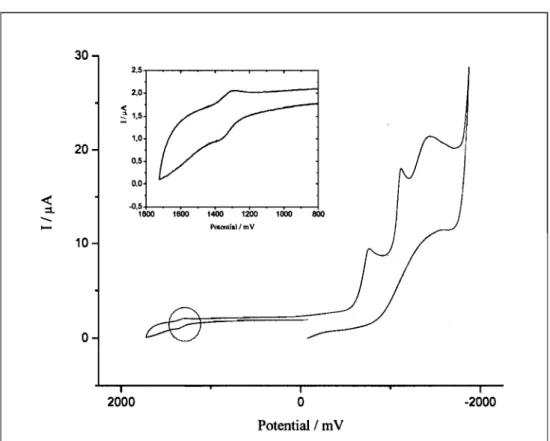
Interestingly, in the case of complex 3, an extremely high intensity is observed
for the ligand reductions. The Ru(IIIIII) couple is observed at 1.33 V, which is
in the normal range for this redox couple. However, the intensity of the ligand
reduction peak is significantly increased (Figure 13).
30 2,5 2,0 < ~ 1,5 1,0 20 0,5 0,0
-<
-0,5 ::1. 1800--
... 10o
2000 1800 1400 1200 1000 f>(J(cndal/mVo
Potential / m V -2000Figure 13. Cyclic voltammogram of 3 in CH3CN with a platinum electrode
at 4· lO-4M.
We believe that this is due to an electron transfer from the electron-rich carbene
ligand to the rather electron-deficient terpyridine ligand. We suppose that the
Br
Figure 14. Schematic representation of the possible electron transfer in complex 3 [31].
If this is the case, there could be an electron transfer that induces measurements in not only the first diffusion layer as usually in cyclic voltammetry, but leads to a transfer through several diffusion layers, producing the high intensity seen for the ligand reductions in Figure 11. In this case, the effect should disappear at low concentrations. So additional experiments at different concentrations need to be done to further elucidate this effect.
2.2.1.2 Spectroscopie properties
The absorption spectra of [IH+][PF6-], 2 and 3 are shown in Figure 15, the
absorption data is tabulated in Table IL
60000
50000
1 - - - -([IH+UPF 6]) - ( 2 )40000
,
- ---- (3),
8 1 lU30000
~
\ W20000
\10000
0
-
--
---200
300
400
500
600
À..nrnFigure 15_ Absorption of [lH+][PF6-], 2 and 3 in deaerated acetonitrile_
The ligand itself shows a strong II-transition at 244 nm that is probably due to the pyridine rings which are behaving as single pyridines_ Even though the two
pyridine rings are joined by a Sp2 -center in a planar conformation, the extension of the II-system does not seem to have a strong effect. Complex 2 shows mostly ligand centered absorption, even though the peak at 300 nrn is much more intense than for the ligand on its own, white complex 3 is more or less rnissing one of the ligand centered peaks around 250 nrn. The II -transition at 302 nm is largely increased for the homoleptic complex 2, it is even bigger than twice the peak of the ligand and is shifted to slightly lower energy, which may be
expected due to the doubling of the arnount of ligand in a homoleptic complex. In the case of the heteroleptic complex, this peak is smaller than for the ligand itself, which may be due to the different ligands bonded to Ru(Il). The region of 350-400 nm shows what may be d-d transitions for complex 2, while they are observed between 320-350 nrn for complex 3. Both complexes 2 and 3 show a low intensity MLCT peak near 450 nrn.
The ligand shows a strong ernission at 347 nm due to the two pyridine rings, which is much less intense for the complexes 2 and 3 (Figure 16).
600
500
400
::i
300
=
200
100
1,
1 1 1 1,
1 1 1 1 \ \ \ \ \ \ \,
,
+- - -
. ([IH )[PF
6))- - ( 2 )
_.-.- (3)
1 " " ", ,
",
.\,
'It
'
i
,
.
,
.
,~,
!
,1'
!
,
i
\
~'
i
\ ~ r\
/
.
,
!
... -._._._.,,-._
r
!
,~ '- - ' _ . _ /1 \\O~~~--~--~==~==-
'
~~~~·.-.·.~~·--~
\
~·--·~-~--~~~
350
400
450
500
1..,
nm
Figure 16. Emission of [lH+][PF6'], 2 and 3 at an excitation wavelength of 244 nm in deaerated acetonitrile.
550
The sharp emission at 488 nm is an artifact due to the excitation wavelength of
244 nm and has been eut-off for complex 2 since it does not have anymore
Table ll. UV-Vis data for ([lH+][PF6]), (2) and (3).
absorption  max' emission  max'
compound nm (2, M·tcm-t) nm (l, a. u.) [lW][PF6
1
244 (39220) 262 (65.48) 290 (16667) 347 (665.57) 525 (64.37) 2 245 (40727) 330 (80.62) 302 (56084) 647 (8.30) 354 (4189) 441 (2037) 467 (1808) 3 244 (10388) 263 (7.07) 296 (12524) 351 (80.23) 448 (1658) 405 (74.62) 525 (10.86) 688 (1.40)2.3 Conclusion
A new six membered imidazole ligand has been synthesized together with its homoleptic complex as weIl as its heteroleptic complex with bromoterpyridine as second ligand. It was expected from literature reports that a carbene ligand should destabilize the metal centered states relative to the 3MLCT state. In the case of the homoleptic complex 2 there is a destabilization for the metal centered states observed in electrochemistry, so that the oxidation of the metal appears at lower values. However, in case of the heteroleptic complex 3 there
seems to be an intra- or intermolecular effect of the electron deficient
terpyridine ligand and the electron-rich carbene ligand. The energy of the metal centered states are even doser relative to the 3MLCT than in the Ru (tpy
h
complex.2.4 Experimental Section
General Procedures. AlI reactions were performed under an argon atmosphere using standard Schlenk techniques unless otherwise stated. AlI chemicals were reagent grade and used as received. Solvents were dried by standard methods. 4'-(4-Bromophenyl)-2,2':6'2"-terpyridine and Ru(Br-ph-tpy)Ch were prepared by literature methods. [32,33] The syntheses implicating [lH+][PF6"] were
carried out on small scale only, due to the expensive starting material.
Physical Measurements and Instrumentation. Nudear magnetic resonance (NMR) spectra were recorded in CD3CN at room temperature (r.t.) on a Bruker AV400 spectrometer at 400 MHz for IH NMR and at 101 MHz for 13C NMR. Chemical shifts are reported in parts per million (ppm) relative to residual solvent protons (1.93 ppm for acetonitrile-d3) and the carbon resonance of the solvent. Absorption spectra were measured in deaerated acetonitrile at r.t. on a
Cary 500i UV-Vis-NIR Spectrophotometer. Experimental uncertainties were ± 2 nm for absorption maxima and 10% for the molar absorption coefficient. Emission spectra were measured in deaerated acetonitrile at r.t. on a Cary Eclipse Fluorescence Spectrophotometer. Experimental uncertainties for emission maxima were approximately ± 5 om. Electrochemical measurements were carried out in argon-purged acetonitrile at room temperature with a BAS CV50W multipurpose equipment interfaced to a Pc. The working electrode was a Pt electrode. The counter electrode was Pt wire, and the pseudo-reference electrode was silver wire. An internal 1 mM ferrocene/ferrocenium sample was used as reference at 395 m V vs SCE in acetonitrile and 432 m V in DMF. The concentration of the compounds was about 1 mM. Tetrabutylammonium hexafluorophosphate (TBAP) was used as supporting electrolyte in
concentrations of 0.10 M. Cyclic voltammograms were obtained at scan rates of 50, 100 and 200 mY/s. For irreversible oxidation processes, the cathodic peak was used as E, and the anodic peak was used for irreversible reduction
processes. An oxidationlreduction was considered reversible when the the separation between cathodic and anodic peaks was smaller than 60 m V, if the ratio of the intensities of the cathodic and anodic currents was, and if the peak potential remaining constant with changing scan rate. Experimental uncertainty
is ± 10 m V for the redox potentials. Elemental analysis was carried with an Agilent LC-MSD TOF, using ESI as ionization method.
1,3-Di-pyridin-2-yl-3,4,5,6-tetrahydro-pyrirnidin-l-ium ([IH1[PF 6']). A mixture of 1,4,5,6-tetrahydropyrimidine (1.3 ml, 15 mmol) and
2-bromopyridine (7.9 ml, 30 mmol) were heated to 96 oC for 48 h. During this time the clear solution gradually darkened to give a viscous brown liquid. The reaction mixture was cooled to r.t. and added to 75 ml MeOH solution
containing a 5-fold excess of NILPF6. The brown solution obtained was kept at 0° C for 2 h during which time the product precipitated. Filtration yielded 1.025 g (18%) of [lH+][PF6'] as an off-white powder. Anal. calcd. for
CI4HI5F6NJ>: N, 14.58; C, 43.76; H, 3.93. Found: N, 14.40; C, 43.60; H, 3.86. IH NMR (400 MHz, CD3CN): ppm 10.36 (s, IH); 8.55 (m, 2H); 8.04 (m, 2H); 7.48 (m, 2H); 4.10 (m, 4H); 2.45 (q, 2H, 1=6 Hz). 13C NMR (100 MHz, CD3CN): ppm 18.6; 43.6; 113.3; 124.1; 140.7; 149.2; 149.5. ESI-MS (in CH3CN): 239 ([IW], 100%) 1,3-Di-pyridin-2-yl-3,4,5,6-tetrahydro-pyrirnidin (1)
5 mg (0.013) of [lH+][PF6·] were added to 5 ml anhydrous deuterated benzene
containing an excess NaH. The white suspension was stirred at r.t. For 36 h. The solid from the suspension has been left to precipitate and the overstanding solution has been used to obtain an NMR from the unconcentrated solution. IH NMR (400 MHz, CJJ6): ppm 8.21 (ddd, 1=5,2,1 Hz, 2H), 7.04 (m, 2H), 6.32 (ddd, 1=7,5,2, 2H), 5.97 (dt, 1=8,1 Hz, 2H), 3.17 (dd, 1=6,12 Hz, 4H), 1.48 (dt, 1=6,13 Hz, IH) (1 proton hidden under grease). 13C NMR (100 MHz, CJJ6):
ppm 148.8; 136.9; 125.8; 112.7; 107.1; 39.4; one peak undistinguishable from impurities.
[Ru(1)2][PF6
h,
(2). RuCh (15 mg, 0.07 mol), [lH+][PF6] (56 mg, 0.14 mmol)and EhN (28 mg, 0.28 mmol) were added to 10 ml ethylene glycol to form a brownish suspension which was heated in a microwave oyen at medium heat for 6 min. The brownish-red suspension was cooled to room temperature and added to an aqueous solution containing a lO-fold excess NHJ>F6• The precipitate was
filtered off, redissolved in a minimum amount of CH3CN and precipitated by
addition of Et20 as yellow microcrystalline powder (18 mg, 86%). Anal. ca1cd. for C2sH2SFI2NsP2Ru: N, 12.92; C, 38.76; H, 3.25. Found: N, 14.40; C, 43.59; H, 3.85 . The errors in the elemental analysis are probably due to an incomplete
counter-ion conversion with the NILPF6 salt. IH NMR (400 MHz, CD3CN): 8
ppm 7.74 (m, 4H), 7.56 (m, 4H), 7.38 (d, J
=
8 Hz, 4H), 6.79 (m, 4H), 4.26 (m, 8H), 2.81 (q, J= 6 Hz, 4H); 13C NMR (100 MHz, CD3CN): 8 ppm 157.6, 140.2,122.1, 111.8,42.35,21.75. Even with longer relaxation times and an increase in the number of scans, the carbene center could not be observed. ESI-MS (in
[Ru(Br-ph-tpy)(1)][PF6h , (3). Ru(Br-ph-tpy)Ch (60 mg, 0.1 mmol) and
[lH+][PF6
1
(40 mg, 0.1 mmol) were added to 8 ml ethylene glycol to form a brownish suspension which was heated to 180 oC for 1.5 h, during which it turned wine-red. The reaction mixture was cooled to r.t. and added to an aqueous solution containing a lü-fold excess NILPF6. The precipitate was filtered off, redissolved in a minimum amount of CH3CN and recrystallizedfrom Et20. The obtained solid was purified by column chromatography on silica (eluent 7:2 CH3CN : sat. KN03 aq.). The first band contained the product
while the second band contained the homoleptic complex Ru[lh. The complex was then reconverted to its PF6 salt and recrystallized from Et20. Yield: 53 mg, 52% of an orange powder. ESI-MS (in CH3CN): 872.581 (M-PF6
t,
363.811Hz), 8.08 (d, 2H, J
=
8 Hz), 7.93 (m, 6H), 7.74 (d, 2H, J=
7 Hz), 7.43 (d, 2H, J=
8 Hz), 7.20 (s, 2H), 7.04 (d, 2H, J=
4 Hz), 6.75 (m, 2H), 4.35 (t, 4H, J=
6 Hz), 4.24 (m, 2H); 13C NMR (100 MHz, CD;CN):ô
ppm 284.4, 163.7, 159.2, 157.6,156.2, 154.4, 152.4, 149.7, 140.6, 139.2, 134.1, 131.0, 128.5, 125.9, 122.4, 121.9, 113.9, 112.52,43.3, 30.83
X-ray crystallography. The crystallographic data for [IH+][PF6], [l]2and 2
'CH3CN is summarized in Table III. Suitable crystals for x-ray crystallography
of [IH+][PF 6] and 2 were obtained by slow diffusion of Et20 into acetonitrile solutions of the respective compound, compound [1]2, was crystallized by slow evaporation of a benzene solution in an NMR tube. A Bruker Smart 6000 diffractometer using graphite-monochromatized Cu Ka: radiation was used for data collection. Absorption corrections were carried out using Sadabs [34]. Structures were solved using direct methods [35, 36]. AIl non-hydrogen atoms were refined anisotropie by least-squares procedures based on F2• [37]
Hydrogens were refined on calculated positions with fixed isotropie U, using riding model techniques. Crystallographic data (exc1uding structure factors) for the structures are shown in appendix A.
Table III. Crysta1lographic data for [IH+][PF ,], [1]2 and <2 'CH3CN
[IH+][PF6
1
[Ill 2·CH3CNchem. fonnula [CI4HISN4][PF6] C2sH2sNs [C2sH2sNsRu] [PF 6]2·CH3 CN
Mw, g'mor1 384.27 476.644 908.63
crystal size,
0.20 x 0.15 x 0.15 0.24 x 0.14 x 0.08 0.22 x 0.16 x 0.08 mm
crystal system monoclinic monoclinic monoclinic
space group P2dc P2dc P2dc a,A 8.8907(1) 10.5459(4) 8.6113(1) b,A 11.4813(1) 12.8430(5) 8.9270(1) c,A 15.5497(2) 9.2601(3) 46.1772(7) rl,deg 103.465(1) 111.587(2) 93.415(1) V,A3 1543.63(3) 1166.2(1) 3543.48(8) Z;De,Mgm-3 4; 1.653 2; 1,3574 4; 1,703 .1 F /J, mm ; 000 2.288; 784 0.672; 504 5.363; 1824
e,
deg 2.92 - 68.99 4.51- 69.18 3.84 - 68.86 temperature, K 150 100 150 indep. reflns. 2847(0.027) 2147 (0.108) 6530 (0.029) (Rint) obsd reflns. [I 2752 1685 5958 ~2cr(I)] no. of variables 227 164 525 GooF 1.036 0.539 1.062 RI [1>20'(1)] 0.0307 0.0485 0.0300 wR2 [aIl data] 0.0802 0.1508 0.0835 res. electron 0.198 0.270 0.971 density"Nothing unreal exists"
Kiri-kin-tha 's First Law of Metaphysics
3.1 Introduction
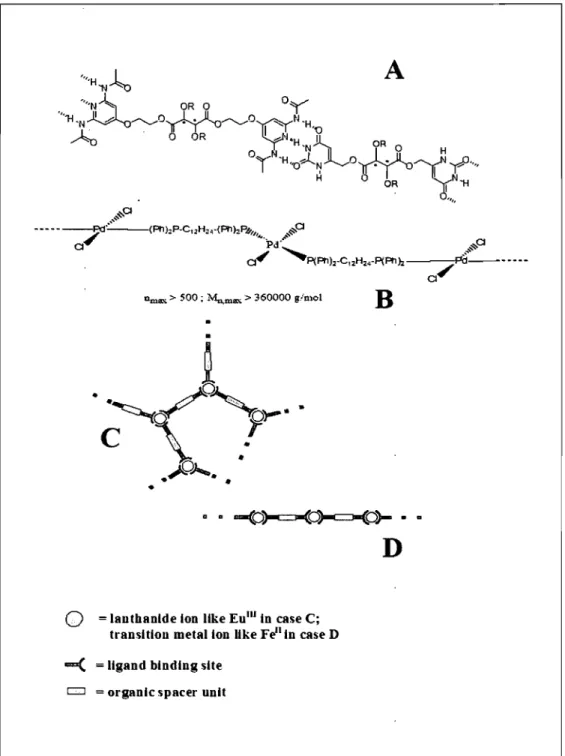
Polymers play a substantial role in the modern society due to the vast variety of their physical and chernical properties as well as their widespread commercial applications [38]. Traditional polymer science is concerned with covalently formed polymers, where the monomers are linked by covalent bonds [39]. The so-formed covalently bonded polymers have well-defined (static) molecular weight distributions that define their physical properties. During the last decades, attention has turned to a new class of polymers, supramolecular polymers in general and coordination polymers in particular. Here, self-assembly has been adopted for the synthe sis of different polymers (Figure 17).
Dm"" > 500 ; M",m"" > 360000 giD,ol
B
.
~
··~\/'O'J-
C
l~
..
•
.
~;...."
..
•o
= lauthanlde Ion IIke Eulll ln case C; transltlou metallon IIke Feil ln case Dau( = ligand blndlng site
CJ = organlc spacer unit
Figure 17. A: Example of a supramolecular polymerie system, showing three complementary synthons and their hydrogen bonding (adapted from Ref. [41]) B: metal-ion induced bonding in a coordination polymer, adapted from Ref. [44] C: Schematie representation ofreversible polymer architectures obtained from different metal-ions with bi-functionalligands.
There are different non-covalent interactions available for these types of polymer assemblies. The most utilized example is hydrogen bonding [40], but also II-II-stacking [41], van der Waals interactions [41] and metal ion
coordination have been used. It is the latter that we will be concerned with in this chapter. The fusion of traditional polymer chemistry with supramolecular chemistry results in a generation of materials that are designed to use
directional interactions and recognition processes on the molecular level [42]. Lehn recognized early on that it was helpful to considerthese materials as (virtual) dynamic combinatoriallibraries [43]. Most important in this approach is this reversibility of the interactions, that leads to dynamic systems who se properties depend on the extent of this reversibility. It also is a means to control / manipulate features such as chain length and geometry, thus allowing for subsequent rearrangement at the molecular level.
Dynamic coordination polymers (DCPs) can be considered a fusion of traditional organic polymers with inorganic coordination chemistry. These polymers are now intensely studied due to their unusual properties provided by the metal ion, e.g. molecular-magnetism, [45-50] synthetic metallic conduction, [51-54] non-linear optics [55-58] and ferroelectrics, [59-62] and this, in
combination with the outstanding mechanical properties of convention al polymers. The possibility to modify their magnetic, electric and optical
properties as weIl as their morphology by the choice of the involved metal ions and the manipulation of its redox properties in addition to the ligands opens pathways to a completely new class of functional materials. Of special interest here are supramolecular coordination polymers that are formed spontaneously in solution via a metal ion induced self-assembly process [63].
The idea to use single molecules or molecular assemblies as electronic devices is a very tempting one, with probably the most popular ex ample being the molecular switch [64]. In order for a molecular switch to work, a bi-stable system is needed, meaning a molecular system that is able to switch reversibly (and detectably) from one stable state to another in response to external stimuli. In addition to that, the system also needs to be controllable and readable on the molecular level to provide a useful switch. The spin cross-over phenomenon is qui te popular in this regard as it is a good ex ample for bi-stability and is observed in solution as weIl as in the solid state [65]. For first row transition met ais having the
l_d
7 configuration in an octahedral geometry, there are two possible ground state configurations with different multiplicities: the low-spin(LS) state in which the ligand field splitting parameter L\ between the t2g and eg sets of the d-orbitaIs is higher than the spin-pairing energy and the opposite case, that gives rise to the high-spin (HS) state. In cases where the spin-pairing energy is in the same range as L\, the two states can interconvert into each other, triggered by an external stimulus such as T, p or À. [9] If the energy separation
L\ between the hg and eg orbital sets is of the order of kT, there will be a
pronounced effect of the temperature on the position of this equilibrium, which renders them switchable. The Fe(ll) systems are of particular interest, since the low spin state is diamagnetic and the change in the number of unpaired
electrons while going to high spin is four. This also means, that the change in the magnetie moment of the complex will be a relatively pronounced one, thus allowing an easy detection of the cross-over point and the determination of the field splitting parameter L\. Such a spin transition is accompanied by
pronounced changes of the systems' physical properties (e.g. spectroscopie: color change; magnetic: diamagnetic (LS) ~ paramagnetic (HS». This implies that the spin transition is detectable and can be followed with spectroscopic methods (e.g., UV-vis spectroscopy, as the spin transition is accompanied by a color change) or magnetic susceptibility measurements. In addition to that, it is also accompanied by a structuraI change: a spin transition can be regarded as a
hg ~ eg charge transfer, which implies changes in the population of these
orbitals and hence in the metal-ligand bond length [12] ..
It is known that the 2,2':6',2" terpyridine induces a strong ligand field and as a result, [Fe(lI)(tpY)2] X2 complexes are generally low spin [14], but it has recently been suggested that bulky substituents in the 6- and 6"-position of the tpy-ligand influence the spin state. Kurth et al. introduced a new approach to manipulate the spin state by introducing mechanical strain through an amphiphilic phase transition [12]. They investigate a Fe(ll) terpyridine coordination polymer whose counterions are replaced by charged amphiphiles (Figure 18).
Dihexadecvl·phosphate [CH,(CH,)"Ol,PIO)OH
- ) - ( +
"'-~~~~~~~~~n.~~~~~~n.~~~~~
~
m~~~~~~
PAC~t ~~t ~~~
... /
""
;
~~
MEPE~~~ ~~~~~
--- --- - ----t29*
--.t-
* ---
-
---_----!.i.. -+-+
___ - - fi i ,Figure 18. (Top) Self-assembly of ditopic ligand 1 and Fe(OAc)2 results in the formation of the linear, rigid-rod-type metallo-supramolecular
polyelectrolyte (MEPE). In a consecutive step, MEPE is assembled with dihexadecyl phosphate, resulting in formation of the corresponding polyelectrolyte amphiphile complex (PAC). The amphiphiles render the MEPEs soluble in organic solvents [66]. Spreading PAC at the air-water interface and subsequent transfer of the Langmuir monolayers on a solid support results in a well-defined multilayer, a section of which is
schematically shown in the bottom of the scheme. (Bottom) Upon heating of the multilayer, the alkyl chains of the mesophase melt, resulting in a
distortion of the metal ion coordination geometry. The unfavorable
coordination of the terpyridines around the Fe(ll) cation results in a lowering of the energy gap between the d-orbital subset, giving rise to a reversible transition from a diamagnetic low-spin state to a paramagnetic high-spin state [9, 12].
These Fe(II) complexes in an octahedralligand field can adopt both, the low spin 1 A1g and high spin 5T 2g conformations. However, in this case, it is not the
spin transition that is accompanied by structural changes, but a forced structural change of the system that induces the spin transition. In this case, the studied coordination polymer is built starting from a rigid ditopic ligand that, combined with an appropriate amount of first row transition metalion, spontaneously assembles into a linear, rigid-rod type, positively charged polymer (Figure 18). This linear arrangement is due to the octahedral coordination geometry of the metal. The ditopic ligand needs to be rigid enough to prevent ring formation; otherwise lower molecular weight species will be favored due to entropic reasons [67]. The investigated system is water-soluble; such systems are easy to handle and weIl suited for industrial applications on a large scale as they do not produce large quantities of organic solvent waste, for example. Importantly, the chain length of these polymers varies with the metal-to-ligand ratio, with the maximum chain length being obtained at about equimolar amounts of metal ion and ligand, which makes it inevitable to weigh the samples with high precision.
The magnetic properties of this system are studied in a Langmuir-Blodgett multilayer. These films are applied onto planar solid substrates by means of
electrostatic layer-by-Iayer self-assembly (ELSA).
It is now interesting to prove if this spin transition is really induced by the structural change of the amphiphiles on the octahedral structure around the metals of the MEPE chain. To obtain more information about this system, the corresponding mononuc1ear complexes have been synthesized and their structura137behaviour as well as their magne tic properties have been studied with and without amphiphiles in the same manner as the MEPE and PAC chains.
3.2 Resu/ts
and
Discussion
The compounds investigated in this chapter are listed in Table IV together with their denotation.
Table IV. Compounds investigated together with their denotation.
Compounds Denotation
[Fe(ph-tpy)z] [OAch MNC_OAc
[Fe(ph-tpY)ZUS04] MNC_S04
[Fe(ph-tpY)ZHDHPh MAC_2
[Fe(ph-tpY)ZHDHP]4 MAC_4
[Fe(tpy-opropo-tpy )n] [OAc ho MEPE
[Fe(tpy-opropo-tpy )n] [DHP]4n PAC_4 [Fe( tpy-opropo-tpy )n] [D HP]6n PAC_6
The mononuc1ear acetate complex (MNC_OAc) was synthesized by the same procedure as the already known MEPE chains, by adding the necessary amount of terpyridine ligand to an FeIl (OAc
h
in glacial acetic acid and stirring the solution for 24 h at r.t. (Scheme ). The Fe(ll)acetate is prepared in situ as it is difficult to store, because the Fe(II) tends towards its +ill oxidation state in the presence of oxygen. Once the terpyridine complex is formed, the oxidation state of the iron is stable. The Fe(II) complex is then added to a solution ofdihexadecylphosphate (DHP) to replace the acetate counterions with DHP (Scheme 6) to form the corresponding mononuc1ear amphiphile complexes (MAC).
CH3COOH
Feo • FeII(OAch ----I.~ 2 ph-tpy r.t., 24 h reflux, 4 h
2DHP
---1.~ FeII(ph-tpy)(DHPh CHCI3, 24 h, r.t.
Scheme 6. Example for the assembly ofMNC_OAc and MAC_2. The MAC_ 4 complex was synthesized in the same way, with four instead oftwo equivalents ofDHP.
Presumably, two of the DHP's are deprotonated to replace the acetate counter ions, while the additional DHP's are forming a hydrogen bonded network,
![Figure 14. Schematic representation of the possible electron transfer in complex 3 [31]](https://thumb-eu.123doks.com/thumbv2/123doknet/8159079.273892/46.916.216.784.116.374/figure-schematic-representation-possible-electron-transfer-complex.webp)
![Figure 16. Emission of [lH+][PF 6'], 2 and 3 at an excitation wavelength of 244 nm in deaerated acetonitrile](https://thumb-eu.123doks.com/thumbv2/123doknet/8159079.273892/49.915.218.786.129.675/figure-emission-lh-pf-excitation-wavelength-deaerated-acetonitrile.webp)
![Table III. Crysta1lographic data for [IH+][PF ,], [1]2 and <2 'CH 3 CN](https://thumb-eu.123doks.com/thumbv2/123doknet/8159079.273892/57.916.211.785.139.982/table-iii-crysta-lographic-data-ih-pf-ch.webp)