Surface properties of concrete and criteria for adhesion of
repair systems
Luc Courard
University of Liège, Belgium E-Mail: [email protected]
Andrzej Garbacz and Tomek Piotrowski
Warsaw University of Technology, Poland
Jakob Sustercic
IRMA, Ljubljana, Slovenia
Abstract
Before any repair operation, an effective assessment of the concrete substrate has to be performed. Usually next to the surface reparation of concrete, evaluation of the cohesion of the superficial concrete is requested for adhesion and durability reasons. Many authors describe the influence of the surface preparation technique on the superficial cohesion of concrete or the adhesion. However, the real effects of surface preparation technique only begin to be investigated in terms of superficial microcracking or roughness quantification.
This project was performed in regards to the influence of concrete substrate strength and preparation technique efficiency. The effect of the concrete removal/preparation technique is most likely dependent upon the nature and the quality of the concrete substrate. Preparation techniques are compared from the point of view of concrete removing but also potential deterioration. The visual observation of the concrete surfaces indicates that the high pressure water jetting technique induces a particular texture characterized by large waves mostly parallel to the water flow. The concrete slabs have afterwards been covered with a Self-Compacting Repair Mortar and adhesion has been characterized.
Keywords: rehabilitation, microcracking, adhesion, concrete, superficial layer.
Introduction
Concrete remains a high-performance and durable material, but the explosion of the quantity of concrete used for constructions and buildings after the Second World War has resulted in an acceleration of maintenance and repair operations on such structures. Concrete bridges have been widely designed all over the world and, with regards to the number of bridges, only some of them presented so large degradations that they collapsed or they were destroyed (Courard, 2005).
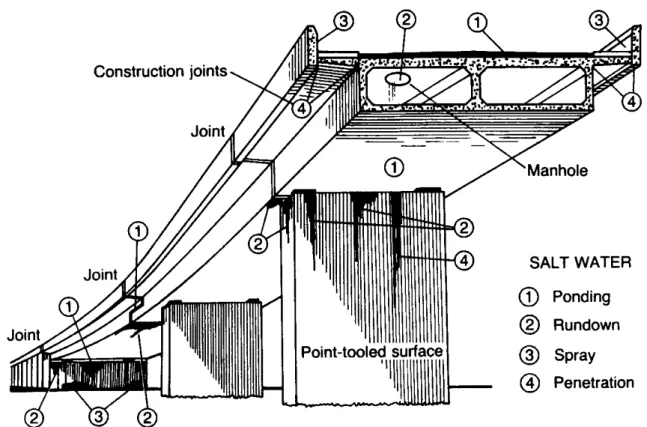
Many types of degradations can be observed on concrete bridge decks like leakage, settlements, deflection, wear, spalling, disintegration, scaling, delamination, etc. (Emmons et al., 1994). They are induced by physical, chemical and mechanical loads. Water is the main factor of aggression, not only by physical effect – i.e. freezing – but
2
also as a way of transportation for acid products – i.e. chlorides - inside the bulk concrete (Fig.1).
Figure 1 : typical zones of chloride ions attack (Pritchard, 1992) The causes of degradation may be classified in three main categories (Maage, 2004):
1. Causes of defects due to inadequate construction or materials: − inadequate structural design;
− inadequate mix design, insufficient compaction, insufficient mixing; − insufficient cover;
− insufficient or defective waterproofing; − contamination, poor or reactive aggregates; − inadequate curing.
2. Causes of defects revealed during service:
− foundation movement, impacted movement joints, overloading; − impact damage, expansion forces from fires.
3. External environment and agents (Fig 2 to 5):
− severe climate, atmospheric pollution, chloride, carbon dioxide, aggressive chemicals;
− erosion, aggressive groundwater, seismic action; − stray electric currents.
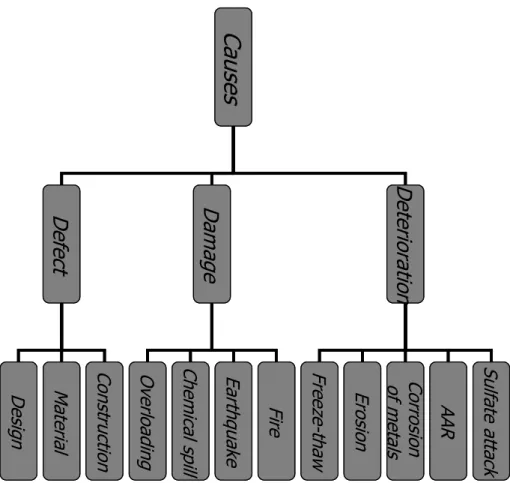
A general classification of the different modes of aggression is presented on Figure 6. The investigations necessary to qualify and quantify the defects and the causes of defects must be organized in such a way that the origin of degradation disappears (Schrader, 1992).
3
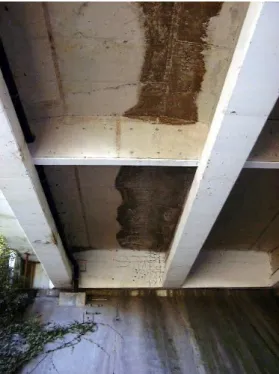
Figure 2: contamination of concrete bridge deck Figure 3: effect on deicing salts – scaling – on bridge concrete protection structures
Figure 4: leakage of Ca(OH)2 through cracked
concrete bridge deck
Figure 5: inefficient concrete beam repair operation (Emmons et al., 1994) Repairing concrete bridge structures is consequently necessary and quite common and usual in many countries. Interface quality will be the first parameter that will influence repair quality (Silfwerbrand, 1990; Silfwerbrand et al., 1998; Vaysburd et al., 2000). Quality is uneasy to define but, at the level of interface, it could integrate everything that promotes contact between the concrete substrate and repair material. Compatibility between the different materials appears to be of prime importance (Courard et al., 2007): shrinkage, rigidity, surface roughness, viscosity, temperature, creep, etc, will make the contact more effective or not and will allow for interactions between the materials. Bond strength is the macroscopic and measurable effect of these interactions (Czarnecki et al., 2007). Quantification is usually made from pull-off test, shear test or direct tensile tests (Bissonnette et al., 2004).
4
C
a
u
se
s
D
e
fe
ct
D
a
m
a
g
e
D
e
te
rio
ra
ti
o
n
D
e
sig
n
M
a
te
ria
l
C
o
n
st
ru
ct
io
n
O
ve
rlo
a
d
in
g
C
h
e
m
ic
a
l
sp
ill
E
a
rth
q
u
a
ke
F
ire
F
re
e
ze
-th
a
w
E
ro
sio
n
C
o
rr
o
sio
n
o
f m
e
ta
ls
A
A
R
S
u
lfa
te
a
tta
ck
C
a
u
se
s
D
e
fe
ct
D
a
m
a
g
e
D
e
te
rio
ra
ti
o
n
D
e
sig
n
M
a
te
ria
l
C
o
n
st
ru
ct
io
n
O
ve
rlo
a
d
in
g
C
h
e
m
ic
a
l
sp
ill
E
a
rth
q
u
a
ke
F
ire
F
re
e
ze
-th
a
w
E
ro
sio
n
C
o
rr
o
sio
n
o
f m
e
ta
ls
A
A
R
S
u
lfa
te
a
tta
ck
Figure 6: causes of concrete degradation
Qualification tests for concrete surface evaluation
In the beginning of a project where repair, protection or reinforcement works are planed on a concrete bridge, the condition of the structure must be inspected and assessed properly. A kind of expertise and qualifications expected from the assessment consultant, depends on the structure, its environment and potential defects (Austin et al., 1995). The investigation must be thorough enough to get a reliable picture over the existence, extent, grade, reasons and effects of all significant degradation mechanisms and to assess their progress and effect on the essential requirements that the structure shall meet.
In order to have an opinion as accurate as possible, the process of assessment should include but not be limited to the following items, as described in the European Standard [EN 1504-9, 4.3]:
• present condition of the existing concrete structure, including non-visible and potential defects;
• original design approach;
• environment, including exposure to contamination;
• conditions during construction (including climatic conditions); • history of the concrete structure;
• conditions of use (e.g. loading);
5
That information will be collected through visual inspection as well as tests procedure realized directly on site or in laboratory conditions. It is of prime importance to be able to check the global structure of the bridges, in order to determine causes and effects. A first step consists of taking into account the structural evaluation of the bridge by the following means:
• test on slab from site if the structure is made of a lot of repetitive elements; • loading test on site, in order to determine residual flexure or axial rigidity; • dynamic evaluation test, in order to evaluate rigidity from proper frequency
measurement;
• stress relaxation evaluation, with flat jacks and pressiometers into concrete sawed cracks.
but also:
• state of stress by means of flat jacks, double sawing method and hole core stress relaxation;
• evolution of geometry: GPS, photogrammetry; • extensometers and gauges for crack evolution.
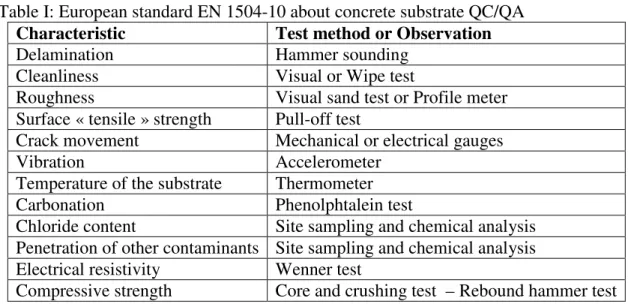
The next step is material oriented: is the quality of concrete still good enough to fulfil essential requirements of bridge deck properties: no chemical contamination, cohesive strength, “waterproofing properties”, etc. New European Standard gives some directions for such investigations (Table I):
Table I: European standard EN 1504-10 about concrete substrate QC/QA
Characteristic Test method or Observation
Delamination Hammer sounding
Cleanliness Visual or Wipe test
Roughness Visual sand test or Profile meter Surface « tensile » strength Pull-off test
Crack movement Mechanical or electrical gauges
Vibration Accelerometer
Temperature of the substrate Thermometer
Carbonation Phenolphtalein test
Chloride content Site sampling and chemical analysis Penetration of other contaminants Site sampling and chemical analysis Electrical resistivity Wenner test
Compressive strength Core and crushing test – Rebound hammer test The RILEM TC 184 IFE tentatively proceed to an evaluation of adequate test for concrete substrate quality assessment and, in accordance with Carino (Carino, 2003), next testing methods can be considered (Table II).
Table II: Semi-destructive and nondestructive tests for concrete quality assessment
In-place tests to estimate strength Non destructive tests for integrity
Rebound hammer Visual inspection
Ultrasonic pulse velocity Stress wave propagation methods Probe penetration Ground penetrating radar
Pull-off and Pull-out Electrical/magnetic methods
Break-off Nuclear methods
6
Finally, concerning the results of the tests and the observations during inspection, decision should be taken. Final decision could be (Maage, 2004):
• do nothing for a certain time,
• re-analysis of structural capacity, possibly leading to downgrading of the function of the concrete structure,
• prevention or reduction of future deterioration, without improvement of the concrete structure,
• improving, strengthening or refurbishment of all the concrete structure, • reconstruction of part of all of the concrete structure,
• demolition of part of all the concrete structure.
Here is considered the case where it is possible to enhance duration of life of the concrete bridge deck. Taking into account of real situation of structure, it is necessary to select repair techniques and materials and concrete surface preparation method. The selected method will directly influence on quality of surface and in consequence the efficiency of the repair operation (Courard et al. 2010 (a)).
Principles for adhesion
The concept of adhesion has firstly to be clearly defined because of the “duality” of the term (Derjaguin, 1978): “on one hand, adhesion is understood as a process through which two bodies are brought together and attached – bonded – to each other, in such a way that external force or thermal motion is required to break the bond. On the other hand, we can examine the process of breaking a bond between bodies that are already in contact. In this case, as a quantitative measure of the intensity of adhesion, we can
take the force or the energy necessary to separate the two bodies”.
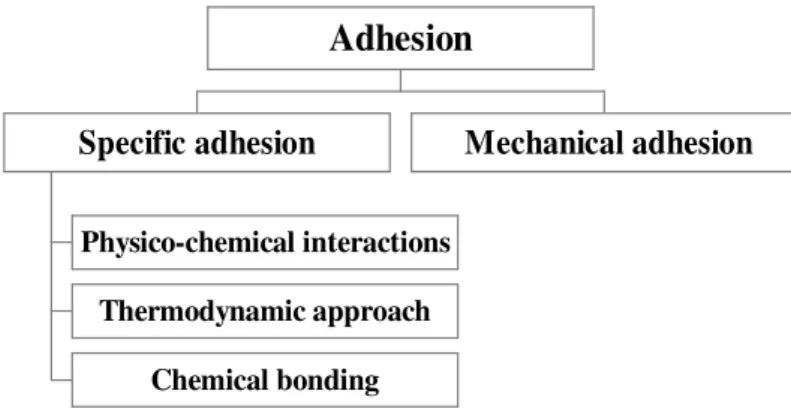
Adhesion has therefore two different aspects, according to whether our interest is mainly (1) in the conditions and the kinetics of contact or (2) in the separation process (Courard et al., 2010(b)). The intensity of adhesion will depend not only on the energy that is used to create the contact, but also on the interaction existing in the interface zone (Courard, 2000). Generally speaking, mechanism of adhesion has to be considered from two origins: specific adhesion and mechanical interlocking (Figure 7):
Physico-chemical interactions Thermodynamic approach
Chemical bonding
Specific adhesion Mechanical adhesion
Adhesion
Figure 7: principles of the theory of adhesion.
When the materials are in contact, the effective area, that means the surface where contact really exists, will be a fundamental parameter to be taken into account to explain
7
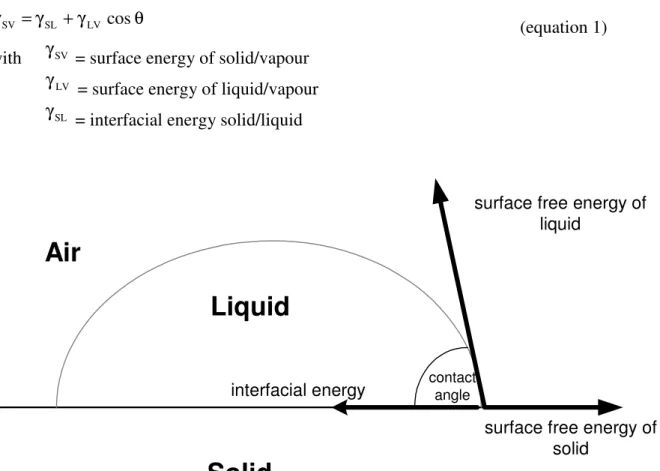
the adhesion process. This is the result of the wetting procedure of the solid body by the liquid phase. The wetting procedure can be explained as follows (Fiebrich, 1994): the surface energies of the solid and the liquid interact each other and a change of the energy conditions occurs due to surface decrease of liquid/vapour and solid/vapour interfaces while a new interface (liquid/solid) is created (Fig. 8). At this point of view, contact angle is an interesting representation of this phenomenon: the lower is the contact angle, the better is the spreading on the surface and the more effective will be the inter-molecular interactions at the interface. Relation between contact angle and free energies of liquid and solid is described with the equation of Young and Dupré (equation 1): θ γ + γ = γSV SL LV cos (equation 1)
with γSV = surface energy of solid/vapour LV
γ
= surface energy of liquid/vapour
SL
γ
= interfacial energy solid/liquid
Liquid
Solid
Air
surface free energy of liquid
surface free energy of solid
interfacial energy contactangle
Figure 8: wettability of a solid surface by a liquid – Young Dupré equation
The next step is the development of these interactions – van der Waals forces – between the different phases. Their effect is based on the formation of electric fields of different intensities, depending on the presence of permanent or induced dipole bonds, or only dispersion bonds. They can be attributed to two different effects (Courard, 2000): (a) dispersion forces arising from internal electron motions which are independent of
dipole moments;
(b) polar forces arising from the orientation of permanent electric dipoles and the induction effect of permanent dipoles on polarisable molecules.
Hydrogen bond forces can also be seen as a special case of dipole interactions: their range of actions extends further than that of the other secondary forces. At a higher level of energy, chemical bonds may appear when there is the development of covalent or
8
ionic bond. This is the case if bonding agents are intentionally used, particularly at the interface polymer/mineral substrate (e.g., silane family products). It is usually stated (Courard et al., 1998) that the transition zone that is formed when new concrete is cast against old concrete is very similar to bond between aggregates and cement paste.
Surface preparation techniques
The aim of concrete surface removal and preparation prior to repair is to get a concrete surface of properties similar to those of the bulk concrete (Murray, 1989). The related operations should thus normally lead to the following results (Courard et al. 2008):
• the exposed concrete surface sound, uniform, cohesive and free from dust, oil or other contaminants,
• the shape of the surface providing a good anchorage for the repair material (in that respect, parallelepiped or “ink-bottle” shapes are desirable).
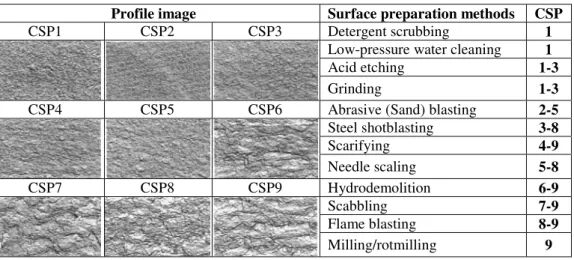
Existing concrete surfaces need to be roughened up to obtain a profile likely to promote good mechanical interlocking. The main parameters influencing the quality of the adhesion of the repair system on the concrete substrate are the magnitude of shear forces that will be acting at the interface, the repair material properties, the existing concrete properties and the placement technique (Cleland et al., 1992). Concrete removal techniques (Trend et al., 1998) commonly used in the field are summarized in Table 3, together with provided by the ICRI (ACI) reference replicates of Concrete Surface Profile (CSP) that can help for the visual surface qualification (Table III).
Table III: Commonly used concrete surface preparation methods and corresponding Concrete Surface Profile (CSP) (Bissonnette et al., 2006)
Profile image Surface preparation methods CSP
CSP1 CSP2 CSP3 Detergent scrubbing 1
Low-pressure water cleaning 1
Acid etching 1-3
Grinding 1-3
CSP4 CSP5 CSP6 Abrasive (Sand) blasting 2-5
Steel shotblasting 3-8 Scarifying 4-9 Needle scaling 5-8 CSP7 CSP8 CSP9 Hydrodemolition 6-9 Scabbling 7-9 Flame blasting 8-9 Milling/rotmilling 9
Effects of surface preparation
Roughness
The surface treatment of concrete substrate is important in order to promote mechanical
adhesion. The main problems arise from co-lateral effects of the treatment, especially
due to micro-cracks parallel to the surface (Bissonnette et al., 2006). After treatment, concrete surfaces present fractal topography. As for any fractal object, it is possible to break up this surface or this profile in a sum of sub-profiles. Each sub-profile can be
9
differentiated in terms of wavelengths; there is however no limit or precise criterion to validate the choice of decomposition method.
As mechanical interlocking is one of the basic mechanisms of the adhesion process (Courard, 2005), it is fundamental to be able to characterize the “roughness” of the substrate. Depending on local conditions of the specific building various types of surface treatments can be applied (Stromdhal, 2000) and a wild spectrum of shape and roughness can be induced.
The challenge is to quantify surface roughness with one or more parameters in order to evaluate preparation techniques prior to repair (Nittinger, 2001; Garbacz et al., 2006). Roughness is a generic term that depends on the scale that is chosen to quantify the surface: in civil engineering, the millimetre scale is usually enough to distinguish between surface treatments. Micro-roughness may however influence thermodynamic properties of surfaces (Talbot et al., 1994) by changing the contact angle: an increase in roughness usually causes a better spreading of the liquid on the solid surface.
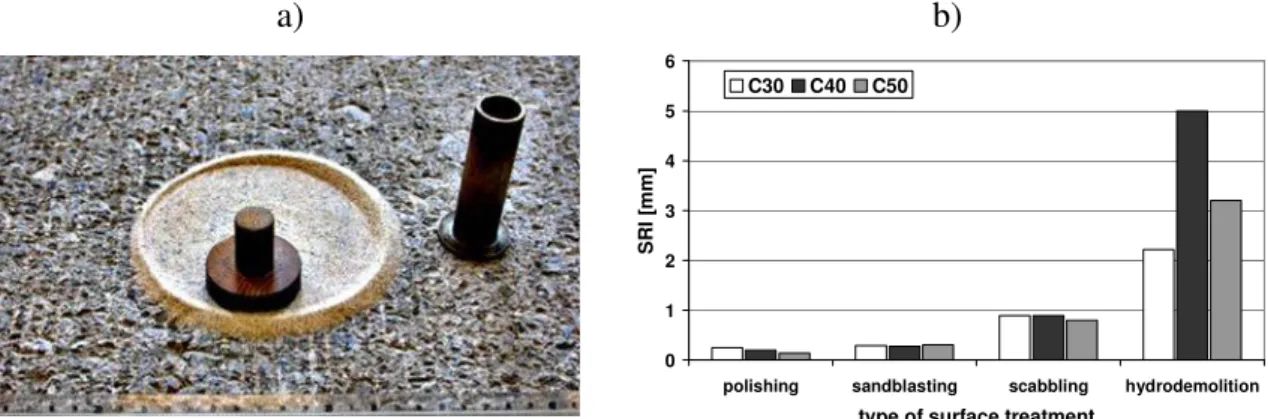
Many approaches are used to quantify surface roughness, for instance by determining the maximal depth of roughness (Courard, 2005), by performing adhesion tests (Bissonnette et al., 2004) or by calculating surface parameters based on image analysis and microscopical observations. Determination of the Surface Rough Index (EN 13036-1) can also give information to differentiate surface preparations. It measures roughness by spreading 50-g of 50-100 µm silica sand onto a surface in a circle (Fig.9a) and defines the average diameter of the area covered as the surface rough index (SRI): the higher the SRI, the rougher the surface (Fig.9b). This technique is however only applicable for horizontal surface.
a) b) 0 1 2 3 4 5 6
polishing sandblasting scabbling hydrodemolition
type of surface treatment
S R I [m m ] C30 C40 C50
Figure 9: sand patch test (a) and examples of Surface Rough Index after different surface treatments (b) (Piotrowski et al., 2007)
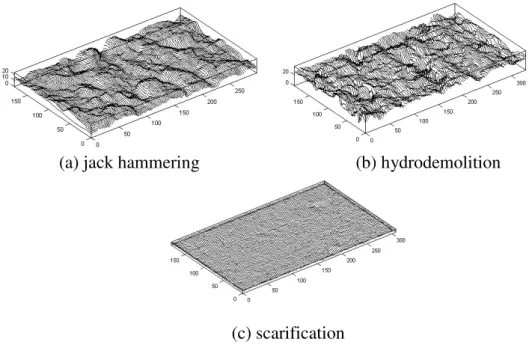
These techniques generally give only a partial view of the surface topography and are unable to provide a digitalized representation from which it is possible to calculate mathematical parameters. New developments are coming from surfometry analysis (Courard et al., 2003) and, more recently, from optical analysis (Perez et al., 2005). It leads to a digitalization of the surface (Fig. 10) from which it is possible, after signal filtering, to calculate geometric and statistic parameters, taking into account the frequency of the waves of high frequencies characterize roughness and of low frequencies associated to the waviness of the profile.
10
(a) jack hammering (b) hydrodemolition
(c) scarification
Figure 10: 3D-view of concrete substrate after different surface treatment (Courard, 2002).
The statistic parameters cannot however be univocally related to adhesion of the overlay. It seems that there is a threshold value, over which an increase in roughness of the profile does not necessarily translate into an increase in adhesion (Stromdhal, 2000). Moreover, an increase in roughness may be obtained with some techniques at the expense of superficial cohesion.
Microcracking
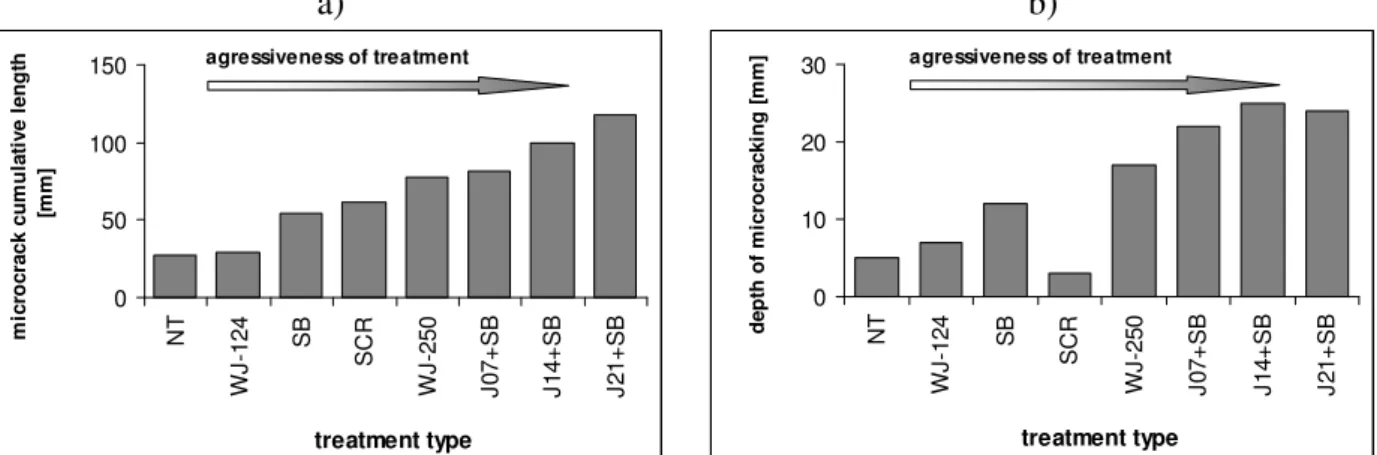
The superficial cracking is considered as the one of the most important parameters influencing adhesion in repair system. The respective influence of the various surface preparation techniques can be evaluated by microscopic observation of the near-to-surface area (Fig.11). Number and length of microcracks have been systematically registered for several of concrete compression strength classes and surface preparation methods (Fig.12).
Figure 11: evaluation of the length (Li) of the cracks and their projection on horizontal reference (Lx)
11 a) b) 0 50 100 150 N T W J -1 2 4 S B S C R W J -2 5 0 J 0 7 + S B J 1 4 + S B J 2 1 + S B treatment type m ic ro c ra c k c u m u la ti v e l e n g th [m m ] agressiveness of treatment 0 10 20 30 N T W J -1 2 4 S B S C R W J -2 5 0 J 0 7 + S B J 1 4 + S B J 2 1 + S B treatment type d e p th o f m ic ro c ra c k in g [ m m ] agressiveness of treatment
Figure 12: the length (Li) of the cracks (a) and depth of microcracking (b) against type of concrete surface treatment: NT – no treatment; WJ – water jetting – pressure 250MPa; SB – sandblasting; SCR – scabbling; J+SB – jack hammering of
weight 7,14,21 kg + sandblasting (Czarnecki et al., 2007) From the results obtained, the following conclusions can be formulated:
• low pressure water jetting does not generate microcracks in comparison to non-treated concrete substrate where cracks were presumably due to plastic shrinkage,
• sandblasting induces almost no significant degradation in the concrete substrate, • scabbling induce a big amount of microcracking in very near-to-surface area
decreasing its quality,
• high-pressure water jetting seems to induce some superficial cracking,
• the number of cracks and the total crack length resulting from the preparation with jack-hammer are significantly higher than with any other of the investigated techniques. It is also clear that increasing the jackhammer weight - and thus, its impact energy - causes both the length and the number of cracks increase significantly,
• as the treatment aggressiveness increases the number of microcracks increases. However in all tested cases the depth of microcracking was lower than 25 mm.
Cohesion of the near-to-surface layer
Pull-off test is usually performed in order to evaluate the bond strength between concrete substrate and repair material; if the test is made in absence of repair layer, it can be adopted as a cohesion measurement of the superficial concrete. There seems to be a correlation between the degree of aggressiveness and the reduction of strength: while sandblasting only induces a small decrease of pull-off strength, hydro jetting and scabbling, which are much energetic surface treatments, produce a larger decrease of resistance (12 and 13 %, respectively). The concrete quality – in terms of compressive strength class – does not seem to have a major influence on the cohesion of the superficial concrete (Fig.13). However, the high strength rates of the concretes probably limit the influence of the surface treatment on the quality of the surface.
12
Adhesion of repair system
Based on obtained results surface preparation effect can be divided in two groups in regards to EN 1504-10: bond strength after hydrodemolition and sandblasting is greater than the threshold minimum values for laboratory performance: 2.0 MPa for structural repair, 1.5 MPa for nonstructural. The bond strength for polishing and scabbling is close to or below the limit (Fig.13a). On the base of a visual assessment, the type of failure was registered for each specimen. In case of slabs treated by polishing, all failures appeared at the interface between concrete substrate and repair mortar. Scabbled surfaces present ruptures in the near to interfacial zone probably due to microcracking. Situation is more unclear for sandblasting and hydrodemolition techniques where cohesive A and interface A/B failures were observed (Fig.13b).
a) b) 0.0 0.5 1.0 1.5 2.0 2.5 3.0 3.5 4.0 4.5 5.0
polishing sandblasting scabbling hydrodemolition
type of surface treatment
p u ll -o ff s tr e n g th [ M P a ] C30 C40 C50 0% 10% 20% 30% 40% 50% 60% 70% 80% 90% 100%
polishing sandblasting scabbling hydrodemolition
type of surface treatment
ty p e o f fa il u re m o d e [ % ]
deep mean surface
Figure 13: Pull-off cohesion test results (a) and type of failure mode registered (b) (Piotrowski et al., 2007)
Conclusions
The investigation concerning the behaviour of the interface between repair systems and concrete substrate have shown that quality of concrete substrate is important factor affecting adhesion in repair system and has to be evaluated prior to repair. Mechanical preparation of concrete surface has to be balanced with the co-lateral effects such as superficial cracking: too much energy will induce the loss of benefits due to better mechanical anchorage. The problem is that we have not yet all the knowledge about synergetic effects of parameters characterizing surface quality (surface roughness, microcracking, wettability). “Out-of-science” parameters seem to have also important influence on the success of the repair. For example, it is necessary to operate with qualified people on site and to educate surveyors to be sure that the adequate choice of materials and repair techniques will offer an efficient and durable work.
References
Austin, S., Robins, P. and Pan, Y. (1995) Tensile Bond Testing of Concrete Repair,” Materials and Structures, 28(179), 249-259.
13
Bissonnette, B. and Courard, L. (2004) Pull-off Test for the Evaluation of the Superficial Cohesion of Concrete Substrates in Repair Works: Analysis of the Test Parameters, Materials and Structures, 37(269), 342-350.
Bissonnette, B., Courard, L., Vaysburd, A. and Bélair, N. (2006) Concrete removal techniques: influence on residual cracking and bond strength. Concrete International, 28(12), 49-55.
Carino, N.J. (2003) Nondestructive test methods to evaluate concrete structures. Sixth CANMET/ACI International Conference on the Durability of Concrete, Special Seminar, Thessaloniki, Greece, 75p.
Cleland, D. J., Yeoh, K.M. and Long A.E. (1992) The Influence of Surface Preparation Method on the Adhesion Strength of Patch Repairs for Concrete, Proceedings of the 3rd Colloquium on Materials Science and Restoration,” Esslingen, Germany, 858-871.
Courard, L. and Darimont, A. (1998) Appetency and adhesion: analysis of the kinetics of contact between concrete and repairing mortars. L. Courard, A. Darimont. in: RILEM International Conference, Interfacial Transition Zone in Cementitious Composites (Eds A. Katz, A. Bentur, M. Alexander and G. Arliguie, E&FN Spon), Haïfa, Israël : 185-194.
Courard L. (2000) Parametric Study for the Creation of the Interface between Concrete and Repair Products. Mater. Struct., 33, 65-72.
Courard, L. (2002) Evaluation of thermodynamic properties of concrete substrates and cement slurries modified with admixtures. Mater. Struct., 35, 149-155.
Courard, L. and Nélis, M. (2003), Surface analysis of mineral substrates for repair works: roughness evaluation by profilometry and surfometry analysis. Mag. Concrete Res., 55(4), 355-366.
Courard, L. (2005) Adhesion of repair systems to concrete: influence of interfacial topography and transport phenomena, Mag. Concrete Res., 57(5), 273-282.
Courard, L. and Bissonnette, B. (2007) Compatibility performance as a fundamental requirement for the repair of concrete structures with Self-Compacting Repair Mortars (keynote lecture). L. Courard and B. Bissonnette. In: 5th International RILEM Symposium on Self-Compacting Concrete, Proceedings PRO 54 (Eds. G. De Schutter and V. Boel, Rilem Publications), Gent, Belgium, 667-675.
Courard, L. Garbacz, A. and Piotrowski, T. (2008) Effects of concrete surface quality on repair mortars. CCC 2008 Challenges for civil construction (Torres Marques et al., Eds), FEUP, Porto.
(a) Courard, L. Vaysburd, A. and Bissonnette, B. (2010) Repair of concrete industrial floors with bonded cement-based material overlays: some recommendations Seventh International Colloquium Industrial Floors ’10, (Ed. K. Littmann, Technische Akademie Esslingen), Ostfildern/Stuttgart, Germany (14-16 December 2010), 617-622.
(b) Courard, L. and Garbacz, A. (2010) Surfology: what does it mean for polymer concrete composites? Restoration of Buildings and Monuments 16 (4/5), 291-302.
Czarnecki L., Courard L., Garbacz A. (2007) Evaluation of repair efficiency – effect of concrete surface quality, Engineering and Building (in Polish), 12, 630-634.
Emmons, P.H. and Vaysburd, A.M. (1994) Factors Affecting the Durability of Concrete Repair: the Contractor's Viewpoint, Construction and Building Materials, 8(1), 5-16.
14
Fiebrich M.H. (1994) Scientific aspects of adhesion phenomena in the interface mineral substrate-polymers. In: ed. F.H. Wittman, Aedificatio Verlag, Adherence of young and old Concrete, Proc. of 2nd Bolomey Workshop, Unterengstringen, 25-58.
Garbacz, A., Gorka, M. and Courard L. (2005) Effect of concrete surface treatment on adhesion in repair systems, Mag. Concrete Res., 57(1), 49-60.
Garbacz, A., Courard, L. and Kostana, K. (2006) Characterization of concrete surface roughness and its relation to adhesion in repair systems”. Mater. Charact., 56, 281-289.
Maage, M. (2004) The new European EN 1504 standard. Guidelines for consultant, NORECON Seminar, Kopenhagen, Denmark.
Murray, M.A. (1989) Surface Preparation for Adhesives: Concrete Practice Note,” Concrete International, 11(9), 69-71.
Nittinger, B. (2001) Concrete Surface Preparation Using Hydro Demolition, Concrete Repair Bulletin, V. 14, No. 1, 6-7.
Perez, F., Courard, L., Bissonnette, B., Garbacz, A. and Gorka, M. (2005) Two different techniques for the evaluation of concrete surface roughness. In: ICCRRR 2005
International Conference on Concrete Repair, Rehabilitation and Retrofitting (Eds. H.
Beushausen, F. Dehn and M.G. Alexander, 2006 Taylor & Francis Group, London), South Africa, 1015-1020.
Piotrowski, T., Garbacz, A., Schwall, A., Courard, L. (2007) On the effect of concrete substrate roughness on stress wave propagation in repair systems, Adhesion in
Interfaces of Building Materials: a Multi-scale Approach (ed. L. Czarnecki and A.
Garbacz), Advances in Materials Science and Restoration AMSR No. 2, Aedificatio Publishers, 247-257.
Pritchard, B. (1992) Bridge design for economy and durability, Thomas Telford Services, London, 172p.
Schrader, E.K. (1992) Mistakes, Misconceptions, and Controversial Issues Concerning Concrete and Concrete Repairs (parts I-III), Concrete International, 14(9-11).
Silfwerbrand, J. (1990) Improving Concrete Bond in Repaired Bridge Decks, Concrete International, 12(9), 61-66.
Silfwerbrand, J. and Paulsson, J. (1998) Better Bonding of Bridge Deck Overlays, Concrete International, 20(10), 56-61.
Strömdahl, C. (2000) The History of Hydro Demolition, Concrete Engineering International, V. 4, No. 8, 32-35.
Talbot, C.; Pigeon, M.; Beaupré, D.; and Morgan, D.R. (1994) Influence of Surface Preparation on Long-Term Bonding of Shotcrete, ACI Materials Journal, V. 91, No. 6, 560-566.
Trende, U., and Büyüköztürk, O. (1998) Size Effect and Influence of Aggregate Roughness in Interface Fracture of Concrete Composites,” ACI Materials Journal, 95(4), 331-338.
Vaysburd, A.M. and Emmons, P.H. (2000) How to Make Today’s Repairs Durable for Tomorrow – Corrosion Protection in Concrete Repair? Construction and buildings Materials, 14(4), 189-197.
Acknowledgements
These research projects were supported by the scientific cooperation program between foreign agencies of Wallonia-Brussels International (Belgium), MNiSW (Poland) and Slovenian Research Agency (Slovenia).