Unexpected influence of ionic
strength on
branched-pathway
interactions between
f-lactamases and
f-halogenopenicillanates
Fabien DE MEESTER, Andre MATAGNE, Georges DIVE and Jean-Marie FRERE*
Laboratoires deMicrobiologie etd'Enzymologie, Universite deLiege, InstitutdeChime, B6, B-4000 Sart Tilman (Liege), Belgium
Ionic strength strongly influenced the turnover/inactivation ratio in the interaction between
,I-halogeno-penicillanates and some class A ,-lactamases. This suggested the stabilization of a highly charged intermediate by solvation. Those data could be interpreted on the basis ofa reaction pathway where an
episulphonium ion was transiently formed. The various mechanisms proposed for explaining the'
formation'
of the dihydrothiazine chromophore are discussed.INTRODUCTION
Inactivation of active-serine /3-lactamasesby halogeno-penicillanates (Pratt & Loosemore, 1978; Orlek et al., 1980) is accompanied by a rearrangement of the penicilloyl moiety of the acyl-enzyme into a
dihydro-thiazinechromophore (EC',Scheme 1). With someclass
A enzymes, hydrolysis of the acyl-enzyme sometimes competes with that rearrangement (Scheme 1, k+3 #0) and the product itself readily rearranges into
2,3-dihydro-2,2-dimethyl-1,4-thiazine-3,6-dicarboxylate
(Frere et al., 1982; De Meester et al., 1986). Branched
pathwayshave not been detected withclass Cenzymes, andtheZn2+-containingfl-lactamasesutilize ,-halogeno-penicillanatesasnormalsubstrates(Bicknelletal., 1985;
De Meesteret al., 1986).
The various mechanisms that have been proposed (Cohen & Pratt, 1980; Charnas & Knowles, 1981; Foulds etal., 1984) to account forthe formation of the
dihydrothiazinefailtoexplainthefollowingexperimental results.
(1) No spontaneous opening ofthe thiazolidine ring
has been observed at neutral pH with long-lived
acyl-enzyme adducts formed between penicillins and active-site-serine DD-peptidases (Frere etal., 1976, 1978).
(2)Whenturnoverof the inactivatorwasobserved,the product rapidly rearranged into the dihydrothiazine (Frere et al., 1982a), whichmakes it difficult to involve
anenzyme-linked base in the rearrangement.
Wenowwish toreportthatthe drastic effects of ionic
strength on the apparent turnover/inactivation ratio
suggestadifferentrearrangement pathway,possibly one involving an episulphonium intermediate.
K k+2k
E+C~% EC EC* E+P
k+4
EC'
Scheme1. Interaction between
fl-lactamases
(E) and «-hal-ogenopenicillanate(C).Inmanycases, thek+3step isnotdetected.
MATERIAL ANDMETHODS
Clavulanic acid, /?-iodo-, k-bromo- and /,-chloro-penicillanic acidsweregifts ofDr.G. Rolinson (Beecham Pharmaceuticals, Betchworth, Surrey, U.K.), Dr. J. Kemp(Pfizer Central Research, Sandwich, Kent,U.K.), Dr. H.Vanderhaeghe (Katholiek Universiteit, Leuven,
Belgium) and Dr. M.Page (The Polytechnic,
Hudders-field, West Yorkshire, U.K.) respectively. Details of synthesis of ,-iodopenicillanic acid sulphone will be provided by J. M. F. on request. The /,-lactamases of
Streptomyces albus G, Klebsiella pneumoniae 10436, Bacillus licheniformis 749C andBacilluscereus5/B6were purifiedasdescribed by De Meester etal. (1987a), Joris et al. (1987), Thatcher (1975a) and Thatcher (1975b) respectively. The RTEM-2 ,-lactamase was purchased
from the Experimental Plant Microbial Technology
Laboratory, Porton Down, Salisbury, Wiltshire, U.K.
The DD-peptidase ofActinomadura R39 waspurified as
described by Frereet al. (1974).
The conductivity of the buffer (sodium phosphate, pH 7.0)wasadjustedtovarious valuesasmeasured with aMetrohm E527 conductometerequippedwithacellthe
constantof whichwas11.6 cm-'. Under thoseconditions,
50mM-sodium phosphate buffer (pH 7.0) and 50 mm-NaCl yielded conductance values of0.45 and 0.40 mS
respectively. Variations of ionic strength were always
measuredasvariations ofconductivity. All experiments were performed in the presence of EDTA (1O,M) to inactivate any contaminating trace of /1-lactamase II.
Thepresenceof EDTA didnotalter thepropertiesofthe class A fl-lactamases. In the case of the Streptomyces albus G fl-lactamase, all buffers contained 5% (v/v)
ethyleneglycol and 5% (v/v) glycerol.
Kinetic measurements
Inactivation rate constants
(ki)
were measured in the presence of a reporter substrate by continuouslymonitoring the rate of hydrolysis of nitrocefin or cephaloridin. Those experimentswere performedwith a
Beckman DU8spectrophotometerlinkedto anAppleII
microcomputer via a RS232C interface (De Meester et al. 1987b). The value of the ratios
(ki)1im
/Km andk+21K
were computed as described previously (Frereet al., 1982b). The apparent
(k+3+k+4)/k+4
ratio wasF. De Meester and others
determined by measuring the minimum
CO/EO
ratio necessary to obtain complete inactivationof the enzyme(where
Eo
and C0 aretheinitial concentrations of enzyme and inactivator respectively). The errors (S.D.) on the measurements of(ki),im/IKm
and of (k+3 + k+4)/k+4 wereabout5and 10
%
respectively. In the following discussion it will beuseful to rememberthat,in the case of branchedpathways andif
k,3
is >k+4,
inactivationischaracterizedby apseudo-first-order rate constant:
ki
(k)im [C]
[C]+KKc where(k1,
k+2k+4
k+2+k+3+k+4 andKC_
k+3K k+2+k+3 and thus(ki),im.
k+2.
k+4
KC K k+3The stopped-flow experiments were performed on a
Sigma ZWS-11 stopped-flow mixing unit (Biochem, Munich, Germany) adapted to a Dia-Log optical and detection set-up (Garching Instrument, Dusseldorf, Germany). The signals were analysed by a
data-acquisitionand treatment system for fast transientoptical signals as describedby Houssier & O'Kinski (1981). RESULTS AND DISCUSSION
Influence of ionic strength on the apparent (k+3 +
k+4)/k+4
ratio
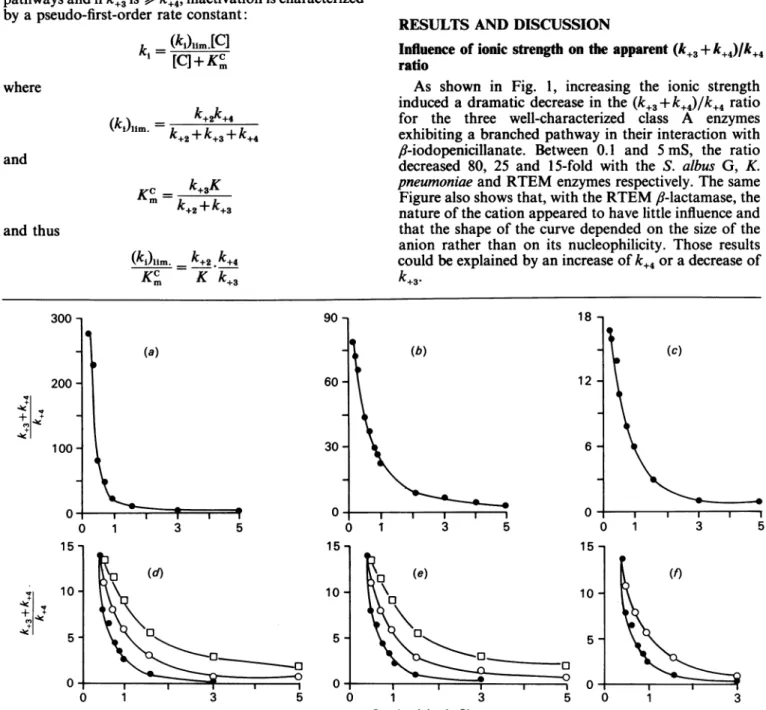
As shown in Fig. 1, increasing the ionic strength
induced a dramatic decrease in the
(k+,
+k+4)/k+4
ratiofor the three well-characterized class A enzymes exhibiting a branched pathway in their interaction with
fl-iodopenicillanate.
Between 0.1 and 5 mS, the ratio decreased 80, 25 and 15-fold with the S. albus G, K. pneumoniaeand RTEM enzymes respectively. The same Figure also showsthat, with the RTEM,-lactamase, the natureofthecation appeared to have little influence and that the shape of the curve depended on the size of the anion rather than on its nucleophilicity. Those results could beexplained byanincrease ofk+4oradecrease ofk+3.
(a) 90 -60 -30 - 0-1 3 5(d)
0 15 10 5 0 18 -(b) I I I I -I 3 5 12 -6 -(c) 01 l l l 0 1 3 5 15 10 5 0 (f) 0 1 3 5 0 1 3 5 0 1 3 Conductivity (mS)Fig.1. Influenceof ionicstrengthonthe apparent(k+3+k+4)/k+4ratio for the interaction between Ii-iodopenicillanate and thecdassA
l-lactamases
(a-c)Allexperiments wereperformed at30°C in6mM-phosphate. The conductivitywas adjusted to higher values by using NaCl. Theapparent(k+5 +k+4)/k+4ratiowasdeterminedasexplainedinthe Materials andmethods section. (a) S.albusG
,B-lactamase:10IO1 samplesofenzyme(1 mg ml-')wereincubated for 20minat30°Cwith 10,uloffl-iodopenicillanate solutions
ofincreasingconcentrations. Thepresenceofresidualactivitywasdetectedbyaddition of150 /SM-nitrocefin in 50 ml of100 ,UM-sodium phosphate, pH7.0. (b) Klebsiella pneumoniae (K1) fl-lactamase: conditions were as described above; the enzyme
concentrationwas0.5mg-ml-'.(c)RTEMfl-lactamase:conditionswereasdescribedabove;the f-lactamaseconcentrationwas
0.8mg*ml-'.(d-]) Influenceof thenatureof the salt: conditionswere asin(c),and thefollowingsaltswereused. (d)fl,NaF;
0, NaCl; *,Nal. (e) EO,NaF; 0, NaBF4; *,Nal. (f) *, NaI; 0,NaCl and LiCl (thecurves were superimposable). The
following conductivities were observed with 100mm concentrations of the various salts: 0.58 mS (NaF), 0.8 mS (NaCl),
0.78 mS (NaI), 0.74mS (NaBF4) and 0.64 mS (LiCl). Above 2.0mS, conductivities were no longer strictly proportional to concentrations. 300 200
4++
4c14 -k 0 15 l- 10- 5-t)ff *. 1 246 lF l7 l1Generally, little influence of ionic strength on the
kinetic parameters of class A /6-lactamases has been
observed. Some authors routinely use 0.5 M-NaCl in
incubationmixtures, and their resultsare notsignificantly different from those obtained at much lower salt
concentrations. Moreover, Fukagawa et al. (1984) observed a monotonic and non-spectacular effect of ionic strengthon thekinetic parameters of the B. cereus
/J-lactamase I with benzylpenicillin, ampicillin and
cephaloridin.
Recent results obtained with the same enzyme (S.
Waley,
personalcommunication)indicate that thevaluesofk+2and
k+3
aresimilar with severalpenicillins. In thatcase, variations of
k+3
due to ionic strength would thusdirectly reflect on the
kcat
values. With the S. albus Genzyme, the addition of 0.6 M-NaCl to 10mM-sodium phosphate decreased the
kcat
value byafactor of 3 with nitrocefin and 5with cephaloridin. Moreover, the study of other branched-pathway inactivators with the three enzymesstudied inthe present workyieldedthefollowingresults.
(i) Clavulanate inactivated the S. albus G/,-lactamase
with a turnover/inactivation ratio of 18000 +1000 in 50mM-sodium phosphate, pH 7.0 (Frere et al., 1982b).
The addition of 1 M-NaCl did not alter that ratio. (ii)
/,-Iodopenicillanic
sulphone inactivated theK. pneumoniae ,J-lactamase with turnover/inactivation
ratiosof 750, 850, 1000 and 2500 in 15 mM-sodiumbuffer added with 0, 40, 100 and 350 mM-NaCl respectively.
Attempts to obtain an estimation of
k+4
were made with the B. licheniformis ,-lactamase for which no turnover of ,3-iodopenicillanate was observed (De Meesteretal., 1986). Thoseexperiments, performedwith the help of the stopped-flow equipment, indicated that the appearance of the enzyme-bound chromophore at320nm remained strictly pseudo-first-order: at ,-iodopenicillanate concentrations of 5, 50 and 500fM and in 10mM-sodium phosphate, pH7.0, the values of the characteristic constants were 0.15+0.05,
1.5+0.3 and 15+5 s-' respectively. That the apparent
pseudo-first-order rate- constant remained propor-tional to the
/8-iodopenicillanate
concentration(k,/[C]
=k+2/K=30000M-'s-')
and very similar tothat obtained by monitoring the inactivation of the enzyme (De Meesteretal., 1986), aswell as the absence oflagin the appearance of the chromophore, indicated that the rate of formation of theacyl-enzyme was in all
casessmaller thantherateofthe rearrangement. Itcould
thus be concluded thatk+4was muchlarger than 15s-',
but itwas notpossibleto directly measure theinfluence of the ionic strength on the value of
k+4.
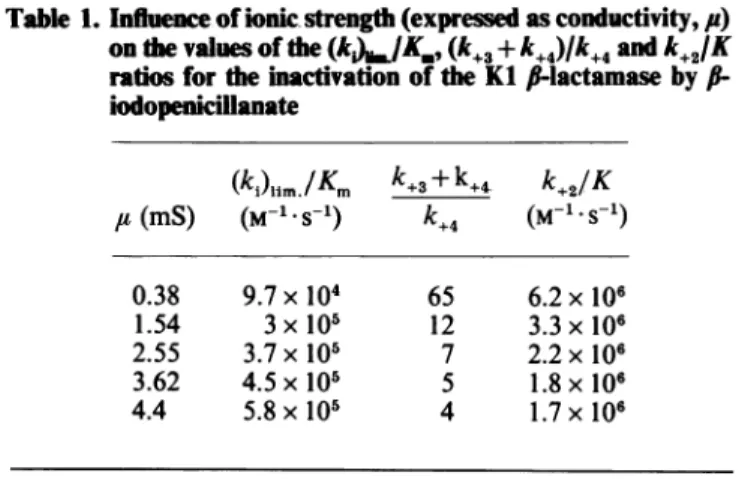
Variation of the inactivation rate with ionicstrength
The pseudo-first-order inactivation rate constant for the inactivation of the KI /3-lactamase was measured at ahigh
C0/EO
ratiosothat thehydrolysisof the inactivator remained negligible. To 500S1 of 70/M-nitrocefin in6mM-sodium phosphate, pH 7.0, added with various
NaCl concentrations andcontaining
,l-iodopenicillanate
concentrations
varying
from20.5toa82.2/LM(20.5,
32.9,
54.8 and 82.2), 50 ng of enzyme were added and theabsorbance was
continuously
monitored at 482nm. Ateachionicstrength,the apparent first-orderrateconstant remained proportional to the inactivator concentration
and only the
(ki)lim
/Km ratio could be measured(Frere
et al., 1982b). The value of
k+2/K
was alsocomputed
Table 1.Influence of ionicstrength (expressedasconductivity,/')
onthevaluesofthe
(k)O.JK*,
(k+3+k+4)/k+4andkjK
ratios for the inactivation of theKlf-lactamasebyf(-iodopenicillanate (k) jim
/Km
k+3+k+4k+2K
,u(mS) (M-1.S-1)k+4
(M-1.S-1 0.38 1.54 2.55 3.62 4.4 9.7x 10⁴ 3x 10⁵ 3.7x 10' 4.5x 10' 5.8x10⁵ 65 12 7 5 4 6.2x10⁶ 3.3x10⁶ 2.2x10⁶ 1.8x10⁶ 1.7x10⁶for each ionic strength. Table I shows that the
(ki)lim/Km
ratio increased with ionic strength, whereas thek+2/K
ratio slightly decreased. Those results could again be
explained by an increase of
k+4
which more thancompensated for the decrease ofk+2/K. Influence of the nature of the halogen
At pH 7.0 and in 6mM-sodium phosphate, the K. pneumoniae enzyme exhibited
(k+3+
k+4)/k+4
ratiosof 85 and 875 with ,-iodo- and bromo-penicillanate respectively. With /3-chloropenicillanate, although the
(k+3
+k+4)/k+4 ratio was decreased by increasing thebuffer concentration to 50 mm, it was still larger than
3000. This decrease ofthe ratio with increasing leaving capacity of the halogencould beinterpreted byassuming
that the departure of the halogen was the rate-limiting step of the rearrangement. Moreover, with
,-chloro-penicillanate, a branched pathway was also observed
with the B. licheniformis ,-lactamase. In 50mM-sodium
phosphate, pH7.0, the
(k+3
+k+4)/k+4
ratiowas 1000and(ki)jim
/Km
was 350m-1
-s-.Those results were also in good agreement with a decrease ofthe value of
k4
when I is replaced by Cl. Indeed, if the difference was only due to an increasedk+3,
a ratherunlikely
value muchlarger
than15000
s-should be assumed for the ,-chloro derivative. Proposed rearrangementpathway
A plausible rearrangement pathway must account for
the very rapid rearrangement and for the unexpected influence of ionic strength on the
(k+3+k+4)/k+4
ratio, which suggested the stabilization of a highly charged intermediate by a solvation effect. Since the pathways proposed previously (Cohen & Pratt, 1980; Charnas & Knowles, 1981; Foulds et al., 1984) involved the formation of athiolateanion,it wasimportanttoobtain further information allowing their rejection. That the base-catalysed removal of the C6 proton was quite unlikelywas shownby the facts that the dihydrothiazinewasquantitativelyandrapidly formed upon methanolysis of 8-iodopenicillanic acid and that the dihydrothiazine
was also immediately formed when the TEM and
Klebsiella enzymes hydrolysed fl-iodopenicillanate at
pH 5.0. The chromophore also appeared without any delay upon the hydrolysis of 500,u1 of 100
liM-fl-iodopenicillanate by 30,tg of the Bacillus cereus Zn2+
,/-lactamase
II in 100,uM-cacodylate buffer, pH4.75,F. De Meester and others I HH S CH3 \Ly -ACH3
EOQ2
H co02-0 ° CH3 EO H H C02_ III Rotation (180°) I HH N < I ~CH3 EO> S- H3 0 I, -I1 Step 1 Step2 H 1I Scheme2. Proposed episulphonium pathway fortheformationof thedihydrothiazine chromophoreI, Acyl enzyme; I', acyl enzymeafter a 1800 rotationaroundC5-C6;II,episulphonium intermediate; III, rearranged enzyme-linkeddihydrothiazine.
the presence of a free thiol group was obtained by addition of 5,5'-dithiobis-(2-nitrobenzoic acid) to (1)
100
,uM-a-methylbenzylpenicilloate
at pH 7.0 or (2) 13/sM-benzylpenicilloyl-enzyme
(R39 DD-peptidase) atpH7.8. This indicated that, under those conditions, no spontaneousopening ofthethiazolidineringoccurred at
a detectable rate and that the rapid formation of the
chromophore was impossible to explain on that basis. Moreover, the ionic-strength effect was specific to ,-halogenopenicillanates. The mechanisms generally
accepted for the branched pathways observed with clavulanate or penicillin sulphones also involve the
breaking of the C5-S or
C6-O
bond, and little variation of the(k+33+k+4)/k+4
ratiowas observed in thosecases.As an alternative hypothesis, we propose that the
highly chargedintermediatemightbe theepisulphonium
ion shown in Scheme 1. A similarepisulphoniumion had
alreadybeen envisaged byMcMillan &
Stoodley (1966)
as an intermediate in the slow rearrangement of
4D-carbomethoxy-5,5-dimethyl-a-chloro-2-thiazolidine
acetate to the
dihydrothiazine,
butrejected
for kinetic reasons.Inthemodelproposedhere(Scheme 2),thedeparture
of the halogen (Step 1) would be
rate-limiting.
This would also explain the observation that the rearrange-mentwhichfollows thehydrolysis
of thefl-lactam
amide bond is several orders ofmagnitude
faster withfi-halogenopenicillanates than with the a isomers (Pratt
&Cahn, 1988). Similarly, with the
fl-chloro
compound,we observed an immediate rearrangement, whereas McMillan & Stoodley (1966) isolated a rather stable
product by methanolysis of
methyl-6a-chloropenicil-lanate. Indeed, molecular models of the episulphonium
ionsobtainedstarting with the hydrolysis products of
,-iodopenicillanateanda-iodopenicillanate clearly showed thatthe latterwassostericallyhindered that its formation was impossible. Among the mechanisms proposed for
explaining the rearrangement, that which involves an
intermediate episulphonium ion remains the only one in agreementwith all the experimental facts. It is interesting to remember that an episulphonium ion is also an
intermediate in the reactions of mustard gas, which proceed orders-of-magnitude faster than expected for
primary alkyl halides (Bartlett & Swain, 1949).
Although most of the evidence remains indirect, the high rate of the phenomenon seems to exclude the
possibilityofa moredirect demonstration.Indeed,inall theexperimentsthat wereperformed,the openingof the
fl-lactam
amide(k,2
step) always appeared to remainrate-limiting.
This work was supported in part by the 'Fonds de li Recherche Scientifique Medicale' (contract n° 3.4507.83), an
'Action concertee' with the Belgian Government(convention
86/91-90),aconvention with the
'Re6gion
wallonne'(C2/C16/ Conv.246/20428), the 'Fonds de Recherche de la Faculte de MedecineULg' and a contractwith theEuropean Economic Community (BAP-0197-B).REFERENCES
Bartlett, P. D. & Swain, C. G. (1949) J. Am. Chem. Soc. 71,
1406-1415
Bicknell, R., Emanuel, E., Gagnon, J. &Waley, S.G. (1985)
Biochem. J. 229, 791-797 248
Charnas, R. L. & Knowles, J. R. (1981) Biochemistry 20, 3214-3219
Cohen, S. A. &Pratt, R. F.(1980)Biochemistry 19,3996-4003 De Meester, F., Frere, J.M., Waley, S.G., Cartwright, S.J., Virden, R. &Lindberg, F. (1986) Biochem. J.239, 575-580 De Meester, F., Joris, B., Lenzini, M. V., Dehottay, P., Erpicum, T., Dusart, J., Klein, D., Ghuysen, J.M., Frere, J. M. &Van Beeumen,J. (1987a)Biochem. J. 244,427-432 De Meester, F., Joris, B., Reckinger, G., Bellefroid-Bourguignon, C., Frere, J. M. & Waley, S.G. (1987b) Biochem. Pharmacol. 36, 2393-2403
Foulds, C. D., Kosmirak, M., O'Sullivan, A.C., Sammes,
P.G. (1984) in Recent Advances in the Chemistry of ,-Lactam Antibiotics (Brown, A. G. & Roberts, S.M., eds.), p.255, Royal Society ofChemistry, London
Frere, J. M., Moreno, R., Ghuysen, J. M., Delcambe, L., Dierickx, L. & Perkins, H. R. (1974) Biochem. J. 143,233-240 Frere, J. M., Ghuysen, J. M.,Vanderhaeghe, H.,Adriaens, P., Degelaen, J. & DeGraeve, J. (1976) Nature (London) 260, 451-454
Frere, J. M., Ghuysen, J. M. & De Graeve, J. (1978) FEBS Lett. 88, 147-150
Frere, J. M., Dormans, C., Duyckaerts, C. & De Graeve, J. (1982a) Biochem. J. 207, 437-444
Frere, J. M., Dormans, C., Lenzini, V. M. & Duyckaerts, C. (1982b) Biochem. J. 207, 429-436
Fukagawa, Y., Sakamoto, M. & Ishikura, T. (1984) in Recent Advances in theChemistry offl-LactamAntibiotics(Brown, A.G. &Roberts, S. M., eds.), pp. 381-386, Royal Society of Chemistry, London
Houssier, C. & O'Kinski, C. T. (1981) NATO Adv. Study Inst. Ser. B64, 309-339
Joris, B., De Meester, F., Galleni, M., Frere, J. M. & Van Beeumen, J. (1987) Biochem. J. 243, 561-567
McMillan, I. & Stoodley, R. J. (1966) Tetrahedron Lett. 1205-1210
Orlek, B. S., Sammes, P. G., Knott-Hunziker, V. & Waley, S. G. (1980) J. Chem. Soc. Perkins Trans. 1, 2322-2329 Pratt, R. F. & Cahn, D. J. (1988) J. Am. Chem. Soc. 110,
5096-5104
Pratt, R. F. andLoosemore, M. J. (1978) Proc. Natl. Acad. Sci. U.S.A. 75,4145-4149
Thatcher, D. R. (1975a) Methods Enzymol. 43, 640-652 Thatcher, D. R. (1975b) Methods Enzymol. 43, 653-664