Multiagent Incremental Learning in Structured
Networks
Gauvain Bourgne1, Amal El Fallah Seghrouchni2, Nicolas Maudet1, and Henry Soldano3
1
LAMSADE, Univ. Paris-Dauphine Paris 75775 Cedex 16 (France)
Email: {bourgne,maudet}@lamsade.dauphine.fr
2
LIP6, Univ. Pierre and Marie Curie
104, Avenue du Pr´esident Kennedy - 75016 - Paris (France) Email: [email protected]
3
LIPN
93430 Villetaneuse (France)
Email: [email protected]
Abstract. This paper presents a framework for incremental multiagent
learn-ing in structured networks, that is, systems in which the communicational links between agents is constrained. Learning examples are incrementally distributed among the agents, and the agents must build a common hypothesis that is con-sistent with all the examples present in the system. We recently proposed layered mechanisms to enable agents to coordinate their hypotheses at different levels, that have been shown to guarantee (theoretically) global consistence, but: (i) this is just one aspect of their effectiveness; and (ii) this would be of little practical interest were these mechanims to involve a great loss of efficiency (for instance a prohibitive communication cost). We explore these questions theoretically and experimentally (using different boolean formulas learning problems).
1 Introduction
Different tasks can be achieved by groups of autonomous agents, either competitively or cooperatively. In this paper, we are interested in multiagent concept learning: group of agents perceive individually and locally the environment (receiving examples), and cooperate to come up, each of them, with a “satisfying” underlying concept
(hypothe-sis). We believe there are (at least) two features that must be taken into account when a
group of distributed agents are collaborating to achieve such a common learning task:
– the learning task is likely to be incremental, that is the training set is not given a
priori. Instead examples are collected incrementally (and locally) by agents;
– communications between agents cannot be guaranteed. This can be due to the fact
that the communication channel may be unreliable, and/or simply that there exists a (fixed or evolving) topology constraining interactions between agents. In this paper we are concerned with this latter aspect of the problem.
A typical example application would a distributed sensor network, where each sensor (seen as an agent) would have control over some restricted area, and would need to interact with neighbours sensors in order to analyze the behaviour of some unknown third-party. The research challenge is then to design mechanisms that enjoy efficiency properties without being overwhelmingly burdening as far as communication is con-cerned. We are not aware of any attempt to tackle both features simultaneously. In particular, an incremental multiagent algorithm was proposed in [2], but it assumes that the system is a fully connected society of agents. The purpose of this paper is to pro-vide a first approach to tackle symbolic learning in a structured network of agents (as we shall see, our experimental study provides interesting clues to develop more refined variants). This work will be based on an hypothesis refinement framework described in [1]: the general idea of this mechanism is to allow agents to propagate relevant ex-amples to a learning agent. While the proposed mechanism has been shown to guaran-tee some theoretical consistency properties, other aspects should be considered before one can conclude that it is practically useful. For instance, it is crucial to analyze how costly would be such a mechanism in terms of communications. The first contribution of this work is to provide such an analysis. In practice, there are many other parame-ters that are needed to assess the quality of the mechanism. Is the obtained hypothesis accurate, and concise? What is the average communication cost? Does the mechanism end up replicating every examples? does it requires lots of internal computations? In this paper, we discuss these aspects by performing a number of experiments on differ-ent (typical) constrained networks.As argued before, while some other papers address some of these features, there are very few works addressing both aspects of the prob-lem in combination —especially in a symbolic learning perspective. In general indeed, learning in complex situations (involving uncertainty and unreliable communications) is performed with a numerical model, see e.g. [9]. Ontanon et al. [7] is a notable excep-tion, and presents an argumentation based multiagent learning system for case-based reasoning. The remainder of this paper is as follows. Section 2 presents the basic in-gredients of our approach, giving details on the knowledge representation, and the key notion of consistency, which represents the adequacy between an hypothesis and a set of examples. Section 3 gives the details of the main mechanisms used in the paper. The proposed mechanism can be guaranteed to ensure consistency at the global level, but may require an quadratic number of communications in the worst-case. To get a clearer picture of the situation, we ran several experiments that are reported and commented in Section 4.
2 Formal model
This section presents a general formal model for dealing with consistency between groups of agents in a multiagent system. It is here presented in the context of multiagent concept learning (interpreted as the building of a common consistent hypothesis).
2.1 Knowledge representation
We take a system populated by n agents a1, . . . , an. Each agent aihas two different kinds of knowledge:
– Eiis the example memory, representing certain, non-revisable individual knowl-edge of each agent. This set represents the collected knowlknowl-edge of each individual agent, and would be called observation set in other contexts. These examples are
certain and fully described (We do not consider uncomplete or noisy information).
– hi is the working hypothesis, or favourite hypothesis of the agent, representing the uncertain, explicit knowledge of the agent. It is derived from non-monotonic inferences and is therefore revisable.
The following representation will be used for learning boolean formulae. We consider a propositional language Lp, defined over a set of atoms A. An example e in an example memory is represented by a tag + or − (depending wether they belong or not to the target concept) and a description which is a conjunctive statement, that is, a conjunction of atoms from A. An example memory Eiwill then be divided in two sets Ei+and E
− i that contains respectively examples labeled with + (positive examples) or − (negative examples). An hypothesis will then be a disjunction of conjunctive statements, or terms, that is hi = p1 ∨ . . . ∨ pm, where each term pk is a conjunction of atoms: pk = a1∧ . . . ∧ aland ∀jaj∈ A.A hypothesis is thus a formula in disjunctive normal form.
2.2 Consistency
As hypotheses are uncertain, they can be in contradiction with some other knowledge. We want to ensure that the working hypothesis hihas some property ensuring its in-ternal coherence and adequacy with the non-revisable knowledge Ei. Very abstractly, we shall capture this adequacy by a complete binary relation Cons(h, E) between an hypothesis h and certain knowledge E, the consistency relation. For a given case, we will assume that there exists a hypothesis h0 that is consistent with the union of the sets of all example memories (in our concept learning application, it means that the target concept can be expressed in the hypothesis language). To instantiate consistency in concept learning, we first introduce a generality relation. We will say that a term p is more general than another term p"
(p |=s p"), iff the constituting atoms of p are in-cluded in those of p"
.Then a hypothesis covers an example iff one of its term is more general than the example’s description, and covers an example set iff it covers every examples in it. We shall then consider that an hypothesis is consistent with a set of examples E (noted Cons(h, E)) iff it ensures the two following properties: (i)
Coher-ence: h does not cover any negative example of E−; and (ii) Completeness: h does cover all positive example of E+. This consistency relation is compositionnal, meaning that: Cons(h, O) and Cons(h, O") iff Cons(h, O ∪ O").
We now extend this notion of consistency to groups of agents.
Definition 1 (Group Consistency). An agent aior an hypothesis hiis group consistent
wrt. the group of agents G (GCons(ai, G) or GCons(hi, G)) iff Cons(hi, ∪i∈GEi). Depending on the cardinality of the group G, we can talk of different “levels” of consis-tency: (i) internal consistency— this is the limit case when G is limited to a single agent (ensures that its hypothesis is consistent with its certain knowledge (Cons(hi, Ei)); (ii)
peer consistency— when G is a pair of agents (important in our context for
characteriz-ing results of local bilateral communications.); and (iii) MAS-consistency —in the limit case involving all agents within the society.
2.3 Revision mechanism
To ensure consistency at these different levels, agents will use reasoning and commu-nication processes that we shall call revision mechanism. As with consistency, it is pos-sible to consider different levels of revision mechanism depending on the number of agents involved in the process. To begin with, each agent will be equipped with an
inter-nal revision mechanism, which is a mechanism µ by which an agent ai(with its working hypothesis hiand its example memory Ei) receiving an example e updates its example memory by adding up e, and update its working hypothesis to h"
i = µ(Ei, hi, e) such that Cons(h", E
i∪ {e}) (such a mechanism is said to preserve internal consistency). Then, a local revision mechanism is a mechanism M2by which an agent a
ireceiving a labeled example e communicates with another agent ajto update its working hypoth-esis and possibly the hypothhypoth-esis of the other agent. A global revision mechanism is a mechanism Mnby which an agent a
ireceiving a labeled example e triggers a series of local revision mechanisms to update its working hypothesis and possibly the hypothe-ses of the other agents. A revision mechanism M is said to guarantee GCons(ai, G) iff, for any example e reaching ai,it is the case that the execution of M by aiwith G will result in a situation where GCons(ai, G) holds.
2.4 Communicational constraints
The communication of the agents might be constrained by topological considerations. A given agent will only be able to communicate with a number of neighbours. We can then construct a communication graph representing these communication links between the agents4. In the following, we will suppose that this graph is connected, that is, it contains a path between any pair of agents, and that it remains static during the time required for the revision process (though it could possibly change between revisions).
2.5 Problem description
Given a system of n agents a1, . . . , an, the objective is usually to devise some global mechanism guaranteeing MAS-consistency. Agents cooperate during the revision to form a common MAS-consistent hypothesis. When an agent aireceives a new exam-ple contradicting the common hypothesis, this agent triggers a revision mechanism to rebuild another hypothesis and ensure its MAS-consistency. Once the revision is done, another example can be received, and the process can be iterated. This iteration pro-duces a sound multiagent incremental learning process. The multiagent incremental learning mechanism described in [2] can be interpreted as a global revision mecha-nism guaranteeing MAS-consistency in fully connected societies of agent. However, this solution offers no guarantee when we have to deal with some communicationnal constraints restricting the communicationnal links between the agents.
4We assume that the relation that links two neighbours in a communication graph is symmetric,
3 Mechanisms with propagations
In the fully connected context studied in [2], a single learner agent initiating the revision would use in turn all the other agents as critics to validate its hypothesis until all these agents would directly accept the same hypothesis. However, when communications are constrained, a single learner cannot directly propose its hypothesis to all others agents. The global mechanism must then rely on some kind of propagation. In [1], a layered mechanism based on these principles and decomposed at three levels has been proposed. It is a simple mechanism that we study here as a first step-stone whose analysis will be helpful to devise more refined mechanism. Each agent possess an internal revision mechanism µ preserving internal consistency. Two agents can then reach a common peer-consistent hypothesis through a local revision mechanism where a learner agent use its internal revision mechanism to propose hypotheses to a critic agents. At last, a global revision mechanism articulates these local exchanges to ensure that MAS-consistency is reached. We first recall briefly the basic ideas of this mechanism, before turning on to the examination of its efficiency properties.
3.1 Learning process
Our internal revision process is based on MGI, an incremental bottom-up learning pro-cess fully described in [6]. As said before, the hypothesis is a disjunction of terms p. In MGI, each of these terms is by construction the lgg (least general generalisation) of a subset of positives examples {e1, ..., en}, that is the most specific term cover-ing {e1, ..., en}. The lgg operator is defined by considering examples as terms (using their description), so we denote as lgg(e) the most specific term that covers e, and as lgg(h, e) the most specific term which is more general than h and that covers e. Restrict-ing the term to lgg is at the core of many bottom-up learnRestrict-ing algorithms (for instance [3]). Taking a current hypothesis h, consistent with an example memory E = E+∪E−, and a new labeled example e, the revision mechanism builds a new hypothesis h" consis-tent with E∪{e}. There are three possible cases: (i) consisconsis-tent example — Cons(h, {e}: no update needed.(ii) positive counterexample — e positive and h '|=se: here, we seek to generalise in turn the terms p of h. If a coherent generalisation p" = lgg(p, e) is found, p"replaces p in h, otherwise h ∨ lgg(e) replaces h. (iii) negative counterexample
— e negative and h |=se: each term p covering e is then discarded from h and replaced by a set of terms {p"
1, ...., p "
n} that is, as a whole, coherent with E− ∪ {e} and that covers the examples of E+uncovered by the suppression of p.
3.2 Local hypothesis exchange
At the local level, pairs of agents use a simple protocol for hypothesis exchanges, as proposed in [1]. The agent applying this mechanism, called M2
U, takes an active role in building and refining an hypothesis. It is called the learner agent. The second agent is a critic, that uses its knowledge to acknowledge or invalidate the proposed hypothesis. The learner agent ai first updates its hypothesis hi to h"i using an internal revision mechanism µ guaranteeing internal consistency. Then it proposes it to the partner agents aj, and ajeither replies with acceptdirectand adopts h"ias its new working hypothesis
if Cons(h"
i, Oj), or otherwise sends counter-example(o"), where o" ∈ Oj is such that Cons(h"
i, {o
"}) is false. Upon reception of a counter-example, a
i applies again µ to revise its hypothesis with the new observation, and proposes the resulting hypothesis as before, except that an acceptation will now result in a acceptindirect message. This revision mechanism can be shown to guarantee peer consistency [1], and ensures that afterwards, both agents share the same hypothesis.
3.3 Propagating hypotheses in a network
In [1], Bourgne et. al. propose to use the same principle as in [2] of a main learner, the root, being the origin of the hypothesis, but, here, its neighbours will be in turn critics and learners, acting as proxies to propagate the hypothesis.To ensure that propagation does not reach the same agent from two different ways, cycles are eliminated by con-structing (on-the-fly) a spanning tree (a tree-like sub-graph that contains all the nodes of the original graph). The global revision mechanism Mn
P [1] does this while propa-gating the hypothesis. The agent initiating Mn
P is called the root, it will have a role of
learner during the whole process, and will be the source of the adopted hypothesis. It
is initially the only marked agent. It first sends request-links messages to all its neigh-bours, who become its children and are thus marked. Then, it selects its first child to take a role of critic in a local exchange (with M2
U), before asking it to propagates the resulting hypothesis. When asked to propagate an hypothesis, a child acwould first send
request-links to its neighbours (except its parent) if it has not already done so (marked
neighbours will reject the request while others would become its children).
– If it has a child that has not accepted its current hypothesis, acwould select it as a critic and take a role of learner to propose its hypothesis (adopted from its parent). • If the local exchange ends with acceptdirect, ac asks its child to propagate in
turn this hypothesis.
• If it ends with acceptindirect, achas learned a counter-example and changed its hypothesis. It informs its parent by sending a message hyp-changed. Receiving this message, the parent will act as a learner to get the new counter-example through a local exchange, and warns its own parent to do the same until the root get the counter-example, and build a new hypothesis.
– Otherwise, all its children, if any, have acknowledged its hypothesis h, accan thus tell its parent that it acknowledges h (strong-accept). The parent would then check if it has other children that have not yet strongly accepted h, and start a local ex-change with them or send a strong accept to its own parent.
When the root has received a strong accept from all its children for its current hypoth-esis, it means that this hypothesis is consistent with all agent and has been adopted by every one of them. The global revision is completed. This mechanism guarantees consistency (provided the system is connected, of course), and the resulting MAS-consistent hypothesis is shared by all agents in the system after termination. Note also that it behaves like the SMILE algorithm [2] when the network is fully connected. How-ever, this only provides a rather coarse-grained understanding of the effectiveness of this mechanism, and many questions remain. How accurate is the obtained hypothesis? How
compact is it? On top of that, the complexity of the process consisting in building the propagation network on-the-fly while propagating the hypothesis may raise doubts on its practical relevance. If the communication cost involved is prohibitive, this would be a severe weakness for a mechanism that ambitions to be deployed on large-scale agent networks. We now turn our attention to these issues.
3.4 Communication Complexity
To discuss the communicational complexity of our mechanism, we divide the commu-nication in two categories, whether they serve to build the spanning tree (link requests) or to validate an hypothesis. The first kind of communication can indeed be done once for all before learning if the communicational links are stable. For establishing the span-ning tree, each agent has to request links with each of its neighbours (except its parent, if any), the cost would thus be O(e) where e is the number of edges. The worst case would then be O(n2
), when the graph is fully connected.
Then, for validating an hypothesis, we first compute the number of messages that are needed to propagate a counter-example back to the root in the worst case, that is, when the counter-example is as far as possible from the root, and is used as a critic in last position. Let L be this maximal path, between the root a0 and an agent ak. The hypothesis of the root would only be proposed to ak after being validated by all the other agents as ak is the last critic, thus after n − 1 series of dialog which size is roughly constant (propose(h), accept, propagate, and later on strong-accept). Then, when the hypothesis is proposed to ak, the counter example is given, and a series of L exchanges (namely, propose(h), counterexample(e), propose(h!)), accept, hyp-changed propa-gate this counter-example back to the root. Thus, for each counter-example, we have O(L + n) communications of 4 to 5 messages. As in the worst case, L = n − 1, there is at worst O(n) communications per counter example. The total number of communica-tions for hypothesis validation is thus O(nc) where c is the number of counter-examples involved in the building of the hypothesis, which surely cannot be greater than the num-ber of examples in the system that are not known by the root. This upper bound on the number of counter-examples involved is tight, as the following example shows.
Example 1. Suppose n agents are connected on a single line, from a1to an. The concept to be
found is ab ∨ oc. The example memories are empty, except for Enwhich contains two examples
{bac+, bec−}. The working hypothesis is bac for all agents. Now a1receives boc+: h is made
more general and becomes bc. This hypothesis is propagated and accepted by all agents until an,
which provides the counter-example bec−. Then an−1proposes an empty hypothesis, since its
memory does not contain any positive example to cover. anprovides again a counter-example by
exhibiting bac+: a new hypothesis bac is formed and accepted. But now observe that the same dialogue will bilaterally occur between agents to propagate back to the root, where boc ∨ bac is accepted. In this example, the two examples initially present in the system have been used by each agents as counter-examples.
In practice, c will really depend on n. Indeed, the probability that an hypothesis in-crementally built by an agent is contradicted by another example in the system depends on the number of examples upon which it is built, and such a number will tend to be lower when n increases (as each agent hold less examples).
4 Experiments
In this section, we describe our experiments with this propagation protocol, used for learning several difficult boolean formulas. An experiment is typically composed of 20 to 50 run, each one corresponding to a sequence of examples incrementally learned by the MAS: a new example is sent to a random agent when MAS-consistency is restored.
4.1 Parameters
We considered different boolean problems of various difficulty. The 11-multiplexer (M11, see [5]) uses 3 address boolean attributes a0, a1, a2and 8 data boolean attributes d0, ..., d7. Formulae f11is satisfied if the number coded by the 3 address attributes is the number of a data attribute whose value is 1. More complex variant are M11 9, where 9 irrelevant attributes are added to the examples description, and the 20-multiplexer, M20, which has 4 address boolean attributes and 16 data boolean attributes. X-OR problems concerns a number of boolean attributes whose sum must be odd. We will use these parity problems with 5 attributes, and either 5 or 15 irrelevant attributes ( Xor5 5 and Xor5 15). At last, we shall use a simple DNF with 4 terms on 9 attributes, DNF4-9, whose formulae is a0a1a2 ∨ a2a3a4∨ a4a5a6∨ a6a7a8. Table 1, further on, gives the total number of attributes, and the number of terms of the target formulae of these problem. In these problems, there is 2p possible examples where p is the number of attributes. Half of them are positive (except in DNF4-9).
We tested the protocols in different settings, corresponding to different topologies of
the agent networks. Two parameters can vary: the number of agents in the networks, and
the type of network. Fully connected graphs are used to compare the performance of Mn
P with those of SMILE [2] in an equivalent context. Lines graph, where every agent aiis connected to two agents, ai−1and ai+1except for a0and an, provides worst-case scenarios. Regular trees of degree 3 are taken as examples of hierachical structures. Finally, we used small worlds, that are quite common in self organised networks such as for instance peer-to-peer or social networks.
4.2 Evaluation
We assess the performances according to several effectiveness and efficiency measures.
Effectiveness is evaluated through two different measures. Accuracy is the classical
rate of accurate classification of a batch of test examples distinct from the learning set, whereas Hypothesis size is the number of terms in the hypothesis. A small hypothesis is more simple and easier to understand.
Efficiency is concerned with three aspects: (i) Redundancy, which is used to study
the distribution of the examples in the MAS memory, is written RS = nS/ne, where nSis the total number of examples stored in the MAS, and neis the total number of ex-amples received from the environment in the MAS; (ii) Computational cost is the mean number of internal revisions done during a global revision; and (iii) Communicational
cost finally is mainly measured through the mean size of data transfer per global
4.3 Results
We give here our main results of our experiments, illustrated with M11 and Xor5 15 problems. Conclusions on the general behaviour have been checked with all problems.
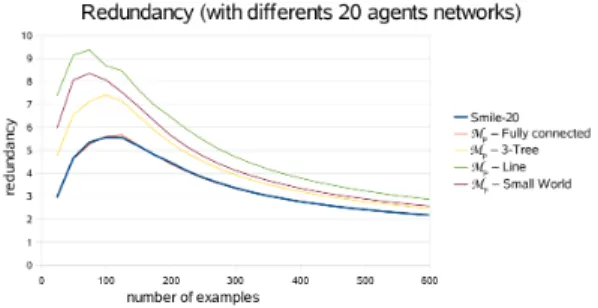
Redundancy and computational cost. Figure 1 shows the redundancy results for
different 20 agents networks with M11 problem. We can see that for fully connected societies, the propagation mechanism behaves exactly like SMILE, as ensured by con-struction. In other topologies, the redundancy is slightly higher, especially for Line networks, but remains quite low (e.g. 2.85 for M11 with a Line of 20 agents). The average ratio of redundancy between Mn
P and Smile is also low (around 1.2), with a maximum of 1.66 for lines of 20 agents in complex problems (Xor5 15). It tends to be more important in complex problems, where redundancy is slightly higher. Dealing with communicational constraints might increase redundancy, but not importantly. The
Fig. 1. Redundancy of MP with 20 agents in different topologies compared to a 20-SMA using
Smile (M11 problem).
same behaviour is observed for the computational cost. In all cases, number of internal revision per global revision and final redundancy appear to be linear with the number of agents. Besides, the shorter the Characteristic Path Length (CPL) is in the spanning tree, the better the redundancy and computational cost are.
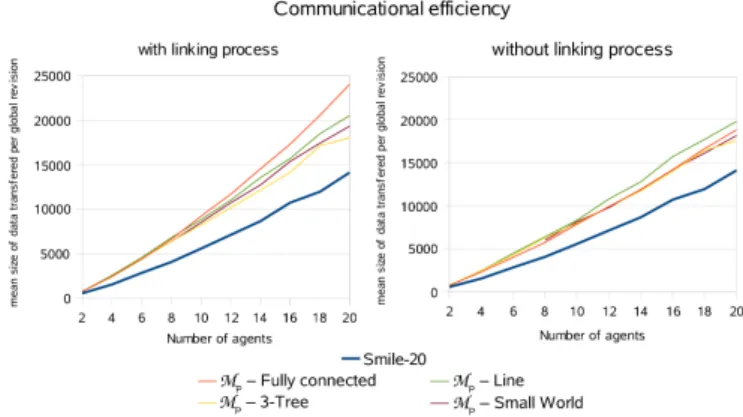
Communicational cost. We now detail the results regarding communicational
effi-ciency. Figure 2 gives the mean size (in bits) of data transfer per global revision for M11 problem. The propagation mechanism again has a slightly higher cost than SMILE. But here, due to the linking process, the worst configuration is the fully connected society. In order to ensure a better readability of the results, we used static structures, but as the spanning tree is rebuild at each revision, these results should be the same with variable connections. However, if we known that the links are static, we can build the spanning trees only once and memorize it. To assess communicational cost in such cases, we measured a link free communicational cost that does not take into account the linking process. Then, all topologies have more similar cost, though the line network still suffer from the highest number of exchanges needed to get a counter-example back to the root.
Effectiveness. Accuracy and hypothesis size have been measured for different
topolo-gies with our propagation mechanism and compared with results from SMILE [2].Sim-ilarly, our mechanism improves both accuracy and hypothesis size when compared to
Fig. 2. Communicational cost of MPin different topologies compared to a 20-SMA using Smile,
with or without linking process (M11 problem).
a single agent using MGI. This result holds for all topologies tested, however the ex-tent of this gain varies: best results are observed for fully connected societies, whereas lines structured societies of agents get less benefit.This accuracy gain is observed for all our boolean problems, especially for those whose difficulty is linked to the size of the hypothesis space. Having each new hypothesis formed over only a subset of the information in the system and then refined through relevant counter examples seems to direct the exploration of the hypothesis space toward better hypotheses. Our internal learning process is indeed order dependent. Trying several combinations depending on the agents forming the hypotheses and having relevant examples then given in order boost the effectiveness of this bottom-up algorithms. Note that though there are several agents and memories implied, this is not an “ensemble effect” as only one common con-sistent hypothesis is formed. Topologies in which a given agent has more neighbours in its spanning tree show significantly better results. Our conjecture is that it is linked with redundancy. The more an hypothesis is refined by relevant counter-examples, the more precise it grows. Hypotheses formed with a small number of examples are more likely to be refined. If redundancy is low, each agent will only have a small fraction of the total number of examples, and thus hypotheses formed individually by them are more likely to trigger refinement. This conjecture is supported by experimental measure showing that the most precise hypotheses correspond to the maximal number of internal revisions. Better results are observed on topologies that exhibit low redundancy (that is fully connected graphs and 3-trees).
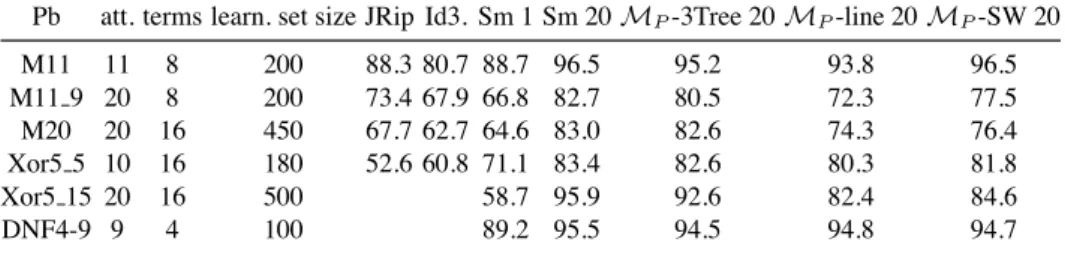
This result also holds for mean hypothesis size, and is verified for our different boolean problems, as shown in the following table, giving accuracy results of MP with trees, lines or small worlds of 20 agents, along with the results of SMILE with a single agent and a 10 agents MAS, and those of two standard algorithms: JRip (an implementation of RIPPER [4]) and Id3 [8].5Table 1 summarizes the results.
5For the experiments with JRip and Id3, we measured the mean accuracy on 50 trials.JRip and
Fig. 3. Accuracy of MP with 20 agents in different topologies compared to a 20-SMA using
Smile and a single agent 9Xor5 15 problem).
Pb att. terms learn. set size JRip Id3. Sm 1 Sm 20 MP-3Tree 20 MP-line 20 MP-SW 20
M11 11 8 200 88.3 80.7 88.7 96.5 95.2 93.8 96.5 M11 9 20 8 200 73.4 67.9 66.8 82.7 80.5 72.3 77.5 M20 20 16 450 67.7 62.7 64.6 83.0 82.6 74.3 76.4 Xor5 5 10 16 180 52.6 60.8 71.1 83.4 82.6 80.3 81.8 Xor5 15 20 16 500 58.7 95.9 92.6 82.4 84.6 DNF4-9 9 4 100 89.2 95.5 94.5 94.8 94.7
Table 1. Characteristics and compared accuracies results of different boolean problems.
5 Extensions
From our experimental results, it is clear that accuracy, redundancy, computational cost and link free communicational cost depend on the structure of the networks. More pre-cisely, results are better when the spanning trees used for propagation have a small depth. It is due to the fact that bringing back counter-examples to the root is quite costly. Moreover, as each link in the process gets the counter-example, it augments re-dundancy, and thus impact effectiveness. Improved versions of this mechanism should then seek to diminish as much as possible this effect. A first idea is to improve the adequacy of our spanning tree, by ensuring that it is not deep. If we use a different spanning tree for each possible root, or build it dynamically, the minimum depth can be achieved by building it width-first. However, if one wants to use a single spanning tree for all updates, then we should seek to minimize its mean depth for each possible root, which is equivalent to minimizing its CPL. Another method would be to avoid tracking the counter examples back to the root by changing root every time that an hypothesis is refined. The agent who refined it would thus become a new root and proposes its hypothesis to its children. To avoid sending too much messages for building new span-ning trees, it would then be best to just adapt the former tree by just changing its root and reversing some parent-child links. A last idea is to have agents drops the examples they learned from others after each global revision. This would ensure that there is no redundancy in the system. First results with Xor5 15 shows that accuracy is indeed improved (98% accuracy with 500 examples in MAS of 20 agents), and no more
de-pendent of the network structure. However, communicational cost is then much more important and still depends on the topology. Some tradeoff (dropping only part of the external examples) could be useful if the communicational cost is important.
6 Conclusion
This paper provides an analysis of a general consistency revision mechanism dealing with communicational constraints in structured networks. We have discuss its com-municational complexity, and evaluated its effectiveness and efficiency in a multiagent concept learning application, where it has been compared to a simpler mechanism for fully connected multiagent systems. Experimental results have shown that our mecha-nism is quite as effective and only slighlty less efficient, despite these constraints, and remains practicable. Moreover, we have presented some leads to improve it, based on the analysis of experimental results.
References
1. Gauvain Bourgne, Amal El Fallah Seghrouchni, and Nicolas Maudet. Towards refinement of abductive or inductive hypothesis through propagation. Journal of Applied Logics, 2008. 2. Gauvain Bourgne, Amal El Fallah Seghrouchni, and Henry Soldano. Smile: Sound
multi-agent incremental learning ;-). In Proc. of AAMAS 2007, pages 164–171. ACM Press, 2007. 3. Mary Elaine Califf and Raymond J. Mooney. Bottom-up relational learning of pattern
match-ing rules for information extraction. Journal of Mach. Learn. Res., 4:177–210, 2003. 4. William W. Cohen. Fast effective rule induction. In ICML, pages 115–123, 1995.
5. Saher Esmeir and Shaul Markovitch. Lookahead-based algorithms for anytime induction of decision trees. In ICML’O4, pages 257–264. Morgan Kaufmann, 2004.
6. M’hammed Henniche. Mgi: an incremental bottom-up algorithm. In IEEE Aust. and New Zealand Conference on Intelligent Information Systems, pages 347–351, 1994.
7. Santiago Onta˜non and Enric Plaza. Recycling data for multi-agent learning. In ICML ’05, pages 633–640. ACM Press, 2005.
8. J. Ross Quinlan. Induction of decision trees. Machine Learning, 1(1):81–106, 1986. 9. Peter Stone. Intelligent Autonomous Robotics: A Robot Soccer Case Study. Synthesis Lectures