HEDG Working Paper 10/26
Inequality of Opportunities in Health in
Europe: Why So Much Difference Across
Countries?
Florence Jusot
Sandy Tubeuf
Alain Trannoy
October 2010
;¤york.ac.uk/res/herc/hedgwp
Inequality of Opportunities in Health in Europe: Why So Much Difference Across
Countries?
Florence JUSOTa, Sandy TUBEUFb, Alain TRANNOYc Oct. 2010
a[email protected]– LEDa-LEGOS (Université Paris-Dauphine) and IRDES (Institut de Recherche et de
Documentation en Economie de la Santé), Paris, France.
b[email protected]– Academic Unit of Health Economics (University of Leeds), Leeds, United Kingdom. c [email protected] – EHESS (Ecole des Hautes Etudes en Sciences Sociales) and GREQAM-IDEP
(Institut d’Economie Publique), Marseille, France.
Abstract
Among inequalities in health, those which are explained by circumstances during childhood or parents' characteristics are recognized as inequalities of opportunities in health and are considered as the most unfair. Tackling health inequalities in later life and improving the underlying socioeconomic determinants for older people is at the core of the European Union healthy-ageing strategy. We use the 2004 Survey on Health Ageing and Retirement in Europe and examine the influence of social and family background on the probability of reporting a good self-assessed health in adulthood using logistic models in ten European countries. The comparison of the odds ratios associated with family background without and with adjustment for individual educational level and occupation allows assessing the direct influence of family background and its influence through the determination of individual social status. Using the Gini index, we evaluate the magnitude of inequalities of opportunities in health, regardless of the mechanism of transmission and consider it in comparison with several indicators of economic and sanitary conditions. Inequalities of opportunity are more marked in Mediterranean and Germanic countries than in Nordic and Benelux countries. For instance, they are twice more important in Spain than in Sweden. Whereas they are mainly explained by social reproduction in most countries a direct effect of fathers' occupation on adult health remains in Belgium, Germany, Italy and Spain. There are country-specific protective social backgrounds: son of agricultural workers in Belgium, and son of technicians or fathers in armed forces in Spain. Parents' longevity has a significant protective effect on adult health. Differences in inequalities of opportunities in health between European countries emphasize the importance of policies reducing either social reproduction or intergenerational reproduction of health.
Keywords: Europe; equality of opportunity; inequality in health; intergenerational transmission; older adults; Gini index
Codes JEL: D63; I12.
Acknowledgements
We gratefully acknowledge the financial support of the Risk Foundation (Health, Risk and Insurance Chair, Allianz). This paper is part of the research program “Inégalités sociales de santé”, supported by DREES-MiRe, Inserm, DGS, InVS, INCa and CANAM. We thank Marc Fleurbaey, Erik Schokkaert, Eddy Van Doorslaer, Jennifer Parr, and the participants to the 2008 Ageing, Health and Retirement in Europe workshop, IRDES, Paris, France, to the 2008 Health, inequalities, risk and public policy workshop, CERSES, Paris, France, to the 2nd thematic ADELF Conference on Social Epidemiology and Inequalities in health, Toulouse, France, and to the 7th World Congress of IHEA in Beijing, China, for their helpful comments.
1.
Introduction
Tackling health inequalities in later life and improving the underlying socioeconomic determinants for older people is at the core of the European Union healthy-ageing strategy and health-promotion activity (Jagger, Robine, Van Oyen & Cambois, 2007; Marmot, Friel, Bell, Houweling, Taylor & the Commission on Social Determinants of Health, 2008). If healthy life expectancy has increased in the late decades in Europe (Jagger, Gillies, Cambois, Van Oyen, Nusselder, Robine et al. 2009), this improvement is not equally distributed among older people (Crimmins & Cambois, 2003); (Jagger, Gillies, Moscone, Cambois, Van Oyen, Nusselder et al. 2008). A large number of recent European studies have shown persistent social health inequalities on general population data (Mackenbach, Bos, Andersen, Cardano, Costa, Harding et al. 2003); (Hernandez-Quevedo, Jones, Lopez & Rice, 2007); (Mackenbach, Stirbu, Roskam, Schaap, Menvielle, Leinsalu et al. 2008) as well as among older adults (Masseria, Mossalios & Allin, 2006). They have highlighted the importance of social aspects in the explanation of systematic differences in health status in Europe. The magnitude of social health inequalities has been shown to vary from one country to another and to be related to political and economic context (Dahl, Fritzell, Lahelma, Martikainen, Kunst & Mackenbach, 2006; Eikemo, Bambra, Joyce & Dahl, 2008).
However, the long-term impact of social conditions in childhood on health inequality among the elderly has been much less investigated in European comparisons. And yet, among those inequalities in health, those which are related to childhood circumstances are particularly interesting as they are considered as the most unacceptable inequalities according to the growing political philosophy literature on responsibility and compensation (Roemer, 1998); (Fleurbaey, 2008); (Fleurbaey & Schokkaert, 2009); (Trannoy, Tubeuf, Jusot & Devaux, 2010). Since social background and others parental characteristics are independent from the individual’s own responsibility, any difference in the distribution of health in adulthood according to social and family background is recognised as inequalities of opportunities of health. There is therefore a need to measure inequalities of opportunities in health and to understand their construction and their links with political and economic context.
Several studies have already suggested that health in adulthood is influenced by social background and life course epidemiology has described two mechanisms displaying this effect: the latency model and the pathway model (Currie & Hyson, 1999); (Elstad, 2005); (Hertzman, Power, Matthews & Manor, 2001); (Power & Hertzman, 1997); (Hyde, Jakub, Melchior, Van Oort & Weyers, 2006); (Melchior, Lert, Martin & Ville, 2006b); (Melchior, Berkman, Kawachi, Krieger, Zins & Bonenfant, 2006a); (Trannoy, Tubeuf, Jusot & Devaux, 2010). The latency model shows the direct influence of social and family living conditions in childhood on health in adulthood following a latency period (Barker, 1996); (Wadsworth, 1999). The pathway model relies on social background having an indirect influence on the health status in adulthood subsequent life trajectories and particularly through a transmission of socioeconomic status
(SES) over different generations. Furthermore scholars have confirmed the correlation existing between health statuses across generations (Ahlburg, 1998); (Cournil & Kirkwood, 2001); (Trannoy, Tubeuf, Jusot & Devaux, 2010). But still there is a lack of quantification of the magnitude of inequality of opportunity in health and comparative analysis within Europe. And yet, the differences of economic situations and welfare policies in Europe allow exploring potential macro-level determinants and then providing relevant elements for designing public health policies.
The aim of the paper is to fill the gap by exploring inequalities of opportunities in health in Europe. We firstly aim to understand the role of social and family background on health status in people aged 50 and more in 10 European countries. Then, we compare the level of inequalities of opportunities between countries and in relation to several macro-level economic indicators.
2. Methods
The Survey of Health, Ageing and Retirement in Europe (SHARE) is a multidisciplinary database interviewing Europeans over the age of 50 and their spouses. The first wave of data was collected in 2004 in eleven countries (Austria, Belgium, Denmark, France, Greece, Germany, Italy, the Netherlands, Spain, Sweden, and Switzerland). This paper uses data from the early release 1 of SHARE 2004, with exception of data from Switzerland due to the very small sample size. Additional information about the dataset is available in Börsch-Supan et al. (Börsch-Supan, Brugiavini, Jürges, Mackenbach, Siegrist & Weber, 2005).
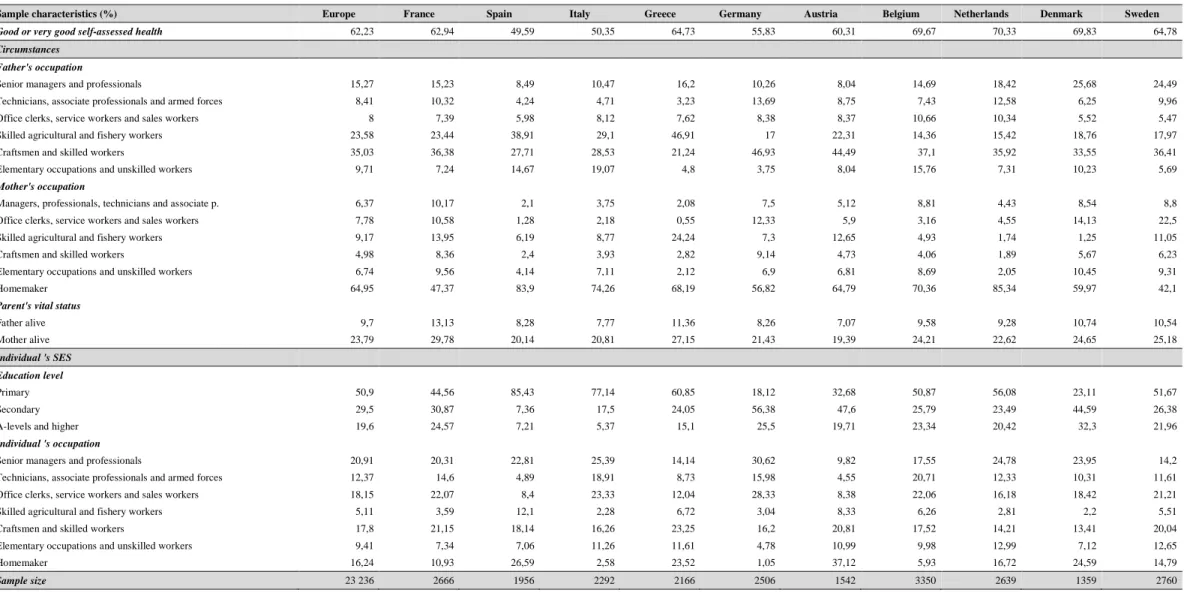
Our study focuses on a sample of 23,236 Europeans aged 50 years old and over (Table 1). The outcome of interest is self-assessed coming from the question “would you say your health is…” reported in five categories “very good, good, fair, poor, and very poor”. In Europe, 62 % of older adults report a good or very good health status. The other parameters of interest are social background, parents’ health, the respondents’ age, sex and SES. Social background is measured by the last occupation of both parents, described with the ISCO classification (International Standard Classification of Occupations). Fathers’ occupations are classified into six groups: (i) “senior managers and professionals”, (ii) “technicians and associate professionals and armed forces”, (iii) “office clerks, service and sales workers”, (iv) “skilled agricultural and fishery workers”, (v) “craftsmen and skilled workers” and, (vi) “elementary occupations and unskilled workers”. Concerning mothers, a classification in six groups is also proposed. The first five groups are the same as the six groups of fathers’ occupations, but groups (i) and (ii) have been grouped, and a sixth group for homemakers has been added. Considering the age of the studied sample, most of the respondents have lost their parents: only 9.7 % of the individuals have a father alive and 23.8 % a mother alive, so we measure their health either with their vital status or their age at death. We divided the group of deceased parents into two groups with respect to the median age at death of their own country: those who died earlier and those who died at median age or later. Finally, each respondent’s current SES is considered by two variables: educational level described into three categories: no diploma or primary
diploma, secondary diploma, and A-levels and higher, and the current or last occupation described into seven groups: the first six groups are the same as fathers’ occupation and a last group for homemakers.
Empirically, we use logistic regressions and explain the probability to report a good or very good health status in every country and at European level. We firstly explain health status according to circumstances only after adjustment for age introduced in 10-year age classes and sex in model 1. Then, we add individual’s current characteristics such as educational level and social status in model 2. This two-step analysis permits understanding the underlying mechanisms of the influence of circumstances on adult health whether it is a direct effect on health or an indirect effect through the influence of social background on descendant’s SES as described in introduction.
Finally we use the findings of model 1 to compute for each individual his predicted probability of being in good health only considering the full influence of social and family background and the constant parameter in order to measure the contribution of circumstances to individual health status. We then evaluate the magnitude of inequalities in opportunities in health by computing the Gini index of the age and sex adjusted predicted probabilities of being in good health in Europe and in each country. This measure of inequalities of opportunities relies on the view that inequalities of opportunities are the inequalities related to circumstances only, regardless of the underlying mechanisms of transmission of inequalities in health.
We finally analyse the correlation between inequalities of opportunities in health and several relevant macro-level indicators across European countries obtained from a recent publication (Jagger et al., 2008). Those indicators have been selected to cover broad dimensions of socioeconomic and sanitary conditions: gross domestic product [GDP], inequality of income distribution as measured by the Gini index and poverty risk for people aged 65 years and more, expenditure on elderly care. Most data were related to 2005 and were collected or estimated to ensure maximum harmonisation across all countries. The exception was expenditure on elderly care, for which the most recent data available were from 2004.
3. Results
a. Sample description
Table 1 provides the distribution of the sample according to self-assessed health, circumstances and individual SES. 62.2% of the European sample reports a good or a very self-assessed health status. However, we can notice important differences between countries, the proportion of individuals reporting a good health status varies from 50% in Spain to 70% in the Netherlands.
Regarding fathers’ occupation, most of the respondents in Europe have a father who was craftsman or skilled worker (35%), or agricultural worker (24%) whereas only 15% of the sample is born from a father who was manager or professional. However, the proportion of fathers who had a high SES (occupation categories (i) and (ii)) is higher in Denmark and Sweden whereas the proportion of fathers
who were agricultural workers is higher in Greece, Spain, and to a lesser extent in Italy. As for mothers, 65% of respondents in Europe have a mother who was homemaker, with a particularly high proportion in the Netherlands (85 %), Spain (84 %), Italy (74%), and Belgium (70%) and a proportion below 50% in France and in Sweden. In most countries, when mothers of respondents were active, they were agricultural worker and office clerks or service workers.
Considering the age of the respondents, it is not surprising to find that only 9.7% of the fathers are still alive and 23.8% of the mothers. The proportion of alive parents also varies from one country to another, with the highest proportion being in France (13 % for fathers and 30 % for mothers) and the lowest in Austria (7 % for fathers and 19 % for mothers), in accordance with differences in life expectancy among European countries.
b. Results at European-level
Results of logistic regressions are presented in Table 2; they are expressed as odds ratios. Our results at European level (columns 2 and 3) are powerful as they rely on a large sample (23,236 individuals) whereas country analyses (columns 4 and over) sometimes rely on much smaller sample size, such as Denmark or Austria sample sizes, but still above 1000.
At the European level, it appears that all considered circumstances influence health status in adulthood without adjustment for individual SES (model 1).
Father’s occupation is the most strongly and significantly circumstance associated with the probability of good self-assessed health status. Individuals born to a father who had an elementary occupation or was an unskilled worker significantly report a poorer health status than individuals born to father in any other SES. Moreover, we can notice a gradient associated with father’s occupation as odds ratios related to good health reaches 1.72 (p<0.001) for the first SES category and 1.8 (p<0.001) for the second. Mother’s occupation also significantly contributes to the probability of reporting a good health status but for the highest occupation category, only (OR. =1.22, p<0.01).
Parents’ health also drives health disparities: having a father or a mother who died in older ages (OR. =1.21 and 1.15 respectively for father and mother, p<0.001) or who is still alive at the time of the survey (OR. =1.4 and 1.46 respectively for father and mother, p<0.001) is associated with a higher probability of good health status in adulthood.
When individual’s own SES characteristics are introduced in model 2, the association between father’s occupation and self-assessed health status weakens but remains significant. On the contrary, mother’s occupation does not influence health status anymore. As for parents’ health, it remains significantly associated with health status with only a slight decrease in the odds ratios between model 1 and model 2.
As expected, individual education level significantly influences health in adulthood: having A-levels or a higher diploma is associated with an odds ratio equal to 1.75 (p<0.001) in comparison with
primary degree. Consistent results are observed for individual’s occupation with odds ratios equal to 1.77 and 1.69 for the two highest categories (p<0.001) in comparison with having an elementary occupation or being an unskilled worker.
Finally, there are significant country effects: Spaniards, Italians and German people significantly report a lower health status than Swedes whereas Belgians, Dutch and Danish people significantly report a better health status. Those effects confirm that a country by country analysis is relevant and may help to understand country-specific patterns.
c. Country by country results
The analyses restricted to circumstances (model 1) confirm the association between social circumstances and health status in most of the countries except Greece and the Netherlands where none of the odds ratios reach the 5% significance level in, and only few circumstances are significant at this level in Sweden. There are no significant association between father’s occupation and self-assessed health in the Netherlands. In Sweden and in Greece, only one of the top two occupation categories seem to be related to a better self-assessed health status (OR. =1.64 (p<0.05) and 1.59 (p<0.1) respectively).
Father’s occupation appears to be strongly related to self-assessed health status in France, Belgium, Spain, Italy, Germany, and Austria, and to a lesser extent in Denmark. The odds ratio associated with the highest occupation category reaches a value as high as 3.15 (p<0.001) in Germany and the odds ratio associated with the second higher occupation category equals 3.43 (p<0.001) in Spain in comparison with the lowest occupation.
When individual’s SES is introduced in model 2, the odds ratios associated with father’s occupation reduce but the association remains significant in half of the countries. This relationship is particularly resilient in Germany both in high and in middle high social occupation (respectively OR. = 2.46 (p<0.001) and OR. = 2.19 (p<0.01)) in the career ladder. Country-specific patterns are found in Spain with a strong protective effect of being son of “technicians, associate professional and armed forces” (OR. =2.69 (p<0.001)) as well as in Belgium and in Italy with a strong protective effect of being son of “skilled agricultural and fishery workers” (respectively OR. =1.71 (p<0.001) and OR. =1.49 (p<0.01)). On the contrary the association between father’s occupation and self-assessed health fully vanishes in countries where it was initially found weak, i.e. France, Denmark, Sweden and Greece.
Despite lower odds ratios as well as lower levels of significance than fathers’ occupation, some mothers’ occupations are also associated with a better health status without adjustment for individual SES (model 1). The most important associations are found in France with an odds ratio of 1.64 (p<0.01) for sons of women who were office clerks or service workers and in Sweden with an odds ratio of 1.42 (p<0.05) for sons of women who were in the highest occupation category in comparison with son of homemakers. Odds ratios associated with mother’s occupation decrease after adjustment for individual SES. However, a significant relationship remains in France and in Greece where being born to an office
clerk or a service worker in the former and being born to a farmer in the latter are more protective for health than being born to a homemaker.
Regarding parents’ health, as measured by their longevity, having a father alive or died in older age significantly increases the probability to report good health in comparison with having a father prematurely dead in most countries, except in Spain and Greece. The effect is particularly important in France with an odds ratio of 1.77 (p<0.001) when the father is still alive and an odd ratio of 1.34 (p<0.001) when the father died at later ages. Interestingly in Germany, Austria and Denmark, having a father deceased at later ages is more protective than having a father alive, while it is the opposite in other countries. The longevity of the mother also matters in most of the countries, but the odds ratios do not reach the 5% significance level in Belgium, Denmark and Sweden. In Austria, the Netherlands, Germany, Greece and Spain, having a mother still alive rather than prematurely dead is associated with impressive odds ratios comprised between 1.60 and 2.01. Conversely, having a mother deceased at later age is only significant in Spain and Italy (p<0.05), as well as in France and Denmark (p<0.1) and the odds ratios are always below those associated with having a mother alive. Noticeably, the odds ratios associated with parents’ longevity remained sensibly unchanged after adjustment for individual SES.
A higher education levels positively and significantly influences health in adulthood in every countries with a particularly strong association in Greece for A-levels and higher diplomas in comparison with primary education (OR. =3.44, p <0.001).
Current occupation is also associated with health status but its impact is less homogeneous across countries. No association was found in Greece whereas very strong association is found in France, Germany, Denmark and the Netherlands with odds ratios higher than 2 for the two highest occupation categories. Interestingly, there is an impressive protective effect on health of being “skilled agricultural and fishery workers” in the Netherlands (OR. =3.41, p<0.01).
d. Evaluation of inequalities of opportunity
Graph 1 represents the magnitude of inequalities of opportunity in health in European countries, namely the inequalities in health related to circumstances as measured by the age and sex adjusted probability of reporting a good health status in model 1. Inequalities of opportunities in health are particularly marked in Spain, Germany, France, Italy, Austria and Greece, with Gini indexes comprised between 0.13 and 0.16 and it is in Sweden, in the Netherlands that they are the lowest with Gini indexes below 0.10.It is meaningful to compare the degree of inequalities of opportunity in health in each country with a set of selected relevant macro-level factors in 2005. Graph 2 shows that inequalities in opportunities are inversely correlated with gross domestic product (GDP) per capita; the lower the inequalities of opportunity, the higher is the GDP per capita (ρ=0.43). Income inequality over European countries describes a similar pattern as inequalities of opportunities in health (Graph 3), showing a strong correlation between the Gini income index and the Gini of opportunity in health (ρ=0.40). Graph 4
underlines that the level of inequalities of opportunity is also related (ρ=0.29) to the proportion of poverty risk for people aged more than 65 years, as measured by the number of people aged 65 years and older with an equivalent disposable income below the risk-of-poverty threshold, which is set at 60% of the national median equivalent disposable income after social transfers. Finally Graph 5 emphasises that countries where inequalities of opportunity in health are the lowest are countries devoting a higher share of social protection expenditure to care of the elderly (covering care allowance, accommodation, and assistance in undertaking daily tasks) as a percentage of GDP (ρ=0.39).
4. Discussion
This study attests the existence of a long-term influence of the father’s and the mother’s occupations as well as their health status, as measured by their longevity, on self-assessed health in middle-aged and beyond. Thus, it shows the existence of inequalities of opportunity in health in Europe, namely differences in health related to circumstances.
Inequalities of opportunity in health are particularly marked in Spain, Germany, France, Italy, Austria and Greece, suggesting country-specific differences related to social hierarchy and economic, sanitary and redistribution policies.
The use of SAH to measure the respondent's health could be criticised as this variable may suffer from individual reporting heterogeneity in particular for international comparisons (Jürges, 2007). Nevertheless, this indicator has been found to be a rather good indicator of health, which predicts mortality (Idler & Benyamini, 1997) and a study on French data has shown that SAH would be the least biased health indicator as compared to several other indicators (Devaux, Jusot, Sermet & Tubeuf, 2008). Another concern might be the lack of comparability of parents’ occupation across countries. The categories of the International Standard Classification of Occupations (ISCO) are built with respect to the type of work performed and may correspond to different social status between countries. For instance, the Dutch farmers are more likely to be owners of the land they harvest and so wealthier than farmers in Mediterranean countries, which could explain the protective effect on health associated with this occupation in the Netherlands.
Those findings show a strong association between father’s occupation and health and support the various mechanisms of transmission of social background which have been proposed in the literature. The decrease in the odds ratios associated with father’s SES after adjustment for individual SES suggests an indirect effect of social background due to a social reproduction mechanisms in accordance with the pathway model (Currie & Hyson, 1999); (Elstad, 2005); (Hertzman et al., 2001); (Power & Hertzman, 1997); (Hyde et al., 2006); (Melchior et al., 2006b); (Melchior et al., 2006a); (Trannoy et al., 2010). On the contrary, the effect of father’s occupation which has fully vanished in France, Denmark, Sweden and Austria shows that the determination of individual’s SES is the main mechanism of influence of father’s occupation in those countries. Social reproduction across generations and subsequent inequalities in
opportunities has been well-studied from sociological and ethical viewpoints (Bourdieu, 1977); (Fleurbaey, 2008; Roemer, 1998) and its importance has been empirically confirmed in Europe (Lefranc, Pistolesi & Trannoy, 2008).
Conversely, the effect of fathers’ occupation on adult health remains significant after adjustment for individual’s SES at European-level as well as in Spain, Italy, Germany and Belgium, suggesting a direct effect in accordance with the latency model (Barker, 1996); (Wadsworth, 1999). There are country-specific protective social backgrounds. In Germany, the two highest occupation categories have a significant and protective direct impact on descendant’s health whereas there is a strong deleterious impact on health of being son of unskilled worker. The intergenerational effect of social background is a bit specific in Belgium and in Spain: being born to a farmer is the only occupation that has a strong direct on health status in Belgium while in Spain, having a father technician or in the armed forces offers a better protection than having a father who was senior manager or professional. This latter result could be related to the specificity of the period of Francoism dictatorship and to the lack of universality of the Spaniard health care system during this period (European Observatory on Health Care Systems, 2000).
An association between mother’s occupation and self-assessed health was also found but reduced in comparison with father’s occupation. This weaker impact may be related to the low participation rate of women to the labour market in the mother generation given that 65% of mothers were homemakers. Moreover, our finding suggest the predominance of the indirect effect of mother’s occupation going through social reproduction since mother’s occupation does not influence health status anymore after adjustment for individual SES at European-level as well as in Italy, Germany, Belgium and the Netherlands. A direct effect of mother’s occupation only exists in France and in Greece and especially in France, where female participation rate was sensibly high in the mother’s generation.
Regarding parents’ health, as measured by their longevity, findings support the hypothesis of an intergenerational transmission of health status (Ahlburg, 1998); (Cournil & Kirkwood, 2001); (Trannoy et al., 2010), since in every country self-assessed status is associated with the longevity of at least one of the two parents. Moreover, if there are country-specific effects regarding the effect of parental health some common features still emerge. The main one is that when mother’s longevity is correlated with good health of the descendant, it is always the fact that she is still alive which is the most favourable outcome for adult health whereas in some countries a father deceased at later ages is more protective than a father alive. The rationale which supports such a switch across genders may come from the fact that fewer fathers are still alive at the time of the survey than mothers because of biological differences in mortality and adverse conditions for these generations of fathers. Indeed, the father of a 70 years old descendant in 2004 was approximately born in 1904 therefore he has experienced the privation of the First World War as a child and was a good candidate for being a soldier during the Second World War. Germany exemplifies the intuition of the mechanism: having a father deceased at later age and a mother alive are significantly associated with good health while father alive and mother deceased at late age are not significant. This pattern goes for Austria and Denmark as well. France, Italy, Belgium and Sweden
do not obey this scheme, quite the contrary, since having a father alive has a higher impact on health than having a father deceased at later age. One potential explanation is that the more important human losses associated with the Second World War were in Germany and in Austria (reference). Although in Germany, a parent alive does not convey a signal about the strength of the dynasty, in France, for instance, it tells something related to the health of the father and then the robustness of the dynasty.
The comparison of the magnitude of inequalities of opportunity in health across European countries provides interesting results. We find the traditional divide between Northern and Southern countries in Europe. But the surprise comes from the fact that German and Austrian are more similar to their Mediterranean neighbours than to their Nordic ones. The lowest level of inequalities of opportunity in health in the Nordic countries is in tune with the result obtained by Lefranc et al. (2008) according to which Scandinavian countries have almost succeeded in erasing inequality of opportunity in income acquisition. The Netherlands as well as Belgium are also known to have a social model close to the models of Nordic countries and to suffer from lower income-related health inequalities (Koolman & van Doorslaer, 2004); (Eikemo et al., 2008).
This pattern is confirmed by the comparison of the degree of inequalities of opportunity in health in each country with a set of selected relevant macro-level factors in 2005. Inequalities of opportunity in health are lower in countries with higher GDP per capita, with lower income inequalities, with lower poverty rates and which devote higher social protection expenditures to care of the elderly. Thus social democratic countries which are more egalitarian seem to perform rather well in the achievement of equality of opportunities in health, as it has been shown for equality of opportunity in income acquisition (Lefranc et al., 2008) and social health inequalities (Dahl et al., 2006).
5. Conclusion
This study highlights the existence of important inequalities of opportunity in health in Europe, related both to a long-term influence of social origin and parent's health status and an indirect effect going through the influence of social and family background on descendant's social achievement. Those inequalities are higher in Mediterranean countries and in Germany and Austria. This country-specific pattern suggests that inequalities in opportunity in health are lower in countries having higher GDP per capita; lower income inequalities, lower poverty rates and which devote higher expenditures to elderly care.
As social background and parents' health both represent factors beyond the realm of individual responsibility (Roemer, 1998); (Fleurbaey, 2008; Fleurbaey & Schokkaert, 2009); (Trannoy et al., 2010), they are socially or morally unacceptable sources of inequality. Furthermore, the recent report of the World Health Organization’s Commission on the Social Determinants of Health (Marmot et al., 2008) highlights the role of childhood conditions as primary sources of inequality in health. Given the magnitude of the indirect effect of social background, reducing social reproduction across generations
would also provide important benefits on health in the course of life. Consequently, improving childhood conditions and equality of opportunity in income acquisition appears to be first-rate candidate for a policy aiming at reducing inequality in health.
6. References
Ahlburg,D. (1998). Intergenerational transmission of health. American Economic Review, 88(2), 265-270.
Barker,D.J.P. (1996). Fetal origins of coronary heart disease. Britain Medicine Journal, 311 171-174.
Börsch-Supan,A., Brugiavini,A., Jürges,H., Mackenbach,J.P., Siegrist,J., & Weber,G. (2005). Health, ageing and retirement in Europe - First results from the Survey of Health, Ageing and Retirement in Europe. Mannheim.
Bourdieu,P. (1977). Cultural reproduction and social reproduction. In J. Karabel, & A.H. Halsey (Eds.), Power and ideology in education.
Cournil,A., & Kirkwood,T.B.L. (2001). If you would live long, choose your parents well. TRENDS in
Genetics, 17(5), 233-235.
Crimmins,E., & Cambois,E. (2003). Social inequalities in health expectancy. In J.-M. Robine, C. Jagger, C. Mathers, E. Crimmins, & R. Suzman (Eds.), Determining Health Expectancies (pp.111-126). Chichester.
Currie,J., & Hyson,R. (1999). Is the impact of health shocks cushioned by socioeconomic status? The case of birth weight. American Economic Review, 89(2), 2455-250.
Dahl,E., Fritzell,J., Lahelma,E., Martikainen,P., Kunst,A.E., & Mackenbach,J.P. (2006). Welfare state regimes and health inequalities. In J. Siegrist, & M. Marmot (Eds.), Social inequalities in health - New evidence and policy implications (pp.193-221).
Devaux,M., Jusot,F., Sermet,C., & Tubeuf,S. (2008). Hétérogénéité sociale de déclaration de l'état de santé et mesure des inégalités de santé. Revue Française des Affaires Sociales, 1.
Eikemo,T.A., Bambra,C., Joyce,K., & Dahl,E. (2008). Welfare state regimes and income-related health inequalities: a comparison of 23 countries. Eur J.Public Health, 18(6), 593-599.
Elstad,J.I. (2005). Childhood adversities and health variations among middle-aged men: a retrospective lifecourse study. European Journal of Public Health, 15(1), 51-58.
European Observatory of health (2000), "Health care systems in transition: Spain", Regional Office for Europe on behalf of the European Observatory on Health Systems, and Policies, Copenhagen http://www.euro.who.int/__data/assets/pdf_file/0009/96408/E70504.pdf
Fleurbaey,M. (2008). Fairness, responsibility, and welfare. Oxford.
Fleurbaey,M., & Schokkaert,E. (2009). Unfair inequalities in health and health care. Journal of Health
Hernandez-Quevedo,C., Jones,A., Lopez,A.N., & Rice,N. (2007). Socio-economic inequalities in health: a comparative longitudinal analysis using the European Community Household Panel. Social Science
and Medicine, 63(1246), 1262.
Hertzman,C., Power,C., Matthews,S., & Manor,O. (2001). Using an interactive framework of society and lifecourse to explain self-rated health in early adulthood. Social Science and Medicine, 53(12), 1575-1585.
Hyde,M., Jakub,H., Melchior,M., Van Oort,F., & Weyers,S. (2006). Comparison of the effects of low childhood socioeconomic position and low adulthood socioeconomic position on self-rated health in four European studies. J Epidemiol Community Health, 60 882-886.
Idler,E.L., & Benyamini,Y. (1997). Self-rated health and mortality: a review of twenty-seven community studies. Journal of Health and Social Behaviour, 38(March), 21-37.
Jagger,C., Gillies,C., Cambois,E., Van Oyen,H., Nusselder,W., Robine,J.-M., & EHLEIS team (2009). Trends in disability-free life expectancy at age 65 in the European Union 1995-2001: a comparison of 13 EU countries. EHEMU Technical report, 5.1.
Jagger,C., Gillies,C., Moscone,F., Cambois,E., Van Oyen,H., Nusselder,W., Robine,J.-M., & EHLEIS team (2008). Inequalities in healthy life years in the 25 countries of the European Union in 2005: a cross-national meta-regression analysis. The Lancet, 372(9656), 2124-2131.
Jagger,C., Robine,J.-M., Van Oyen,H., & Cambois,E. (2007). Healthy ageing - a challenge for Europe.
Jürges,H. (2007). True health vs response styles: exploring cross-country differences in self-reported health. Health Economics, 16(2), 163-178.
Koolman,X., & van Doorslaer,E. (2004). On the interpretation of a concentration index of inequality.
Health Economics, 13(7), 649-656.
Lefranc,A., Pistolesi,N., & Trannoy,A. (2008). Inequality of opportunities vs. inequality of outcomes: are Western societies all alike? Review of Income and Wealth, 54(4), 513-546.
Mackenbach,J.P., Bos,V., Andersen,O., Cardano,M., Costa,G., Harding,S., Reid,A., Hemstrom,O., Valkonen,T., & Kunst,A.E. (2003). Widening socioeconomic inequalities in mortality in six western European countries. International Journal of Epidemiology, 32 830-837.
Mackenbach,J.P., Stirbu,I., Roskam,A.-J.R., Schaap,M.M., Menvielle,G., Leinsalu,M., Kunst,A.E., & the European Union Working Group on Socioeconomic Inequalities in Health (2008). Socioeconomic inequalities in health in 22 European countries. The New England Journal of Medicine, 358 2468-2481.
Marmot,M., Friel,S., Bell,R., Houweling,T., taylor,S., & the Commission on Social Determinants of Health (2008). Closing the gap in a generation: health equity through action on the social determinants of health. The Lancet, 372 1661-1669.
Masseria,C., Mossalios,E., & Allin,S. (2006). Measurement of socioeconomic inequality of health in 10 European countries: an exploratory analysis of SHARE using three approaches. European Commission
Melchior,M., Berkman,L.F., Kawachi,I., Krieger,N., Zins,M., & Bonenfant,S. (2006a). Lifelong socioeconomic trajectory and premature mortality (35-65 years) in France: findings from the GAZEL Cohort Study. Journal of Epidemiology and Community Health, 60 937-944.
Melchior,M., Lert,F., Martin,M., & Ville,I. (2006b). Socioeconomic position in childhood and in adulthood and functional limitations in midlife: data from a nationally-representative survey of French men and women. Social Science and Medicine, 63(11), 2813-2824.
Power,C., & Hertzman,C. (1997). Social and biological pathways linking early life and adult disease.
British Medical Bulletin, 53(1), 210-221.
Roemer,J. (1998). Equality of opportunity. Cambridge.
Trannoy,A., Tubeuf,S., Jusot,F., & Devaux,M. (2010). Inequality of Opportunities in Health in France: A first pass. Health Economics, 19(8), 921-938.
Wadsworth,M.E.J. (1999). Early life hypothesis. In M. Marmot, & R. Wilkinson (Eds.), Social determinants of health Oxford: Oxford University Press.
Table 1: Descriptive analysis of the study sample (2004 SHARE Survey)
Sample characteristics (%) Europe France Spain Italy Greece Germany Austria Belgium Netherlands Denmark Sweden
Good or very good self-assessed health 62,23 62,94 49,59 50,35 64,73 55,83 60,31 69,67 70,33 69,83 64,78
Circumstances Father's occupation
Senior managers and professionals 15,27 15,23 8,49 10,47 16,2 10,26 8,04 14,69 18,42 25,68 24,49
Technicians, associate professionals and armed forces 8,41 10,32 4,24 4,71 3,23 13,69 8,75 7,43 12,58 6,25 9,96
Office clerks, service workers and sales workers 8 7,39 5,98 8,12 7,62 8,38 8,37 10,66 10,34 5,52 5,47
Skilled agricultural and fishery workers 23,58 23,44 38,91 29,1 46,91 17 22,31 14,36 15,42 18,76 17,97
Craftsmen and skilled workers 35,03 36,38 27,71 28,53 21,24 46,93 44,49 37,1 35,92 33,55 36,41
Elementary occupations and unskilled workers 9,71 7,24 14,67 19,07 4,8 3,75 8,04 15,76 7,31 10,23 5,69
Mother's occupation
Managers, professionals, technicians and associate p. 6,37 10,17 2,1 3,75 2,08 7,5 5,12 8,81 4,43 8,54 8,8
Office clerks, service workers and sales workers 7,78 10,58 1,28 2,18 0,55 12,33 5,9 3,16 4,55 14,13 22,5
Skilled agricultural and fishery workers 9,17 13,95 6,19 8,77 24,24 7,3 12,65 4,93 1,74 1,25 11,05
Craftsmen and skilled workers 4,98 8,36 2,4 3,93 2,82 9,14 4,73 4,06 1,89 5,67 6,23
Elementary occupations and unskilled workers 6,74 9,56 4,14 7,11 2,12 6,9 6,81 8,69 2,05 10,45 9,31
Homemaker 64,95 47,37 83,9 74,26 68,19 56,82 64,79 70,36 85,34 59,97 42,1
Parent's vital status
Father alive 9,7 13,13 8,28 7,77 11,36 8,26 7,07 9,58 9,28 10,74 10,54 Mother alive 23,79 29,78 20,14 20,81 27,15 21,43 19,39 24,21 22,62 24,65 25,18 Individual 's SES Education level Primary 50,9 44,56 85,43 77,14 60,85 18,12 32,68 50,87 56,08 23,11 51,67 Secondary 29,5 30,87 7,36 17,5 24,05 56,38 47,6 25,79 23,49 44,59 26,38
A-levels and higher 19,6 24,57 7,21 5,37 15,1 25,5 19,71 23,34 20,42 32,3 21,96
Individual 's occupation
Senior managers and professionals 20,91 20,31 22,81 25,39 14,14 30,62 9,82 17,55 24,78 23,95 14,2
Technicians, associate professionals and armed forces 12,37 14,6 4,89 18,91 8,73 15,98 4,55 20,71 12,33 10,31 11,61
Office clerks, service workers and sales workers 18,15 22,07 8,4 23,33 12,04 28,33 8,38 22,06 16,18 18,42 21,21
Skilled agricultural and fishery workers 5,11 3,59 12,1 2,28 6,72 3,04 8,33 6,26 2,81 2,2 5,51
Craftsmen and skilled workers 17,8 21,15 18,14 16,26 23,25 16,2 20,81 17,52 14,21 13,41 20,04
Elementary occupations and unskilled workers 9,41 7,34 7,06 11,26 11,61 4,78 10,99 9,98 12,99 7,12 12,65
Homemaker 16,24 10,93 26,59 2,58 23,52 1,05 37,12 5,93 16,72 24,59 14,79
15
Table 2: Odds ratios of good self-assessed health associated with circumstances, education andoccupation. Men and women, aged 49 years and over
Probability of good self-assessed health Europe (23236) (a) France (2666) (a) Spain (1956) (a) Italy (2292) (a) Model adjusted for age and sex Model 1 (b) Model 2 (c) Model 1 (b) Model 2 (c) Model 1 (b) Model 2 (c) Model 1 (b) Model 2 (c)
Father’s professional status
Senior managers and professionals 1.72 *** 1.30 *** 1.72 ** 1.12 1.73 ** 1.35 1.96 *** 1.42 $
Technicians, associate prof. and armed forces 1.80 *** 1.41 *** 1.85 ** 1.18 3.43 *** 2.69 *** 2.02 ** 1.43
Office clerks, service workers, shop sales
workers 1.49 *** 1.23 *** 1.64 * 1.29 1.35 1.20 2.07 *** 1.63 *
Skilled agricultural and fishery workers 1.27 *** 1.27 *** 1.30 1.34 1.03 0.97 1.45 ** 1.49 **
Craftsmen and skilled workers 1.21 *** 1.15 ** 1.18 1.12 1.20 1.13 1.46 ** 1.36 *
Elementary occupations and unskilled 1 1 1 1 1 1 1 1
Mother’s professional status
Senior managers, professionals, technicians, and
associate prof. 1.22 ** 1.08 1.35 $ 1.12 0.89 0.71 1.25 1.08
Office clerks, service workers, shop sales
workers 1.10 1.03 1.64 ** 1.46 * 0.72 0.61 0.76 0.67
Skilled agricultural and fishery workers 0.95 1.02 1.04 1.14 0.83 0.86 0.74 $ 0.78
Craftsmen and skilled workers 0.98 0.95 1.14 1.15 1.38 1.38 1.25 1.18
Elementary occupations and unskilled workers 0.88 * 0.91 0.79 0.80 0.68 0.74 0.99 0.99
Homemakers 1 1 1 1 1 1 1 1
Father’s health
Father alive 1.40 *** 1.38 *** 1.77 *** 1.68 ** 1.17 1.18 1.53 * 1.54 *
Father deceased in later ages 1.21 *** 1.19 *** 1.34 *** 1.29 ** 0.86 0.85 1.10 1.09
Father prematurely deceased 1 1 1 1 1 1 1 1
Mother’s health
Mother alive 1.46 *** 1.39 *** 1.29 * 1.17 1.60 ** 1.56 ** 1.30 * 1.23
Mother deceased in later ages 1.15 *** 1.12 *** 1.18 $ 1.16 1.31 * 1.26 * 1.27 * 1.26 *
Mother prematurely deceased 1 1 1 1 1 1 1 1
Individual’s education level
Primary 1 1 1 1
Secondary 1.37 *** 1.30 * 1.69 * 1.48 **
A-levels and higher 1.75 *** 1.99 *** 1.78 * 1.91 *
Individual’s professional status
Senior managers and professionals 1.77 *** 2.23 *** 1.19 1.68 *
Technicians, associate prof. and armed forces 1.69 *** 2.31 *** 1.81 $ 1.17
Office clerks, service workers, shop sales
workers 1.54 *** 1.65 ** 1.95 ** 1.73 **
Skilled agricultural and fishery workers 1.10 1.30 1.54 0.76
Craftsmen and skilled workers 1.11 $ 1.09 1.17 $ 1.18
Elementary occupations and unskilled 1 1 1 1
Homemakers 1.33 *** 1.36 1.22 1.05 Countries Sweden 1 1 France 0.93 0.94 Spain 0.61 *** 0.75 *** Italy 0.58 *** 0.69 *** Greece 1.02 1.12 $ Germany 0.68 *** 0.62 *** Austria 0.92 0.90 Belgium 1.31 *** 1.36 *** The Netherlands 1.24 *** 1.33 *** Denmark 1.28 *** 1.18 * Pseudo-R2 0.0773 0.0926 0.0832 0.1127 0.0927 0.1028 0.0757 0.0915
(a) Sample size is indicated between brackets. (b) Model 1: Logistic regression, adjusted on age, sex, and circumstances, in addition to country dummies in the full European model. Significance levels: $ 10%, * 5%, ** 1%, *** 0.1%. (c) Model 2: Logistic regression, adjusted on age, sex, circumstances, education level and occupation, in addition to country dummies in the full European model. Significance levels: $ 10%, * 5%, ** 1%, *** 0.1%.
16
Table 2: Odds ratios of good self-assessed health associated with circumstances, education andoccupation. Men and women, aged 49 years and over (continued)
Probability of good self-assessed health Greece (2166) (a) Germany (2506) (a) Austria (1542) (a) Belgium (3350) (a) Model adjusted for age and sex Model 1 (b) Model 2 (c) Model 1 (b) Model 2 (c) Model 1 (b) Model 2 (c) Model 1 (b) Model 2 (c)
Father’s professional status
Senior managers and professionals 1.59 $ 1.26 3.15 *** 2.46 *** 2.39 ** 1.62 1.94 *** 1.43 *
Technicians, associate prof. and armed forces 1.29 1.00 2.59 *** 2.19 ** 2.03 ** 1.51 1.60 ** 1.32
Office clerks, service workers, shop sales workers 1.54 1.37 1.83 * 1.54 2.45 *** 1.92 * 1.65 *** 1.30
Skilled agricultural and fishery workers 1.16 1.30 1.64 * 1.64 $ 1.53 $ 1.57 $ 1.69 *** 1.71 ***
Craftsmen and skilled workers 1.12 1.17 1.52 $ 1.48 $ 1.70 ** 1.47 $ 1.09 1.07
Elementary occupations and unskilled 1 1 1 1 1 1 1 1
Mother’s professional status
Senior managers, professionals, technicians, and
associate prof. 1.31 1.10 1.12 1.01 1.07 0.97 1.03 0.99
Office clerks, service workers, shop sales workers 0.40 0.42 1.14 1.05 0.93 0.84 1.15 1.05
Skilled agricultural and fishery workers 1.24 $ 1.41 * 0.69 * 0.74 0.92 0.92 0.69 $ 0.73
Craftsmen and skilled workers 0.74 0.69 1.00 0.95 0.80 0.76 0.92 0.88
Elementary occupations and unskilled workers 1.71 1.96 $ 0.92 1.01 0.89 0.93 0.83 0.83
Homemakers 1 1 1 1 1 1 1 1
Father’s health
Father alive 1.22 1.23 1.23 1.19 1.02 0.94 1.44 * 1.44 *
Father deceased in later ages 1.00 0.99 1.46 *** 1.43 *** 1.24 $ 1.19 1.16 $ 1.15 $
Father prematurely deceased 1 1 1 1 1 1 1 1
Mother’s health
Mother alive 1.68 **
* 1.59 ** 1.67 *** 1.59 *** 2.01 *** 1.92 *** 1.24 $ 1.20
Mother deceased in later ages 1.12 1.10 1.01 0.96 1.21 1.18 1.14 1.10
Mother prematurely deceased 1 1 1 1 1 1 1 1
Individual’s education level
Primary 1 1 1 1
Secondary 1.95 *** 1.29 * 1.34 * 1.48 ***
A-levels and higher 3.44 *** 1.48 * 1.81 ** 1.73 ***
Individual’s professional status
Senior managers and professionals 1.11 2.01 *** 1.77 * 1.44 *
Technicians, associate prof. and armed forces 0.89 2.22 *** 1.61 $ 1.25
Office clerks, service workers, shop sales workers 1.50 1.64 ** 1.73 ** 1.50 **
Skilled agricultural and fishery workers 0.95 1.20 0.99 0.87
Craftsmen and skilled workers 0.95 1.21 1.23 1.10
Elementary occupations and unskilled 1 1 1 1
Homemakers 1.13 1.25 1.69 * 1.32 $
Pseudo-R2 0.1451 0.1672 0.0946 0.1094 0.0705 0.0861 0.0498 0.0639
(a) Sample size is indicated between brackets.
(b) Model 1: Logistic regression, adjusted on age, sex, and circumstances, in addition to country dummies in the full European model. Significance levels: $ 10%, * 5%, ** 1%, *** 0.1%.
(c) Model 2: Logistic regression, adjusted on age, sex, circumstances, education level and occupation, in addition to country dummies in the full European model. Significance levels: $ 10%, * 5%, ** 1%, *** 0.1%.
17
Table 2: Odds ratios of good self-assessed health associated with circumstances, education andoccupation. Men and women aged 49 years and over (continued)
Probability of good self-assessed health Netherlands (2639) (a) Denmark (1359) (a) Sweden (2760) (a) Model adjusted for age and sex Model 1 (b) Model 2 (c) Model 1 (b) Model 2 (c) Model 1 (b) Model 2 (c)
Father’s professional status
Senior managers and professionals 1.18 1.01 1.66 * 1.24 1.30 1.08
Technicians, associate prof. and armed forces 1.25 1.11 2.17 * 1.66 1.64 * 1.38
Office clerks, service workers, shop sales workers 0.90 0.88 0.80 0.64 1.25 1.16
Skilled agricultural and fishery workers 1.33 1.33 1.21 1.09 1.11 1.16
Craftsmen and skilled workers 0.98 1.07 1.49 $ 1.27 1.02 1.02
Elementary occupations and unskilled 1 1 1 1 1 1
Mother’s professional status
Senior managers, professionals, technicians, and
associate prof. 1.49 1.27 1.44 1.25 1.42 * 1.30
Office clerks, service workers, shop sales workers 1.33 1.20 1.20 1.20 1.13 1.08
Skilled agricultural and fishery workers 2.12 $ 1.87 0.93 1.04 1.08 1.14
Craftsmen and skilled workers 1.58 1.35 0.75 0.77 0.86 0.86
Elementary occupations and unskilled workers 0.67 0.68 1.42 1.47 $ 1.00 1.04
Homemakers 1 1 1 1 1 1
Father’s health
Father alive 1.43 $ 1.40 $ 1.19 1.18 1.39 * 1.38 $
Father deceased in later ages 1.28 ** 1.27 * 1.40 * 1.42 ** 1.23 * 1.22 *
Father prematurely deceased 1 1 1 1 1 1
Mother’s health
Mother alive 1.70 *** 1.62 *** 1.41 $ 1.36 1.23 $ 1.19
Mother deceased in later ages 1.15 1.10 1.31 $ 1.25 1.00 0.97
Mother prematurely deceased 1 1 1 1 1 1
Individual’s education level
Primary 1 1 1
Secondary 1.23 $ 1.38 * 1.19
A-levels and higher 1.56 ** 1.47 $ 1.52 **
Individual’s professional status
Senior managers and professionals 2.11 *** 2.66 *** 1.82 **
Technicians, associate prof. and armed forces 2.01 ** 1.97 ** 1.70 *
Office clerks, service workers, shop sales workers 1.62 ** 1.71 * 1.16
Skilled agricultural and fishery workers 3.41 ** 1.71 0.79
Craftsmen and skilled workers 0.93 * 1.24 1.06
Elementary occupations and unskilled 1 1 1
Homemakers 2.09 *** 2.05 $ 1.38 ***
Pseudo R2 0.0419 0.0662 0.0578 0.0810 0.0479 0.0665
(a) Sample size is indicated between brackets.
(b) Model 1: Logistic regression, adjusted on age, sex, and circumstances, in addition to country dummies in the full European model. Significance levels: $ 10%, * 5%, ** 1%, *** 0.1%.
(c) Model 2: Logistic regression, adjusted on age, sex, circumstances, education level and occupation, in addition to country dummies in the full European model. Significance levels: $ 10%, * 5%, ** 1%, *** 0.1%.
18
8. FiguresGraph 1 : Inequalities of opportunities in health in Europe