Université de Montréal
Optimization models and methods for real-time transportation planning in forestry
par Amine Amrouss
Département d’informatique et de recherche opérationnelle Faculté des arts et des sciences
Thèse présentée à la Faculté des des arts et des sciences en vue de l’obtention du grade de Philosophiæ Doctor (Ph.D.)
en informatique
Avril, 2016
RÉSUMÉ
Lors du transport du bois de la forêt vers les usines, de nombreux événements imprévus peuvent se produire, événements qui perturbent les trajets prévus (par exemple, en raison des conditions météo, des feux de forêt, de la présence de nouveaux chargements, etc.). Lorsque de tels événements ne sont connus que durant un trajet, le camion qui accomplit ce trajet doit être détourné vers un chemin alternatif. En l’absence d’informations sur un tel chemin, le chauffeur du camion est susceptible de choisir un chemin alternatif inutilement long ou pire, qui est lui-même "fermé" suite à un événement imprévu. Il est donc essentiel de fournir aux chauffeurs des informations en temps réel, en particulier des suggestions de chemins alternatifs lorsqu’une route prévue s’avère impraticable. Les possibilités de recours en cas d’imprévus dépendent des caractéristiques de la chaîne logistique étudiée comme la présence de camions auto-chargeurs et la politique de gestion du transport. Nous présentons trois articles traitant de contextes d’application différents ainsi que des modèles et des méthodes de résolution adaptés à chacun des contextes.
Dans le premier article, les chauffeurs de camion disposent de l’ensemble du plan hebdomadaire de la semaine en cours. Dans ce contexte, tous les efforts doivent être faits pour minimiser les changements apportés au plan initial. Bien que la flotte de camions soit homogène, il y a un ordre de priorité des chauffeurs. Les plus prioritaires obtiennent les volumes de travail les plus importants. Minimiser les changements dans leurs plans est également une priorité. Étant donné que les conséquences des événements imprévus sur le plan de transport sont essentiellement des annulations et/ou des retards de certains voyages, l’approche proposée traite d’abord l’annulation et le retard d’un seul voyage, puis elle est généralisée pour traiter des événements plus complexes. Dans cette ap-proche, nous essayons de re-planifier les voyages impactés durant la même semaine de telle sorte qu’une chargeuse soit libre au moment de l’arrivée du camion à la fois au site forestier et à l’usine. De cette façon, les voyages des autres camions ne seront pas mo-difiés. Cette approche fournit aux répartiteurs des plans alternatifs en quelques secondes.
De meilleures solutions pourraient être obtenues si le répartiteur était autorisé à apporter plus de modifications au plan initial. Dans le second article, nous considérons un contexte où un seul voyage à la fois est communiqué aux chauffeurs. Le répartiteur attend jusqu’à ce que le chauffeur termine son voyage avant de lui révéler le prochain voyage. Ce contexte est plus souple et offre plus de possibilités de recours en cas d’imprévus. En plus, le problème hebdomadaire peut être divisé en des problèmes quotidiens, puisque la demande est quotidienne et les usines sont ouvertes pendant des périodes limitées durant la journée. Nous utilisons un modèle de programmation mathématique basé sur un réseau espace-temps pour réagir aux perturbations. Bien que ces dernières puissent avoir des effets différents sur le plan de transport initial, une caractéristique clé du modèle proposé est qu’il reste valable pour traiter tous les imprévus, quelle que soit leur nature. En effet, l’impact de ces événements est capturé dans le réseau espace-temps et dans les paramètres d’entrée plutôt que dans le modèle lui-même. Le modèle est résolu pour la journée en cours chaque fois qu’un événement imprévu est révélé.
Dans le dernier article, la flotte de camions est hétérogène, comprenant des camions avec des chargeuses à bord. La configuration des routes de ces camions est différente de celle des camions réguliers, car ils ne doivent pas être synchronisés avec les chargeuses. Nous utilisons un modèle mathématique où les colonnes peuvent être facilement et naturellement interprétées comme des itinéraires de camions. Nous résolvons ce modèle en utilisant la génération de colonnes. Dans un premier temps, nous relaxons l’intégralité des variables de décision et nous considérons seulement un sous-ensemble des itinéraires réalisables. Les itinéraires avec un potentiel d’amélioration de la solution courante sont ajoutés au modèle de manière itérative. Un réseau espace-temps est utilisé à la fois pour représenter les impacts des événements imprévus et pour générer ces itinéraires. La solution obtenue est généralement fractionnaire et un algorithme de branch-and-price est utilisé pour trouver des solutions entières. Plusieurs scénarios de perturbation ont été développés pour tester l’approche proposée sur des études de cas
provenant de l’industrie forestière canadienne et les résultats numériques sont présentés pour les trois contextes.
Mots clés: temps réel, transport, foresterie, recherche opérationnelle, génération de colonnes.
ABSTRACT
When wood is transported from forest sites to mills, several unforeseen events may occur, events which perturb planned trips (e.g., because of weather conditions, forest fires, or the occurrence of new loads). When such events take place while the trip is under way, the truck involved must be rerouted to an alternative itinerary. Without relevant information on such alternative itineraries, the truck driver may choose a needlessly long one or, even worse, an itinerary that may itself be "closed" by an unforeseen event (the same event as for the original itinerary or another one). It is thus critical to provide drivers with real-time information, in particular, suggestions of alternative itineraries, when the planned one cannot be performed. Recourse strategies to deal with unforeseen events depend on the characteristics of the studied supply chain, such as the presence of auto-loaders and the management policy of forestry transportation companies. We present three papers dealing with three differ-ent application contexts, as well as models and solution methods adapted to each context.
In the first paper, we assume a context where truck drivers are provided a priori with the whole weekly plan. In this context, every effort must be made to minimize the changes in the initial plan. Although the fleet of trucks is homogeneous, there is a priority ranking of the truck drivers. The priority drivers are ensured the highest work-loads. Minimizing the changes in their plans is also a priority. Since the consequences of unforeseen events on transportation are cancellations and/or delaying of some trips, the proposed approach deals first with single cancellations and single delayed trips and builds on these simple events to deal with more complex ones. In this approach, we try to reschedule the impacted trips within the same week in such a way that a loader is free at the truck arrival time both at the forest site and at the mill. In this way, none of the other trips will be impacted or changed. This approach provides the dispatchers with alternative plans in a few seconds.
Better solutions could be found if the dispatcher is allowed to make more changes to the original plan. In the second paper, we assume a context where only one trip at a time is communicated to the drivers. The dispatcher waits until the truck finishes its trip before revealing the next trip. This context is more flexible and provides more recourse possibilities. Also, the weekly problem can be divided into daily problems since the demand is daily and the mills are open only for limited periods in the day. We use a mathematical programming model based on a time-space network representation to react to disruptions. Although the latter can have different impacts on the initial transportation plan, one key characteristic of the proposed model is that it remains valid for dealing with all the unforeseen events, regardless of their nature. Indeed, the impacts of such events are reflected in the time-space network and in the input parameters rather than in the model itself. The model is solved for the current day each time an unforeseen event is revealed.
In the last paper, the fleet of trucks is heterogeneous, including trucks with onboard loaders. The route configuration of the latter is different than the regular truck routes, since they do not have to be synchronized with the loaders. We use a mathematical model where the columns can be easily and naturally interpreted as truck routes. We solve this model using column generation. As a first step, we relax the integrality of the decision variables and consider only a subset of feasible routes. The feasible routes with a potential to improve the solution are added iteratively to the model. A time-space network is used both to represent the impacts of unforeseen events and to generate these routes. The solution obtained is generally fractional and a heuristic branch-and-price algorithm is used to find integer solutions. Several disruption scenarios were developed to test the proposed approach on case studies from the Canadian forest industry and numerical results are presented for the three contexts.
Keywords: Real-time, transportation, forestry, operational research, column gen-eration.
CONTENTS RÉSUMÉ . . . ii ABSTRACT . . . v CONTENTS . . . vii LIST OF TABLES . . . x LIST OF FIGURES . . . xi
LIST OF ABBREVIATIONS . . . xii
DEDICATION . . . xiii
REMERCIEMENTS . . . xiv
CHAPTER 1: INTRODUCTION . . . 1
CHAPTER 2: LITERATURE REVIEW . . . 7
2.1 Operational research in forestry . . . 7
2.1.1 Models and solution methods . . . 8
2.1.2 Strategic planning . . . 10
2.1.3 Tactical and operational planning . . . 12
2.1.4 Uncertainties in forestry . . . 13
2.2 Dynamic vehicle routing problems . . . 16
2.2.1 Vehicle routing problem . . . 16
2.2.2 Dynamic vehicle routing problem . . . 17
2.3 Transportation in forestry . . . 20
2.3.1 Strategic and tactical transportation . . . 20
2.3.2 Operational transportation . . . 21
2.4 Contributions of this thesis . . . 26
CHAPTER 3: ARTICLE 1: MANAGING UNFORESEEN EVENTS IN FORESTRY TRANSPORTATION . . . 28 3.1 Introduction . . . 30 3.2 Problem description . . . 31 3.3 Literature review . . . 33 3.4 Methodology . . . 35 3.4.1 Canceled trip . . . 39 3.4.2 Delayed trip . . . 44 3.4.3 Loader breakdown . . . 45 3.5 Results . . . 46 3.6 Conclusion . . . 55
CHAPTER 4: ARTICLE 2: REAL-TIME MANAGEMENT OF TRANS-PORTATION DISRUPTIONS IN FORESTRY . . . 57
4.1 Introduction . . . 59
4.2 Problem description . . . 61
4.3 Proposed approach . . . 63
4.3.1 Time-space network . . . 64
4.3.2 Dealing with disruptions . . . 66
4.3.3 Mathematical programming model . . . 69
4.4 Computational results . . . 72
4.4.1 Unforeseen events . . . 72
4.4.2 Case studies . . . 74
4.4.3 Experimental results . . . 75
CHAPTER 5: ARTICLE 3 : A HEURISTIC BRANCH-AND-PRICE AL-GORITHM TO SOLVE REAL-TIME TRANSPORTATION
PROBLEMS IN FORESTRY . . . 82
5.1 Introduction . . . 84
5.2 Problem description . . . 87
5.3 Optimization approach . . . 91
5.3.1 Reacting to an unforeseen event . . . 91
5.3.2 Column generation . . . 92 5.3.3 Heuristic branch-and-price . . . 97 5.3.4 Summary . . . 98 5.4 Computational results . . . 99 5.5 Conclusion . . . 104 CHAPTER 6: CONCLUSION . . . 106 BIBLIOGRAPHY . . . 111
LIST OF TABLES
2.I Taxonomy of vehicle routing problems by information evolution
and quality [100] . . . 18
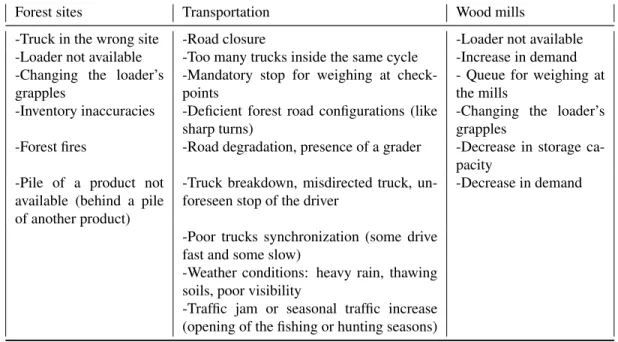
3.I List of common unforeseen events . . . 32
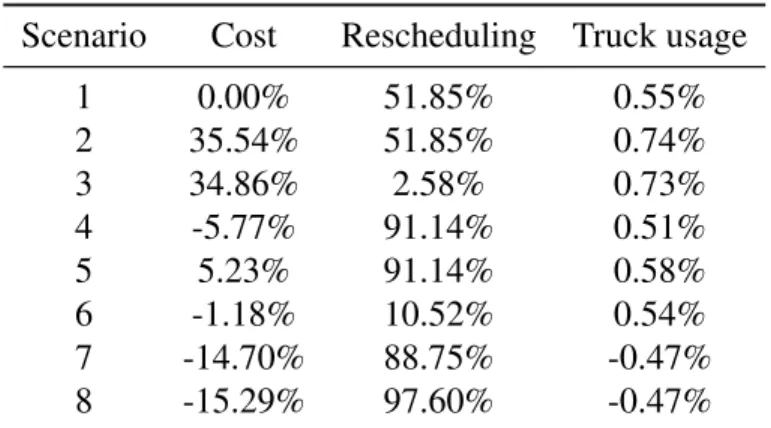
3.II Results for one canceled trip . . . 49
3.III Results for one loader breakdown . . . 53
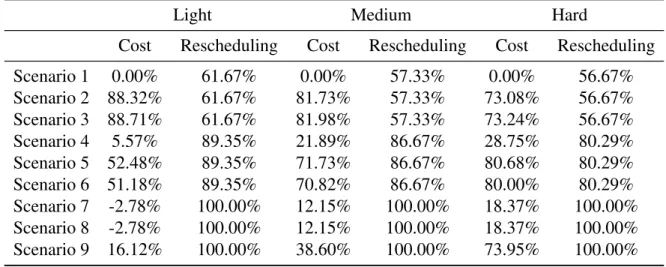
3.IV Comparison of case studies . . . 53
4.I Description of case studies . . . 75
4.II Results on case studies . . . 78
5.I Results after six disruptions . . . 100
5.II Description of unforeseen events . . . 101
5.III Impact of compatibility degree on results . . . 102
LIST OF FIGURES
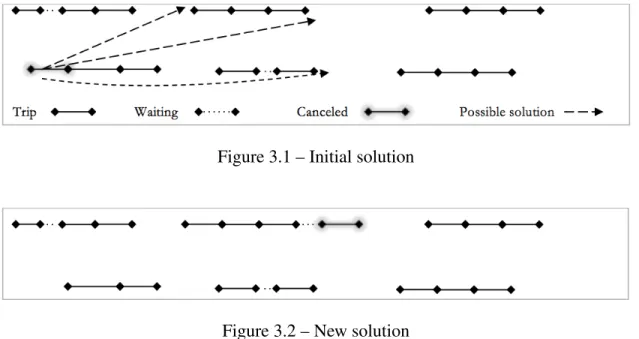
3.1 Initial solution . . . 40
3.2 New solution . . . 40
4.1 Time-space network . . . 65
LIST OF ABBREVIATIONS
DSS Decision Support System
DVRP Dynamic Vehicle Routing Problem LP Linear Programming
LTSP Log-Truck Scheduling Problem MIP Mixed Integer Programming
OR Operational Research VRP Vehicle Routing Problem
“The way we see the problem is the problem.” — Stephen Covey
REMERCIEMENTS
Il m’est particulièrement agréable d’exprimer ma reconnaissance envers toutes les personnes dont l’intervention au cours de cette thèse a permis son aboutissement.
Mes remerciements vont d’abord à Bernard Gendron et Michel Gendreau, pour m’avoir accueilli au sein de leur équipe et pour la confiance qu’ils m’ont accordée tout au long de ce travail. Merci pour votre encadrement, vos conseils judicieux et pour vos qualités humaines et scientifiques. Ma reconnaissance va également à Nizar El Hachemi pour ses encouragements et ses conseils qui m’ont facilité l’atteinte des objectifs de cette thèse.
Je remercie le réseau VCO pour m’avoir offert de travailler sur ce projet et pour leur soutien financier. Merci aussi à FPInnovations pour m’avoir accordé un stage, aidé à comprendre l’industrie forestière canadienne et fourni les données nécessaires pour compléter ce travail. Je remercie également le CIRRELT pour m’avoir offert des conditions de travail favorables à la réalisation de ce travail.
Je suis aussi reconnaissant à tout le corps professoral et administratif du DIRO et du CIRRELT pour tous les efforts déployés durant toutes ces années, ainsi qu’à tous les étudiants ayant contribué de près ou de loin au bon déroulement de cette thèse.
Je termine en exprimant ma profonde gratitude à toute ma famille pour leurs encour-agements et leur patience. Sara, grâce à ton soutien, j’ai pu mener à terme ce travail.
CHAPTER 1
INTRODUCTION
Well-managed forests contribute to the conservation of the wildlife, the economic and the social well-being of millions of people around the world. According to the U.N. Food and Agriculture Organization (FAO) [46], wood is the main energy source for about a third of the world population. Forests provide also many direct and indirect employment opportunities to a large share of the world population. They are estimated at 13.2 million for the formal sector and 41 million for the informal sector. The formal sector involves wood production and processing and the pulp and paper industry. The informal sector consists of seasonal and part-time jobs performed by farmers and self-employed workers. Many countries include these jobs in agriculture, hunting, and fishing statistics rather than in forestry ones. The organization estimates also that forests cover over 4 billion hectares. However, the forest area has decreased from 31.6% of the global land area in 1990 to 30.6% in 2015. Therefore, a lot of effort was dedicated to planting trees, which are estimated at 7 percent of the total forest area in 2015. Moreover, different management plans were developed for about 52% of the forest area by 2010. This includes both plans intended to wildlife conservation and to wood production.
Canada has the third largest forest area in the world after Russia and Brazil. In 2014, the Canadian forest sector revenues attained 58 billion dollars according to the Forest Products Association of Canada (FPAC) [47]. This is partly due to the increasing interest in research and development, which was allocated over 200 million dollars in 2012. However, recent years have been difficult for the Canadian forest industry. It was highly affected by the global economic downturn, the collapse of the US housing market and the development of electronic media to the detriment of newsprint. Therefore, the FPAC 2020 vision was born with the aim of developing innovative forest products, reducing the environmental footprint and creating employment opportunities.
Transportation accounts for an important proportion of wood procurement costs and environmental impact. For example, trucking costs are estimated at 30% of the total cost in Quebec [40, 105]. The total cost includes stumpage, harvesting, transportation, silviculture and administration expenses. Also, log-trucks travel empty from mills to forest sites and therefore lose half of their transportation capacity. If the geographical positions of supply and demand points allow a flow of products going in opposite directions, one must take advantage of backhauling opportunities. In addition to empty driven trips, the unproductive activities include waiting. Loading and unloading operations are performed by loaders at forest sites and mills that are usually operated only for a specific period of the day. To avoid creating queues at the loaders, the synchronization of the trucks with the loaders must be taken into account.
In some Canadian provinces, the forest industry must also compete with oil and mining industries to retain the truck drivers. In addition to cost reduction and efficiency improvement, this leads to higher demand for accommodating drivers by proposing good quality routes. This means, for instance, that one must avoid routes that alternate trips to the south and to the north or those that alternate days with high and low work-loads. Although it could be hard to meet all these objectives, some forest companies still rely on experienced dispatchers to derive transportation plans. This manual planning is laborious and stressful for the dispatcher. Therefore, more and more companies adopted decision support systems in the recent years. In addition to the graphical interfaces and the analysis capabilities that these systems provide to the managers, they generally use operational research models and methods to optimize the transportation. This resulted in lower costs and better quality routes.
Deriving schedules for trucks to transport different wood products between forest sites and wood mills at a minimal cost is known in the literature as the log-truck scheduling problem (LTSP). The main objective is to satisfy the demand for wood products at the wood mills, while not exceeding the supply at the forest sites. Some
of the objectives presented above may or may not be taken into account depending on the application context. For example, the fleet of trucks could include trucks that are equipped with onboard loaders. These trucks do not need to be synchronized with loaders, but their usage is limited. Indeed, the onboard loaders decrease their transportation capacity and consequently their cost-efficiency. Also, some trucks may have specific constraints. For example, some roads cannot be used by some classes of trucks. Some drivers may have also preferences with regards to the vis-ited sites. Every effort should be made to satisfy these needs especially for senior drivers.
The transportation plans obtained through the resolution of the LTSP are vulnerable to unforeseen events. The nature of the unforeseen events that arise in the forest industry is distinct from what can be found in the literature on similar problems in other sectors. We have drawn up a list of the most frequent unforeseen events. The list includes unforeseen events that are likely to appear at the forest sites, those involving trucks and road networks and those that occur at the mills. The manual reactions to these events are generally inefficient and time consuming. A more responsive and quicker decision system could improve the performance of the transportation fleet. More and more log-trucks are equipped with onboard computers and communication technologies that enable to capture the impacts of these events in real-time. In this thesis, we propose models and methods to generate, in a short computational time, new transportation plans in reaction to these impacts.
This thesis has been realized in collaboration with FPInnovations. FPInnovations is a not-for-profit research center that creates scientific and technical solutions to support the Canadian forest sector’s competitiveness. Created in 2007 through the merger of Forintek, the Forest Engineering Research Institute of Canada (FERIC), the Pulp and Paper Research Institute of Canada (Paprican), and the Canadian Wood Fibre Centre, it brings together stakeholders with diversified backgrounds and acts as an innovation hub involving the industry, the government and universities. Its Value Maximization and Decision Support (VMDS) research group develops decision support systems to help
industry members to generate more value through implementing value chain concepts. The latter include supply chain agility, which is considered, by many specialists, as a requirement for any modern supply chain. This is especially true given that the need and the request for timed deliveries are increasing in the forest industry. Within this framework, FPInnovations has raised the interest of forest companies for the development of methods and models to improve the responsiveness of the transportation systems to disruptions.
Two recent theses [37, 106] dealing with tactical and operational transportation planning in forestry designated the real-time rescheduling problem as one of the important research extensions of their work. These theses were realized in collaboration with FPInnovations and the work presented in [106] led to the development of Truck Scheduler. This tool optimizes transportation by minimizing both transportation (loaded and empty trips) costs and queuing times for loading and unloading the trucks. It pro-duces transportation plans that satisfy a set of constraints such as demand satisfaction, increasing drivers’ satisfaction and balancing the workload between different weeks. This tool takes several parameters (e.g., demand, supply, etc.) as an input. In practice, however, these parameters could be inaccurate since the decision maker might not have full knowledge of them and will then use estimates to derive the transportation plan. Using the same tool to reschedule transportation is not suited for a real-time application, first because it is time-consuming and second, it is often required to minimize the modifications to the initial transportation plan. The goal of this thesis is to develop fast algorithms that are able to handle the constraints necessary to deliver transportation plans in real-time.
To gain a better understanding of the forest operations, the author of this thesis was granted a four-month internship at FPInnovations. The first application context that was defined by FPInnovations during this internship involved the use of Truck Scheduler to construct a weekly transportation plan for a homogeneous fleet of trucks. The full weekly plan is communicated in advance to the drivers. In this context, the plan must be
followed as much as possible after a disruption. Chapter 3 presents a heuristic method that produces new transportation plans with few deviations from the initial one. The method uses different recourses, such as adding a truck or extending mills opening hours to find feasible solutions in a short computational time. Chapter 4 presents a second application context, where only one trip at a time is communicated to the drivers. This allows to reoptimize the transportation plan after a disruption. The fleet is homogeneous and demand is stated on a daily basis. We present a mathematical programming model with flow constraints and a time-space network as input. This network changes whenever unforeseen events occur, as it will incorporate the consequences of the events. In this context, the model is solved for the current day every time unforeseen events occur and modifications to the time-space network are performed. Chapter 5 presents a third application context where the fleet of trucks is heterogeneous and the demand is stated on a weekly basis. We use a mathematical model where the columns correspond to truck routes. Similarly to Chapter 4, we use a time-space network to represent the disruption consequences and to generate feasible routes. The latter must, though, not deviate a lot from the routes in the initial transportation plan. We use column generation to solve the model as the number of feasible routes can be large. Real data provided by FPInnovations and generated unforeseen events through a discrete-event simulation procedure are used to assess the three approaches.
The author of this thesis developed the solution approaches proposed in Chapters 3, 4, and 5. He wrote the code, implemented and tested the models and the algorithms, and analysed output data. Michel Gendreau and Bernard Gendron supervised the thesis, helped with the design of the experiments, discussed the results and commented on the three manuscripts at all stages. The mathematical model proposed in Chapter 4 is adapted from [38], which is part of the Ph.D. thesis of Nizar El Hachemi. Dr. El Hachemi helped understanding the application context and the mathematical model. He also contributed to adaptating the model to a real-time setting. Moreover, he revised the second manuscript in Chapter 4 and participated to the discussions that led to the design of the third study in Chapter 5.
The remainder of this thesis is organized as follows. In Chapter 2, a literature review is presented. We start by reviewing the operational research contributions to the forest in-dustry. This includes strategic, tactical and operational planning problems. We also give some examples of uncertainties that arise in forestry. A separate section is devoted to for-est transportation, which is the subject of this thesis. We review also the dynamic vehicle routing problem, which gives a general framework for the real-time forest transportation problem. Chapters 3 through 5 present the three articles that have been produced over the course of these doctoral studies. Chapter 3 presents Managing unforeseen events in forestry transportation, which has been accepted for publication in J-FOR, The Journal of Science and Technology for Forest Products and Processes. Chapter 4 presents Real-time management of transportation disruptions in forestry, which has been submitted for publication to Computers & Operations Research. Chapter 5 presents A heuris-tic branch-and-price algorithm to solve real-time transportation problems in forestry, which has been submitted for publication to the European Journal of Operational Re-search. Finally, Chapter 6 summarizes the contributions of this thesis and discusses potential future research directions.
CHAPTER 2
LITERATURE REVIEW
Operational research (OR) has played an important role in improving the forest resources management practices since the 1960s [121]. Moreover, the last 50 years have witnessed an increase in practical requirements that must be taken into account during the optimization process. The literature is rich in examples of challenges faced by OR practitioners in the forest industry. One example of these is real-time transportation, which is the subject of this thesis. This problem is closely related to dynamic vehicle routing problems (DVRP) that can be found in other industrial sectors. In this chapter, we review the literature on OR in forestry and, more in detail, in log transportation and DVRP. We conclude this chapter by stating the contributions of this thesis.
2.1 Operational research in forestry
Optimization techniques are used in a wide range of applications within the forest industry. This includes long-, medium- and short-term planning problems. The long-term strategic planning may involve a time horizon of more than one hundred years in the case of forest management, while the short-term planning for trucks dispatching involves only a few seconds. In a more formal way, [107] defines the time horizon for strategic, tactical, operational and real-time planning problems at more than five years, between six months and five years, between one day and six months and less than one day periods, respectively. Note, however, that this definition can vary depending on the country and the context of application. This section reviews OR in forestry, but we devote a separate section to OR in forest transportation, which is the subject of this thesis. The present review does not cover all the planning problems that arise in the forest industry. We refer the interested reader to the two recent books [31, 122], where various subjects, models and methods can be found.
2.1.1 Models and solution methods
An optimization model formulates a real problem using a set of decision variables, constraints, and an objective function. It ensures the best use of available resources, while minimizing or maximizing the objective function. The objective may also include different goals that must be balanced. The mathematical model is solved using an appropriate solution method. Requirements on the quality and the time of the solution are usually part of the description of the real problem. For the real-time problem that we study in this thesis, there is a need to solve the model in a small computational time. However, tactical and strategic problems can take up to several hours to find a solution. [107] provides a list of typical forest planning problems along with the time available to solve them.
The main methods used to solve planning problems in forestry are derived from mixed integer programming (MIP) and linear programming (LP) models. LP models are often used in strategic forest management, while MIP models are used for operational and real-time log-truck scheduling, annual harvesting, and equipment scheduling. MIP models may be hard to solve using a commercial solver, but the properties of the problem can be used to improve the solution approach. Branch-and-bound and cutting plane algorithms, or their combination (branch-and-cut) are often used to solve MIP models. The number of variables in these models is generally too large to be handled explicitly. Column generation is then used to add iteratively only the variables that have the potential to improve the objective function. The problem is separated into a master problem and a subproblem. The master problem has the same structure as the model to be solved, but includes only a subset of the variables. The subproblem is used to identify the new variable to be included in the master problem. This method has received a lot of attention in recent years and has been used for solving the log-truck scheduling problem (LTSP) [97, 104, 105].
Dynamic programming involves breaking the problem down into a set of stages. At each stage, there are a number of states corresponding to the possible conditions at the start of the stage. Given a state, a decision must be made, which yields a new state at the following stage. The goal of the method is to find the optimal policy, which consists of the set of optimal decisions to take at each stage and each state. Dynamic programming is often used to solve the subproblem of the LTSP in a column generation method. The columns in the master problem correspond to feasible routes for each log-truck. Using a time-space network, a route corresponds to a path in the network. Dynamic programming is used to find the shortest path in such networks [104, 105]. It is also the main method used to solve the bucking problem, which consists in cutting trees into different log types [107].
Well-designed heuristics are able to quickly find high quality solutions. They use logic rules to guide the search for these solutions, but there is no proof of their quality. Therefore, a solution is considered of high quality if it is at least as good as a manual solution derived by an experienced planner [107]. Heuristics are used in many planning problems in the forest industry, especially for operational and real-time problems where fast solutions are needed.
Simulation is used to evaluate the solutions found by solving the mathematical models. Given the stochastic nature of many parameters included in forest planning problems and the unforeseen events that can be revealed during the execution of the plans, simulation can be used to identify the bottlenecks associated with the execution of the solutions. The model can be modified and solved again after the simulation. This technique was recently used to assess the performance of a transportation plan considering uncertainty in trucks arrival time at a mill [78]. In stochastic programming, simulation can be used to generate a set of scenarios that are used as input to the optimization model. This method assumes that uncertainties can be described by proba-bility distribution functions that allow to generate these scenarios. The goal is to find a feasible solution that maximizes or minimizes the expectation of the objective function
given a set of scenarios. This is the case for example in forest management, where simulation is used to model the evolution of forests over time and to choose the potential silvicultural interventions to reach the desired forest state. Then, a mathematical model is solved to decide which silvicultural intervention must be applied to each sector [126].
The evaluation of the solutions must also be done by the planner. Since the num-ber of decision variables can be large, a graphical interface must be used to format the solution in an easily readable way. Many decision support systems were developed in the forest industry [9, 69, 115, 124]. More details on decision support systems and OR methods used in the forest industry are given in the next subsections, which cover all planning levels (strategic, tactical and operational), as well as a subsection presenting how uncertainties are handled.
2.1.2 Strategic planning
Several surveys traced the development, as well as the challenges faced by OR in forestry. [10] reviews the OR contributions from the late 1960s to the mid 1980s, while [109] is a recent survey presenting also 33 current open problems in forestry. Some of the applications are very specific, whereas others are more general. The latter involve several decision problems. An example of a general problem is strategic forest management planning. This problem aims at maximizing the net worth of forest resources, while preserving the surrounding social, ecologic and economic systems. This involves, among other things, the wildlife, habitat and scenic beauty conservation [11].
To preserve the wildlife habitat, some contiguous areas of a certain age must be preserved [95] and several constraints are imposed on the maximal area to be harvested. Also, if a block is harvested, the adjacent ones must be preserved for a certain number of years. On the other hand, minimal area limitations are also necessary to ensure cost-efficiency. From a modelling perspective, this gives rise to a large set of constraints, and binary variables are generally used to decide which blocks to harvest [89]. The
main OR contributions try to minimize the number of constraints, while ensuring that the linear relaxation solutions remains close to the initial integer program solutions [54, 55, 83, 84, 90, 118]. Besides the economic benefits of harvesting, it is also used to reduce tree diseases and fire risks. Fire is also used as a natural mean to preserve the forest health. In [79, 80], the authors review OR approaches to forest fire management problems. This involves also air tankers location and crew scheduling problems [56].
Strategic planning is considered both at governmental and industrial levels. The US Forest Service developed Timber RAM (Resource Allocation Method) [92], which is a strategic LP model used to plan long-term harvesting and reforestation. Later, it developed FORPLAN [69] to take into account the new socio-economic concerns. In Sweden, Heureka [124] contains an optimization module and a simulator to evaluate the management plans. Similarly, FOLPI [51] was developed by the New Zealand forestry ministry. These countries have different regulations and approaches to solve the strategic problems. The different requirements give rise to different constraints from a modelling perspective [60], which impacts also the quality of the solutions [59].
Strategic decisions include also road construction, the opening and location of mills, transportation equipment, information technology, etc. Synchronizing all these activities is known as supply chain management. For example, road building/upgrading investment decisions must take into account some of the supply chain components, such as the customer demands, the cost variations and the inventory management policies [96]. The goal is to improve the efficiency of the flow of wood from planting and harvesting (sourcing) to the distribution of the final product to end consumers (sales) [22, 24].
Issues that arise in strategic planning are generally hard to measure, often conflicting and hard to manage simultaneously. Finding an optimal solution is generally hard to achieve and the challenge is rather to find feasible solutions [82]. However, such solutions must be optimized, since they have long-term impacts on the quality and
quantity of the available wood. Decomposition techniques and hierarchical planning approaches are generally used for this purpose [119]. The first step is generally to make decisions on the volume and then on the areas to harvest or plant. Strategic decisions impact the tactical ones, which in turn impose restrictions on the operational planning. Simulation models allow evaluating the impact of these strategic decisions [15].
An important problem in the hierarchical planning is the interaction of the decisions at different planning levels. Generally, the models are solved separately and they are linked using heuristic methods. This is done through aggregation and disaggregation of decisions between the planning levels. [81] reviews the principles of hierarchical planning and presents some practical experiences and feedbacks from both the industry and the government with regards to the hierarchical forestry planning systems that they use.
2.1.3 Tactical and operational planning
The definition of the tactical and operational planning levels is very dependent on the context of application. They are also defined by the contracts between the different parties. Therefore, they are reviewed in a single subsection.
At the medium-term planning level, tactical problems typically integrate harvesting with transportation [109]. However, tactical harvesting and road building decisions were originally taken separately. [66] analyzed the advantages of combining the two problems into a single model. Different formulations and resolution methods can be found in the literature. These problems are generally modelled as mixed integer programs (MIP). [4] uses Lagrangian relaxation, while [45] uses constraint aggregation to solve such models. Also, many decision support systems (DSS) such as FORPLAN [69], SNAP [112], PLANS [115] and RoadOpt [68] include models to make choices of roads to build or upgrade. Locating harvesting machinery is another problem that is linked with harvesting and transportation. PLANEX [44] uses a heuristic method based on a geographic information system (GIS) and economic parameters to decide of
machinery installations, road building and wood transportation in Chile. [18] included also crew scheduling with harvesting decisions.
At the short-term planning level, operational problems involve harvesting, bucking and transportation [42]. The wood logs are generally defined by their species, quality, shape, diameter and length. Short-term harvesting problems decide which areas to harvest each week. They decide also which patterns to use to define the demanded logs. OPTICORT [43] uses column generation to define the areas, the volume, the products to harvest, the machinery to use and the assignment of these products to the customers. [70] use a tabu search to define the bucking patterns, given certain market prices. For the same problem, [20] uses dynamic programming and simulation, while [41] uses a Dantzig-Wolfe decomposition procedure and solve the subproblems using dynamic programming.
Horizontal collaboration also gained a lot of interest in the last few years. OR is more and more used to evaluate this kind of collaborations. In [12], the authors propose an approach to find an agreement between multiple firms on a common harvesting plan. In [49], the cost allocation problem in a collaboration at the log transportation level is addressed, while [73] proposes an evaluation methodology for a collaboration between a paper mill and a wholesaler.
2.1.4 Uncertainties in forestry
Several sources of uncertainty exist in the forest industry [109]. The wood markets include uncertainties about the prices and demand volumes. The forest areas involve uncertainties about the trees growth and quality, the global and per species volumes estimates and diseases and fire risks. The wood production includes inaccuracies about the harvesting and transportation plans. Other uncertainties include technology devel-opments and regulations changes. These inaccuracies are generally handled through including extra travel times for transportation estimates, extra inventories for demand levels, extra dollars for costs estimates, etc. In the 80s, chance constrained programming
was mainly used to solve strategic forest management problems under timber growth uncertainties [63, 123]. Other stochastic models have been lately introduced to cover other types of uncertainties in the forest industry.
In [1], the authors consider a tactical harvesting and road construction problem with market uncertainty. The stochastic model that they developed tries to find the best solution that is feasible under all the generated timber prices variations scenarios. In addition to the big number of scenarios that could be generated, the nonanticipativity constraints make the problem resolution harder. These constraints state that if two different scenarios are identical up to a certain time interval, the decision variables values must also be identical up to that interval. The authors use a branching scheme where these constraints are implicitly satisfied.
The same problem was considered in [117], but under uncertainty in timber growth. The authors use the progressive hedging method where the problem is decomposed and the model is solved for each scenario separately in an iterative fashion. This allows to remove the nonanticpativity constraints. The proposed method penalizes the deviations from the average value in all scenarios of the variables that must satisfy these constraints. The iterative fashion allows the convergence to a solution that respects the nonanticiptavity constraints.
In [23], the authors present a Scandinavian case study where there are uncertainties about the demand. The original approach was to keep a safety stock to face the demand fluctuations. The authors propose, instead, a robust optimization approach to eliminate these stocks. The approach decomposes the problem into two separate problems. In the first problem, they find a feasible solution. The second gives the worst-case scenario given this solution. This is used as a valid inequality in the first model. The process is repeated until the first problem produces a solution satisfying the worst-case scenario.
In [113], the authors study the problem of selecting natural areas to be preserved for the protection of species over time. In practice, these decisions take place sequen-tially as funds become available. Site availability is dynamic, since some parcels can be converted from open space to developed uses if protection is delayed. To solve the sequential site selection problem under uncertainties in budget and site availability, the authors use an integer programming model that maximizes the expected number of species represented by the set of selected sites. The uncertainty is characterized by a set of scenarios. Since the number of the scenarios increases exponentially with the number of sites, the authors choose randomly a subset of scenarios to be included in the model.
There is still a lot of work to be done in formulating and solving stochastic problems in the forest industry. In [109], at least 10 of the 33 open challenges that were identified for OR in forestry involve uncertainties. Large-scale problems in forest management and value chain management are more challenging, since they include many stochastic processes. It is hard to quantify and to represent the underlying multiple sources of uncertainties. It is also hard to construct mathematical models that explicitly consider uncertainty, especially for multi-objective and multi-stage planning problems.
There are significant computational challenges to solve these complex problems. The number of scenarios, in a scenario-based model, can be large and the problem cannot be solved directly. Ad-hoc methods can be used to reduce the size of the pool of scenar-ios. The problem can also be decomposed into several subproblems that are easy to solve. Stochastic optimization assumes that the uncertainty has a probabilistic descrip-tion, which can be hard to define. Depending on the complexity of this descripdescrip-tion, the model may become hard to solve within a reasonable computational time. In robust op-timization, the uncertainty is only known to belong to some uncertainty set and there is no requirement to have probability distributions. The goal is to find the optimal solution that is feasible in the worst-case scenario. To avoid conservative and costly solutions, care must be taken in the construction of the uncertainty set, which is challenging for large scale forest planning problems.
2.2 Dynamic vehicle routing problems
The real-time transportation problem that we study in this thesis is closely related to the dynamic vehicle routing problem that has received a lot of interest during the last few years. Indeed, the search for efficiency at all the business levels is a key element to main-tain the competitiveness of a modern company. This includes the efficient distribution of goods and services. Also, the customer needs are evolving and the capability to fulfill these requirements impacts the competitiveness of the companies. The late technologi-cal advances allow to track the fleet of vehicles in real-time, which gives opportunities to react efficiently to changes in demand and travel times. Numerous decision systems were developed for that purpose. They range from scheduling maintenance workforce [74] for dynamically revealed service requests to city logistics systems [127] for chang-ing travel and service times. In this section, we start by presentchang-ing the static vehicle routing problem before discussing the dynamic version.
2.2.1 Vehicle routing problem
The vehicle routing problem (VRP) [114] aims at designing a set of minimal cost routes for a homogeneous fleet of vehicles in order to satisfy the demand of a given set of customers. Some variations of this problem may have a different objective function such as minimizing the number of vehicles used [75]. In the capacitated VRP (CVRP), the vehicles have finite capacity, while the heterogeneous VRP (HVRP) considers vehicles with different capacities and configurations. Another variation imposes time windows within which a customer can be served. This is known as the VRP with time windows (VRPTW) [67]. The VRPTW can also be extended to include both pickup and delivery operations. In the pickup and delivery problem with time windows (PDPTW) [36], the customer demands consist of a pickup at an origin site followed by a delivery at a destination site within given time windows. The dial-a-ride and dial-a-flight problems are examples of PDPTW applications. Many distinctions can be found based on whether there is a single or multiple vehicles, if people or commodities are transported, etc.
The customers are generally visited only one time in the problems presented above. However, in some applications such as forestry, several visits to the pickup and delivery sites are necessary to satisfy the demand. Also, the possibility of serving a customer by more than one vehicle is used to potentially reduce the total costs. This can be achieved, for example, if a certain number of vehicles are not fully loaded. The spare space can be used to deliver a given demand in a split way instead of using extra vehicles. In the literature, the researchers studied split pickup problems [72], split delivery problems [58], and split pickup and delivery problems [87].
The amount of published material on VRP has exponentially increased since its first introduction. This is due to the diversity of its variants and of the optimization ap-proaches that have been proposed to tackle them. This includes both exact and approx-imate approaches. The next subsection presents the dynamic version of the VRP along with some solution methods. We refer the interested reader to the books [53, 114] for a complete review of the VRP variants, solution methods, challenges and applications.
2.2.2 Dynamic vehicle routing problem
Other variations of the VRP are based on the nature and quality of the data it considers. If all the data is known beforehand, the VRP can be solved statically. But if the data is evolving over time, the VRP must be solved dynamically. This is known as dynamic VRP (DVRP). Also, the data may be assumed to be fixed and accurate. The problem is then considered as deterministic. On the other hand, data can be expressed as random variables with certain probability distributions. This is known as stochastic VRP (SVRP). Table (2.I) [100] summarizes these problems.
Information quality
Information evolution Deterministic input Stochastic input
Input known beforehand Static and deterministic Static and stochastic
Input changes over time Dynamic and deterministic Dynamic and stochastic
Table 2.I – Taxonomy of vehicle routing problems by information evolution and quality [100]
The problem that we study in this thesis falls into the category of dynamic and deterministic problems. The latter are also called real-time or online VRPs. In these problems, a part of the input is revealed dynamically and the routes are modified accordingly. In the problem we study, the dynamic input corresponds to the unforeseen events. The transportation plan is re-optimized every time a disruption happens. High quality solutions must be found in a short computational time. Also, one must reduce the deviations from the initial plan. The dynamic and deterministic log-truck scheduling problem is able to find a trade-off between solution quality, computational time and perturbations for the original plan. The main drawback of this approach is that it does not anticipate the disruptions. A stochastic model would be able to produce solutions that are less vulnerable to disruptions. Unfortunately, there exists no study on the probability distributions of such events in the forest industry. Conducting such a study is challenging given that it is hard to get historical data. This is, however, an avenue for future research since many forest companies are investing in log-trucks with onboard computers, positioning systems, and communication technologies that can be used to collect accurate data on disruptions.
The uncertainty sources that are mostly addressed in the literature on DVRP are new customer requests [100]. Some applications involve stochastic travel times [127] and
less importantly vehicle breakdowns [76]. Moreover, there are problems where there is no need to define complete routes with different customers visits. This is the case for emergency vehicles [62]. Taxi bookings can also arrive dynamically, but some requests may be known in advance in the case of an early booking [21]. These applications consider generally one source of uncertainty at a time. In the forest industry, in contrast, the events that impact the transportation can be of different natures: trucks, loader breakdowns, road closures, delays, etc. In this thesis, we consider all these events simultaneously.
The approaches used to solve DVRP include many techniques both to generate and to evaluate new routes. For example, in express courier applications, it is possible to reject some new requests because of infeasibility or cost inefficiency [52]. It is also possible to divert a vehicle from its destination to serve a nearby customer [64]. This is generally allowed by the supporting urban transportation network, which enables reaching the same destination by taking different itineraries. The forest roads do not generally allow this kind of recourses.
Solution approaches for dynamic and deterministic VRP are generally based on those that were developed for the static VRP. They rely on the extensive research that was done in this field and their adaptation to dynamic contexts proved to be efficient. [101] developed a dynamic programming approach to solve a single vehicle dial-a-ride problem where they consider both service time minimization and customer satisfaction maximization. The problem aims at finding the best route each time a request is revealed. The use of dynamic programming, however, necessitates an important computational effort, as the size of the instances increases significantly. This is known as the curse of dimensionality. To cope with the latter, Approximate Dynamic Programming approximates the value function and avoids the evaluation of all possible states.
In [26], the authors use a column generation approach for a DVRP with time win-dows where the demands arrive dynamically. The approach uses the existing columns to generate the new ones after each request. For a DVRP with pickup and delivery where requests for transportation tasks between an origin and a destination node arrive dynamically, [125] developed five policies based on either offline reoptimizations or heuristic methods.
The solution approaches include also metaheuristics. [13] addresses a patient trans-portation problem where requests for transtrans-portation between locations in a hospital cam-pus arrive dynamically. The authors use an insertion algorithm to find a feasible solution that is improved by a tabu search heuristic. [52] addresses a dynamic courier service problem using also a tabu search heuristic that is implemented on a parallel platform. Genetic algorithms are used in [116] and [61] where both requests and travel times vari-ations are considered. [50] and [88] developed approaches based on ant colony systems.
2.3 Transportation in forestry
The problem that we study in this thesis is a dynamic and deterministic VRP with time windows. Time windows are mainly the opening times of the mills and the operat-ing hours of the loaders at the forest sites. However, these time windows are generally not as tight as in other industries. This is also a pickup and delivery problem with split pickups and deliveries, since several visits are necessary to both the mills and the forest sites in order to satisfy the demand. Additional constraints include the synchronization with loaders for both loading and unloading operations. We consider also both the ho-mogeneous and the heterogeneous cases. This section reviews the contributions of the OR community to forest transportation in general including the real-time problem.
2.3.1 Strategic and tactical transportation
Strategic transportation planning is mainly concerned with road building and investments in heavy transportation modes such as trains [9]. Tactical planning involves
upgrading roads and managing the fleet utilization [107]. If a heavy transportation mode is used, the tactical decisions may involve the upgrading of these modes, such as adding wagons to trains or changing their schedules. Strategic and tactical transportation planning problem are generally integrated with harvesting problems. At the strategic level, the harvesting and road building decisions are mutually influential. At the tactical level, harvesting decisions involve the assignment of the harvested wood to the customers. These decisions are critical for the transportation costs since they influence directly the backhauling opportunities [25].
FlowOpt [48] is a decision system used for strategic and tactical transportation problems in Sweden. At the strategic level, the aim is to decide whether to use trains, trucks or their combination. The decisions concern also the train capacity and the terminal location. At the tactical level, decisions concern the areas to harvest, the allocation of wood to customers and backhauling opportunities. The system considers also collaboration between companies to exchange wood in order to enable backhauling. This approach generated cost savings of up to 12.8% in some case studies. The transportation planing problem is formulated as a linear programming problem. The model is solved using column generation. The subproblem is a constrained shortest path problem, which is used to generate iteratively the best possible backhauling routes.
FPInterface is a simulation tool developed by FPInnovations in Canada. It contains a transportation planning method named MaxTour [9]. The latter generates backhaul-ing tours given the volumes of supply, their destinations and different configurations of trucks. The method is based on the Clarke and Wright savings algorithm [27].
2.3.2 Operational transportation
Operational transportation decisions deal generally with trucks scheduling. De-pending on the quality of the roads, transportation can be done in one or two phases. If the harvested areas are difficult to access, the first phase consists of forwarding the logs from the harvested areas to sites that are close to roads. The second phase is the
transportation to the mills. This phase involves the most important saving opportunities and has then received more attention. This problem is known as the log-truck scheduling problem (LTSP).
Many approaches were developed to solve the LTSP. [104] studies a daily LTSP. The problem is formulated using an integer programming model with binary variables representing truck routes. These variables represent the columns of the model. The in-tegrality constraints are relaxed and the model is solved using column generation where the routes are generated dynamically. This is done by solving a shortest path problem in a time-space network. An integer solution is found using a branch-and-bound algorithm. A similar approach is used in [98]. However, the authors generate a priori a set of routes following certain rules. Also, the authors use a heuristic branch-and-price method to find an integer solution.
In [38], the authors use a two-phase approach to solve the weekly LTSP. The first phase involves an integer linear program that determines the destinations of full truckloads. The demand is then expressed as a set of trips to operate throughout the week and the weekly LTSP is decomposed into seven daily LTSPs. The daily LTSP is formulated as an integer programming model using arcs from a time-space network. Besides minimizing transportation costs, the authors consider also minimizing the loader working time at forest sites. To derive integer solutions, a heuristic branching strategy favouring solutions with lower loader working times is used. This two-phase approach is also used in [40] . However, the daily LTSP is solved using two approaches. The first one uses a constraint-based local search method where constraints are used to control the local search. The second one integrates the first approach with a constraint programming model.
In [57], the authors assume a context where all the transportation requests are a priori known. The loaded travel times are then fixed and the goal is to minimize empty driven trips. The authors adapted the unified tabu search algorithm, initially proposed
for a general VRP [28], to solve a daily LTSP. The same context is studied in [39], but the authors combine a constraint programming model with an integer programming model to solve the problem.
In [85], a simulated annealing method is used to solve a daily LTSP. Simulation was used to evaluate the quality of the first found solution with regards to different metrics such as empty travel and waiting time. Then, heuristic rules were used to modify this solution based on its performance. This produces new routes, which are considered during the simulated annealing process. A new solution is then generated, simulated and evaluated again. If this solution has a better performance than the previous one, it is kept with a certain probability. The process is repeated until there is no improvement.
Many decision support systems were also developed. ASICAM is a DSS that was developed in Chile [120]. It is used on cases with a fleet reaching 220 trucks. The system uses a simulation process based on heuristic rules to design daily transportation plans. The reported results show an improvement of the quality of the schedules and cost savings between 15% and 35%.
EPO is a system that integrates strategic, tactical and operational planning problems [77]. The system was developed and used in Finland on cases with a fleet of 250 trucks but there were different dispatching centers, each managing up to 20 trucks. The approach starts first by allocating the wood from forest sites to mills. The second phase aims at designing weekly transportation plans. This is done using a combination of an optimization method and some heuristics in addition to some prior knowledge. The third phase involves manual post-processing based on the dispatcher’s experience.
RuttOpt was developed in Sweden [5]. The DSS produces transportation plans for up to five days for a fleet size ranging from 10 to 110 trucks. The proposed approach is based on a two-phase algorithm. The first one solves a linear programming model to generate a feasible flow between the forest sites and the mills for each truck. The second
phase solves the routing problem using a tabu search method. The reported cost savings range from 5% to 30 %.
2.3.3 Real-time transportation
Real-time transportation deals with truck dispatching where typically only one load at a time is assigned to idle trucks. In this thesis, however, we study a real-time problem where we generate daily or weekly plans every time the original weekly transportation plan is disrupted. Note that this problem involves the dispatching problem as well, but tries to take advantage of the available information about future trips.
The LTSP literature addresses mostly the static LTSP. In contrast, not much research has been done for solving the real-time LTSP. A New Zealand forestry company has developed a decision support system called CADIS (for Computer Aided Dispatch) for dispatching the log-trucks in real-time in a context where the supply and the demand for forest products are continuously changing during the day [110]. Given more accurate data about the supply and the demand, the dispatcher communicates one trip at a time to the drivers as they complete their current trip. This system was tested with a fleet of 120 trucks. However, it was used for only a short period because of the dissolution of the company due to financial issues. Moreover, because of confidentiality agreements, only the general scheme of how this system works was provided in [110]. However, [108] gives a feedback about the implementation challenges and the lessons learned from this application. The author reports that CADIS was particularly useful when the overall supply was low.
In [110], the problem is modelled using binary variables to decide which routes to select. These route variables represent the columns of the mathematical model. The constraints are demand satisfaction and not exceeding both supply and the number of available trucks. The solution approach starts by looking for the best single trip for the trucks. The trucks are ordered by the expected completion time of their current trip. These single trips are found using a greedy algorithm. The dispatcher can use these trips
for urgent requests. Then, a second greedy heuristic is used to derive full routes. Again, the first trips of these routes are made available to the dispatchers. The routes are also used in the linear relaxation of the mathematical model, which is solved using column generation. To find integer solutions, a branch-and-bound algorithm with heuristic branching rules is used. The first trips are again communicated to the dispatcher. This approach provides the dispatchers with feasible trips quickly, which are improved when enough time is available between successive trip requests from the drivers.
Few works considered a priori stochastic information about the input of a dispatching problem. In [86], the authors use a simulation approach to solve a dispatching problem for a case study involving 30 trucks. Although the travel speed is supposed equal for all trucks, some assumptions were made about the distribution of truck delays both during transportation and waiting at mills. Stochastic information was also available about loading times, the quantities and the nature of the product being loaded. For example, the probability of a product to be loaded is equal to the percentage of that product available at the forest site. The dispatcher has to assign a new pickup operation to the trucks each time they quit the wood mills. Three methods were developed for this purpose. The first one considers a random assignment where the probability of a truck being sent to a forest site is the same among all the sites. The second one is a static assignment where each truck is only allowed to visit an a priori fixed forest site. The authors refer to the third method as the "informed" assignment. In this method, an estimate of the time when the supply will be exhausted at a forest site is calculated. The truck is then sent to the forest site such that the difference between its exhaustion time and the truck arrival time is minimized. However, if a loader at a forest site remains idle for a long time, the truck is sent there. These methods were evaluated using simulation. Although the authors expected that the "informed" method would outperform the two other methods, the fixed assignment method was able to deliver slightly more wood. This is explained by the fact that the fixed method assigned wood flows between mills and forest sites that are close. The "informed" method, instead, does not contain enough information about the transportation distances and costs.
Some commercial DSSs include also a dispatching module. FLO is a system developed in the US and used in applications involving a fleet of 50 trucks on average [9]. The system comes with different communication and reporting technologies. The loader operators at the forest site have to enter the quantities of available wood and to define the product to be loaded and its destination. They repeat this process until the end of their working day. An optimization module matches this data with the availability of the trucks and their positions and selects a truck to pickup the available load. The truck position is tracked using global information and positioning systems (GIS and GPS). Once the truck reaches the mill, it is unloaded. If the truck is still within operating hours, it can be considered for a second pickup by the optimization module. Otherwise, it is sent to its home base. The optimization module is, however, undocumented and it is then hard to assess its performance.
Forestruck is an information system that was developed in Chile. It considers the whole supply chain from a management perspective starting at the sourcing (wood production) and ending at the sales (wood delivery) [9]. The system contains a module for truck dispatching, but there is no indication on whether an optimization model is used or not, nor on its performance.
2.4 Contributions of this thesis
We demonstrate in this thesis that real-time re-planning in reaction to disruptions can be done effectively and efficiently for realistic instances of log-truck scheduling prob-lems. This problem is different from the dispatching problem where only one trip at a time must be planned, without the need to generate a complete daily plan. In this the-sis, we generate new daily and weekly plans after each disruption. We present a list of frequent disruptions in forest transportation. Unlike in the urban context, where the literature deals generally with one problem at a time (often demand changes), we
pro-pose an approach that is valid for all types of disruptions. We relate also the real-time LTSP to other known routing problems and show the differences such as volumes to be transported, quality of the forest roads networks, and synchronization constraints. Transportation management practices differ from one forest company to another, which defines different application contexts. We study three contexts of application driving different solution methods. We start by defining core events, which can be used to de-scribe other disruptions. In the first application, we use a heuristic to construct a new transportation plan with very limited deviations from the initial one. Given the conserva-tive culture of the Canadian forest industry, we suggest different solution options rather than imposing one optimal solution. In the second and third applications, a time-space network is used to capture the impacts of the disruptions and represent the trips and activities that are still feasible in the physical network. Then, an arc-based mathemati-cal model is used in the second application, where the transportation plan is completely re-optimized for the remaining of the current day. In the third application, we use a route-based model where a column in the model corresponds to a feasible route. The goal is to reoptimize a weekly transportation plan with few deviations from planned truck trips. The model is solved using column generation and a branch-and-price algorithm with a heuristic branching rule. During the column generation process, we use a compatibility degree to capture the trade-off between minimizing cost and deviations from planned truck trips. We demonstrate that MIP technology can be exploited in this context since effective solutions can be found in a few minutes. We evaluate the three solution meth-ods using real instances from the Canadian forest industry and a simulation procedure that we developed to generate the disruptions.
CHAPTER 3
ARTICLE 1: MANAGING UNFORESEEN EVENTS IN FORESTRY TRANSPORTATION
Chapter notes
This chapter was accepted for publication in J-FOR, The Journal of Science and Technology for Forest Products and Processes on February 26, 2016. Preliminary work was presented at the following conferences:
• VCO Workshop, Montreal, Canada, February 27, 2015
• 56th CORS Annual Conference, Ottawa, Canada, June 26-28, 2014 • VCO Summer School 2014, Halifax, Canada, June 11-13, 2014 • Optimization Days 2014, Montreal, Canada, May 5-7, 2014
• 55th CORS Annual Conference, Vancouver, Canada, May 27-29, 2013 • VCO Summer School 2013, Montreal, May 17, 2013
• 1st FIBRE Conference, Cornwall, Canada, May 13 -16, 2013 • Optimization Days 2013, Montreal, Canada, May 6-8, 2013
M
ANAGING UNFORESEEN EVENTS IN FORESTRY
TRANSPORTATION
Amine Amrouss1,2,*, Michel Gendreau1,3, Bernard Gendron1,2
1Interuniversity Research Centre on Enterprise Networks, Logistics and Transportation (CIRRELT),
Canada
2Department of Computer Science and Operations Research, Université de Montréal, P.O. Box 6128,
Station Centre-Ville, Montreal, Canada H3C 3J7
3Department of Mathematics and Industrial Engineering, Polytechnique Montréal, C.P. 6079,
succursale Centre-ville, Montreal, Canada H3C 3A7
When wood is transported from forest areas to plants, several unforeseen events may occur and disrupt planned trips. In this paper, we present heuristic methods for solving real-time transportation problems in which the initial plan must be re-optimized to deal with unforeseen events. Here, the nature of the events that must be dealt with differs radically from what can be found in the routing literature, since one must deal not only with changes in the demand (e.g., the arrival of a new request), but also with changes in the topology of the transportation network (e.g., road closures). Since the consequences of such events on transportation are cancellations and/or delaying of some trips, the proposed approach deals first with single cancellations and single delayed trips and builds on these simple events to deal with more complex ones. The heuristic methods we propose provide the dispatchers with alternative plans in a few seconds.