HAL Id: tel-00789726
https://tel.archives-ouvertes.fr/tel-00789726
Submitted on 18 Feb 2013HAL is a multi-disciplinary open access
archive for the deposit and dissemination of sci-entific research documents, whether they are pub-lished or not. The documents may come from teaching and research institutions in France or abroad, or from public or private research centers.
L’archive ouverte pluridisciplinaire HAL, est destinée au dépôt et à la diffusion de documents scientifiques de niveau recherche, publiés ou non, émanant des établissements d’enseignement et de recherche français ou étrangers, des laboratoires publics ou privés.
Ngoc Chan Nguyen
To cite this version:
Ngoc Chan Nguyen. Service recommendation for individual and process use. Other [cs.OH]. Institut National des Télécommunications, 2012. English. �NNT : 2012TELE0044�. �tel-00789726�
DOCTORAT EN CO-ACCREDITATION
TELECOM SUDPARIS ET L’UNIVERSITE EVRY VAL D’ESSONNE
Sp´ecialit´e: Informatique
Ecole doctorale: Sciences et Ing´enierie Pr´esent´ee par
Nguyen Ngoc Chan
Pour obtenir le grade deDOCTEUR DE TELECOM SUDPARIS
SERVICE RECOMMENDATION
FOR INDIVIDUAL AND PROCESS USE
Soutenue le 13/12/2012 devant le jury compos´e de : Directeur de th`ese :
M. Samir Tata Professeur, TELECOM SudParis, France
Rapporteurs :
M. Marlon Dumas Professeur, University of Tartu, Estonia
M. Schahram Dustdar Professeur, Vienna University of Technology, Austria
Examinateurs :
M. Bruno Defude Professeur, TELECOM SudParis, France
M. Fran¸cois Charoy Professeur, Universit´e de Lorraine, France
M. Sami Bhiri Maˆıtre de conf´erences, National University of Ireland, Ireland
M. Walid Gaaloul Maˆıtre de conf´erences, TELECOM SudParis, France (Encadrant)
Acknowledgements
GFirst and foremost, I would like to express my appreciation and gratitude to my ad-visor, Dr. Walid Gaaloul, who offered abundantly helpful assistance, support and guidance. His vision, creativeness and enthusiasm inspired me greatly to work. This dissertation would not have been possible without his help.
I am sincerely and heartily grateful to my supervisor, Professor Samir Tata, who gave me a lot of valuable advice. His expertise and experiences influenced and helped me be more mature in doing research.
I would like to thank to Dr. Sami Bhiri for his helpful comments and English correc-tion. I would like to thank to Professor Bruno Defude, Brigitte Houassine and other staffs of the Information Department for their kind help and assistance.
I acknowledge the TELECOM SudParis institute for offering me a scholarship and providing me good environment and facilities to complete my thesis.
I am obliged to my colleagues, Mohamed Sellami, Mohamed Amin Sakka, Rami Sel-lami, Olfa Bouchaala, Mourad Amziani, who not only made many useful discussions in research but also brought out many interesting stories and unforgettable memories. I express my deepest gratitude to my loving wife, Vy. Her love and encouragement fostered me to concentrate at work. Her understanding and supports helped me to get through many difficult times.
Finally, I am forever indebted to my beloved parents for their understanding, end-less patience and encouragement. They have given me constant supports, needed inspiration and always wish the best things to me. I dedicate this thesis to them.
Abstract
Web services have been developed as an attractive paradigm for publishing, discov-ering and consuming services. They are loosely-coupled applications that can be run alone or be composed to create new value-added services. They can be consumed as individual services which provide a unique interface to receive inputs and return outputs; or they can be consumed as components to be integrated into business pro-cesses. We call the first consumption case individual use and the second case business process use.The requirement of specific tools to assist consumers in the two service consump-tion cases involves many researches in both academics and industry. On the one hand, many service portals and service crawlers have been developed as specific tools to assist users to search and invoke Web services for individual use. However, current approaches take mainly into account explicit knowledge presented by service descrip-tions. They make recommendations without considering data that reflect user interest and may require additional information from users. On the other hand, some business process mechanisms to search for similar business process models or to use reference models have been developed. These mechanisms are used to assist process analysts to facilitate business process design. However, they are labor-intense, error-prone, time-consuming, and may make business analyst confused.
In our work, we aim at facilitating the service consumption for individual use and business process use using recommendation techniques. We target to recommend users services that are close to their interest and to recommend business analysts services that are relevant to an ongoing designed business process. To recommend services for individual use, we take into account the user’s usage data which reflect the user’s interest. We apply well-known collaborative filtering techniques which are developed for making recommendations. We propose five algorithms and develop a web-based application that allows users to use services. To recommend services for business process use, we take into account the relations between services in busi-ness processes. We target to recommend relevant services to selected positions in a business process. We define the neighborhood context of a service. We make rec-ommendations based on the neighborhood context matching. Besides, we develop a query language to allow business analysts to formally express constraints to filter services. We also propose an approach to extract the service’s neighborhood context from business process logs. Finally, we develop three applications to validate our approach. We perform experiments on the data collected by our applications and on two large public datasets. Experimental results show that our approach is feasible, accurate and has good performance in real use-cases.
Keywords: Service recommendation - business process design - neighborhood context - query language - process mining
Table of contents
1 General Introduction 9
1.1 Context . . . 9
1.2 Thesis objectives . . . 10
1.3 Thesis outline . . . 11
2 Context and Research Problem 13 2.1 Thesis context and research problem . . . 13
2.1.1 Web service discovery . . . 13
2.1.2 Web services in business processes . . . 15
2.1.3 Thesis research problem: How to recommend services for indi-vidual and process use? . . . 16
2.2 Motivating example . . . 18
2.3 Thesis principles, approach and contributions . . . 22
2.3.1 Principles . . . 22
2.3.2 Approach . . . 23
2.3.3 Contributions . . . 24
3 State of the Art 27 3.1 Introduction . . . 27
3.2 On facilitating Web service discovery . . . 28
3.2.1 Text-based Web service discovery . . . 28
3.2.2 QoS-based Web service discovery . . . 30
3.2.3 Semantic-based Web service discovery . . . 32
3.2.4 Usage-based Web service discovery . . . 34
3.2.5 Synthesis . . . 35
3.3 On facilitating business process design . . . 36
3.3.1 Business process modeling . . . 36
3.3.2 Business process similarity . . . 38
3.3.3 Business process querying . . . 41
3.3.4 Business process mining . . . 43
3.3.5 Synthesis . . . 44
3.4 Conclusion . . . 45
4 Service Recommendation Based on Past Usage Data 47 4.1 Introduction . . . 47
4.2 Collaborative filtering techniques . . . 48
4.2.1 Memory-based CF . . . 48
4.2.2 Model-based CF . . . 49
4.2.3 Hybrid CF . . . 50
4.3 Illustrating example . . . 50 1
4.4 Service recommendation based on past usage data . . . 51
4.4.1 Service-based algorithm . . . 51
4.4.2 User-based algorithm . . . 53
4.4.3 Service-user combination algorithm . . . 55
4.4.4 LSI-based algorithm . . . 57
4.4.5 Power assignment algorithm . . . 60
4.5 Conclusion . . . 61
5 Service Recommendation based on Neighborhood Context Match-ing 65 5.1 Introduction . . . 66
5.2 Preliminaries . . . 67
5.2.1 Business process graph . . . 67
5.2.2 Neighborhood context . . . 69
5.2.3 Loop cases . . . 72
5.3 Querying services . . . 73
5.3.1 Query’s grammar . . . 73
5.3.2 Query’s execution . . . 75
5.3.3 Advantages of the query . . . 76
5.4 Neighborhood context matching . . . 77
5.4.1 Connection flow matching . . . 77
5.4.2 Context matching . . . 78
5.4.3 Zone weight consideration . . . 78
5.4.4 Computational complexity . . . 80
5.5 Recommendation . . . 81
5.6 Taking into account parallel flow relations . . . 83
5.6.1 Neighborhood context . . . 83
5.6.2 Updating neighborhood context matching . . . 85
5.7 Similarity between connection elements . . . 87
5.7.1 Primitive rules . . . 87
5.7.2 Similarity computation . . . 88
5.7.3 Integration into the neighborhood context matching . . . 90
5.8 Conclusion . . . 90
6 Capturing Neighborhood Contexts from Business Process Logs 93 6.1 Introduction . . . 93
6.2 Running example . . . 94
6.3 Exploiting neighborhood context from logs . . . 95
6.3.1 Preliminaries . . . 96
6.3.2 Log-based business process . . . 96
6.3.3 Log-based neighborhood context . . . 97
Table of contents 3
6.4.1 First zone matching . . . 99
6.4.2 Further zone matching . . . 101
6.4.3 Matching with zone weight consideration . . . 103
6.5 Service recommendation . . . 103
6.6 Conclusion . . . 104
7 Implementation and Experiments 105 7.1 Introduction . . . 105
7.2 Implementation . . . 107
7.2.1 Application for individual use . . . 107
7.2.2 Applications for business process use . . . 108
7.2.3 Synthesis . . . 114
7.3 Experiments . . . 114
7.3.1 Individual use Experiments . . . 115
7.3.2 Process use Experiments . . . 119
7.4 Conclusion . . . 126
8 Conclusion and Future Work 129 8.1 Conclusion . . . 129
8.2 Future work . . . 131
8.2.1 Improving recommendation quality . . . 131
8.2.2 Integrating into cloud computing . . . 132
Appendix A 135 A.1 Levenshtein distance of two inverse strings . . . 135
A.2 Service location in layers . . . 138
A.3 Checking primitive rules . . . 139
Appendix B 143 B.1 Service matching in different layers . . . 143
Appendix C 147 C.1 List of publications . . . 147
List of Tables
3.1 Synthesis on service discovery approaches that satisfy our principles . 35
3.2 Synthesis on process design approaches that satisfy our principles . . . 44
4.1 Original usage matrix . . . 51
4.2 User weights computed by TF-IDF. . . 53
4.3 Service weights computed by TF-IDF. . . 55
4.4 User weights given by the user-service combination algorithm. . . 57
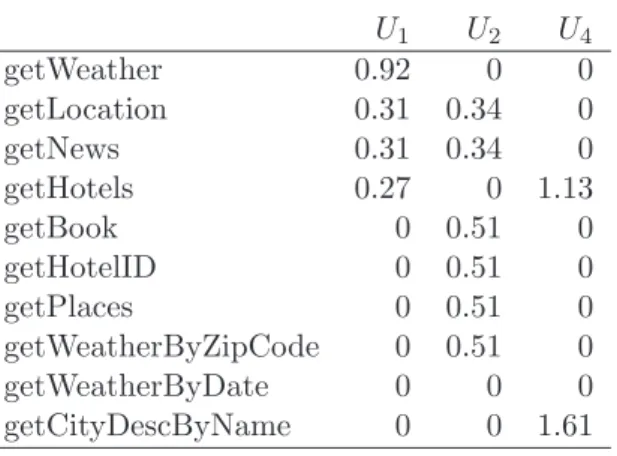
4.5 Decomposed matrices in a 3-D space. . . 60
5.1 Query grammar . . . 74
5.2 Query examples . . . 75
5.3 Probability that aj appears in the possible cases . . . 89
5.4 Similarities between typical connection elements . . . 89
6.1 Example: event logs of the liability claim process . . . 95
7.1 Experiments with the two relevant sets . . . 116
7.2 Details of the dataset . . . 120
7.3 Examined cases . . . 120
A.1 Probability that an output flow is executed . . . 139
A.2 Similarities between typical connection elements . . . 140
List of Figures
2.1 Web service architecture . . . 14
2.2 Consuming Web services for individual use problematic . . . 16
2.3 Consuming Web services for business process design problematic . . . 18
2.4 Flight & hotel reservation processes . . . 19
2.5 An incomplete train reservation process . . . 20
2.6 Service recommendations for the ‘unknown’ service . . . 20
2.7 The complete train reservation process . . . 21
2.8 Recommendations for the selected services . . . 21
2.9 New traveling process improved from the train reservation process . . 22
3.1 Basic architecture of the WS search engine using VSM [8]. . . 29
3.2 Scenario of WS recommendation by syntactical matching [9] . . . 30
3.3 QoS aware search engine for Web services [62] . . . 31
3.4 Combining Service Request Expansion and LSI [18] . . . 34
3.5 The architecture of the ICoP framework [50] . . . 41
3.6 Example of a BPMN-Q query [35] . . . 42
4.1 Decomposition in k dimensions [145] . . . 58
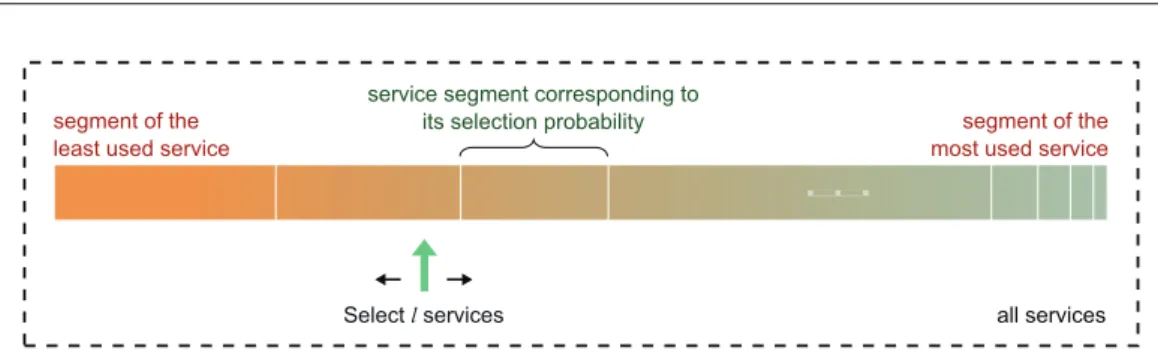
4.2 Select services based on their selection probabilities . . . 62
5.1 Incomplete train reservation process . . . 66
5.2 Flight reservation business process . . . 67
5.3 Business process graph of the ‘train-reservation’ process (Figure. 5.1) . 68 5.4 Neighborhood context graphs of ax (in Figure 5.1) and a6 (in Figure 5.2) 71 5.5 Connection flows in loop cases . . . 72
5.6 Recommendations for the ‘unknown’ service . . . 82
5.7 Recommendations for the selected services . . . 82
5.8 New traveling process improved from the train reservation process . . 82
5.9 Label-based business process graph of the ‘flight-reservation’ process . 85 5.10 Updated neighborhood context graphs or services ax and a6 . . . 86
6.1 The liability claim business process discovered from event logs [155] . 95 6.2 Log-based business process graph . . . 97
6.3 Example: neighborhood context graph . . . 98
6.4 Log-based business process graph . . . 99
6.5 Neighborhood context graph . . . 99
7.1 Architecture of our service recommendation tool (IRec) based on usage data . . . 108
7.2 A screen-shot from IRec . . . 109 7
7.3 PRec, a service recommendation application for process use . . . 110
7.4 Querying web services for process design using WebRec . . . 111
7.5 Business process extracted from logs and the related recommendations 113 7.6 Synthesized results of particular users . . . 117
7.7 RMSE distribution with k = 100 . . . 118
7.8 Experiment with different k-parameter values . . . 119
7.9 Percentage of services whose matching value >= 0.5 . . . 121
7.10 Percentage of services with different kth-zone values . . . 122
7.11 Precision and Recall values computed by taking into account the first zone . . . 123
7.12 Precision values in case of two recommended services . . . 123
7.13 Recall values computed based on the number of relevant processes . . 124
7.14 Comparing the simplest case of our approach to the random case . . . 125
7.15 Average computation time with k = 3 . . . 125
B.1 Current matching case . . . 143
B.2 Ignored cases . . . 143 B.3 Example: case 1 . . . 144 B.4 Example: case 2 . . . 145 B.5 Example: case 3 . . . 145 B.6 Example: case 4 . . . 146 B.7 Example: case 5 . . . 146
Chapter 1
General Introduction
G
1.1
Context
The evolution of communication networks and technologies involves the explosion of services over the Internet. Service providers always compete to rapidly provide the best services to users. This circumstance requires the development of service oriented applications. Web services appeared as an attractive paradigm for publishing and consuming services. The goal of Web service development is to assist service providers to flexibly create new services and dynamically exchanging data with their partners for collaborative business. Web services are developed as loosely-coupled applications that can be run alone to provide a simple function or composed to create new value-added services. For instance, simple Web services can be services for city codes, local temperatures, quotes, up-to-date news, and composite Web services can be flight booking processes that compose functionality offered by other services such as customer authentication, online check-in, car rental, and payment to accomplish a flight booking transaction.
To consume a service, a user sends her request and obtains a response from the using service. To develop a composite service, a (business) process analyst designs a business process and looks for appropriate services to integrate into the designed process. Basically, services can be consumed in two different ways. They can be consumed as simple services which provide an interface to receive inputs and return outputs; or they can be consumed as components to be integrated into business processes. We call the first consumption case individual use and the second case (business) process use.
To find a service for individual use, a user can use a well-known search engine such as Google, Yahoo or Baidu. However, in most cases, she prefers to use specific service search engines that can not only provide her ‘good’ services but also can assist her to discover other interesting services. Similarly, to find a service for process use, a process analyst also needs specific tools that can understand the business context in order to rapidly find the most relevant services to integrate into the ongoing designed process.
The requirement of specific tools to assist consumers in the two cases involves many researches in both academics and industry. On the one hand, many service portals (such as XMethods, BindingPoint, WebServiceX.NET, WebServiceList, StrikeIron, RemoteMethods, Woogle, and eSynaps) and service crawlers (such as Seekda and EmbracereRegistry) have been developed as specific tools to assist users to search and invoke Web services for individual use. On the other hand, some business process search mechanisms (such as label matching, structural matching, behavioral match-ing) and querying languages (such as BPQL, BP-QL, BP-Mon and BPMN-Q) have been developed to assist process analysts to facilitate business process design.
To assist users to consume services for individual use, current approaches take into account data from provider side such as Web service descriptions, QoS and semantic concepts of services. They exploit explicit knowledge presented by service documents or QoS. They make recommendations without considering data that reflect user interest, such as usage data. In addition, they can meet text-based synonym and polysemy problems. Some of them are time consuming and some others require efforts from users such as rating Web services.
To assist users to consume services for process use, current approaches propose mechanisms to search for similar business process models. Some of them propose to use reference models. However, the design with reference models is still labor-intensive, which is absolutely error-prone and time-consuming. Meanwhile, searching entire process models costs much computation time and it can make business analysts confused, especially when the number of activities is large. In some cases, a compro-mise between the computational complexity and the quality of results needs to be found.
1.2
Thesis objectives
In this thesis, we aim at facilitating the service consumption in two cases: in-dividual use and process use. Our purpose is twofold: (i) recommending to users services that are close to their interest and (ii) recommending to process analysts services that are relevant to selected positions in a designed pro-cess.
To achieve the first objective, we use usage data and adapt well-known collabora-tive filtering (CF) techniques. We aim at discovering the user’s interest that is hidden in the usage data. We also aim at using CF techniques, which have been developed for item recommendation and prediction. We do not ask users any effort to provide additional information such as profile, rating or comments. Whenever a user selects a service, our approach dynamically recommend services that are relevant to her in-terest. To do so, we firstly identify user interests based on past usage data. Then, we integrate these interests in CF algorithms to calculate similarities between users and services. Based on the computed similarities, we select appropriate services for recommendations. Since usage data reflect user interest, our recommendations are
Thesis outline 11 expected to be close to this interest.
To achieve the second objective, we capture relations of selected services with others. We define the neighborhood context of a service. We match neighborhood contexts to infer similarity between services. We make recommendations based on the neighborhood context matching. In our approach, we aim at taking into account existing data to generate service recommendations. We aim at discovering implicit knowledge hidden in business process models. We also do not ask users any effort to provide additional information. Whenever a business analyst selects a service, our approach recommend her services whose neighborhood contexts are similar to the selected service’s context. Apart from service relations captured from business process models, we also discover these relations from business process event logs. In addition, we develop a query language in order to allow process analysts to formally express business constraints to filter services.
1.3
Thesis outline
This thesis includes 8 chapters:
In chapter 2, we introduce in details the thesis context, research problem and our contributions. We also present a typical scenario to motivate and illustrate our approach.
In chapter 3, we present the work related to our thesis. We study different ap-proaches on improving Web services discovery and facilitating business process design. We introduce their models and analyze their solutions. This analysis allows us to jus-tify the need of service recommendation based on usage data and interactions between services in business processes.
Chapters 4, 5 and 6 are the core of our thesis, which elaborate our approach to recommend services for individual and business process uses.
In chapter 4, we present our solution to recommend services based on past usage data. We present four algorithms based on CF techniques and one algorithm based on a power assignment strategy. These algorithms take into account usage data to make recommendations.
In chapter 5, we present the neighborhood context of a service. We also present a query language that allows business analysts to filter relevant services based on the neighborhood context matching. Then, we elaborate the neighborhood context matching computation and show how to recommend services that are relevant to a chosen position in a business process. Finally, we examine the parallel flow rela-tion between services and the similarity between connecrela-tion elements to improve the neighborhood context matching values.
In chapter 6, we examine business process logs. We present how we build neighbor-hood context from the execution orders recorded in business process logs. Then, we
present an algorithm to compute the similarity between the extracted neighborhood contexts. Finally, we present our solution to recommend services.
In chapter 7, we present applications and experiments to validate our approach. Finally, in chapter 8, we summary our work and give an outlook to the future work.
Chapter 2
Context and Research Problem
Contents
2.1 Thesis context and research problem . . . 13 2.1.1 Web service discovery . . . 13 2.1.2 Web services in business processes . . . 15 2.1.3 Thesis research problem: How to recommend services for individual
and process use? . . . 16 2.2 Motivating example . . . 18 2.3 Thesis principles, approach and contributions . . . 22 2.3.1 Principles . . . 22 2.3.2 Approach . . . 23 2.3.3 Contributions . . . 24
2.1
Thesis context and research problem
In this section, we present the context and research problem of our thesis. First, we introduce existing mechanisms to discover Web services (section 2.1.1). Then, we present the integration of Web services in business processes and the importance of business process design (section 2.1.2). Finally, we present our research problem related to service recommendation for individual and process use (section 2.1.3).
2.1.1
Web service discovery
Web services have been developed as a standard technology to deliver services over the Internet. The Web service architecture (Figure. 2.1) consists of three actors: ser-vice provider, serser-vice requester and serser-vice registry. Serser-vice providers traditionally describe their developed services using Web service Description Language (WSDL) [1] and publish them on service registries, such as Universal Description Discovery and In-tegration (UDDI) [2] registries. Service requesters who want to consume Web services use the search function provided by service registries to find their services. Service
Figure 2.1: Web service architecture
registries return to requesters the locations of the requested services which are de-ployed at the provider site. The requesters then interact with the requested services by sending and receiving Simple Object Access Protocol (SOAP) [3] messages.
The Web service architecture creates fundamentals for the Web service develop-ment. Many companies developed and published their Web services. A survey of Gartner on 110 companies [4] showed that 54% are working on Web services. In an-other survey on 2847 executives worldwide in 2007 [5], 80% companies were using or going to use Web services and 78% identified that Web services are the most impor-tant technologies for their business. The growing rate of the number of Web services collected by search engines from Oct. 2006 to Oct. 2007 is 286% [6]. However, since 2006, most of large public UDDI registries such as SAP’s, IBM’s and Microsoft’s were discontinued [7].
The growing up in the amount of Web services and the discontinuing of public UDDI registries make Web services more scattered. Many Web service portals, such as XMethods, BindingPoint, WebServiceX.NET, or Web service crawlers, such as Seekda and EmbraceService, were developed to allow service providers to continue publishing their service descriptions. They also provide interfaces for users to search
and invoke Web services. Seekda 1 which has been launched since 2006 has collected
28606 Web services from 7739 providers. Meanwhile, EmbraceService2registry stores
more than 8000 Web services. Apart from them, users can also discover Web services via search engines such as Google, Yahoo, AlltheWeb or Baidu.
The Web service technology has been proven as an efficient mean to delivering services to users. They are used worldwide in most of the companies. However, the Web service concept is still not familiar to end users, which still get difficulty in discovering Web services. They need advanced mechanisms to assist them to better discover services. This requirement leads to many researches on proposing solutions to
1
http://webservices.seekda.com/browse
2
Thesis context and research problem 15 enhance Web service discovery. Some approaches analyze Web service descriptions for better matching with the query strings [8, 9, 10], other approaches group Web services in clusters [11, 12], some approaches examine the quality of services [13, 14, 15], whereas [16, 17, 18] rely on the semantic descriptions of Web services.
2.1.2
Web services in business processes
Web services are developed as loosely-coupled applications that not only can be run alone to provide single-use functions but also can be composed with other services offered by other companies to create new value-added services. A service which is created by the composition of other services is called a composite service. It can be described from the view of a single company, called service orchestration, or from a global perspective, called service choreography [19, 20]. Interactions of service compo-nents in a composite service is generally specified by a process analyst/designer. There are many business process-based languages and standards to assist process analysts to specify interactions between services. In 2003, Business Process Execution Language for Web services (BPEL4WS or BPEL for short) [21] was issued by Microsoft, IBM, Siebel Systems, BEA and SAP as a standard for Web service orchestration. Intalio, Sun, BEA and SAP also released a joint specification named Web services Choreog-raphy Interface (WSCI) which is later superseded by the Web services ChoreogChoreog-raphy Description Language (WS-CDL) [22] in 2005. BPEL provides an XML-based gram-mar for describing the control logic required to coordinate Web services participating in a process flow. WS-CDL is an XML-based language that is used to describe the in-teractions between multiple services. WS-CDL also specifies the ordering structures, such as sequence, parallel and choice, to define the interactions between Web services. A business process can be implemented as a Web service composition that exe-cute a set of services to achieve a business goal. It is managed by business process management (BPM) technology which includes methods, techniques, and tools to support the design, enactment, management, and analysis of business processes. The BPM life-cycle consists of 4 phases: design, configuration, enactment and diagnosis [23]. Among these phases, design is the initial and key phase of business process development as it helps to design the business process model, plan resources, identify new opportunities and foresee risks. In the design phase, process analysts sketch out business processes using a graphical modeling tool, such as ARIS and MID Innovator. However, designing a business process from scratch is always a labor-intensive and time-consuming task. Process analysts need tools and mechanisms to facilitate the business process design. Many approaches were proposed to address this need. They propose to use reference models [24, 25], match business processes for similarity search [26, 27, 28, 29, 30, 31, 32], create a query language [33, 34, 35, 36, 37] or discover process models from event logs [38, 39, 40, 41, 42].
2.1.3
Thesis research problem: How to recommend services for
in-dividual and process use?
As we mentioned in the thesis’s introduction (section 1.1), basically, there are two service consumption cases: individual use and process use.
To find a service for individual use, users often spend much time to find, compare and decide the services that are best fitted to their needs. They may easily get confused by the number of Web services returned by search engines or service crawlers. Moreover, they may not be aware about the functionality and quality of the returned services (Figure. 2.2).
Figure 2.2: Consuming Web services for individual use problematic
Intuitively, users need support to understand their interests and suggest them appropriate services. In this case, recommender systems (RS) [43, 44] can be a good solution as they are developed to recommend users the most suitable items to their needs. Currently, many approaches apply RS techniques to assist users to discover services. Some of them [11, 8] apply content-based filtering technique to match WS descriptions and user’s requests. Other approaches apply associated rules [45, 46] or collaborative filtering techniques on the service’s QoS [13, 10]. These approaches, however, do not take into account user’s behavior which is an important parameter for finding services that are close to user interest. User ratings are also considered for service recommendation [16]. Other solutions [47, 17, 48] use semantic annotation markup language, and rely on semantic description matching to recommend services. However, the above approaches exploit explicit knowledge which is either repre-sented by user ratings, semantic descriptions or service’s QoS. They do not consider user interest which is implicitly reflected by usage data to make recommendations. Most of them take into account data from provider side (such as service descriptions, service’s QoS, semantic annotations, etc.). Few of them consider data from customer side (profile, rating, comments, etc).
In our work, we aim at recommending services that are close to user interest. We propose solution from the customer side. We target to exploit implicit knowledge hidden in usage data. We do not ask users any effort such as rating or comments.
Thesis context and research problem 17 To address this research problem, we need to answer the following questions:
1. How to identify user interest?
2. How to recommend services that are close to user interest? 3. How efficient our recommendations are?
From a process use perspective, process analysts need tools to facilitate the process design. It would be inefficient if every time a company engages in modeling or re-designing its process, it did so “from scratch” without consideration of previous design experiences, best practices or how other companies perform similar processes. In recent years, there have been many efforts on helping business analysts to create new business process models faster and more accurately by using available reference models [24, 25], or finding existing similar models to inspire the new process design [27, 28, 30, 26].
However, business analysts merely take reference models as a source of inspiration, but ultimately, they design their own models on the basis of the reference models. The design with reference models is still labor-intensive, which is absolutely error-prone and time-consuming [49]. Indeed, recommending entire process models costs much computation time and it can make business analysts confused, especially when the number of activities is large, e.g. hundreds of activities and transition flows. In some cases [27, 26, 50], a compromise between the computational complexity and the quality of results needs to be found.
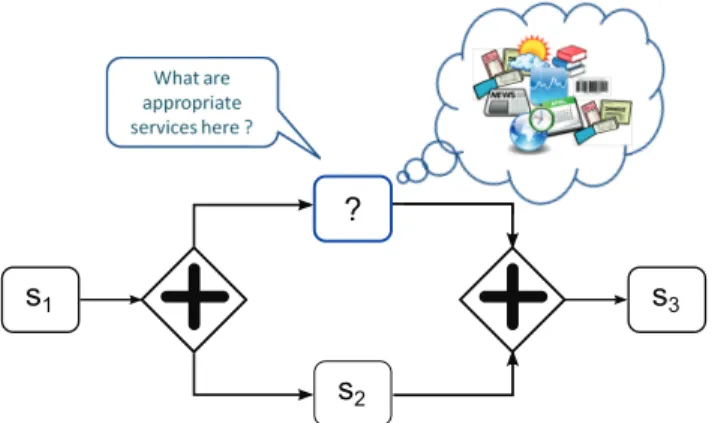
On the other hand, in some circumstances, process analysts need recommenda-tions for some selected posirecommenda-tions instead of entire processes. For example, a process analyst is designing a process as shown in Figure 2.3. s1, s2 and s3 are services that
execute some given tasks. The process analysts is looking for services that are suit-able to the missing position (with the ‘?’ mark) in the ongoing designed process. In this case, recommending an entire business process is not helpful. Instead, service recommendation is more suitable and straightforward.
Service recommendation for process use not only helps to find suitable services for a missing positions but also helps to find other alternatives for a selected service. These alternatives can be useful in either designing process variants or replacing a service in case of failure. For example, assume that service s1(Figure 2.3) is vulnerable
and the process analyst wants to find suitable services that can replace s1 to keep the
service available. In this case, she can use service recommendations.
In this work, our objective is to facilitate the business process design. We aim at recommending services that are relevant to selected positions of an ongoing design process. We target to exploit implicit knowledge hidden in business process models. We use existing data (previous process models, process logs) to make recommenda-tions instead of asking process analysts additional information. We also want to avoid the computational complexity problem. To address this research problem, we need to answer the following questions:
s1
?
s2
s3
Figure 2.3: Consuming Web services for business process design problematic 1. How to recommend services for a particular position?
2. How to formally express constraints to filter services? 3. Can business process logs be useful? and How? 4. How efficient our recommendations are?
2.2
Motivating example
We present in the following a scenario to illustrate and motivate our approach. It is also used to explain our approach in the next chapters.
A traveler is planing a trip for her holidays. She intends to travel by train. So, she searches for train booking related services. She decides to use ‘Search trains’ Web service offered by our travel agency. Assume that this is the first time she uses our system. The system will record the ‘Search trains’ Web service as her first historical usage data. By analyzing usage data, our approach can infer the user interest and recommend her suitable services. For example, it detects that users who use the ‘Search trains’ service often use the ‘Search hotels’, ‘Rent cars’ and ‘Weather information’ services. So, it recommends her these services. Now, assume that the traveler is interested in the recommended ‘Search hotels’ service and she uses it to search for hotels. Our approach updates her usage data with the ‘Search hotels’ service and reanalyzes it. Assume that it detects that users who use ‘Search trains’ and ‘Search hotels’ services often use ‘Rent cars’, ‘Book tours’ and ‘Activities to do’ Web services. Then, it update the recommendation list with the new services.
By considering usage data, which reflect user interest, our approach can recom-mend services that are close to her interest. In addition, it recomrecom-mends services without asking users any additional effort. Recommendations are generated dynami-cally whenever users select a service for individual use.
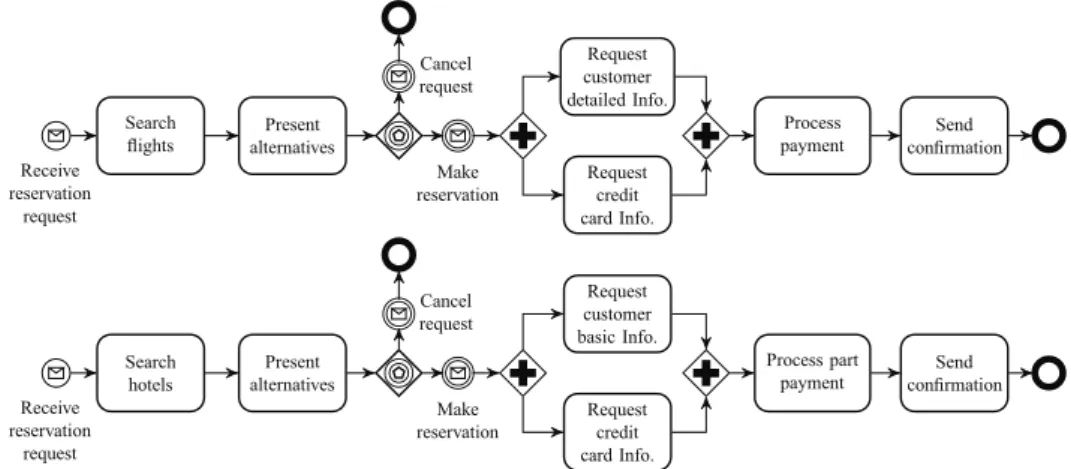
Motivating example 19 Back to the motivating example, our travel agency notices that their customers often consume a group of services in a time interval to achieve a specific business goal. They usually do not use just one service, rather they combine many of them. However, they do it in an ad-hoc manner. For instance, they start by searching for hotels using ‘Search hotels’ service, then collect manually the results delivered by this service, make their choice and thereafter call the ‘Process payment’ service. In order to satisfy the evolutive needs of their customers and offer a more complex and value-added service, the travel agency decides to take benefits from the multiple functionalities that business process management systems can offer by composing services as business processes. For example, it composes the ‘Search flights’ and ‘Search hotels’ services with other services such as, ‘Present alternatives’, ‘Request customer detailed Info.’, ‘Request customer basic Info.’, ‘Request credit card Info.’, ‘Process payment’ and ‘Send confirmation’, to provide a flight and hotel reservation processes (Figure 2.4). Receive reservation request Search !ights Present alternatives Make reservation Cancel request Request customer detailed Info. Request credit card Info. Process payment Send con"rmation Receive reservation request Search hotels Present alternatives Make reservation Cancel request Request customer basic Info. Request credit card Info. Process part payment Send con!rmation
Figure 2.4: Flight & hotel reservation processes
Suppose that the traveler now wants to book a train and a hotel using a business process. Unfortunately, only hotel reservation process is supported (Figure 2.4). The train reservation process has not yet been developed. So, the user request is forwarded to our process analyst. The process analyst analyzes the user request and find that she has to develop either a train reservation process to support a separate payment or a combined trains-hotels reservation process to support a combined payment. These processes must be rapidly designed to answer these new business needs. Evolving user requirements impulse the business analyst to develop more and more value-added services by composing existing services.
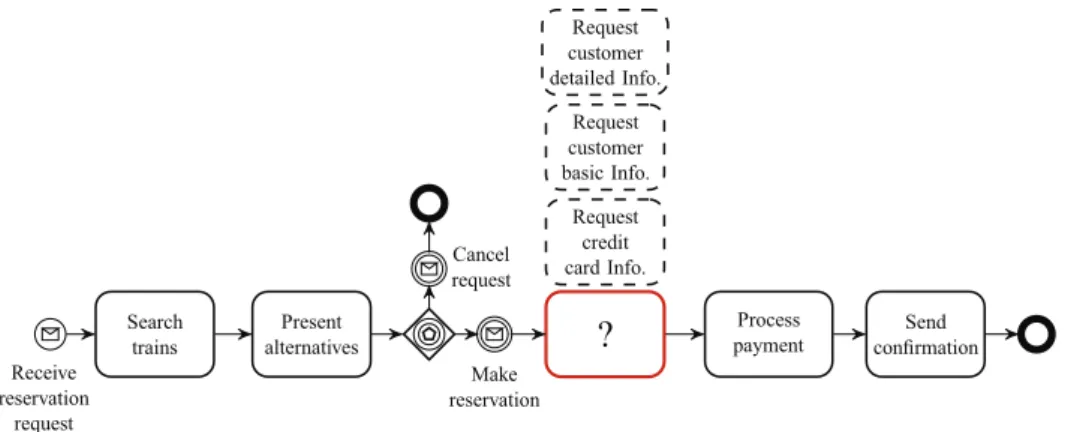
The business analyst decides to design the “train-reservation” process. Based on her experience, she rapidly sketches-out the “train-reservation” process with some basic Web services as given in Figure 2.5. The ‘Search trains’ service receives a user’s request and searches for requested trains. The ‘Present alternatives’ service renders the results returned by the ‘Search trains’ service and presents it to the user. Then,
the user can either cancel her request or process the payment. The ‘Process payment’ service executes the payment and finally, the ‘Send confirmation’ service returns the user an invoice. The process analyst is looking for suitable services that can be executed before the ‘Process payment’ service. She marks it ‘unknown’ (notated by a round-corner rectangle with a ‘?’ symbol) and asks the system for recommendations.
Receive reservation request Search trains Present alternatives Make reservation Cancel request ? paymentProcess Send con!rmation
Figure 2.5: An incomplete train reservation process
Existing approaches (such as reference models, process matching, etc.) that pro-pose entire process recommendations are not suitable in this circumstance because the process analyst look for services instead of business processes. Besides, existing service discovery approaches propose usually functionality-based search tools, which were mainly built for individual use service consumption, and do not take into account the process context (i.e. interaction with the other services in the process), which is important in the process use service consumption.
Receive reservation request Search trains Present alternatives Make reservation Cancel request Request customer basic Info. Process payment Send con!rmation Request customer detailed Info.
?
Request credit card Info.Figure 2.6: Service recommendations for the ‘unknown’ service
Indeed, The process analyst wants to know appropriate services that can be per-fectly plugged in the missing position. By capturing the interactions between services in processes, our approach can recommend her services that are appropriate to the missing position. Concretely, it detects that the ‘unknown’ service has similar neigh-borhood context with the ‘Request customer detailed Info.’, ‘Request customer basic Info.’ and ‘Request credit card Info.’ in the previously designed Flight & hotel reser-vation processes (Figure 2.4) because they have similar connections with the same services, which are ‘Present alternatives’ and ‘Process payment’. So, we recommend
Motivating example 21 these services for the missing position (Figure 2.6).
The business analyst considers these recommended services. She thinks that the ‘train-reservation’ process should not bother users by requesting their personal infor-mation. In addition, to process the payment, this process needs the “Request credit card Info.” service. So, she replaces the missing service by the “Request credit card Info.” service. The complete “train-reservation” process is shown in Figure 2.7.
Receive reservation request Search trains Present alternatives Make reservation Cancel request Request credit card Info. Process payment Send con!rmation
Figure 2.7: The complete train reservation process
After designing the ‘train-reservation’ process, she thinks about other process variants in order to create more value-added services. She wants to know services that are also appropriate to the positions of ‘Search trains’ and ‘Process payment’. So, she requests recommendations for these positions. She still keeps selecting the ‘Request credit card Info.’ service. By using the same principle, which is recommending services that have similar neighborhood context from previously designed business processes, recommendations for these selected positions are generated by our approach as shown in Figure 2.8. Receive reservation request Search !ights Search hotels Search trains Present alternatives Make reservation Cancel request Request credit card Info. Request customer basic Info. Request customer detailed Info. Process payment Process part payment Send con"rmation
Figure 2.8: Recommendations for the selected services
With these recommendations, the business analyst may find that she can integrate the ‘Search hotels’ service to the designed process to create a combined ‘trains-hotels’ reservation process. In this case, apart from the credit card information, she needs also the user information for the hotel reservation. Finally, she creates the combined reservation service as shown in Figure 2.9.
By presenting this example, we show that service recommendation is essential to facilitate business process design. By taking into account the neighborhood context of services, we can make service recommendations without asking users any additional
Receive reservation request Search trains Search hotels Present alternatives Make reservation Cancel request Request customer detailed Info. Request credit card Info. Process payment Send con!rmation
Figure 2.9: New traveling process improved from the train reservation process information (such as service descriptions, locations, input, output etc.). Instead, we exploit existing knowleddge which are the relations between services in business processes. We also show that service recommendation not only helps to complete the design of a business process but also helps to create more value-added services.
In summary, our approach can help to facilitate service consumption in two cases: individual use and process use. In the first case, we compare user usage data to detect the correlations between users and services in terms of usage profiles. We recommend to a user services that are similar to the currently used service, or were used by similar users. As the usage data reflect user interest, our approach can recommend services that are close to the user interest. In the second case, we assist business analysts to rapidly design new business processes. To do so, we compute the similarity between services based on relations with other services in business processes. Then, for a selected service, we recommend services that have similar relations.
2.3
Thesis principles, approach and contributions
2.3.1
Principles
In our approach, we consider the following principles:
• Focused and fine-grained results. In order not to confuse users, the ap-proach should not recommend complicated results such as reference models or entire business processes, but rather focused and fine-grained results. Con-cretely, for a specific position in the ongoing designed process it should recom-mend users a ranked list of services.
• No additional information. The approach should not bother service con-sumers by asking them additional or complementary information.
• Exploiting implicit knowledge. The approach should extract and utilize im-plicit knowledge hidden in usage data such as user-service interactions, designed process models, or business process logs.
• Balanced computational complexity. The approach should make a com-promise between the computational complexity and the quality of results. Besides, we also consider the following general principles:
Thesis principles, approach and contributions 23 • Simplicity. The approach should not ask users complex interactions to achieve
recommendations.
• Flexibility. Users should be able to adjust the number of recommended services. They should be able to select algorithms or set parameter values to get different recommendation strategies. They should also be able to specify constraints to filter recommended results.
2.3.2
Approach
To recommend services for individual use, we take into account usage data. We realize that usage data of each user reflect her interest. Therefore, by taking into account these data, we can make recommendations that are close to user interest.
collaborative filtering (CF) is one of the most successful technologies for developing recommender systems [51]. It has been developed and improved over the past decade with a wide variety of techniques [52]. CF techniques have been successful in research (with many projects such as GroupLens [53], Ringo [54], Video Recommender [55], and MovieLens [56]) and in commerce (with well-known websites such as Amazon, CDNow, MovieFinder, and Launch [57]). CF techniques are efficient and highly performant in generating recommendations [58].
As CF techniques bring out many advantages for recommendation, we apply them in the context of service use to generate service recommendations. In our approach, we firstly identify user interests based on past usage data. Then, we integrate these interests in CF algorithms to calculate similarities between users and services. Based on the computed similarities, we select appropriate services for recommendations. We implemented five algorithms, including three memory-based CF algorithms, one model-based CF algorithm and one algorithm to solve the new item (or cold-start) problem. Our memory-based CF algorithms take into account the correlations be-tween services and users. The model-based CF algorithm applies the singular value decomposition and latent semantic indexing. The last algorithm deals with the usage frequency of services.
To recommend services for process use, we take into account relations between services in business processes. Inspired by the maxim “Judge a man not by the words of his mother, but from the comments of his neighbors”, we propose to recommend services that have similar neighborhood context with the selected one. This context is defined as a business process fragment around the service. For a selected service, we match its neighborhood context with the neighborhood contexts of other services. The matching between two neighborhood contexts is scored by a similarity value. Then, based on the similarity values, we recommend to the process analyst services that have the highest similarity values.
We have also identified parameters that have an impact on the neighborhood context matching. We integrated these parameters in our computation to improve the matching values. In addition, we proposed a query language to help process analysts
formally express neighborhood constraints to filter the recommendation results (see the research problem in section 2.1.3).
In most cases, neighborhood contexts are captured from business process mod-els. However, in some cases, such as in a hospital information system [59], business processes are not explicitly presented. We realize that in these cases, business pro-cess event logs can be exploited to capture neighborhood contexts. So, we propose a solution to extract service neighborhood contexts from process event logs. We also take into account the importance of service execution, which is reflected by their occurrence in logs, for service recommendation.
We developed four applications, named IRec, PRect, WebRec and LogRec, to vali-date our approach. IRec generates service recommendations for individual use. PRec and WebRec makes recommendations for business process use. They run different algorithms of our approach. Finally, LogRec was developed as a proof of concept to validate our log-based approach.
We performed experiments on the data collected by our IRec application and on two large public datasets. We evaluated the efficiency of our approach based on precision/recall and root mean square error. We made statistics on the recommended services to estimate the recommendation quality. We also measured the performance of our algorithms based on the computation time.
2.3.3
Contributions
In summary, our contribution in this thesis are as following:
• Four algorithms based on collaborative filtering to recommend to users services that are close to their interests. By studying the advantages of collaborative filtering, we propose to apply this technique on service usage data to capture the correlation between users and services and generate recommendations. • One algorithm to improve the probability of selecting less used services. This
algorithm is developed to overcome the new item (or cold-start) problem: an item that has no (or limited) usage data is hard to be recommended.
• The new concept “service neighborhood context” which represent the business process fragment around a service. By taking into account the neighborhood context, our objective is twofold: (i) focusing on specific parts of the business process which can avoid the NP-complexity problem and (ii) benefiting from ex-isting business processes by extracting implicit knowledge induced from business process fragments.
• A solution to recommend to process analysts services that are relevant to selected positions in a designed process. This solution helps to facilitate business process design, improve the designed process and create new business process variants. • A query language that uses the neighborhood context matching to search and fil-ter services that have similar neighborhood context. This query language allows
Thesis principles, approach and contributions 25 adding constrains, such as including/excluding services, to filter the returned results.
• A solution to capture service neighborhood contexts from business process event logs and an algorithm to compute the matching of the extracted neighborhood contexts. We extract execution orders of services from business process execu-tion logs. Then, we create business processes based on the extracted orders. We construct service neighborhood contexts based on these processes. Finally, we match these contexts to generate recommendations.
• Applications for service recommendation and experiments. We deployed four applications to validate our approach. These applications are published in a public web site3. Besides, we also provide rich experiments on the collected usage data and large public datasets to demonstrate the feasibility and the efficiency of our proposed techniques.
3
Chapter 3
State of the Art
Contents
3.1 Introduction . . . 27 3.2 On facilitating Web service discovery . . . 28 3.2.1 Text-based Web service discovery . . . 28 3.2.2 QoS-based Web service discovery . . . 30 3.2.3 Semantic-based Web service discovery . . . 32 3.2.4 Usage-based Web service discovery . . . 34 3.2.5 Synthesis . . . 35 3.3 On facilitating business process design . . . 36 3.3.1 Business process modeling . . . 36 3.3.2 Business process similarity . . . 38 3.3.3 Business process querying . . . 41 3.3.4 Business process mining . . . 43 3.3.5 Synthesis . . . 44 3.4 Conclusion . . . 45
3.1
Introduction
Facilitating Web service discovery and business process design are two hot research topics. Many solutions have been proposed to assist users to retrieve their interested services and process analysts to design a process. Many problems have been identi-fied and tackled such as service selection, service execution, service recommendation, business process modeling, business process searching and so on. Existing approaches analyzed different aspects of a Web service, such as service descriptions, execution conditions, service behaviors, etc.. Functionality properties (such as Web service op-erations, inputs, outputs) and non-functionality properties (such as quality of services, execution order) have been examined. Web service and process presentations, such as XML-based, semantic web, graph-based, have been also explored.
In this chapter, we study existing solutions on facilitating Web service discovery and business process design. In section 3.2, we present solutions that assist consumers
to discover Web service. We classify them in 4 categories: text-based, QoS-based, semantic-based and past-usage based. In section 3.3, we present solutions that as-sist process analysts to design business processes. We classify them in 4 categories: business process modeling, business process similarity, business process querying and business process mining. We present shortcomings of the related approaches, identify the difference and bring out the advantages of our approach.
3.2
On facilitating Web service discovery
Industrial and academic researchers have proposed many approaches to assist providers deliver the most relevant Web services to particular user’s needs. Some approaches analyzed Web service descriptions [11, 8, 9, 12], some studied the QoS of services [14, 15, 13], while others used semantic concepts to discover services [16, 17, 10, 18]. Different methods in information retrieval, data mining and artificial intelligence do-mains were experimented such as collaborative filtering [8, 14, 15, 10], associated rules [46, 45, 60], clustering [11, 12, 61], divide and conquer [12] and so on. Different types of applications such as similarity search engines [11, 8, 12, 10] and Web service recommender systems [9, 46, 45, 60, 16] were also developed.
In order to clarify the difference between the existing approaches and identify the need of a Web service recommender system based on user’s behavior, we classify them into 4 groups based on the used methodologies, including text-based approaches, QoS-based approaches, semantic-based approaches and usage-based approaches. In the following, we study in details the solutions in each category.
3.2.1
Text-based Web service discovery
An early work that analyzes Web service descriptions to build a similarity search engine for Web services was proposed by Dong et. al. [11]. The authors developed a Web service search engine that aims at computing the similarity between inputs, outputs and operations in a corpus. They proposed to pre-process the Web service descriptions in order to split the names of inputs, outputs and operations then cluster them in different concepts. Each input/output is formed as a vector with three elements, for example: the input i of a Web service operation op has a vector i = (pi;
ci; op), where pi is the set of input parameter names, and ci is the set of concepts
associated with the parameter names. Whereas, each operation op is identified by a vector op = (w; f ; i; o), where w is the text description of the Web service to which op belongs, f is the textual description of op; i and o denote the input and output parameters. Similarity of Web service operations is computed based on the similarities of vector elements. The similarity between inputs, outputs or Web service descriptions is computed by the similarity between the corresponding concepts using Term Frequency-Inverse Document Frequency (TF-IDF) measure.
On facilitating Web service discovery 29 descriptions. However, they match the query vector directly with document vectors without structuring the input, output and operation vectors or clustering them in different concepts like Dong et. al. [11]. They firstly collect Web service descriptions, i.e. WSDL files, from different resources, such as user’s uploading, links from websites, or references from UDDI repositories. Then, each Web service description file is parsed to generate a corresponding vector. Each element in the vector corresponds to a word in the description and its value is the number of time that the word appears in the description. The user’s query string is also represented as a vector. Each term in the vectors is weighted by TF-IDF and the similarity between a query-vector and a document-vector is computed by Vector Space Model (VSM), i.e. the cosine of the angle between the two vectors. Finally, for each query string, the authors recommend the Web services whose descriptions have the highest similarity values with the query string. Figure. 3.1 shows the basic architecture of their system.
Figure 3.1: Basic architecture of the WS search engine using VSM [8]. In [9], Blake et. al. attempted to recommend Web services that are relevant to user’s daily routine. Different from [11] and [8], which manipulated the user’s query strings and Web service descriptions, they examined the similarity between the text data that a user was viewing/processing and the operations of a Web service. They firstly capture the text data that a user is working on such as HTML files, Word documents, File systems, messages (ICQ, SOAP, etc) (Figure. 3.2, step 1). Then, they extract text strings from the captured data (step 2). These extracted strings are compared to the operations of available Web services (step 3) to infer the similarity between them. In their approach, they captured four naming tendencies that software designers/developers used to name a Web service and proposed to apply Levenshtein Distance(LD) and Letter Pairing(LP) to compute the similarity between two strings. Finally, Web services that have the highest similarity values are recommended to the user (step 4).
Figure 3.2: Scenario of WS recommendation by syntactical matching [9] synonym problems, i.e. one word can have many meanings (polysemy) and one meaning can be expressed by different words (synonym). In addition, these ap-proaches suppose that the service description text is always correct and meaningful. Consequently, they do not address the need to flexibly deal with the cases that a user either types incorrect words, abbreviated words or multi-meanings words in the query. Available supported languages could be also considered as another shortcoming of the text-based approaches. Currently, Web service documents are mostly described in English. Hence, the query should be in English and users must type correctly the queried words in English. This issue may limit the Web service discovery.
3.2.2
QoS-based Web service discovery
Many QoS driven approaches have been proposed for Web service search [62], Web service recommender system [14], Web service reliability prediction [63, 15], Web service selection [13, 64, 65, 66], optimal service composition [67, 68, 65, 69] and so on.
In [62], Zhang et. al. proposed a search engine that took into account both functionality and QoS for service ranking. The functionality is described by the Web service description, such as operation, input and output. The QoS is non-functionality features, such as price and response time. A user’s query includes both functionality and QoS requests (Figure. 3.3). In the QoS query, ‘Constraint’ is a vector of queried values corresponding to QoS attributes. The ‘Weight’ vector allows user to specify the weight of each QoS attribute in her query. The authors computed both the
On facilitating Web service discovery 31
functionality matching and the QoS matching. A λ ∈ [0, 1] parameter is used to
balance the bias of these matching.
Figure 3.3: QoS aware search engine for Web services [62]
Different from [62], the authors in [14] took into account only QoS values of Web services to build a Web service recommender system. They aim at predicting the probability that a user a uses a Web service i in order to recommend her the Web services that have the highest probabilities. To do so, they built a user-item matrix, where the rows present the user IDs, the columns present the Web service IDs and each entry of this matrix is a vector of QoS values observed by the corresponding user on the corresponding Web service. Based on this matrix, they compute the similarity between Web services and users using Pearson Correlation Coefficient. The probability that a user a will use a Web service i is formulated based on the computed similarities. Two QoS metrics that are taken into account for their experiments are the round-trip-time and the failure-rate of the requests to each Web service.
The authors in [15] extended the prediction function proposed in [14] to a hybrid function that consists of item-based and user-based prediction functions. A parameter µ is added to balance the weight of item-based and user-based prediction functions. The authors in [63] also used the user-Web service QoS matrix and a prediction func-tion. However, instead of predicting the usage probability, they predicted the failure of a composite Web services. This failure is aggregated from the failure probability of Web service components.
Other approaches [70, 13, 71, 69] also dealt with the QoS of composite Web ser-vices. However, instead of predicting the failure probability [63], their objective is to optimize Web service compositions by selecting the best Web services that sat-isfy given QoS constraints. The authors in [70, 13] proposed to apply two models: the combinatorial model which defines the problem as a multi-dimension multi-choice knapsack problem (MMKP) and the graph model that defines the problem as a
multi-constrained optimal path (MCOP) problem. In both models, a user-defined utility function of some system parameters may be specified to optimize application-specific objectives. Meanwhile, [71, 69] presented service execution paths in Directed Acyclic Graph (DAG) and formulated the service selection as an optimization problem which can be solved by linear programming methods.
Cardellini et. al. [65] proposed a service selection scheme which also optimizes the end-to-end aggregated QoS by means of a simple linear programming problem. However, instead of independently handling service requests [70, 71], they dealt with flows of requests, where each flow is a sequence of homogeneous requests originating by the same user/organization over time, all requiring the same QoS level.
The authors in [66] proposed an extensible, preference-oriented, open and fair QoS model for Web service selection. Their model allows providers to flexibly add new specific domain criteria for evaluating the QoS of Web service without changing the underlying computation model. It provides means for users to accurately express their preferences without resorting to complex coding of user profiles. It manipulates the QoS information collected from provider’s site, such as service privacy, and user’s site, such as feedbacks. Meanwhile, Haddad et. al. [64] focused on the transactional QoS criteria. They aimed at choosing Web services to create composite services that satisfy some transactional properties. For example, the composite services have to support atomic transactions, compensable transactions or they have to terminate after a finite number of execution steps.
Generally, QoS approaches facilitate the Web service discovery based on QoS at-tributes (such as throughput, bandwidth, execution time, failure rate, privacy or feed-back) which are explicit knowledge. They can be classified in two categories based on service’s consumption purposes: individual use, such as [62, 14, 15, 63], and process use, such as [13, 64, 65, 66, 67, 68, 69]. Our approach is also developed to facilitate these consumption cases. However, we do not take into account QoS infor-mation. Instead we exploit implicit knowledge hidden in user usage data and service composition structure. These parameters are important for improving Web service discovery as they expose the user’s preferences and service’s composition context. As taking into account different parameters for making recommendations, our approach can complement QoS approaches and vice-versa.
3.2.3
Semantic-based Web service discovery
A Web service recommender system based on semantic matching and rating predic-tion was proposed by Manikrao et. al. [16]. They proposed to describe Web services
as ontologies using DARPA Agent Markup Language1 (latterly Web Ontology
Lan-guage [72]). Then, they matched all semantic attributes of Web services and consid-ered that two Web services are similar if their individual semantic attributes matching is greater than given thresholds. The proposed system can predict the rating of a user
1
On facilitating Web service discovery 33 to a Web service based on her previous ratings on other similar Web services. In their proposition, two services are more similar if their average ratings are less different.
The authors in [17] also proposed to use DARPA Agent Markup Language to semantically describe Web services. They aimed at utilizing a semantic language to present the Web service capabilities, which cannot be described by the conventional WSDL documents. They proposed to match the input/output concepts of a service request to the input/output concepts of service advertisements respectively in order to find relevant services to the request. The matching degrees are: exact, plug in, subsume and fail. The output concepts match has higher priority than the input concepts match. In other words, services whose advertisements are better matched on output concepts are preferred for recommendation rather than on input concepts. Instead of describing Web services as ontologies like [16, 17], Ma et. al. [12] explored the semantic concepts hidden in the Web service descriptions. They proposed a two-phase approach that applies the Divide and Conquer methodology and Singular Value Decomposition technique. In the first phase, the collection of Web service descriptions is divided into a set of smaller clusters by using the Divide and Conquer approach (Bisecting k-means algorithm). In this phase, VSM and TF-IDF are applied to syntactically match the query and Web service descriptions in clusters to identify the most relevant cluster to the query. In the second phase, the SVD technique is applied on the selected cluster to decompose the document vectors and present them in a reduced space. Similarities between the query vector and the decomposed document vectors are inferred by the cosine of the angel between these vectors. Based on these similarities, the relevant services to the query are identified.
The authors in [10] also applied SVD and LSI and provided experiments on pre-cision and recall metrics. However, instead of filtering Web services in two phase like Ma et. al. [12], they applied VSM and LSI directly on the corpus of Web service documents. Concretely, they presented Web service documents in a corpus as a ma-trix of documents and terms. Then, they decomposed the document-term mama-trix to an approximate matrix using SVD. Finally, they matched the query terms and the document rows in the decomposed matrix in order to find the closest documents to a given query.
Paliwal et. al. [18] proposed to link the Web service request and Web services descriptions to high-level ontology concepts before decomposing and matching them (Figure. 3.4). To do so, they firstly pre-process service request and determine the overall search category of Web services (step 1). Then, they retrieve relevant indexed service descriptions from the UDDI based on the high-level ontology concept of the Web service request (step 2). Next, they retrieve associated low-level ontology con-cepts related to the initial service request from an ontology framework based on the terms in the request (step 3). Then they expand the request with the retrieved con-cepts and transform the Web service descriptions into term-document matrices (step 4). These matrices are decomposed using SVD (step 5) and matched to the request vector to infer the similarity between them (step 6).
Figure 3.4: Combining Service Request Expansion and LSI [18]
Semantic-based approaches that described Web services as ontologies [16, 17] can present better functional and non-functional properties of Web services. However, creating and publishing ontology annotated content is time-consuming and error prone task as it needs to be done by domain experts using questionable editing tools. Meanwhile, rating-based solutions such as [16] may meet the new item problem, which means new items that have not yet rated are not selected for recommendation while items that have higher ratings are always recommended. Semantic-based approaches that exploit the latent semantics hidden in Web service descriptions [12, 10, 18] can generate recommendations without creating ontologies or asking any effort from users. In our work, we examine the latent semantics hidden in user usage data.
3.2.4
Usage-based Web service discovery
Although the past usage data are important resource exposing users’ interests, there are still few approaches that take these data into account for Web service discovery. Birukou et. al. [45, 60, 46] proposed to utilize the past usage data for a Web service recommender system. They defined an ‘Implicit Culture’ concept as a relation be-tween a set and a group of agents such that the set’s elements behave according to the group’s culture. Based on this concept, they consider that if a user has a sim-ilar request with other members of the community, he will be suggested operations that were used by those members. Therefore, they record the usage of users together
![Figure 3.1: Basic architecture of the WS search engine using VSM [8].](https://thumb-eu.123doks.com/thumbv2/123doknet/11583022.298206/38.892.286.640.492.706/figure-basic-architecture-ws-search-engine-using-vsm.webp)
![Figure 3.2: Scenario of WS recommendation by syntactical matching [9]](https://thumb-eu.123doks.com/thumbv2/123doknet/11583022.298206/39.892.195.662.219.527/figure-scenario-ws-recommendation-syntactical-matching.webp)
![Figure 3.4: Combining Service Request Expansion and LSI [18]](https://thumb-eu.123doks.com/thumbv2/123doknet/11583022.298206/43.892.217.639.209.555/figure-combining-service-request-expansion-and-lsi.webp)
![Figure 3.5: The architecture of the ICoP framework [50]](https://thumb-eu.123doks.com/thumbv2/123doknet/11583022.298206/50.892.172.755.205.407/figure-architecture-icop-framework.webp)