HAL Id: hal-01058162
https://hal.archives-ouvertes.fr/hal-01058162
Submitted on 26 Aug 2014HAL is a multi-disciplinary open access archive for the deposit and dissemination of sci-entific research documents, whether they are pub-lished or not. The documents may come from teaching and research institutions in France or abroad, or from public or private research centers.
L’archive ouverte pluridisciplinaire HAL, est destinée au dépôt et à la diffusion de documents scientifiques de niveau recherche, publiés ou non, émanant des établissements d’enseignement et de recherche français ou étrangers, des laboratoires publics ou privés.
Educational program evaluations: rationalizing
assessment models and processes for engineering
education quality enhancement
Siegfried Rouvrais, Claire Lassudrie
To cite this version:
Siegfried Rouvrais, Claire Lassudrie. Educational program evaluations: rationalizing assessment mod-els and processes for engineering education quality enhancement. CDIO 2014 : 10th international con-ference Conceive Design Implement Operate on sharing successful engineering education experiences, Jun 2014, Barcelona, Spain. �hal-01058162�
EDUCATIONAL PROGRAM EVALUATIONS: RATIONALIZING
ASSESSMENT MODELS AND PROCESSES FOR ENGINEERING
EDUCATION QUALITY ENHANCEMENT
Siegfried Rouvrais, Claire Lassudrie, Samia Ech-Chantoufi, and Soukaina Bakrim Institut Mines-Télécom, TELECOM Bretagne, IRISA
ABSTRACT
In engineering education, several reference models of quality are defined by accreditation bodies or quality assurance organisations, at national and international levels. With approaches based on standards, they favour transparency and benchmarking of programs, in line with accountability issues. Quality assessors and program managers have to juggle with such models: grasp all - lose all. As shown by several accreditation system updated requirements, to support continuous improvements in the field of engineering education, reference models to align with tend now to be complemented by assessment models and processes. However, more closer to recommendations or good practices to follow, managing the quality enhancement of an engineering higher education institution still often remains practically informal and subjective. To cope with such challenge, the main contribution of this paper is to analyse three quality frameworks (CDIO, EFQM, and ISO-SPICE) and compare them in the context of quality enhancement. By analysing their respective reference models and assessment processes, it permits to sketch the broad lines of a multimodal and adaptive system to flexibly manage quality in engineering education. This paper will permit readers (i) to identify the strengths and weaknesses of different models for engineering education quality assessment, (ii) to benefit from a global comparison of assessment models and processes and (iii) to grasp an overview of some possible ways of improvement of the CDIO self-assessment approach.
KEYWORDS
Quality assurance, quality enhancement, reference model, assessment model, assessment process, engineering education, SPICE, EFQM, CDIO Standard 12.
INTRODUCTION
Agencies or associations for assessment and accreditation of engineering education institutions are now in place in many countries worldwide. For educational program leaders, responsibilities and challenges in enhancing the quality are increased. According to ISO 9000, quality is defined as a “degree to which a set of inherent characteristics fulfils requirements” (ISO 9000:2005). Quality permits to satisfy demands of societal and public accountability thanks to reference models. But “one concern regarding the advancement of Engineering Education Quality Assurance is the lack of uniformity in Accreditation standards
and practices” (Gray, Patil and Codner, 2009, p.20). To face the declining trust in the ability of Higher Educational Institutions to meet quality standards, quality assurance continuous systems tend now to be a must do. For educational quality managers, processes have then to be formalized.
To support continuous improvements in the field of engineering education, standards and criteria are parts of reference models, sometimes associated with measurement models for interpreting the data and showing evidence. Program managers and leaders have to juggle with these criteria, more and more exhaustive. Thus, the main goal of this paper is to propose some areas of improvement for educational system assessment in engineering education based upon the CDIO standards. In a context of criteria variety, this generic structure opens the doors to future marketplaces including shared examples of evidence (Kontio et al., 2012).
The analysis of three quality frameworks (i.e. CDIO, EFQM, and ISO-SPICE) in the context of engineering education quality helped to build a generic framework usable as a basis for revising the CDIO model. Each one is characterized by an assessment model and an assessment process. More formal and applicable to engineering education, the EFQM model (EFQM, 2011) has a focus on Total Quality Management, and has been successfully applied to education (Boele et al., 2008); In an industrial context, primarily focused on software systems engineering, CMMI (SEI, 2010) and SPICE/ISO 15504 (ISO/IEC 15504-1:2004) provides comprehensive frameworks for process assessment and improvement. SPICE framework has been adapted to apply to different fields or domains, such as automotive systems, aerospace systems, medical devices or banking services. As such, the SPICE framework is a sound international standard which is widely used in different industrial domains. It can be adapted to the education sector (Mitasiunas and Novickis, 2012), so that its concepts and methods may thus be transposed to engineering education.
GENERIC DEFINITIONS TO START WITH: ASSESSMENT, EVALUATION, MODELS, AND PROCESSES
In the context of engineering education, as noted by (Gray et al. 2012), evaluation and assessment terms are not uniformly used. On the one hand, Quality Evaluation refers to a “systematic examination of the extent to which an entity is capable of fulfilling specified requirements” (ISO/IEC 14598-1:1999). On the other hand, Quality Assessment relates to “a determination of the extent to which the organization's standard processes contribute to the achievement of its business goals and to help the organization focus on the need for continuous process improvement” (ISO/IEC 15504-1:2004). The term assessment is more linked to continuous improvement, whereas the term evaluation is more related to the decision of acceptance of a final product or system.
According to these definitions and the objectives of this paper, the term assessment will be used in the proposed analysis of this paper. Different frameworks for quality assessment are used in higher education. First, an assessment is conducted according to an Assessment
Process. The Assessment Process defines how the assessment is to be performed: e.g. how
the data is collected and validated, how the planning is developed and executed. It takes into account:
- The inputs, such as the scope, purposes, constraints, assessor competencies and
experiences, and all additional information;
- The outputs such as identification of evidences, ratings, assessment records.
An Assessment Process is supported by an Assessment Model which describes what is assessed. An Assessment Model is based on:
- A Reference Model: it defines a set of best practices (or Standards) related to the domain, considered as a reference to assess and used to improve the quality. It includes the scope of the model, the purposes and the outcomes expected;
- A Measurement Framework: it defines the maturity levels to be considered. Thus, the
Measurement Framework comprises a set of Assessment Indicators which support
the ratings of the various Standards.
Based on the aforementioned definitions and derived from ISO 15504 definitions (ISO/IEC 15504-1:2004), the Generic Assessment Framework used in this paper is shown in Figure 1.
Fig.1. Generic Assessment Framework. THE CDIO APPROACH
The missions of the CDIO initiative are to (i) sustain an active global community which develops and shares best practices in engineering education, (ii) to enable educational institutions to produce graduates capable of interpreting and responding to the ever-changing needs of society, and (iii) to advance a coherent and common framework for engineering education, which stresses the engineering fundamentals, set in the context of real-world products, processes and systems. To meet the aforementioned missions, the twelve CDIO standards serve as guidelines for educational program change and provide a framework for continuous improvement in engineering education worldwide (Crawley et al., 2014). Thus, the CDIO framework, specific to engineering education, includes a set of resources used to support changes and improve educational programs and Higher Educational Institutions systems. It is more and more used as a complement to accreditations (e.g. as in Europe for the EUR-ACE system in line with ENQA requirements, e.g. (Rouvrais, 2012)).
The CDIO Assessment Model
The CDIO initiative offers a set of Reference Models: 12 standards are specified. They address:
• Program Philosophy (Standard 1);
• Curriculum development (Standards 2, 3 and 4);
• Design-implement experiences and workspaces (Standards 5 and 6);
• Methods of teaching and learning (Standards 7 and 8);
• Faculty development (Standards 9 and 10);
• Assessment and evaluation (Standards 11 and 12).
It is to be noted that this set of resources can be adapted by HEI to their educational context before implementation. In the CDIO framework:
• each Standard is described with statement of the standard, its meaning, significant terms, background, etc.;
• the Rationale (ie the reasons for adoption of the Standard) and Examples of Evidence for each standard are specified;
A rating guide (six-point rating scale called Rubric) to assess levels of maturity with a standard is included. As a measurement framework, the levels seek to indicate progress towards the planning, the implementation and the adoption of each standard based on the evidences gathered:
0. There is no documented plan or activity related to the standard;
1. There is an awareness of need to adopt the standard and a process is in place to address it;
2. There is a plan in place to address the standard;
3. Implementation of the plan to address the standard is underway across the program components and constituents;
4. There is documented evidence of the full implementation and impact of the standard across program components and constituents;
5. Evidence related to the standard is regularly reviewed and used to make improvements.
For instance, to achieve the level 4 in Standard 6 (Engineering workspaces), one example of evidences would be: “An active learning laboratory has been designed specifically to support design-implement projects for 250 students at a time.”(CDIO, 17 May 2010). The CDIO
Rubrics are hierarchical: each successive level includes those at lower levels, e.g., “Level 5
that addresses continuous process improvement presumes that Level 4 has been attained” (CDIO, 1 December 2010).
The CDIO Assessment Process
Based on its Standard 12 (CDIO, 2010a), the CDIO framework supports quality enhancement, on a continuous and flexible basis. CDIO uses the term evaluation for its Standard 12. As described for this standard, “Program evaluation is a judgment of the overall value of a program based on evidence of a program's progress toward attaining its goals. A CDIO program should be evaluated relative to the twelve CDIO Standards. Evidence of overall program value can be collected with course evaluations, instructor reflections, entry and exit interviews, reports of external reviewers, and follow-up studies with graduates and employers. The evidence can be regularly reported back to instructors, students, program administrators, alumni, and other key stakeholders. This feedback forms the basis of decisions about the program and its plans for continuous improvement.”
CDIO defines a set of stages to follow in the assessment process. In order to help different key stakeholders of engineering education to assess and improve the quality of their educational system, the CDIO framework thus defines both an Assessment Model (which includes the 12 Standards), but also an Assessment Process, less formalized. The ranking of each standard is recorded in a CDIO Self-Assessment Template.
DISAMBIGUATION OF ASSESSEMENT MODELS AND ASSESSMENT PROCESS? CDIO initiative provides a complete framework, based on samples of Evidences that serve as guidelines for the data collection and the Standards rating. After collection and analysis of the data corresponding to the Examples of Evidences, the assessor rates each standard from 0 to 5 (5 levels of compliance). This can lead to subjectivity since no formal guideline is provided to the assessor. An ambiguous Assessment Model can lead to various misunderstandings among stakeholders and skew the Assessment Process. For comparability or share-ability, it is fundamental to define it accurately, even with a certain degree of flexibility. The CDIO Standard Descriptions and Rationales sometimes lack repeatability and universality when applied to different programs. Besides, the Standard definitions remain sometimes ambiguous and likely to be misinterpreted. E.g., “When two teams assess the same program separately, they may rate differently due to the vagueness of Standards. To analyze correlations between assessors, a common interpretation is needed. One sentence criterion can lead to misunderstandings, especially when the standards need to be translated and introduced to a non-English speaking context for student assessors” (Lassudrie et al., 2013).
There are potential challenges:
- to refine the Standards descriptions that are likely to be misinterpreted; - to prioritize the Standards depending on their importance;
- to review the linkage between the criteria (Examples of Evidences) of CDIO
Standards. E.g., to group indicators (for the Standards performance, the Standards
capability, etc.)
- to divide each maturity level (Rubric) into 2 or 3 attributes that address specific area of it. E.g, generic Level 3 questions the implementation of the Standard in general, but no precision about the implementation aspects is added (because the maturity levels are likely to be misinterpreted).
The Standards assessment order is not defined: it is possible for an assessor (or a team of assessors, being various stakeholders) to rank two Standards independently without taking into account a potential priority or coherency between them. Is there an iterative convergent process? For each CDIO Standard, Criteria (Examples of Evidences) are provided within the
Rubrics. They are correlated to each other but differ depending on the Standard content.
Thus, one Standard should not be attributed a specific scale if the Standards correlated to it do not reach a required scale. Otherwise, there will be an incoherency and inconsistency in the assessment (e.g. stakeholder’s correlation (Malmqvist, 2104)). For example, Standard 3 is correlated to Standards 1 and 2 and should not be rated at level 3 unless Standards 1 and 2 are at least at level 3.
A REFINED ASSESSEMENT MODEL INSPIRED FROM OTHER QUALITY ASSESSMENT SYSTEMS?
Unlike a generic quality framework such as ISO 9001, which is more intended for certification purposes, frameworks and models such as EFQM and SPICE focus on continuous improvement. Even if they share common concepts, they nevertheless support distinct models.
“The EFQM (European Fundamental for Quality Management) model basically looks at an organization, its results, and the way the results lead to learning, improvement and innovation. It was developed for firms but can be applied to any kind of organization” (Boele et al., 2008). Its framework has proven its efficiency in the education sector, that’s why many institutions use it nowadays (CIE, 2003). Its main objective is to develop new practical solutions to improve the different practices of the engineering schools. To meet this, EFQM established the “Excellence Model”, an Reference Model supported with the fundamental concepts of excellence, and an Assessment Model and an Assessment Process to assess those concepts (Centre for Integral Excellence, 2003).
• The EFQM model defines 8 Fundamental Concepts of Excellence as a Reference
Model. They address the purposes of the organization, its outcomes, the
responsibilities, etc. The assessment of each Concept is based on 9 criteria that are common to all the concepts: 5 enablers that cover what the organization does, and 4 results that cover what the organization achieves.
• Each criterion is specified with criterion-parts that address different areas of it. For each enabler criterion-part, EFQM gives examples of approaches that demonstrate its achievement. For each result criterion-part, EFQM defines the possible ways of measuring the results. For instance, to measure the achievement of the 7th criterion (People Results), one way to measure results is “Staff perception surveys” and “Evaluation and feedback mechanisms within University-wide”. Moreover, to measure the achievement of the 2nd criterion (Policy and Strategy), an example of approaches would be “Innovation strategy to encourage and stimulate the research, new technologies and/or new ideas” (CIE, 2003).
The domain of software engineering has been under the pressure of fast and massive improvements, but has been able to face it methodologically thanks to advanced software assessment models such as CMMI (Dounos and Bohoris, 2007) or SPICE. SPICE framework
(Software Process Improvement and Capability determination), also known as the ISO/IEC
15504 Standard (ISO/IEC 15504, 2004), is a set of documents first used for software development processes. A Reference Model in SPICE is called “Process Reference Model” (PRM). It is composed of one or more processes that are considered to be fundamental for the organization, the description of their purposes, their scope and the expected outcomes. These models help organizations to identify the strengths and the weaknesses of processes so as to enhance them. As in CDIO, the SPICE Measurement Framework is based on levels of compliance. In SPICE, the levels concern the process performance, management, definition and deployment, control and optimization.
• The measurement framework is a set of 9 attributes that are common to processes and allocated to 6 capability levels.
• Each capability level is composed of 1 or 2 attributes that describe and focus on an aspect of the level. E.g., in the 3rd level, a process is established if the two attributes “definition of the process” and “deployment of the process” are achieved.
• They are supported by a set of indicators of process performance and process capability. “The indicators are used as a basis for collecting the objective evidence that enables an assessor to assign ratings” (ISO/IEC 15504-5:2005). Each process attribute is rated using the ordinal rating scale N-P-L-F (N: not achieved, P: partially
achieved, L: largely achieved, F: fully achieved) (ISO/IEC15504-2:2003). First the
assessor collects and validates the evidences based on indicators. Then, each process attribute is rated by a percentage and converted using the rating scale N-P-L-F.
• The process capability is linear: to say that a process is in a level in SPICE requires that the attributes of the previous levels have been achieved.
• Criteria (indicators) are inter-linked depending on their roles: as indicators of process performance or indicators of process capability. The indicators of performance are directly linked to the Process Reference Model purposes (addressed in level 1). The indicators of process capability are linked to related processes.
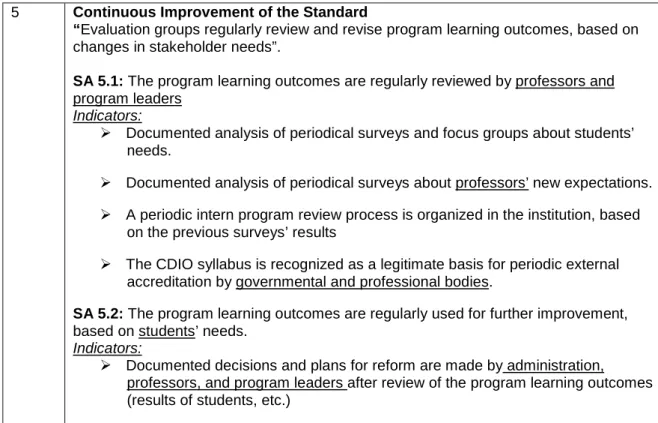
Figure 2 presents potential extensions to CDIO Standard structure so as to support the concept of Standard Attribute to define more precisely each Standard rubric (example of Standard 2, Learning Outcomes).
5 Continuous Improvement of the Standard
“Evaluation groups regularly review and revise program learning outcomes, based on
changes in stakeholder needs”.
SA 5.1: The program learning outcomes are regularly reviewed by professors and
program leaders
Indicators:
Documented analysis of periodical surveys and focus groups about students’ needs.
Documented analysis of periodical surveys about professors’ new expectations. A periodic intern program review process is organized in the institution, based
on the previous surveys’ results
The CDIO syllabus is recognized as a legitimate basis for periodic external accreditation by governmental and professional bodies.
SA 5.2: The program learning outcomes are regularly used for further improvement,
based on students’ needs.
Indicators:
Documented decisions and plans for reform are made by administration, professors, and program leaders after review of the program learning outcomes (results of students, etc.)
4
Full implementation of the plan to address the Standard
“Program learning outcomes are aligned with institutional vision and mission, and levels
of proficiency are set for each outcome”
SA 4.1: Documented evidence of the full implementation of the program learning
outcomes by program leaders.
Indicators:
The Syllabus learning outcomes are already used in some courses and are being developed for other courses.
The professors are using the Syllabus as support for their courses
Validation by professors, program leaders and industrial companies of the alignment of the learning outcomes with their needs and the institutional mission, and also with national accreditation criteria.
SA 4.2: Documented evidence of the impact of the adoption of the CDIO syllabus Indicators:
Survey and focus group for students about the impact of the Syllabus on their education
Survey and interview for professors to record their opinion about the new program learning outcomes.
3 Implementation of the plan to address the Standard
“Program learning outcomes are validated with key program stakeholders, including
faculty, students, alumni, and industry representatives.”
SA 3.1: The previous planned activities for Syllabus customization for the institution’s
context are almost fully achieved and already used for more than 1 year with collection and analysis of data related to the program components and constituents.
Indicators:
There are learning outcomes at three levels: the program plan, the track plan, and individual course plans.
The detailed CDIO Syllabus is customized for the institution’s context.
New Curriculum adapted to the CDIO principles is ready to be used or has been used for more than 1 year
Organizing conferences developing posters, etc. To present and explain the CDIO context and the new curriculum to the students and record opinions about it.
Appropriate data are collected and analyzed to evaluate the results compared with the expected results and to help to managing the quality of the
implementation. 2 Plan to adopt the Standard
“A plan to incorporate explicit statements of program learning outcomes is accepted by program leaders and engineering faculty.”
PA 2.1: A comprehensive plan of the curriculum modification is now ready to be used. It
has been validated by the direction and the program leaders, and is known by all the professors.
Documented plan signed and approved by all the stakeholders mentioned above.
Learning outcomes are being mapped onto ABET EC2000 Criterion 3a – 3k
SA 2.2: The plan contains all important information for its realization. Indicators:
The plan for the program modification is based upon CDIO syllabus, and addresses all its points
It contains all the activities to be done, with precise deadlines and roles attributed for each one
All the program leaders are involved in the plan realization depending on their responsibilities within the faculty.
The resources and the work environment are mentioned in the plan. 1 Awareness about the Standard
“The need to create or modify program learning outcomes is recognized and such a
process has been initiated”.
SA 1.1: The professors, students and faculty partners such as industrial companies are
aware of the program’s weaknesses and the points that need to be reviewed in the curriculum.
Indicators:
Documented complaints from Professors of some departments
Documented complaints from students concerning the program‘s content Organizing conferences and meetings between the program leaders and the
industrial companies delegates to discuss the learning outcomes review.
SA 2.2: Some activities are being done by professors and program leaders to enhance
the learning outcomes:
Indicators:
Some professors from different departments and disciplines are formed to review the learning outcomes of the whole curriculum
Documented specifications of the programs’ weaknesses and needs are being written by those mentioned above.
0 Incomplete Standard
“There are no explicit program learning outcomes that cover knowledge, personal and interpersonal skills, and product, process and system building skills.”
Indicators:
The programs already existing do not cover all the learning outcomes mentioned in CDIO, but only some of them
Fig.2. Refined CDIO Standard 2 with Standard Attributes.
The NPLF scoring process may also be introduced in the CDIO Measurement Framework. It contains four levels:
1- N- Not achieved: There is little or no evidence of achievement of the defined attribute in the assessed standard.
2- P- Partially achieved: There is some evidence of an approach to, and some achievement of, the defined attribute in the assessed standard. Some aspects of achievement of the attribute may be unpredictable.
3- L- Largely achieved: There is evidence of a systematic approach to, and significant achievement of, the defined attribute in the assessed standard. Some weakness related to this attribute may exist in the assessed standard.
4- F- Fully achieved: There is evidence of a complete and systematic approach to, and full achievement of, the defined attribute in the assessed standard. No significant weaknesses related to this attribute exist in the assessed standard.
As an assessment example, it may then be possible to attribute the scale 2 only to a Standard, because the attributes SA 1.1 and SA 1.2 are fully achieved, and the attributes SA 2.1 and SA 2.2 are largely achieved. Since the attribute SA 3.1 is only partially achieved, according to the table below, the standard can only have the scale 2. Table below shows the NPLF values converted into percentages:
N Not achieved 0 to 15%
P Partially achieved 15% to 50 % L Largely achieved 50% to 85% F Fully achieved 85% to 100%
Table 1: NPLF rating scale.
A REFINED ASSESSEMENT PROCESS INSPIRED FROM OTHER QUALITY ASSESSMENT SYSTEMS?
The EFQM model is based on a self-Assessment Process defined as “A comprehensive, systematic and regular review of an organization’s activities and results against a model of business excellence” (EFQM, 1999).
• A rating matrix called RADAR is used. The elements of this matrix are composed of attributes. They guide the assessment of both the enablers and the results (the 9 criteria). For each criterion, its criterion-parts are assessed by measuring the percentage of achievement of the RADAR attributes.
• The rate of a criterion part is the average of the attributes’ rating. The final rate of a criterion is the mean of the rates of its criterion-parts. Besides, the EFQM Model uses a weighted rating allocation.
• The last step of rating consists of combining the percentage rates recorded using the
RADAR, factor in the weighting, and then we derive the rate on a scale from 0 to
1000 points. The EFQM Measurement Framework is quite different from the one of CDIO. The criteria cover both what the organization does and achieves. The results address stakeholder satisfaction as well as process results. Each criterion is divided into 4 or 5 criterion-parts that describe specific parts of it. Those criteria are based on the stakeholders’ performance and satisfaction.
• Moreover, the model refers to 8 stages to follow as guidelines for the assessment process (Kasperavičiūt, 2011).
In EFQM, “The relationship between different criteria of the Model is strong, with key themes emerging (such as communication) which are influenced and analyzed in different criteria in different ways” (Centre for Integral Excellence, 2003, p.8). The linkage is defined at four levels:
• Across the whole Model: each criterion is linked to all other criteria with a specific theme;
• Between the enablers and the results: in terms of cause an effect;
• Within the results: with a set of performance and perception indicators ;
• Across the enablers: the approaches taken for one enabler have effects on other enablers.
SPICE documents include guidelines for conducting an assessment (ISO/IEC15504-3:2005). This documented Assessment Process defines 3 activities that should be conducted during the assessment: Planning, Data Collection and Data Validation. The rating mechanism, the assessment outputs, the roles, responsibilities and competencies for conducting an assessment are also documented in this guide. These guidelines could be used to improve the CDIO assessment process specifically in defining roles and responsibilities for the assessment process and in identifying most important stakeholders (e.g. Dean, teachers, program leaders, students) to be involved in the assessment of each Standard (and each level).
CONCLUSION
In order to meet the various challenges of quality management, internationalization and competition among the educational systems, the implementation of assessment processes for quality in engineering education has become crucial. They have to rely on assessment models and measurement frameworks, more or less formalized. The CDIO assessment system is specific to engineering education, based on maturity levels, but does not include formalized assessment process. Thus, its framework needs to be revised and refined so as to better respond to the needs of an institution in terms of repeatability, objectivity, etc.
There exist different assessment models used in other domains such as SPICE and EFQM. SPICE defines a set of indicators as a basis for collecting the objective evidences that enable an assessor to assign ratings and capability levels for the processes. It also defines some requirements and gives guidance about the assessment process. EFQM defines an assessment model supported by a set of indicators concerning the approaches and the results in terms of performance, satisfaction, impact, etc.
This paper defended a multimodal and adaptive system in the context of quality enhancement for engineering education. It proposed to analyze different in order to envision refinement of the CDIO assessment models, processes and measurement frameworks, perhaps to the lesser detriment of flexibility but to the benefit of repeatability and objectivity.
REFERENCES
Boele E.B., Burgler H., and Kuiper H. (2008) “Using EFQM in Higher Education: Ten years of experience with program auditing at Hanzehogeschool Groningen”. Contributions to the Higher Education Research 1.
CDIO (2010a) “The CDIO Standards v2.0 (with customized rubrics)”. http://www.cdio.org/knowledge-library/documents/cdio-standards-v-20-customized-rubrics Accessed: January 2014
CDIO (17 May 2010) “CDIO Standards and Rubrics with Sample Evidence”.
CIE - Centre for Integral Excellence (2003) “EFQM Excellence Model - Higher Education Version 2003”, Sheffield Hallam University.
Continuous Quality Improvement in Higher Education: A case study in Engineering School of Boras University, Ahoo Shokraiefard
Crawley E.F., Malmqvist J., Ostlund S., Brodeur D.R., and Edström K. (2014). “Rethinking Engineering Education: The CDIO Approach”. 2nd Edition, Springer Verlag.
Dounos P.K., and Bohoris G. A. (2007) “Exploring the interconnection of known TQM process improvement initiatives in Higher education with key CMMI concepts”. 10th Quality Management and Organisational Development Conference, 18-20 June, Helsingborg, Sweden.
EFQM (2011) “Introducing the EFQM Excellence Model”.
http://www.efqm.org/the-efqm-excellence-model Accessed: November 2013
Gray P.J., Patil A., and Codner G. (2009) “The Background of Quality Assurance in Higher Education and Engineering Education”. In Patil, A.S. and Gray, P.J. (Editors). “Engineering Education Quality Assurance: A Global Perspective”. Springer. 316 pages.
ISO 9000:2005 Quality management systems -- Fundamentals and vocabulary.
ISO/IEC 15504-2:2003 Software engineering — Process assessment — Part 2: Performing an assessment.
ISO/IEC 15504-1:2004 Information technology -- Process assessment -- Part 1: Concepts and vocabulary.
ISO/IEC 15504-5:2005 Information technology -- Process assessment -- Part 5: An exemplar software Process assessment model.
ISO/IEC 14598-1:1999 Information technology -- Software product evaluation -- Part 1: General overview.
Kasperavičiūt R. (2011) “The application of the EFQM Excellence Model to Higher Education Schools”
Mykolas Romeris University.
! "#$%#& ' (( ) ) * ( +
,-. - / 0 , 1 2 3 4 3 5 1 . , 3
) ) (( 6%7-6#8
Lassudrie C., Rouvrais S., Kontio, J. (2013) “Managing the continuous improvement loop: A student perspective based on a semester project”. Proceedings of the 9th intl. CDIO Conference: "Engineering Leadership in Innovation and Design". 9-13 June.
Malmqvist J., Peterson L., and Arehag M. (2014) “Ratings of Engineering Education Program Quality – correlation between expert, alumni and program director assessments?” In electronic proceedings of the 10th Intl CDIO conference, Universitat Politècnica de Catalunya, Barcelona, Spain, June 16-19. Mitasiunas, A. and Novickis, L. (2012) “Enterprise SPICE based Education Capability Maturity Model”,
Workshops on Business Informatics research, Lecture Notes on Business Information Processing,
Springer, vol 6, p 102-116.
Rouvrais, S. and Landrac, G. (2012) “Resistance to Change in Institutionalizing the CDIO Standards: From a Waterfall to an Agile Improvement Model”. 8th International CDIO Conference, Queensland University of Technology, Brisbane, July 1-4, 2012.
SEI (2010), “Capability Maturity Model Integration” (CMMI), V1.3. Software Engineering Institute, Carnegie Mellon University.
Steed, C., Maslow, D., and Mazaletskaya, A. (2005) “The EFQM Excellence Model for Deploying Quality Management: a British-Russian journey”. Higher education in Europe. pp. 307-319.
BIOGRAPHICAL INFORMATION
Dr. Siegfried Rouvrais is Research Associate Professor at Telecom Bretagne and CNRS. Author of several international publications in Engineering Education, he organized the international CDIO 2012 Fall meeting and was elected to the board of CDIO international council member in 2013. His current scholarly interests are in methods and processes for Higher Education changes.
Dr. Claire Lassudrie is an Associate Professor at Telecom Bretagne and a researcher in the area of software process assessment and improvement and risk management. She worked for 20 years at the France Telecom R&D Center, where she was involved in a major process improvement program based upon ISO SPICE. She contributes to ISO and French AFNOR standardization groups on System and Software Engineering.
Ing. Samia Ech-Chantoufi and Soukaina Bakrim are both senior engineering students. In the perspective of the 2015 program renewal at Telecom Bretagne, they analyzed models and processes for quality enhancement during a joint semester project, proposed to enhance the CDIO assessment models and processes (standard 12), and implemented a software prototype to support multi-role assessment.
Corresponding author Dr. Siegfried Rouvrais Telecom Bretagne [email protected] CS 83818 F-29238 Brest, France 33-229-001504
This work is licensed under a Creative Commons Attribution-NonCommercial-NoDerivs 3.0 Unported License.