HAL Id: inria-00451667
https://hal.inria.fr/inria-00451667
Submitted on 29 Jan 2010
HAL is a multi-disciplinary open access
archive for the deposit and dissemination of
sci-entific research documents, whether they are
pub-lished or not. The documents may come from
teaching and research institutions in France or
abroad, or from public or private research centers.
L’archive ouverte pluridisciplinaire HAL, est
destinée au dépôt et à la diffusion de documents
scientifiques de niveau recherche, publiés ou non,
émanant des établissements d’enseignement et de
recherche français ou étrangers, des laboratoires
publics ou privés.
Area and Reconfiguration Time Minimization of the
Communication Network in Regular 2D Reconfigurable
Architectures
Christophe Wolinski, Krzysztof Kuchcinski, Jürgen Teich, Frank Hannig
To cite this version:
Christophe Wolinski, Krzysztof Kuchcinski, Jürgen Teich, Frank Hannig. Area and Reconfiguration
Time Minimization of the Communication Network in Regular 2D Reconfigurable Architectures.
Inter-national Conference on Field Programmable Logic and Applications (FPL 2008), Sep 2008, Heidelberg,
Germany. pp.391-396, �10.1109/FPL.2008.4629969�. �inria-00451667�
Area and Recon!guration Time Minimization of the Communication Network in
Regular 2D Recon!gurable Architectures
Christophe Wolinski
Univ. of Rennes I/IRISA
France
Krzysztof Kuchcinski
Lund University
Sweden
J¨urgen Teich, Frank Hannig
Univ. of Erlangen-Nuremberg
Germany
∗Abstract
In this paper, we introduce a constraint programming-based approach for the optimization of area and of recon!g-uration time for communication networks for a class of reg-ular 2D recon!gurable processor array architectures. For a given set of different algorithms the execution of which is supposed to be switched upon request at run-time, we pro-vide static solutions for the optimal routing of data between processors. Here, we support also multi-casting data trans-fers for the !rst time. The routing found by our method min-imizes the area or the recon!guration time of the commu-nication network, when switching between the execution of these algorithms. In fact, when switching, the communica-tion network recon!guracommunica-tion can be executed in just a few clock cycles. Moreover the communication network area can be minimized signi!cantly (62% in average).
1 Introduction
In this paper, we focus on the problems of the static op-timization of area and recon!guration time for communica-tion network of regular 2D recon!gurable processor array architectures. To solve these problems (a) jointly and (b) not for a single, but for a whole set of algorithms, a unique constraint programming approach has been applied.
Previously we have introduced an abstract model for minimization of the number of multiplexers [12]. This model is limited and covers only unicasting data transfers. In this paper, we propose a new optimized formulation that makes it possible to support multicasting data transfers. Moreover, we de!ne new cost functions that make the min-imization of other communication network parameters pos-sible, such as area as well as parallel and sequential recon-!guration time.
The correctness of our approach is illustrated by apply-ing our methodology to a concrete architecture, namely
weakly programmable processor array (WPPA) [7]. This
∗This work has been supported in part by the German Science
Founda-tion (DFG) in project under contract TE 163/13-1 and TE 163/13-2.
WPPE WPPE WPPE WPPE WPPE WPPE WPPE WPPE WPPE WPPE WPPE WPPE WPPE WPPE WPPE WPPE WPPE WPPE WPPE WPPE WPPE WPPE WPPE WPPE WPPE WPPE WPPE WPPE WPPE WPPE WPPE WPPE WPPE WPPE WPPE WPPE
Interconnect Cell
I/O I/O I/O
I/O I/O I/O
I/O I/O I/O I/O I/O I/O i0 i1 i2 i3 Instruction Decoder o0 o1 Input Registers/FIFOs Output Registers ALU type1 mux mux demux
General Purpose Regs ip0 ip1 ip2 ip3
op0 op1 BUnit regFlags f0 f1 r0 r1 r2 r3 r4 r5 r6 r7 r8 r9 r10 r11 r12 r13 r14 r15 regGP rPorts wPorts regI regO Instruction Memory pc
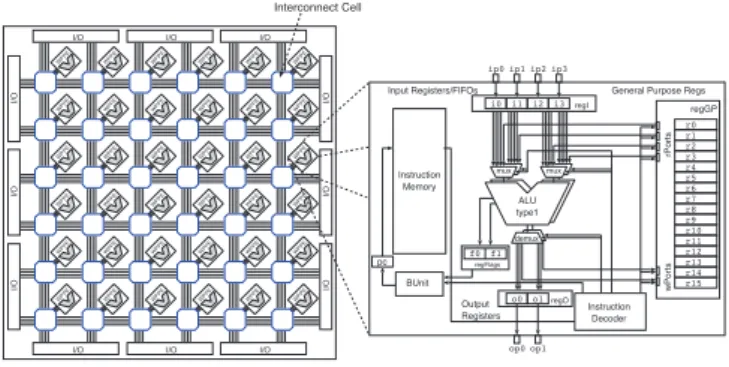
Figure 1. Example of a WPPA. All param-eters such as number and type of proces-sor elements and their interconnect structure can be de!ned at synthesis-time according to domain-speci!c needs.
architecture belongs to a class of computer architectures that consist of an array of processing elements with recon-!gurable interconnections and limited programming possi-bilities, see Fig. 1. However, we would like to emphasize that our approach is not limited to WPPAs and can be ap-plied to any other regular 2D recon!gurable architecture. To our knowledge there is no other published similar solution. Related work. Routing of communication requests in recon!gurable networks is a topic of huge relevance in the area of billion transistor SoCs. Here, two different direc-tions can be distinguished: The !rst aims at establishing dynamically connections between hardware components by switching wires. This area is called circuit-switched routing and our approach presented here also belongs to this class. Especially for !ne-grained recon!gurable hardware sys-tems (e.g., FPGA) concepts such as recon!gurable multiple buses [1] have been recently studied. In [6], a template-based approach is presented where it is possible to set a !xed routing path between modules by attaching these tem-plates through dynamic partial recon!guration.
In case of dynamically changing communication re-quests, the other main stream is based on message passing
networks-on-a-chip (NoC), see for instance [2, 5]. Here,
through router nodes to their destinations. In the context of recon!gurable FPGA designs, these capabilities have also been studied. For example in [3], a 2D NoC concept called DyNoC (Dynamic Network-on-a-Chip) that can be dynami-cally recon!gured at run-time is presented. The concept ap-plies modi!ed XY-routing in a mesh-like NoC that can han-dle also obstacles given by placed modules on the FPGA. Unfortunately, the cost of NoC solutions can be very high. Also, the delay of communications can be substantial, i.e., in case of congestions or, in case of multi-hop routing. Fi-nally, also memory elements must be provided in router nodes to store data packets temporarily. For cycle-based recon!gurable coarse-grained architectures such as WPPAs that we are considering in this paper, a routing network would be much too slow as we demand the ability to switch communications on a cycle-base here. Also, the connec-tions themselves should be delay-free. Therefore, circuit routing is the only viable solution here.
A communication-conscious mapping approach for WP-PAs, based on integer linear programming, is presented in [10]. But, this approach considers only the static mapping of a single application. In [9], the authors present map-ping heuristics to merge datapaths and to share intercon-nection structures in recon!gurable architectures. The min-imization of the interconnection network’s size leads also to reduced recon!guration times. Whereas the optimization goals are similar to ours, we present an exact and resource constraint method where a limited number of channels be-tween the processor elements can be considered.
Routing has been de!ned before using constraint satis!-ability encodings. In [11], authors encode FPGA detailed routing problems using SAT de!nition. They can !nd a routing or prove that a particular global routing does not have a detailed routing for a given number of tracks per channel. Unlike our approach, their formulation cannot be used for optimization of particular features of routing.
Organization. Section 2 introduces WPPAs, shows how an application can be executed on it and presents a formula for parallel recon!guration time overhead calculation. Sec-tion 3, is devoted to a small example introducing the prob-lem of routing data dependencies for a given algorithm. The optimization problem is discussed in Section 4. Finally, a case study is presented (Section 5) with promising opti-mization results.
2 Weakly programmable processor arrays
A WPPA architecture consists of an array of weakly
programmable processor elements (WPPEs) each having a
VLIW (Very Long Instruction Word) structure, see Fig. 1 (right). The parameters of each WPPE can be customized at synthesis-time with respect to the number and types of func-tional units such as adders, subtractors, multipliers, shifters, and modules for logical operations. Furthermore, special
South config reg. West config reg.
North config reg. PE_in config reg.
East config reg.
PE
Interconnect Cell
South input South output North output North input
West input West output East output East input PE input PE output
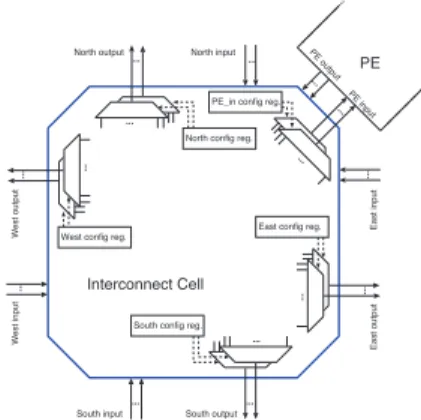
Figure 2. Multiplexer architecture of an inter-connect cell (re!nement of Fig. 1 (left)).
storage elements at the inputs of each WPPE have been proposed to store incoming data [7]. The instruction set of a single WPPE is minimized also according to domain-speci!c computational needs.
In order to allow to model a vast set of different in-terconnect topologies, dynamically recon!gurable intercon-nect structures have been investigated by the de!nition of a switchable interconnect cell structure a WPPE is connected to. In our example in Fig. 1 (left), the interconnect cell form a regular 2D-mesh topology.
A set of VLIW programs and an interconnect
con!gura-tion together form a so-called setup. The global setup mem-ory contains several processor array setups, one for each
algorithm which can be processed by the array. Since an on-chip setup memory consumes logic resources, it has to be as small as possible.
A given WPPA is characterized not only by the number and types of processing elements and their internal structure but also by the interconnection capabilities. These are given in terms of (a) number of channels in each direction (east, west, north, south), see Fig. 2, and (b) number of ports of a processing element.
Algorithm recon!guration on WPPAs is initiated and re-quiring two steps: Program recon!guration which is be-yond the scope of this paper and interconnect
recon!gura-tion. Interconnect recon!guration is possible through
over-writing con!guration registers located in each interconnect cell as shown in Fig. 2. Each connection to other PEs via so-called channels may be changed dynamically by load-ing a new value to each of these con!guration registers. Note, if there are several multiplexers in one direction, the select signals are concatenated in one recon!guration reg-ister. This enables to recon!gure all channels in the same direction within one cycle.
The corresponding time overhead for con!guration of the interconnect in one multicast domain is given as
Figure 3. Processor array implementation of a FIR !lter with L = 6 taps.
lows:
TINTcfg=o +tmuxN+tmuxE+tmuxS+tmuxW+tmuxPEin (1)
where
tmuxx=! 1 if #multiplexers in direction x ≥ 10 else
The variable o is in our case a constant which re"ects the overhead for the setup of a con!guration automaton. In a WPPA framework implemented in FPGAs, an experimental running example requires a setup time of o=4 cycles.
3 Algorithm class and mapping
Starting point of the design "ow for mapping algorithms onto WPPAs is the class of so called dynamic piecewise
reg-ular algorithms (DPRAs) [4]. This class of algorithms
de-scribes loop nests containing uniform data dependencies by a set of recurrence equations.
The following example of an FIR !lter yout[n] =
!L−1m=0a[m] × u[n − m] with L taps is used to illus-trate the mapping of regular algorithms onto a pro-grammable array architecture. After embedded all co-ef!cients a[m] and !lter inputs u[n − m] into a com-mon two-dimensional space, we obtain the description: par (n>=0 and n<=T-1 and m>=0 and m<=L-1)
a[n,m] = a[n-1,m] if (n > 0);
u[n,m] = u[n-1,m-1] if (n > 0 and m > 0);
x[n,m] = a[n,m] * u[n,m];
y[n,m] = y[n,m-1] + x[n,m] if (m > 0);
y_out[n] = y[n,m] if (m == L-1);
The application of space-time transformation [4] leads to a
2D processor array structure1as shown in Fig. 3.
Now, for con!guration of the communication intercon-nect, we have to lock at the algorithms’ data dependencies, e.g., the dependency between variable a and a as vector
(1,0)T, between u and u as vector (1,1)T, and !nally
be-tween y and y as vector (0,1)T.
For a given algorithm Ai, we can group the set of data
dependencies like in the FIR-algorithm above into a set { !di,1,··· , !di,D(i)} of two-dimensional vectors in the
follow-ing. Note that for each algorithm Aito be executed at
run-time, there may be a different set of data dependencies. On the physical processor array, these data dependencies result in connection dependencies as can be seen in Fig. 3.
1The depicted array implementation of the FIR !lter is able to process
three input samples in parallel.
Now, in case the target WPPA does not support these vec-tors directly as interconnect channels, they must be routed over disjoint routing paths of channels. The corresponding optimization problem to !nd such a routing con!guration for several algorithms simultaneously, is the subject of Sec-tion 4.
4 Optimization of communication overhead
Now, we present our framework for statically mini-mizing the interconnect con!gurations for a set of time-multiplexed algorithms such that the recon!guration over-head in terms of required multiplexers is minimized as a secondary goal. We will see that this problem involves solv-ing routsolv-ing problems. We model the problem ussolv-ing con-straint programming over !nite domains formulation [8].
Modeling of all connection dependencies !di, j for each
algorithm Ai (1 ≤ i ≤ K) is done using a set of 2D arrays
of cells of size N × M. N and M denote the maximum horizontal and vertical part of the Manhattan distance of all connection dependencies. Therefore, the optimization problem is independent of the processor array’s size. Each
cell Celln,mis identi!ed by its (n,m) coordinates in 2D grid
(0 ≤ n ≤ N −1,0 ≤ m ≤ M −1). Each array represents
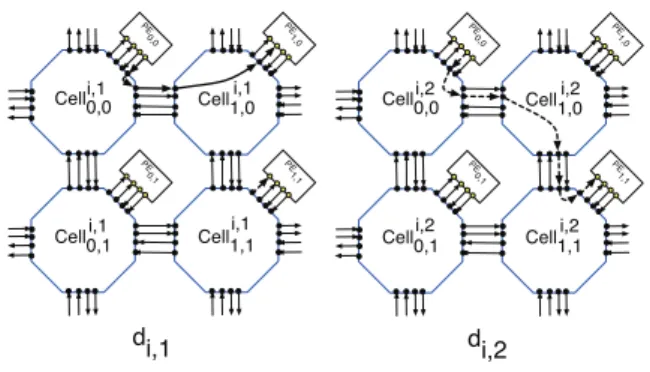
im-plementation of a single connection dependency for a given algorithm. For example, implementation of two
connec-tion dependencies {(1,0)T, (1,1)T} is depicted in Fig. 4 for
N = M = 2. Cell0,0 PE 0,0 Cell0,1 PE 0,1 Cell1,0 PE 1,0 Cell1,1 PE 1,1 Cell0,0 PE 0,0 Cell0,1 PE 0,1 Cell1,0 PE 1,0 Cell1,1 PE 1,1 di,2 di,1 i,1 i,1
i,1 i,1 i,2
i,2 i,2
i,2
Figure 4. Example of implementation of con-nection dependencies !di, j= {(1,0)T, (1,1)T}. It can be noted that connections between different PEs can be routed using different resources. In principle we need to make a number of decisions that can be grouped into two classes.
• decisions on the selection of the path from source PE to destination PE that passes different cells, and • decisions on the selection of different connections in
the channels between cells.
Both decisions in"uence the number and size of multiplex-ers that need to be included to recon!gure static connections between cells when recon!guring from an algorithm into another one. They need to be considered simultaneously. For this purpose we have de!ned a constraint programming model.
Before de!ning the model we need to point out that all connections need to be implemented in a single cell since all
the cells in the architecture execute the same program and they use the same channel connections to transfer the data (so called modulo routing [12]). This means that we can re-duce the optimization problem to a single cell that contains all routed connection for all connection dependencies for given algorithms. Normally, the implemented connections for one algorithm cannot use the same connection channels. A cell that implements all connections from Fig. 4 is de-picted in Fig. 5. Bold lines represent the implementation of
connection dependency (1,0)T while doted lines represent
connection dependency (1,1)T, Celln,m North South West East PE n,m 20 21 22 23
Figure 5. The cell connections for implemen-tation of !di, j= {(1,0)T, (1,1)T}.
Our communication minimization problem is split into two steps to reduce the complexity of our method. In the !rst step, all possible paths between interconnect cells and
PEs in the system corresponding to all !di, j1 ≤ j ≤ D(i) and
1 ≤ i ≤ K are found using a CP formulation. In the second step, another CP formulation is used for multiplexer area and recon!guration time minimization. We will see later that the area and recon!guration time are expressed in terms of size and number of multiplexers. It encodes all paths using model variables and assigns connection dependencies to connections of channels implementing identi!ed paths.
All paths corresponding to a given dependency !di, j are
found by applying a SimplePath constraint to the
Simpli-!ed System Graph (SSG). The SSG graph is de!ned as a
directed graph. Vertices are cells and processing elements while edges represent inter-cell channels between process-ing elements and cells.
The constraint that !nds all simple paths in a graph takes as a parameter a graph, a source and a destination vertex (i.e. PEs in our case). This constraint can be combined with other constraints to generate paths of a limited length that is useful in practice.
The identi!ed paths need to be encoded in our model as variables. This is achieved by a special constraint (ExtensionalSupport in our case) that de!nes a relation between model variables using a table of values. For this purpose we use 0/1 variables Chi, j(n,m)(n&,m&) that de!ne for algorithm i and dependency j whether a directional channel from cell (n,m) to cell (n&,m&)is used (value 1) or not (value 0). Table 1 presents variables that are set to one for different
paths for connection dependencies (1,0)T and (1,1)T from
Fig. 4. All other variables in each row are equal zero. In our model we also maintain explicitly input/output
Table 1. Encoding of simple paths for imple-mentation of connection dependencies. !
di,1= (1,0)T path 1 Chi, jPE(0,0)(0,0), Chi, j(0,0)(1,0), Chi, j(1,0)PE(1,0)
path 2 Chi, j
PE(0,0)(0,0), Chi, j(0,0)(0,1), Chi, j(0,1)(1,1), Chi, j(1,1)(1,0), Chi, j(1,0)PE(1,0)
!
di,2= (1,1)T path 1 Chi, jPE(0,0)(0,0), Chi, j(0,0)(1,0), Chi, j(1,0)(1,1), Chi, j(1,1)PE(1,1)
path 2 Chi, j
PE(0,0)(0,0), Chi, j(0,0)(0,1), Chi, j(0,1)(1,1), Chi, j(1,1)PE(1,1)
pairs of channels that de!ne internal cell connectivity. For example, pair (Chi,2(0,0)(1,0),Chi,2(1,0)(1,1))de!nes internal cell connection from “West” to “South” indicated as doted line in Fig. 5.
In this way we provide opportunity to select one of the paths for implementing a given connection dependency. For a selected path a number of speci!c channel connections need to be determined. They implement communication between cells and a cell and a PE. In our example depicted in Fig. 5, each channel has two connections and commu-nication dependencies can use any of the connections but normally they cannot share a channel connection. It is only possible for multicast communications that will be dis-cussed later.
The channel selection is implemented using a channel
occupation table. It is in turn implemented in our model
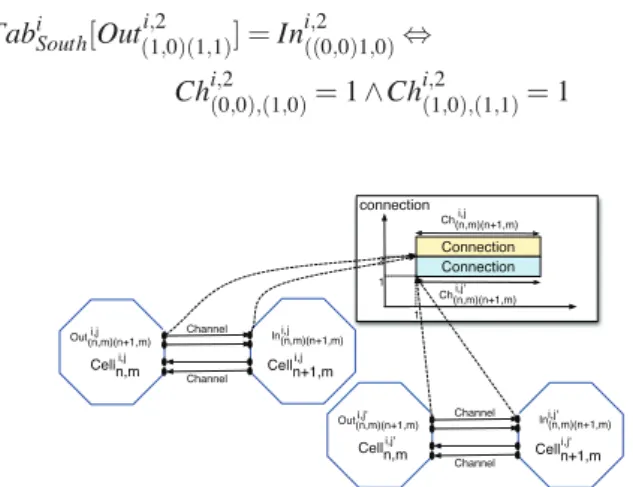
using Diff2 constraint that assures that any pair of rectan-gles speci!ed on a list of rectanrectan-gles do not overlap. The idea is depicted in Fig. 6. In this formulation each rectangle represents a channel connection and the constraint assures that two connections will not use the same connection in the channel. A rectangle is speci!ed using its origin (x,y) and lengths in both directions lxand ly, i.e. using list [x,y,lx,ly]. All channels connecting two cells or a cell and PE in a given direction are collected in a list of rectangles. For example, in direction “South” from Fig. 5, variables Chi, j(0,0)(0,1) and
Chi, j(1,0)(1,1)for all 1 ≤ j ≤ D(i) are used for selection of
con-nections. For our example it is de!ned using constraints (2). Note that we use a special feature of Diff2 constraint that considers rectangles with length zero as non-existing. This makes it possible to consider only selected connections and assure that they do not use the same connection channel at the same time.
Diff2([1,Out(i,10,0)(0,1),Chi,1(0,0)(0,1),1], (2)
[1,Out(i,11,0)(1,1),Chi,1(1,0)(1,1),1], [1,Out(i,20,0)(0,1),Chi,2(0,0)(0,1),1], [1,Out(i,21,0)(1,1),Chi,2(1,0)(1,1),1]),
For multicast communication this condition is relaxed. In addition we also enforce that the same connection is used for multicast communications in the same direction (con-straint 3).
∀1≤ j, j&≤D(i), j(= j& Out(i, jn,m)(n&,m&)=Outi, j
&
(n,m)(n&,m&) (3)
We introduce vectors Tabi
Dirto collect all inputs that are
connected to a given cell output connection for a given
gorithm i and connection direction Dir. These vectors are de!ned for direction south, west, north, east and PE. The information for these vectors is gathered using constraint (4) that is formulated for all internal cell connections. For the example of connection dependencies presented in Ta-ble 1 only one internal cell connection exists from “West” to “South” and therefore only one constraint has to be
for-mulated for this output direction (4). Vectors Tabi
Dir are
later used for formulation of cost functions. It can be noted that the number of model variables in the model is radically reduced comparing to our previous model [12].
Tabi
South[Out(i,21,0)(1,1)] =Ini,2((0,0)1,0)⇔ (4)
Chi,2(0,0),(1,0)=1 ∧Chi,2(1,0),(1,1)=1 Celln,m Out(n,m)(n+1,m)i,j i,j Celln+1,m In(n,m)(n+1,m)i,j i,j Channel Channel connection Connection Connection 1 2 Ch(n,m)(n+1,m) 1 i,j Celln,m Out(n,m)(n+1,m)i,j' i,j' Celln+1,m In(n,m)(n+1,m)i,j' i,j' Channel Channel Ch(n,m)(n+1,m)i,j'
Figure 6. The channel connection selection for two connection dependencies !di, jand !di, j&.
The model de!nes all communications for a single algo-rithm. They are then combined into a single model that con-tains all algorithms with their connections dependencies. In this model we de!ne a number of cost function to reduce the communication overhead related to recon!guration. To
de!ne these cost function the tables Tabide!ned in (4) are
used. The main cost function de!nes a condition that spec-i!es when a multiplexer is needed. A multiplexer needs to be included in a WPPE if there exist two paths
implement-ing connection dependencies for two disjoint algorithms Ai
and Ai&, and there exist an output connection that has inputs
from two different connections. This condition is de!ned using our tables depicted in Fig. 7. In this table each
vec-tor Tabi
Dir (column in the array) de!nes input connection
numbers connected to given output connections in the al-gorithm i. Each row, on the other hand de!nes, for each output connection, input connection numbers for all algo-rithms. Therefore a number of different connection num-bers (in the row) de!nes number of inputs to this particu-lar output and a multiplexer with this number of inputs. In this case we do not consider zeros since numbering starts
from one. Two variables MultSizeDir,t and MultExistDir,t
are associated to each row. The !rst one de!nes the multi-plexer’s size and the second de!nes whether the multiplexer is needed or not. In our experiments, we consider two opti-mization objectives; the multiplexers’ area and the recon!g-uration time overhead. The related cost functions are
spec-i!ed using variables MultSizeDir,tand MultExistDir,twhose
values are calculated directly from table TabDir.
Figure 7. The table structure used for compu-tation of cost functions.
The recon!guration time overhead is de!ned according to Eq. (1) and expressed below with constraints (5).
∀DIR
!
t MultExistDir,t>0 ⇔ t muxDir (5)
RecTimeOverheadCostFunction =
!
Dirt muxDir
Above constraints use rei!ed constraint, i.e., constraint
Cond ⇔ B that re"ects satis!ability of condition Cond into
a 0/1 variable B.
Area overhead is de!ned below as weighted sum of dif-ferent types of multiplexers, i.e., two input, three input, etc.
List = {MultSizeSouth,1, . . . ,MultSizePE,K} (6)
∀i∈{2,...,K}Count(i,List,MuxSizei)
AreaOverheadCostFunction =
!
Ki=2(i− 1)·MuxSizei
Constraint Count(K, List, Var), used in the above for-mulation, assures that number of elements of List with value K equals Var.
5 Experimental results
To validate our approach for area and recon!guration time overhead minimization, we have carried out
experi-ments using six algorithms Aiwith different connection
de-pendencies, as presented in Table 2. Each experiment used different combinations of these algorithms to evaluate re-con!guration overhead. The algorithms represent both ex-isting algorithms as well as synthetic benchmarks. Algo-rithm 1 represents the connection dependencies of a matrix-matrix multiplication algorithm and Algorithm 2 is a FIR !lter algorithm. They are two frequently used digital signal
processing algorithms. The connection dependencies of A3
stem from a Sobel image !ltering example. Algorithms A4
to A6represent synthetic benchmarks. All of the following
experiments have been run on 2 GHz Intel Core Duo under Mac OSX operating system.
In Table 3, we present our results obtained for minimiza-tion of area overhead and sequential recon!guraminimiza-tion time. We also compare the obtained results with a na¨#ve approach. All experiments are carried out for a minimal assumed num-ber of channel connections and input/output ports needed for routing all dependencies. As can be seen, the area and sequential recon!guration time improvement between the na¨#ve approach and our method are rather large. The aver-age value for area improvement is 62% and averaver-age sequen-tial recon!guration time improvement is 41%.
Table 2. Six algorithms and their connection dependencies. Algorithm d!i, j A1 {(−1,0)T, (0,1)T, (0,1)T} A2 {(−1,0)T, (−1,−1)T, (0,1)T} A3multicasting {(0,−1)T, (−1,−2)T, (−1,−1)T, (−2,−1)T, (1,0)T} A4 {(2,0)T, (2,1)T} A5 {(0,1)T, (1,1)T} A6 {(0,1)T, (1,0)T}
Table 3. Area overhead and sequential recon-!guration time of (a) na¨"ve solution and (b) op-timized solutions for different combinations of algorithms.
#MUX with N inputs Improvement
Algorithms Na¨#ve Optimized Area Area Serial
2 3 4 5 2 3 4 5 Na¨#ve Opt. Reconf.
A1, A2 6 1 6 1 83.33% 50.00% A1, A5 4 3 4 3 25.00% 12.50% A1, A6 5 3 5 3 40.00% 22.22% A2, A5 5 1 5 1 80.00% 44.44% A2, A6 5 3 5 3 40.00% 22.22% A5, A6 5 5 0 100.00% 55.56% A1, A2, A5 3 4 3 11 3 72.53% 53.33% A1, A2, A6 4 3 4 10 4 60.00% 42.86% A1, A5, A6 5 3 4 11 4 63.64% 46.67% A2, A5, A6 4 3 2 1 10 4 60.00% 42.86% A1, A2, A5, A6 3 3 2 4 1 15 6 60.00% 47.37% A1, A2, A3, A4, A5, A6 7 5 3 1 2 2 2 30 11 63.33% 55.88%
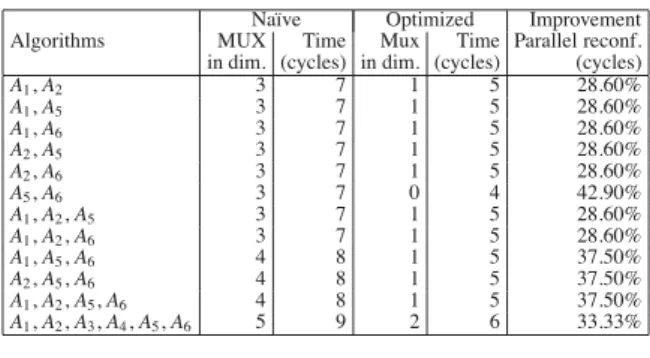
Table 4 presents the results of minimizing the parallel recon!guration time, again comparing na¨#ve with our opti-mized solutions. We specify the number of dimensions that use multiplexers. The recon!guration time is shorter for parallel recon!guration when optimized with our method and in average we obtain 32% improvement.
6 Conclusions and future work
In this paper, we have presented a constraint program-ming formulation for minimization of area as well as se-quential and parallel recon!guration time overhead for reg-ular recon!gurable architectures. Our system makes it also possible to make a design space exploration that involves trading multiplexers against channel connections, for exam-ple. The experimental results indicate large savings of area, specially for applications that have larger number of algo-rithms and a large number of PEs.
The following extensions are possible for future work: First, a different cost function would make it possible to minimize, for example, a number of channel connections with a given limit on a number of multiplexers or a maximal length of routed paths for a given set of algorithms.
The search space for the considered problem is large, and for large problems, we cannot !nd or prove optimality of our solutions. This is partially caused by existence of many symmetrical solutions with the same cost. These could be eliminated by introduction of additional symmetry elimina-tion constraints. We leave it for our future work.
Table 4. Parallel recon!guration time of (a) na¨"ve solution and (b) optimized solutions for different combinations of algorithms.
Na¨#ve Optimized Improvement Algorithms MUX Time Mux Time Parallel reconf. in dim. (cycles) in dim. (cycles) (cycles)
A1, A2 3 7 1 5 28.60% A1, A5 3 7 1 5 28.60% A1, A6 3 7 1 5 28.60% A2, A5 3 7 1 5 28.60% A2, A6 3 7 1 5 28.60% A5, A6 3 7 0 4 42.90% A1, A2, A5 3 7 1 5 28.60% A1, A2, A6 3 7 1 5 28.60% A1, A5, A6 4 8 1 5 37.50% A2, A5, A6 4 8 1 5 37.50% A1, A2, A5, A6 4 8 1 5 37.50% A1, A2, A3, A4, A5, A6 5 9 2 6 33.33%
References
[1] A. Ahmadinia, C. Bobda, J. Ding, M. Majer, J. Teich, S. Fekete, and J. van der Veen. A Practical Approach for Circuit Routing on Dy-namic Recon!gurable Devices. In Proc. of the 16th Int. Workshop on Rapid System Prototyping (RSP), pages 84–90, Montreal, Canada, June 2005.
[2] L. Benini and G. Micheli. Network on Chips: A new SoC Paradigm. IEEE Computer, January 2001.
[3] C. Bobda and A. Ahmadinia. Dynamic Interconnection of Recon-!gurable Modules on ReconRecon-!gurable Devices. IEEE Design & Test, 22(5):443–451, 2005.
[4] F. Hannig and J. Teich. Resource Constrained and Speculative Scheduling of an Algorithm Class with Run-Time Dependent Con-ditionals. In Proc. of the 15th Int. Conference on Application-speci!c Systems, Architectures, and Processors (ASAP), pages 17–27, Galve-ston, TX, USA, Sept. 2004.
[5] A. Hemani, A. Jantsch, S. Kumar, A. Postula, J. Oberg, M. Millberg, and D. Lindqvist. Network on Chip: An Architecture for Billion Transistor Era. In Proc. of the Int. NorChip Conference, Sept. 2000.
[6] M. H¨ubner, C. Schuck, M. K¨uhnle, and J. Becker. New
2-Dimensional Partial Dynamic Recon!guration Techniques for Real-time Adaptive Microelectronic Circuits. In Proc. of the Symposium on Emerging VLSI Technologies and Architectures (ISVLSI), page 97, Washington, DC, USA, 2006.
[7] D. Kissler, F. Hannig, A. Kupriyanov, and J. Teich. A Highly Param-eterizable Parallel Processor Array Architecture. In Proc. of the Int. Conference on Field Programmable Technology (FPT), pages 105– 112, Bangkok, Thailand, Dec. 2006.
[8] K. Kuchcinski. Constraints-Driven Scheduling and Resource Assign-ment. ACM Transactions on Design Automation of Electronic Sys-tems (TODAES), 8(3):355–383, July 2003.
[9] N. Moreano, G. Araujo, Z. Huang, and S. Malik. Datapath Merg-ing and Interconnection SharMerg-ing for Recon!gurable Architectures. In Proc. of the 15th Int. Symposium on System Synthesis (ISSS), pages 38–43, New York, NY, USA, 2002.
[10] S. Siegel, R. Merker, F. Hannig, and J. Teich. Communication-conscious Mapping of Regular Nested Loop Programs onto Mas-sively Parallel Processor Arrays. In Proc. of the 18th Int. Conference on Parallel and Distributed Computing and Systems (PDCS), pages 71–76, Dallas, TX, USA, Nov. 2006.
[11] M. N. Velev and P. Gao. Comparison of Boolean Satis!ability En-codings on FPGA Detailed Routing Problems. In Proc. of the con-ference on Design, Automation and Test in Europe (DATE), pages 1268–1273, Munich, Germany, 2008.
[12] C. Wolinski, K. Kuchcinski, J. Teich, and F. Hannig. Optimization of Routing and Recon!guration Overhead in Programmable Processor Array Architectures. In Proc. of the 16th IEEE Symposium on Field-Programmable Custom Computing Machines (FCCM), poster, Palo Alto, CA, USA, Apr. 2008.