HAL Id: hal-02440859
https://hal.archives-ouvertes.fr/hal-02440859
Submitted on 15 Jan 2020
HAL is a multi-disciplinary open access
archive for the deposit and dissemination of
sci-entific research documents, whether they are
pub-lished or not. The documents may come from
teaching and research institutions in France or
abroad, or from public or private research centers.
L’archive ouverte pluridisciplinaire HAL, est
destinée au dépôt et à la diffusion de documents
scientifiques de niveau recherche, publiés ou non,
émanant des établissements d’enseignement et de
recherche français ou étrangers, des laboratoires
publics ou privés.
Distributed Hypothesis Testing Over a Noisy Channel
Sadaf Salehkalaibar, Michèle Wigger
To cite this version:
Sadaf Salehkalaibar, Michèle Wigger. Distributed Hypothesis Testing Over a Noisy Channel.
In-ternational Zurich Seminar on Communications, Feb 2018, Zurich, Switzerland.
�10.3929/ethz-b-000245046�. �hal-02440859�
Conference Paper
Distributed Hypothesis Testing Over a Noisy Channel
Author(s):
Salehkalaibar, Sadaf; Wigger, Michèle
Publication Date:
2018-02
Permanent Link:
https://doi.org/10.3929/ethz-b-000245046
Rights / License:
In Copyright - Non-Commercial Use Permitted
This page was generated automatically upon download from the ETH Zurich Research Collection. For more information please consult the Terms of use.
Distributed Hypothesis Testing Over a Noisy
Channel
1Sadaf Salehkalaibar and2Mich`ele Wigger
1ECE Department, College of Engineering, University of Tehran, Tehran, Iran, [email protected] 2LTCI, Telecom ParisTech, Universit´e Paris-Saclay, 75013 Paris, France, [email protected]
Abstract—A coding and testing scheme is presented for the distributed hypothesis testing problem over a noisy channel. The coding scheme combines the Shimokawa-Han-Amari hypothesis testing scheme with Borade’s unequal error protection (UEP) channel coding. The type-II error exponent of our scheme consists of three competing error exponents: two of them coincide with the exponents found by Shimokawa-Han-Amari for distributed hypothesis testing over a noiseless link (with the rate be replaced by the mutual information between channel input and output), and the third includes Borade’s miss-detection exponent for UEP over a noisy channel. Depending on the problem setup, any of the three exponents can be active. When testing against conditional independence, only the two Shimokawa-Han-Amari exponents are active, and the scheme achieves the optimal type-II error exponent found by Sreekuma and G¨und¨uz.
I. INTRODUCTION
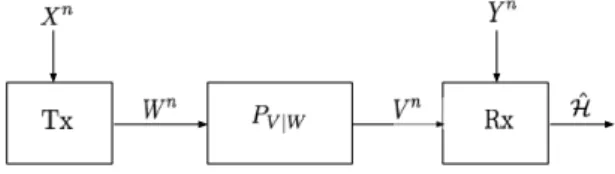
Consider a distributed hypothesis testing problem where a sensor describes its collected information to a remote decision center over a noisy channel. The decision center decides on a binary hypothesis (H = 0 or H = 1) that determines the joint probability distribution underlying its own observation and the information observed at the sensor. The goal of the communication is to maximize the type-II error (deciding ˆH = 0 when H = 1) exponent under a constrained type-I error (deciding ˆH = 1 when H = 0).
The special case of this problem where communication takes place over a noiseless link was studied in [1]–[4]. These works present achievable type-II error exponents for general joint probability distributions underlying the two hypotheses and the optimal type-II error exponent for the special case called “testing against conditional independence” [4]. Dis-tributed hypothesis testing problems over noiseless networks with multiple sensors or decision centers or with relays have been considered in [4]–[8]. The work most closely related to this paper is by Sreekumar and G¨und¨uz [9]. It proves that the optimal type-II error exponent for “testing against conditional independence” over a noisy channel, coincides with the optimal type-II error exponent of the same test over a noiseless link of rate equal to the capacity of the noisy channel. Their result is based on a joint hypothesis-testing and channel-coding scheme, see also [9, Remark 6] for a discussion on this. In this work, we propose a coding scheme for distributed hy-pothesis testing over a noisy channel with general probability distributions. The coding and testing scheme applies separate hypothesis testing and channel coding by combining the Shimokawa-Han-Amari (SHA) hypothesis-testing scheme [3]
Fig. 1. Hypothesis testing over a noisy channel
with Borade’s unequal error protection (UEP) channel coding [12]. The idea is to reinforce the protection of the message that the SHA scheme produces to indicate that the transmitter decides on the alternative hypothesis H = 1. Our analysis in general shows three competing error exponents, two of them coincide with the two competing error exponents obtained for testing over a noiseless link [3] when the communication rate is replaced by the mutual information between input and output of the channel. The third error exponent depends again on this mutual information, and on Borade’s miss-detection exponent [12] for channel coding with UEP. In the special case of “testing against conditional independence”, recover the optimal exponent by Sreekuma and G¨und¨uz [9]. In this case, our third error exponent is never active and the overall type-II error exponent depends on the noisy channel only through its capacity.
Notation: We mostly follow the notation in [10]. Moreover, we use tp(·) to denote the joint type of a tuple. For a joint type ⇡ABover alphabets A⇥B, we denote by I⇡AB(A; B)the
mutual information of a pair of random variables (A, B) with probability mass function (pmf) ⇡AB. Similarly for entropy,
conditional entropy, and conditional mutual information. When it is unambiguous, we may abbreviate ⇡AB by ⇡. We also
abbreviate independent and identically distributed by i.i.d. II. SYSTEMMODEL
Consider the distributed hypothesis testing problem in Fig. 1, where a transmitter observes source sequence Xnand
a receiver source sequence Yn. Under the null hypothesis:
H = 0: (Xn, Yn) i.i.d. ⇠ P
XY, (1)
and under the alternative hypothesis:
H = 1: (Xn, Yn) i.i.d. ⇠ QXY. (2)
for two given pmfs PXY and QXY. The transmitter can
communicate with the receiver over n uses of a discrete
International Zurich Seminar on Information and Communication (IZS), February 21 – 23, 2018
memory channel (W, V, PV|W) where W denotes the finite
channel input alphabet and V the finite channel output alpha-bet. Specifically, the transmitter feeds inputs
Wn= f(n)(Xn) (3)
to the channel, where f(n) denotes the chosen (possibly
stochastic) encoding function
f(n):Xn! Wn. (4)
Based on the sequence of channel outputs Vn and the source
sequence Yn, the receiver decides on the hypothesis H. That
means, it produces the guess ˆ
H = g(n)(Vn, Yn), (5)
by means of a decoding function
g(n):Vn⇥ Yn! {0, 1}. (6)
Definition 1: For each ✏ 2 (0, 1), an exponent ✓ is said ✏-achievable, if for each sufficiently large blocklength n, there exist encoding and decoding functions (f(n), g(n)) such that
the corresponding type-I and type-II error probabilities at the receiver ↵n= Pr[ ˆH = 1|H = 0], (7) n= Pr[ ˆH = 0|H = 1], (8) satisfy ↵n ✏, (9) and lim n!1 1 nlog n ✓. (10) The goal is to maximize the type-II error exponent ✓.
III. CODING ANDTESTINGSCHEME
We describe a coding and testing scheme for the general distributed hypothesis testing problem over a noisy channel. The analysis of the scheme is postponed to Section V. Preparations: Choose a large positive integer n, an auxiliary distribution PT over W, a conditional channel input
distribu-tion PW|T, and a conditional source distribution PS|X over a
finite auxiliary alphabet S so that
I(S; X) < I(S; Y ) + I(V ; W|T ), (11) where the mutual informations in (11) are calculated according to the following joint distribution
PSXY W V T = PS|X· PXY · PT· PW|T· PV|W. (12)
Then choose a sufficiently small µ > 0 and nonnegative rates (R, R0)so that
R + R0= I(X; S) + µ (13) R < I(V ; W|T ) (14) R0< I(S; Y ). (15)
Code Construction: Construct a random codebook CS= Sn(m, `) : m2 {1, ..., b2nRc}, ` 2 {1, ..., b2nR
0
c} , by independently drawing all codewords i.i.d. according to PS(s) =Px2XPX(x)PS|X(s|x).
Generate a sequence Tn i.i.d. according to P
T. Construct a
random codebook
CW = Wn(m) : m2 {1, ..., b2nRc}
superpositioned on Tn where each codeword is drawn
in-dependently according to PW|T conditioned on Tn. Reveal
the realizations of the codebooks and the sequence Tn to all
terminals.
Transmitter: Given that it observes the source sequence Xn=
xn, the transmitter looks for a pair (m, `) that satisfies
(sn(m, `), xn)2 Tn
µ/2(PSX). (16)
If successful, it picks one of these pairs uniformly at random and sends the codeword wn(m)over the channel. Otherwise
it sends the sequence of inputs tn over the channel.
Receiver: Assume that Vn = vn and Yn = yn and that the
“time-sharing sequence” Tn= tn. The receiver first looks for
an index m02 {1, . . . , b2nRc} so that
(wn(m0), vn, tn)2 Tn
µ(PW V T). (17)
If it is not successful, it declares ˆH = 1. Otherwise, it randomly picks one of the indices `0 that satisfy
Htp(sn(m0,`0),yn)(S|Y ) = min
˜
`2{1,...,b2nR0c}
Htp(sn(m0,˜`),yn)(S|Y ),
(18) and checks whether
(sn(m0, `0), yn)2 Tµn(PSY). (19)
If successful, it declares ˆH = 0. Otherwise, it declares ˆH = 1. IV. ANACHIEVABLEERROREXPONENT
The coding and testing scheme described in the previous section allows to establish the following theorem.
Theorem 1: Every error exponent ✓ 0 that satisfies the following condition (33) is achievable:
✓ max PS|X,PT W: I(S;X|Y )I(W ;V |T ) min ✓1, ✓2, ✓3 , (20) where ✓1= min ˜ PSXY: ˜ PSX=PSX ˜ PSY=PSY D( ˜PSXY||QXYPS|X), (21) ✓2= min ˜ PSXY: ˜ PSX=PSX ˜ PY=PY H(S|Y )HP˜(S|Y ) h D( ˜PSXY||PS|XQXY) + I(V ; W|T ) I(S; X|Y )i, (22) ✓3= D(PY||QY) + I(V ; W|T ) I(S; X|Y )
+X
t2W
PT(t)· D(PV|T =t||PV|W =t),
(23) and all expressions are calculated with respect to the joint distribution in (12).
Proof: Based on the scheme in Section V.
Lemma 1: It suffices to consider the auxiliary random variable S over an alphabet S that is of size |S| = |X | + 2. For the specical case of PY = QY, it suffices to consider
|S| = |X | + 1.
Proof: Based on Carath´eodory’s theorem. Omitted. Our coding and testing scheme combines the SHA hypoth-esis testing scheme for a noiseless link [3] with Borade’s UEP channel coding that protects the 0-message (which indicates that the transmitter decides on H = 1) better than the other messages [11], [12]. In fact, since here we are only interested in the type-II error exponent, the receiver should decide on H = 0 only if the transmitter also shares this opinion.
The expressions in Theorem 1 show three competing error exponents. In (21) and (22), we recognize the two competing error exponents of the SHA scheme for the noiseless setup: ✓1 is the exponent associated to the event that the receiver
reconstructs the correct binned codeword and ✓2is associated
to the event that either the binning or the noisy channel introduces a decoding error. The exponent ✓3 in (23) is new
and can be associated to the event that the specially protected 0-message is wrongly decoded. We remark in particular that ✓3contains the term
Emiss:=
X
t2W
PT(t)· D(PV|T =t||PV|W =t), (24)
which represents the largest possible miss-detection exponent for a single specially protected message at a given rate I(W ; V|T ) [12, Th. 34].
Which of the three exponents ✓1, ✓2, ✓3is smallest depends
on the source and channel parameters and the choice of PS|X
and PW. Notice that the third error exponent ✓3 is inactive
for channels with large miss-detection exponent (24), such as binary symmetric channels with small cross-over probability, or for sources where
min ˜ PSXY: ˜ PSX=PSX ˜ PY=PY D( ˜PSXY||PS|XQXY) = D(PY||QY), (25)
This is the case for example when “testing against conditional independence” [4] where both terms are 0.
Corollary 1 (Lemma 5 in [9]): Consider the “testing against independence” setup where
Y = ( ¯Y , Z), (26) and QX ¯Y Z decomposes as
QX ¯Y Z= PXZ· PY¯|Z. (27)
Error exponent ✓ 0is achievable if, ✓ max
PS|X, PW:
I(S;X|Z)I(W ;V )
I(S; ¯Y|Z), (28) where mutual informations are calculated with respect to the joint law PX ¯Y ZPS|XPWPV|W.
Proof: Fix independent random variables T and W and a random variable S so that
I(S; X|Z) I(W ; V |T ) = I(W ; V ). (29) Then, Theorem 1 specializes to:
✓1= min ˜ PSX ¯Y Z: ˜ PSX=PSX ˜ PS ¯Y Z=PS ¯Y Z D( ˜PSX ¯Y Z||QX ¯Y ZPS|X) = min ˜ PSX ¯Y Z: ˜ PSX=PSX ˜ PS ¯Y Z=PS ¯Y Z D( ˜PSX ¯Y Z||PXZPY¯|ZPS|X) = D(PS ¯Y Z||PZPY¯|ZPS|Z) = I(S; ¯Y|Z).
Moreover, exponents ✓2 and ✓3 cannot be smaller than
I(S; ¯Y|Z) because of the nonnegativity of the KL-divergence and the mutual information and because
I(V ; W ) I(S; X) + I(S; ¯Y , Z) = I(V ; W ) I(S; X|Z) + I(S; ¯Y|Z)
I(S; ¯Y|Z), (30) where the inequality holds by (29).
Notice that the error exponent in Corollary 1 is optimal [9]. We now present an example and evaluate the largest type-II error exponents attained by our scheme. We also show that depending on the choice of the model parameters, a different error exponent ✓1, ✓2,or ✓3 is active.
Example 1: Let under the null hypothesis H = 0: X⇠ Bern(p0), Y = X N0,
N0⇠ Bern(q0), (31)
for N0independent of X. Under the alternative hypothesis:
H = 1: X⇠ Bern(p1), Y ⇠ Bern(p0? q0), (32)
with X and Y independent. Assume that PV|W is a binary
symmetric channel (BSC) with cross-over probability r 2 [0, 1/2].
For this example, PY = QY and Theorem 1 simplifies to:
✓ max PS|X,PT W: I(S;X|Y )I(W ;V |T ) min ✓1, ✓2, ✓3 , (33) where ✓1 D(PX||QX) + I(S; Y ), (34)
✓2 D(PX||QX) + I(V ; W|T ) + I(S; Y ) I(S; X), (35)
International Zurich Seminar on Information and Communication (IZS), February 21 – 23, 2018
✓3
X
t2W
PT(t)D(PV|T =t||PV|W =t)
+ I(V ; W|T ) + I(S; Y ) I(S; X). (36) Depending on the parameters of the setup and the choice of the auxiliary distributions, either of the exponents ✓1, ✓2, or
✓3 is active. For example, when the cross-over probability of
the BSC is large, r 0.4325, D(PX||QX) X t2W PT(t)D(PV|T =t||PV|W =t) + I(V ; W|T ), (37) and irrespective of the choice of the random variables S, T, W the exponent ✓3 is smaller than ✓1 and ✓2. It is then optimal
to choose S constant and (T, W ) so as to maximize the sum P
t2WPT(t)D(PV|T =t||PV|W =t)+I(V ; W|T ). In particular,
for a scenario with parameters p0 = 0.1, q0= 0.25, p1= 0.2
and r = 4
9 one obtains numerically that the optimal error
exponent achieved by our scheme is ✓ = 0.0358.
In contrast, when the cross-over probability of the BSC is small, the miss-detection exponent (24) is large and the exponent ✓3 is never active irrespective of the choice of the
auxiliary random variable S. The overall exponent is then determined by the smaller of ✓1 and ✓2, and in particular by
a choice S, X, W that makes the two equal. In this case, for a scenario with parameters p0 = 0.2, q0 = 0.3, p1 = 0.4,
and r = 0.1, the largest exponent achieved by our scheme is ✓ = 0.19.
V. PROOF OFTHEOREM1
The proof of the theorem is based on the scheme in Section III. Before analyzing this scheme, notice that by the functional representation lemma, there exists a function over appropriate domains and for each time t 2 {1, . . . , n} a random variable tover a finite alphabet so that the
time-tchannel input and output satisfy:
Vt= ⇠(Wt, t). (38)
Let Pn be the set of all types over the product alphabets
Sn⇥ Sn⇥ Wn⇥ Wn⇥ Wn⇥ Vn⇥ n⇥ Xn⇥ Yn, and
let Pn
µ be the subset of types ⇡SS0T W W0V XY 2 Pn that
simultaneously satisfy the following conditions:
|⇡SX PSX| µ/2, (39a)
|⇡S0Y PSY| µ, (39b)
|⇡T W0V PT W V| µ, (39c)
⇡V| T W = {V = ⇠( , T, W )}, (39d)
H⇡S0 Y(S|Y ) H⇡SY(S|Y ). (39e)
We first analyze the type-I error probability averaged over the random code construction. Let (M, L) be the indices of the codeword chosen at the transmitter, if they exist, and define the following events:
ETx:{@(m, `): (Sn(m, `), Xn)2 Tµ/2n (PSX)} (40) ERx(1):{(Sn(M, L), Yn) /2 Tµn(PSY)} (41) ERx(2):{9m06= M : (Tn, Wn(m0), Vn)2 Tµn(PT WPV|W)} (42) ERx(3):{9`06= L: Htp(sn(M,`0),yn)(S|Y ) = min ˜ ` Htp(sn(M,˜`),yn)(S|Y )}. (43) With these definitions, we obtain for all sufficiently small values of µ and sufficiently large blocklengths n:
↵n Pr[ETx] + Pr[ERx(1)|ETxc ] + Pr[ERx(2)|ETxc,ERx(1)c]
+ Pr[ERx(3)|ERx(1)c,ETxc] (44)
✏/4 + ✏/4 + ✏/4 + ✏/4 = ✏, (45) where the first summand of (44) can be upper bounded by means of the covering lemma [10] and the rate constraint (15); the second by means of the Markov lemma [10]; the third by means of the packing lemma [10] and the rate constraint (14); and the fourth by following similar steps as in analysis of the type-I error probability in [5, Appendix H].
Now, consider the type-II error probability. Let Pn µ,0be the
subset of types ⇡S0T W0 V XY over the alphabets Sn⇥ Wn⇥
Wn⇥ n⇥ Vn⇥ Xn⇥ Ynthat satisfy (39b), (39c), and
⇡V| T = {V = ⇠(T, )}. (46)
Define for each pair (m, m0)2 {1, . . . , b2nRc}2 and (`, `0)2
{1, . . . , b2nR0c}2 the set: A(m, m0, `, `0) :=n('n, xn, yn) :tp Sn(m, `), Sn(m0, `0), Wn(m), Wn(m0), 'n, ⇠n(Wn(m), 'n), xn, yn 2 Pn µ o ; and for each m0 2 {1, . . . , b2nRc} and `02 {1, . . . , b2nR0
c} the set: A(0, m0, `0) :=n('n, xn, yn) :tp Sn(m0, `0), Tn, Wn(m0), 'n, ⇠n(Tn, 'n), xn, yn 2 Pn µ,0 o . (47) By ⇠n(Wn(m), 'n), here we mean the component-wise
ap-plication of the function ⇠(., .) defined in (38) to the n-length sequences Wn(m)and 'n.
Define the region ARx,n✓ n⇥ Xn⇥ Yn
ARx,n= [ m,m0 [ `,`0 A(m, m0, `, `0)[ [ m0,`0 A(0, m0, `0), (48) where m and m0 take value in {1, . . . , b2nRc} and ` and `0
in {1, . . . , b2nR0
c}. Notice that ARx,n is deterministic for a
given codebook, but random in the analysis here.
Since ARx,n includes the acceptance region at the receiver,
the average (over the random codebooks) type-II error proba-bility is upper bounded as:
EC[ n] Pr
⇥
( n, Xn, Yn)2 ARx,n|H = 1⇤. (49)
We can then write: EC[ n]
[ m,m0 [ `,`0 A(m, m0, `, `0)[ [ m0,`0 A(0, m0, `0)|H = 1i Prh( n, Xn, Yn)2 [ (m,`) A(m, m, `, `)|H = 1i + Prh( n, Xn, Yn)2 [ (m,`)6=(m0,`0) A(m, m0, `, `0)|H = 1i + Prh( n, Xn, Yn)2 [ m0,`0 A(0, m0, `0)|H = 1i. (50) In a similar way as in [5], it can be shown that for sufficiently large blocklengths n, the first probability in (50) is upper bounded as: Prh( n, Xn, Yn)2[ m [ ` A(m, m, `, `)|H = 1i 2 n✓1,µ, (51) where
✓1,µ:= min⇡SXY2PnµD(⇡SXY||PS|XQXY) (µ) (52)
for a function (µ) that goes to zero as µ ! 0. Moreover, for sufficiently large n, the second probability in (50) is upper bounded as: Prh( n, Xn, Yn)2 [ (m,`)6=(m0,`0) A(m, m0, `, `0)i 2 n✓2,µ, (53) where ✓2,µ:= min ⇡SS0 W W 0 V XY2Pnµ D(⇡SXY||PS|XQXY)
+ I(S; Y ) + I(V ; W|T ) I(S; X) 0(µ), (54) for a function 0(µ) that goes to zero as µ ! 0.
The last term in (50) is upper bounded for sufficiently large blocklength n: Prh( n, Xn, Yn)2 [ m0,`0 A(0, m0, `0)|H = 1i X m0,`0 Prh( n, Xn, Yn)2 A(0, m0, `0)|H = 1i X m0,`0 X ⇡S0 T W 0 V XY2Pµ,0n Prhtp⇣Sn(m0, `0), Tn, Wn(m0), n, ⇠n(Tn, n), Xn, Yn⌘ = ⇡S0T W0 V XY H = 1 i X m0,`0 X ⇡S0 T W 0 V XY2Pµ,0n 2 nD ⇡S0 T W 0 V XY PSPT WP ⇡V| TQXY
where the last inequality holds by the way the random code-books are generated and because given H = 1, the sources Xn, Yn are i.i.d. ⇠ Q XY. Define now ˜ ✓3,µ:=⇡ min S0 T W 0 V XY 2Pn µ,0 D(⇡S0T W0 V XY||PSPT WP ⇡V| TQXY) R R0 µ (55)
and notice that there exist functions 00(µ)that ! 0 as µ ! 0
and so that the following inequalities hold: ˜ ✓3,µ (a) min ⇡S0 T W 0 V XY2Pµ,0n h D(⇡T W0 V||PT WP ⇡V| T) + D(⇡XY||QXY) +E⇡XY[D(⇡S0|XY||PS)] i I(S; X) 2µ (b) min ⇡S0 T W 0 V XY2Pµ,0n h D(⇡T W0V||PT WPV|W =T) i + D(PY||QY) + I(S; Y ) I(S; X) 00(µ) (c) EPT W[D(PV|W||PV|W =T)] + D(PY||QY) + I(S; Y ) I(S; X) 00(µ)
= D(PY||QY) + I(V ; W|T ) + I(S; Y ) I(S; X)
+X
t
PT(t)· D(PV|T =t||PV|W =t) 00(µ)
:= ✓3,µ. (56)
All three inequalities are based on the data processing inequal-ity for KL-divergences; (a) also uses (13); and (b) and (c) also use the continuity of KL-divergences and that all types in Pn
0,µ
satisfy (39b), (39c), and (46). Thus, for sufficiently large n: Prh( n, Xn, Yn)2 [
m0,`0
A(0, m0, `0)|H = 1i 2 n✓3,µ.(57)
Combining (50), (51), (53), and (57), taking µ ! 0 and n! 1, the proof can be established by standard arguments.
REFERENCES
[1] A. Ahlswede and I. Csiszar, “Hypothesis testing with communication constraints,” IEEE Trans. on Info. Theory, vol. 32, no. 4, pp. 533–542, Jul. 1986.
[2] T. S. Han, “Hypothesis testing with multiterminal data compression,” IEEE Trans. on Info. Theory, vol. 33, no. 6, pp. 759–772, Nov. 1987. [3] H. Shimokawa, T. Han and S. I. Amari, “Error bound for hypothesis
testing with data compression,” in Proc. IEEE Int. Symp. on Info. Theory, Jul. 1994, p. 114.
[4] M. S. Rahman and A. B. Wagner, “On the Optimality of binning for distributed hypothesis testing,” IEEE Trans. on Info. Theory, vol. 58, no. 10, pp. 6282–6303, Oct. 2012.
[5] S. Salehkalaibar, M. Wigger and L. Wang, “Hypothesis testing over multi-hop networks,” Available at: https://arxiv.org/abs/1708.05198. [6] W. Zhao and L. Lai, “Distributed testing against independence with
multiple terminals,” in Proc. 52nd Allerton Conf. Comm, Cont. and Comp., IL, USA, pp. 1246–1251, Oct. 2014.
[7] Y. Xiang and Y. H. Kim, “Interactive hypothesis testing against inde-pendence,” in Proc. IEEE Int. Symp. on Info. Theory, Istanbul, Turkey, pp. 2840–2844, Jun. 2013.
[8] M. Wigger and R. Timo, “Testing against independence with multiple decision centers,” in Proc. of SPCOM, Bangalore, India, Jun. 2016. [9] S. Sreekuma and D. Gunduz, “Distributed hypothesis testing over noisy
channels,” available at: https://arxiv.org/abs/1704.01535.
[10] A. El Gamal and Y. H. Kim, Network information theory, Cambridge Univ. Press, 2011.
[11] D. Wang, V. Chandar, S. Y. Chung and G. W. Wornell, “On reliability functions for single-message unequal error protection,” in Proc. IEEE Int. Symp. on Info. Theory, MIT, pp. 2934–2938, 2012.
[12] S. P. Borade, “When all information is not created equal,” Thesis, Massachusetts Institute of Technology, 2008.
[13] T. M. Cover and J. A. Thomas, Elements of Information Theory, John Wiley, 1991.