Any correspondence concerning this service should be sent
to the repository administrator:
[email protected]
This is an author’s version published in:
http://oatao.univ-toulouse.fr/22454
Official URL
DOI :
https://doi.org/10.1109/IPIN.2018.8533778
Open Archive Toulouse Archive Ouverte
OATAO is an open access repository that collects the work of Toulouse
researchers and makes it freely available over the web where possible
To cite this version:
Van Den Bossche, Adrien and Dalce,
Rejane and Gonzalez, Nicolas and Val, Thierry LocURa: A New
Localisation and UWB-Based Ranging Testbed for the Internet of
Things. (2018) In: IEEE International Conference on Indoor
Positioning and Indoor Navigation (IPIN 2018), 24 September 2018
- 27 September 2018 (Nantes, France).
LocURa:
A New Localisation and UWB-Based
Ranging
Testbed for the Internet of Things
Adrien van den Bossche1, R´ejane Dalce´2, Nicolas Gonzalez1, Thierry Val1
1
Institut de Recherche en Informatique de Toulouse, Universit´e Toulouse 2 Jean Jaur`es, France 2
Institut de Recherche en Informatique de Toulouse, Institut National Universitaire Champollion, France {adrien.van-den-bossche, rejane.dalce, nicolas.gonzalez, thierry.val}@irit.fr
Abstract—As many applications of the Internet of Things assume the knowledge of mobile object position, localisation has become a hot topic in the academic research community as well as for industrial R&D departments. Although distance measurements (ranging) and localisation can be studied though simulations, using real nodes provides more accurate and realistic results, especially when the nodes are deployed in the target environment. In order to support this effort, the paper presents LocURa4IoT, a new Localisation and UWB-based Ranging testbed for the Internet of Things. The testbed is made of 20 nodes based on Decawave DW1000 UWB-based transceiver and Arduino-compliant micro-controllers. The nodes’ control infrastructure is presented in the paper, as well as a few results obtained with LocURa. Two open datasets are also published with the paper.
Index Terms—Ranging protocols; Time Of Flight; Testbed; Indoor Localisation
I. INTRODUCTION
Wireless networks have come a long way from their humble beginnings as mere extensions to existing wired networks. As the performance increased, these networks evolved and became an integral part of day to day human operations. Wireless Sensor Networks soon followed, accompanied by MANETs and VANETs. The addition of communication abil-ities to everyday objects gave birth to the Internet of Things (IoT) which is now poised to revolutionise all aspects of human life. This type of huge networks is expected to generate humongous amounts of data which will be fed to applications in various domains such as transportation, health, trade etc. In order to be useful, the produced data must be tagged with, at least, a timestamp and a location. Indeed, while knowing that the temperature in a room is 50°C is a significant piece of information, it does not help much if the room cannot be identified. This localisation issue is not new: in outdoor environments, GPS signals are massively used. Unfortunately, indoor environments often defeat this solution due to the presence of numerous obstructions. Hence, indoor localisation has been a competitive research field for the last ten years, both for the academic research community and the industry.
Just as wireless networks evolved through extensive study and experimentation, indoor localisation requires prototyping tools that are accessible to all researchers. Given this re-quirement, this paper introduces LocURa, a testbed dedicated to the study of Time Of Flight (TOF) based localisation.
This platform allows the fast prototyping and evaluation of communication and ranging protocols as well as localisation algorithms in a real indoor environment.
The paper is organised as follows: after detailing the objective and identifying relevant criteria, a review of the existing tools is conducted. The proposed testbed architecture and components are then introduced. Results from a few use cases are presented. Finally, the conclusion and evolution perspectives are presented.
II. CONTEXT
While it is possible to address the localisation issue using various signals, measuring the TOF between a pair of nodes has been one of the most reliable and precise solutions. Although the received power level, which can be expressed as a Received Signal Strength Indication (RSSI), is readily available on most radio platforms, it is strongly challenged by fading phenomena in dynamic indoor environments [1]. Using the signal’s Angle Of Arrival (AOA) could significantly reduce the number of reference nodes but the hardware constraints are often prohibitive for small form-factor devices (antenna ar-rays...). In order for the TOF to be relevant, the system requires the ability to measure very short durations with high precision: this involves high resolution timers dedicated to timestamping radio events. Ultra-Wide Band (UWB) technology is the best candidate for such measurements since its high bandwidth allows for high distance resolution [2].
While IEEE 802.15.4-2011 UWB-compatible transceivers became available, mathematical models have been designed in order to evaluate performance through simulations. One key advantage of simulations is repeatability: with a limited cost, it is usually possible to run the same experiment hundreds of time. This process allows the identification of trends in the system behaviour. Unfortunately, as this technology supports both data and ranging (distance measurements), the evaluation platform must also take various physical parameters into account:
- propagation conditions,
- signal reflections on walls, ceiling, other radio devices, - impact of obstructions of various types and presence of
Line Of Sight (LOS) and non-LOS links, - impact of PHY-level clock synchronisation, - PHY-level clock skew,
- impact of node temperature on performance, as said tem-perature is influenced by the communication protocol’s states (reception, idle, transmission...),
- influence of antenna orientation and directivity,
Modeling all these phenomena is a complex task. Having to configure all these parameters for a single simulation and interpret the results would be even more daunting. Thus, it is preferable to have a real world testbed for the evaluation of the proposed solutions. By replicating the target environment, it is possible to predict to a certain degree the behaviour and performance of the protocols and/or algorithms. Such a testbed, in addition to giving access to UWB devices, should offer well known services such as:
- local and 24/7 remote access, - experiment management tools:
– dynamic node configuration,
– individual and bulk firmware upgrade, – scenario execution and repetition,
– environment parameters records (temperature, humid-ity...),
– predefined data processing tools and scripts, – datasets download interface.
A few nice-to-have features would include:
- live-access to the data produced: dashboards would help keep track of specific criteria,
- node mobility,
- live video stream associated to the experiment: this would allow to correlate the experimental results with uncontrol-lable events occurring on site.
Within such an environment, results repeatability will be easier to investigate: from the user’s point of view, launching hundreds of experiments will be as easy as running a hundred simulations. Intensive use of the platform brings the need for it to be as cost effective as possible: the hardware components should be affordable while the pieces of software used should come from the open-source ecosystem. In addition to reducing costs, this last point ensures that the tools are reviewed by a significant community and can then be trusted. These characteristics make it possible for other research teams to replicate the testbed with a reasonable investment: these sister platforms could be deployed in specific environments (mines, tunnels...). On the other hand, the existing testbed can be useful to other researchers who are more interested in algorithms and data processing: the datasets generated during experiments can be made available to colleagues from other research facilities in order to compare new algorithms and inspire new protocols. Given the requirements outlined in the previous paragraphs, the next section will review the existing platforms for reliable TOF-based ranging and protocol testing.
III. RELATEDWORK
In order to facilitate the prototyping and evaluation of new ranging protocols and localisation algorithms while ensuring a certain level of confidence in the results, a physical test
platform is required. In [3] an UWB-based radio node De-caWiNo and the corresponding libraries were introduced. Both the hardware and software were published under an open-source license in order to grant fellow researchers the ability to modify the hardware and software platform. Using the provided primitives, new communication protocols as well as ranging protocols can be implemented on the devices. While DecaWiNo requires the user to delve into the code, other UWB-enabled commercial platforms such as [4], [5] and [6] offer access to the measurement results. TimeDomain offers a development kit which allows reconfiguration of the nodes: for example, either TDMA or Aloha MAC can be selected. Nevertheless, based on the information we obtained, modification of the source code is not allowed. InfSoft’s approach to indoor localisation is quite different: the company uses its expertise to design a customised product for the client, using various radio technologies (UWB, BLE, WiFi...). The software responsible for interpreting and displaying the data is also provided by InfSoft.
It is apparent, from this brief review of the existing radio devices, that, whether the user wants to tinker with of just obtain standardised data from the network, an off-the-shelf solution exists. Unfortunately, this is not enough if the goal is to extensively study the localisation problem. As a matter of fact, running a single experiment is meaningless: random environmental influences may be to blame (or praise) for the results. Therefore, repeatability is an important aspect of experimentation. Said repeatability requires a structured testbed which can automatically run experiments a number of times and feed multiple datasets to other algorithms. Large scale IoT testbeds flourish around the world. Two of the most well-known testbeds are FIT IoT-Lab [7] and SmartSantander [8]. In order to fuel the use of experimentation facilities among the scientific community, the end users and service providers, the SmartSantander project offers an access to its platform which consists in a variety of sensors deployed in a smart city, organised in a three-tiered fashion: IoT nodes sense the environment, repeaters forward the data from/to IoT nodes through 802.15.4 DSSS links and gateways allow information exchange between the IEEE 802.15.4 network and other technologies (Wi-Fi, GPRS/UMTS, Ethernet).
FIT IoT-Lab offers remote access to sensor networks de-ployed at six different locations across France. Upon regis-tering, users may launch experiments and retrieve the data produced by the nodes. Although most of the nodes only implement IEEE 802.14.5 DSSS radio communications, the platform allows the integration of other technologies, as long as the proposed module implements a required python class. Finally, mobility [9] is supported by the use of robots such as the Turtlebot2 and the Wifibot. At the moment, only fixed circuit-based mobility is available but user controlled mobility and model-based mobility are being implemented.
The proposed infrastructure in both testbeds enables great control over the experiments but, unfortunately, the radio technology is not suitable for precise localisation: being narrowband, 802.15.4 DSSS does not support fine distance
resolution.
The fact that most large-scale testbeds employ 802.15.4 DSSS has motivated researchers to create their own UWB-enabled setups. In [10], autonomous anchor calibration is studied. Tag localisation is the focus in [11] while [12] aims at enhancing the performance of fall detection solutions by localising the monitored elderly and providing the companion robot with the position where the suspected fall took place. Unfortunately, in addition to using homemade devices, the testbeds used in [10] and [11] involve heterogeneous node architectures, i.e. the tags can only perform transmission and not receive data. Although the concern for energy consumption is perfectly valid, such testbeds’ usability is quite limited. In the case of [12], IEEE 802.15.4-2011 compliant hardware is used (Decawave EVB1000 [13]) but the objective so far is not to provide a platform for other researchers to test their own solutions. We can only conclude that a suitable testbed for precise indoor localisation is yet to be found.
IV. LOCURA4IOT: A NEWLOCALISATION& UWB-BASEDRANGINGTESTBED FOR THEIOT A. Nodes Description
The LocURa testbed is based on DecaDuino [3], an open framework for the fast-prototyping and performance evaluation of UWB-based protocols. DecaDuino provides a driver for the DecaWave DW1000 UWB transceiver and others modules based on this transceiver, such as DecaWave DWM1000 [13]. In addition to wireless communication, DecaDuino supports ToF ranging. Since this framework was designed to aid in the implementation of TOF based protocols, DecaDuino also provides access to the Physical-level 64GHz high pre-cision timer which offers precise message timestamping at both transmission (tT X) and reception (tRX) with a resolu-tion of 15.625ps. Finally, DecaDuino implements advanced synchronisation/timestamping features described in the IEEE 802.15.4-2011 standard, such as delayed transmission and receiver skew evaluation. The internal transceiver temperature of each node is also available on the testbed: this parameter generally has a significant impact on the synchronisation processes, impacting the frequency stability of cost-effective quartz.
A compliant hardware called DecaWiNo is also described in [3] and shown in Figure 1. On this design, the transceiver is a DWM1000 [13] and the Arduino-compliant board is a Teensy 3.2 which embeds an ARM Cortex M4 32-bit MCU rated at 72MHz, with 64kB RAM and 256kB program memory. DecaWiNo follows an open hardware design; various resources on this node can be found at [14]. There is no specific Operating System deployed on the micro-controller of the node; all protocol operations have been implemented in C.
B. Testbed Description
The LocURa testbed is made by three layers: the lower layer is the Wireless Sensor Network (WSN) used for the experiments. The second layer is the Controller layer: as
Fig. 1. DecaWiNo: a Deca-Wireless Node
the name implies, the devices in this layer are used to configure, active/deactivate the nodes in the WSN and interact with the nodes via a serial connection. The third layer, or Data and Algorithms layer, is dedicated to data centralisation and processing. The following paragraphs will describe the components of each layer.
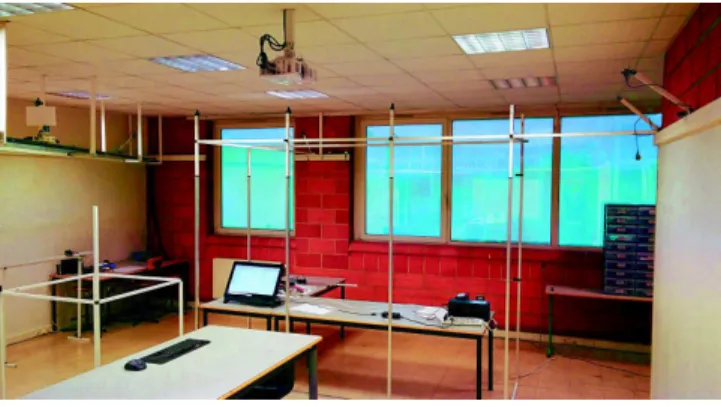
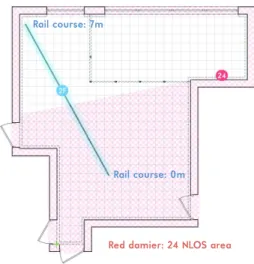
The LocURa WSN comprises 20 DecaWiNos deployed in a single 100 square-meters room. The walls are either made of terracotta bricks or drywalls. The 20 nodes are deployed on a single horizontal plane which is 2.65m from the floor and created using a PVC structure, as shown on Figure 2. The position of the nodes (antenna position) has been measured using laser telemeters during the installation with an accuracy under 1cm. At this time, two mobile nodes are positioned on two motorised rails respectively 2 and 7 metres long; linear position, speed and acceleration of the mobiles can be controlled from the experimentation scenarios; the 2D-positions of the mobiles are available in real-time using the stepper-motor feedback, with a 1mm accuracy. The real mobile position can be exploited in the results to compute ranging/localisation error. Figure 3 represents the room and the 3 nodes (0x20, 0x24 and 0x2F) involved in the experiments presented in section V.
Fig. 2. The testbed room
Ceiling-mounted 7-meterlength rail Walls: terracotta bricks Walls: drywalls Outdoorglasswindows PVC structure forfixed nodes
Fig. 3. The testbed room
are 1-hop neighbours and the 380 links are bidirectional considering an observed Frame Error Rate (FER) below 1%. In this configuration, the maximum distance on the platform between two nodes is 10 meters (in outdoors measurements, the same radio devices were able to communicate at distances up to 30 meters). Thanks to the disposition of the walls, some links are NLOS (Non Line-of-Sight), as we will see in the next section of the paper.
As is usually the case with testbeds, the experiments are managed by a central server that enables remote node pro-gramming (flashing) and log centralisation. The nodes are managed by cost-effective controllers based on Rasberry-Pi. The controllers provide both flashing/reprogramming services and logging of the serial output of the nodes via USB cables. Controllers are synchronised via Precision Time Protocol (PTP, IEEE 1588) over Ethernet to enable a homogeneous console log among controllers. With a precision of a dozen microseconds, PTP is not suitable for TOF/TOA indoor rang-ing operations: the 64GHz timers embedded on the DecaWino nodes are used for this purpose. Using PTP timestamps, the logs are merged and the result is available on the testbed server. Node behaviours are described using Arduino sketches and the interaction between the nodes, the experimentation scenario, is described with a python script. Within this script, a basic experiment can be run once or multiple times. Since the script also controls the rail, an experiment can be used to study the impact of various protocol parameters in the presence of node mobility.
Live access to the nodes’ input/output console is also possi-ble via the MQTT protocol: this enapossi-bles real-time processing (localisation algorithms...) in a typical IoT-fashion, using pop-ular IoT tools such as Node-RED or MQTT Python agents. For example, Node-RED is used to compute the ranging error for each estimate published on MQTT: this error is then appended to the ranging data and published on the MQTT bus (see datasets provided in section V of the paper).
Finally, while providing a public access to the testbed is a
perspective we are actively studying, it is not the only open approach we are considering. As a matter of fact, the testbed has been developed by using cost-effective and open-source hardware and software to enable its open dissemination [14]. In addition, we intend on making the datasets created using our own testbed and experiments available to the research commu-nity in formats that allow easy processing using Python. The next section will describe a few of those experimental results.
V. PLATFORMUSAGE ANDRESULTS
In this section, we present several experimentation scenarios and results obtained using the LocURa testbed.
A. Transceiver Temperature Impact on Clock Skew
The clock skew usually has a significant impact on the syn-chronisation process, and thus, the ranging error. The general-purpose quartz (10ppm) typically used on cost-effective wire-less nodes are mainly impacted by the temperature variation. The UWB reception process causes heavy computation by the transceiver, implying a high energy consumption (300mW) and a temperature increase during long reception periods.
In experiment #1, we ran two scenarios involving two nodes, A and B. In both scenarios, node A sends frames at a rate of 10fps as in a typical beaconing protocol, during 500s (5000 frames). A’s transceiver is in idle mode between two transmissions and does not listen to the medium between two frames. In scenario #1a, node B runs a continuous RX mode: upon receiving a frame, B evaluates the difference (skew) between its own clock and A’s using the clock skew evaluation function of DecaDuino. B also tracks its own temperature. In scenario #1b, node B runs a 10ms slotted RX mode (and then is in idle mode during 90ms) for the 2000 first frames, then returns in continuous RX mode for the last 3000 frames. From a network point of view, the first part of the experiment corresponds to beacon tracking in a WSN while the second part fits in an ad-hoc scheme where nodes may be solicited at any time.
Fig. 4. Skew Evolution for experiment #1a and #1b
Figure 4 represents the skew evolution for the two scenarios #1a and #1b, for each message. As we can see, for scenario #1a, the absolute skew is minimal at the beginning of the experiment and then the clock difference increases pretty quickly. In scenario #1b, the clock difference is relatively
stable for the 2000 first frames, when the slotted RX mode is activated. As soon as the continuous RX mode is activated, the clock difference increases sharply.
Figure 5 represents the clock skew distribution vs the normalised temperature of node B. The reference temperature is defined as node B’s temperature at the beginning of the experience. As we can see, the receiver temperature has a direct impact on clock skew, which impacts the ranging accuracy, as we will see in the next experiment.
!
" # $ %
Fig. 5. Skew vs. Transceiver Temperature in Experiment #1
B. Ranging Error vs Distance, by Protocol
In experiment #2, we compare two well-known ranging protocols: Two-Way Ranging (TWR) and Symmetric Double-Sided Two-Way Ranging (SDS-TWR) (Figure 6). While TWR is simpler and only requires 3 messages, the clock skew between the two nodes impacts the ranging process because timestamps t2 and t3 are not obtained with the same clock (server’s clock) as t1 and t4 (client’s clock). Thanks to the symmetry in the 4-message exchange, SDS-TWR protocol is more robust than TWR. In [15], we have proposed a correction method based on the skew value available from DecaDuino. This correction (TWR-skew) improves the ranging results obtained from the original TWR.
Fig. 6. TWR and SDS-TWR protocols sequence diagram
In experiment #2, the 7-meter long rail is used to move the mobile node 0x2F (server) while ranging with fixed node 0x20 (client) is taking place, using SDS-TWR. A total of 1300 range estimates have been collected in this experiment. The timestamps t1, t2, t3, t4, t5 and t6, the skew and the nodes’ temperature have been logged into an open dataset [16]. TWR has been extracted from the same dataset, considering
only timestamps t1, t2, t3 and t4. The real distance has also been included in the dataset, enabling the computation of the ranging error.
Figure 7 shows the ranging error for each protocol. As we can see, using TWR-skew leads to as good a performance as with SDS-TWR while saving 1 message. The dataset has been published to encourage the reuse of the experiment’s results.
!!"
!
Fig. 7. Ranging Error vs Distance, for each protocol
C. NLOS impact on Ranging Error
NLOS negatively impacts the TOF ranging quality. NLOS conditions should be detected to propose a correction, or, in an n-lateration localisation context, avoid the NLOS ranging values in the localisation computation. In experiment #3, we investigate the NLOS Indicator proposed by DecaWave [13].
Rail course: 0m Rail course: 7m
Red damier: 24 NLOS area
Fig. 8. Node Map for experiment #3
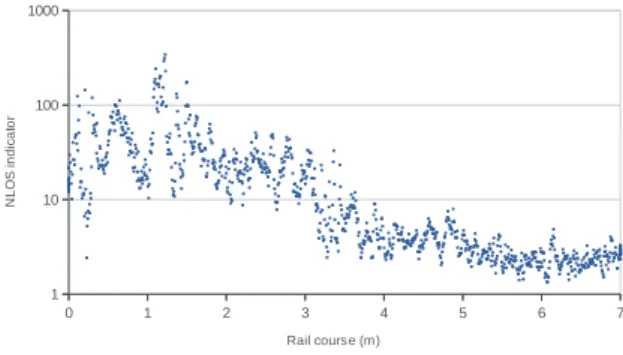
In this experiment, the 7-meter long rail is used to move the mobile node 0x2F (client) while performing ranging with the fixed node 0x24 (server). Due to node placement in the room, the link between 0x24 and 0x2F can either be LOS or NLOS, depending on the rail course: in the interval[0m, 3.40m], the radio link is in hard-NLOS because of the wall angle (material used: terracotta bricks); in the interval[3.40m, 7m], the link is LOS. Figure 8 illustrates the deployment of nodes 0x24 and 0x2F during experiment #3. For this experiment, TWR protocol ran 1047 times. The mobile speed was set to 3.3cm/s.
The dataset [17] of this experiment is available online. Figure 9 illustrates the raw NLOS indicator value vs. the rail course. As we can see, the proposed indicator is quite relevant, even without averaging. Considering a threshold value equal to 9, the hard-NLOS situation is correctly detected 93% of the time.
Fig. 9. NLOS Indicator vs. Rail Course
Figure 10 represents the ranging error vs the rail course. Using the NLOS indicator, erroneous range estimates can be avoided. The challenge consists now in proposing a correction model to deal with NLOS links. The open dataset can be used in this objective.
Fig. 10. Ranging Error vs. Rail Course
VI. CONCLUSION
This paper introduced LocURa, an UWB-based platform for prototyping and evaluation of ranging and localisation solutions. This platform offers a ranging service based on radio TOF among twenty nodes which can act both as transmitters and receivers. These nodes are based on Decawave transceiver DW1000 and an Arduino-compatible controller (Teensy 3.1). In the testbed’s current state, two nodes are mobile: a script-controlled rail is used to move each on a defined axis in the room. Data generated by the experiment is collected via USB by RaspberryPi 3 units, which are responsible for publishing the content on an MQTT bus over an Ethernet network. This MQTT bus is also used to send commands to the various devices: this enables a high level of automation for the experiments. While all the data is logged, the testbed also offers a live feedback on the experiment (node position, ranging error and so on) though a GUI based on Node-RED.
Finally, using three studies, we have illustrated the use of the platform.
Having such a tool is an opportunity for the entire commu-nity: while it gives us the ability to test our protocols on a real platform, it also produces data that can be shared with other researchers. The next step is to give remote access to fellow researchers. We are also working on including other mobile nodes (secondary rails) as well as nodes which can rotate on an axis. Some of these nodes will be placed in our anechoic chamber: this will allow comparative studies and investigation of the environmental impact. New fixed nodes will also be deployed in the main testbed room: they will be placed at a different height in order to support 3D-localisation. Finally, we will update part of our deployment with the latest generation of transceivers: with this new hardware, we plan on coupling TOF and Angle Of Arrival localisation.
ACKNOWLEDGMENT
The testbed has been created thanks to a FEDER/French Occitanie R´egion grant with the GUINNESS project. The testbed is located in the research lab at the Institut Universitaire de Technologie (IUT) de Blagnac, University of Toulouse Jean-Jaur`es, France.
REFERENCES
[1] L. Gui, M. Yang, P. Fang and S. Yang, “RSS-based indoor localisation using MDCF”, in IET Wireless Sensor Systems, vol. 7, no. 4, pp. 98-104, 8 2017.
[2] M. Ghavami,L. B. Michael, R. Kohno, “Ultra wideband signals and systems in communication engineering”, Wiley Editions 2007 [3] A. van den Bossche, R. Dalce, N.I. Fofana, T. Val, “DecaDuino: An
Open Framework for Wireless Time-of-Flight Ranging Systems”, IFIP Wireless Days (WD 2016), Toulouse, mars 2016
[4] TimeDomain, https://timedomain.com/, last accessed July 16, 2018 [5] InfSoft, https://www.infsoft.com/solutions/basics/project-procedure, last
accessed July 16, 2018
[6] UWINLOC, http://uwinloc.com/, last accessed July 16, 2018 [7] E. Fleury , N. Mitton , T. Noel, C. Adjih, ”FIT IoT-LAB: The Largest
IoT Open Experimental Testbed”, ERCIM News, ERCIM, 2015. [8] P. Sotres, J.R. Santana, L. S´anchez, J. Lanza, L. Mu˜noz, ”Practical
Lessons From the Deployment and Management of a Smart City Internet-of-Things Infrastructure: The SmartSantander Testbed Case”, IEEE Access Year: 2017, Volume: 5, Pages: 14309 - 14322
[9] https://www.iot-lab.info/robots, last accessed July 16, 2018
[10] A. Vashistha, A. Gupta, Choi L. L., ”Self Calibration of the Anchor nodes for UWB-IR TDOA based Indoor positioning System”, IEEE 4th World Forum on Internet of Things (WF-IoT), 2018
[11] R.W.C. Ling, A. Gupta, A. Vashistha, M. Sharma, Choi L. L., ”High Precision UWB-IR Indoor Positioning System for IoT Applications”, IEEE 4th World Forum on Internet of Things (WF-IoT) 2018 [12] E. Bonizzoni, A. Puiatti, S. Sapienza, P. M. Ros, D. Demarchi, P.
Bonato, ”UWB Tracking for Home Care Systems with Off-the-Shelf Components”,IEEE International Symposium on Circuits and Systems (ISCAS) 2018
[13] Decawave products, https://www.decawave.com/products/overview and documentation https://www.decawave.com/product-documentation, last accessed 13/05/2018
[14] DecaWiNo and DecaDuino ressources, https://www.irit.fr/∼Adrien.
Van-Den-Bossche/projects/decaduino, last accessed July 16, 2018 [15] R. Dalce, A. Van den Bossche, T. Val, ”Reducing localisation overhead:
a ranging protocol and an enhanced algorithm for UWB-based WSNs” IEEE Vehicular Technology Conference (VTC 2015), Glasgow, Scot-land, 2015.
[16] Experiment #2 dataset https://www.irit.fr/∼Adrien.Van-Den-Bossche/
locura-datasets/20180508T175828 LocURa-Dataset.zip
[17] Experiment #3 dataset https://www.irit.fr/∼Adrien.Van-Den-Bossche/