HAL Id: hal-00819338
https://hal.archives-ouvertes.fr/hal-00819338
Submitted on 2 May 2013HAL is a multi-disciplinary open access archive for the deposit and dissemination of sci-entific research documents, whether they are pub-lished or not. The documents may come from teaching and research institutions in France or abroad, or from public or private research centers.
L’archive ouverte pluridisciplinaire HAL, est destinée au dépôt et à la diffusion de documents scientifiques de niveau recherche, publiés ou non, émanant des établissements d’enseignement et de recherche français ou étrangers, des laboratoires publics ou privés.
Comparability Measurement for Terminology Extraction
Fabien Poulard, Béatrice Daille, Christine Jacquin, Laura Monceaux,
Emmanuel Morin, Helena Blancafort
To cite this version:
Fabien Poulard, Béatrice Daille, Christine Jacquin, Laura Monceaux, Emmanuel Morin, et al.. Com-parability Measurement for Terminology Extraction. Workshop on Creation, Harmonization and Application of Terminology resources (CHAT 2011) in conjunction with the 18th Nordic Conference on Computational Linguistics (NODALIDA 2011)., May 2011, Riga, Latvia. pp.3-10. �hal-00819338�
Comparability measurement for terminology extraction
Fabien Poulard and B´eatrice Daille Christine Jacquin and Laura Monceaux
Emmanuel Morin
Universit´e de Nantes – LINA / UMR CNRS 6241 [email protected]
Helena Blancafort Syllabs
Abstract
In this paper we describe recent work carried out in the context of the TTC project1 towards the automatic construc-tion of comparable corpora for multilin-gual terminology extraction. We focus on the communicative intention as the variable of discourse analysis that is best suited to select Web documents valuable for terminology applications and propose a classifier based on language independent features to automatically cluster crawled documents sharing the same communica-tive intention. The results of our experi-ments indicate the need to consider more sophisticated features.
1 Introduction
The notion of comparability for a corpus is still un-der construction. Comparable corpora are pairs (or more) of monolingual corpora which are not nec-essarily translations of each others but share some characteristics (domain, genre, topic. . . ). The de-gree of comparability is perceived as the amount of these common characteristics: on one extrem-ity, we find parallel corpora and on the other ex-tremity the independent corpora wich have noth-ing in common (Prochasson, 2010). The choice of the common characteristics which define the con-tent of corpus depends on its application task. For multilingual terminology extraction, the mono-lingual corpora must share an important part of the vocabulary in translated forms (D´ejean and Gaussier, 2002). Documents domain (including the sub-domain and the topic), genre, audience, language register, communicative intentions are also characteristics of interest.
The TTC project (Terminology extraction Translation tools and Comparable corpora) aims at
1http://www.ttc-project.eu/
leveraging machine translation tools (MT tools), computer-assisted translation tools (CAT tools) and multilingual content management tools by automatically generating bilingual terminologies from comparable corpora in five European lan-guages (English, French, German, Spanish and one under-resourced language, Latvian), as well as in Chinese and Russian. One key objective of the project is to automate methods for building com-parable corpora in specialized domains from the Web. We focus on the lexical quality of the docu-ments as we want to select docudocu-ments embedding a rich terminology.
In this paper, we report our work regarding the development of a system to automaticaly classify crawled Web documents according to several char-acteristics in order to ensure the monolingual com-parability of automaticaly compiled corpora.
First, we present various methods used to cat-egorize Web documents according to their genre, their discourse type or their communicative inten-tion. Then, we present a corpus we built for this study composed of documents in seven languages from five different families, as well as the termi-nology we observed within. Thereafter we dis-cuss our proposition of a classifier for communica-tive intentions based on language independent fea-tures. We finally discuss the results of our experi-ments and conclude.
2 Categorizing Web Documents
Genre is one of the various variables of discourse analysis together with domain, register, document typology, document structure, etc. It is a “social type of communicative actions, characterized by a socially recognized communicative purpose and common aspect of form” (Crowston and Williams, 2000). Kessler et al. (1997) argue that the cate-gorization of documents should not be trained on genres as atomic entities given their heigh volatil-ity. Instead they propose a classification of
gen-res as “generic facets” to distinguish “a class of texts that answers to certain practical interests, and which is associated with a characteristic set of computable structural or linguistic properties”.
The genre is not the only characteristic to be considered to ensure monolingual comparability. The type of discourse (link between authors and audience, (Nakao et al., 2010; Ke and Zweigen-baum, 2009)) and the communicative intention may also be taken into consideration.
2.1 Webgenres
Deciding the genre of a Web document is a diffi-cult task whether it must be done manually or au-tomaticaly because the directory of webgenres is dynamic. Some genres are borrowed from tradi-tional media, others derive from the formers, oth-ers again are emerging but are not yet well defined, others finally are spontaneous and have never been observed before. This evolutivity and the number of webgenres differenciates them from their tradi-tional counterparts (Sharoff, 2011).
The attempts of automatic categorization of document in genre modelize the documents as “bags of words” (Dhillon et al., 2003) or com-bine dimension reduction (discriminative analy-sis, principal component analysis) and cluster-ing (Poudat and Cleuziou, 2003) or classification (Cleuziou and Poudat, 2008). There has been sev-eral attemps to extend genre categorization to Web documents (Meyer-zu Eissen and Stein, 2004; Chaker and Habib, 2007; Dong et al., 2008; Ma-son, 2009; Waltinger et al., 2009). They usu-ally combine various documents features with cat-egorization algorithms based on machine learning techniques (support vector machines, clustering, neural networks. . . ). Chaker and Habib (2007) group these features in four categories: metadata elements (URL, description, keywords. . . ), pre-sentation features (various HTML tags, links, im-ages. . . ), surface features (text statistics, function words, closed-class genre specific words, punctu-ation marks. . . ) and structural features (parts-of-speech (POS), Tense of verbs. . . ).
Experiments from Meyer-zu Eissen and Stein (2004) show that 70 % of the documents are as-signed a correct genre.
2.2 Discourse
Goeuriot et al. (2008) have experimented the cate-gorization of documents according to their type of discourse. They distinguished scientific discourse
from popular scientific discourse. In the former, experts of a domain write for the same experts while in the latter experts or non experts write for non experts.
They propose a stylistic analysis on three levels implying deep linguistic analysis:
• The structural level consists of external cri-teria regarding the structure of the document and quantitative data (number of sentences and global size) ;
• The modal level consists of internal crite-ria caracterizing the position of the author in his writing. They considered allocutive 2 and elocutive modalities3inspired from Cha-raudeau (1992) ;
• The lexical level consists of internal crite-ria such as the presence of specific lexical units (specialized vocabulary, numbers, mea-sure units), bibliographic elements, particu-lar characters (brackets, other alphabet, sym-bols) and of quantitative data (size of the words, punctuation).
They obtain an average recall4 of 87 % and an average precision5of 90 % for French documents and quite similar results for Russian (75 % recall and 87 % precision). The results on Japanese are lower with 46 % precision and 60 % recall. 2.3 Communicative intention
For Shepherd et al. (2004), the evolution of we-bgenres is also guided by the functional dimen-sion of documents: browsing, emailing, search-ing, chattsearch-ing, interactsearch-ing, shoppsearch-ing, collaboratsearch-ing, etc. These communicative intentions may have a greater stability even if for annotators “the bound-ary between look’n’feel and communicative inten-tions is fuzzy” (Sharoff, 2011). Dong et al. (2008) consider the functionality of a Web document as part of its genre with its form and content. They associate for these three dimensions a particular kind of feature: stemmed terms for the content, HTML tags structuring the content (headings, ta-bles, bullets. . . ) for the form and HTML tags with
2Marks of the adressee presence. 3
Marks of the author presence.
4
Recall is a measure of completeness. It corresponds to the fraction of correct instances among all instances that ac-tually belong to the relevant subset
5Precision is a measure of exactness. It corresponds to the
correct instances among those that the algorithm believes to belong to the relevant subset.
content (applet, link, form. . . ) for the functional-ity.
Sharoff (2011) experimented the classification of documents from the British National Corpus (BNC) according to their communicative intention (discussion, instruction, propaganda, recreation, regulation and reporting). He obtained an average precision of 83 % and an average recall of 80 %.
3 Corpus compilation
We built a multilingual corpus composed of Ger-man, English, Spanish, French, Latvian, Russian and Chinese Web documents. We present below our methodology to compile and annotate this cor-pus and its characteristics.
3.1 Crawled corpora
To compile the corpus, we used the first version of Babouk (de Groc, 2011), a focused web crawler (Chakrabarti et al., 1999) developed in the context of TTC to gather domain-specific corpora. To ini-tialize the crawling, Babouk takes a list of seeds (terms or URLs) as input. During the first iteration of the crawling process, the given seeds are ex-panded to a large terminology using the BootCaT procedure (Baroni and Bernardini, 2004). Then, the generated lexicon is weighted automatically to build a thematic filter that is used by the catego-rizer in a second step to compute the relevance of webpages and filter non relevant documents. As a result, Babouk outputs a corpus consisiting of the retrived HTML files and two additional files for each HTML file:
• A Dublin Core6 metadata file characterizing each crawled document retained for the cor-pus. It contains the file of the page, the seeds used for the crawling, the publisher, its orig-inal format as a mime-type, its geographic coverage, the language it is published in, the source url and the date of publication. • A text file containing the plain text extracted
from the corresponding web page.
To ensure the comparability of the corpus, we applied the same procedure to crawl the data us-ing parallel term seeds (translation of seeds from English) in the domain of wind energy, a domain that is specific enough and for which corpora can be found on the web. Wind energy is one of
6http://dublincore.org/
the domains we deal with in TTC, as it is a new emerging domain for which little terminology re-sources exist. Other properties that may play a role in monolingual comparability, such as web genre, language register, authorship, communicative in-tentions and audience, are to be determined in a second step.
3.2 Inter-annotator Campain for the Annotation in English
In addition to the files and metadata produced by the crawler, we annotated other document features whose values are detailed in Table 1:
• the webpage type (consistent with the set of web page values from Montesi and Navarrete (2008)) ;
• the communicative intentions (Sharoff, 2004; Sharoff et al., 2007) ;
• the authorship (Sharoff, 2004) ; • the audience (Sharoff, 2004) ;
• and the language register (Goeuriot et al., 2008).
Before annotating documents in the various lan-guages, an annotation campaign was organized on a common language (English). The various an-notators annotated in three phases the same 120 texts in English. After each phase, the results were analyzed and the annotation guide (Monceaux et al., 2011) was updated to improve the annotation. We measured the inter-annotator agreement (IAA) with the Kappa measure (Fleiss and others, 1971) to evaluate the reliability of the annotations.
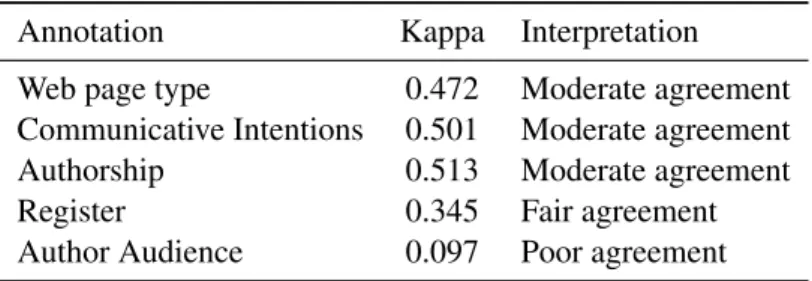
Table 2 synthesizes the IAA rates obtained by the end of the campaign. While the agreement is moderate or fair for most of the annotations, no sufficient interannotator agreement could be reached on the author audience characteristic. In consequence, this characteristic has not been an-notated in the final annotation process. It has to be noted that we do not obtain excellent agreement for the various annotations which gives an idea of the difficulty of the task.
3.3 Corpus characteristics
The webpage type, communicative intentions, au-thorship and language register features have been manually assigned to around 200 texts for seven languages (German, English, Spanish, French,
Feature Values
Webpage type academic article, news article, adverts, legal text, expert report, report, guides, FAQs entries, catalog, glossary entries, announcement, ency-clopedia entries, not text, blog entries, threads, homepages, reviews, warning, editorial, schedule, abstract, others
Communicative Intentions information, discussion, instruction, list of something, regulation, pro-motion, reporting, unknown
Authorship single author, multiple co-authors, corporate, unknown
Register formal, informal
Table 1: Document features and their values as they are annotated on the corpus.
Annotation Kappa Interpretation
Web page type 0.472 Moderate agreement
Communicative Intentions 0.501 Moderate agreement
Authorship 0.513 Moderate agreement
Register 0.345 Fair agreement
Author Audience 0.097 Poor agreement
Table 2: Inter-annotator agreement for the annotated features measured with the Kappa measure and their interpretation.
Language No. documents No. words
German 200 285 286 English 210 209 150 Spanish 214 226 458 French 200 504 114 Latvian 225 388 098 Russian 193 318 966 Chinese 210 NA 1 452 1 948 735
Table 3: Characteristics of the corpus.
Latvian, Russian and Chinese). These texts con-stitute our gold standard corpus.
Table 3 presents the main features of the corpus: the number of documents and the number of words for each language. This corpus is composed of al-most two million words in seven languages. The texts have all been converted into utf-8 for conve-nience. Every document is stored in the corpus as an HTML file, a text file and an XML file contain-ing the metadata and the annotations.
4 Corpus Analysis
After the corpus annotation task, we started to an-alyze the terminology that we extracted from the corpora. We observed a correlation between the kind of terminology and the communicative inten-tions.
The richest terminologies were found in the documents with informative, promotive and reg-ulative intentions, each one whith a specific type of terminology. Informative documents i.e. show a rich technical terminology: rotor bobin´e, circuit rotoriqueor even multiplicateur de type plan´etaire ´epicyclo¨ıdal for French, and vertical axis tur-bines, Horizontal Axis Wind Turbines (HAWT) or Diffuser-Augmented Wind Turbines (DAWT) for English.
The terminology of documents aiming at pro-motion make reference to products, such as named entities (name of products such as Prod-uct Model:BF-H-500), their constitutive element (glass fiber reinforced plastic) and their localiza-tions (parc ´eolien de Teterchen).
As expected, documents aiming at regulation embed a legal terminology with terms such as un-acceptable harm, bienes inmuebles, impactos am-bientalesand planeamiento urban´ıstico.
The documents with other communicative in-tentions show less numerous terms. Still, we found some terms in documents aiming at dis-cussion, namely documents discussing the pros and contras of the installation of wind generators : nuisances sonores (noise) or bruit m´ecanique (mecanical noise).
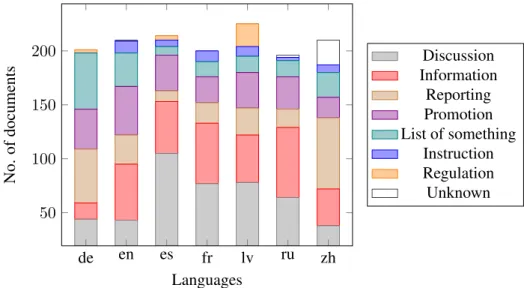
Unfortunately, the various communicative in-tentions are not equally present and reachable on the Web as shows the Figure 1 representing their distribution among our corpora. Hence, discus-sion, information, reporting, promotion and list of something are the principal communicative in-tentions found in the corpus while regulation is mostly invisible. Therefore communicative inten-tions may be interesting features to choose docu-ments relevant for terminology applications. They both allow the selection of documents with a rich terminology and enable to differentiate several kinds of terminology.
5 Classifying Web Documents Using Language Independent Features
We believe that the monolingual comparability of a corpus can be achieved by controling the domain and the communicative intention of the documents it is composed of. As we discussed in the previous section, it is possible to crawl documents belong-ing to the same domain. However, we do not have tools to predict the communicative intention of a document.
We face two main challenges to build a classifier for communicative intention in our context:
• we work with a relatively wide specialized domain with few resources and no scientific journals ;
• we must handle several distant languages with the same method and therefore are lim-ited to features without any linguistic anchor. 5.1 Proposition
We propose to use supervised learning to pre-dict the communicative intention of a document. Given the distant languages we deal with, we need a language independent method and therefore only use very shallow text features for the classifica-tion. Among the features experimented in the lit-terature, we selected the URL, the page layout, char ngrams and some other quantitative features. We represent the URL as a bag of words by splitting it in sequences using special characters
as delimiters (/, ., , #, &. . . ). The extracted se-quences are normalized using unicode. For each document we obtain a vector of booleans indicat-ing if any of the collected words is present in the URL of the document.
The page layout of the documents is constrained by the HTML tags. We compute the distribution, in terms of frequencies, of such tags. Preliminary experiments shown that it is preferable to only consider structuring tags (p, h1, ul, li. . . ).
We also use bags of character ngrams. Like for URL we build vectors of booleans indicating if the associated ngram is present in the document. The best discrimination is offered by ngrams com-posed of four characters.
Finally, we used quantitative features such as the size of the document, the number of words7 and their average size, the distribution of these words according to the unicode category of the characters they are composed of, the number and average size of sentences, . . .
5.2 Experiments and results
We experimented two supervised learning ap-proaches: a clustering one (k-Means) and a cat-egorization one (SVM).
Using k-Means, we want documents to form cluster for each communicative intention. There-fore we compute a centroid for each communica-tive intention, using training data. Then commu-nicative intention values are associated to docu-ments depending on the centroid they are the clos-est to.
On the other side, SVM (Support Vector Ma-chines) computes hyperplanes where the density of documents for each communicative intention is the highest while maximizing the margin between documents of different communicative intentions. Then communicative intention values are associ-ated to documents depending on the hyperplane they belong to.
We experimented both learning algorithms with our language independent features. It results that the choice of the method has virtually no impact on the result and therefore we only present the re-sults obtained with SVM in Table 4. A classifier is built for each language and evaluated with micro-precision, micro-recall and micro-f-score that is
7As we refuse the use of language specific tools, we
con-sider as a word a sequence of characters sharing the same unicode category.
de en es fr lv ru zh 50 100 150 200 Languages No. of documents Discussion Information Reporting Promotion List of something Instruction Regulation Unknown
Figure 1: Distribution of the communicative intentions in terms of number of documents for each lan-guage composing our corpus.
Language Precision Recall F1-score English 25,2 % 25,8 % 13,3 % French 39,8 % 39,8 % 24,9 % German 6,8 % 25,8 % 10,8 % Spanish 39,4 % 50,4 % 34,8 % Latvian 52,2 % 41,0 % 30,6 % Russian 32,2 % 33,4 % 20,8 % Chinese 47,5 % 36,4 % 24,1 % Table 4: Results obtained with SVM for each lan-guage.
the computation of these measures on the contin-gency table including all classes (all communica-tive intentions). As the various communicacommunica-tive intentions are not equaly distributed in the cor-pora, we run the evaluation with a 3-folds strati-fied cross-validation which preserve the same dis-tribution of the communicative intentions among the various folds.
All the results are low which may indicate that the communicative intention is not language inde-pendent. The variations of the results between the languages mainly reflects the distribution of the communicative intentions among the documents as well as the lack of homogeneity between each monolingual corpus.
6 Conclusion
For comparable corpora extracted from the Web using a crawler for terminology oriented appli-cations, it is important to categorize the
docu-ments with regards to terminology, named enti-ties. . . Communicative intentions may be interest-ing features as they may allow to differentiate lex-ical items. Hence, informative documents should contain specific domain terminology, documents with promotion intentions should contain brand names, and regulative documents the legal terms.
In order to classify documents according to their communicative intention, in this paper we run an experiment with language independent fea-tures that seem relevant to other categorization tasks such as webgenre or discourse type. To classify documents written in seven languages be-longing to five different families, we used features based on the URL, the page layout and charac-ters ngrams. The experiments showed that these language independent features are not sufficient to distinguish communicative intentions.
More sophisticated features, including deeper linguistic features, should be considered and would require linguistic preprocessing. The best results on web genres classification make use of part-of-speech tagging while for discourse clas-sifications very subtile features such as modality marks are used. Sharoff (2011) obtained better results in classifying English and Russian docu-ments according to their communicative intentions using deeper linguistic features.
Another consideration is that maybe our hy-pothesis that the classification should be placed between the crawl process and the terminology ex-traction is not valid after all. Terminology may be necessary to predict the communicative intention
and not the other way around.
Acknowledgments
The research leading to these results has received funding from the European Community’s Sev-enth Framework Programme (FP7/2007-2013) un-der Grant Agreement no◦248005.
We thank all the annotators (Ana Laguna, Maya Abboud, Somara Seng, Tatiana Gornostay, Iveta Keiˇsa and others) for the time they have spent on the construction of the corpus as well as J´erˆome Rocheteau for the development of the handy an-notation tool OUSIA8.
References
Marco Baroni and Silvia Bernardini, 2004. BootCaT:
Bootstrapping corpora and terms from the web, vol-ume 4.
Jebari Chaker and Ounelli Habib. 2007. Genre cat-egorization of web pages. In Seventh IEEE
In-ternational Conference on Data Mining Workshops
(ICDMW 2007), pages 455–464, Oct.
Soumen Chakrabarti, Martin Van den Berg, and Byron Dom. 1999. Focused crawling: a new approach to topic-specific Web resource discovery. Computer
Networks, 31(11-16):1623–1640.
Patrick Charaudeau. 1992. Grammaire du sens et de
l’expression. Hachette.
Guillaume Cleuziou and C´eline Poudat. 2008. Classi-fication de textes en domaines et en genres en com-binant morphosyntaxe et lexique. In Actes de TALN, number 1, pages 9–13. ATALA.
Kevin Crowston and Marie Williams. 2000. Re-produced and emergent genres of communication on the world-wide web. The Information Society, 16(3):201–216.
Cl´ement de Groc. 2011. Babouk - exploration ori-ent´ee du web pour la constitution de corpus et de terminologies. In 22es Journ´ees francophones
d’Ing´enierie des Connaissances (IC’2011), May. Inderjit S. Dhillon, Subramanyam Mallela, and Rahul
Kumar. 2003. A divisive information-theoretic feature clustering algorithm for text classifica-tion. Journal of Machine Learning Research, 3(7-8):1265–1287, Oct.
Lei Dong, Carolyn Watters, Jack Duffy, and Michael Shepherd, 2008. An Examination of Genre At-tributes for Web Page Classification, pages 133–143. IEEE Computer Society, Jan.
8http://code.google.com/p/
dublin-core-ousia/
Herv´e D´ejean and ´Eric Gaussier. 2002. Une nouvelle approche `a l’extraction de lexiques bilingues `a partir de corpus comparables. Lexicometrica, Alignement
lexical dans les corpus multilingues, pages 1–22. J.L. Fleiss et al. 1971. Measuring nominal scale
agree-ment among many raters. Psychological Bulletin, 76(5):378–382.
Lorraine Goeuriot, Natalia Grabar, and B´eatrice Daille. 2008. Characterization of scientific and popular sci-ence discourse in french, japanese and russian. In
Proceedings of the Sixth International Language
Re-sources and Evaluation (LREC 2008), number 1,
pages 2933–2937. European Language Resources Association (ELRA).
Guiyao Ke and Pierre Zweigenbaum, 2009.
Cat´egorisation automatique de pages web
chi-noises, pages 203–228. ARIA.
Brett Kessler, Geoffrey Nunberg, and Hinrich Sch¨utze. 1997. Automatic detection of text genre. In
Pro-ceedings of the 35th Annual Meeting of the Associa-tion for ComputaAssocia-tional Linguistics and 8th Confer-ence of the European Chapter of the Association for Computational Linguistics.
Jane E. Mason. 2009. An n-gram based approach to
the automatic classification of web pages by genre. Ph.D. thesis, Dalhousie University.
Sven Meyer-zu Eissen and Benno Stein. 2004. Genre classification of web pages. In S. Biundo, T. Fruh-wirth, and G.Editors Palm, editors, Advances in
Artificial Intelligence (KI 2004), pages 256–269.
Springer, Berlin Hedelberg New York.
Laura Monceaux, Christine Jacquin, and B´eatrice Daille. 2011. Guidelines for monolingual annota-tion.
Michela Montesi and Trilce Navarrete. 2008. Classify-ing web genres in context: A case study document-ing the web genres used by a software engineer. Inf.
Process. Manage., 44:1410–1430, July.
Yukie Nakao, Lorraine Goeuriot, and B´eatrice Daille. 2010. Multilingual modalities for specialized lan-guages. Terminology, 16(1):51–76, May.
C´eline Poudat and Guillaume Cleuziou. 2003. Genre and domain processing in an information retrieval perspective. In Proceedings of the 3rd
Inter-national Conference on Web Engineering (ICWE
2003), pages 399–402. Springer-Verlag Berlin
Hei-delberg.
Emmanuel Prochasson. 2010. Alignement multilingue en corpus comparables sp´ecialis´es.
Serge Sharoff, Bogdan Babych, and Anthony Hartley. 2007. “Irrefragable answers” using comparable cor-pora to retrieve translation equivalents. Language
Serge Sharoff. 2004. Analysing similarities and differ-ences between corpora. In Proceedings of the 7th
Conference of Language Technologies (Jezikovne Tehnologije), volume 83.
Serge Sharoff, 2011. Chapter 7 - In the Garden and in
the Jungle, volume 42. Springer Netherlands. Michael Shepherd, Carolyn Watters, and Alistair
Kennedy. 2004. Cybergenre : Automatic identifi-cation of home pages on the web. Journal of Web
Engineering, 3(3-4):236–251.
Ulli Waltinger, Alexander Mehler, and Armin Wegner. 2009. A two-level approach to web genre classifi-cation. In Joaquim Filipe and Jos´eEditors Cordeiro, editors, Proceedings of the 5th International
Confer-ence on Web Information Systems and Technologies