HAL Id: inria-00375277
https://hal.inria.fr/inria-00375277v2
Submitted on 21 Aug 2009
HAL is a multi-disciplinary open access
archive for the deposit and dissemination of
sci-entific research documents, whether they are
pub-lished or not. The documents may come from
teaching and research institutions in France or
abroad, or from public or private research centers.
L’archive ouverte pluridisciplinaire HAL, est
destinée au dépôt et à la diffusion de documents
scientifiques de niveau recherche, publiés ou non,
émanant des établissements d’enseignement et de
recherche français ou étrangers, des laboratoires
publics ou privés.
Distributed Processing of Continous Join Queries using
DHT Networks
Wenceslao Palma, Reza Akbarinia, Esther Pacitti, Patrick Valduriez
To cite this version:
Wenceslao Palma, Reza Akbarinia, Esther Pacitti, Patrick Valduriez. Distributed Processing of
Con-tinous Join Queries using DHT Networks. 2nd International Workshop on Data Management in
Peer-to-Peer Systems (DAMAP), Mar 2009, Saint-Petersbourg, Russia. pp.34-41. �inria-00375277v2�
Distributed Processing of Continuous Join Queries using
DHT Networks
Wenceslao Palma
INRIA and LINA University of Nantes, France
[email protected]
Reza Akbarinia
INRIA and LINA Nantes, France
[email protected]
Esther Pacitti
INRIA and LINA University of Nantes, France
[email protected]
Patrick Valduriez
INRIA and LINA Nantes, France
[email protected]
ABSTRACT
This paper addresses the problem of computing approxi-mate answers to continuous join queries. We present a new method, called DHTJoin, which combines hash-based place-ment of tuples in a Distributed Hash Table (DHT) and dis-semination of queries exploiting the trees formed by the un-derlying DHT links. DHTJoin distributes the query work-load across multiple DHT nodes and provides a mechanism that avoids indexing tuples that cannot contribute to join results. We provide a performance evaluation which shows that DHTJoin can achieve significant performance gains in terms of network traffic.
1.
INTRODUCTION
Recent years have witnessed major research interest in data stream management systems (DSMS), which can man-age continuous and unbounded sequences of data items. There are many applications that generate data streams including financial applications [7], network monitoring [24], telecom-munication data management [6], sensor networks [4], etc. Processing a query over a data stream involves running the query continuously over the data stream and generating a new answer each time a new data item arrives. However, the unbounded nature of data streams makes it impossible to store the data entirely in bounded memory. This makes difficult the processing of queries that need to compare each new arriving data with past ones. For example, real data traces of IP packets from an AT&T data source [11] show an average data rate of approximately 400 Mbits/sec, which makes it hard to keep pace for a DSMS. Moreover, a DSMS may have to process hundreds of user queries over multi-ple data sources. For most distributed streaming applica-tions, the naive solution of collecting all data at a single
site is simply not viable [8]. Therefore, we are interested in techniques for processing continuous queries over collec-tions of distributed data streams. This setting imposes high processing and memory requirements. However, approxi-mate answers are often sufficient when the goal of a query is to understand trends and making decisions about measure-ments or utilizations patterns. An example of such queries is join queries which are very important for many applica-tions. For example, consider a network monitoring appli-cation that needs to issue a join query over traffic traces from various links, in order to monitor the total traffic that passes through three routers (R1, R2 and R3) and has the
same destination host within the last 10 minutes. Data col-lected from the routers generate streams S1,S2and S3. The
content of each stream tuple contains a packet destination, the packet size and possibly other information. This query can be posed using a declarative language such as CQL [2], a relational query language for data streams, as follows:
q1: Select sum (S1.size)
From S1[range 10 min], S2[range 10 min], S3[range 10 min]
Where S1.dest=S2.dest and S2.dest=S3.dest
A common solution to the problem of processing join queries over data streams is to execute the query over a sliding window [12] that maintains a restricted number of recent data items. To improve performance and scalability, dis-tributed processing of data streams is a well accepted ap-proach [25][8]. However, even in a distributed setting high stream arrival rates and cost-intensive query operations may cause a DSMS to run out of resources. For example, when the memory allocated to maintain the state of a query is not sufficient to keep the window size entirely, the completeness, i.e., the fraction of results produced by an query operator over the total results (which could be produced under per-fect conditions) is reduced.
A major problem in the distributed processing of data streams is the occurrence of node failures. For example, consider the join query q1of the above example. A possible
query plan that consists of two join operations is (S1 ⊲⊳
S2) ⊲⊳ S3 where each join operation can be allocated to
two different nodes and streams tuples come from different nodes. If during the processing of the continuous query q1
the node that processes S3 fails, the node that processes
they produce join query results. Thus, if no matching tuple of S3appears in the node that processes (S1⊲⊳ S2) ⊲⊳ S3, the
resources involved in sending, processing and storing S1 ⊲⊳
S2 tuples are wasted and the results may be incomplete.
Furthermore, this produces unnecessary intermediate join results and reduces completeness of results due to the lack of matching tuples caused by the failure of a node.
In this paper, we address the problem of computing ap-proximate answers to windowed stream joins over data streams. We propose a method, called DHTJoin, which deals with ef-ficient processing of join queries over all data items which are stored in a DHT network. We provide an efficient process-ing of join queries, in terms of network traffic, by avoidprocess-ing the indexing of tuples that are not involved by the target continuous query and by addressing node failures that can produce unnecessary intermediate join results. We evalu-ated the performance of DHTJoin through simulation. The results show the effectiveness of our solution compared with previous work.
This paper is an extended version of [19] with the following added value. First, we present a dissemination system (Sec-tion 3.2) based on the trees formed by DHT links that uses O(n − 1) messages. This yields an important reduction of network traffic compared with the O(nlogn2 ) messages
gener-ated by the dissemination system proposed in our previous work. We also propose (Section 3.4) and validate (Section 5) an optimization that avoids the sending of unnecessary inter-mediate results, i.e. tuples that cannot contribute to join re-sults, when a node fails. For example, considering the query q1of the above example and the query plan (S1⊲⊳ S2) ⊲⊳ S3,
when the node that processes (S1⊲⊳ S2) ⊲⊳ S3 finds out that
cannot generate join results due to the lack of S3 matching
tuples, it sends a feedback message to node that processes S1⊲⊳ S2 which immediately suspends the sending of
unnec-essary intermediate results. Finally, we show analytically in Section 4 that DHTJoin can scale up the processing of con-tinuous join queries using multiple peers and improves the completeness of join results linearly as memory capacity is increased.
The rest of this paper is organized as follows. In Section 2, we introduce our system model and define the problem. In Section 3, we describe DHTJoin. In Section 4, we provide an analysis of result completeness of our algorithms which relates memory constraints, stream arrival rates and result completeness. In Section 5, we provide a performance eval-uation of our solution through simulation using Java. In Section 6, we discuss related work. Finally, Section 7 con-cludes.
2.
SYSTEM MODEL AND PROBLEM
DEF-INITION
In this section, we introduce a general system model for processing data streams over DHTs, with a DHT model and a stream processing model. Then, we state the problem.
2.1
DHT Model
In our system, the nodes of the overlay network are or-ganized using a DHT protocol. While there are significant implementation differences between DHTs [20] [23], they all map a given key k onto a node p using a hash function and can lookup p efficiently, usually in O(logn) routing hops where n is the number of nodes. DHTs typically provide two
basic operations : put(k, data) stores a key k and its asso-ciated data in the DHT using some hash function; get(k) retrieves the data associated with k in the DHT. Tuples are originated at certains nodes and continuous queries are orig-inated at any node of the network. Nodes insert data in the form of relational tuples and queries are represented in SQL. Tuples and queries are timestamped to represent the time that they are inserted in the network by some node. We assume that data and query sources are equipped with well-synchronized clocks by using the public domain Network Time Protocol (NTP) designed to work over packet-switched and variable latency data networks and already tested in a distributed DSMS as Borealis [25]. Each tuple has a unique key generated using the name of the node that inserts it, the name of the relation to which it belongs and its timestamp. Additionally, each query is associated with a unique key qid
used to identify it in query processing, optimization tasks and to relate it to the node that submitted it. We identify two types of queries depending on the attributes involved. If the join attribute is the same in all the relations of the query (e.g. query q1 of section 1) we say that it is a query
of type 1, otherwise we say that the query is of type 2, i.e. the join attributes are different.
2.2
Stream Processing Model
A data stream Si is a sequence of tuples ordered by an
increasing timestamp where i ∈ [1..m] and m ≥ 2 denotes the number of input streams. At each time unit, a num-ber of tuples of average size li arrives to stream Si. We
use λi to denote the average arrival rate of a stream Si in
terms of tuples per second. Many applications are inter-ested in making decisions over recently observed tuples of the streams. This is why we maintain each tuple only for a limited time. This leads to a sliding window S[Wi] over Si
that is defined as follows. Let Wi denotes the size of S[Wi]
in terms of seconds, i.e. the maximum time that a tuple is maintained in S[Wi]. Let T S(s) be a function that denotes
the arrival time of a tuple s and t be current time. Then S[Wi] is defined as S[Wi] = {s|s ∈ Si∧ (t − T S(s) ≤ Wi}.
Tuples continuously arrive at each instant and expire after Wi time steps (time units). Thus, the tuples under
consid-eration change over time as new tuples get added and old tuples get deleted. In practice, when arrival rates are high and the memory dedicated to the sliding window is limited, it becomes full rapidly and many tuples must be dropped before they naturally expire. In this case, we need to decide whether to admit or discard the arriving tuples and if ad-mitted, which of the existing tuples to discard. This kind of decision is made using a load shedding strategy [22][26] which yields that only a fraction of the complete result will be produced.
2.3
Problem Definition
In this paper, we address the problem of processing join queries over data streams. We view a data stream as a se-quence of tuples ordered by monotonically increasing times-tamps. The nodes are assumed to synchronize their clocks using the public domain Network Time Protocol (NTP), thus achieving accuracies within milliseconds [3]. Each tu-ple and query have a timestamp that may be either implicit, i.e. generated by the system at arrival time, or explicit, i.e. inserted by the source at creation time. Formally, the prob-lem can be defined as follows. Let S = {S1, S2, ...., Sm} be
a set of data streams, and Q = {Q1, Q2, ...., Qn} be a set of
join queries specified on these data streams. Our goal is to provide an efficient method to execute Q over S in a way that minimizes network traffic.
3.
DHTJOIN METHOD
In this section, we describe our solution, DHTJoin, for processing continuous join query processing using DHTs. The main issues for processing continuous queries in DHTs are the following: how to route data and queries to nodes in an efficient way; how to provide a data storage mechanism for storing relational data; and how to provide a good ap-proximate answer to join queries.
DHTJoin has two steps: indexing of tuples and dissemina-tion of queries. A tuple inserted by a node is indexed, i.e., stored at another node using DHT primitives and a query is disseminated using the embedded trees inherents to DHTs networks. However, a node indexes a tuple only if there is a query that contains an attribute of the arriving tuple in its where clause. To this end, a node stores locally a dissemi-nated query and once it receives a tuple it checks for already disseminated queries that contain an attribute of the arriv-ing tuple in its where clause.
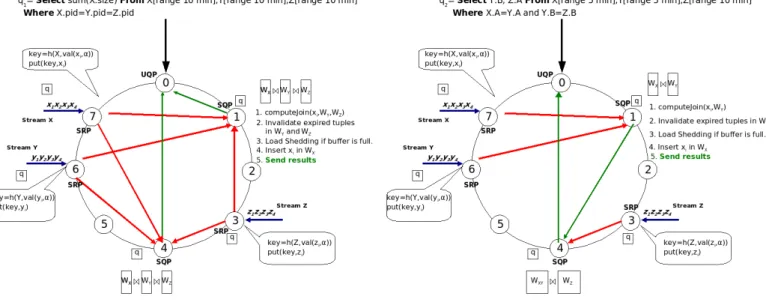
We describe the design of DHTJoin based on Chord which is a simple and very popular DHT. However, the techniques used here can be adaptable to others DHTs such as Pas-try [21] and TapesPas-try [28]. To process a query, we consider different kinds of nodes. The first kind is Stream Reception Peers (SRP) for indexing tuples to the second kind of nodes, the Stream Query Peers (SQP). In Figure 1(b), nodes 3, 6 and 7 correspond to SRP because they receive tuples belong-ing to streams z, y, and x respectively. SQP are responsible for executing query predicates over the arriving tuples using their local sliding windows, and sending the results to the third kind of node(s), the User Query Peers (UQP). In Fig-ure 1(b), nodes 1 and 4 are SQP because node 1 computes the join predicate X.A = Y.A of query q2 (submitted at
node 0) and node 4 performs the join predicate Y.B = Z.B of q2. In addition, node 0 is a UQP because query q2 was
submitted at this node.
To support dissemination of queries, a node must be a dis-semination node (i.e. executes a disdis-semination protocol) while to index tuples, a node must be a DHT peer. Note that the difference between SRP, SQP and UQP is functional and the same node can support all these functionalities.
3.1
Indexing tuples
Let us describe our DHTJoin method for streams S = {S1, S2, ...., Sm}. Let si be a tuple belonging to Si. Let A
be the set of attributes in si and val(si, α) be a function
that returns the value of an attribute α ∈ A in tuple si.
Let h be a uniform hash function that hashes Si’s name
and val(si, α) into a DHT key, i.e. a number which can be
mapped to a node id. Let S[Wi] denote a sliding window on
stream Si. Recall that we use time-based sliding windows
where Wiis the size of the window in time units. At time t,
a tuple belongs to S[Wi] if it has arrived in the time interval
[t − Wi, t].
For indexing a tuple sithat arrives at a SRP, each tuple
ob-tains an index key computed as key = h(Si, val(si, α)). The
attribute α in si is chosen by searching locally for queries
that contains α in its where clause. Then si is indexed to
a SQP, by performing put(key, si). Thus, tuples of different
streams having the same key are put in the same SQP node and are stored in sliding windows where they are processed to produce the result of a specific join predicate.
3.2
Disseminating queries
Query dissemination is important to distribute query load so that many DHT nodes may participate in query process-ing tasks or optimization decisions. A query can originate at any of the nodes and is disseminated using a tree [5]. To disseminate a query, DHTJoin dynamically builds a dissem-ination tree as proposed in [9]. The root of the tree is the node that submits the query (an UQP node). The query is disseminated from the root node to all nodes of the DHT using a divide-and-conquer approach. A dissemination mes-sage contains qidand a range of dissemination. For example,
using a fully-populated Chord ring with 8 nodes, each one contains a routing table of log(n) entries called fingers. The ithentry in the table at node n contains the identity of the first node that succeeds or equal n + 2i. A dissemination
message initiated at node 0 is sent to finger nodes 1, 2 and 4 (see Figure 2) giving them the disseminations limits [1,2), [2,4) and [4,0) respectively. The disseminations limits are used to restrict the forwarding space of a node and they are constructed using as a upper bound the finger i + 1. Each node applies the same principle reducing the search scope. When node 2 receives the dissemination message with limits [2,4) it examines the routing table and sends the message to node 3. Once node 4 receives the dissemination message it examines the routing table and sends the message to nodes 5 and 6 with limits [5 ,6) and [6,0) respectively. In the same way, node 5 does not continues with the dissemination pro-cess (since there are no nodes between [5,6)) and node 6 disseminates the message to node 7. This forwarding pro-cess assures a network coverage of 100%, generates n − 1 messages and a tree of depth log(n), which fixes the latency of query dissemination.
3.2.1
Adaptability to other DHTs
The design of DHTJoin is based on Chord which is a sim-ple and very popular DHT. However, the dissemination tech-nique used can be adapted to others DHTs such as Pastry [21] and Tapestry [28]. Recall that the basic idea in the dis-semination of queries (using Chord) is to consider a lookup operation as a binary search in spite of its ring geometry. In the case of Pastry and Tapestry are both extended versions of PRR trees that support dynamic node membership. We here take Pastry as an example and demonstrate how to apply the dissemination of queries into Pastry using the mechanism proposed in [5]. Assuming a network of size n each Pastry node maintains a routing table of log2bn rows with 2b entries each. For the purposes of routing the
iden-tifier of a node and keys can be thought of as a sequence of L digits in base 2b. The mechanism to route a message is
prefix-based, i.e. the routing is achieved by forwarding the message to a node that shares a common prefix by at least one more digit. Pastry can route a message to any node in log2bnhops. For easy of explanation we use b = 1, L = 3 and a network of 8 nodes. A dissemination message initiated a node 000 contains the query id qidand the message is sent
to the 3 nodes of its routing table 100, 010 and 001 adding the routing table row r of each node. When a node receives a dissemination message it searches in the routing table all the nodes located in rows greater than r (if any) and
dissem-(a) A join example of query type 1 (b) A join example of query type 2 Figure 1: Query Processing in DHTJoin
Figure 2: A dissemination tree formed using DHT links of a 8-node Chord ring
inates them the message. This process is repeated at each node receiving the message generating a dissemination tree of depth log(n).
3.3
Example of DHTJoin query processing
Let us illustrate how DHTJoin performs query processing using the following query of type 2:
q2: Select Y.B, Z.A
From X[range 5 min], Y[range 5 min], Z[range 5 min] Where X.A=Y.A and Y.B=Z.B
This query specifies an equijoin among X, Y and Z streams over the last 5 minutes. The query q2is submitted at node 0
and disseminated over the entire network as soon as it is sub-mitted. Thus, after a while, all nodes will know the existence of this query and be able to index the incoming streams (tu-ples). Once an X-, Y - or Z-tuple arrives at nodes 7, 6 and 3 respectively, each node checks locally whether the query q2contains in its where clause an attribute α of the arriving
tuple (see Figure 1(b)). If yes, nodes 7, 6 and 3 execute the task of a SRP. For instance, in our example, node 7 indexes xi by performing two operations: key = h(X, val(xi, α))
and straight afterwards put(key, xi). A join predicate with
respect to q2is evaluated at a SQP (node 1) only with tuples
that arrive in the system after the query.
DHTJoin manages the sliding windows at each SQP node as follows. Upon each indexed tuple arrival at a SQP node, tuples that have expired are invalidated from the sliding win-dow of a SQP. For example, at node 1 in Figure 1(b), tuples expired in S[WY] are invalidated on the arrival of X-tuples.
The load shedding procedure is executed over S[WX]’s buffer
if there is not enough memory space to insert the arriving tuple. In our example, the intermediate results produced by SQP node 1 are sent to SQP 4 using the value of B attribute belonging to the Y-tuple using key = h(Y, val(yi, B)) and
straight afterwards put(key, {xi, yj}). The join result tuples
produced by SQP node 4 are immediately sent to the appro-priate UQP node (whose address is provided when starting query dissemination).
For queries of type 1 (see Figure 1(a)), we apply the same method. However, as the join attribute is the same in all the relations of query q1, all the tuples having the same
at-tribute value and the join operators are located in the same node without producing intermediate results. In our exam-ple nodes 7,6 and 3 indexes xi, yiand zituples in SQP nodes
1 and 4 depending of the join attribute value. The results produced by SQP nodes 1 and 4 are sent to the UQP node.
3.4
Optimization
DHTJoin distributes the query workload across multiple DHT nodes and provides a mechanism that avoids indexing tuples using attributes not contained in the where clause of a query. However, when a source of data streams interrupts its operation, an SQP node can generate partial results ir-respective of whether they produce join query results. In this section, we address the problem of indexing tuples that never contribute to generate join results.
Let us consider a query of type 2 where there are nodes con-nected by a producer-consumer relationship, whereby a
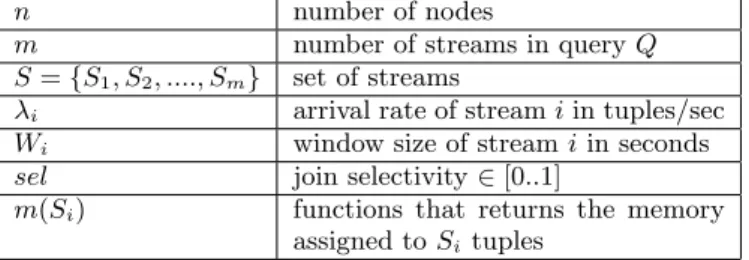
pro-Table 1: Variables and functions used in our analysis n number of nodes
m number of streams in query Q S= {S1, S2, ...., Sm} set of streams
λi arrival rate of stream i in tuples/sec
Wi window size of stream i in seconds
sel join selectivity ∈ [0..1]
m(Si) functions that returns the memory
assigned to Si tuples
ducer node generates tuples to be processed by a consumer node [27]. For example, in query q2 (see Figure 1(b)), node
1 is the producer of join tuples between X and Y (X ⊲⊳ Y ) that node 4 joins with Z-tuples. If the Z source (see node 3 in Figure 1(b)) leaves the DHT, the indexing of Z-tuples is stopped, thus yielding no join results because of no match-ing tuples in node 4. Furthermore, if no matchmatch-ing tuples of Zappears in node 4 before expiration of X ⊲⊳ Y tuples, the resources involved in sending, processing and storing these tuples are wasted.
Motivated by the above situation, we propose the following optimization. Once a node (e.g. node 4) detects that it is not possible to generate join results, due to the absence of matching tuples of Z, it sends a message to node 1 alerting that is not necessary send tuples. This tuple stays stored at node 1 as long as it fits in the window size. Once the communication with the source of Z-tuples is reestablished, node 4 sends a message to node 1 alerting that the tuples can be sent. In this way, during the period that node 4 does not receive Z-tuples, some tuples stored in node 1 are deleted due to window constraints, thus avoiding to send tuples that never contribute to generate join results.
By eliminating unnecessary intermediate results, this opti-mization yields an important reduction of network traffic and a better utilization of local resources. In sensor net-works where the nodes are generally powered by batteries and power preservation is a major objective, this optimiza-tion is particularly useful as reducing network traffic yields reduced power consumption.
4.
ANALYSIS OF RESULT COMPLETENESS
The notion of result completeness is important in dis-tributed and P2P databases since partial (incomplete) query answers are often only possible[18][16]. Result completeness is thus defined as the fraction of results actually produced over the total results (which could be produced under per-fect conditions). In data streaming applications,the poten-tial high arrival rates of streams impose high processsing and memory requirements. However, approximate answers are often sufficient when the goal of a query is to under-stand trends and making decisions about measurement or utilization patterns. Query approximation can be done by limiting the size of states maintained for queries [15]. In our analysis we focus in the case where the memory allocated to maintain the state of a query is not sufficient to keep the window size entirely, thus reducing the received join re-sults and completeness. DHTJoin provides more memory to store tuples, but we consider that determining the number of computing resources necessaries to achieve a certain degree of completeness for a given query is an important aspect in the setup phase of DHTJoin.
In this section, we propose formulas which relate peer mem-ory constraints, stream arrival rates, and result complete-ness. We will use these formulas in our performance evalu-ation and they could be useful to a DHTJoin user (e.g. an application developer) to define and tune a DHT network for specific application requirements. We provide the neces-sary equations to calculate the completeness in a 2-way join and afterwards we generalize our results for a m-way join. For ease of analysis, we make simplifying assumptions: the tuples are uniformly distributed across the DHT network; the memory assigned to store tuples is the same at each peer; we use the average rate to characterize the rate of arrivals of incoming tuples and stream tuples arrive in monotonically increasing order of their timestamps. We use the notations specified in Table 1. In order to illustrate our analysis, let us consider the following join query over two streams S1and
S2:
Q: Select *
from S1[range 5 min], S2[range 5 min]
where S1.x= S2.x
The expected tuple arrival rate of streams S1and S2at each
node of the DHT is λ1 n and
λ2
n respectively. Thus, the
ex-pected number of join tuples generated by S1⊲⊳ S2 per unit
time at each node can be estimated as T(S1, S2) = sel × (
W1λ1
n ) × ( W2λ2
n ) (1) Each node needs a memory space for storing tuples in its local sliding window equivalent to W1λ1
n and W2λ2
n . In
general, if (Wiλi
n > m(Si)) we have a loss rate (Lr) to store
tuples equivalent to: Lr(Si) = ( 0, Wiλi n ≤ m(Si) Wiλi n − m(Si), otherwise (2) Assuming that memory is insufficient to retain all the tu-ples in W1 and W2, the loss of join tuples L of S1 and S2
is: L(S1) = sel × Lr(S1) × ( W2λ2 n ) (3) L(S2) = sel × Lr(S2) × ( W1λ1 n ) (4) Let αibe the Si-tuples stored in the memory space m(Si)
and βibe the Si-tuples not stored due to memory constraints
(see Figure 3). We can rewrite equations (3) and (4) as:
L(S1) = sel×β1×(α2+β2) = (sel×α2×β1)+(sel×β1×β2)
L(S2) = sel×β2×(α1+β1) = (sel×α1×β2)+(sel×β1×β2)
Notice that the tuples related to expression (sel × β1× β2)
are counted in both L(S1) and L(S2). This expression can
be rewritten as: (sel × Lr(S1) × Lr(S2)). The total loss of
join tuples T L of S1⊲⊳ S2is the sum of the loss of join tuples
L(S1) and L(S2) minus the tuples counted twice:
T L(S1, S2) = L(S1) + L(S2) − (sel × Lr(S1) × Lr(S2)) (5)
The completeness C of a S1⊲⊳ S2join query is the fraction
of total results T (S1, S2) minus the loss of tuples T L(S1, S2)
and total results T (S1, S2), using equation (1) and equation
(5) C is:
C= T(S1, S2) − T L(S1, S2) T(S1, S2)
Figure 3: A join state including stored and non stored tuples
Developing expressions in (6) allows us to simplify C to: C= n
2
× m(S1) × m(S2)
W1λ1× W2λ2
(7) Moreover, we can write (7) as:
n= s
C× (W1λ1) × (W2λ2)
m(S1) × m(S2)
(8) This equation allows us to evaluate how many peers are necessary to evaluate a 2-way join query.
Now we generalize our analysis to m-way joins as following. Recall that the total loss of join tuples T L is the sum of the loss of join tuples minus the tuples counted more than one time. The sum of the loss of join tuples can be easily extended to an m-way join as Pm
i=1L(Si). However, the
expression that represents the tuples counted more than one time is more difficult to generalize. We use the same method of rewriting (3) and (4) to find the expression that represents the case of tuples counted more than one time. Thus in a S1 ⊲⊳ S2 ⊲⊳ S3 join we rewrite L(S1),L(S2) and L(S3),
discovering that (sel2
× β1× β2× α3), (sel 2
× β1× β3× α2)
and (sel2
× β2× β3× α1) are counted twice and (sel 2
× β1×
β2× β3) is counted triple. Rewriting αiand βiwe arrive at
the following expression: sel2 Lr(S1)Lr(S2)m(S3) + sel 2 Lr(S1)Lr(S3)m(S2)+ sel2 Lr(S2)Lr(S3)m(S1) + 2sel 2 Lr(S1)Lr(S2)Lr(S3).
Repeating the same method with m-way joins (m ≥ 4) and analyzing the resulting expressions, we arrive at the follow-ing general expression for a S1⊲⊳ S2⊲⊳ .... ⊲⊳ Smjoin:
m X k=2 X S′⊆S |S′|=k X S′′⊆S |S′′|=m−k S′′∩S′=∅ (selm−1(k − 1) Y a∈S′ Lr(a) Y b∈S′′ m(b))
Now, the general case of (5) can be expressed as:
T L(S1, S2, ...., Sm) = m X i=1 L(Si)− m X k=2 X S′⊆S |S′|=k X S′′⊆S |S′′|=m−k S′′∩S′=∅ (selm−1(k − 1) Y a∈S′ Lr(a) Y b∈S′′ m(b)) (9)
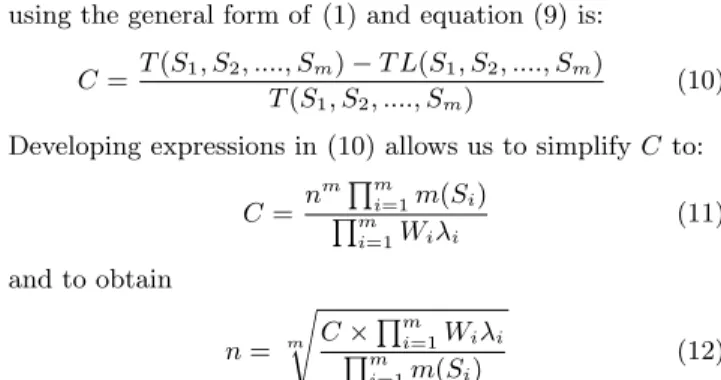
The completeness C of a S1⊲⊳ S2⊲⊳ .... ⊲⊳ Smjoin query,
using the general form of (1) and equation (9) is: C=T(S1, S2, ...., Sm) − T L(S1, S2, ...., Sm)
T(S1, S2, ...., Sm)
(10) Developing expressions in (10) allows us to simplify C to:
C= n mQm i=1m(Si) Qm i=1Wiλi (11) and to obtain n= m s C×Qm i=1Wiλi Qm i=1m(Si) (12) It is clear from our analysis that (11) is independent of selectivity which is reasonable in the context of continuous join queries.
As our analysis shows, DHTJoin can scale up the processing of continuous join queries using multiple peers and improve the completeness of join results. Using (12) a DHTJoin user can adjust the size of the network by evaluating how many peers are necessary to process a continuous join query for given stream arrival rates and a desired result completeness.
5.
PERFORMANCE EVALUATION
To test our DHTJoin method, we built a Java-based sim-ulator. Our simulator is based on Chord which is a simple and efficient DHT. We generate arbitrary input data streams consisting of synthetic asynchronous data items with no tuple-level semantics. We have a schema of 4 relations, each one with 10 attributes. In order to create a new tuple we choose a relation and assign values to all its attributes using a Zipf distribution with a default parameter of 0.9. The max value of the domain of the join attribute is fixed to 1000. Tuples on streams are generated at a constant rate of 30 tuples per second. Queries are generated with a mean arrival rate of 0.02, i.e., a query arrives to the system every 50 seconds on average. The network size is set to 1024 nodes. In all ex-periments, we use time-based sliding windows of 50 seconds and the method of dissemination of queries proposed in Sec-tion 3. For each of our tests, we run the simulator for 300 seconds. In order to assess our approach, we compare the network traffic of DHTJoin against a complete implementa-tion of RJoin [14] which is the most relevant related work (see Section 6). RJoin uses incremental evaluation based on tuple indexing and query rewriting over distributed hash tables. The network traffic is the total number of messages needed to index tuples and disseminate a query in DHTJoin or to index tuples and perform query rewriting in RJoin. In the rest of this section, we evaluate network traffic and the effectiveness of optimization proposed in Section 3.
5.1
Network traffic
In this section, we investigate the effect of tuples’ arrival rate, query’s arrival rate and number of joins on the net-work traffic. The netnet-work traffic of RJoin and DHTJoin grows as the tuples’ arrival rate grows. In RJoin, as more tuples arrive, the number of messages related to the index-ing of tuples and query rewritindex-ing increases (see Figure 4(a)). As expected, DHTJoin generates significantly less messages because a high tuples’ arrival rate does not mean more in-dexing of tuples. The reason is that before inin-dexing a tuple, DHTJoin checks for the existence of a query that requires
0 200 400 600 800 1000 1200 1400 30 40 50 60 30 40 50 60 Number of Messages (x1000)
Tuple Arrival Rate
DHTJoinIndex DHTJoinDiss RJoinIndex RJoinQRewriting RJoin DHTJoin
(a) Effect of tuple arrival rate
0 200 400 600 800 1000 0.02 0.04 0.06 0.08 0.02 0.04 0.06 0.08 Number of Messages (x1000)
Query Arrival Rate
DHTJoinIndex DHTJoinDiss RJoinIndex RJoinQRewriting RJoin DHTJoin
(b) Effect of query arrival rate
0 200 400 600 800 1000
2Way 3Way 4Way 2Way 3Way 4Way
Number of Messages (x1000) Number of Joins DHTJoinIndex DHTJoinDiss RJoinIndex RJoinQRewriting RJoin DHTJoin
(c) Effect of number of joins Figure 4: Effect of tuple/query arrival rates and number of joins on network traffic
0 50 100 150 200 250 300 300 400 500 600 Number of Messages (x1000)
Tuple Arrival Rate
DHTJoin+OPT DHTJoin
(a) Effect of tuple arrival rate
0 50 100 150 200 250 300 50 100 150 200 Number of Messages (x1000)
Length of Inactivity in secs
DHTJoin+OPT DHTJoin
(b) Effect of duration of inactivity Figure 5: Reduction of intermediate results and its impact on network traffic
it. In Figure 4(b), we show that, as more queries arrive, RJoin generates the same number of messages when index-ing tuples. However, more query rewritindex-ing messages are generated when more queries arrive. DHTJoin generates more messages because new queries related to new different values used in the tuples arrive in the system. The number of messages generated by the query dissemination increases but this increase is lower to that of the query rewriting mes-sages generated by RJoin. Figure 4(c) shows that more join require more network traffic. RJoin generates more query rewriting when there are more joins in the queries. However, in DHTJoin the network traffic increases only if the arriv-ing queries require of attributes not present in the already disseminated queries. The reason is that with the dissemina-tion of queries, DHTJoin can avoid the unnecessary indexing of tuples that are not required by the queries.
In summary, due to the integration of query dissemination and hash-based placement of tuples our approach avoids the excessive traffic generated by RJoin which is due to its method of indexing tuples.
5.2
Dealing with stream source failures
In this section, we investigate the effect of optimization proposed in Section 3 in order to reduce the traffic the tuples that never contribute to generate join results due to stream source failures. In this experiment we replicate the same scenario of Figure 1(b) with λi= 400tuples/sec. In Figure
5(a), we show that, as more tuples arrive and considering that the source of Z-tuples leaves the DHT, the proposed optimization reduces the network traffic considerably. In
Figure 5(b), we show that, as more long is the period of inactivity (time between leave and join) of a stream source, the generation of tuples that never contribute to generate join results increases. However, by eliminating unnecessary intermediate results, this optimization yields an important reduction of network traffic.
6.
RELATED WORK
A DHT can serve as the hash table that underlies many parallel hash-based join algorithms. However, our approach provides Internet-wide scalability. Our work is related to many studies in the field of centralized and distributed con-tinuous query processing [13][10][26][6][17]. In PIER [13], a query processor is used on top of a DHT to process one-time join queries. Recent work on PIER has been developed to process only continuous aggregation queries. PeerCQ [10] was developed to process continuous queries on top of a DHT, However, PeerCQ does not consider SQL queries and the data is not stored in the DHT. Borealis [26], Tele-graphCQ [6] and DCAPE [17] have been developed to pro-cess continuous queries in a cluster setting and many of their techniques for load-shedding and load balancing are orthog-onal to our work. The most relevant previous work regard-ing the utilization of a DHT network is [14] which proposes RJoin. In RJoin, a new tuple is indexed twice for each at-tribute it has; wrt the atat-tribute name and wrt the atat-tribute value. A query is indexed waiting for matching tuples. Each arriving tuple that is a match causes the query to be rewrit-ten and reindexed at a different node. This incremental evaluation is based on tuple indexing and query rewriting
over distributed hash tables. A major difference in our work differs is that DHTJoin avoids indexing tuples that cannot contribute to generate join results.
A solution to estimate the completeness has been proposed in [16]. Completeness is calculated on a peer level using the notion of routing graphs. The routing graphs trace the routes that a one time query and its sub-queries take through the network. Our work instead considers continuous queries and completeness is calculated on a data level.
7.
CONCLUSION
In this paper, we proposed a new method, called DHTJoin, for processing continuous join queries using DHTs. DHTJoin combines hash-based placement of tuples and dissemination of queries using the trees formed by the underlying DHT links. DHTJoin takes advantage of the indexing power of DHT protocols and dissemination of queries to avoid the in-dexing of tuples that cannot contribute to generate join re-sults. We show analytically that DHTJoin can scale up the processing of continuous join queries using multiple peers and improves the completeness of join results significantly. To validate our contribution, we implemented DHTJoin as well as RJoin which is the most relevant state of the art so-lution in the context of processing continuous join queries. Our performance evaluation shows that DHTJoin yields sig-nificant performance gains due to the mechanism of indexing tuples and the elimination of unnecessary intermediate re-sults. Our results also demonstrate that the total number of messages of DHTJoin is always less than that of RJoin wrt tuple arrival rate, query arrival rate and number of joins. As future work, we plan to address the problem of effi-cient execution of top-k join queries over data streams using DHTs, taking advantage of the best position algorithms [1] which can be used in many distributed and P2P systems for efficient processing of top-k queries.
8.
REFERENCES
[1] R. Akbarinia, E. Pacitti, and P. Valduriez. Best position algorithms for top-k queries. In VLDB, pages 495–506, 2007.
[2] A. Arasu and J. Widom. A denotational semantics for continuous queries over streams and relations. SIGMOD Record, 33(3):6–12, 2004.
[3] M. Bawa, A. Gionis, H. Garcia-Molina, and R. Motwani. The price of validity in dynamic networks. In SIGMOD Conference, pages 515–526, 2004.
[4] P. Bonnet, J. Gehrke, and P. Seshadri. Towards sensor database systems. In Mobile Data Management, pages 3–14, 2001.
[5] M. Castro et al. An evaluation of scalable
application-level multicast built using peer-to-peer overlays. In INFOCOM, 2003.
[6] S. Chandrasekaran et al. Telegraphcq: Continuous dataflow processing for an uncertain world. In CIDR, 2003.
[7] J. Chen, D. J. DeWitt, F. Tian, and Y. Wang. Niagaracq: A scalable continuous query system for internet databases. In SIGMOD Conference, pages 379–390, 2000.
[8] G. Cormode and M. N. Garofalakis. Streaming in a connected world: querying and tracking distributed
data streams. In SIGMOD Conference, pages 1178–1181, 2007.
[9] S. El-Ansary, L. O. Alima, P. Brand, and S. Haridi. Efficient broadcast in structured p2p networks. In IPTPS, pages 304–314, 2003.
[10] B. Gedik and L. Liu. Peercq: A decentralized and self-configuring peer-to-peer information monitoring system. In ICDCS, pages 490–499, 2003.
[11] L. Golab et al. Optimizing away joins on data streams. In SSPS, pages 48–57, 2008.
[12] L. Golab and M. T. ¨Ozsu. Processing sliding window multi-joins in continuous queries over data streams. In VLDB, pages 500–511, 2003.
[13] R. Huebsch et al. Querying the internet with pier. In VLDB, pages 321–332, 2003.
[14] S. Idreos, E. Liarou, and M. Koubarakis. Continuous multi-way joins over distributed hash tables. In EDBT, pages 594–605, 2008.
[15] J. Kang, J. F. Naughton, and S. Viglas. Evaluating window joins over unbounded streams. In ICDE, pages 341–352, 2003.
[16] M. Karnstedt et al. Estimating the number of answers with guarantees for structured queries in p2p
databases. In CIKM, pages 1407–1408, 2008. [17] B. Liu et al. A dynamically adaptive distributed
system for processing complex continuous queries. In VLDB, pages 1338–1341, 2005.
[18] F. Naumann, J. C. Freytag, and U. Leser.
Completeness of integrated information sources. Inf. Syst., 29(7):583–615, 2004.
[19] W. Palma, R. Akbarinia, E. Pacitti, and P. Valduriez. Efficient processing of continuous join queries using distributed hash tables. In Euro-Par, pages 632–641, 2008.
[20] S. Ratnasamy et al. A scalable content-addressable network. In SIGCOMM, pages 161–172, 2001. [21] A. I. T. Rowstron and P. Druschel. Pastry: Scalable,
decentralized object location, and routing for
large-scale peer-to-peer systems. In Middleware, pages 329–350, 2001.
[22] U. Srivastava and J. Widom. Memory-limited execution of windowed stream joins. In VLDB, pages 324–335, 2004.
[23] I. Stoica et al. Chord: A scalable peer-to-peer lookup service for internet applications. In SIGCOMM, pages 149–160, 2001.
[24] M. Sullivan. Tribeca: A stream database manager for network traffic analysis. In VLDB, page 594, 1996. [25] N. Tatbul, U. ¸Cetintemel, and S. B. Zdonik. Staying
fit: Efficient load shedding techniques for distributed stream processing. In VLDB, pages 159–170, 2007. [26] N. Tatbul and S. B. Zdonik. Window-aware load
shedding for aggregation queries over data streams. In VLDB, pages 799–810, 2006.
[27] Y. Yang and D. Papadias. Just-in-time processing of continuous queries. In ICDE, pages 1150–1159, 2008. [28] B. Y. Zhao et al. Tapestry: a resilient global-scale
overlay for service deployment. IEEE Journal on Selected Areas in Communications, 22(1):41–53, 2004.