GEOLOGICA BELGICA (2011) 14 1/2: 103-106
SHORT NOTE
SYNTHETIC ILMENITE AS A BLANK TO XRF TRACE ELEMENT
DETERMINATION
Jean-Clair DUCHESNE & Guy BOLOGNE
(1 figure, 1 table)
Department of Geology, University of Liège, B20, 4000 Sart Tilman, Belgium
ABSTRACT. This note describes a convenient method to synthesize a blank ilmenite through the evacuated silica-glass tube technique. The lower limit of detection of the V and Cr determinations are 21 ppm and 9 ppm, respectively.
KEYWORDS: ilmenite, XRF trace element analysis, Vanadium, Chromium, evacuated silica-glass tube.
1. Introduction
A major issue in XRF determination is the control of the mineralogical effect in matrix correction. The interelement absorption and enhancement on a line intensity are not the same when a natural sample is compared to a compositionally identical mixture of oxides. In a previous study on the XRF determination of Fe-Ti oxide minerals (Duchesne & Bologne, 2009), we stressed the need of having a blank sample in order to determine concentrations of trace elements close to their detection limits. This is crucial for V and Cr determinations in ilmenite, these elements being particularly sensitive to petrogenetic processes (Duchesne et al., 2007; Charlier et al., 2007; Charlier et al., 2008; Charlier et al., 2010). We report here the method we have used to synthesize a spectrochemically pure stoechiometric ilmenite and the lower limit of detection we have obtained in the XRF analysis of V and Cr in this blank ilmenite.
2. Experimental
Starting from “specpure” pure products, we mix them in the adequate proportions to obtain an ilmenite FeTiO3 composition. We then use a technique known as “evacuated silica-glass tube experiment” in which the mixture is cooked at high temperature in vacuum to synthesize the mineral.
2.1. Chemicals
We have used the following products: (a) Iron oxide (Fe2O3) Matthey “specpure” from Johnson, Matthey & Co; (b) Titanium oxide (TiO2) Matthey “specpure” (J.M. 435) from Johnson, Matthey & Co; (c) Iron powder, -22 mesh, Puratronic 99.998% (010621) from Alfa Aesar GmbH & Co KG.
From the equation Fe + Fe2O3 + 3TiO2 = 3FeTiO3, the calculated proportions are for 10 gr of ilmenite: 1.227 gr
Fe + 3.508 gr Fe2O3 + 5.265 gr TiO2. The oxygen content of the initial mix is directly controlled preventing unwanted reduction or oxidation.
2.2. Operating mode
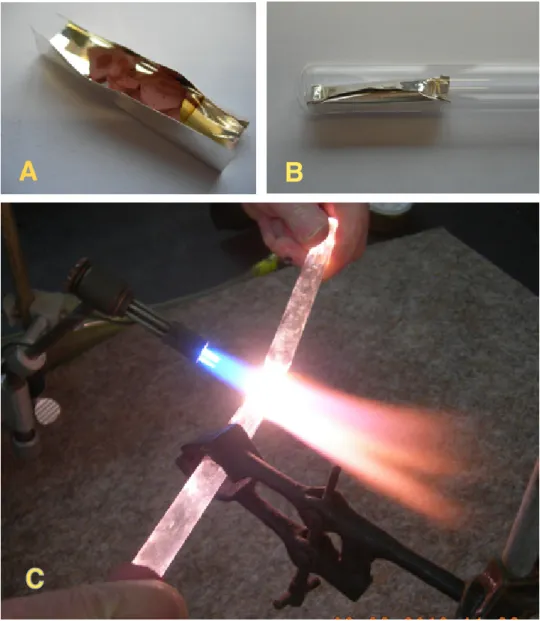
The mixture is crushed and mixed with an agate-and-pestle mortar for 10 min. An aliquot of 1.5 gr is then pressed at 4 tcm-2 to compact the powder as much as possible so that more grains of the starting powder touch each others, helping reaction. The pressed pellet fragments are wrapped in an Ag foil (0.1 mm-thick) (Fig. 1A). The small parcel is then placed into a quartz tube (10 mm in internal diameter, 13 mm external diameter, ca. 30 cm-long)(Fig. 1B). The Ag foil (melting T = 964°C) is necessary to keep the oxides from reacting with the glass tube. The tube is connected to a vacuum pump with a flexible tubing and dried in a furnace at 450°C under vacuum for 20 minutes. It is important to remove any adsorbed moisture that could flash into steam later in the process and could break the tube. The quartz tube (still connected to the vacuum pump) is then heated at about half its length with a propane-oxygen burner (Fig. 1C). It is slowly turned in front of the flame and when sufficiently softened, it is stretched and twisted in order to seal it. The vial is then heated in a furnace at 930°C for 200 hours. The final product was analysed by XRD and turned out to be pure ilmenite, no remaining traces of iron metal, hematite of rutile being identified. The ilmenite powder is then mixed with a few drops of Elvacite dissolved in toluene and pressed to make a 20 mm-diameter pellet as described in Duchesne & Bologne (2009).
2.3. XRF analysis
Three different batches were prepared and analysed following the method of Duchesne & Bologne (2009). The operating conditions for the trace elements are given in Table 1. We have slightly modified the value of the V
104 J.C. DuChesne & G. BoloGne
background measuring angle from 124.82° (Table 1 in Duchesne & Bologne, 2009) to 124.92°. This small change permits to solve a problem mentioned by these authors, that is the possible occurrence of negative peak-background intensities on samples of low V concentrations.
2.4. Detection limits
The 3 samples were analysed 19 times each. The averaged peak intensity values for V and Cr are 942 ± 2.8 cts/s and 43 ± 0.5 cts/s, respectively. For a counting time of 150 s, the observed standard deviations are close to the theoretical values (s= N, with N the total counts), which are 2.5 cts/s for V and 0.5 cts/s for Cr. For V, the results show small but systematic differences of ca. 1.5% for the peak and background intensities between the three blank samples, possibly due to differences in crystallinity of the synthetized ilmenite samples. These differences disappear, however, when the peak-background values are calculated.
The lower limits of detection LD=3 2cB (with cB the peak count) calculated in concentrations, are 21 ppm and
9 ppm, respectively. Note the higher LD values for V than for Cr due to a higher peak intensity.
4. Discussion
This method offers a straightforward and simple way to synthesize “specpure” ilmenite samples and can be applied to Fe-Ti oxide minerals in general. The only limitation to carrying out a blank sample is the purity of the “specpure” products that have been used. The XRF determination of V on blank samples has permitted to refine the measuring angle of the V background value in order to avoid negative values of the peak-background intensities for low-concentration samples. Moreover we observed that the measurements on the blank samples give values lower than the values measured on samples of our collection with the lowest concentrations. The values obtained for the lower limit of detection of Cr and V confirm those of Duchesne & Bologne (2009).
5. Acknowledgements
The authors particularly thank Donald Lindsley (Department of Geosciences, State University of New
A
B
C
Figure 1. A. The Ag foil is open to show fragments of the pressed pellet of starting mixture. Length of the foil is 4 cm. B. The Ag folded foil (4 cm long) is shown in place in the quartz glass tube. C. The quartz glass tube is hold by hand and slowly rotated in front of the flame. The black tongs are used to guide the movement. It takes less than a minute to soften the glass sufficiently to stretch, twist and seal it.
Synthetic ilmenite aS a blank to xrf trace element determination 105
York at Stony Brook) for his helpful guidance in the experimental work, and Frédéric Hatert from the Mineralogy and Crystallochemistry Laboratory (Department of Geology, University of Liège) for performing the XRD analyses. The final version of the paper has greatly benefited from the reviews of B. Charlier and J. Vander Auwera.
6. References
CHARLIER, B., NAMUR, O., MALPAS, S., DE MARNEFFE, C., DUCHESNE, J. C., VANDER AUWERA, J. & BOLLE, O., 2010. Origin of the giant Allard Lake ilmenite ore deposit (Canada) by fractional crystallization, multiple magma pulses and mixing. Lithos, 117: 119-134.
CHARLIER, B., SAKOMA, E., SAUVÉ, M., STANAWAY, K., VANDER AUWERA, J. & DUCHESNE, J. C., 2008. The Grader layered intrusion (Havre-Saint-Pierre anorthosite, Quebec) and genesis of nelsonite and other Fe-Ti-P ores. Lithos, 101: 359-378.
CHARLIER, B., SKAR, O., KORNELIUSSEN, A., DUCHESNE, J. C. & VANDER AUWERA, J., 2007. Ilmenite composition in the Tellnes Fe-Ti deposit (SW Norway): fractional crystallization, postcumulus evolution and ilmenite-zircon relation. Contrib. Miner. Petrol, 154: 119-134.
DUCHESNE, J. C. & BOLOGNE, G., 2009. XRF major and trace element determination in Fe-Ti oxide minerals. Geologica Belgica, 12(3-4): 205-212.
DUCHESNE, J. C., CHARLIER, B. & VANDER AUWERA, J., 2007. Empirical calibration of the V partitioning between magnetite and ilmenite as an oxybarometer (abstract). Eos Trans. AGU, 88 (52), Fall Meet. Suppl. Abstract V54A-08.
Manuscript received 01.07.2007; accepted in revised form 05.09.2010; available on line 15.10.2010
Element X-ray line Count time Collimator Diffracting Measuring angle Detector
pellet crystal peak background
V Ka1 150 0,25 LiF220 123,06 124,92 FPC
Cr § Ka1 150 0,25 LiF220 107,06 108,59 FPC
The Rh-anode tube is operated at 50 kV and 50 mA.
Pulse height discrimination applied. FPC is flow proportional counter. § Cr = CrKa1 - CrBG - 0.0413*(VKa1-VBG)